Tokyo Jonetsu Horumon (情熱ホルモン), The Night We Waited Until the Charcoal-Grilled Offal Became Perfectly Tender
On the path from Ikebukuro toward Shinjuku, in an alley where every storefront flaunts red lettering, Jonetsu Horumon stands. Tokyo has countless yakiniku restaurants, but places t…
Tokyo · Jonetsu Hormon
On the path from Ikebukuro toward Shinjuku, in an alley where every storefront flaunts red lettering, Jonetsu Horumon stands. Tokyo has countless yakiniku restaurants, but places that put offal—horumon (内臓, organ meats like tripe and intestines)—front and center have a different character. It's not a place to come for loin or ribs, but to set organ meats over charcoal and drink beer. That became clear the moment we opened the menu.
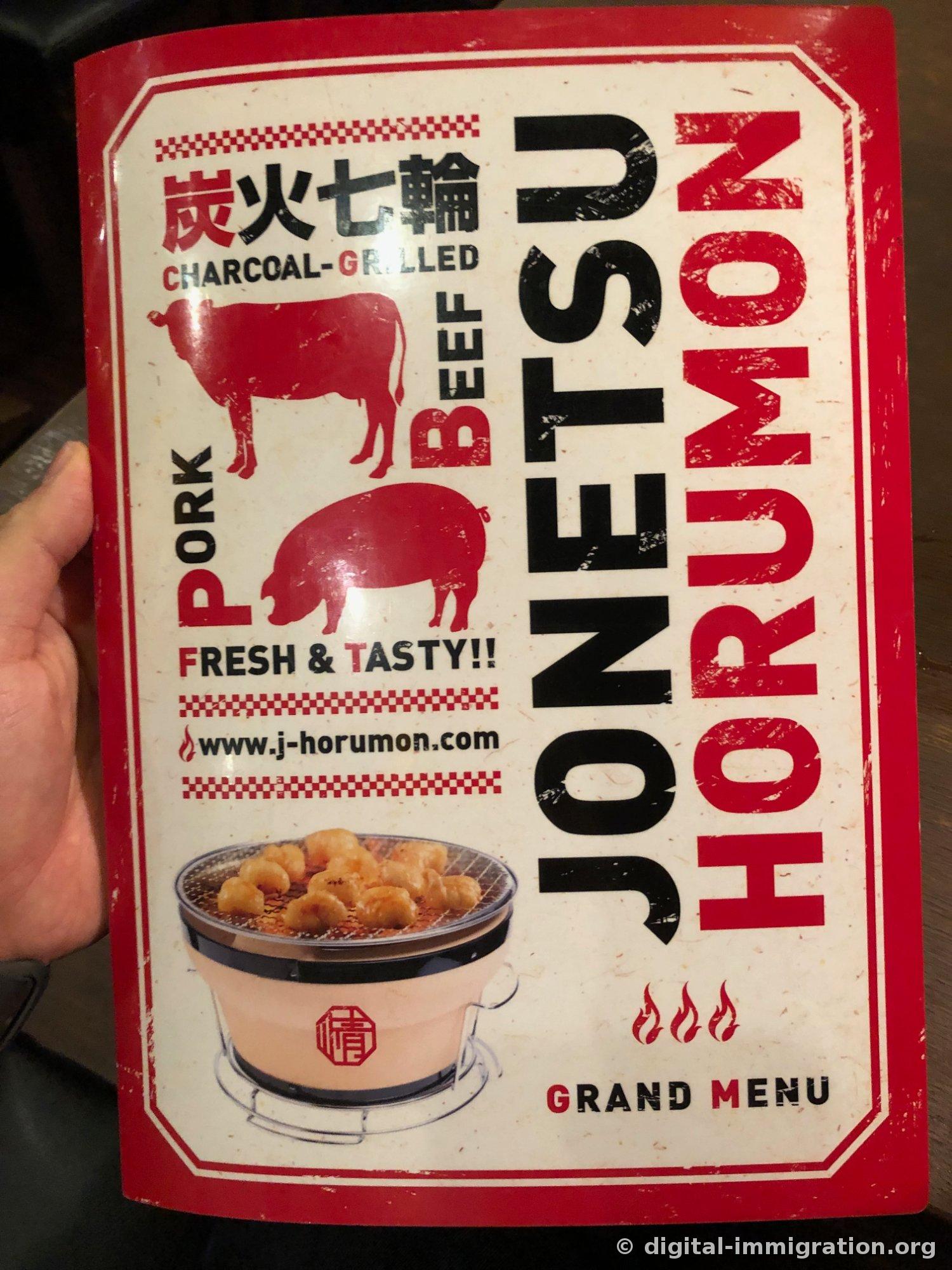
How to Read the Menu — Starting from 190 Yen
Open the menu and the left half is devoted entirely to horumon. Fuwa (lungs) 190 yen, Shiro 190 yen, Kamikawa 190 yen. From there it goes up to Hatsu 290 yen, Yakinsenmai 290 yen, and Hanahana, Giara, Tanmoto, and Rib at 390 yen each. Next to the prices are numbers for こってり度 (fattiness level) and はごたえ度 (chewiness level)—first-timers should definitely check these numbers. Even if you don't know the cut names, you can choose based on whether you want something rich and chewy or light and tender.
The centerpiece menu item in bold is Kurohor (黒ホル) 390 yen. It uses Kuromo wagyu beef intestine and carries a "highly recommended" sticker. Turning the page, you'll find the yakiniku section with Ushishiotan 790 yen, Atsugiri Gyutan 990 yen, Loin 690 yen, and Harami 690 yen. There's also Marucho 590 yen, Shimacho 590 yen, and Jomino 690 yen as the premium offal options. In small print at the bottom: all listed prices are before tax, so add 10% to the final bill.
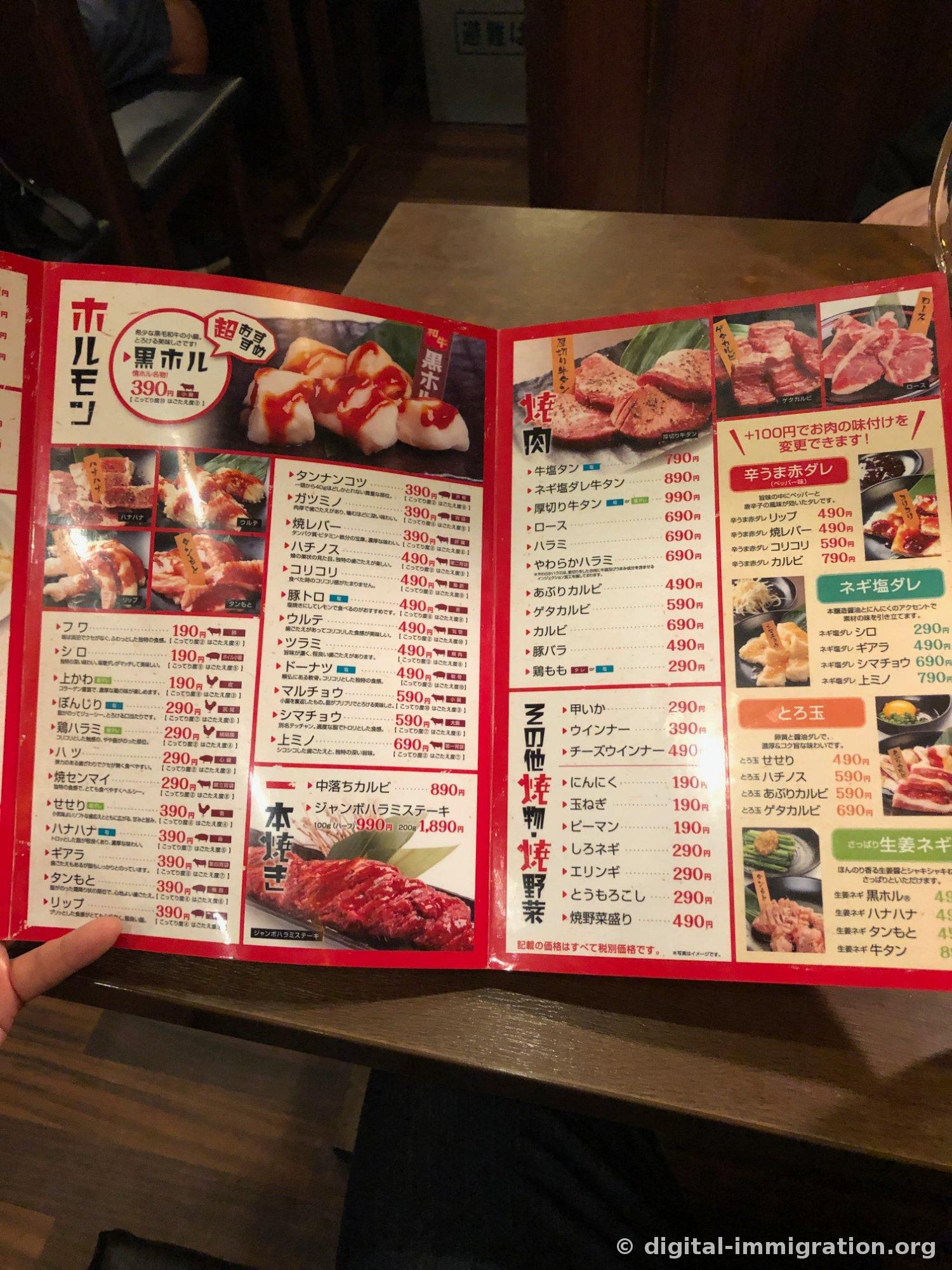
Easy to miss is the small box on the far right. For +100 yen, you can change the meat marinade. There's spicy akadare (辛うま赤ダレ), negi-shio with garlic, toro-tama with egg yolk, and ginger-scallion. Without special request, you get the default sauce, so if you order two plates of the same cut, try swapping the sauce on one. Prices are listed separately for combinations like Negishio Shiro 290 yen and Negishio Jomino 790 yen.
Chewy Intestine Grilled Over Charcoal
The real reason we came was simple: intestine. When it arrived on the plate, it looked unfamiliar. On a black dish with a single bamboo leaf, pale clumps glistened under red marinade, layered on top of each other. The side thick with fat was ivory-colored, the meat side a light pink. Picking one up with chopsticks, it felt substantial and stretchy.
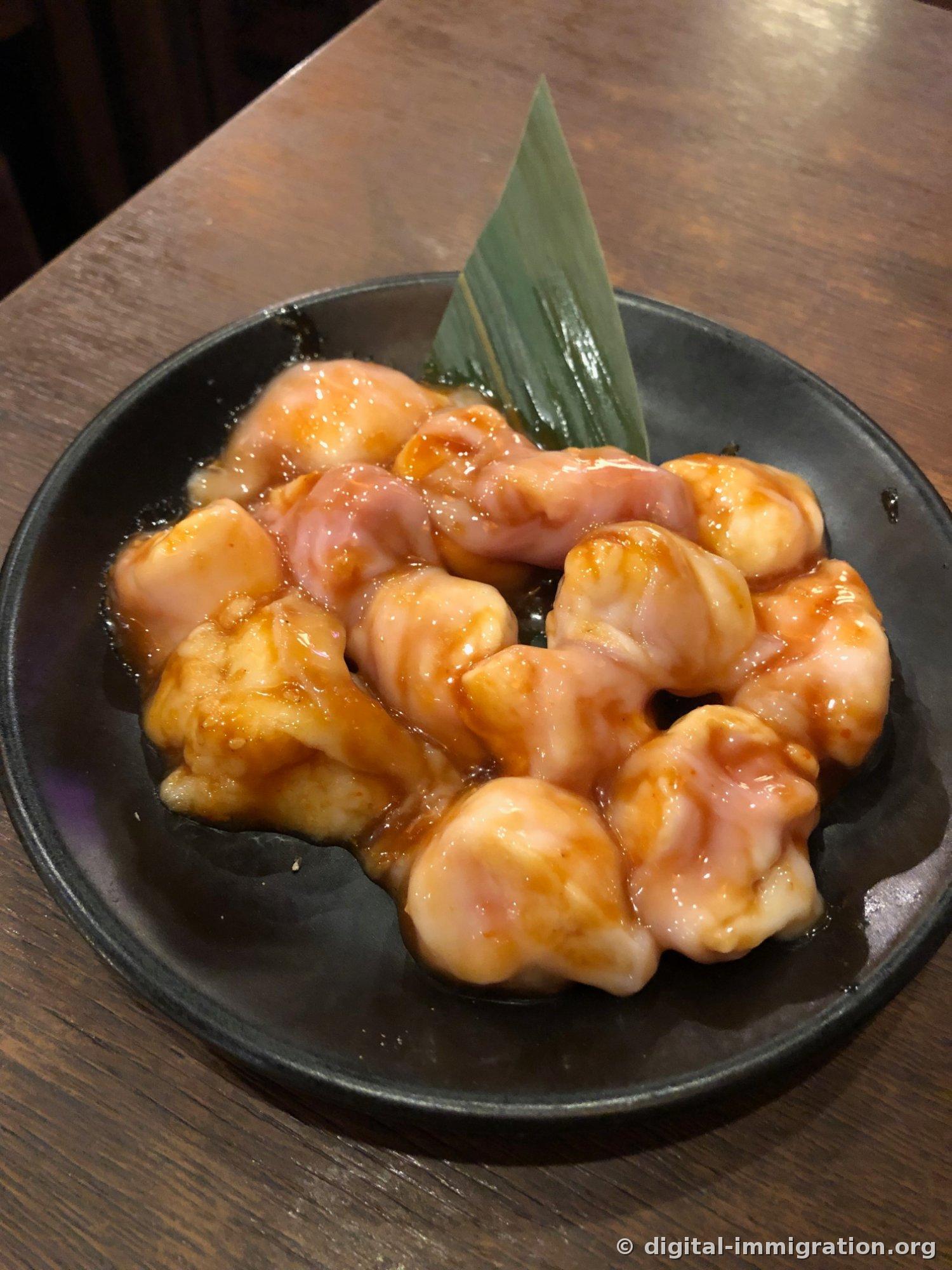
Just placing it on the grill and flipping it immediately leads to failure. When the fat melts and drips onto the charcoal, flames shoot up—the outside burns black while the inside stays lukewarm. After burning the first plate that way, we changed our approach. We put the fat side down first and waited without touching it. Once the surface turns translucent and the edges start to curl, and oil begins to seep out and shine, we flip it exactly once. From that point, thirty seconds is the limit.
In your mouth, first comes the skin bursting with a pop, then a resistance—not rubbery, but like biting into mochi. As you chew, the trapped fat slowly releases. This chewiness only comes from charcoal, not a flat grill. The radiant heat from the shichirin seals the surface first. Each plate holds about a dozen pieces, and split four ways that's three each—so we ended up ordering three more rounds.
The Grill Is Small — Eight Pieces Maximum at a Time
The grill at each table is smaller than you'd expect. About one and a half hand-spans in diameter. Place meat on the grate and eight pieces max before it's full. Greedily overloading it disperses the charcoal's heat, leaving nothing properly cooked. As shown in the photo, white ash covers a coal chunk in the center with red flames peeking around it—the hottest spot is toward the center of the grill, not the edge. We found it easiest to put thicker cuts toward the center and thinner ones toward the outside.
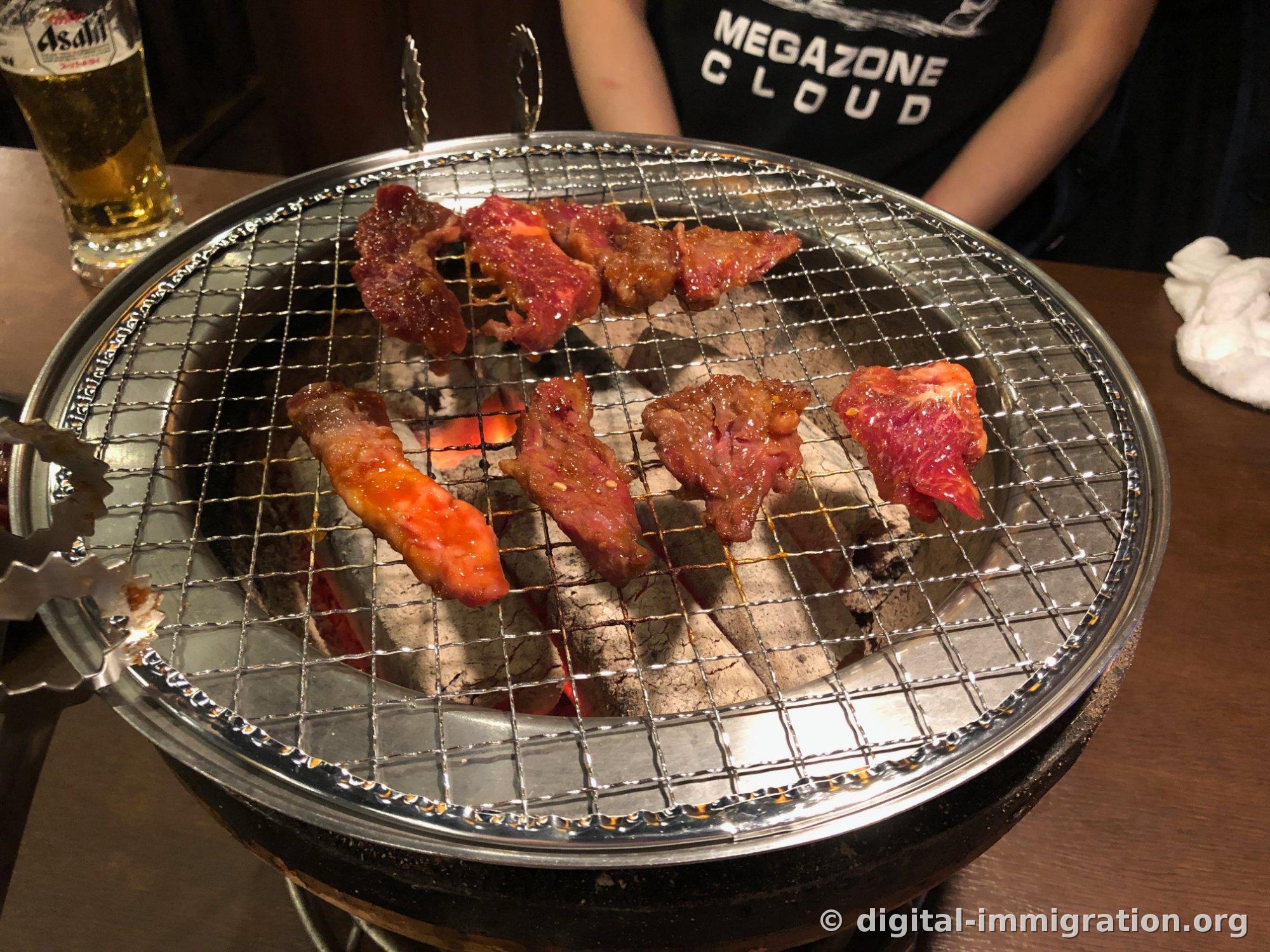
Prepare yourself for smoke. There's a hood over the table, but charcoal's nature means it can't capture all the oily smoke. Your clothes definitely smell when you leave. Don't wear something you plan to wear the next day.
Things to Order Beyond Meat
The back of the menu covers sides and combination sets. Kimchi comes in napa cabbage, radish cube, or cucumber at 320 yen each, or a three-type assortment for 490 yen—the assortment is the better value. Bean sprouts 290 yen, vegetable assortment 390 yen. Familiar items for Korean palates are there, though the seasoning leans Japanese-mild. Sakura Yuke (horse meat tartare) 890 yen comes topped with egg yolk, and Aka no Motsu-ni (braised red offal) 390 yen is listed as a location exclusive.
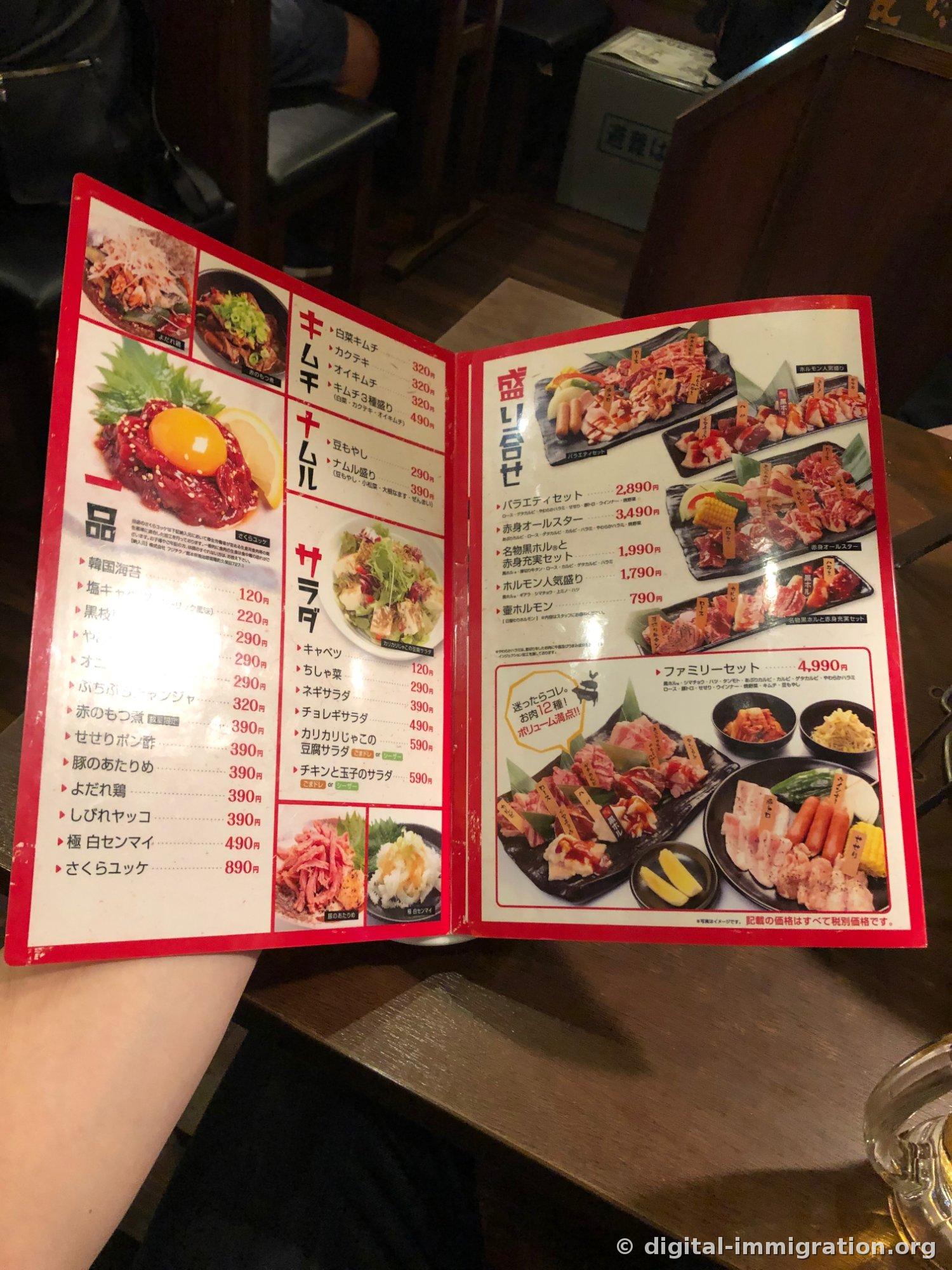
There are also combination sets. Popular Horumon Assortment 1,790 yen, Kurohor Specialty and Rich Red Meat Set 1,990 yen, Variety Set 2,890 yen, Red Meat All-Star 3,490 yen, and Family Set with twelve cuts of meat 4,990 yen. For four or more people, starting with a set then adding individual favorites à la carte made the math work better. Tsubo Horumon 790 yen comes with a note to ask staff about contents—it changes daily.
Location and Practical Tips
The filming location is northwest central Tokyo, between Ikebukuro and Shinjuku. Jonetsu Horumon is a chain with multiple locations in Tokyo, so don't just go to any search result—confirm the coordinates of your target location first. It's tucked deep in an alley, not visible from the main street; you find it by the red sign and charcoal smell.
- All prices are listed before tax. Add 10% to the posted prices for your final bill.
- Hours and reservation policies vary by location—it's best to check ahead. Around Friday evening at 8 PM, seats were nearly gone.
- Order two plates of intestine (Kurohor type) on your first visit. Expect to burn the first plate.
- The sauce upgrade option +100 yen is small print tucked in a menu corner and easy to miss. Tell your server when ordering.
- The draft beer is Asahi. When paired with rich organ meats, glasses empty at an impressive speed.
It's a different kind of experience from the awe of sliced premium wagyu. Here, you walk in and the charcoal smell clings to your clothes instantly. You and your companions take turns backseat-driving the timing of flipping the meat with chopsticks, and before you know it, you've ordered several more plates. Because of that one moment when a single piece of intestine is perfectly cooked and achieves that ideal chewiness, I'm already reserving an evening on my next Tokyo trip for this place.
Bài liên quan
- From Akihabara's Chuo-dori to the Kanda River: A Record of Tokyo's Electronics District Revisited Multiple Times
Tokyo's Akihabara is a neighborhood where it's hard to say you've seen everything in a single visit. I've come multiple times across different seasons, and each time the signs chan…
Tokyo · Akihabara - Buying a Single ¥300 Year-End Jumbo Lottery Ticket at Nishi-Ginza Chance Center in Tokyo
Exit from the Hibiya exit of Tokyo's Shimbashi Station, walk toward the elevated highway for about three minutes, and suddenly you'll see a line of people stretching along the side…
Tokyo · Nishi-Ginza Chance Center - Ueno Ameyoko, the real magic starts after sunset — an evening walk from the Okachimachi Gate to Ueno Station
Every time I come to Tokyo, my feet find their way to Ueno Ameyoko (アメ横) without fail. This time I entered from the Okachimachi side and worked my way toward Ueno Station. I've met…
Tokyo · Ameya Yokocho Market