Buying a Single ¥300 Year-End Jumbo Lottery Ticket at Nishi-Ginza Chance Center in Tokyo
Exit from the Hibiya exit of Tokyo's Shimbashi Station, walk toward the elevated highway for about three minutes, and suddenly you'll see a line of people stretching along the side…
Tokyo · Nishi-Ginza Chance Center
Exit from the Hibiya exit of Tokyo's Shimbashi Station, walk toward the elevated highway for about three minutes, and suddenly you'll see a line of people stretching along the sidewalk. It's the Nishi-Ginza Chance Center (西銀座チャンスセンター). Despite having Ginza in its name, it's actually a very small lottery ticket shop tucked into the corner of a first-floor arcade beneath the Tokyo Metropolitan Expressway, between Shimbashi and Yurakucho. I'd passed by it several times without paying it much attention—I thought it was some famous ramen shop. That day happened to be during the year-end Jumbo lottery sales period (年末ジャンボ), and curious about why the line was so long, I joined the queue.
The Line Comes Before the Shop
I arrived around 11 a.m. on a weekday. Red pole stands and barrier ribbons divided the sidewalk beneath street trees with golden ginkgos and autumn foliage, and people stood two deep inside the queue. Most were in their sixties or older—backpack-wearing older men, women with shopping bags, and office workers in suits who seemed to have squeezed this in during their lunch break. There were hardly any tourists.
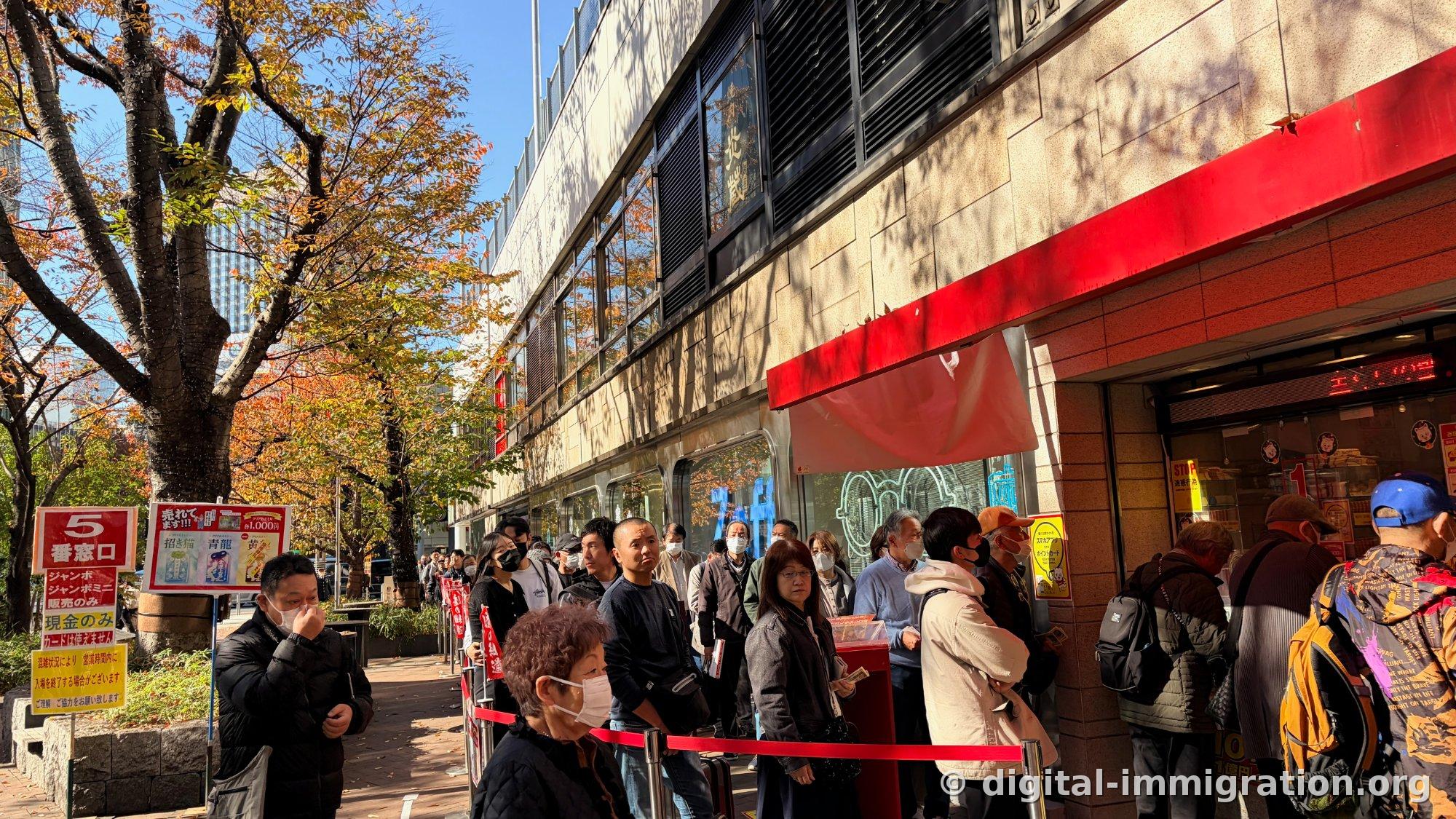
Only after reading the sign at the front of the line did I understand how it was organized. Window 5 is a dedicated counter that sells only Jumbo and Mini Jumbo tickets, with '現金のみ (Cash Only)' printed prominently below. On the adjacent signboard was a notice that depending on how crowded it gets, they may close the line before the sales end time. I actually saw someone turn back to a convenience store because they only had coins in their wallet. If you're coming here, it's better to bring a few ¥1,000 bills in advance.
It took just over 20 minutes to get through the line. Because there are multiple windows, the line moves faster than you'd expect. However, this is based on a weekday morning—I'm told that on the first and last days of the year-end Jumbo sales, the line wraps around the block. I didn't see this myself; it's what an older gentleman ahead of me indicated by gesturing.
What I Saw at the Counter — The Popularity of Windows 1 and 7
As I got closer to my turn, the front of the shop came into view. There's a sign with '宝くじ (Takarakuji)' written in red hiragana on a white background, and next to it hang vertical banners reading 'Shibadai Shrine's Wish Fulfillment' and 'Millionaires from the Heisei to Reiwa Era.' Photos of past grand prize winners and their window numbers are posted on the glass. At this shop, each window has a number, and people insist on choosing specific ones. Windows 1 and 7 are particularly crowded. The reason is simple: records showing that many large prizes have been drawn at these windows are posted there.
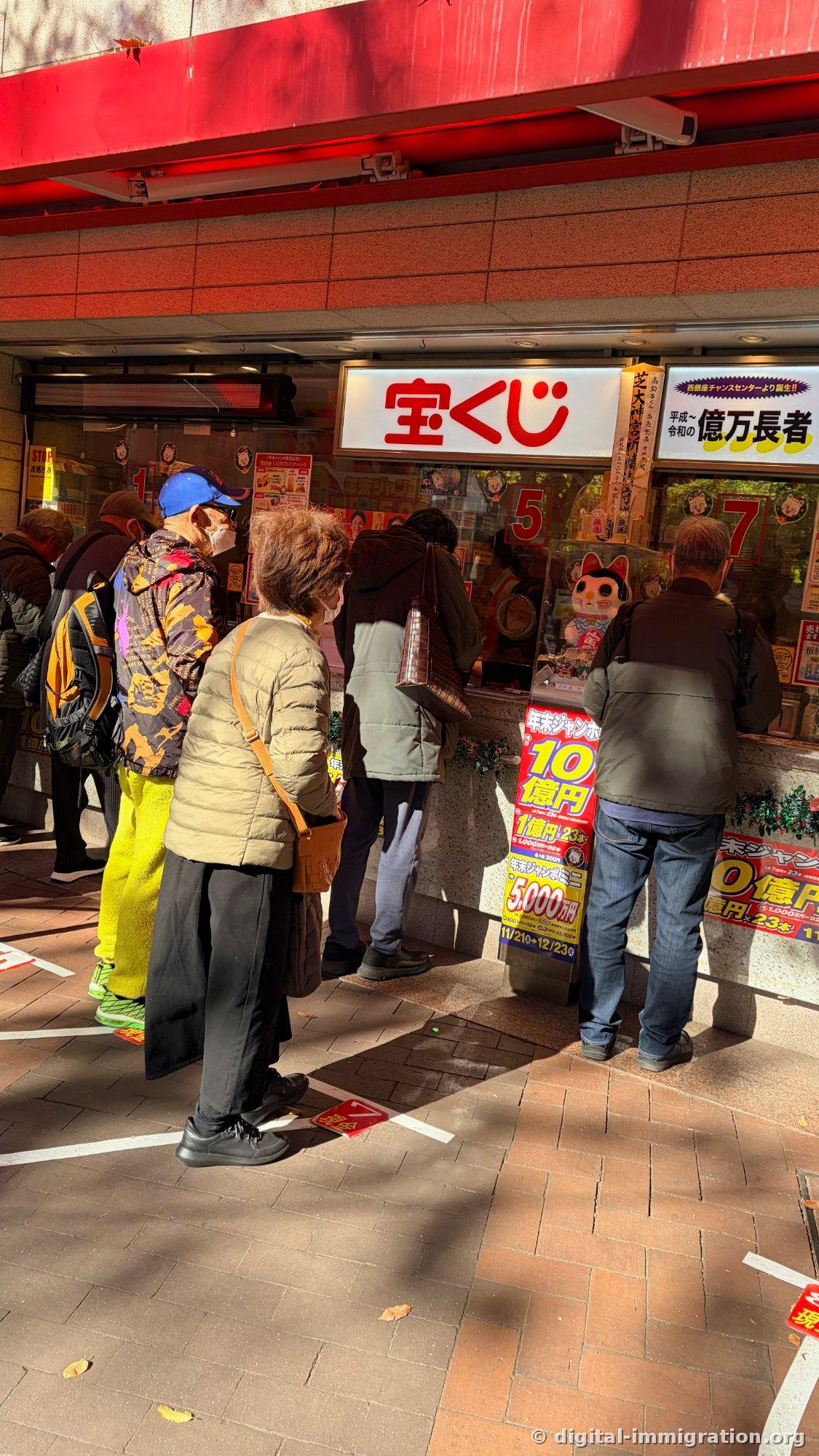
Looking at the ground, white lines are painted to mark the queues, and a red sign with '7' is placed on the floor. This prevents confusion about which window's line you're in. Not knowing this, I just stood in a random line until the person ahead of me said, 'This is window 7,' and I moved. Even without Japanese, you just have to look at the numbers on the floor to line up correctly.
The amounts printed on the promotional signs are blunt: ¥1 billion for the grand prize, 23 ¥100 million prizes, ¥50 million for mini Jumbo. ¥300 per ticket. This stark difference—printed and displayed as-is—is the entirety of the business model. Next to the window are a maneki-neko figurine and flower decorations, and despite it being daytime, the fluorescent lights are brightly lit, making for good photos.
Location and How to Get There
The nearest station is Ginza Station, Exit C6, on the Tokyo Metro Ginza, Marunouchi, and Hibiya lines—a 2–3 minute walk. If coming by JR, it's about 5 minutes from the central exit of Yurakucho Station or about 8 minutes from Shimbashi Station. Because it's located under the Tokyo Metropolitan Expressway, the storefront isn't easy to spot with just a map. At first I wandered on the opposite sidewalk, but once I saw the red canopy and the line of people, I crossed over. Look for the corner toward '西銀座デパート' beneath the elevated highway.
Route-wise, it's easy to fit this in between Ginza shopping or a stroll through Hibiya Park. The shop itself only takes 5 minutes to see, so it's not really worth making a special trip by train. Since operating hours and sales periods differ for each draw, I recommend checking the signboard on-site.
A Single ¥300 Ticket
It was my turn. The staff member inside the window asked 'How many?' with a gesture, and I said one. I was a bit nervous not knowing if single-ticket purchases were allowed, but they sold it without any issue. The ticket I received in exchange for ¥300 in coins was larger than I expected.
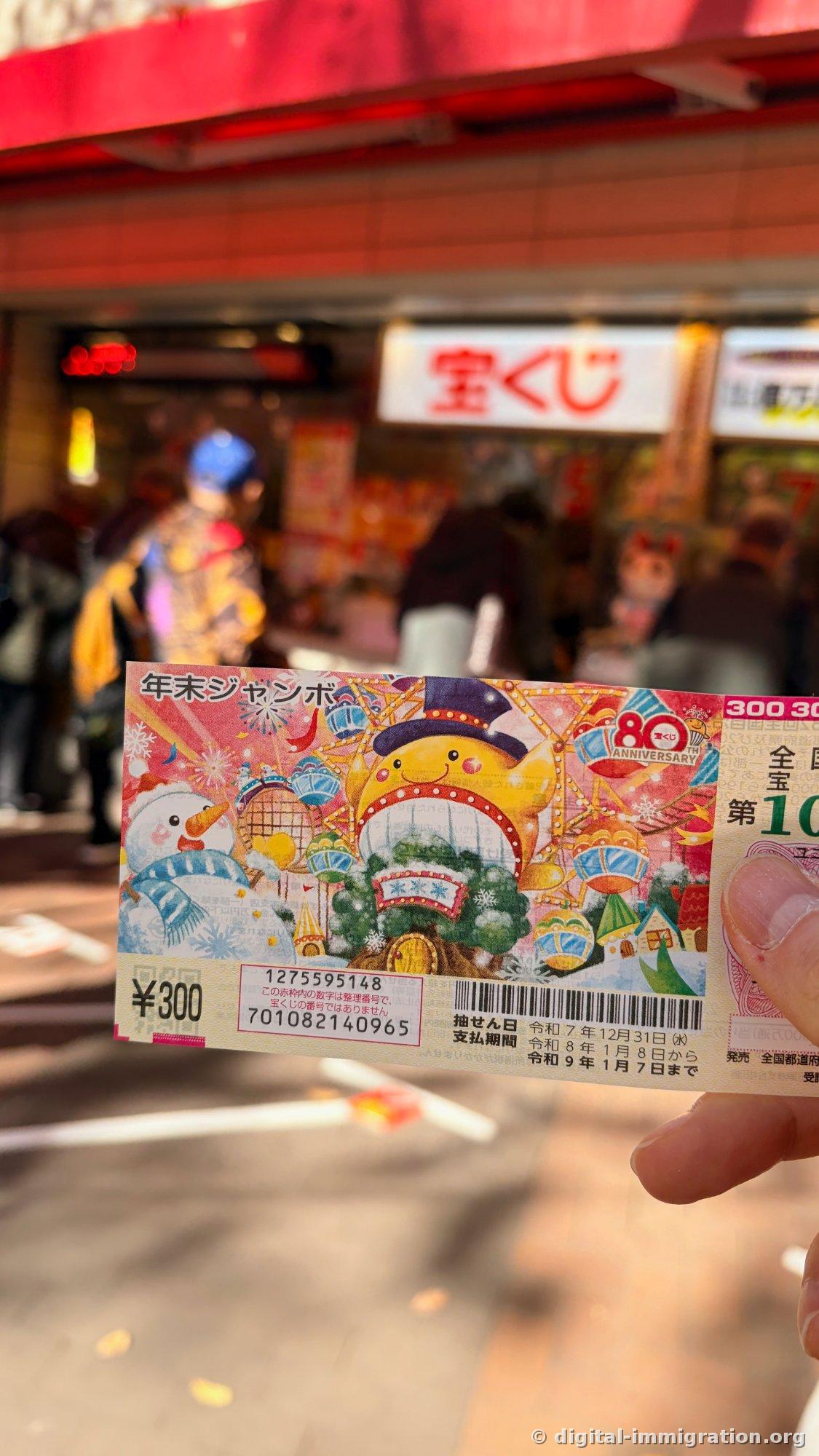
The ticket design was nice. A snowman, a Ferris wheel, and a yellow character in a top hat are drawn like an amusement park, with an 80th-anniversary mark tucked in a corner. At the bottom left is ¥300, and next to it, inside a red border, is a caveat that the number is a serial number, not a winning number. Apparently some people try to check their winnings using this number without realizing the distinction.
The one disappointment was photography. When I tried to shoot inside the window, there was so much reflection that I had to discard several shots, and I felt awkward pointing the camera at the staff. While I was in line, no one openly took photos from the side. After getting my ticket, I stepped out of the line and took photos from a corner of the sidewalk.
I didn't win, of course. Given that the drawing is on December 31st, I won't even know until then. But I don't regret spending that ¥300. The sight of elderly people waiting 20 minutes in line on a weekday morning to buy a single piece of paper, the serious faces as they chose their window number, the white lines drawn on the ground—if you want to see how people actually live in Tokyo rather than just tourist destinations, this is a fairly honest place. I still have the ticket in my wallet. The only consolation is that I have plenty of time before the payment period expires.
Bài liên quan
- From Akihabara's Chuo-dori to the Kanda River: A Record of Tokyo's Electronics District Revisited Multiple Times
Tokyo's Akihabara is a neighborhood where it's hard to say you've seen everything in a single visit. I've come multiple times across different seasons, and each time the signs chan…
Tokyo · Akihabara - Ueno Ameyoko, the real magic starts after sunset — an evening walk from the Okachimachi Gate to Ueno Station
Every time I come to Tokyo, my feet find their way to Ueno Ameyoko (アメ横) without fail. This time I entered from the Okachimachi side and worked my way toward Ueno Station. I've met…
Tokyo · Ameya Yokocho Market - A Day at Kura Sushi in Asakusa, Tokyo: Three Tuna Plates and Ending with Castella Cake
Once you exit Nakamise-dori at Senso-ji in Asakusa, there's a stretch where tourist density drops noticeably. That's where I wandered into Kura Sushi Asakusa—purely because the wai…
Tokyo · Kura Sushi Asakusa