A Day at Asakusa Senso-ji, Starting from the Crosswalk Across Kaminari-mon
Asakusa in Tokyo's Taito Ward. The moment I emerged from the subway exit, what caught my eye wasn't the temple—it was a delivery truck. A SAGAWA truck was parked right at the inter…
Tokyo · Sensoji
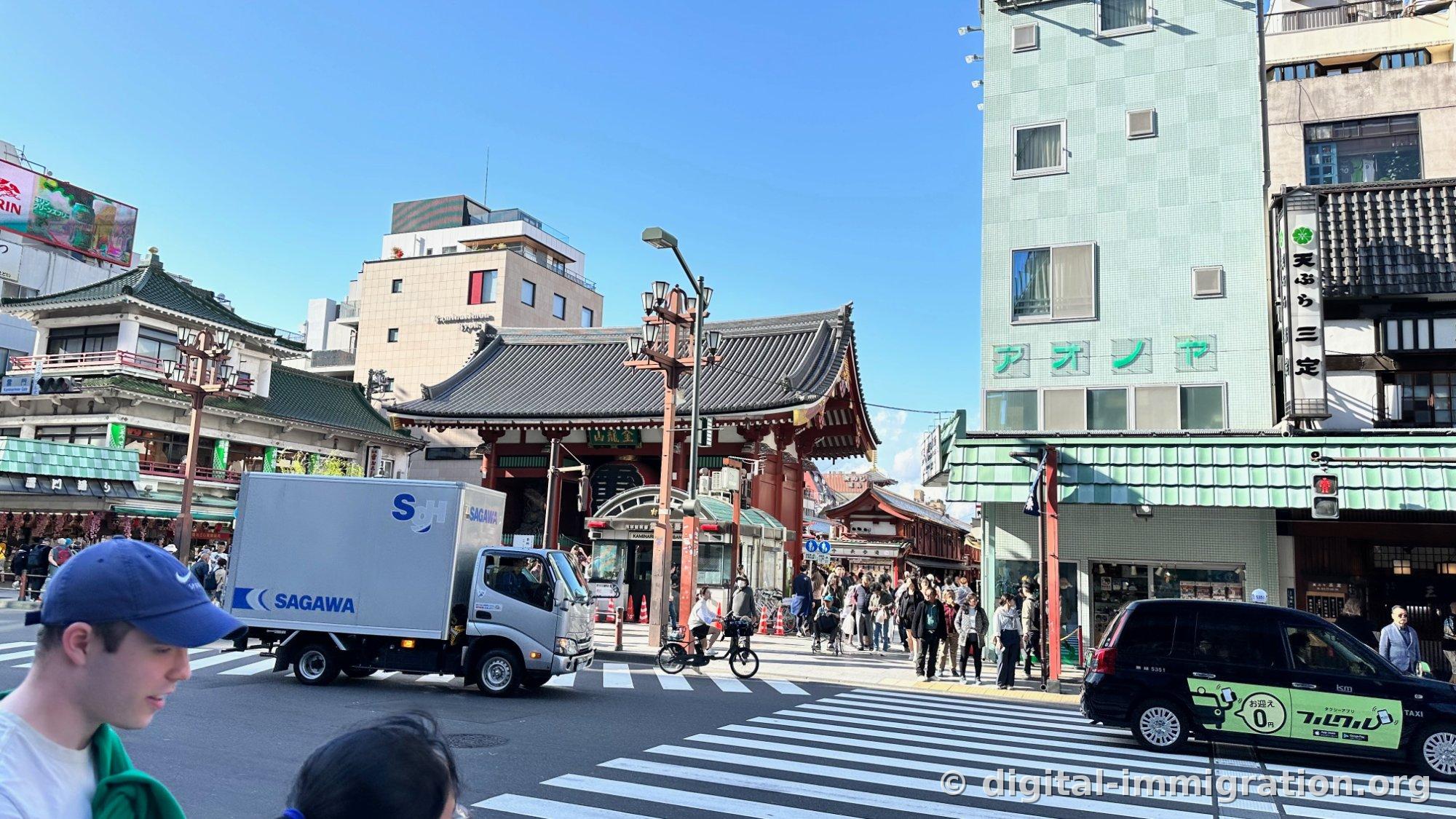
Asakusa in Tokyo's Taito Ward. The moment I emerged from the subway exit, what caught my eye wasn't the temple—it was a delivery truck. A SAGAWA truck was parked right at the intersection in front of Kaminari-mon, and behind it, the temple's tiled roof was half obscured. The straight-on composition I'd seen in tourist photos didn't work from this angle. To the right, I saw an 'アオノヤ' sign on a light green tiled building, and next to it a vertical sign for 天ぷら 三定, a tempura restaurant. My first impression was that this was a neighborhood where the commercial street in front of the temple was very much alive and thriving.
Nakamise Street — 300 Meters of Walking Behind Somebody's Head
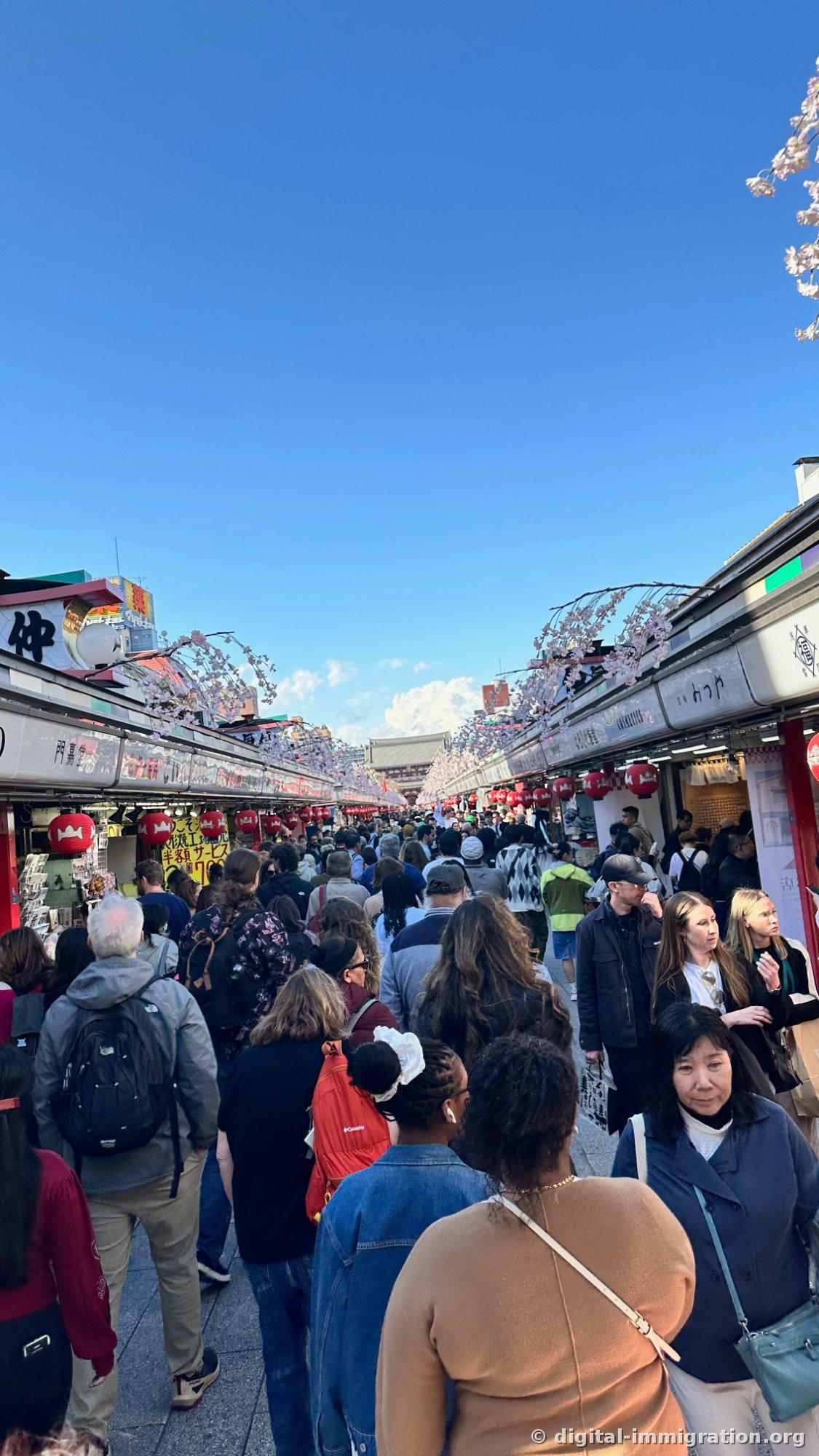
Passing through Kaminari-mon, you immediately arrive at Nakamise Street. I was prepared, but it was worse than expected. Red lanterns hung in a row from the eaves of shops on both sides, and above them, pink artificial cherry blossom branches arched overhead, yet my gaze kept fixed on the back of the person in front of me. I didn't control my walking pace—the group ahead did. To stop and take photos, I had to step to the side, and even then, I was pushed from behind.
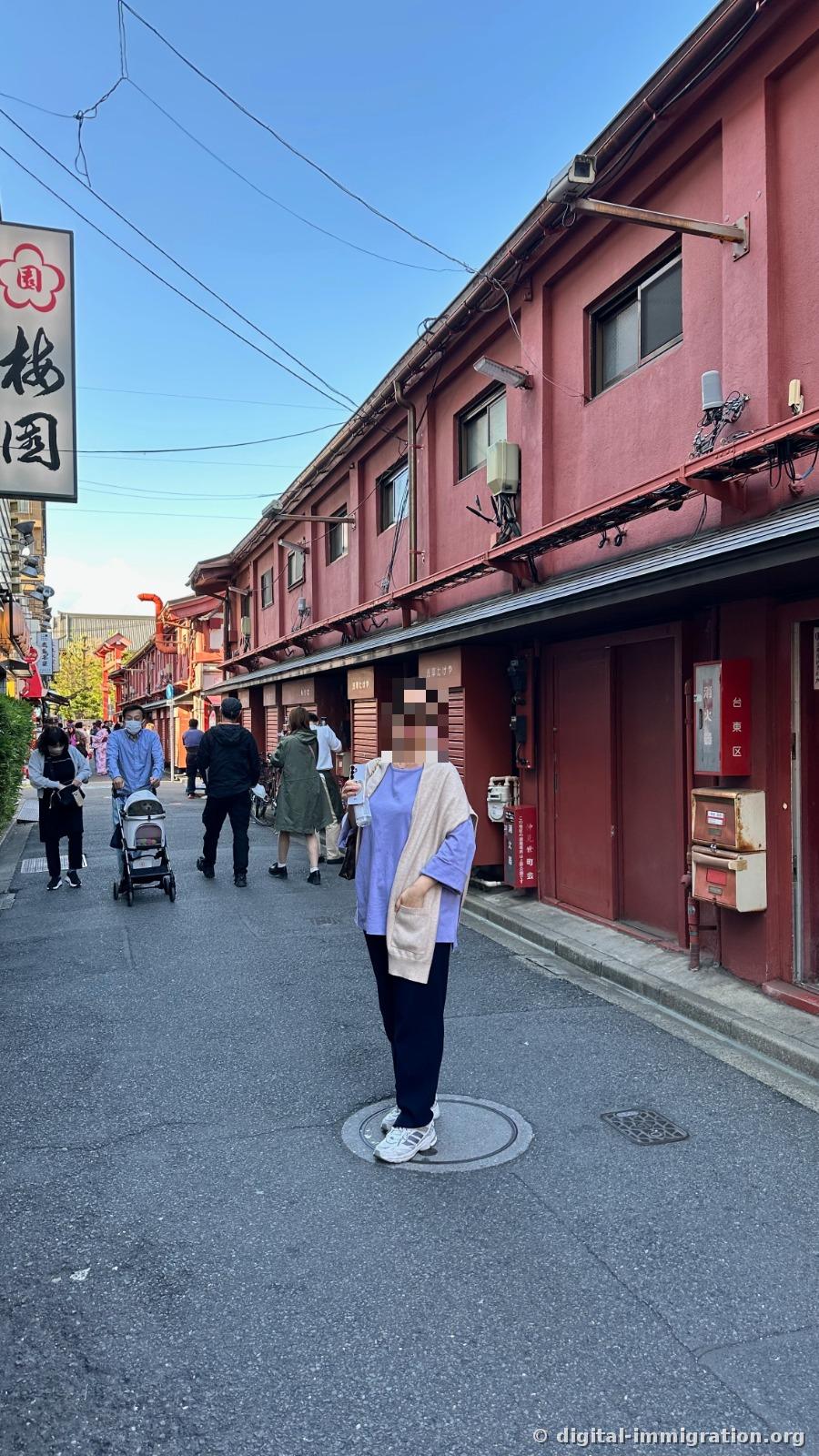
I learned a useful tip here. When the main Nakamise path gets congested, you can slip into the alley behind the shops. It's a narrow passage where the 'backs' of red-painted wooden storefronts line the way, and hardly anyone is there. Past the corner with the 梅園 confectionery shop sign, you mainly see local residents taking strolls with strollers and couples coming out of kimono rental shops. This back alley, with its fire equipment boxes, 台東区 district signs, and tangled electrical wires, actually produced better photos.
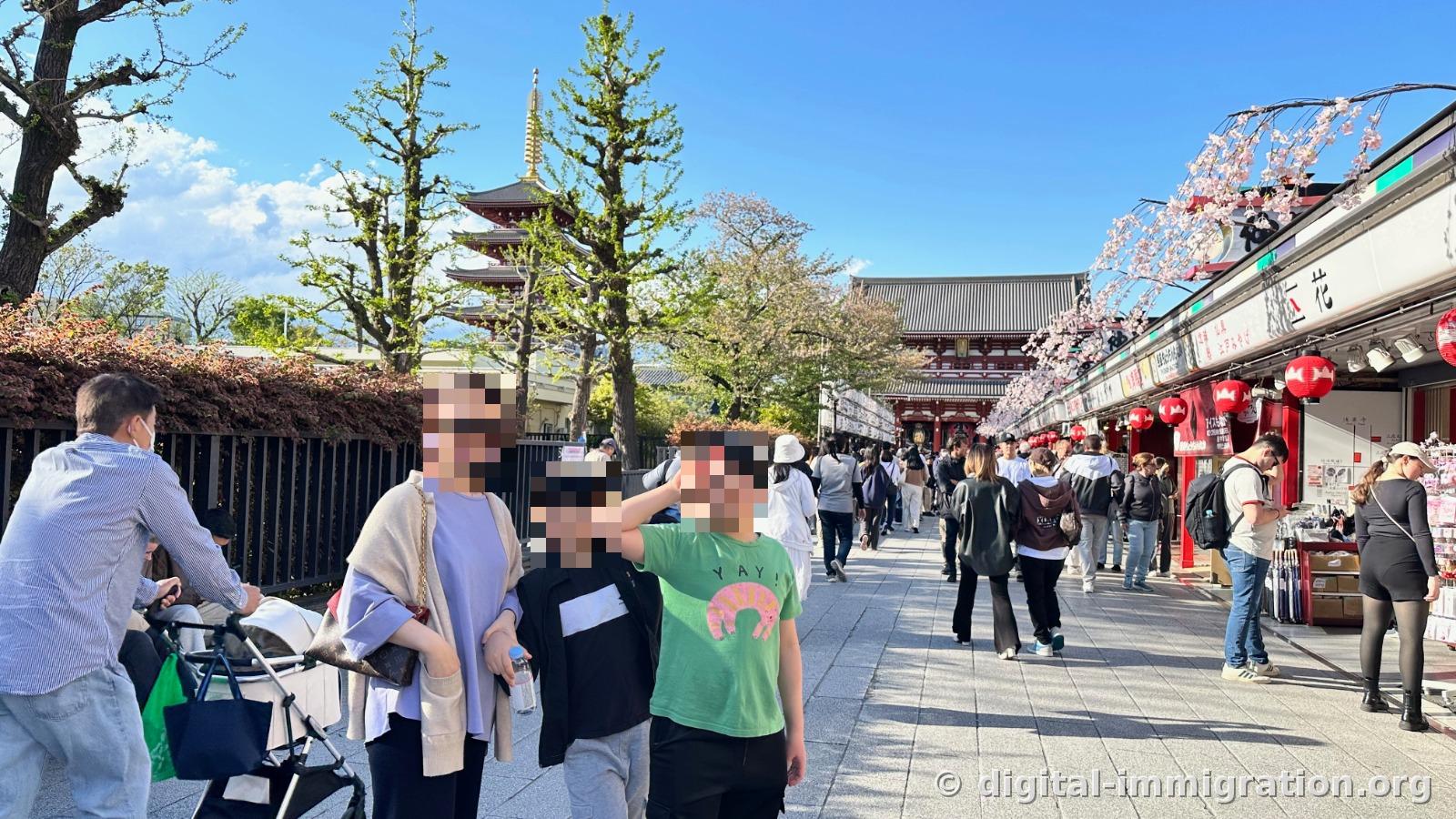
When I rejoined the main street, the five-story pagoda was starting to peek through the trees. On the left were a fence and a ginkgo tree; on the right, shop signs like '二花' and red lanterns; and straight ahead, the red wooden Hozomon gate stood at the end. This section is where Nakamise finally opens up a bit. The floor stones are wider here and the view opens, so many families with children stop in this area.
In Front of Hozomon — You Have to Look Up to See the Sandal
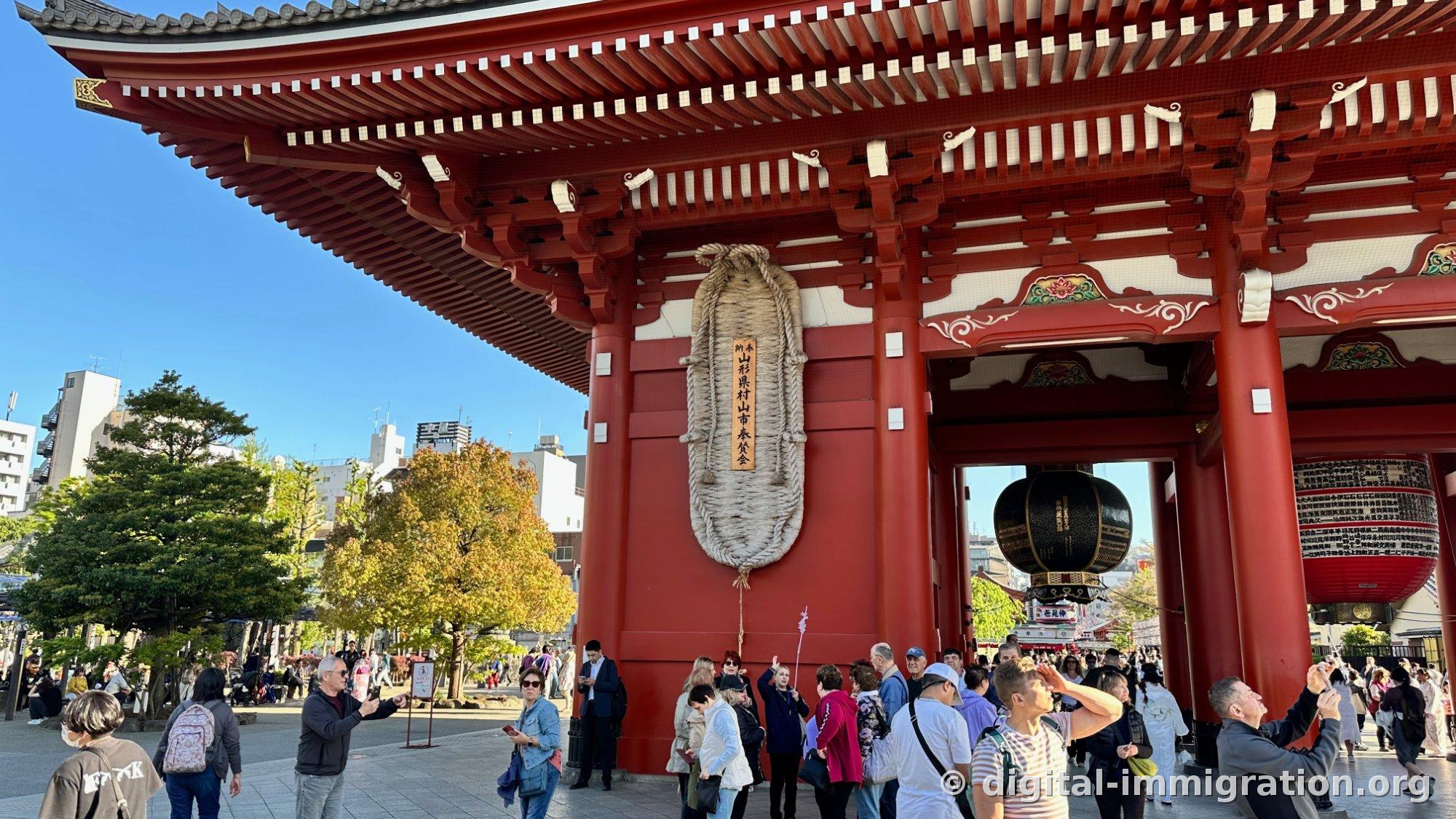
Most people arrive at Hozomon and just photograph the lantern before moving on. But there's a giant straw sandal hanging beside the pillar on the outside of the gate. It's much larger than a person, and the wooden plaque next to it reads '山形県村山市奉賛会'. It's a giant sandal donated by the Murayama City, Yamagata Prefecture association. I missed it the first time I came. You just need to lift your gaze once at the gate.
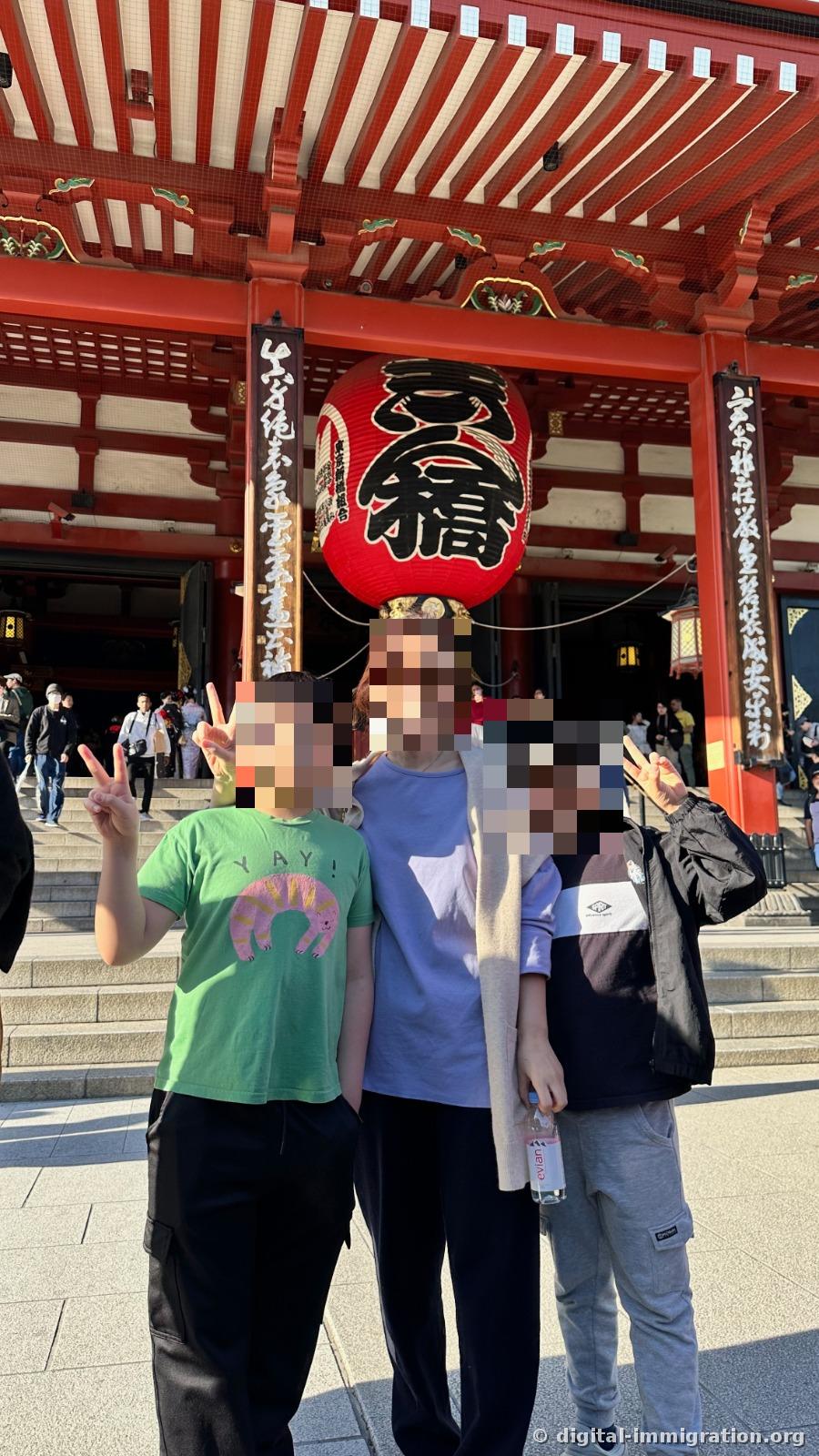
Passing under the gate, there's a large red lantern hanging from the ceiling with '小舟町' written on it. This is the best spot for group photos of families with children. Standing a few steps up on the stairs below the lantern, the characters align perfectly above your head. The only downside is that between 3 and 4 p.m., the western sun comes directly in and everyone squints. We had to take the photo twice.
The Main Hall and Five-Story Pagoda — The Hour of Silhouettes
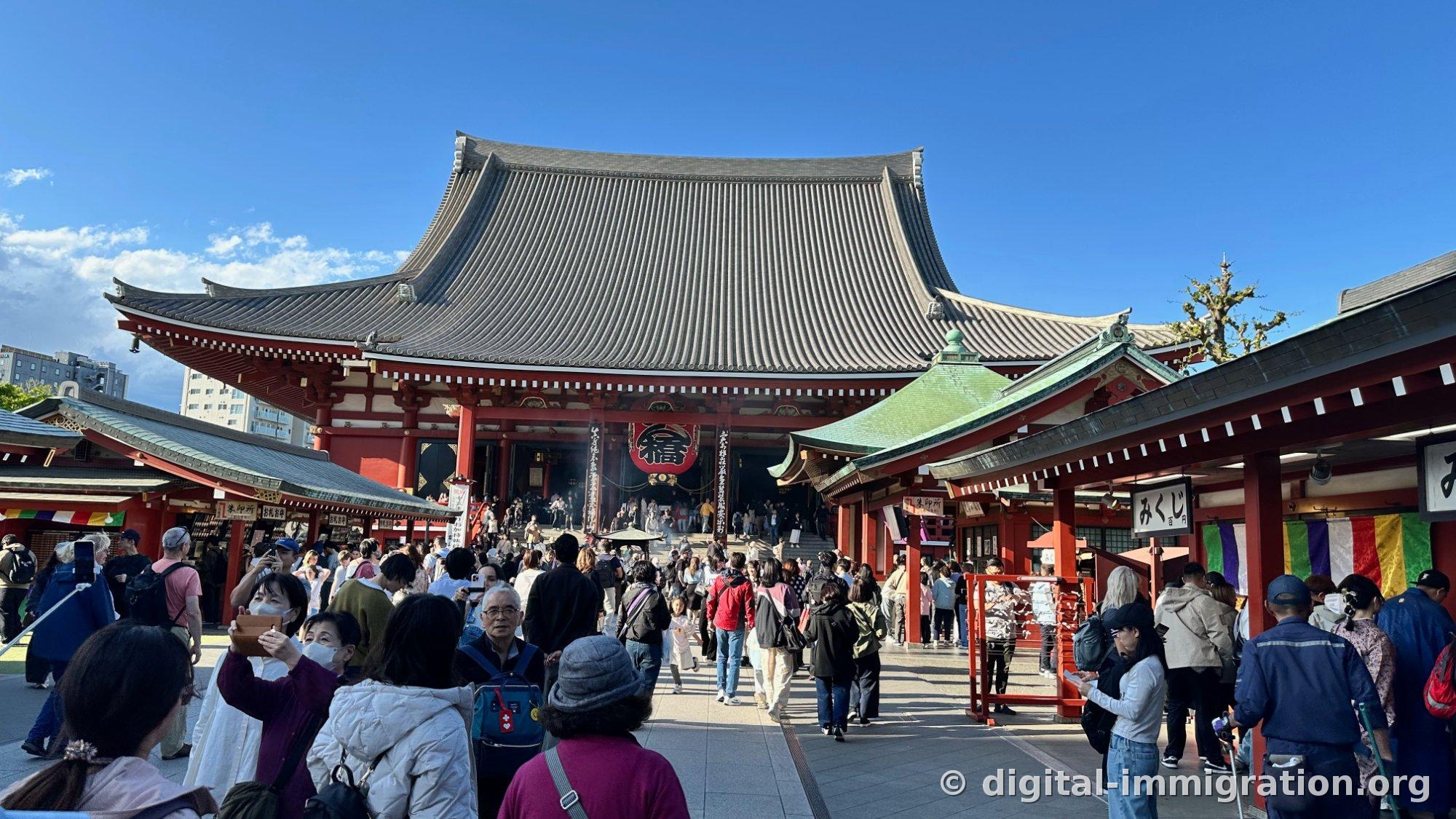
The main hall courtyard is just inside the gate, yet it's as crowded as Nakamise. A large red lantern hangs under the front eaves with the character '福' written boldly on it. On both sides are stamp offices and fortune-telling windows. The fortune-telling works by inserting a 100-yen coin, shaking a cylinder to release a numbered stick, and then opening the corresponding drawer yourself. It's famous for producing the "bad fortune" result fairly often—and indeed, one of our group of three actually drew a bad fortune. We tied it to the nearby rack. The smoke from the incense burner drifted shallowly across the entire courtyard, and the smell clung to our clothes.
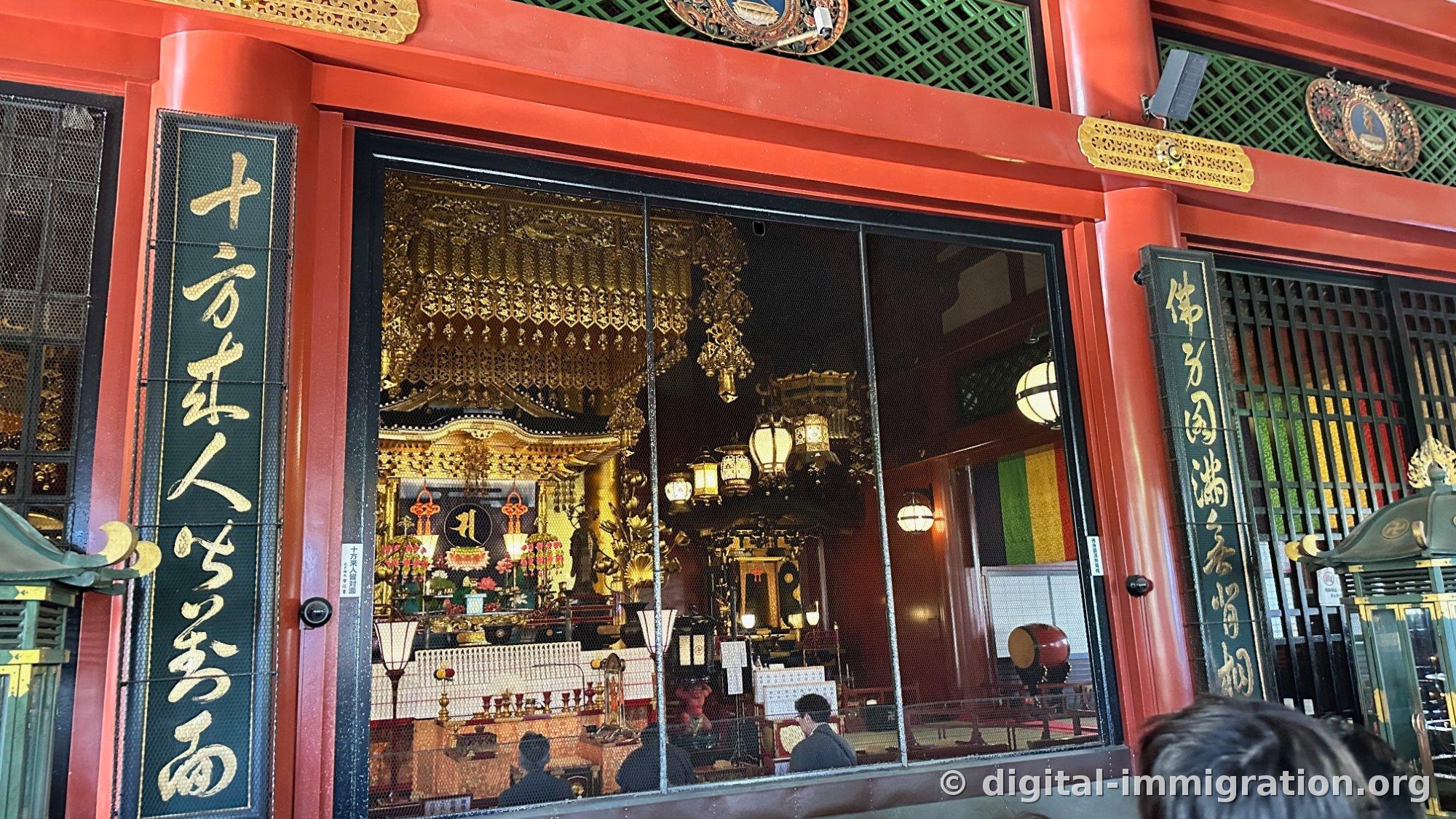
The moment I climbed the steps and peered inside the main hall was the highlight of the day. Through the lattice and mesh screens, layers of golden canopies stretched before me, with lanterns, lotus ornaments, and a red drum placed beneath them. I confirmed there were no photography restrictions and took photos only from outside the window. Gold leaf inscriptions like '十方来人咲一面' and '佛方円満参拝相' were attached to the pillars on both sides, and including them in photos added depth to the space.
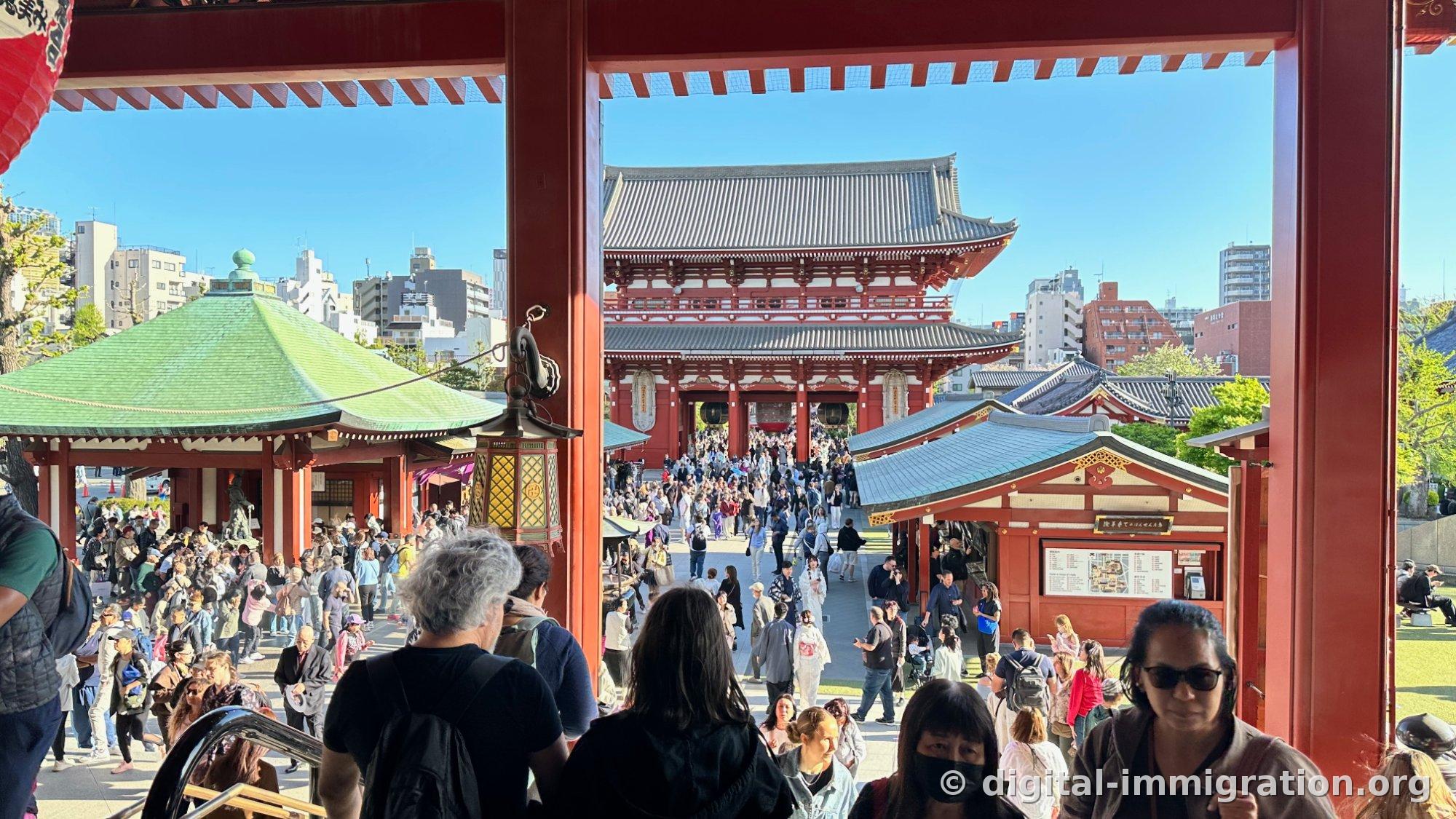
From the top of the main hall steps, turning around to look back, Hozomon is perfectly framed directly ahead. On the left is a small hall with a blue-green copper roof; on the right, a red building with a facilities guide posted; and between them, the approach is packed with people. I believe this spot at the top of the steps offers the best view in all of Asakusa. There's no need to climb anywhere higher.
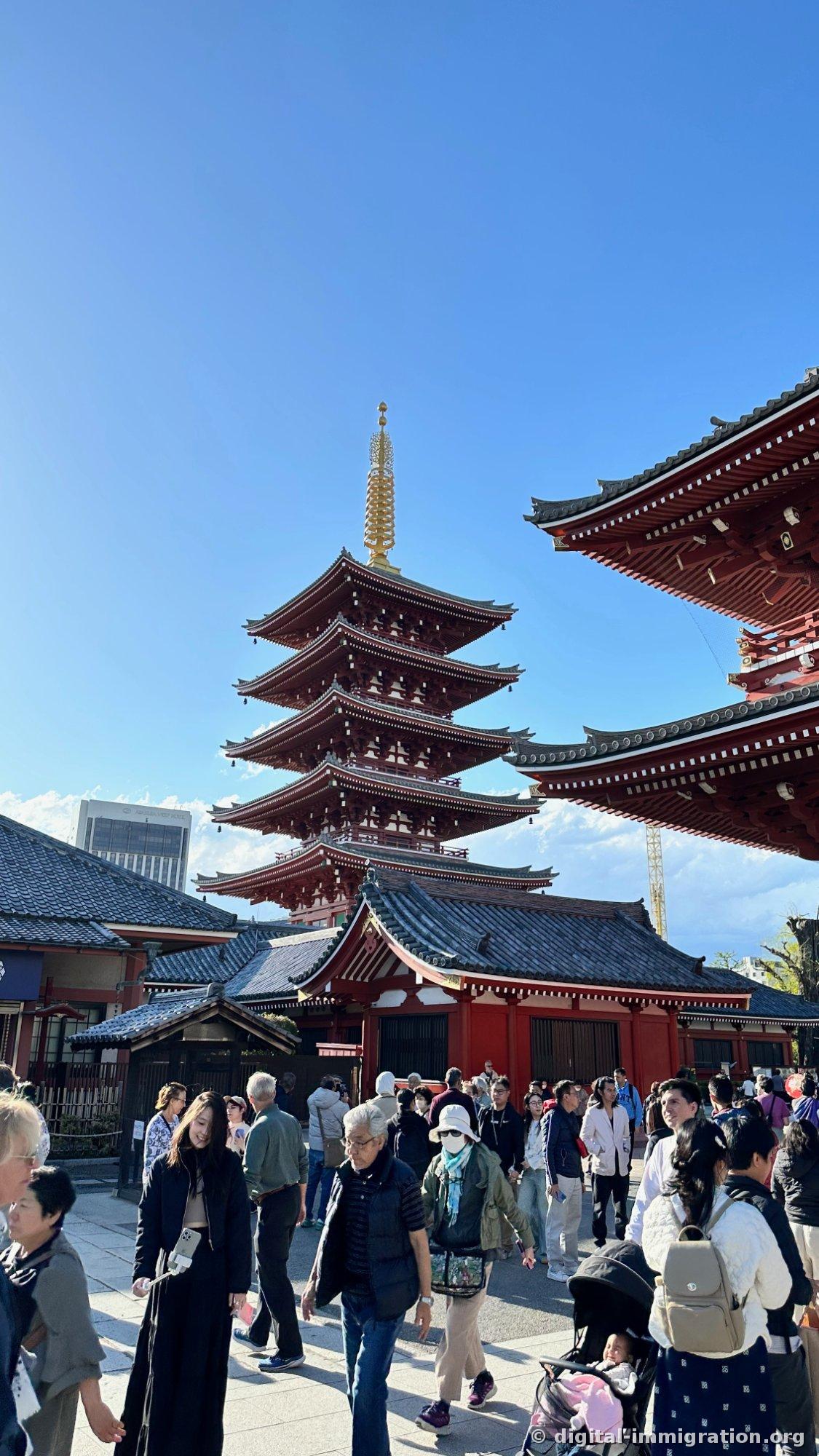
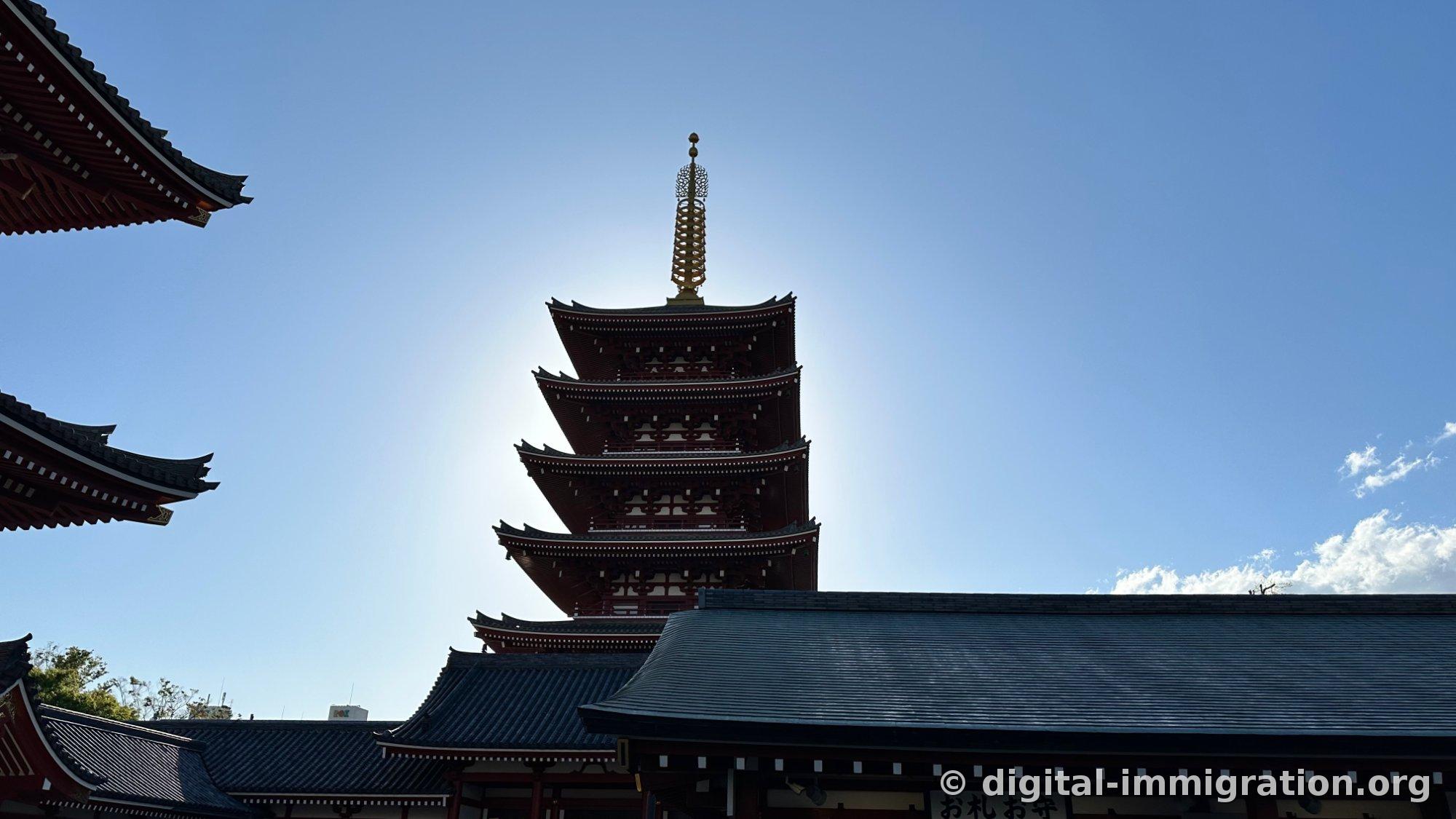
The five-story pagoda becomes a completely different photograph depending on the angle. Looking up at it from the main hall side, the red wooden eaves and structure are clearly visible. But standing with the western sun at your back, the pagoda becomes a solid black silhouette while only the golden finial gleams. The composition of the pagoda silhouette rising above the roof of the amulet booth with its 'お札お守' sign becomes a silhouette regardless of exposure settings. This isn't a failure—it's the correct choice for that time of day.
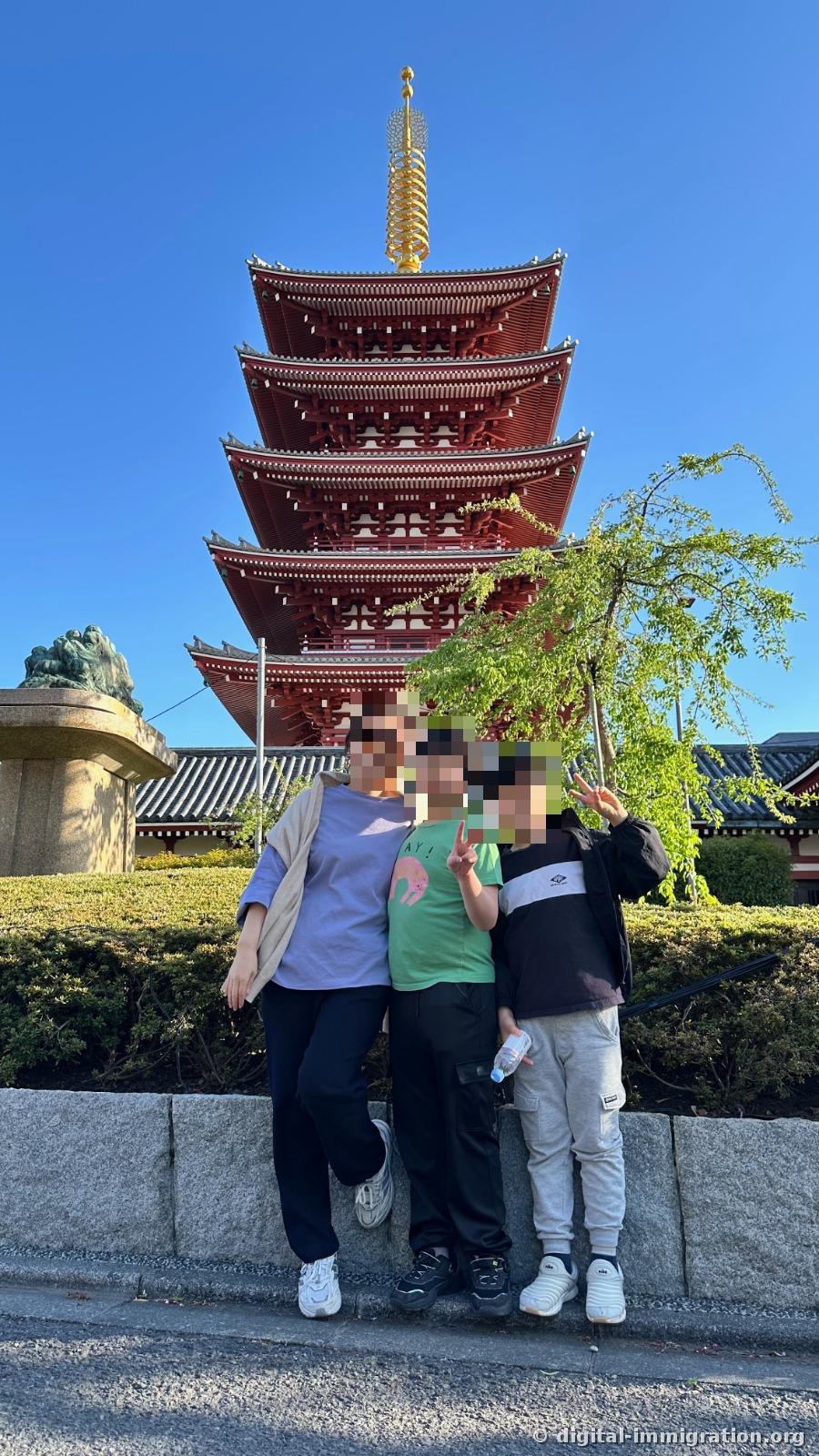
The spot in front of the flower beds below the pagoda turned out to be the easiest place to take group photos without crowds. Sitting on the low stone wall, the entire pagoda fits in the frame, and a lion statue pedestal appears on the left. It was early April, so fresh green leaves were just beginning to emerge on the nearby tree.
Tokyo Skytree Visible from the Grounds, Plus Location and How to Get There
Moving a few steps east from the main hall, Tokyo Skytree appears through the tiled eaves. In front are miscellaneous buildings with signs like HOP INN and TREND, and behind them the tower rises—this chaotic combination is very much Asakusa. If you want to capture the temple and the observation tower in one shot, stand near the washroom (marked with an 'お手洗' arrow sign) on the right side of the main hall and slightly frame the eaves.
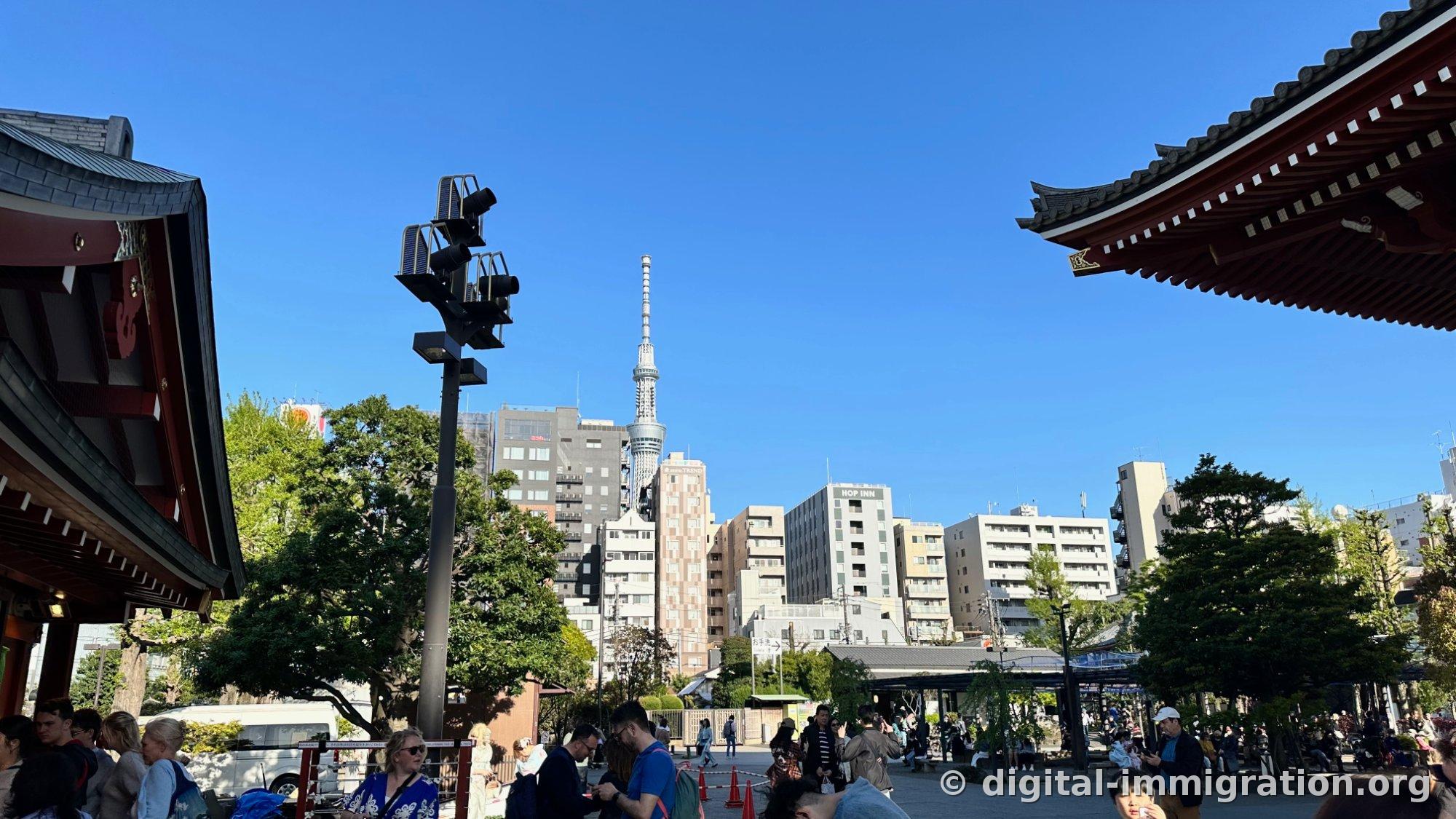
Access is very easy. From Asakusa Station on the Tokyo Metro Ginza Line, Tokyo Metro Asakusa Line, or Tobu Skytree Line, it's a 3-5 minute walk to Kaminari-mon. From the Tsukuba Express Asakusa Station, it takes a bit longer. If coming from the Skytree side, crossing the Sumida River and walking takes about 20 minutes. Temple worship itself is free.
Notes for Next Time
- To avoid crowds, come early in the morning. Nakamise shops generally open late, but the temple grounds and main hall are accessible before that. The exact opening time changes seasonally, so check the signs on-site.
- After 3 p.m., the western sun comes directly in. Take photos of people in the morning and save the pagoda silhouettes for late afternoon.
- If Nakamise gets crowded, take the alley one block over. Same destination, half the stress.
- There are photography restriction signs inside the main hall. It's safest to photograph only from outside the lattice.
- Bring coins in advance. Both the fortune-telling and donation boxes require cash, and 100-yen and 5-yen coins are useful.
- If you plan to bring a stroller, the main Nakamise path is basically impossible. It's much better to take the side routes instead.
Visiting one temple took two and a half hours. At first, jostled by the crowds, I was irritated. But the moment I turned around at the top of the steps, my perspective changed. There was something strange and wonderful about such a crowded temple surviving in the middle of the city for over 800 years.
Bài liên quan
- From Akihabara's Chuo-dori to the Kanda River: A Record of Tokyo's Electronics District Revisited Multiple Times
Tokyo's Akihabara is a neighborhood where it's hard to say you've seen everything in a single visit. I've come multiple times across different seasons, and each time the signs chan…
Tokyo · Akihabara - Buying a Single ¥300 Year-End Jumbo Lottery Ticket at Nishi-Ginza Chance Center in Tokyo
Exit from the Hibiya exit of Tokyo's Shimbashi Station, walk toward the elevated highway for about three minutes, and suddenly you'll see a line of people stretching along the side…
Tokyo · Nishi-Ginza Chance Center - Ueno Ameyoko, the real magic starts after sunset — an evening walk from the Okachimachi Gate to Ueno Station
Every time I come to Tokyo, my feet find their way to Ueno Ameyoko (アメ横) without fail. This time I entered from the Okachimachi side and worked my way toward Ueno Station. I've met…
Tokyo · Ameya Yokocho Market