Tokyo Komichiya Pinocchio—Two-Stack Pancakes for 700 Yen, Baked by an Elderly Couple
Komichiya Pinocchio (小道屋 ピノキオ) is tucked down a side street off a main road in Kita Ward, Tokyo. The signage is small and the glass door is frosted, so even with my map open, I wal…
Tokyo · Komichiya Pinocchio
Komichiya Pinocchio (小道屋 ピノキオ) is tucked down a side street off a main road in Kita Ward, Tokyo. The signage is small and the glass door is frosted, so even with my map open, I walked past it once. Inside, time seems to stop. Dark wood walls, brown leather-backed chairs, glass syrup bottles on each table. It's the complete opposite of the bright white walls and polished lighting in today's trendy soufflé pancake shops throughout Tokyo.
What makes this place special is the couple who runs it. Among the earliest to start baking and selling pancakes in Japan, they still prepare the batter and bake every pancake themselves. The grandfather stands at the griddle in the kitchen, the grandmother works the dining room. Even when orders pile up, the baking pace never changes. They tell you upfront that two pancakes take nearly 20 minutes to bake. This isn't a warning to stay away if you're in a hurry—it means 20 minutes is how long their batter needs.
Twenty Minutes on the Griddle, Pancakes Two Finger-Joints Thick
When the plate arrived, what struck me first was the thickness. The diameter was modest, but the height was impressive. Two stacked pancakes, each about two finger-joints thick. A rectangular pat of butter sits on top, with syrup streaming down the sides and pooling at the bottom of the plate. This has a completely different texture from the trembling soufflé you see all over social media these days. This is old-fashioned pancakes, puffed firm and solid. Looking at the sides, you can see the layered structure clearly—traces of the batter slowly rising on the griddle.
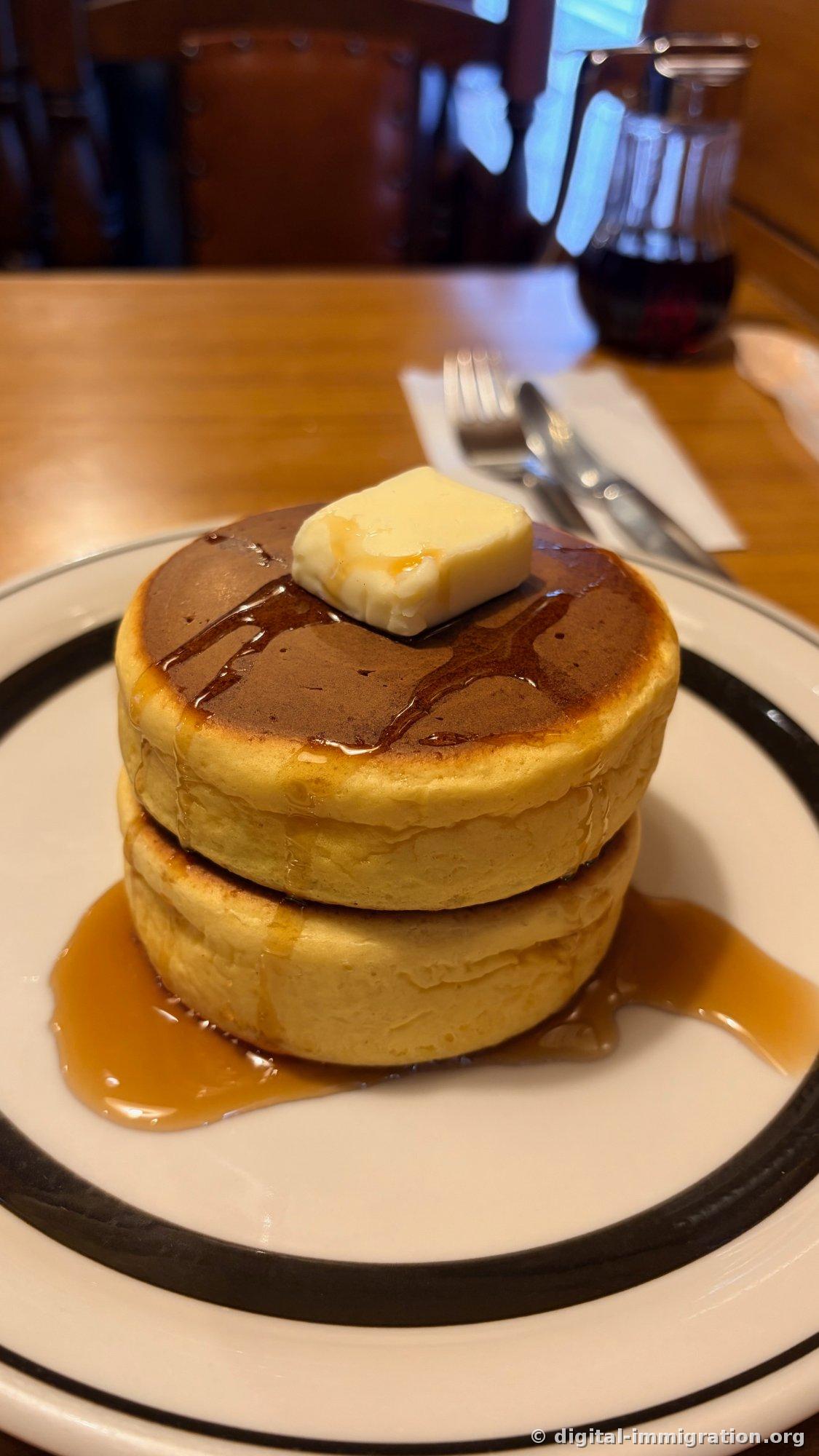
You might think to snap a photo before the butter melts, but I did the opposite. If you let the butter sit on top for 1-2 minutes, the heat melts it into the syrup. In that state, when you cut into it, the cross-section shows those golden juices seeping in.
Everything About This Place Shows in That Cross-Section
When you insert the knife, there's slight resistance on the outside. The surface is uniformly golden-brown, underneath is egg-yellow. Looking at the piece lifted on your fork, you can clearly see the layer of syrup seeping between the two layers of structure. It's dense rather than fluffy. The taste of egg comes first, then butter, then the sweetness of syrup follows later. The batter itself isn't sweet, so even if you pour all the syrup, it never becomes cloying.
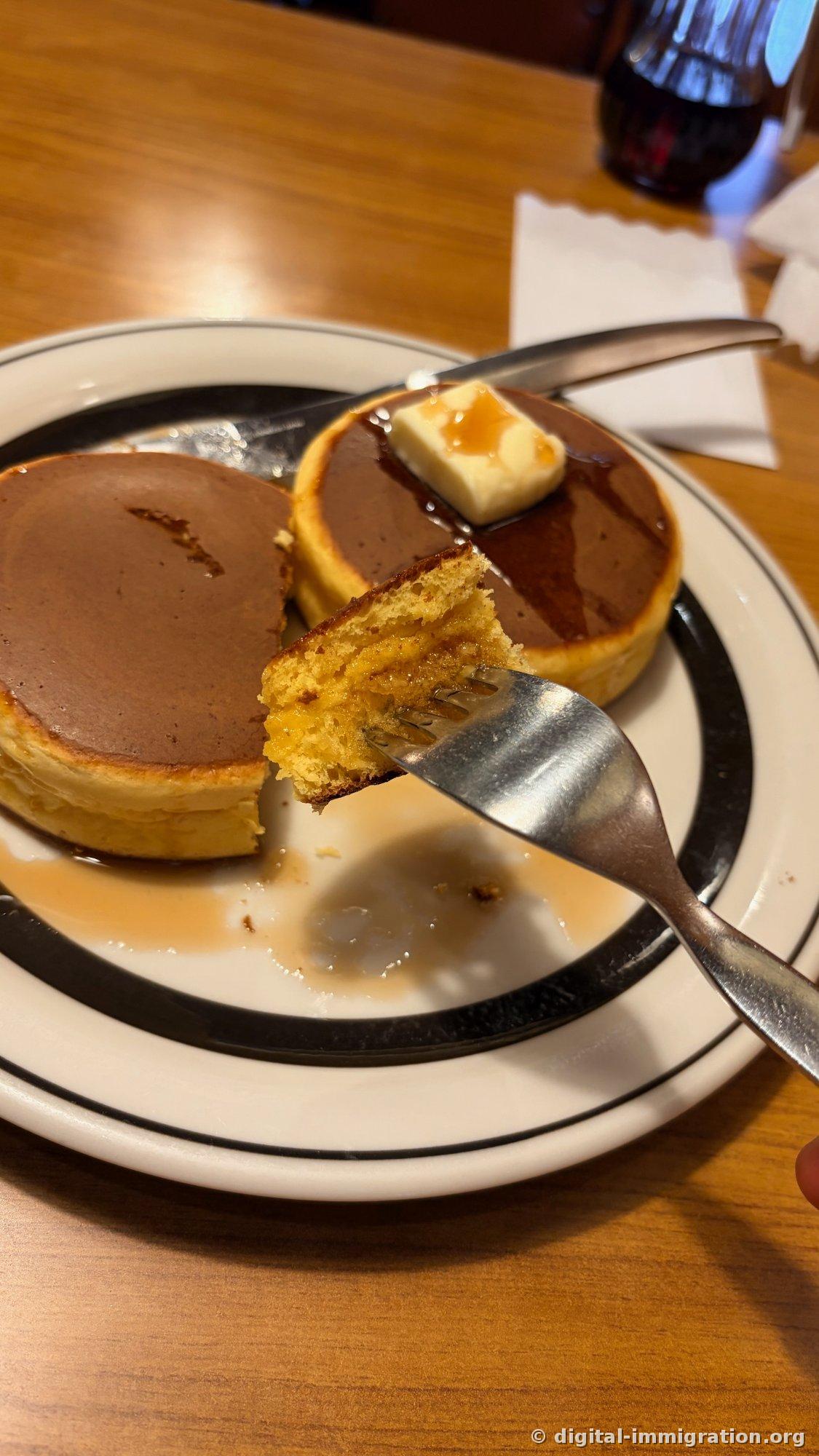
There was one small regret. There was more syrup pooled on the plate than expected, so the last few bites became oversaturated. Next time I'd pour only half the syrup at once rather than all of it. And two pancakes are quite substantial for one person alone. If you're having it as breakfast-lunch combined, it's perfect, but if you plan to order other things to share, two people can get by with one plate.
Handwritten Menu and Real Prices
When you open the menu, it's not printed. Everything is written vertically by hand. The paper has yellowed with age, tucked inside a plastic cover. In one corner is a hand-drawn "THANK YOU!!" sticker, apparently left by a customer. These details speak to how much time has accumulated in this shop.
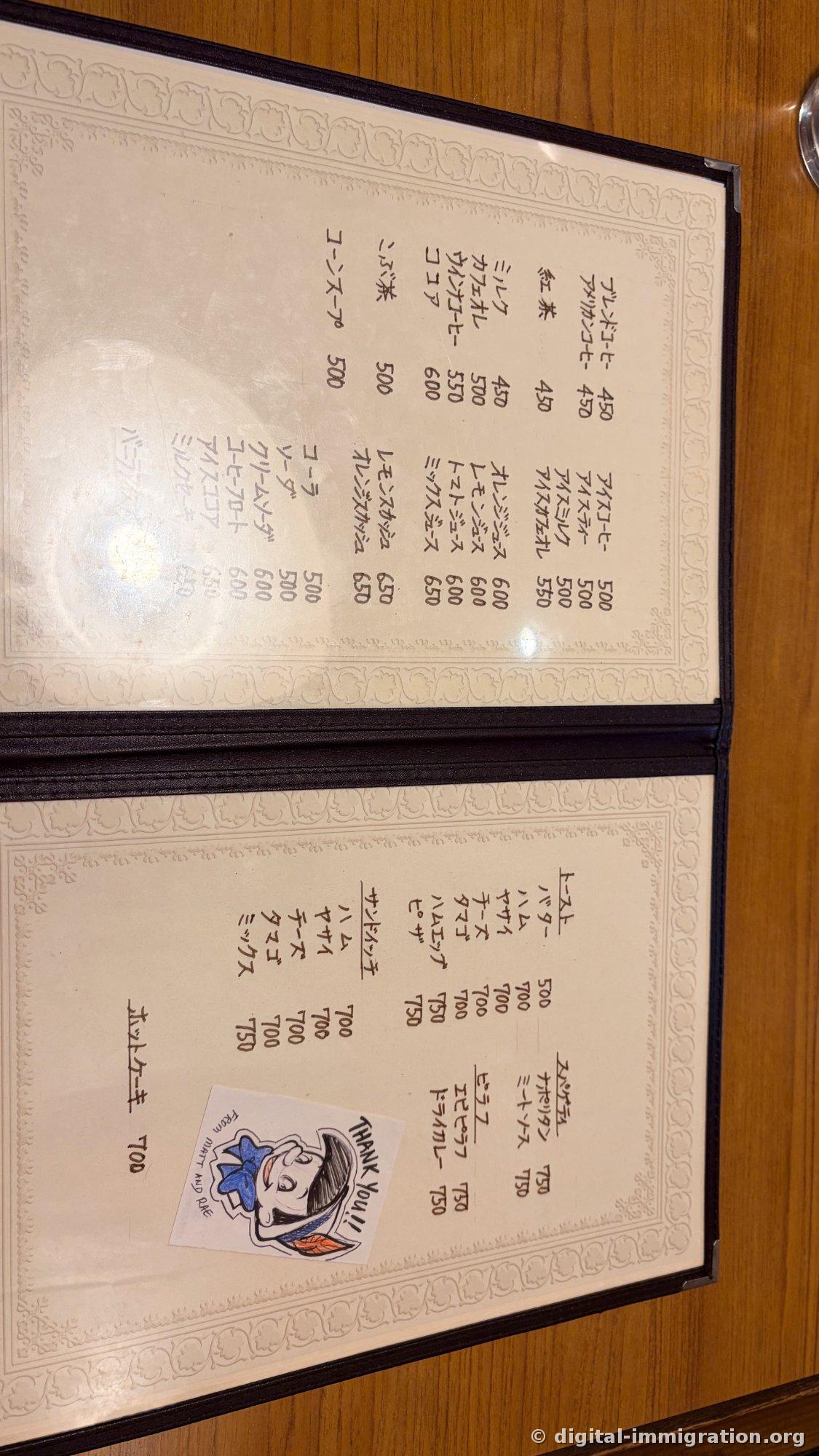
Here are the prices as listed on the menu:
- Pancakes (ホットケーキ) - 700 yen
- Blend Coffee 450 yen / American Coffee 450 yen / Black Tea 450 yen
- Iced Coffee 500 yen / Iced Tea 500 yen / Iced Milk 500 yen
- Milk 450 yen / Café au Lait 500 yen / Black Coffee 550 yen / Cocoa 600 yen
- Toast: Butter 500 yen; Ham, Vegetables, Cheese, Egg 700 yen each; Ham & Egg 750 yen; Pizza 750 yen
- Sandwich: Ham, Vegetables, Cheese, Egg 700 yen each; Mix 750 yen
- Spaghetti: Neapolitan, Meat Sauce 750 yen
- Pilaf: Shrimp, Dry Curry 750 yen
In Tokyo these days, where a plate of thick pancakes easily costs over 1,500 yen, 700 yen is an honest price. Even adding coffee brings you to 1,150 yen. That said, since these prices were captured in a photo of the menu, they may have changed—it's best to check in person.
How to Get There and Where to Sit
The location is near the coordinates on the map below. Since you have to turn into an alley off the main street, even after Google Maps tells you you've arrived at the blue dot, you'll find yourself looking around one more time. I had to scan the building from the opposite side of the street twice before I spotted the sign. If you exit at the station, opening your map and walking there is the most reliable approach.
The shop is small. With only a few tables, during lunch rush you'll need to wait outside. I sat in the seat along the far wall, and I'd recommend that spot because the brown leather chair makes a good background for photos. The window seat gets nice natural light during the day, but the glare is strong and washes out photos of the plate.
Good to Know Before You Go
- It takes nearly 20 minutes after ordering. Don't schedule your next appointment too tightly.
- The shop is small and run by just the elderly couple, so large groups are difficult. Best to come as a pair.
- The entire menu is handwritten Japanese. The pancake is written as 'ホットケーキ'—just look for those characters.
- Hours and closures change often with posted notes. If you're coming from far away, check before you leave.
- It's best to bring cash. Payment is easiest that way.
There are plenty of pancake restaurants in Tokyo where you stand in line. This place, you spend time. You wait 20 minutes watching the grandfather's back at the griddle, receive a 700-yen plate, and finish it in 20 minutes. That exchange somehow lingers with you.
Basahin din
- From Akihabara's Chuo-dori to the Kanda River: A Record of Tokyo's Electronics District Revisited Multiple Times
Tokyo's Akihabara is a neighborhood where it's hard to say you've seen everything in a single visit. I've come multiple times across different seasons, and each time the signs chan…
Tokyo · Akihabara - Buying a Single ¥300 Year-End Jumbo Lottery Ticket at Nishi-Ginza Chance Center in Tokyo
Exit from the Hibiya exit of Tokyo's Shimbashi Station, walk toward the elevated highway for about three minutes, and suddenly you'll see a line of people stretching along the side…
Tokyo · Nishi-Ginza Chance Center - Ueno Ameyoko, the real magic starts after sunset — an evening walk from the Okachimachi Gate to Ueno Station
Every time I come to Tokyo, my feet find their way to Ueno Ameyoko (アメ横) without fail. This time I entered from the Okachimachi side and worked my way toward Ueno Station. I've met…
Tokyo · Ameya Yokocho Market