Antalya Old Town (Kaleiçi) Alley Record — Half a Day Beneath the Tuzcular Mahallesi Sign
I walked through the alleys of Antalya's Old Town in Turkey, known locally as Kaleiçi, for half a day. When you think of Mediterranean cities, you instinctively think of the sea fi…
安塔利亞 · 老城區
I walked through the alleys of Antalya's Old Town in Turkey, known locally as Kaleiçi, for half a day. When you think of Mediterranean cities, you instinctively think of the sea first, but in this neighborhood, the alleys come first. The moment you step inside the city walls, car sounds disappear completely, leaving only the sound of scooters passing over stone pavement and shopkeepers' conversations. This time, I set aside historic site pilgrimages and focused on small things like storefront signs, street stalls, and cups I was drinking from.
The Alleys Themselves Are the Attraction — Orange Trees and Uphill Walks
The old town alleys are typically narrow and typically sloped. In the alley where I took the photo below, orange trees with fruit hanging heavily from their branches grow up the stone wall on the left, and a blue sign reading "Mermerli Beach ➜" is attached to the building wall on the right. Follow that arrow and you come to stairs leading down to the sea. On the left side, there's a sign for Mediterra Art Hotel, and Kaleiçi has this structure where boutique hotels made from renovated old stone houses are packed into nearly every alley. There are no large resort hotels within these walls.
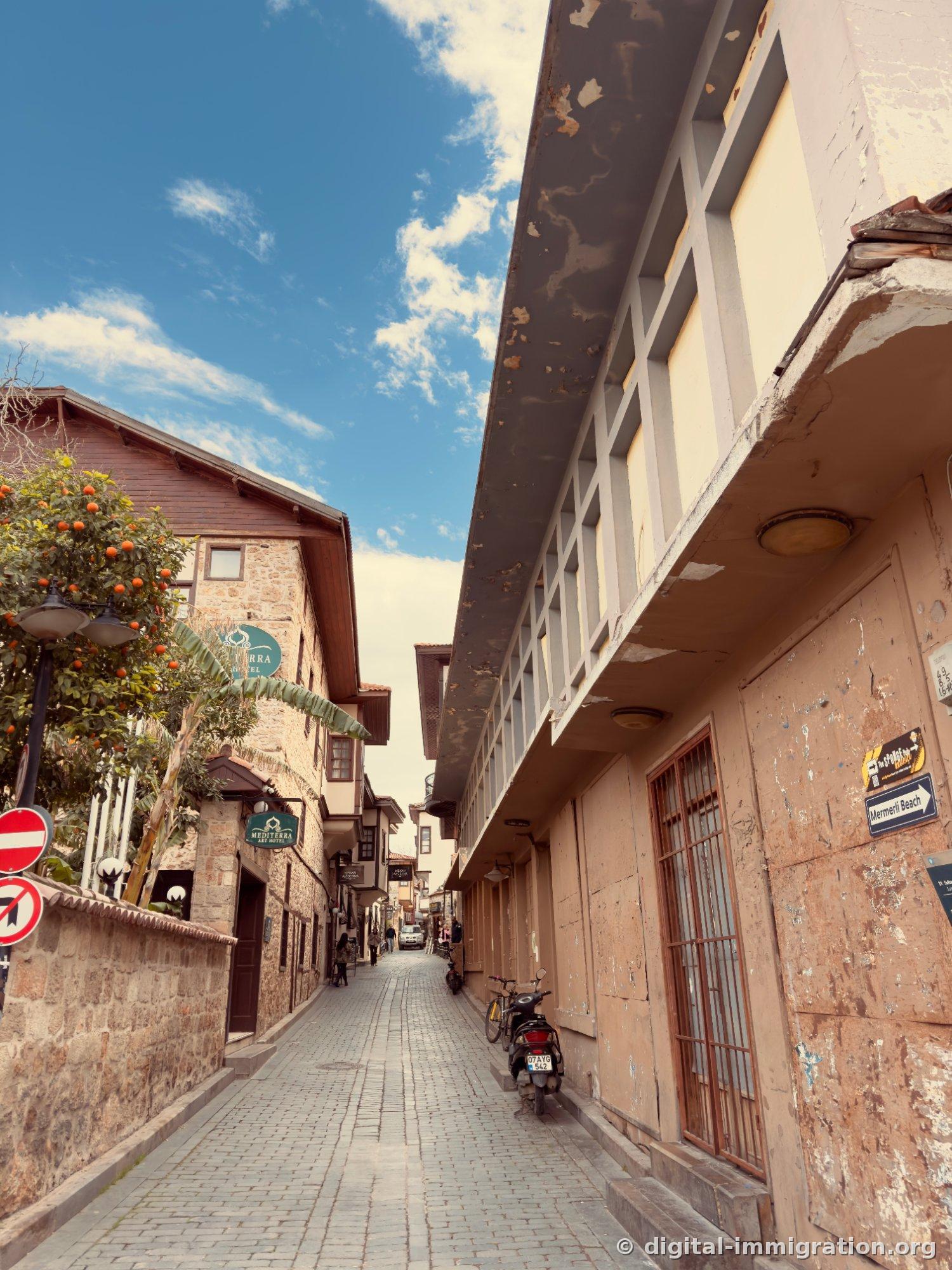
One thing first-time visitors easily miss here: this stone pavement is really slippery after rain. The stones are worn smooth, so slippers or shoes with thin soles struggle on the inclines. Dragging a carry-on luggage is also not recommended — your wheels will echo through the entire alley, and as you can see in the photo, the slopes and uneven surfaces continue endlessly. And despite the narrow lanes, scooters pass through regularly. In the photo, there's even a scooter with license plate 07AYG parked against the wall, and during my walk, I had to step aside several times from the sound of scooters coming from behind.
Ceramics on Stalls and Wooden Cats — Striking Objects
The alley walls themselves are shop display cases. The method is simple—hang a wire mesh and hang everything from it. In the spot where I took the photo below, you could still see the blue address sign reading "Tuzcular Mahallesi" (Tuzcular Neighborhood) at the top of the wall. The way shop displays casually cover administrative signs like this is quintessentially Kaleiçi.
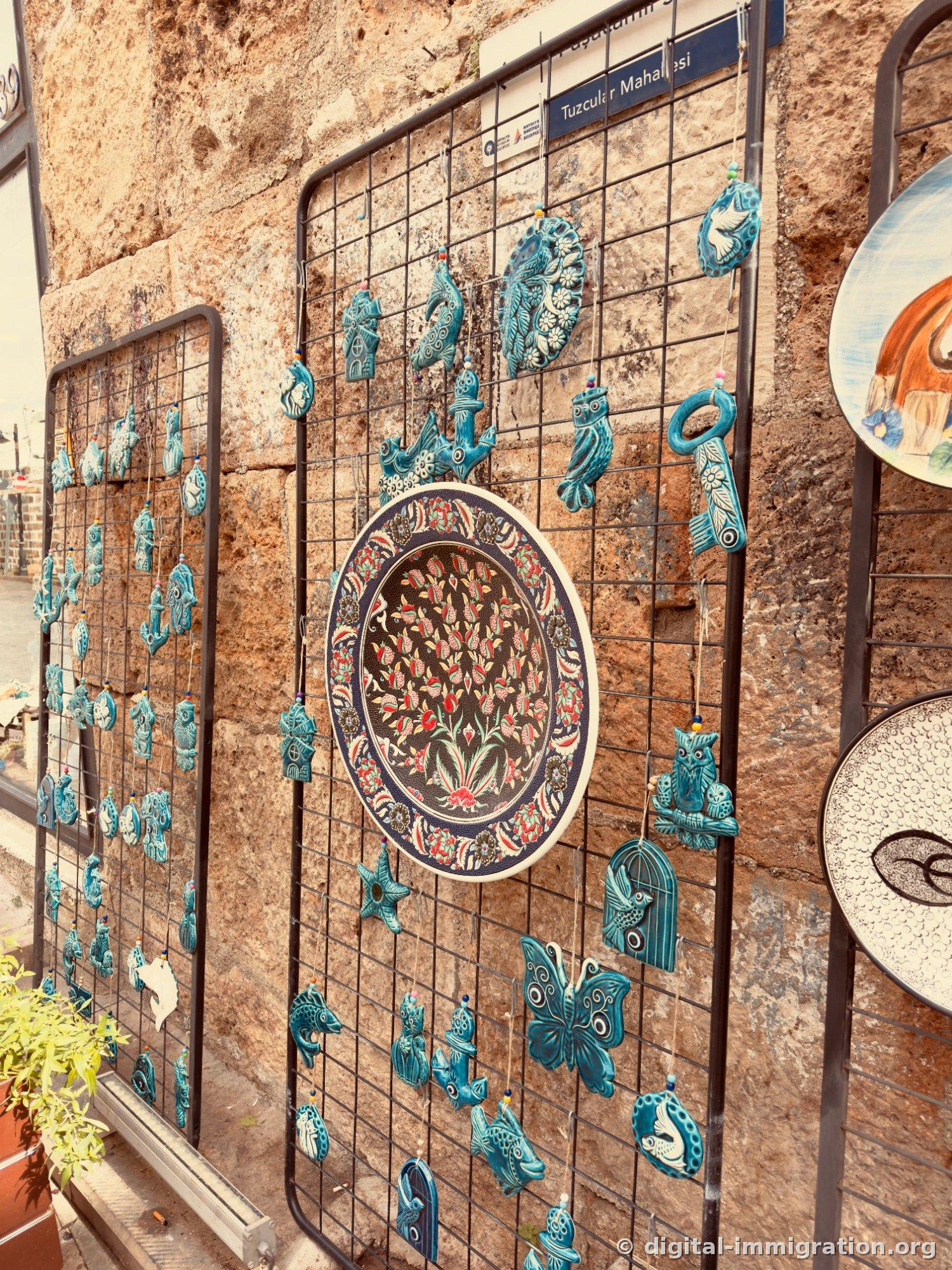
The hanging items are mostly ceramic decorations glazed in turquoise. Owls, butterflies, fish, keys, and palm (hamsa) shapes repeat, and the large plate in the center is densely painted with red tulips and carnations against a black background. These are typical patterns of Ottoman pottery. Practical tip: these small decorations feel noticeably different when you pick them up. If it's heavy with a rough back, it's genuine ceramic; if it's light with a smooth, uniformly finished back, it's molded mass-produced ware. Prices vary by shop, so listing them here would be pointless — but larger plates often don't have price tags, so it's easier to ask first before committing.
Going deeper into the alleys, I came across another stall like this: wooden masks carved with human faces, zebra masks, an old man's face with a mustache, and on the ground, several life-sized wooden cat sculptures standing upright. Beside them, blue nazar boncuk (evil eye) charms hung in rows.
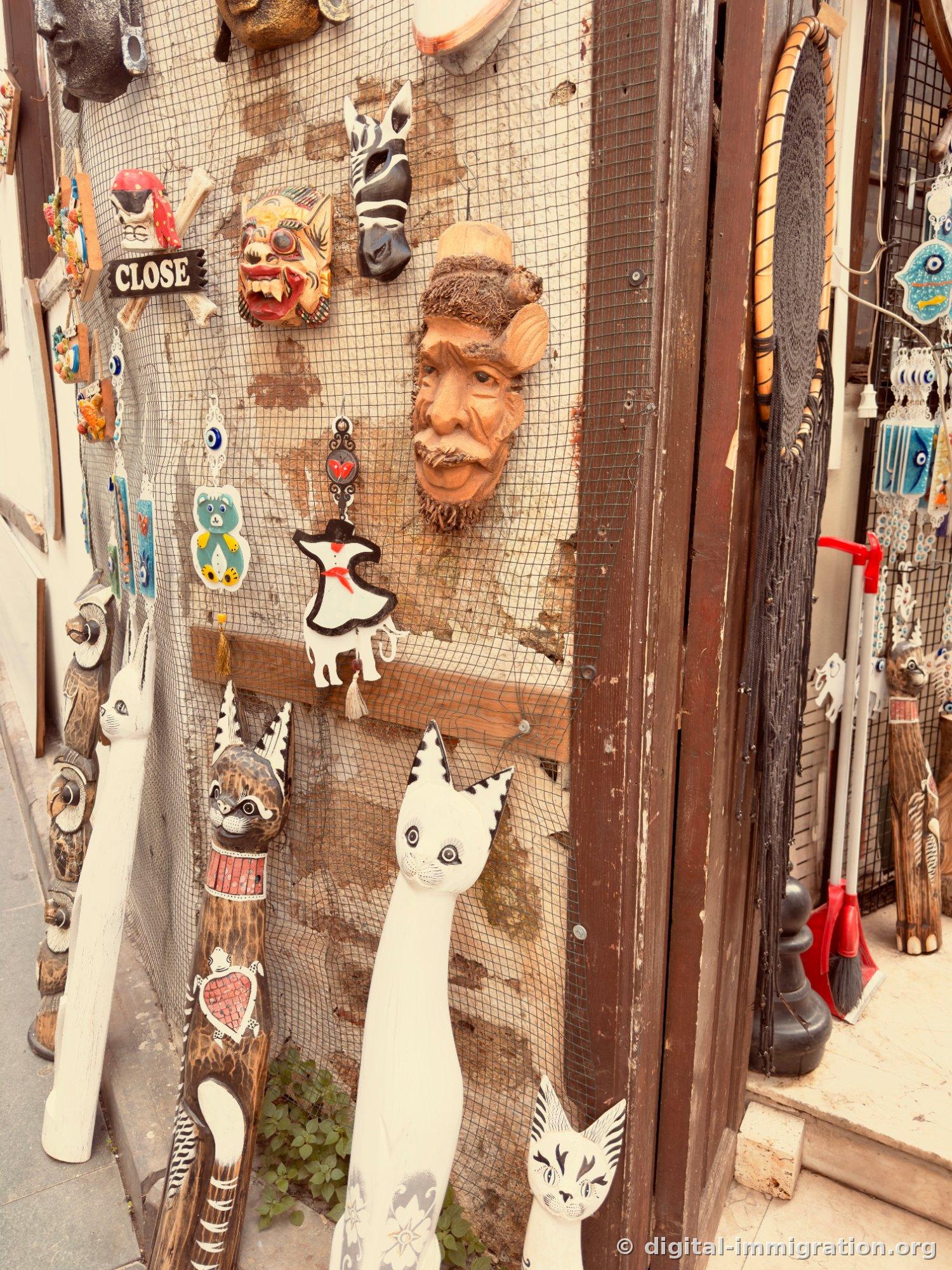
What made me laugh was a wooden sign reading "CLOSE" hanging right in the middle of the display. I never figured out whether it was merchandise hung for sale or an actual closed sign. There was even a broom standing inside. By the way, those wooden cat sculptures, as beautiful as they look, will absolutely not fit in your luggage. Since they're over a meter tall, if you buy one, you'll need to discuss separate packaging and shipping, and if you're not confident about actually taking it home, it's better to just take a photo and move on. I chose the latter.
Location and Accessibility — Where to Start and How to Exit
The area where I took photos is around the boundaries shown on the map below. Kaleiçi is a maze of streets even when you're looking at a map, so exact routes don't really matter. Instead, just remember two reference points. Enter from Hadrian's Gate at the top and descend toward the old harbor (Yat Limanı) at the bottom. Since the whole area is on a gentle downhill slope, this direction is much easier on your legs. Going up from the harbor, on the other hand, means continuous uphill climbing.
Vehicle access is restricted inside the old town, and there are actually no-entry signs at the entrance of every alley. If you're coming by taxi, you usually can't get all the way to your door, so it's better to let them know your accommodation name in advance and get dropped off at the nearest point. Two to three hours is enough time to walk around, but considering the time you'll lose lingering in alleys, half a day is more realistic.
Accommodations Within the Alleys — Signs Carved into Stone Walls
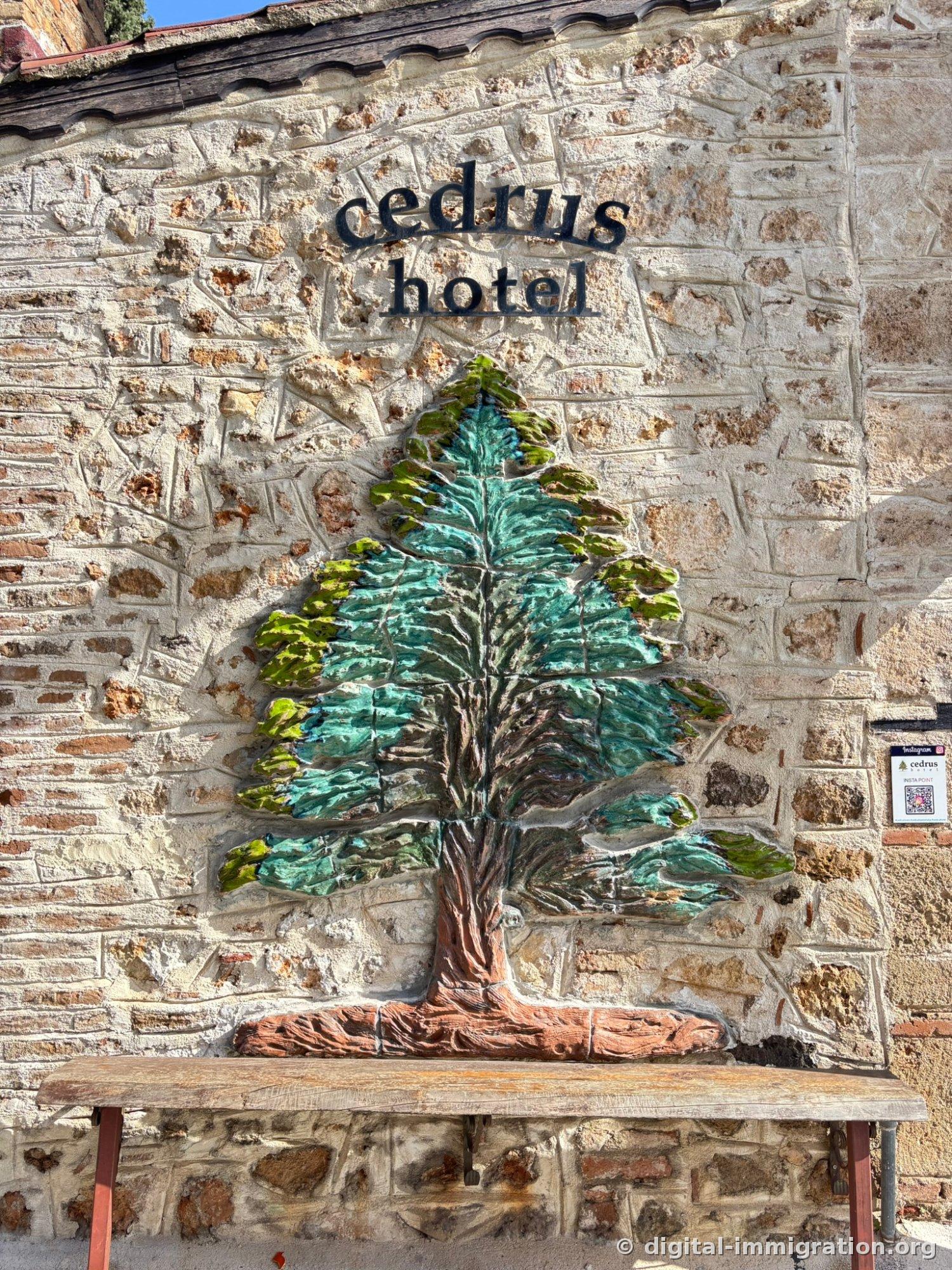
Kaleiçi accommodations have different signage. Since it's a conservation area where large illuminated signs aren't allowed, most affix small metal lettering to stone walls or embed tile reliefs. The cedrus hotel below was particularly striking—in the middle of an aged limestone wall, they've embedded a large relief of a cedar tree (cedrus) in turquoise tile. When afternoon sunlight hits the wall directly, the glaze sparkles and catches the eye from a distance. There's also a small "INSTA POINT" sign with a QR code in the lower right — an invitation to take a photo here.
Then there's a place like this on the other end: a two-story building painted entirely bright pink, with white window frames and flower pots on each window, and a black front door fitted with stained glass featuring tulip patterns. You can also see a blue nazar boncuk (evil eye) decoration set right above the door.
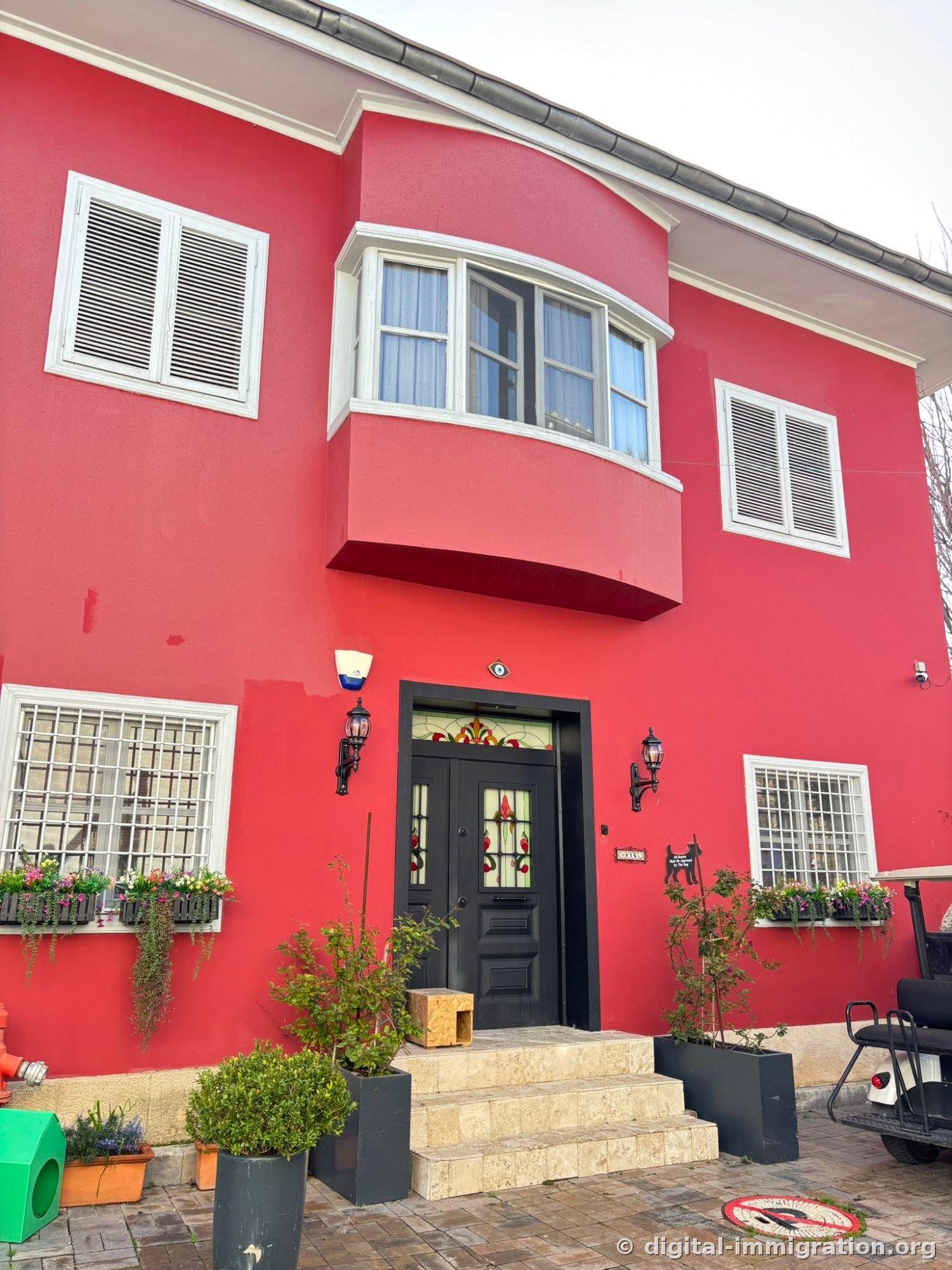
On the right side of the entrance, there's a small black cat silhouette plaque with text in English something like "All Guests Must Be Approved by The Dog" — the angle didn't let me read it completely. Many accommodations in Kaleiçi actually keep multiple cats. If you have allergies, it's good to ask before booking. There was even a green cat house sitting in one corner of the courtyard.
Two Drinks Along the Way — Salep and Strawberry Smoothie
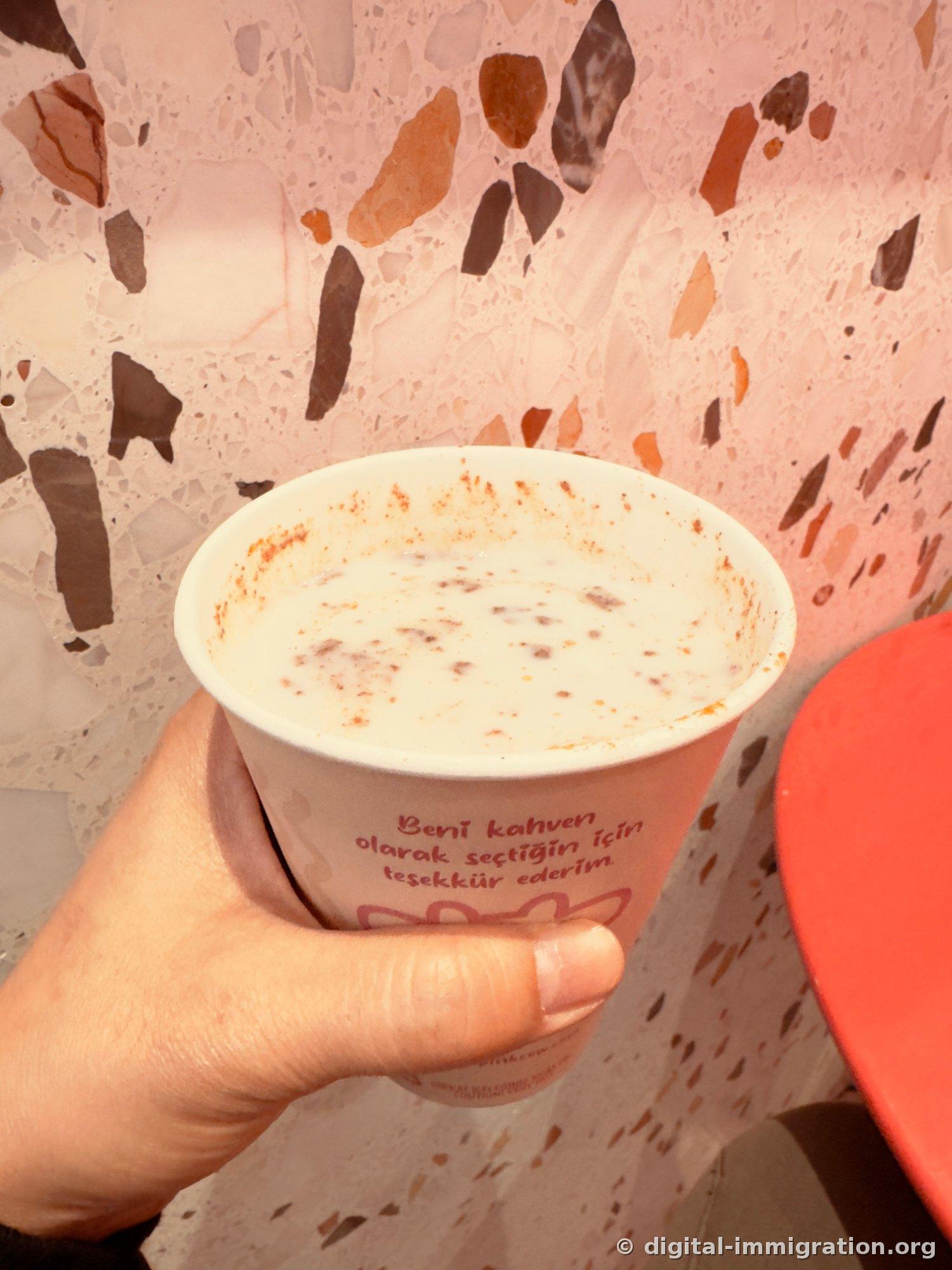
The old town alleys have lots of shade, so in winter and early spring they're colder than you'd expect. What I had then was salep. It's a thick winter drink made by boiling milk with orchid root powder, topped with cinnamon. You can see the cinnamon powder scattered across the surface in the photo. The taste is sweet and heavy—the texture is somewhere between rice drink and warm milk, so people's reactions vary. I drank halfway and got tired of it. Honestly, it's less "delicious" and more "warms your body up." The paper cup had the sweet text "Thank you for choosing me as your coffee" in Turkish, which I found adorable enough to photograph.
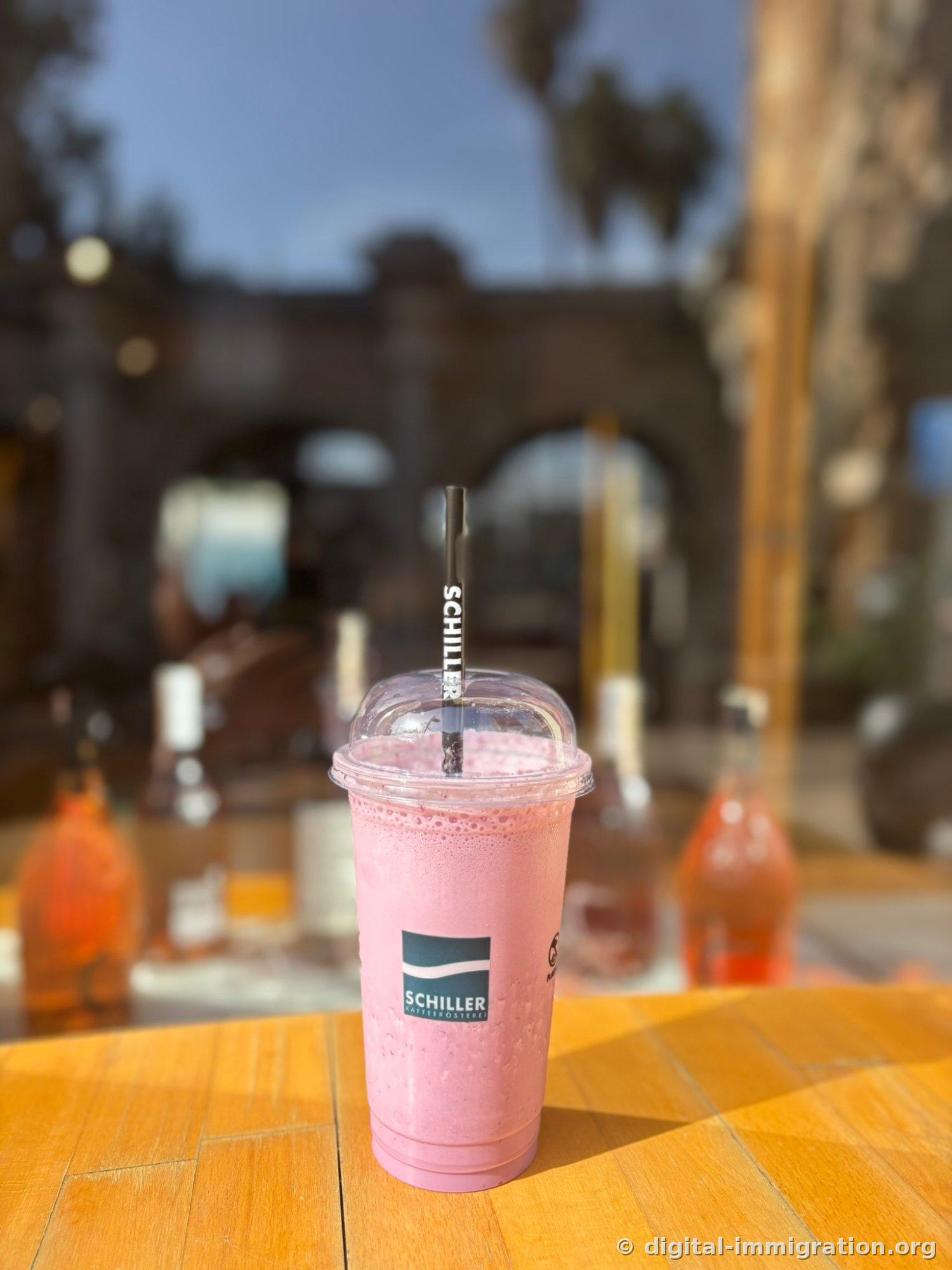
When daylight remained, I went for something cold. A strawberry smoothie ordered at SCHILLER, a German-style roastery café brand, in the alleys. When I set it on the wooden table, the arched stone building behind it was reflected in the clear glass, creating a picture. The straw even has the SCHILLER logo pressed into it. The taste is an ordinary strawberry shake. Nothing special, but after walking uphill for thirty minutes, you need that cold drink.
I didn't note the prices for either drink. Kaleiçi café prices vary considerably depending on which alley you're in, and Turkish lira exchange rates fluctuate frequently, so listing numbers now would just provide outdated information. At places without prices on the menu, it's standard practice to ask before ordering — especially the deeper you go into tourist areas.
If I Go Back, This Is How I'd Do It
- Shoes with proper soles. Stone pavement slopes continue endlessly and become slippery when wet.
- Enter from Hadrian's Gate and descend toward the harbor. The opposite direction is continuous uphill.
- For ceramics, pick them up and judge by weight. For large plates, check the price first.
- For large wooden carvings, figure out how you'll carry them before buying.
- Even in narrow alleys, scooters pass through. Keep your ears open for sounds coming from behind.
The best moments were when I folded the map and just turned into random alleys. Everything connects anyway, and if you keep descending, the sea eventually appears.
繼續閱讀
- 二月格雷梅,在策米飯店(Zemi Hotel Cappadocia)前的山丘上煮新拉麵黑的故事
土耳其卡帕多奇亞的格雷梅(Göreme)以夏季為旅遊旺季。我在二月去了那裡。晨間氣溫降至零下,山谷的稜線上鋪著一層薄薄的白粉,分不清是霜還是雪。坦白說,選擇淡季是這次旅行中做得最好的決定。遊客少,我獨佔了整個山丘觀景台,飯店的露台上除了我以外空無一人。住的是位於格雷梅村邊緣山丘上的策米飯店(Zemi Hotel Cappadocia)。
格雷梅 - 在安塔利亞Kaleiçi懸崖上,在Yuvam Shisha Nargile Kafe俯瞰港灣的午後
土耳其安塔利亞的古城Kaleiçi,城牆內側的巷弄纏繞如迷宮,初訪時根本分不清大海藏在何處。直到爬上懸崖邊的步道,視野才豁然開朗。Yuvam Shisha Nargile Kafe正坐落在這條懸崖線上,俯視著遊艇碼頭(Kaleiçi Yat Limanı)。我在2月灰陰不定的午後進去,坐了三個小時。那些只去過夏日旺季安塔利亞的人,永遠想像不到這個季節的城市有…
安塔利亞 · Yuvam Shisha Nargile Kafe - 安塔利亞卡勒伊奇遊艇港 — 從城牆下港口的三個角度俯瞰的一天
土耳其安塔利亞的舊城卡勒伊奇(Kaleiçi)城牆保存在懸崖上,懸崖下完全是遊艇港。從地圖上看像是「一個港口」,但實際去了就會發現被分成 上層(城牆漫步道)/ 中間層(坡道)/ 下層(碼頭) 三個層次。那天我走過了這三層,照片也分層記錄下來。三月初的安塔利亞白天陽光刺眼,但海風還帶著冬日的尾聲,我穿著短袖出門,卻在港口防波堤上抱著雙臂。
安塔利亞 · 卡萊奇遊艇港