Morning at the Traditional Market Next to Johor KIP Mall, Mangoes 2kg for RM10
On the outskirts of Johor Bahru, Malaysia, on the way up toward Kulai, there's KIPMall. You walk in expecting an air-conditioned shopping center like a typical mall, but instead yo…
柔佛 · 吉普莫爾
On the outskirts of Johor Bahru, Malaysia, on the way up toward Kulai, there's KIPMall. You walk in expecting an air-conditioned shopping center like a typical mall, but instead you end up spending half the day in the covered traditional market section attached to the building. The ceiling exposes bare steel beams with rows of fluorescent lights hanging down. No air conditioning. Yet by nine in the morning, humidity already clings to your shirt.
Fruit Stalls — Piles of Mangoes Catch Your Eye First
From the first corner near the entrance, green mangoes are stacked waist-high. Not the yellow apple mangoes we know, but a variety with light greenish skin. The vendor has halved a few of them and placed them on top to show off the color. The cut surfaces are deep orange. Above the mountain of mangoes, bunches of bananas hang tied with green strings, dangling so densely that when you look up, half your vision is bananas.
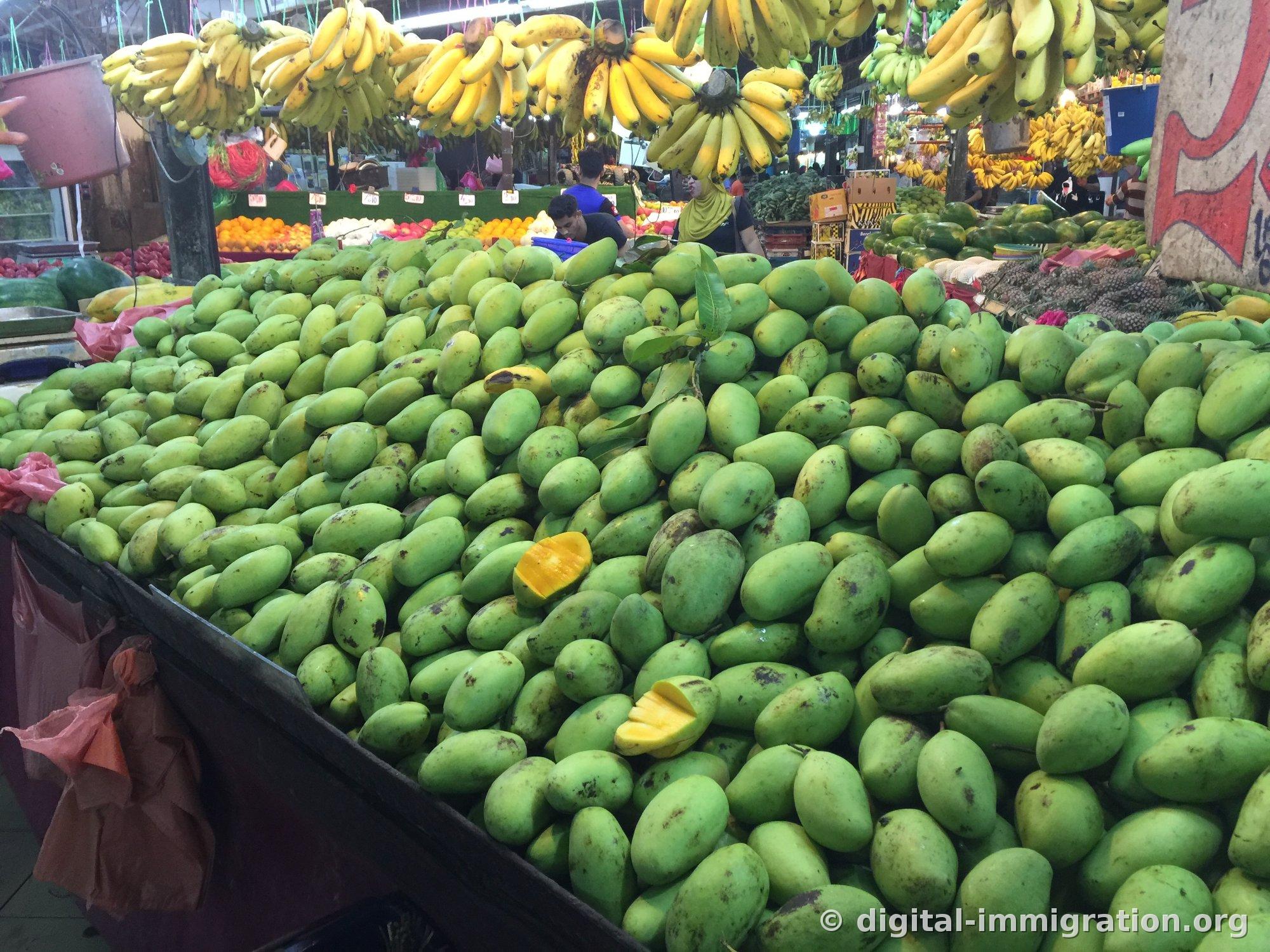
The price signs are handwritten on cardboard. Next to the mangoes, someone's written in red marker in large letters: "2 KG RM10." Mangoes for two kilograms at roughly three thousand won. First-time visitors pause at this price, but here's the thing—this isn't the absolute lowest retail price. If you go thirty meters deeper into the same corridor, you'll find another stall selling the same variety for slightly less. Better to walk around first before buying at the entrance. I didn't know that and bought everything at the entrance stall.
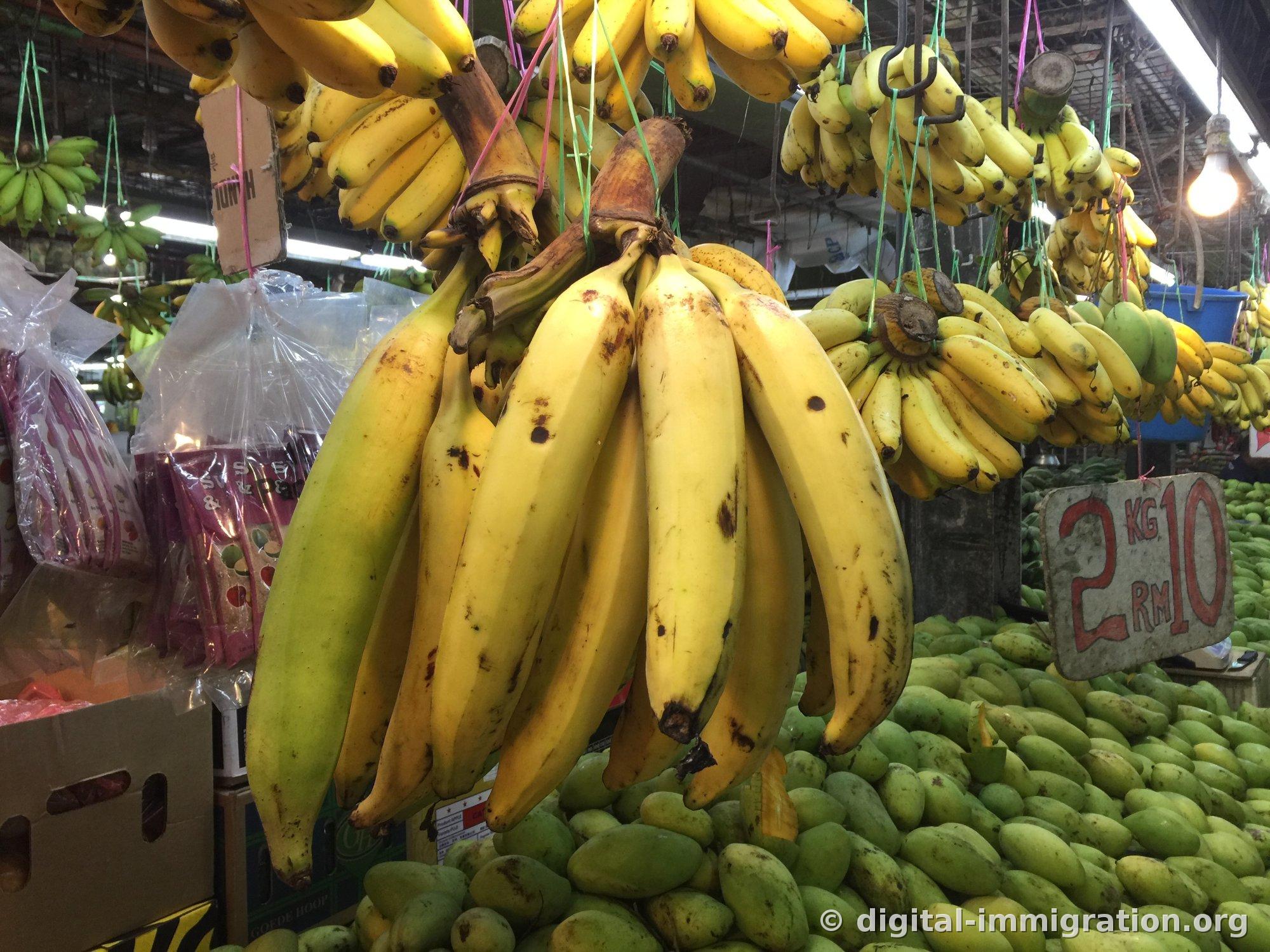
There are at least five or six varieties of bananas. Finger-sized pisang mas, thick and short ones, long and angular ones—each hangs on different hooks. They're tied with colored nylon strings, and the mix of pink, green, and yellow alone makes for a good photo. Since bananas for frying and bananas for eating are different, just ask the vendor "goreng?" (for frying?), and they'll pick the right ones for you.
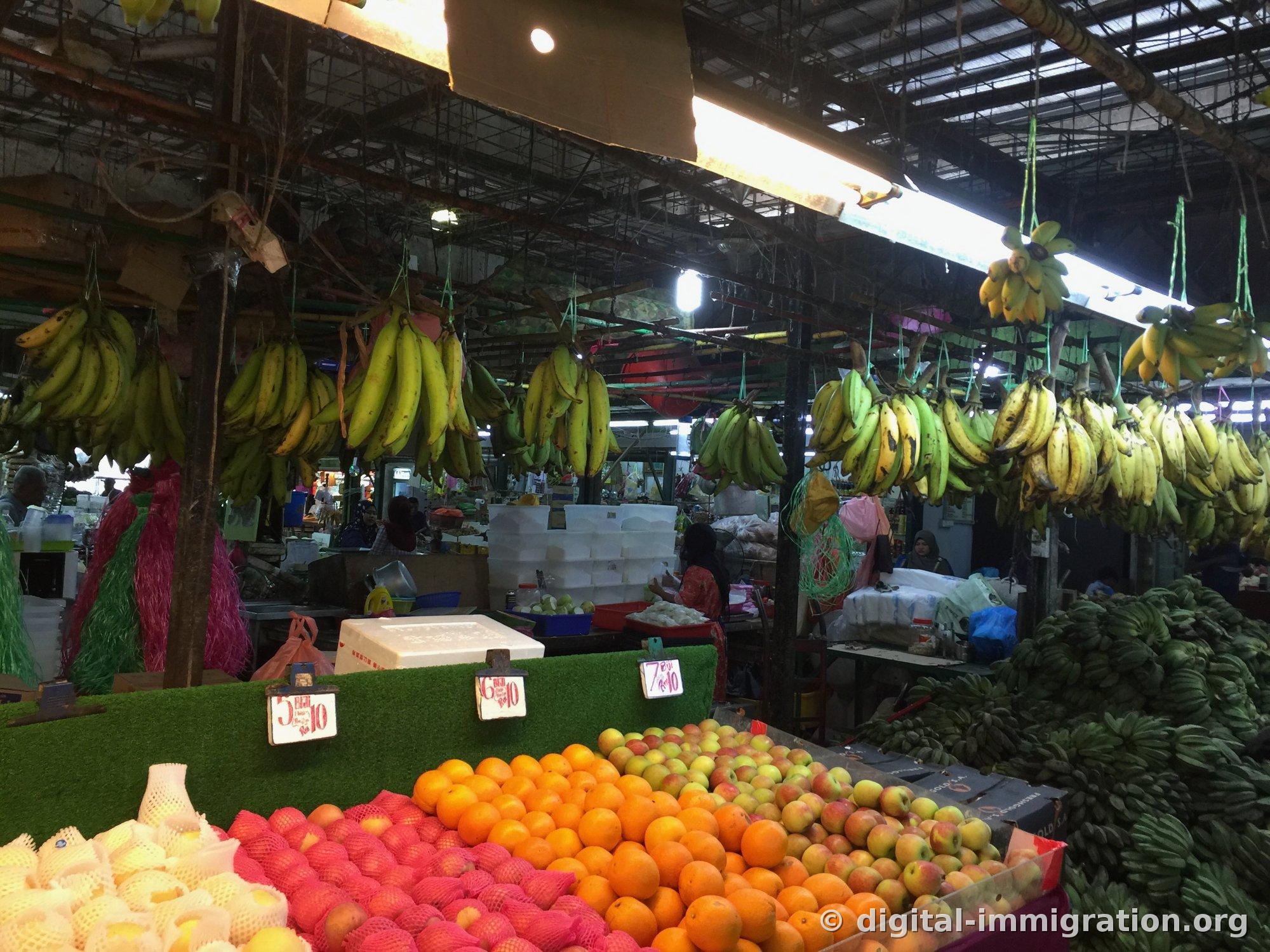
The pricing system at imported fruit stalls is interesting. Apples, oranges, and pears are sold by count, not by weight. Large ones are 5 for RM10, medium are 6, small are 7. There's no room for haggling, but the math is quick. Pears in individual mesh bags come from China or South Africa, and they're definitely pricier than local fruit. There's no reason to buy apples in Johor.
Bananas Stacked on the Floor — The Wholesale Section
Past the fruit corridor toward the mall's inner lobby, the atmosphere changes completely. Blue waterproof sheets are laid on the tiled floor, and on top of them, green banana bunches are piled up like mountains. No stalls, no price tags. This is wholesale stock that's just come in. To the side, an ice cream promotion banner for RM1 stands ignored as people pass by.
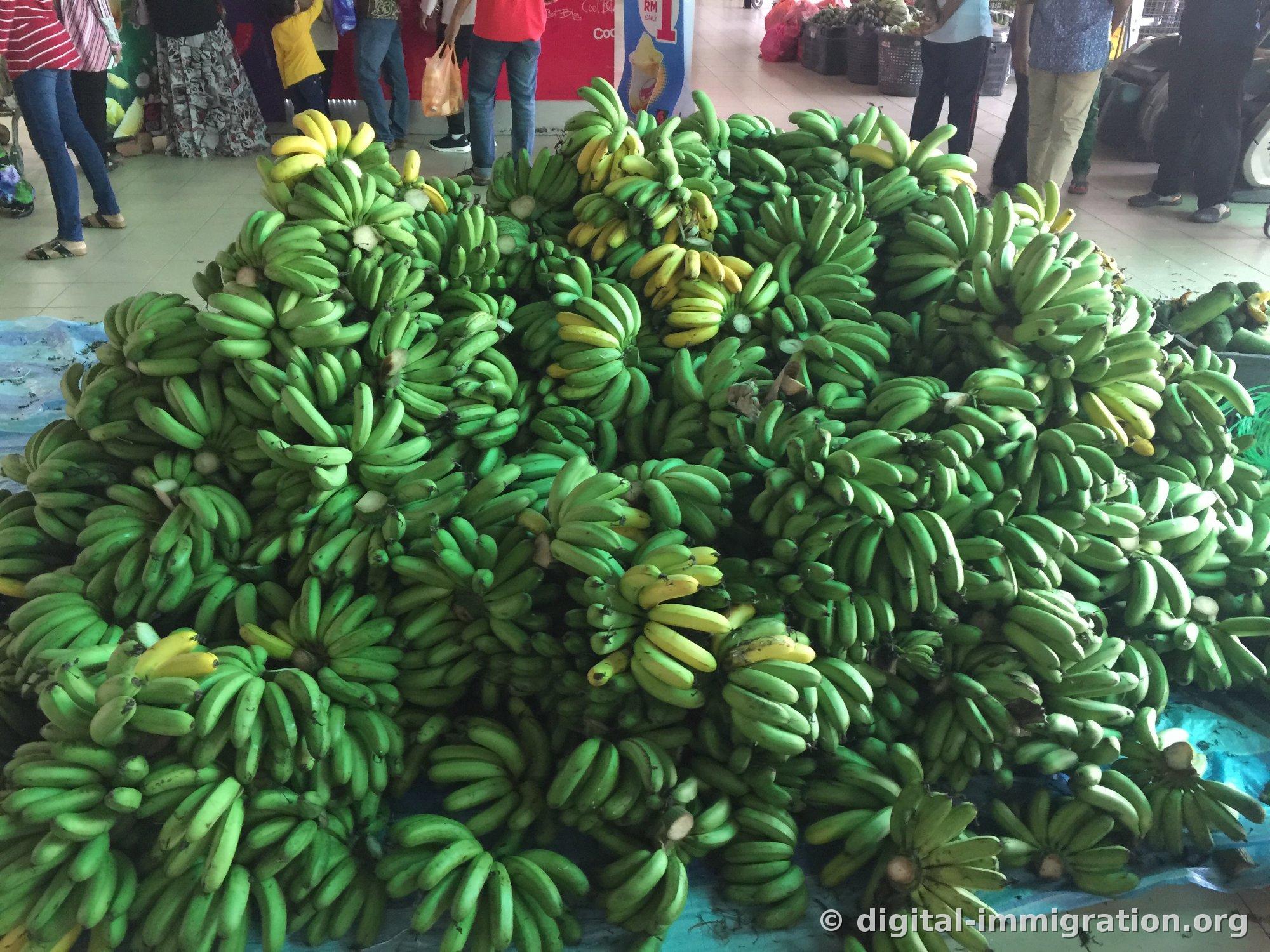
If you bring your nose close to the banana pile, it still smells green. Not the smell of ripeness, but more like grass from the cut stems. These bananas will ripen to yellow in a few days and end up on those hooks we saw earlier. It's a distinctive feature of this market—you can see the entire distribution chain unfold within one space.
Food Alley — Roti Canai Made Right Before Your Eyes
Past the vegetables and dried goods section in the middle of the market, you hear the sound of dough being worked against a griddle. It's a roti canai stall. A young man presses and stretches dough on a marble slab with his palms while a woman beside him folds and flips the cooked ones into rectangles with a spatula. The two work wordlessly in perfect rhythm—one roti takes less than two minutes.
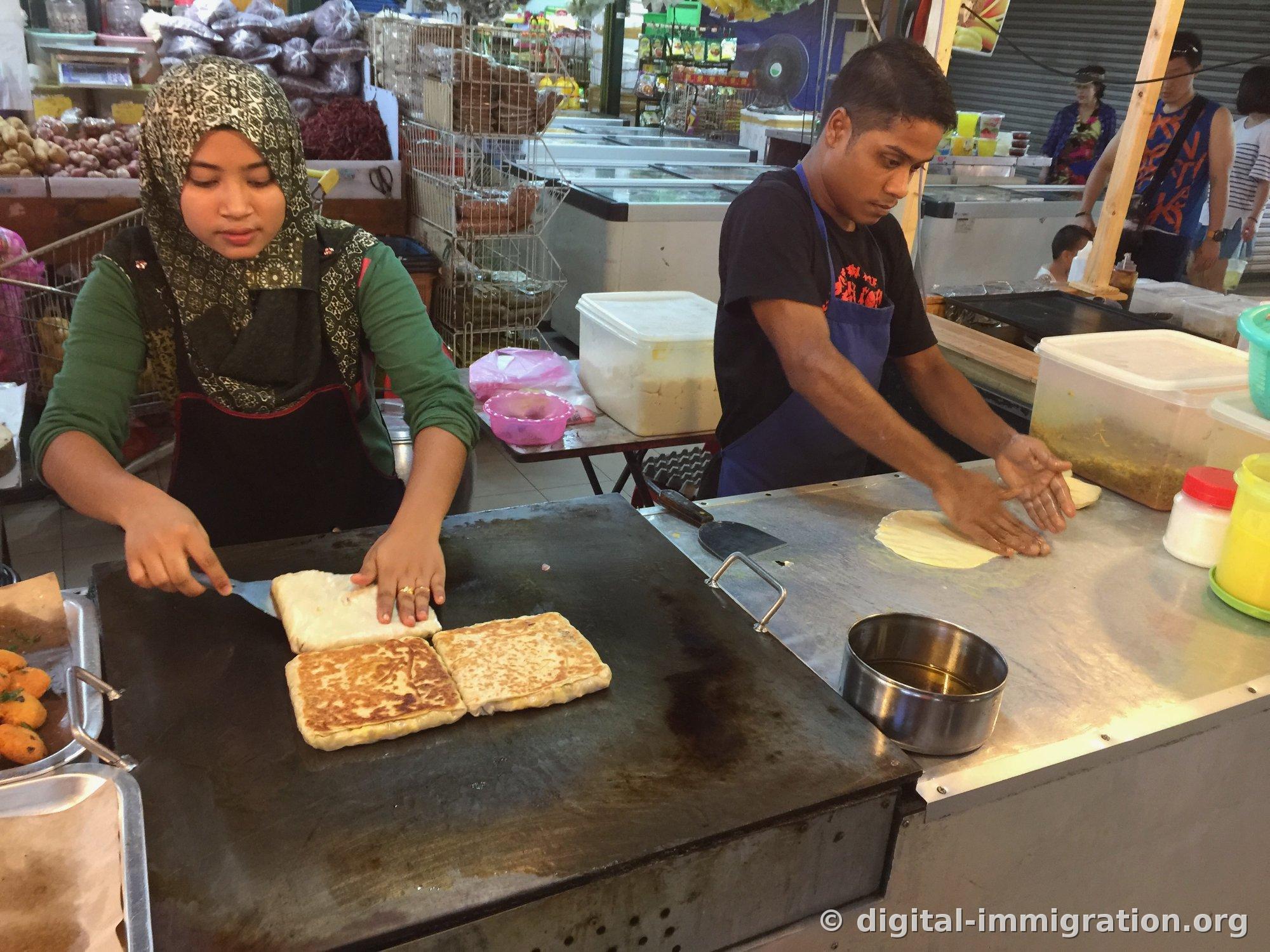
Freshly cooked roti has a crispy exterior and tears into flaky layers inside. The oil smell is savory without being heavy. Since it's a market stall, they usually wrap it in brown paper without a plate, so it's worth scouting out a place to sit first. I ended up standing to eat and got oil all over my hands, which meant I couldn't touch anything at the next stall. Definitely bring wet wipes.
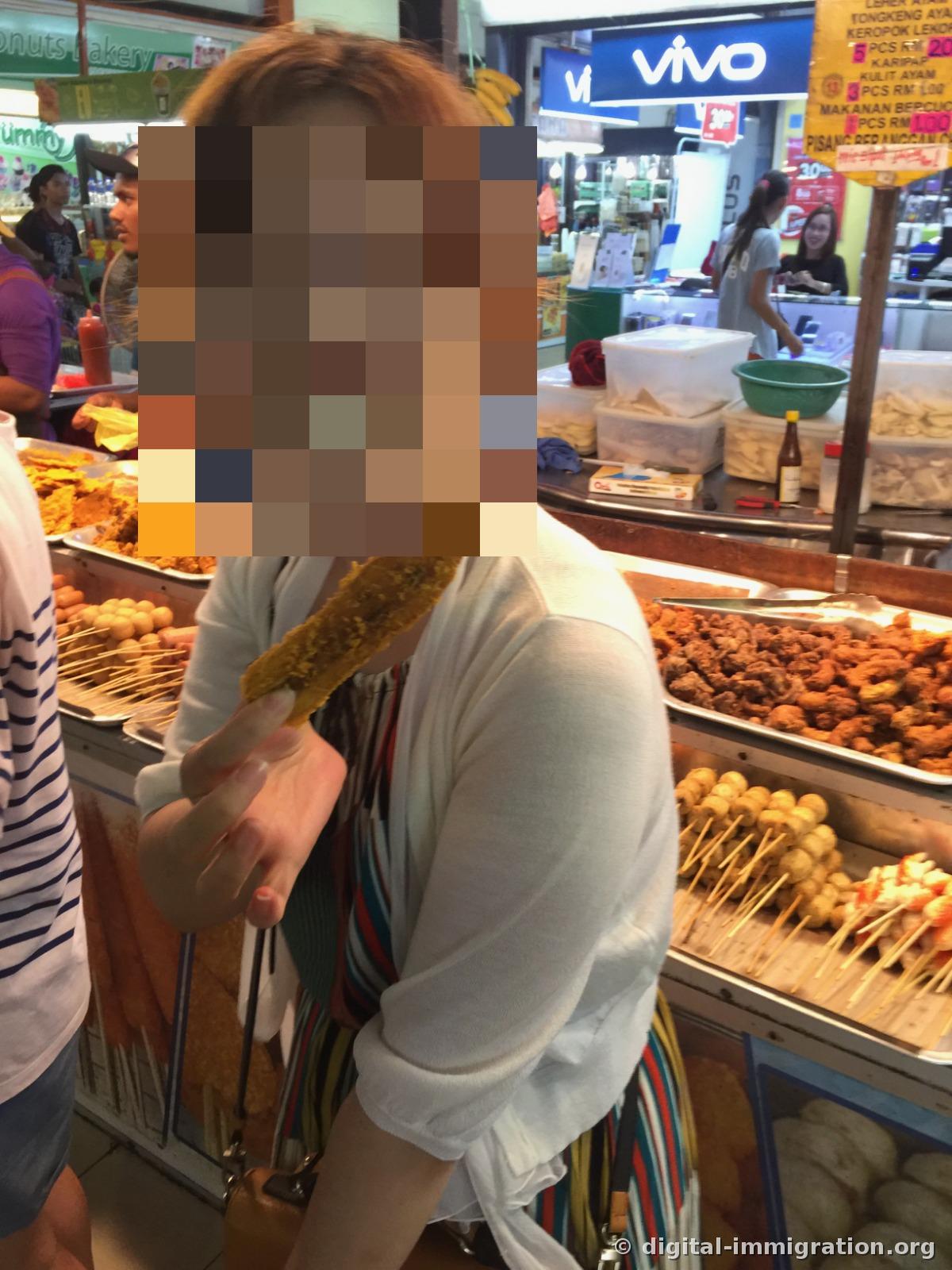
At the frying corner, you grab items by hand and pay. Rows of white fish cake skewers are lined up, and the tray next to them is piled high with fried chicken skin (kulit ayam) and large yellow fried foods. Based on handwritten price signs: fried fish sausage (keropok lekor) 5 pieces for RM2, curry puffs 3 pieces for RM1—prices that give you a real sense of the cost of living. That said, how often vendors change their frying oil varies from stall to stall. It's safest to pick a place that's busy. The VIVO phone store sign visible in the back tells you everything about this space—traditional market and mall shopfront are seamlessly blended with no walls between them.
Bahulu & Snack Corner — RM3.50 Waffles
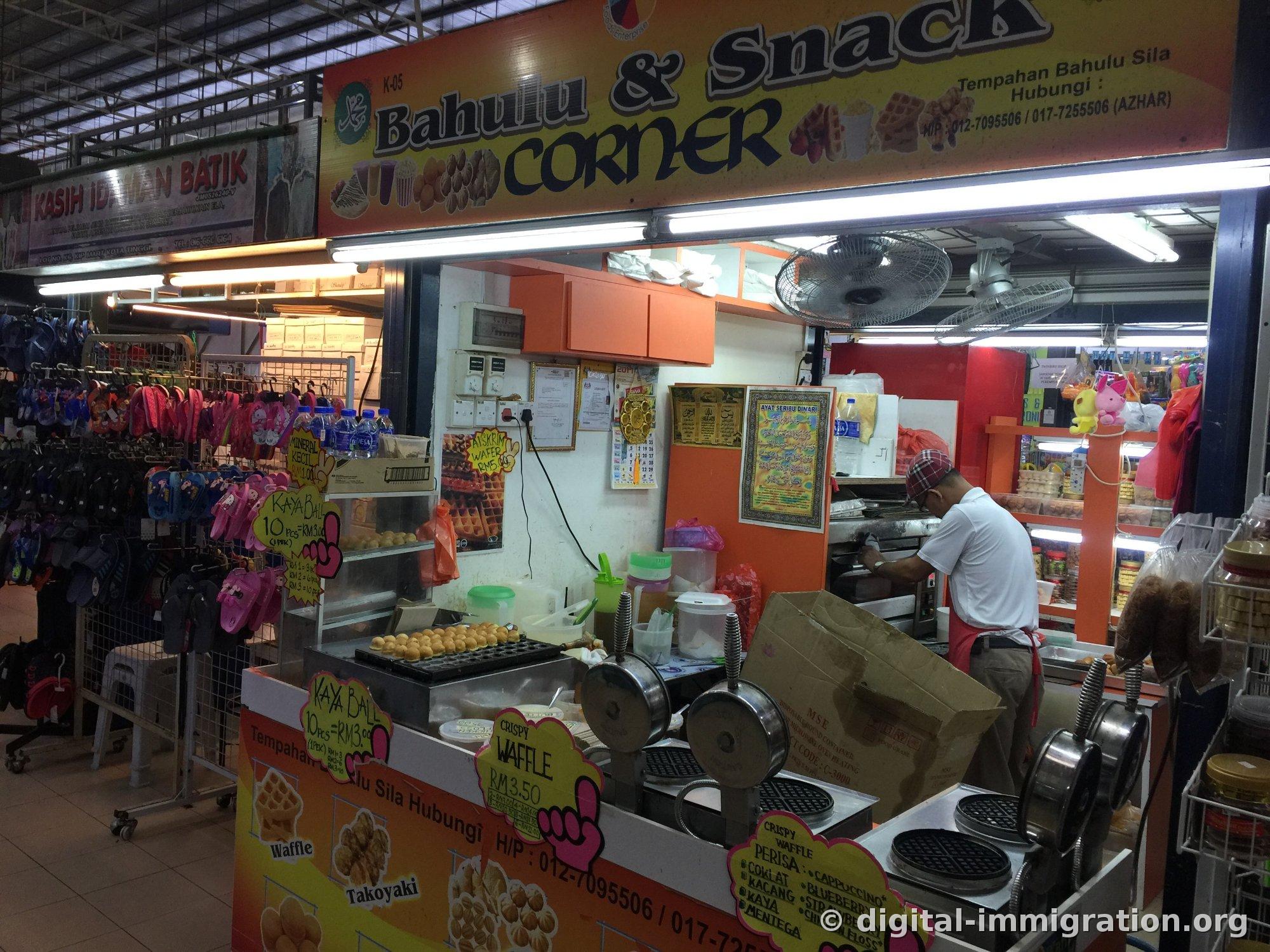
At the end of the food section is Bahulu & Snack Corner with a yellow sign. Shop number K-05. All prices are handwritten on neon paper—kaya balls 10 pieces for RM3.00, crispy waffles RM3.50, ice cream waffle RM5, small bottled water RM1. You can choose from chocolate, blueberry, peanut, kaya, butter, and cheese-floss waffle flavors. A man in a red headwrap keeps opening and closing the waffle machine, and each time he opens it, the sweet smell of batter wafts through the corridor.
Bahulu is a Malay sponge cake like the castella. Stacks of them sit in a glass display case, and the sign even has a phone number for holiday custom orders (tempahan). Fresh-baked and pre-packaged have completely different textures. The packaged ones get dry. If you're going to buy one, ask about that day's batch.
To the left is a batik shop, and children's flip-flops hang in front of it. This chaotic arrangement of waffles being cooked next to flip-flops for sale—that's the real face of the KIP Mall market section.
Location and How to Get There
KIPMall is north of central Johor Bahru. Getting there by public transport from the city center requires transfers and low frequency, so realistically, Grab is your answer. It's 30-40 minutes from JB Sentral, though fares vary significantly by time of day. The problem is getting back. There are times when Grab doesn't pick up well in front of the market. I waited over twenty minutes at two in the afternoon. Head to the main lobby of the mall instead, and you'll get picked up faster.
- Time of day — Fruit selection is best in the morning. By afternoon, the good stuff is picked over.
- Cash — Most market stalls are cash-only. Bring small bills like RM1, RM5, and RM10 split in advance. Hand over a RM50 note and the vendor will literally run to the next stall looking for change.
- What to wear — It's indoors but under a roof with no air conditioning, so it's hot. Shoes that cover your feet beat flip-flops. Fruit juice and water run across the floor.
- Bags — Some stalls charge for plastic bags or don't provide them at all. Bringing one shopping basket makes things easier.
- Business hours and individual stall prices change by day of week and season. The prices in the photos are from the time of visit, so check in person.
People from Singapore make day trips across the causeway and just hit the big malls in central JB before heading back, but if you want to really feel Johor's cost of living, one lap around a roofed market like this is much faster. I can still remember the weight on my wrist as I walked out carrying those two kilograms of mangoes.
繼續閱讀
- 吉隆坡Monkiara Seng Kee Chicken Rice(成記雞飯) — 非得點油飯不可的週末午餐
每當週末有事要去Monkiara Solaris那邊,我的腳步幾乎總是自動走向這家店。在吉隆坡,雞飯招牌滿街都是,但我已經反覆光顧這家成記(Seng Kee)好幾年了。建築外牆上貼著大招牌,寫著'SINCE 1991',下面標著'新山老字號'。新山是柔佛的中文地名。這家老字號從柔佛起家,之後發展到KL,如果要在馬來西亞旅遊,雞飯(Chicken Rice)和…
吉隆坡 · Seng Kee Chicken Rice - 在哥打丁宜傳統市場度過的上午 — 綠芒果堆山和RM3.50華夫餅
馬來西亞柔佛州哥打丁宜(Kota Tinggi)。從新山往東開車進來會到達的小鎮,旅遊指南上只談論瀑布的地方。這次我沒有去瀑布,反而泡在市中心的菜市場(帕薩爾)裡。上午九點多一點,剛踏進只有屋頂的鋼骨建築,迎面撲來的是熱帶水果特有的酸甜發酵味和人的汗臭,以及某處不斷轉動的風扇吹來的風。沒有冷氣。這篇文章是我那晚在住處記下的筆記。
哥打丁宜 - 吉隆坡雙子塔,從白天的榕樹到夜晚的KLCC噴泉——整整一天的記錄
這次在吉隆坡停留期間,我把整整一天都花在KLCC(Kuala Lumpur City Centre)這一個街區。雙子塔是馬來西亞最有名的建築,很容易就被當作「拍一張照片就結束」的景點處理,但我是下午走進去,一直待到晚上噴泉秀結束才離開。總結來說,這個地方白天和夜晚是完全不同的地方。白天只是炎熱的商業區,但一旦太陽下山,整座城市就開始圍繞著這兩座高塔運轉。
吉隆坡 · Petronas Twin Towers