Sarashina Horui Headquarters in Azabu-Juban, Tokyo: A Bowl of White Soba and a Plate of Dashimaki
I visited Sarashina Horui Headquarters, located on the first floor of a red brick building deep within an alleyway in Azabu-Juban, Minato Ward, Tokyo. I'm not someone who goes out…
東京 · 更科堀井麻布十番本店
I visited Sarashina Horui Headquarters, located on the first floor of a red brick building deep within an alleyway in Azabu-Juban, Minato Ward, Tokyo. I'm not someone who goes out of my way to find soba restaurants, but I had heard long ago that this establishment uses the "sarashina" method—grinding buckwheat with the husks removed to extract only the inner core—which results in white noodles. When the plate arrived, my first reaction was a surprised gasp. These weren't the brown buckwheat noodles we know, but white noodles closer to somen.
The Noodles Are White—The Moment You Understand What Sarashina Soba Is
A bamboo mat is laid inside a red lacquered rim, and the white noodles are arranged neatly on top. When you pick up a few strands with chopsticks, they don't snap but slide smoothly away. There's almost no buckwheat aroma. This isn't soba you eat for its fragrance, but for its texture and subtle sweetness. On the first bite without any dipping sauce, a faint sweetness emerges when you chew. Those expecting a strong buckwheat aroma might be disappointed here. Even I initially found it bland.
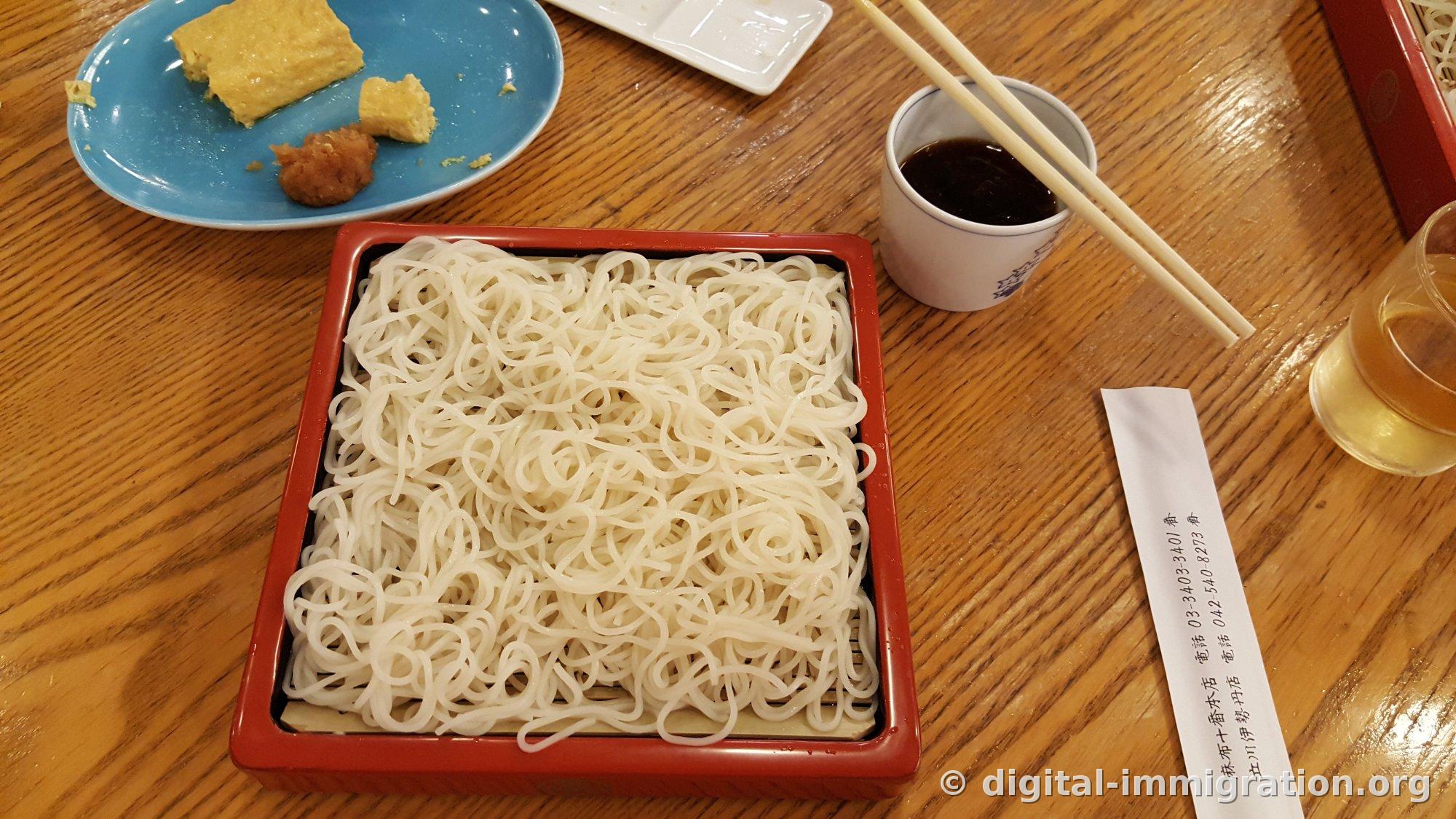
The dipping sauce comes separately in a small cup. That black broth in the white ceramic cup with blue lettering in the upper right of the photo is it. It's much saltier and more intense than the buckwheat noodle broth I've had in Korea—if you fully submerge the noodles in the broth, the saltiness overpowers everything. You should only lightly dip the last third of the noodles. This establishment is known for serving two types of dipping sauce, but on the day I visited, I only received the stronger one. If you want a dipping sauce with a touch of sweetness, it's best to ask the staff when ordering. It was only after seeing the phone number printed on the wooden chopstick wrapper (03-3403-3401) that I thought, oh, this really is the original headquarters.
Dashimaki Tamago—This Is What Actually Lingers in Memory
Since just soba alone would leave me unsatisfied, I added an order of dashimaki (rolled eggs) as a side. This turned out to be the highlight of the day. Two thick pieces arrive on a blue plate, and they're so moist that broth seeps out when you press them with chopsticks. It's not sweet rolled eggs made with sugar, but rather the dashi broth flavor that comes through first. It arrives lukewarm rather than hot, which I initially thought meant it was cold, but once I tasted it, I realized this temperature is what allows the dashi aroma to shine.
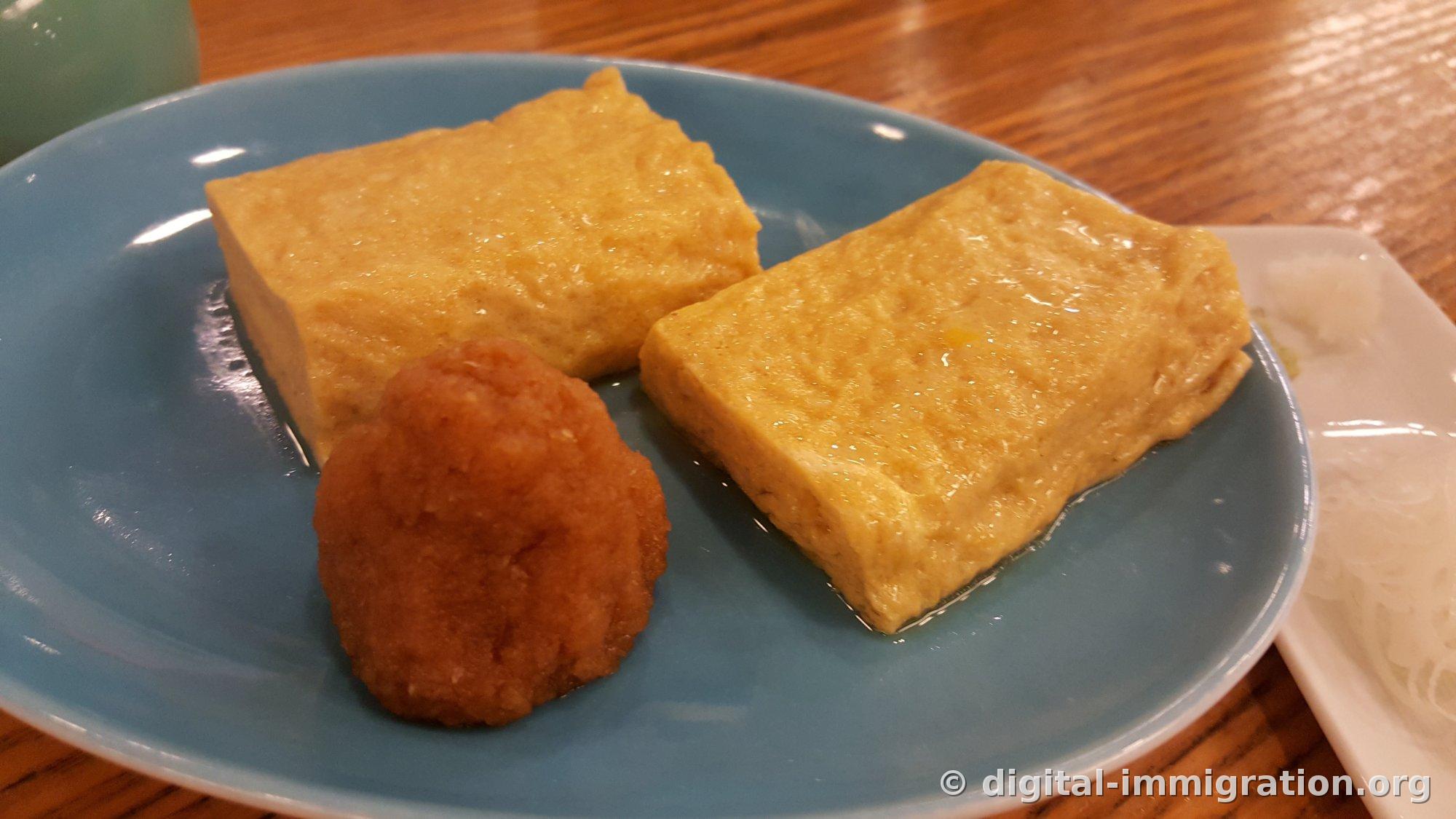
The orange-red mass on the left side of the plate is momiji oroshi, grated radish mixed with red pepper powder. At first, I thought it was just decoration and didn't touch it, but when I placed it on the rolled eggs, the pungent radish flavor washed away the richness rather than adding heat. A separate white plate contains grated radish without the red pepper powder. When you dissolve this into the soba dipping sauce, the saltiness becomes much gentler. I only realized this pairing after I'd finished a piece, which was slightly disappointing.
The Restaurant's Appearance and How to Find It
There are three ways to identify this establishment in the alley. Below the eaves, a wooden lantern displays "更科堀井 そば" written vertically, and above the awning, "更科堀井 総本家" is mounted in gold wooden letters. A white noren curtain hangs at the entrance. The window features a display case with food models of soba and fried items, so you can tell what they serve even without reading Japanese. Since palm plants and street trees stand in front of the restaurant, it's less conspicuous than you'd expect—just turn on your map and look for the first floor of the brick building.
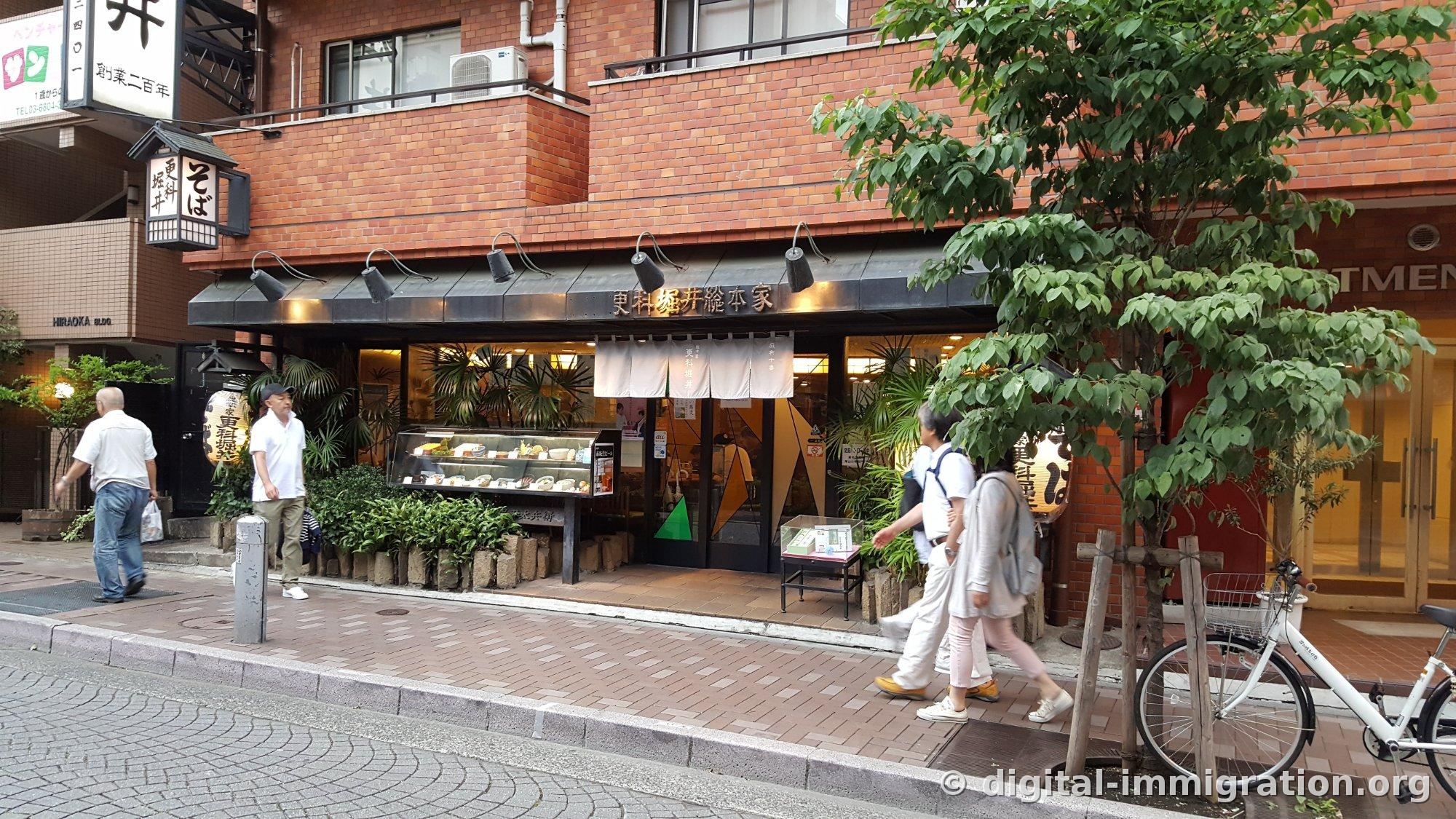
It's a walkable distance from Azabu-Juban Station on the Tokyo Metro Namboku and Oedo lines. The alley is flat, so there's no burden even if you're carrying luggage. The pin on the map below shows where I took these photos.
Things Worth Knowing Before You Go
- By Korean standards, the portion size of one bowl of soba is definitely small. Adding a side dish is practically essential, not optional.
- The dipping sauce is salty. Dip only the ends of the noodles, and adjust the saltiness by adding grated radish.
- If you're expecting soba with a strong buckwheat aroma, this isn't the place. This restaurant is about experiencing the silky texture of white noodles, not the fragrance.
- Prices, business hours, and holidays vary by season, so it's recommended to confirm locally before visiting.
- There are often lines during lunch hours. It's best to arrive with plenty of time to spare.
As I parted the noren curtain on my way out, it struck me that this isn't a place to fill your stomach. One bowl of white noodles, two pieces of rolled eggs, and a bit of radish. Though it's a meal that takes thirty minutes, when I walked through the Azabu-Juban alley again, the dashi aroma lingered in my mouth.
繼續閱讀
- From Akihabara's Chuo-dori to the Kanda River: A Record of Tokyo's Electronics District Revisited Multiple Times
Tokyo's Akihabara is a neighborhood where it's hard to say you've seen everything in a single visit. I've come multiple times across different seasons, and each time the signs chan…
東京 · 秋葉原 - Buying a Single ¥300 Year-End Jumbo Lottery Ticket at Nishi-Ginza Chance Center in Tokyo
Exit from the Hibiya exit of Tokyo's Shimbashi Station, walk toward the elevated highway for about three minutes, and suddenly you'll see a line of people stretching along the side…
東京 · 西銀座幸運中心 - Ueno Ameyoko, the real magic starts after sunset — an evening walk from the Okachimachi Gate to Ueno Station
Every time I come to Tokyo, my feet find their way to Ueno Ameyoko (アメ横) without fail. This time I entered from the Okachimachi side and worked my way toward Ueno Station. I've met…
東京 · 阿美橫丁市場