Don't Just See Pamukkale's Travertine and Leave — Hierapolis Archaeology Museum, an Exhibition Hall Nested Inside a Roman Bath
After walking barefoot across Pamukkale's white travertine terraces, most visitors head straight back down the hillside. I did the same on my first visit. The second time I came to…
Denizli · Hierapolis Archaeological Museum
After walking barefoot across Pamukkale's white travertine terraces, most visitors head straight back down the hillside. I did the same on my first visit. The second time I came to the Denizli area in Turkey, I finally stepped into the Hierapolis Archaeology Museum (Hierapolis Arkeoloji Müzesi), which had caught my eye on the signage at the top of the ruins, and honestly felt I should have switched the order. Only once inside did the scattered fragments of ruins I'd seen outside begin to make sense.
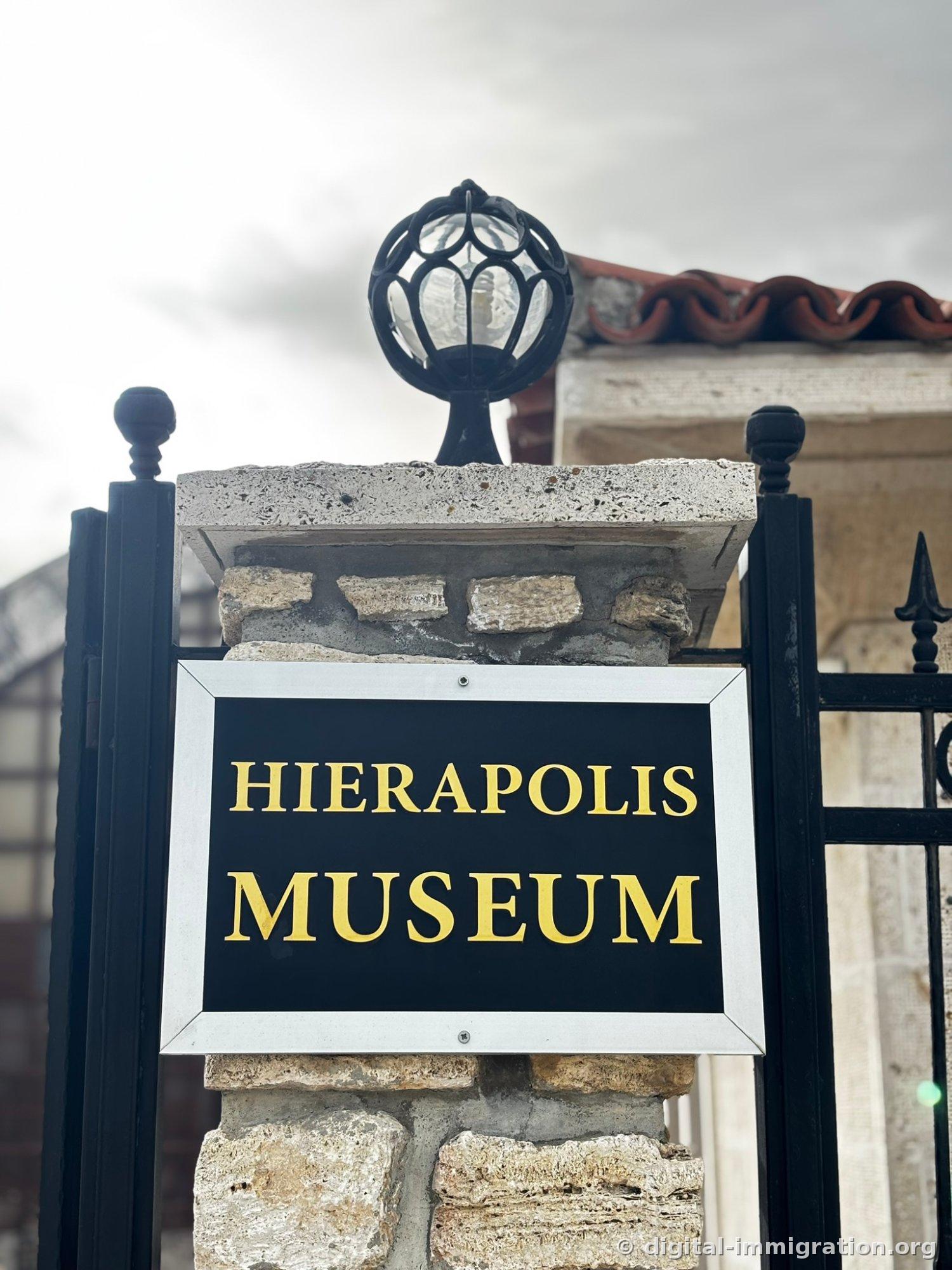
The sign is that simple. Unlike a typical tourist attraction entrance, it's understated enough that many passersby don't even notice it. On the overcast day I visited, the metal lamp beside the gate and the red roof tiles actually caught the eye more. Admission fees and opening hours change seasonally, and the integrated site pass policy gets revised regularly, so there's no point listing specific numbers here — it's best to check at the ticket office or the day's signage on site.
The Exhibition Space Itself Is a Relic — Beneath Roman Bath Barrel Vault Ceilings
As you step through the door, the space overwhelms you before the artifacts do. This museum isn't a new building—it uses the actual Roman-era bathhouse structure from Hierapolis. Massive stone barrel vaults remain intact overhead, and curved lighting rails are strung beneath them. The stone surfaces are left as they are, blackened with soot in some places and yellowed with plaster in others.
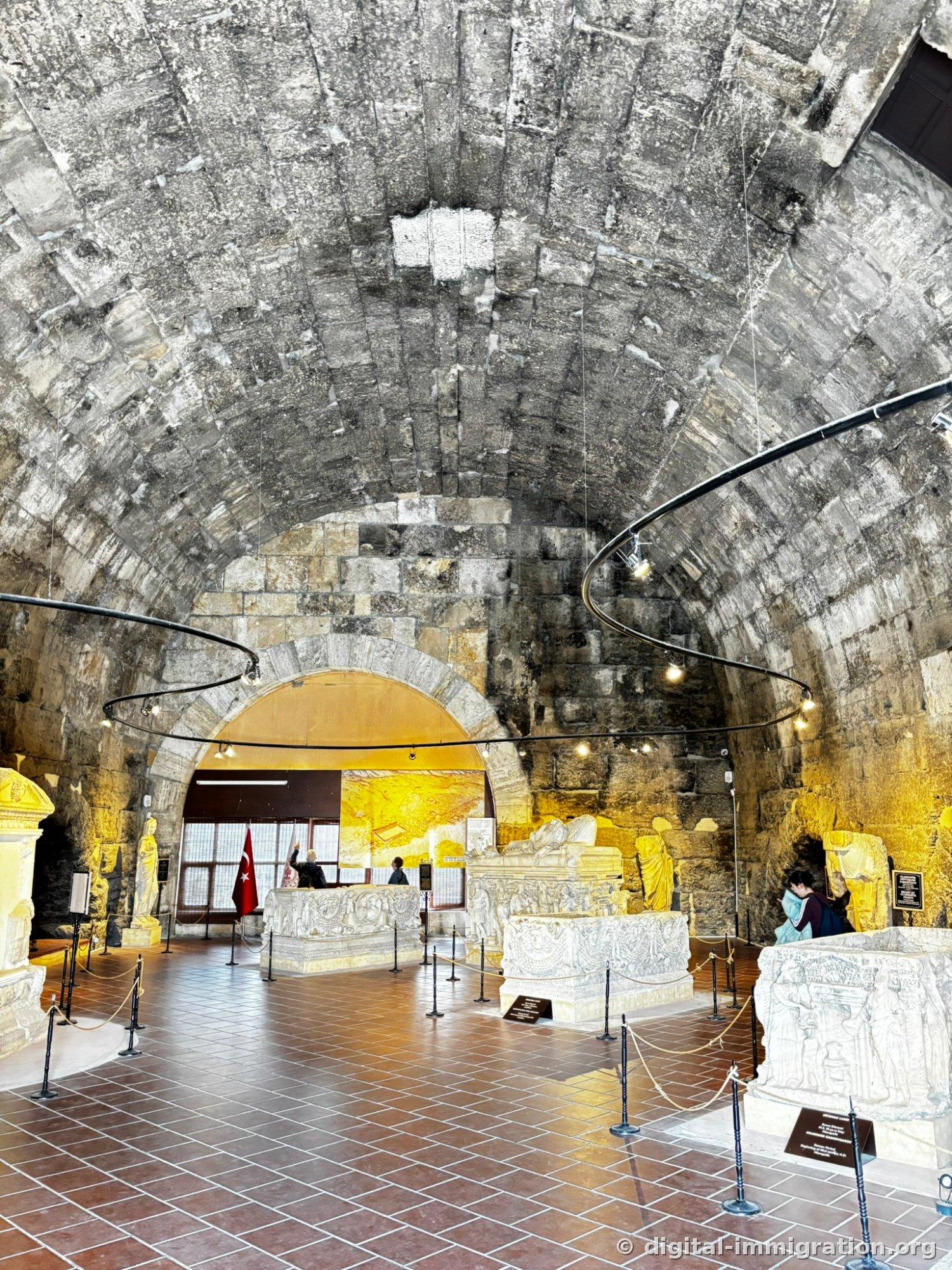
When I visited on an overcast winter day, the indoor space was noticeably cool. The massive stone absorbs heat, making it feel colder than outside. If you enter straight from the Pamukkale hot springs while still wet, it's quite chilly — bringing an outer layer is advisable. On the flip side, during summer afternoons, this thick stone wall offers unbeatable shelter from the heat. The lighting uses spotlights on the artifacts, creating strong contrast. Photos taken on a phone tend to get crushed shadows, so I found it better to dial down exposure by one step for better results.
The Sarcophagus Hall — This Is the Heart of the Museum
If you had to sum this museum up in one sentence, it's "a sarcophagus museum." Hierapolis attracted people seeking thermal spring treatments in antiquity, and many who came to heal ended up dying here, leaving behind a vast necropolis outside the city. The contents of those tombs are gathered in this hall.
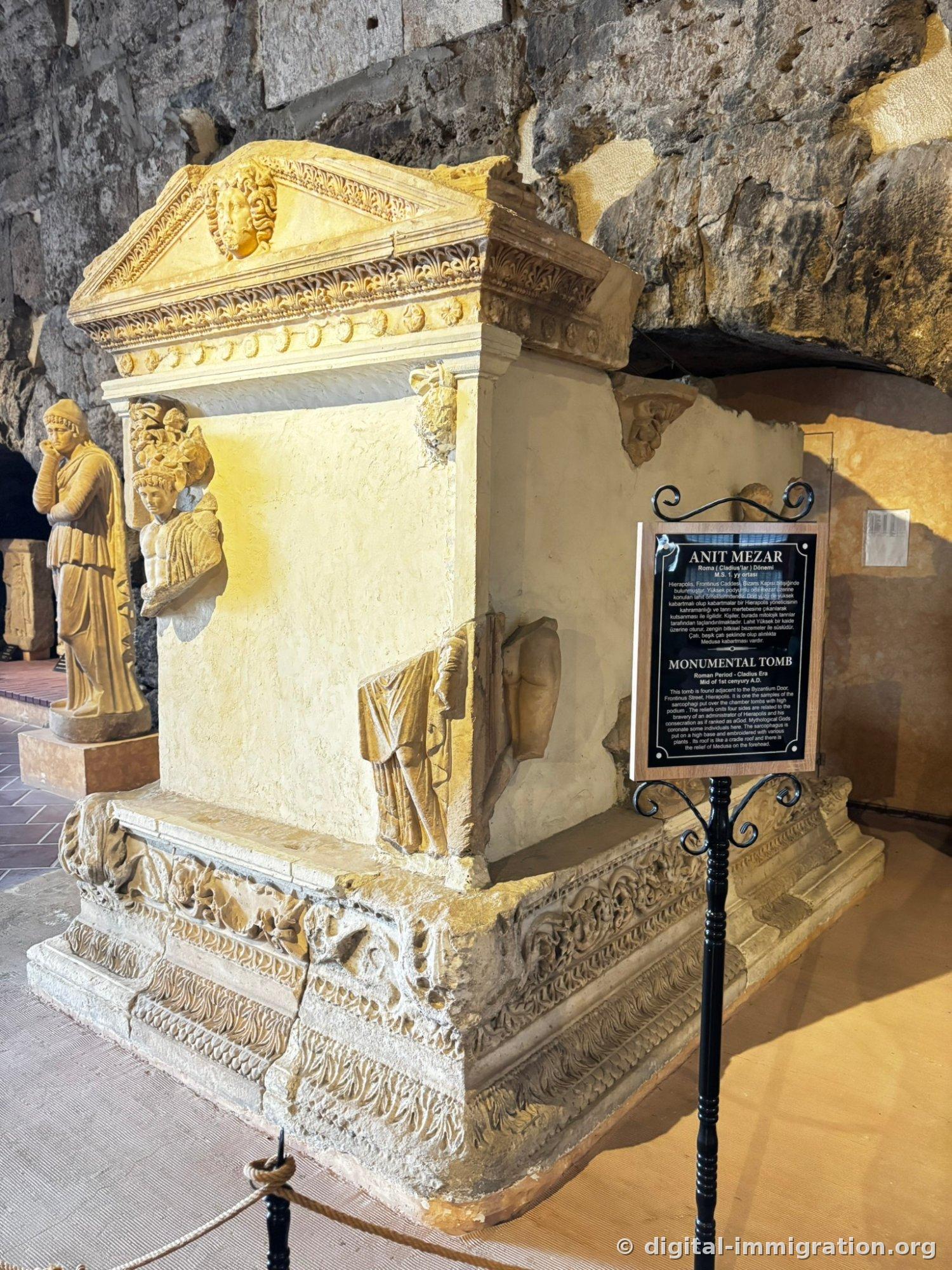
According to the information placard, this came from the Frontinus Street area of Hierapolis, near the Byzantium Gate. The barrel-vault-style lid, the high foundation, and the plant motifs framing all four sides indicate this was the tomb of a high-ranking city official. In the photograph it's impressive, but standing before the actual piece, it towers well above human height. It was hard to grasp that this massive structure was built as a tomb.
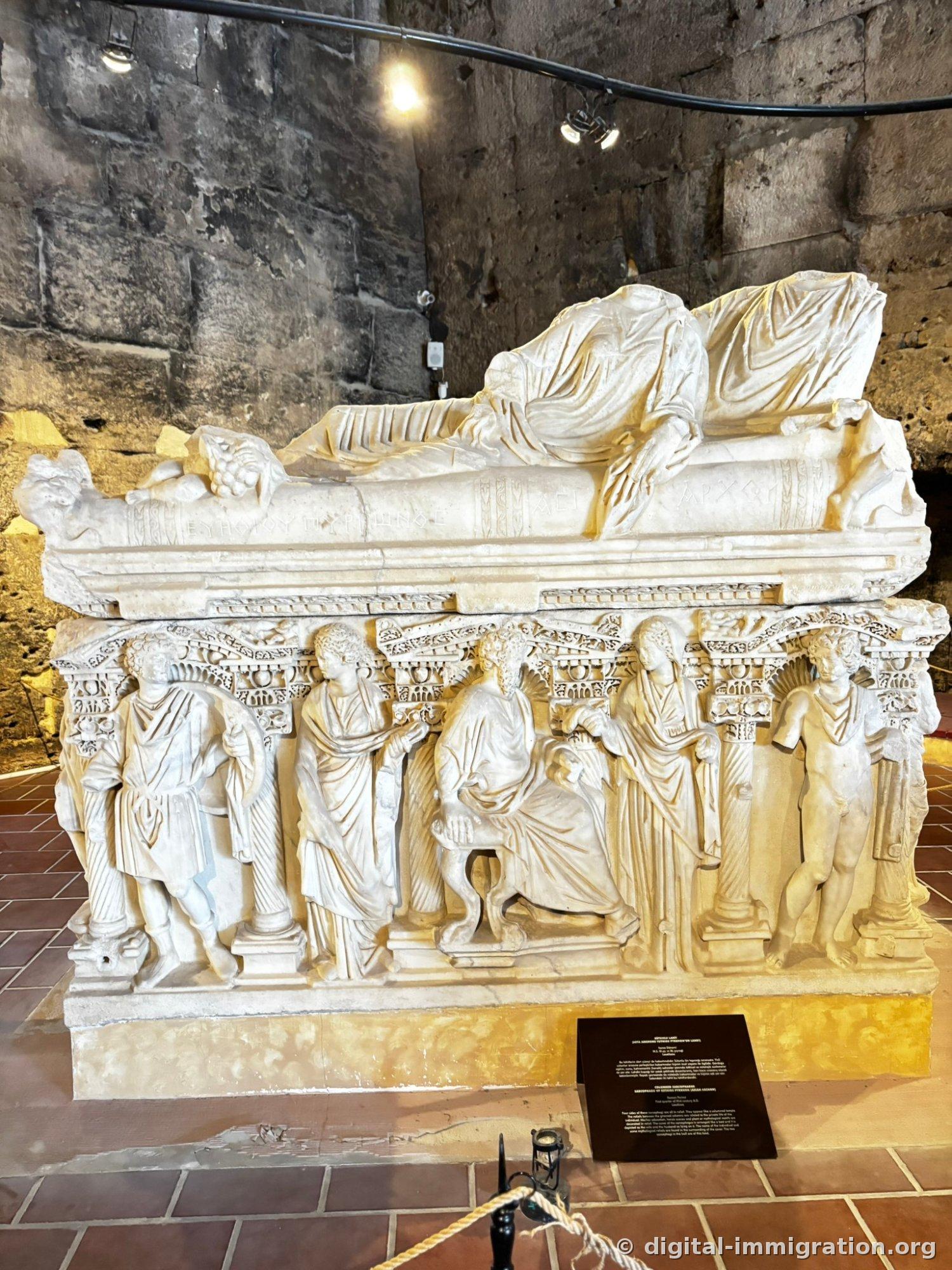
I lingered the longest at this sarcophagus. The heads of the two figures on the lid are broken away, yet the drapery of their clothing and their arms, along with the grape cluster held by one figure, remain vivid. The convention was to carve the deceased not as if sleeping, but as if reclining at a banquet. The relief figures on the body have varied hand gestures, so walking around the rope boundary to view each one from the side reveals different expressions for each figure.
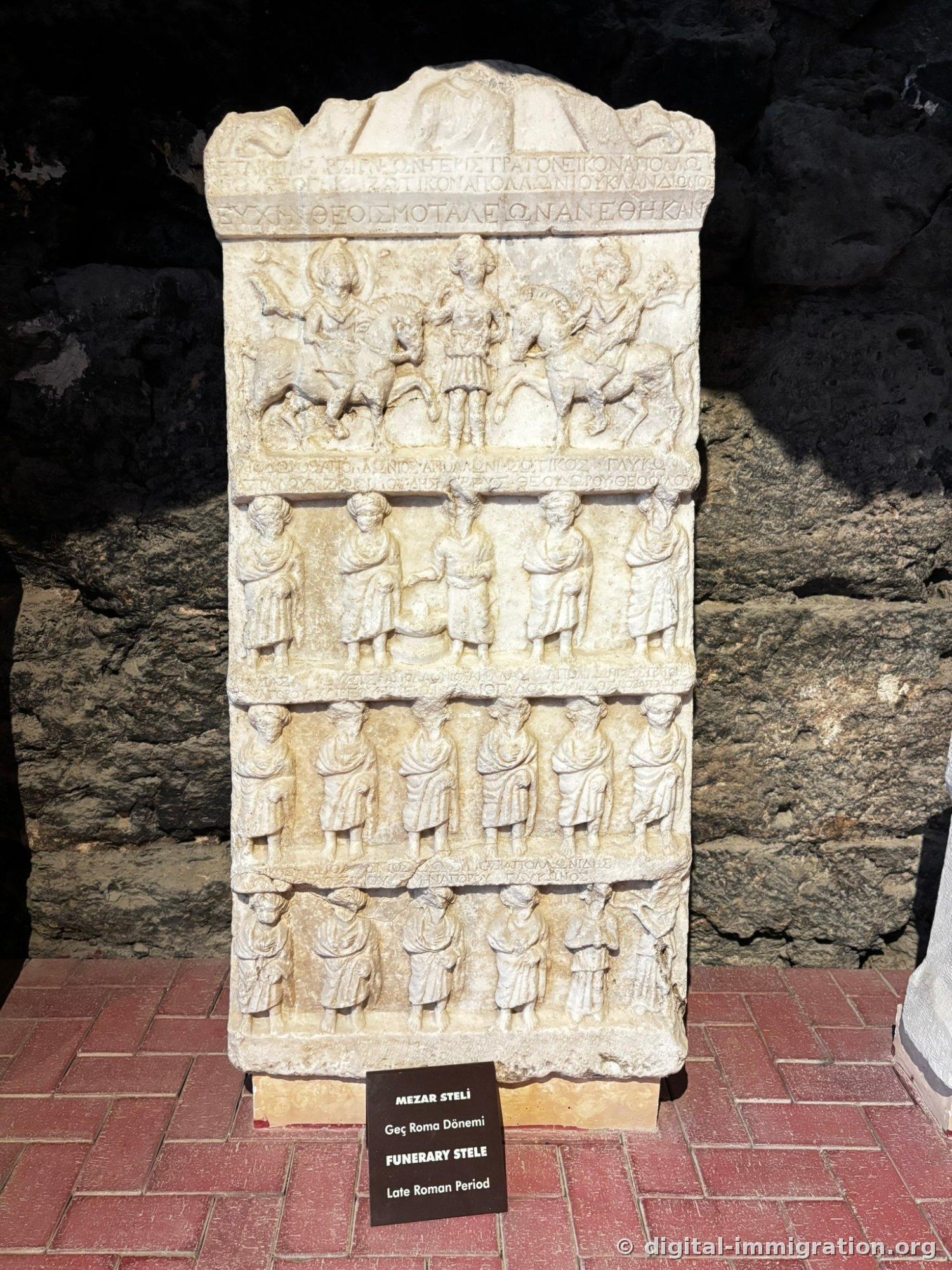
This stele was personally the most compelling to me. Each tier contains a single line of Greek inscription, arranged as names passed down through generations of a single family. The equestrian figures at the top are carved larger, while figures below grow smaller and more densely packed. I can't read Greek, so I won't pretend to transcribe the inscription content — but even without reading the letters, you sense the family's obsession with immortalizing their names in stone.
Gods from the Theater — Hades and Persephone
Moving deeper into the hall, sculptures that once decorated the stage building of the Hierapolis Theater (Tiyatro) are gathered here. This section becomes far more rewarding when you pair it with the outdoor ruins. Climb up to the theater above, and you'll see the stage wall is gutted—these are the pieces that were embedded there.
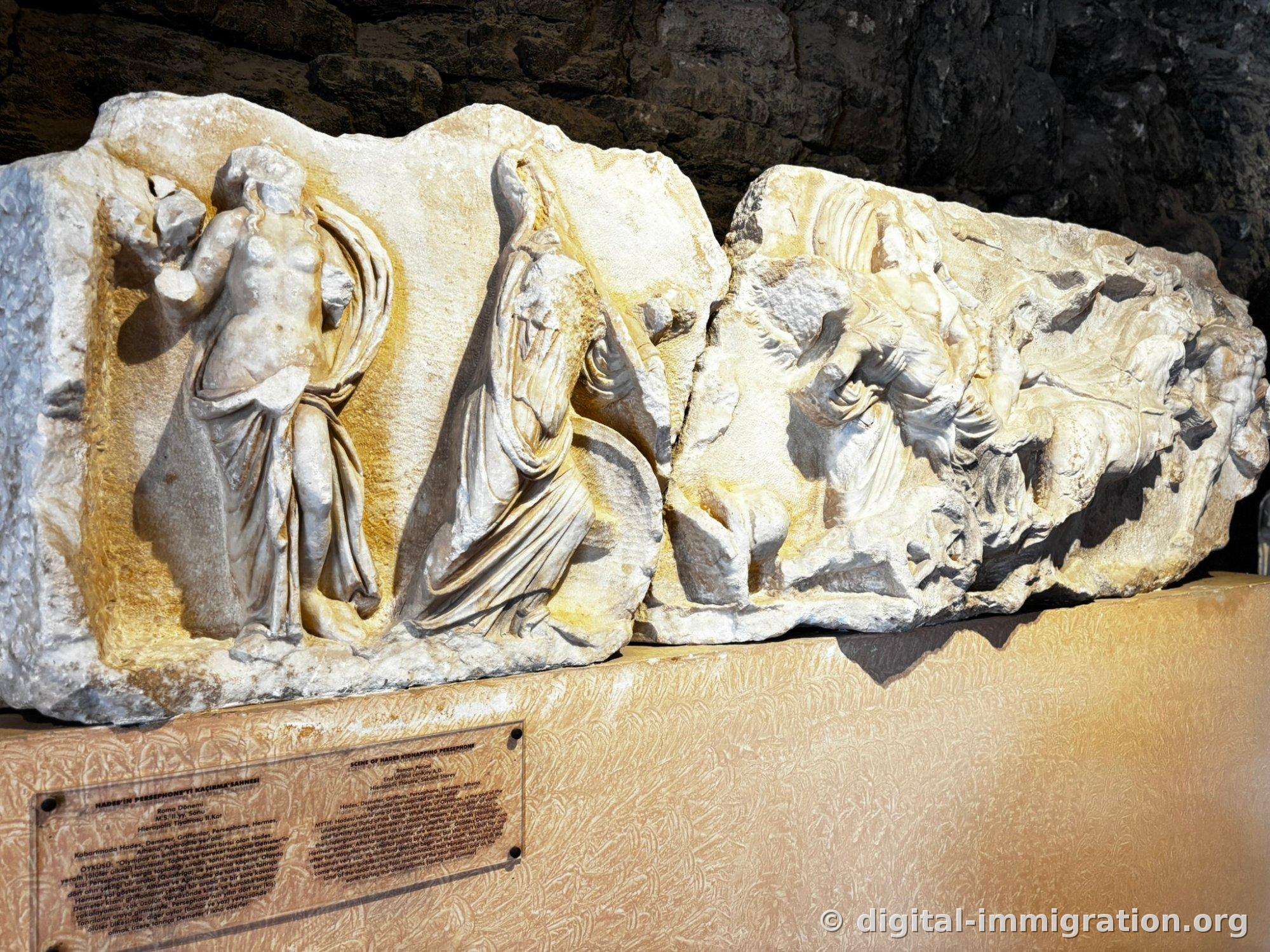
The horses tangled up and bolting toward the right are especially alive. Though the stone is broken and the form half-effaced, the fractured surface actually reads as motion. One detail worth noting: Hierapolis actually possesses a real Ploutonion (Plutonium), a sulfurous gas grotto dedicated to Hades, god of the underworld. The city inscribing tales of the god of the depths on its theater walls didn't feel coincidental.
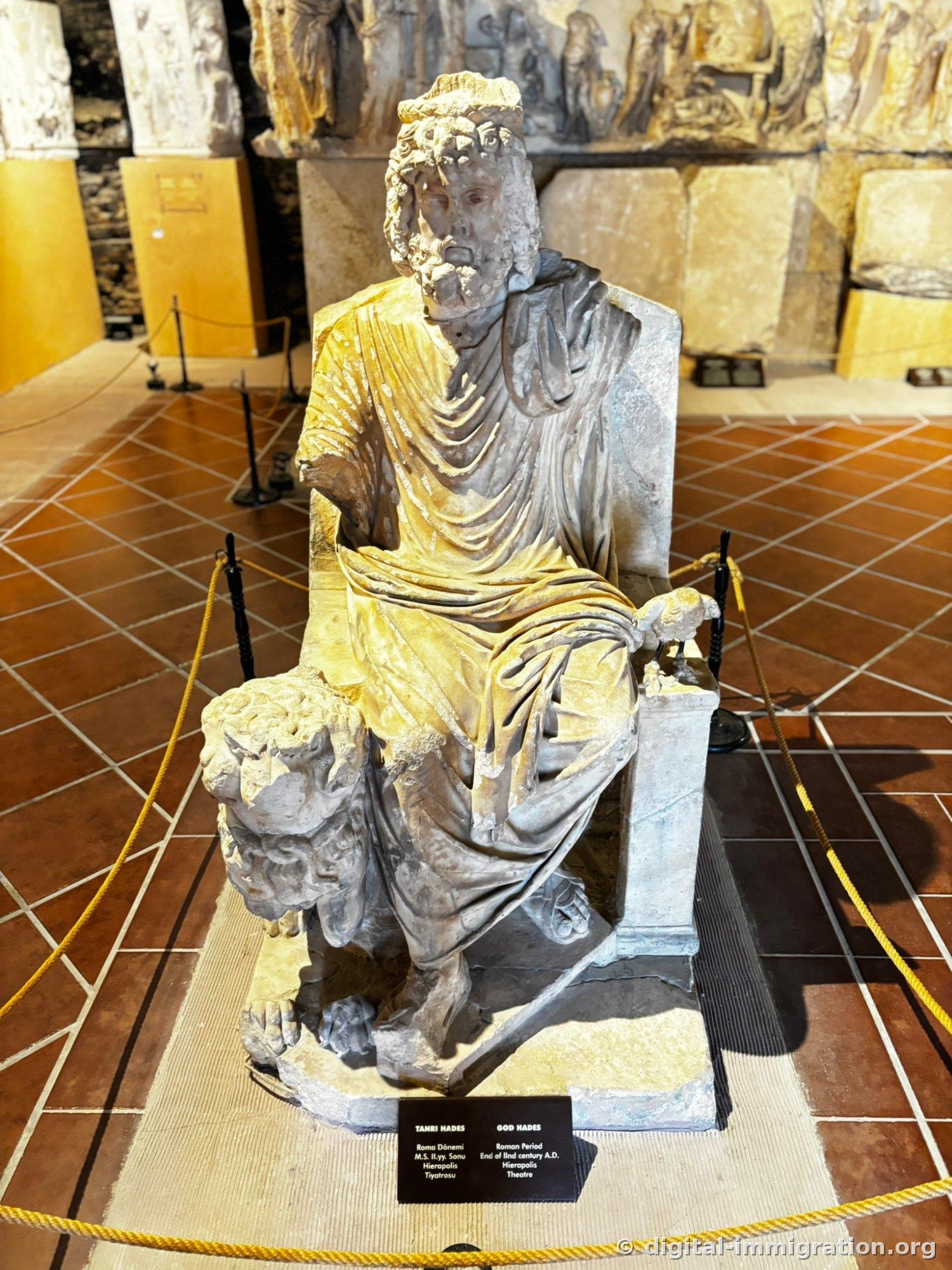
This statue is roped off on all sides, and the face is severely damaged. Yet the drapery flowing from the knees remains nearly untouched, so despite the missing face, the seated figure's weight and presence come through entirely. Don't miss the small bird perched on the right pedestal — it's barely visible from below, and only comes into view when you step back and adjust your eye level.
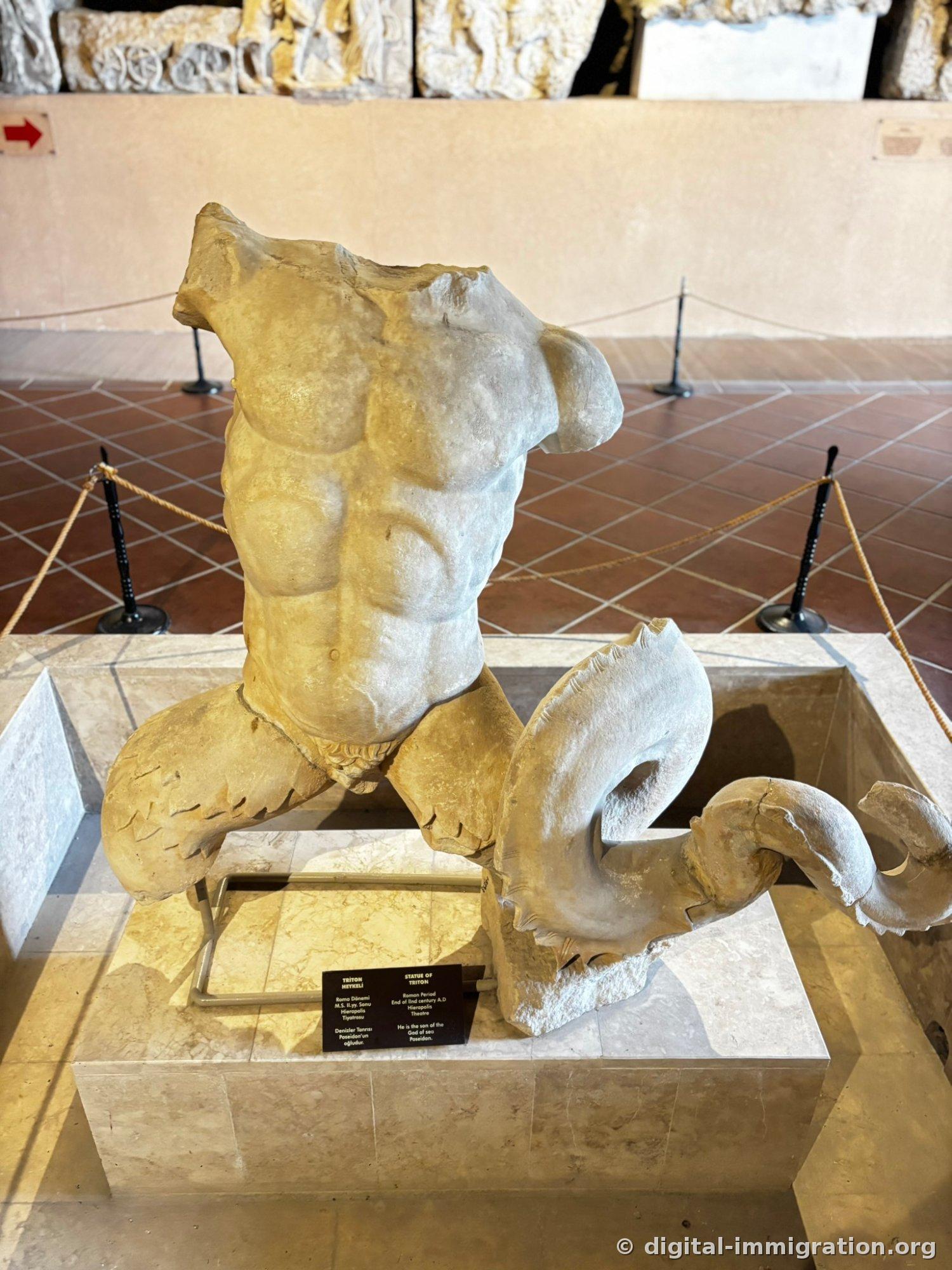
Head and arms gone, yet only the musculature and ribcage remain, making the abdominal muscles stand out even more. The forked tail splays wide to either side, filling the pedestal, so to photograph this piece you need to step quite far back. I initially shot from too close and had the tail cut off, so I had to reshoot.
The Named Ones — Goddesses, Women, and a Public Health Official
Beyond the theater sculpture section, life-sized portrait statues line a brick corridor. I read every single name placard here, and it was worth the effort.
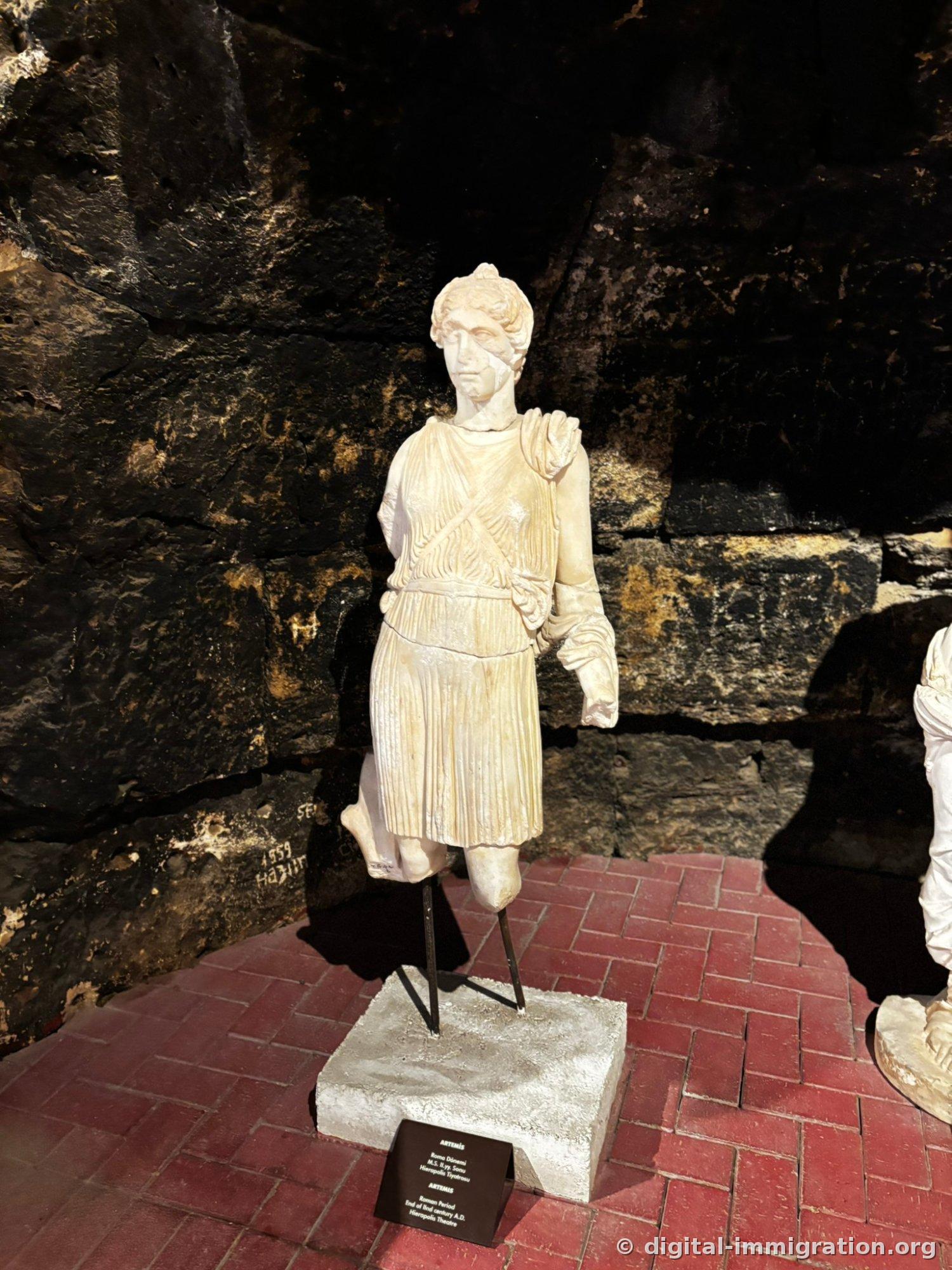
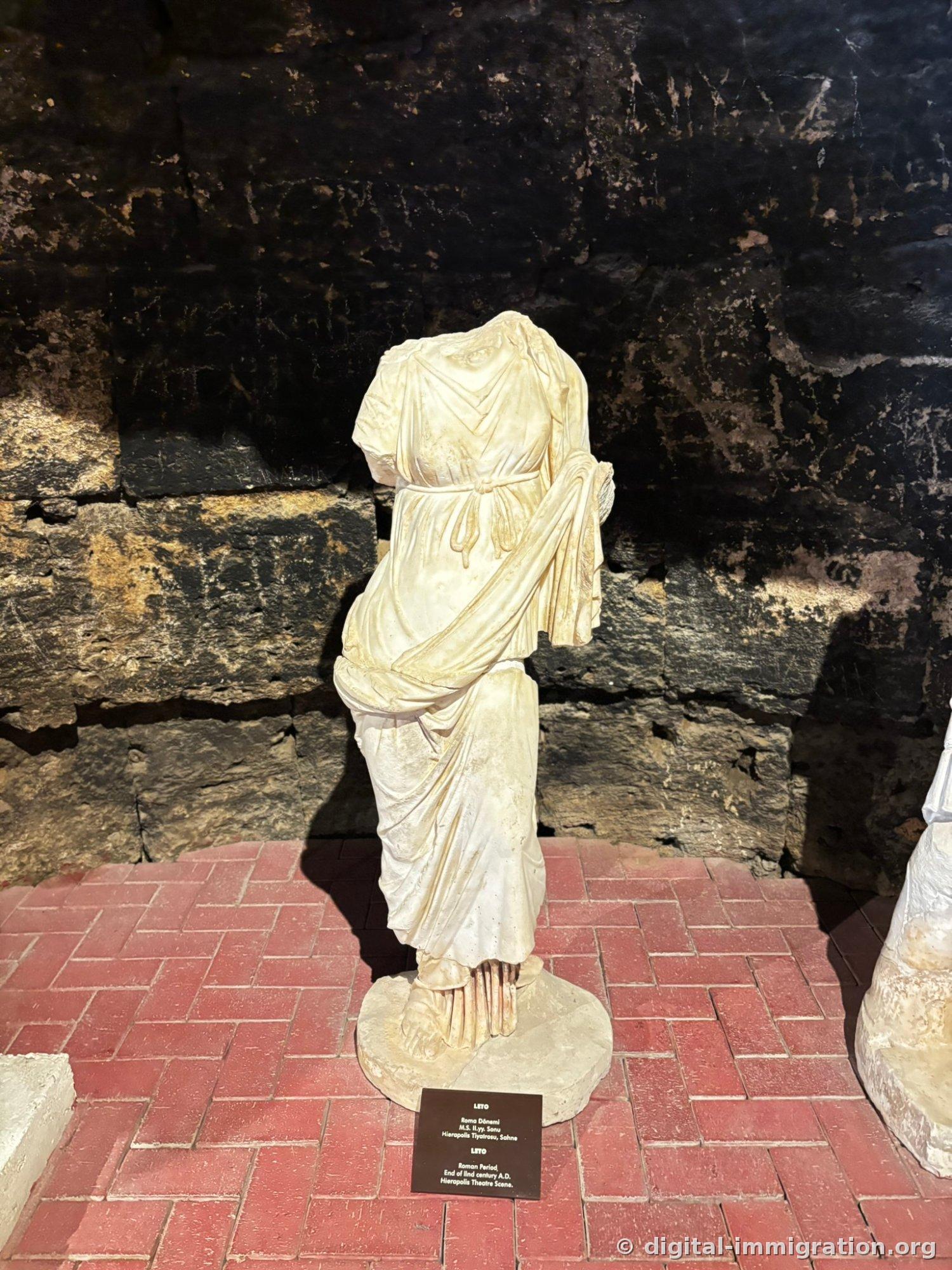
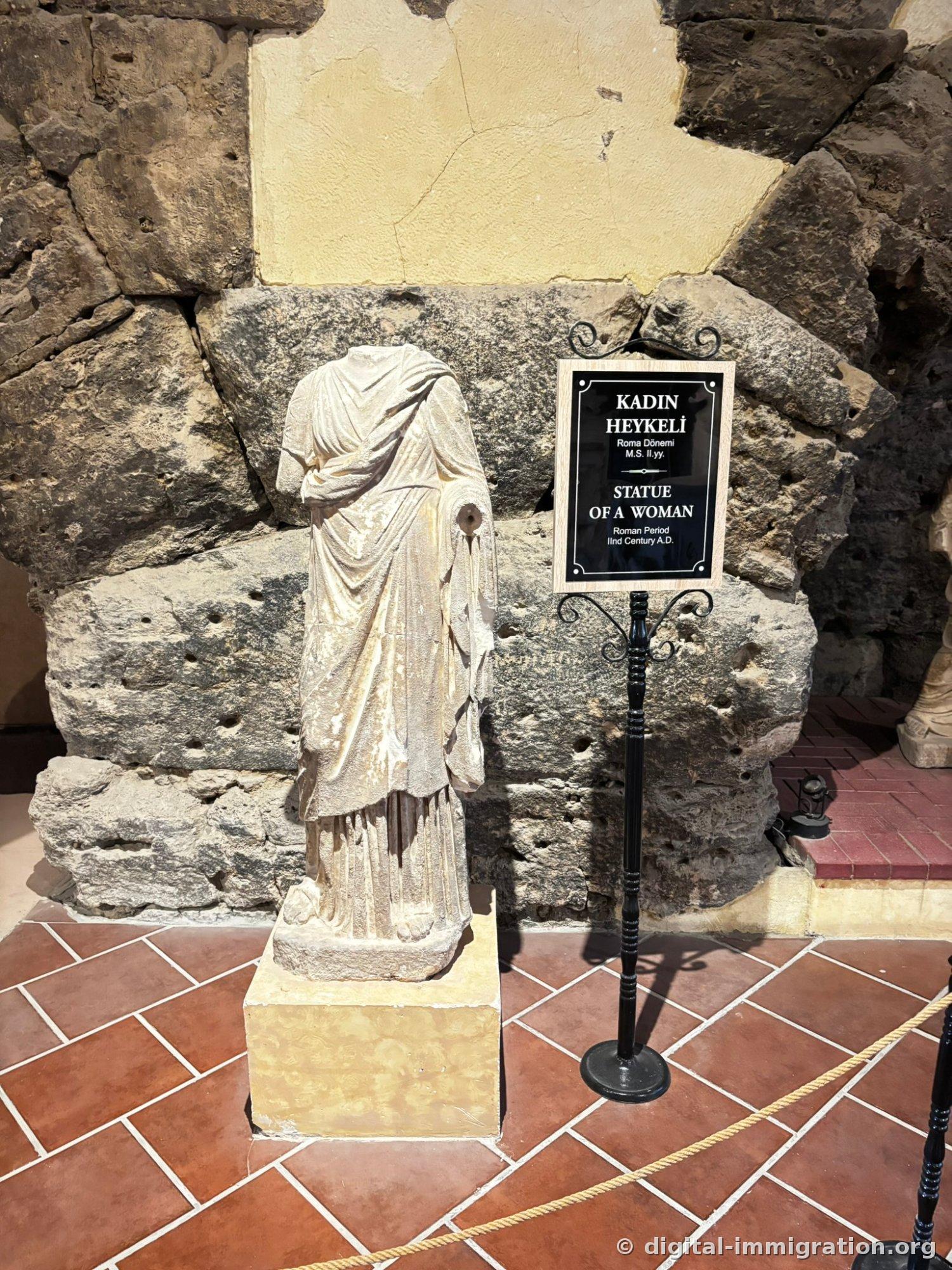
The placard reading simply "statue of a woman" stuck with me more than I expected. Leto and Artemis beside her have names, but this figure is just a woman. Yet the sculptural quality is no less refined.
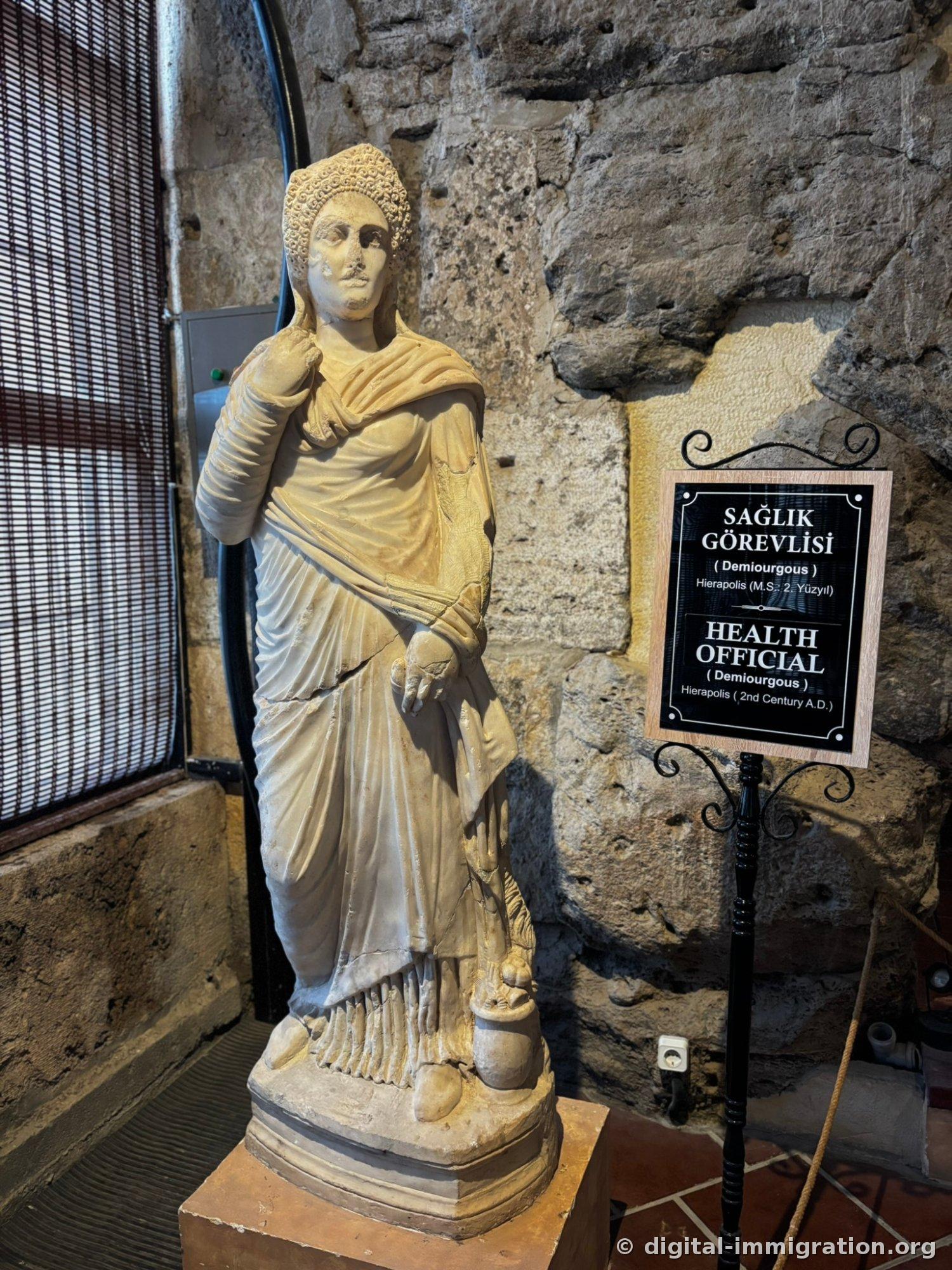
This statue bears perhaps the most intriguing placard in the entire museum. Not a god, not an emperor, but the city's public health official. A city that thrived on hot springs built a full-length portrait statue of the person in charge of health administration. Though the face is abraded at the nose, each individual curl of the crown he wears is crisply rendered. However, this sculpture stands in a corner of the corridor with exposed wiring and an outlet visible directly behind it — an unfortunate display choice that inevitably appears in photographs.
Outdoor Passages and Location — In the Heart of the Ruins
The museum sits within the Hierapolis ruins, in the southern Roman bathhouse complex. Enter from the South Gate on the Pamukkale village side and follow the travertine upslope, and you'll naturally pass by it. It's within walking distance of the amphitheater and Cleopatra's Pool. Think of it not as a standalone building but as one waypoint along an archaeological exploration route. The hilly terrain means there are elevation changes, so athletic shoes beat sandals.
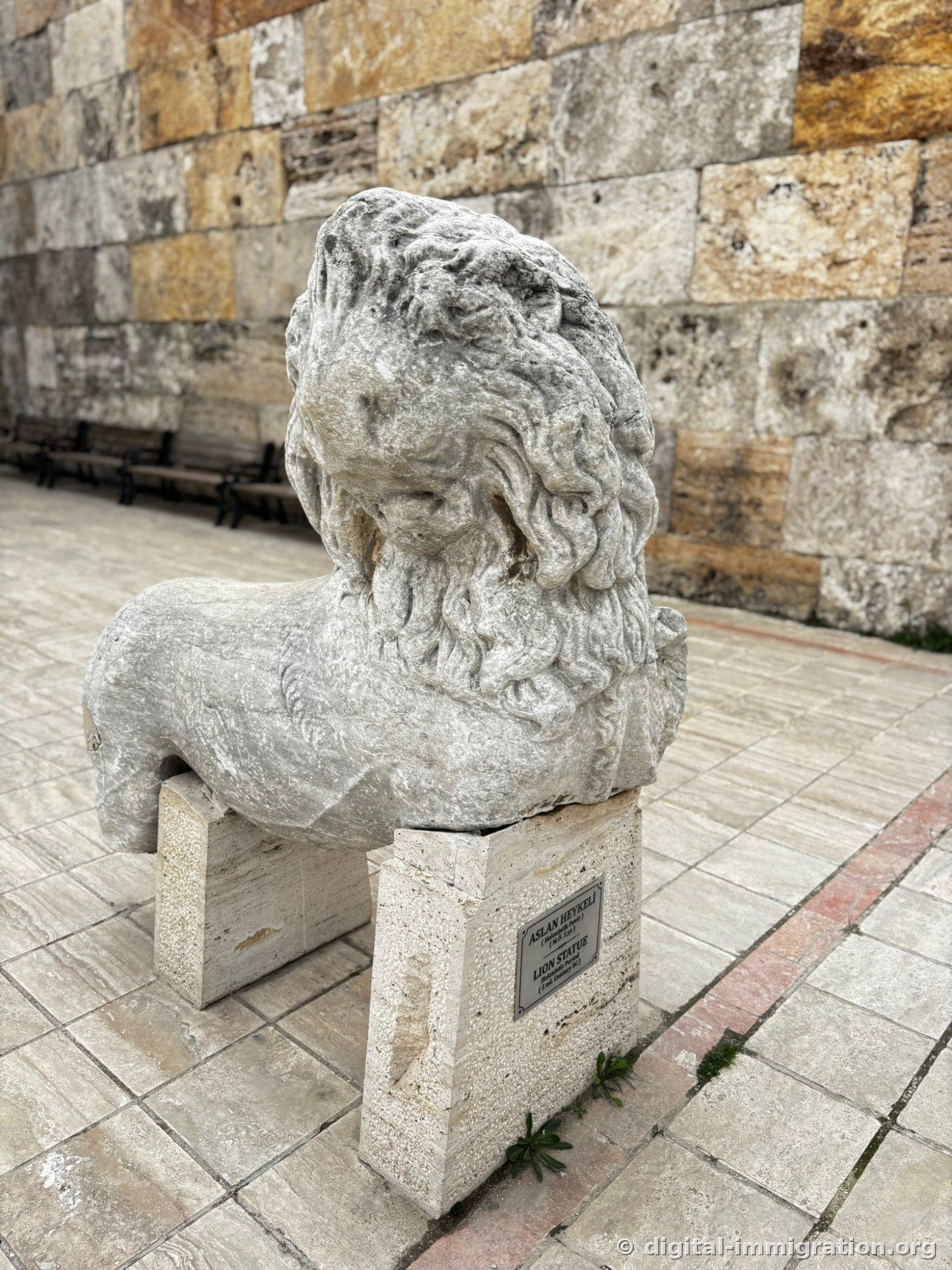
You'll miss this if you only see the indoor galleries. A few pieces sit casually along the outdoor passage beside the building, including this lion. Each mane hair is rendered individually, and unlike most of the indoor artifacts, which are Roman-era, this is from an earlier Hellenistic period. Exposed to the elements, weeds creep up through cracks in the pedestal, and the surface shows noticeably more weathering than the protected indoor pieces. The contrast lingered with me.
Practical Information That Actually Helps
- Reverse the typical order. Most people do travertine → theater → museum, but if you visit the museum before the theater, the empty spaces on the stage wall take on meaning. The Hades, Triton, and Persephone reliefs all came from that theater.
- Temperature. The thick stone structure stays cool in winter and refreshing in summer. If you enter still wet from the hot springs, it can feel cold.
- Time needed. About an hour if you read each placard carefully. Twenty minutes if you rush through. But this is a placard-reading museum—if you make it a 20-minute visit, there's no point going in.
- Photography. The strong spotlight contrast tends to blow out white marble on auto-exposure. Dial down your exposure compensation and reshoot.
- Verify details. Admission fees, opening hours, and whether the site pass includes this museum all vary seasonally. Check on site.
There are frustrations, admittedly. Wayfinding is weak, so you're unsure where to start or end; English descriptions are minimal summaries. Wiring and outlets are left fully exposed behind several sculptures — unfortunate display decisions that always sneak into photos. Yet I know I'd visit again if I returned. The white hillside seen from outside seemed merely a beautiful geological formation, but beneath this cool barrel vault, surrounded by sarcophagi, I realized it was a city where people came seeking healing and ended up buried. That understanding only arrived here.
Read next
- Boiling Shin Ramyeon Black on the Hill in Front of Zemi Hotel Cappadocia in Göreme in February
Summer is peak season in Cappadocia's Göreme. I went in February. Morning temperatures drop below freezing, and there's a thin layer of white powder—frost or light snow—along the r…
Göreme - An Afternoon at Yuvam Shisha Nargile Kafe Overlooking the Harbor from the Cliffs Above Antalya's Kaleiçi
Kaleiçi, the old town within the walls of Antalya, Turkey, is a maze of narrow streets tucked inside ancient ramparts. When you first arrive, you can't quite tell where the sea is.…
Antalya · Yuvam Shisha Nargile Kafe - Antalya's Kaleici Yacht Harbor — One Day Viewing the Harbor Below the City Walls from Three Different Angles
In Antalya's old town of Kaleici (Kaleiçi), Turkey, the city walls remain intact atop a cliff, and beneath that cliff lies an entire yacht harbor. On a map it looks like 'one harbo…
Antalya · Yuvam