Genting Highlands Chin Swee Caves Temple — The 9-Tiered Pagoda, the Path to Hell, and the Giant Buddha on the Mountainside
Malaysia's Genting Highlands is typically remembered for its cable car, casino, and indoor theme park. But halfway up the mountain road to the summit, at a height where clouds gath…
Genting Highlands · Chinsuwi Cave Temple
Malaysia's Genting Highlands is typically remembered for its cable car, casino, and indoor theme park. But halfway up the mountain road to the summit, at a height where clouds gather, there is one space that stands out most distinctly and leaves the deepest impression on the entire mountain. It's the Chin Swee Caves Temple (清水岩廟, Chin Swee Caves Temple). I went up in the morning and ended up staying for more than two hours, and when I left, I thought this was the best thing I had seen in Genting that day.
As soon as you arrive and step out of the car, what catches your eye is the 9-tiered pagoda. Red columns with orange tiles, topped with a golden spire. Standing right next to the parking lot, at first it's hard to grasp its size, but when you see people standing on the railings at each level, then the scale becomes clear.
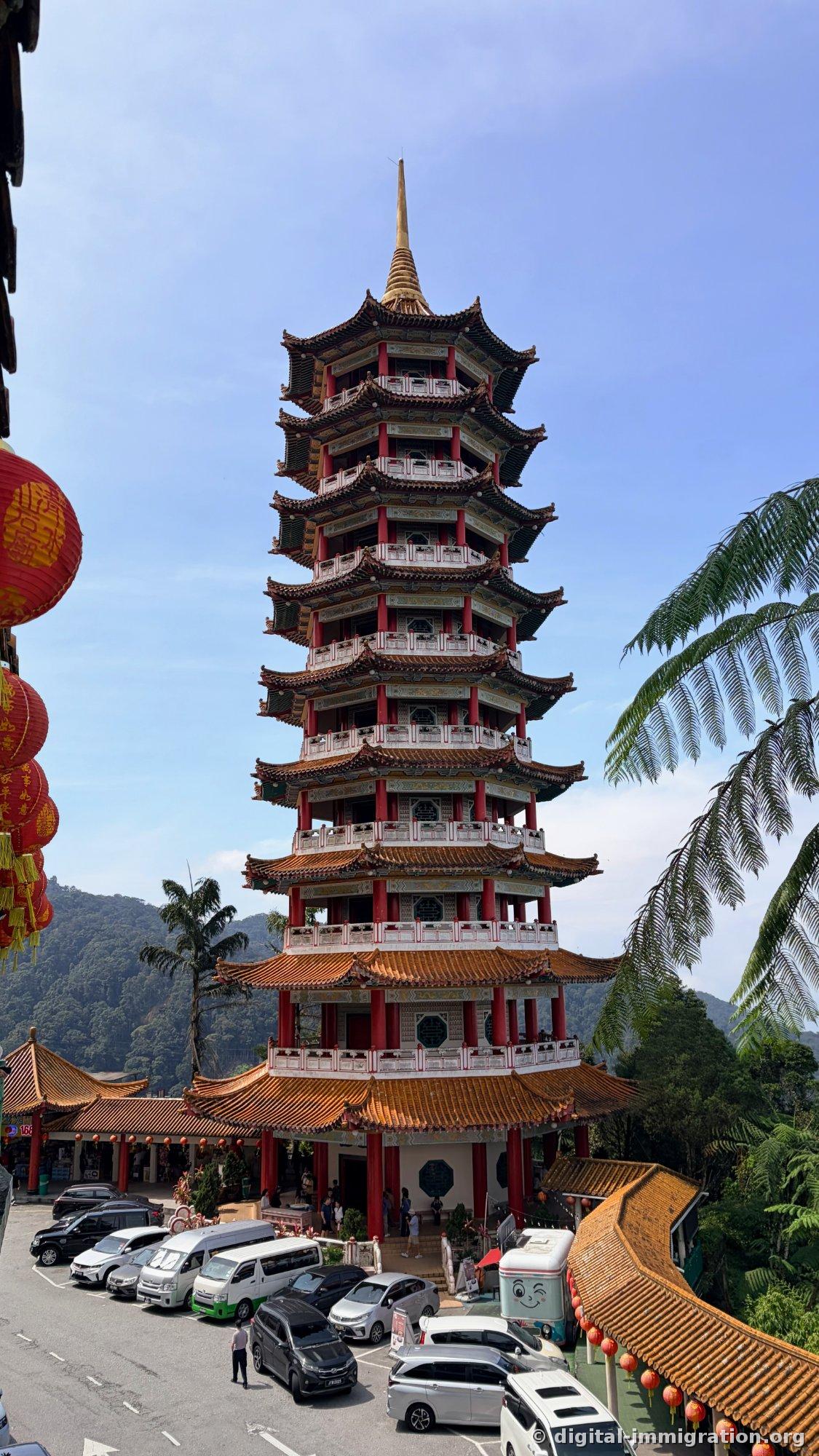
The Towering Pagoda — You Can Climb Each Level
This is not a structure to view from the outside; rather, you enter it and climb via stairs. As you ascend the narrow spiral staircase level by level, each floor opens to a balcony with railings, and the walls are densely studded with enshrined Buddha statues. The stairs are narrow, so whenever people going up and down pass each other, they have to squeeze past one another. If you come on a weekend afternoon, congestion can occur here. If you have knee problems or claustrophobia, it's better to see just a few lower levels and come back down.
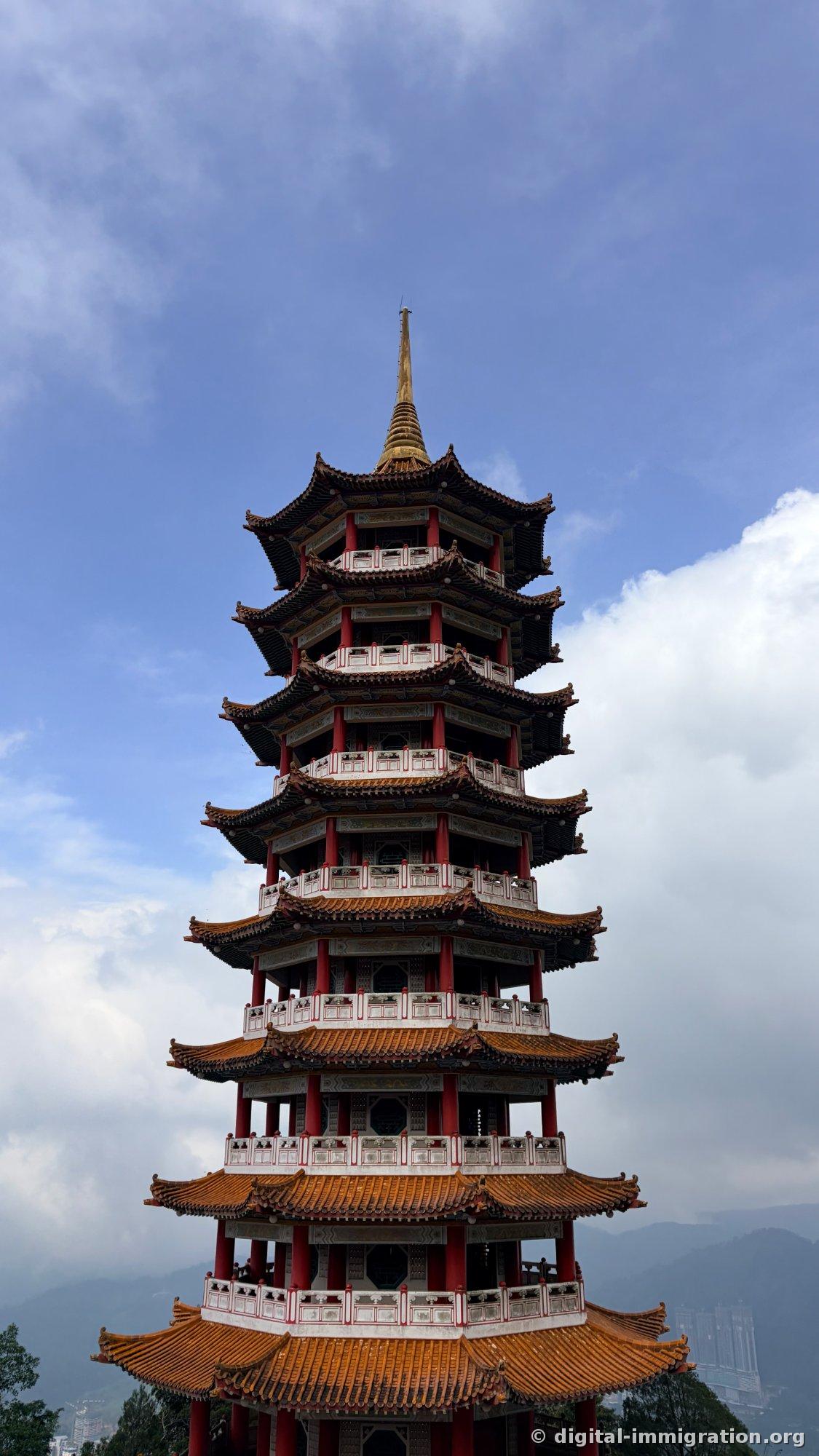
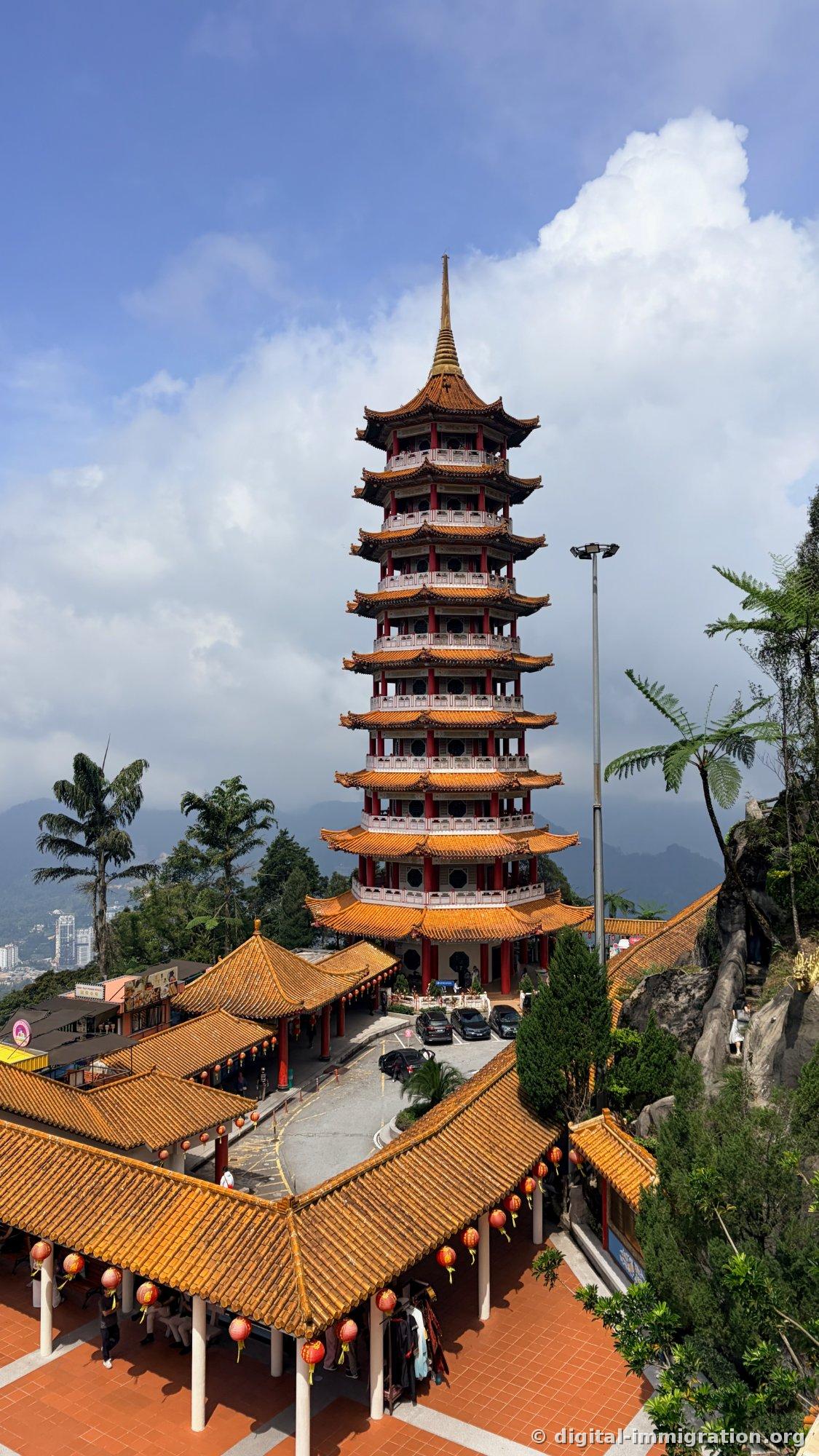
Once you've seen the pagoda and ascend to the upper terrace, the view completely changes. You now look down at the pagoda from above eye level—this is when the photos turn out best. The temple's orange tile roofs overlap in stair-step fashion, and beyond them, Genting's ridgeline extends.
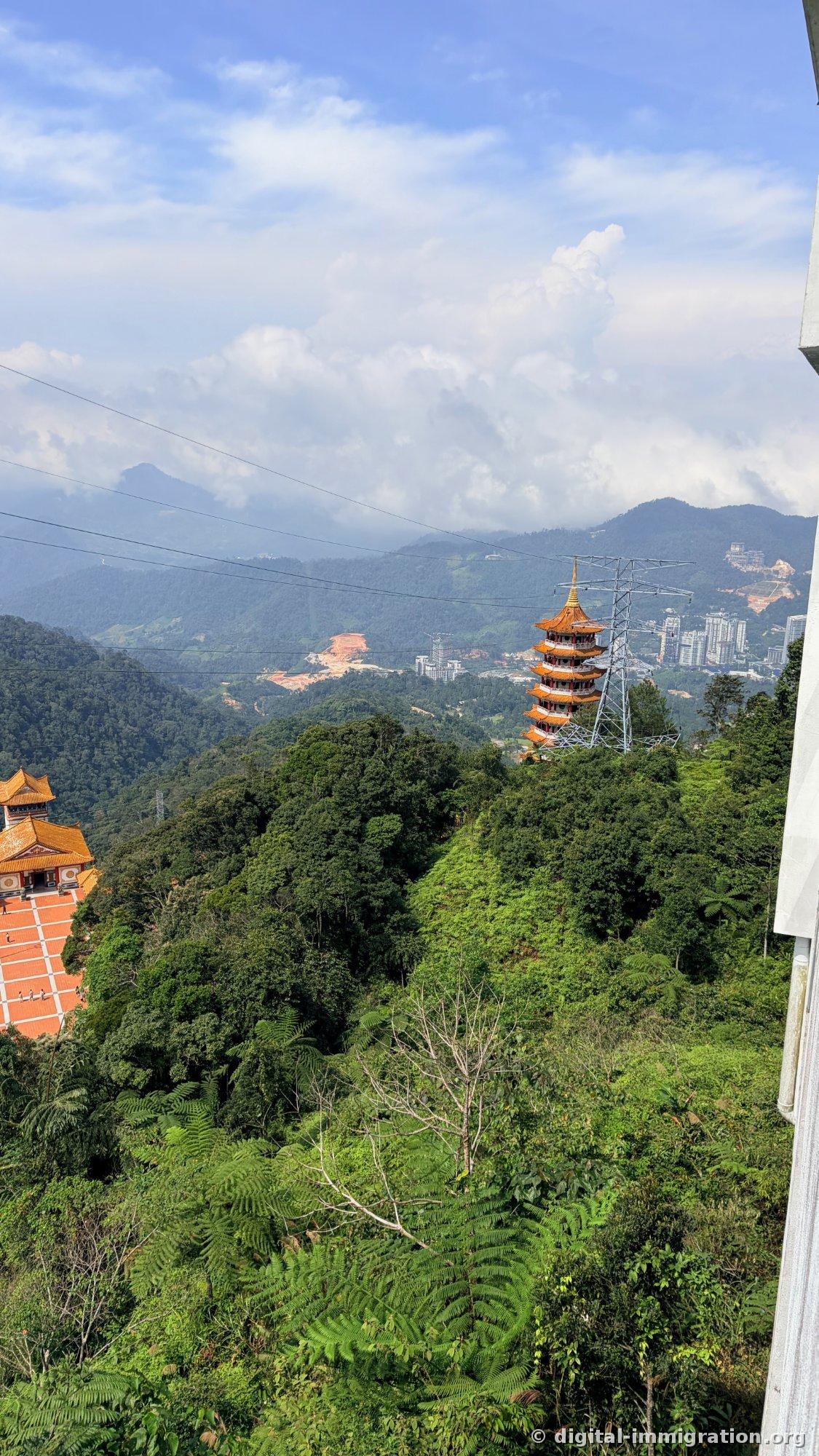
As you climb higher, the pagoda recedes as if on the far side of a ravine, and power transmission towers and wires enter the frame. This photo captures the place's more realistic appearance. The temple sits in the midst of a tropical rainforest, power lines run alongside it, and beyond the ridgeline, you can see red earth excavations under development and new high-rise apartments.
The Path to Hell After Death — The Temple's True Distinctive Feature
Up to this point, it's just a "Chinese temple in the mountains." What makes Chin Swee fundamentally different from other places is the presence of a corridor lined with life-sized sculptural dioramas depicting the process of being judged in the afterlife and dragged to hell after death. As you walk along the narrow path between rocks, each cave-like hollow is arranged with a scene.
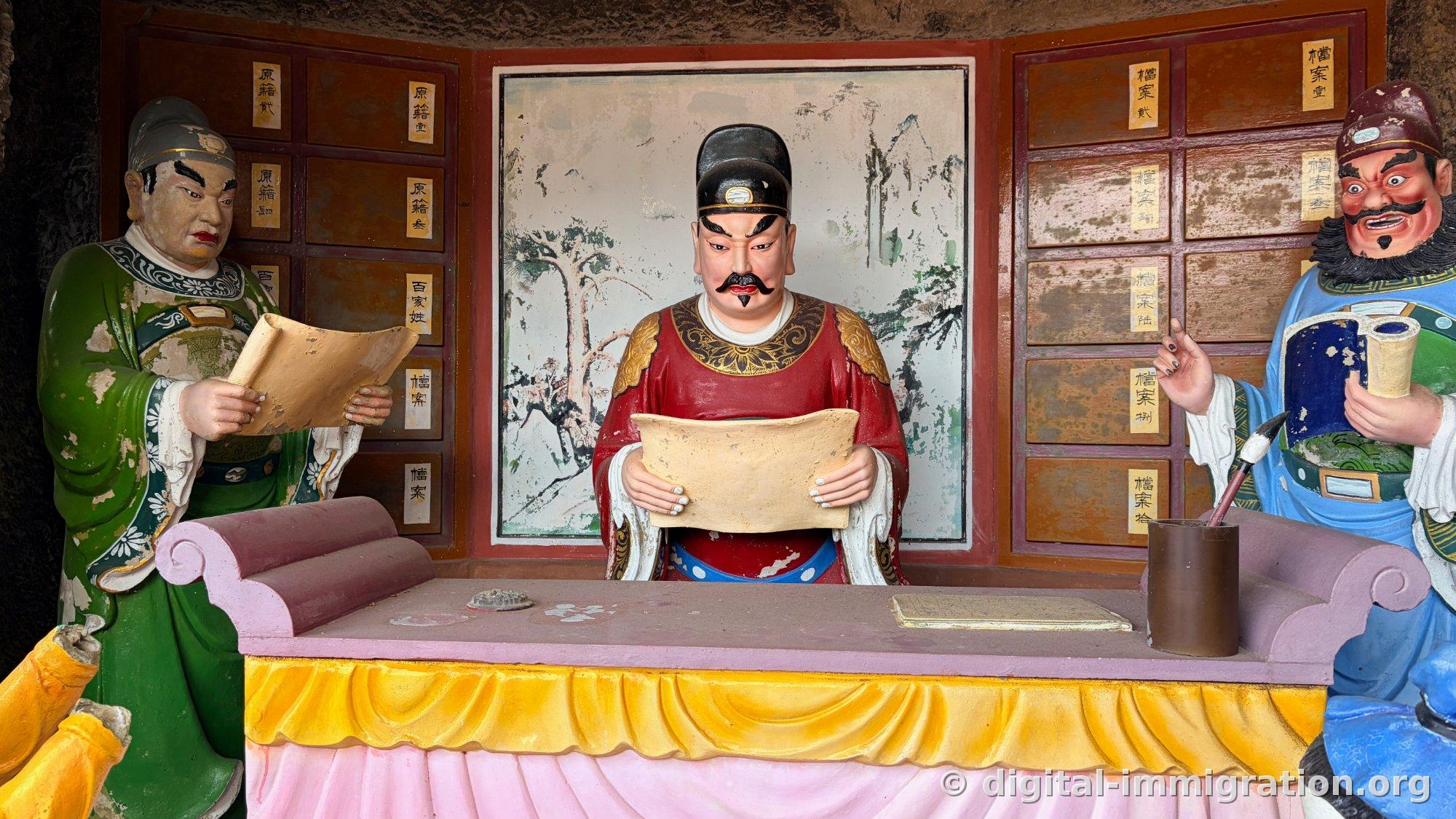
The entrance depicts a judgment scene. A magistrate wearing official robes unfolds a scroll and reads it, while officials on either side pull documents from filing boxes. What was striking was the labels on each wall drawer—'Original Household Registration,' 'Archives,' and similar inscriptions. It's portrayed like a government office managing people's records from their lives.
In the next chamber, a large plaque reads '善惡分明 (Good and Evil Clearly Divided),' and the pillars on either side bear inscriptions 'Good is Rewarded with Good' and 'Evil is Punished with Evil.' A green-faced court official stands holding a staff, and before him a prisoner kneels with bowed head. It's overtly didactic, and that's precisely why you end up standing and looking at it for a long time. I saw several families explaining something to their children here.
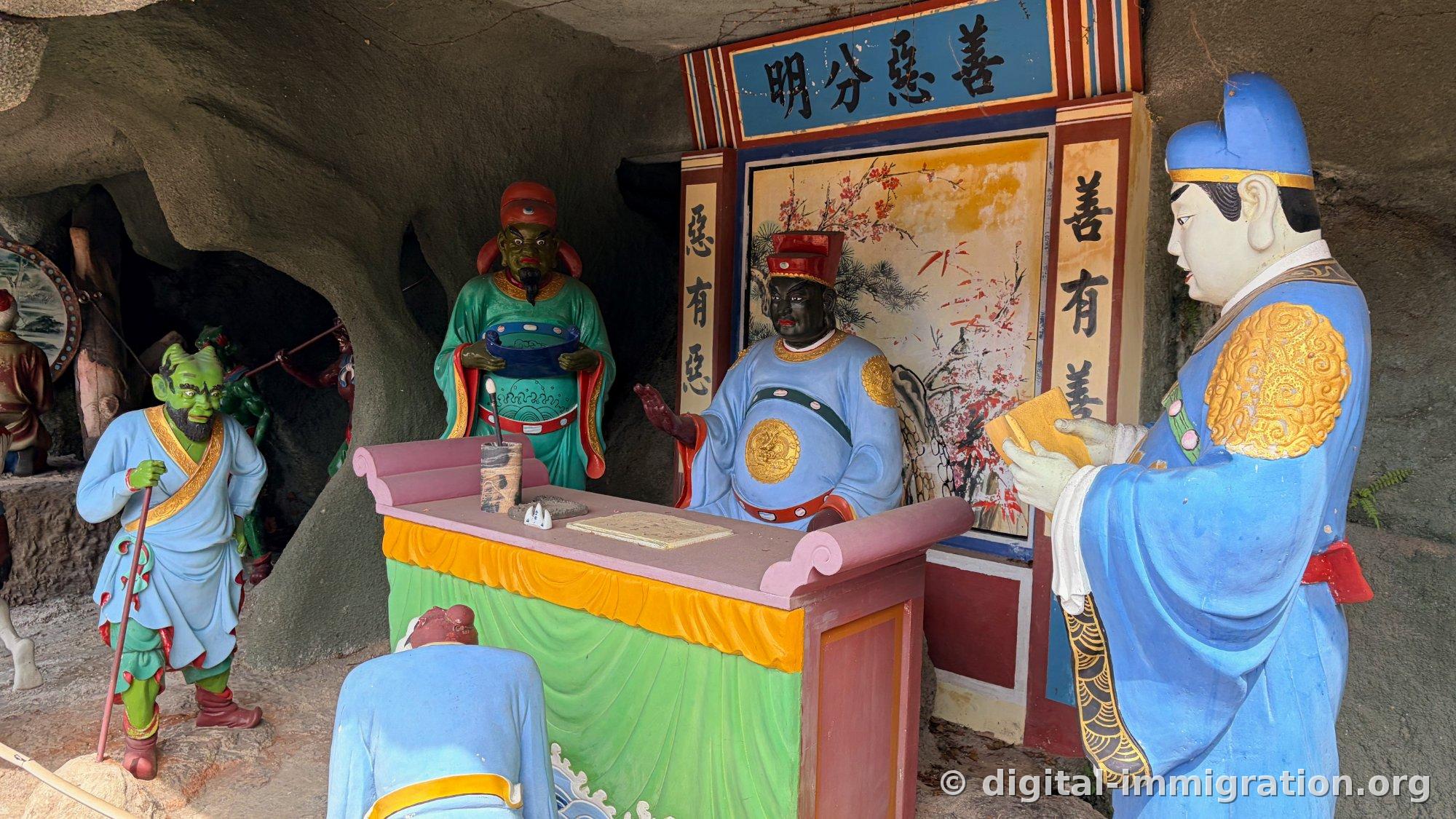
To be honest, the condition of the sculptures is not great. Paint is peeling, there are stains, and being outdoors, moss has accumulated in places. If you expect a well-maintained theme park, you'll be disappointed. Yet this deterioration is oddly effective. If the sculptures had been shiny and new, I don't think they would have remained as memorable.
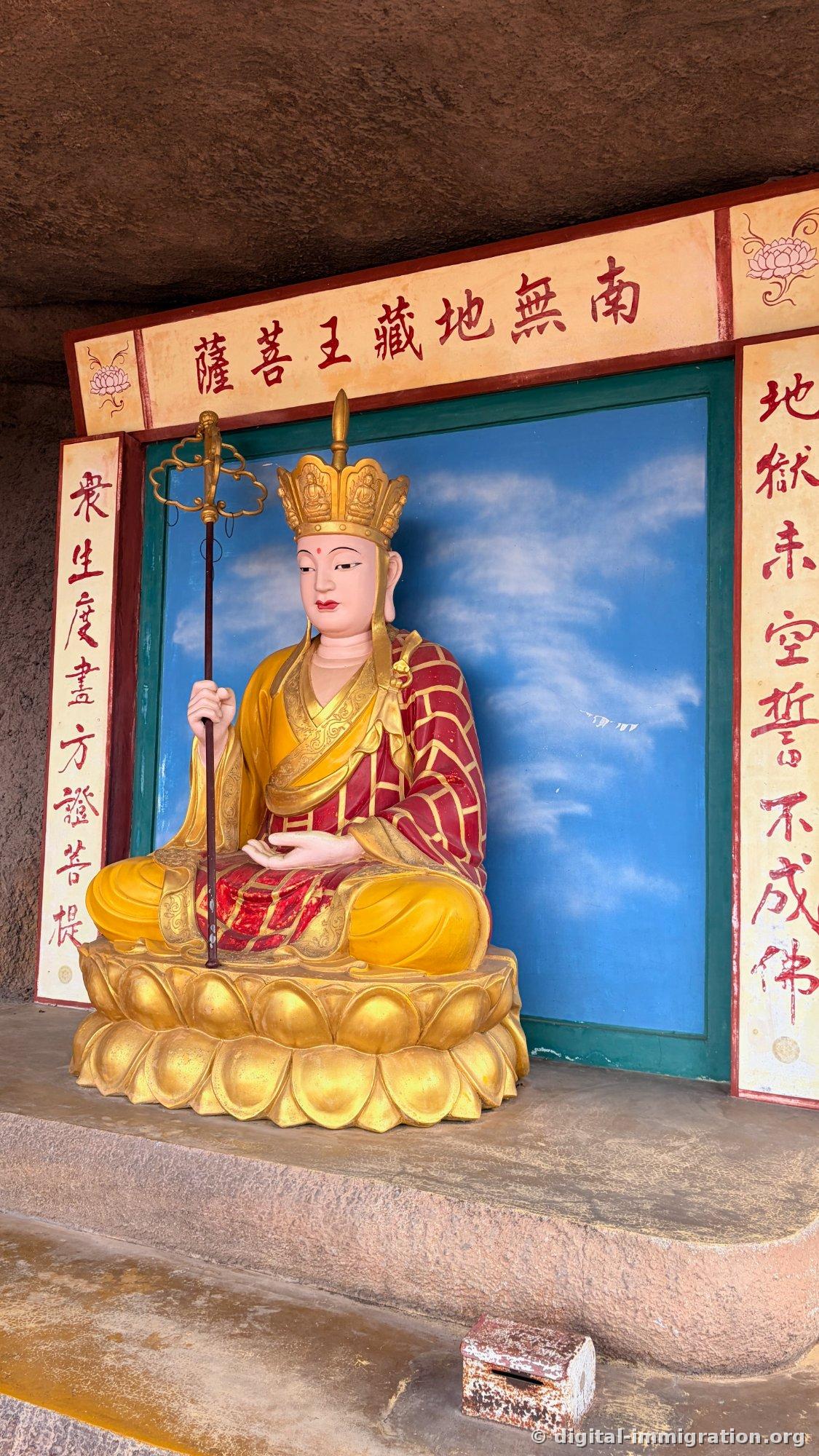
Toward the end of the hell path, a statue of Ksitigarbha Bodhisattva sits in a niche below the rocks. Below a plaque reading '南無地藏王菩薩 (Homage to Ksitigarbha Bodhisattva),' inscriptions on both pillars read I will not attain Buddhahood until hell is empty—a vow written vertically. After viewing all the hell scenes before this, reading this sentence reveals the arrangement's intention clearly. Rather than ending with fear, it concludes with salvation.
Apply for the Digital Arrival Card (MDAC)
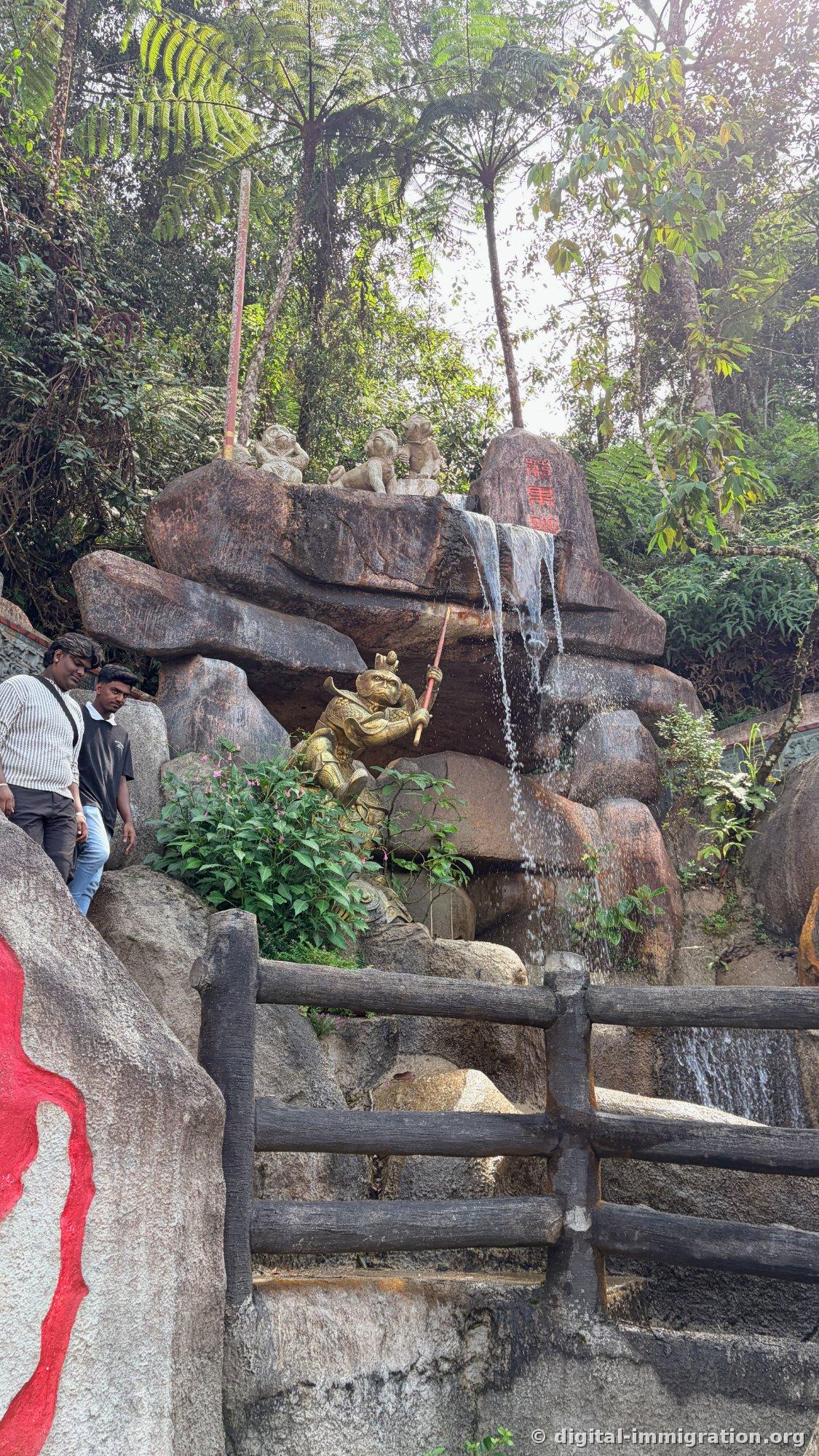
Midway through the path is also an artificial waterfall. Water cascades in two streams below a rock inscribed with red characters, and in front of it stands a golden statue wielding a spear, with monkey sculptures placed on the rocks above. It appeared to be a Journey to the West-style decoration, different in character from the hell scenes. Thanks to the sound of water, this section feels noticeably cooler.
The Colossal Buddha — This Is the Highlight
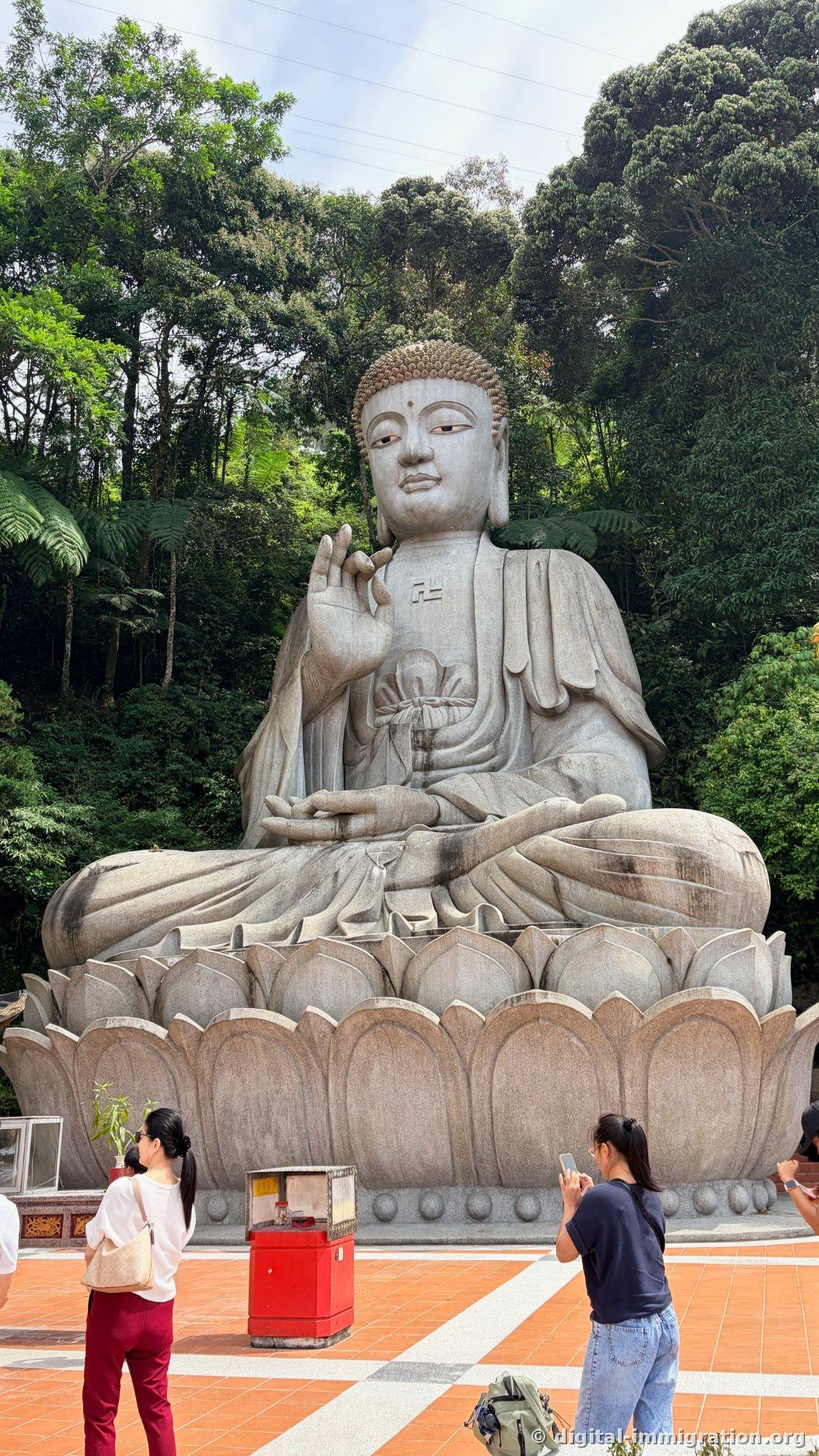
As you descend, an open plaza suddenly appears, revealing a colossal stone Buddha in seated meditation. This is where most photos are taken at this temple. Seated on a lotus platform with raised right hand in the teaching mudra, a swastika (卍) is carved on his chest. Behind him stretches an unbroken tropical rainforest, and above it, the condo towers at Genting's summit pierce through clouds. I've never seen elsewhere such a combination of Buddha, jungle, and ultra-high-rise building all in one frame.
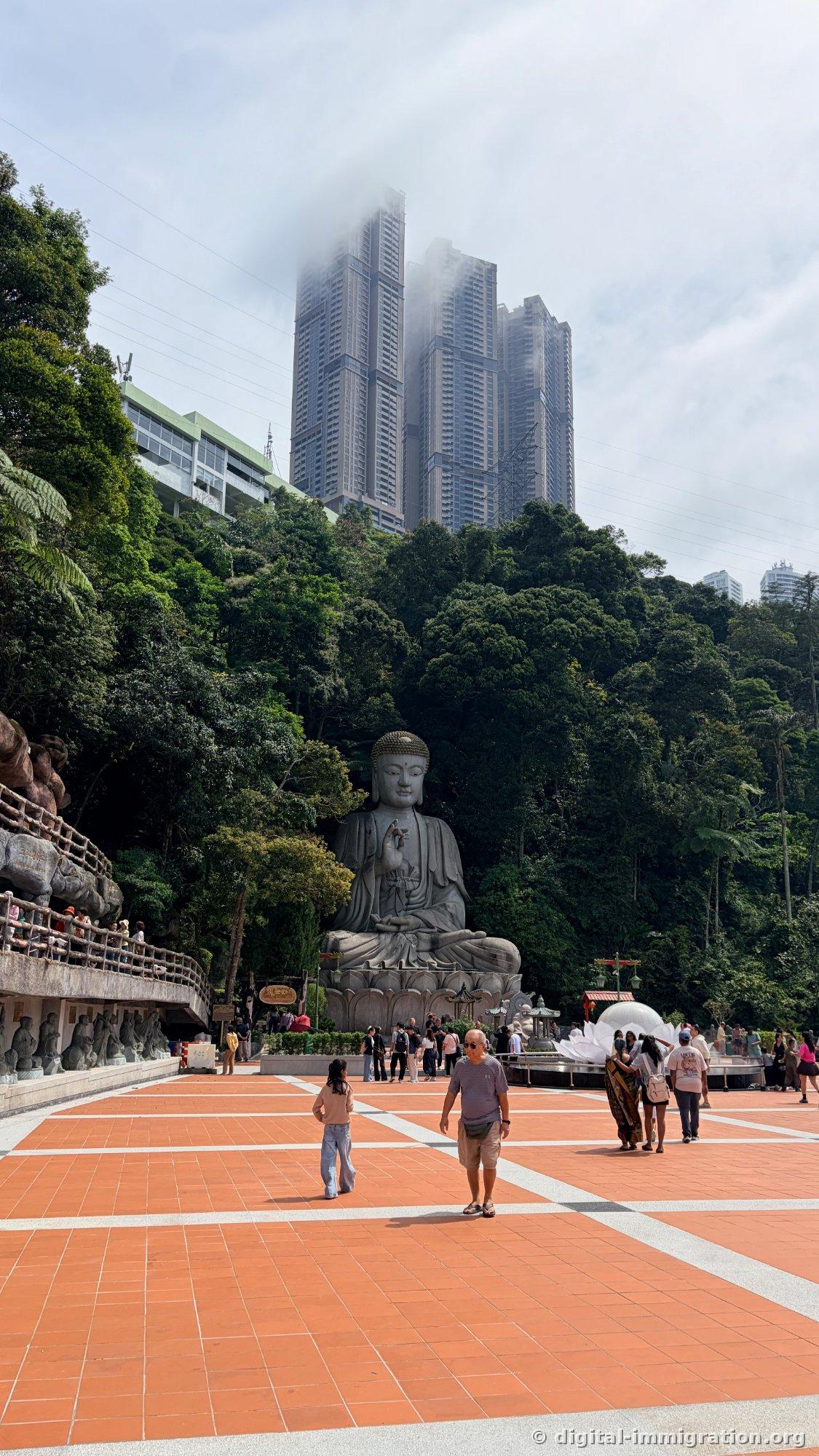
As you approach, the scale becomes clear. People standing beside it barely reach the height of a single lotus petal on the platform. The expression looks better when viewed slightly from the left than straight on. There are dark streaks running down the stone surface where rainwater has flowed, which actually gives the impression of long exposure to the elements.
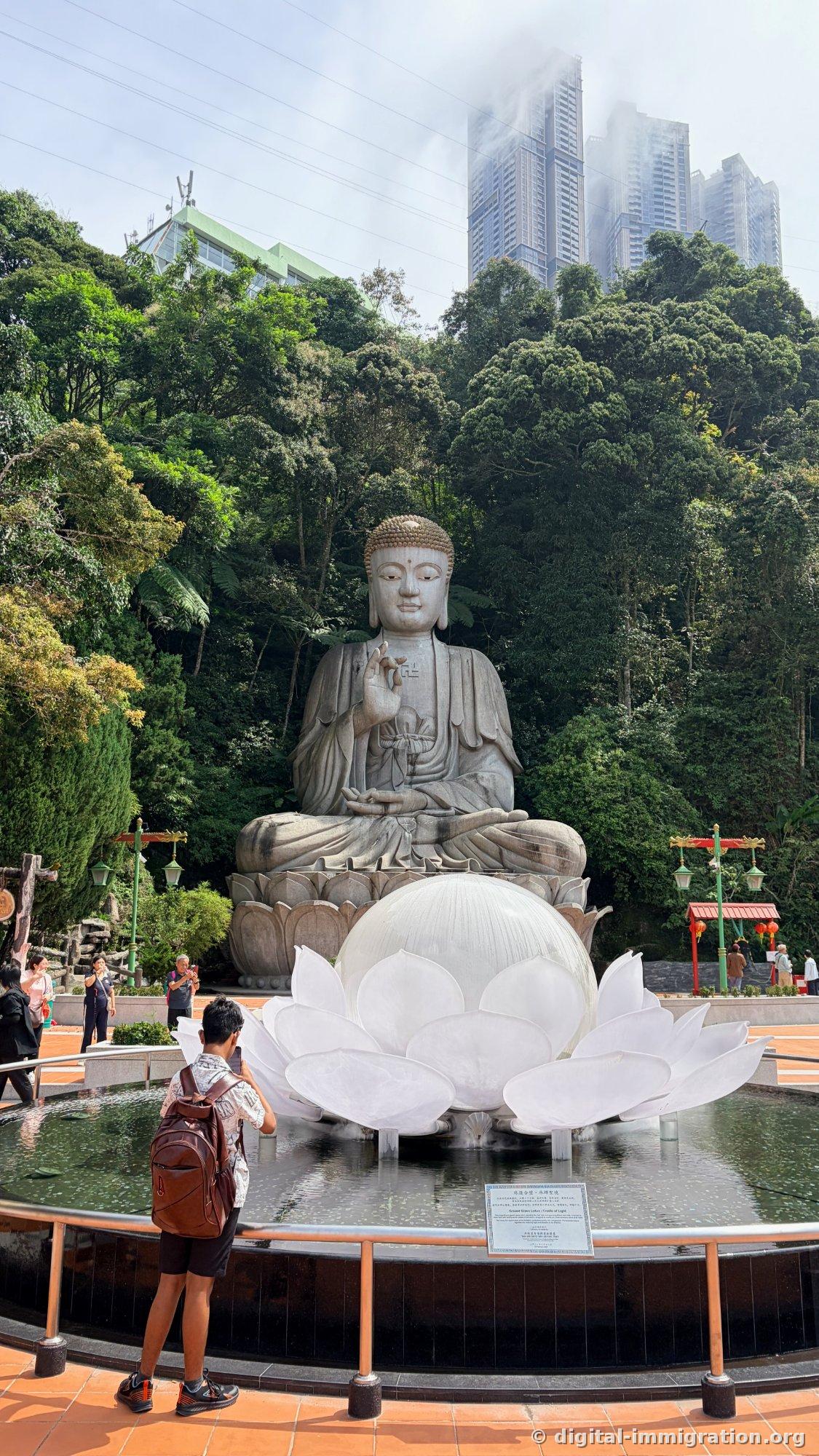
Directly in front of the Buddha statue is a large lotus-shaped basin in white. The signage was labeled in English as 'Crystal Green Lotus,' and the translucent petals allow light to shine through from inside when hit by sunlight. Rather than just photographing the Buddha, positioning this lotus in the foreground creates a much more dynamic composition.
The Guanyin Statue and Plaza — The Path Continuing Upward
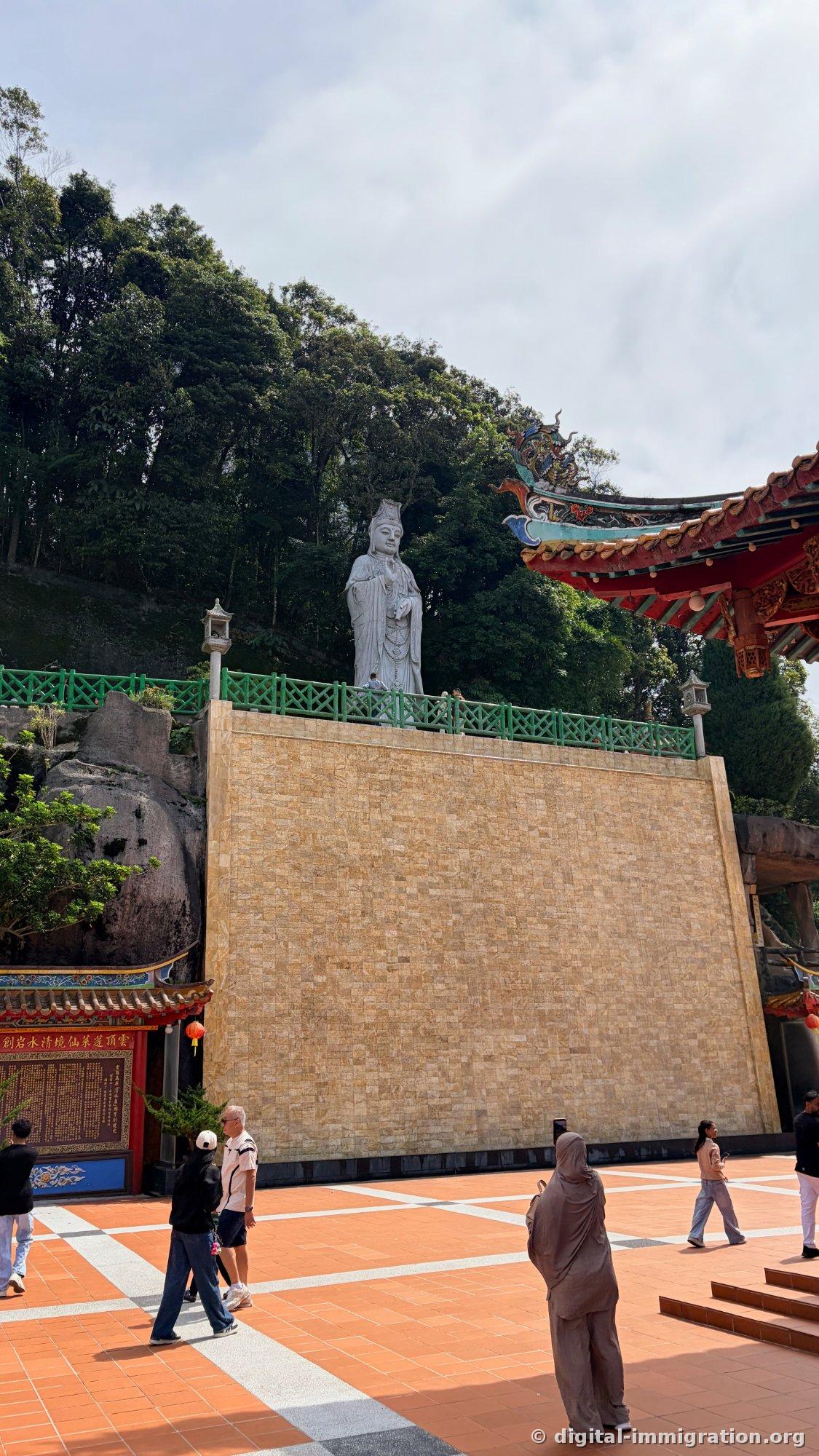
The temple is built by terracing the hillside, so above a retaining wall on one side of the plaza there is another level. Standing atop it is a white Guanyin statue, ringed by green lattice railings. Viewed from below, the Guanyin appears aligned with the temple's eaves.
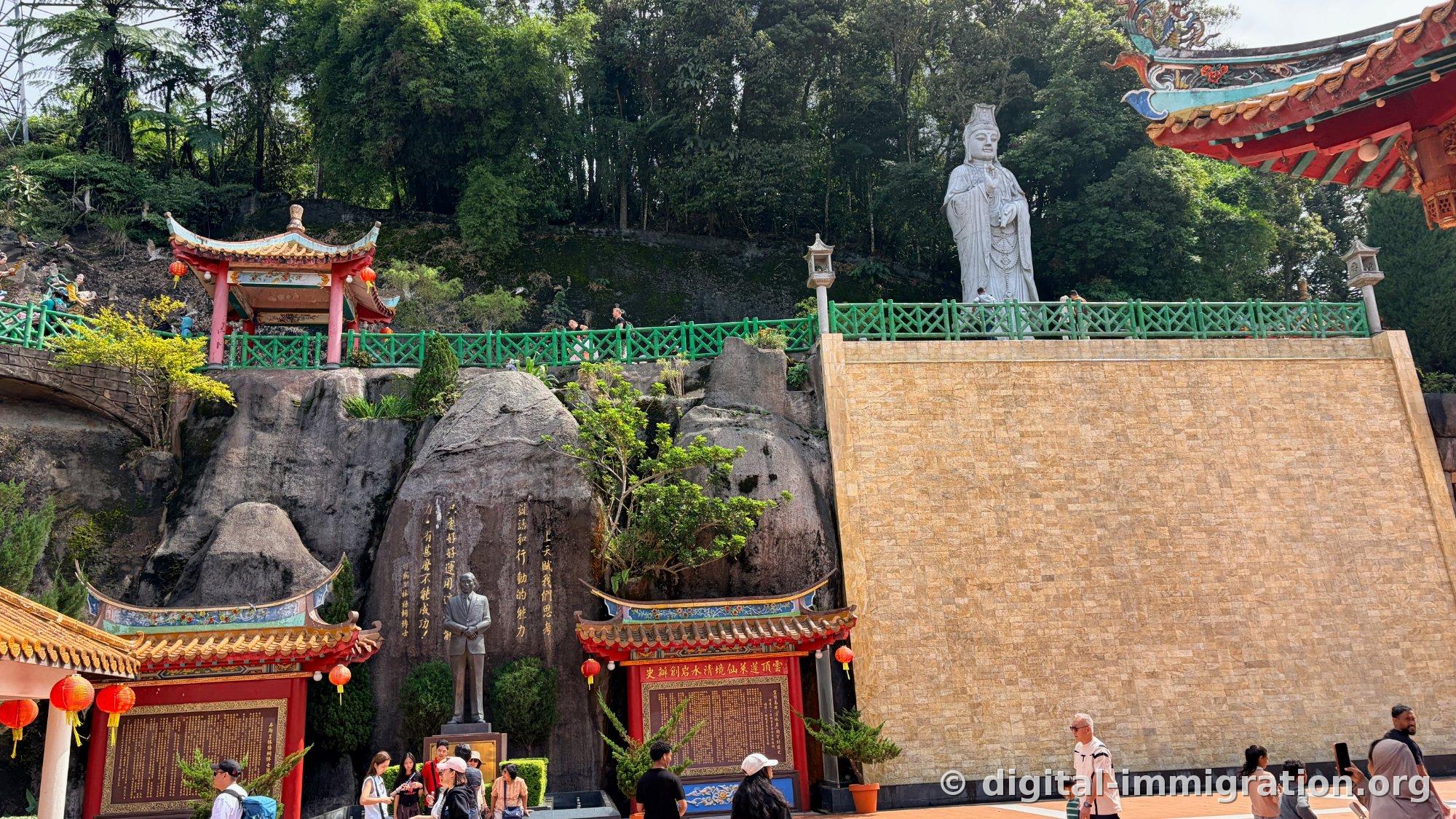
Viewing the same Guanyin statue from further back in the plaza reveals the scale of the yellow stone retaining wall. This plaza offers almost no shade. After around 11 AM, the orange tiles reflect heat directly, making it quite hot. It's good to bring a hat or umbrella, and indeed many people were using umbrellas.
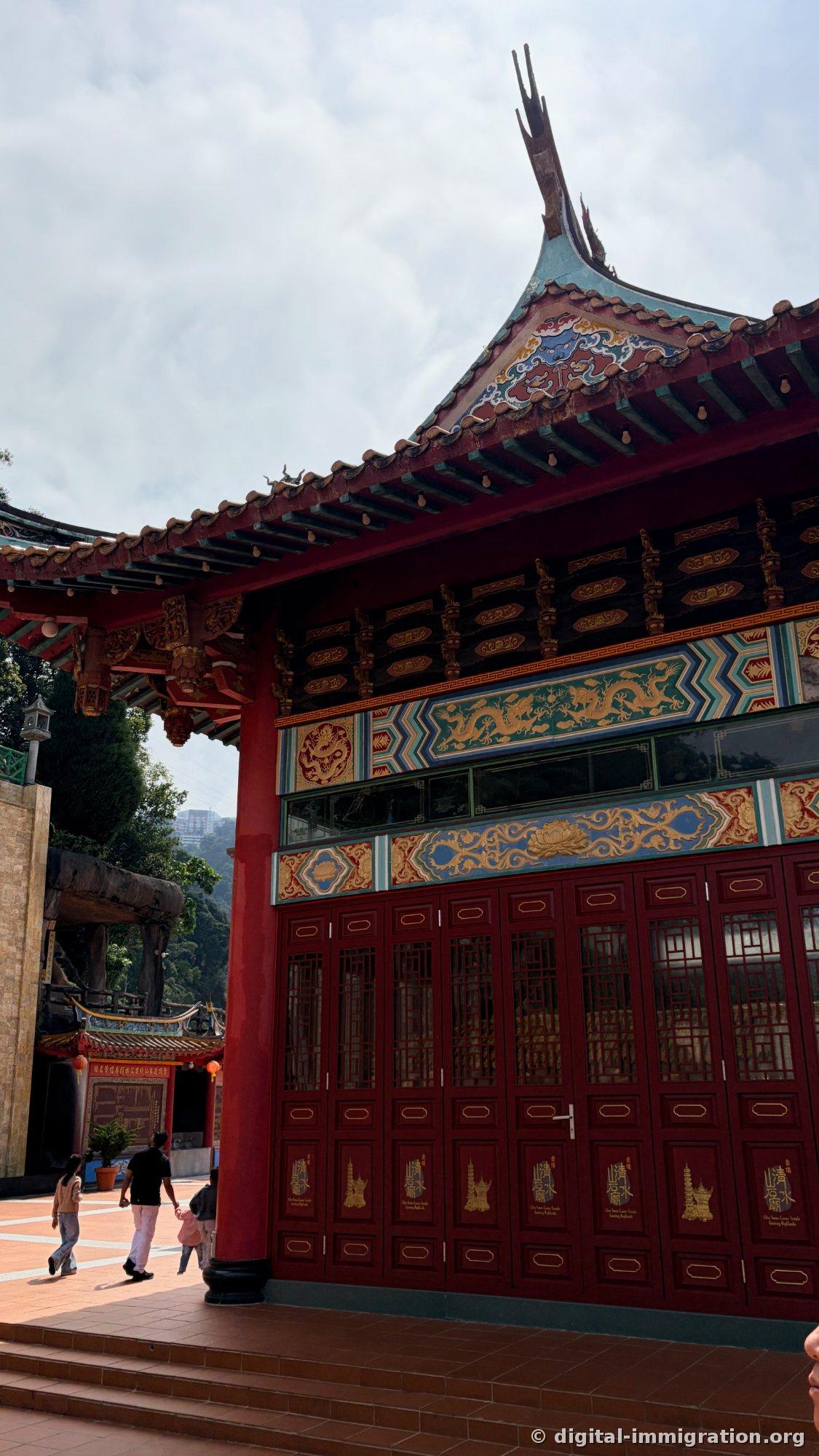
The main hall at the end of the plaza has red pillars lined with purple wooden doors, each bearing 'Chin Swee Caves Temple' and pagoda motifs in gold foil. The decorative painting beneath the eaves has deep, rich colors, so photos come out well even under overcast skies.
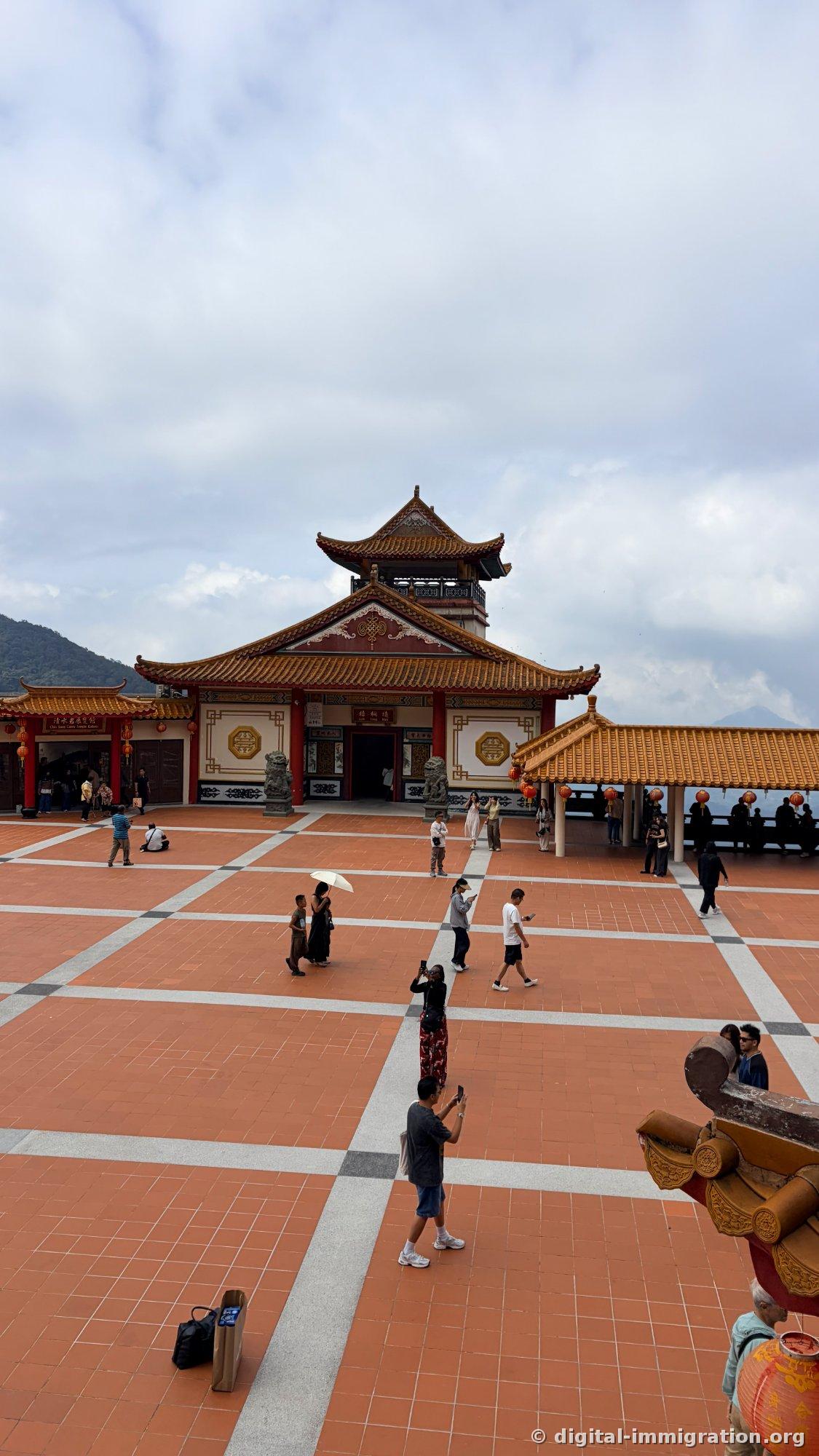
The wide courtyard in front of the main hall opens up like this when viewed from the opposite side. There is a pair of stone lions in front of the main building, and to the left is the entrance to the temple gallery (Chin Swee Caves Temple History Museum).
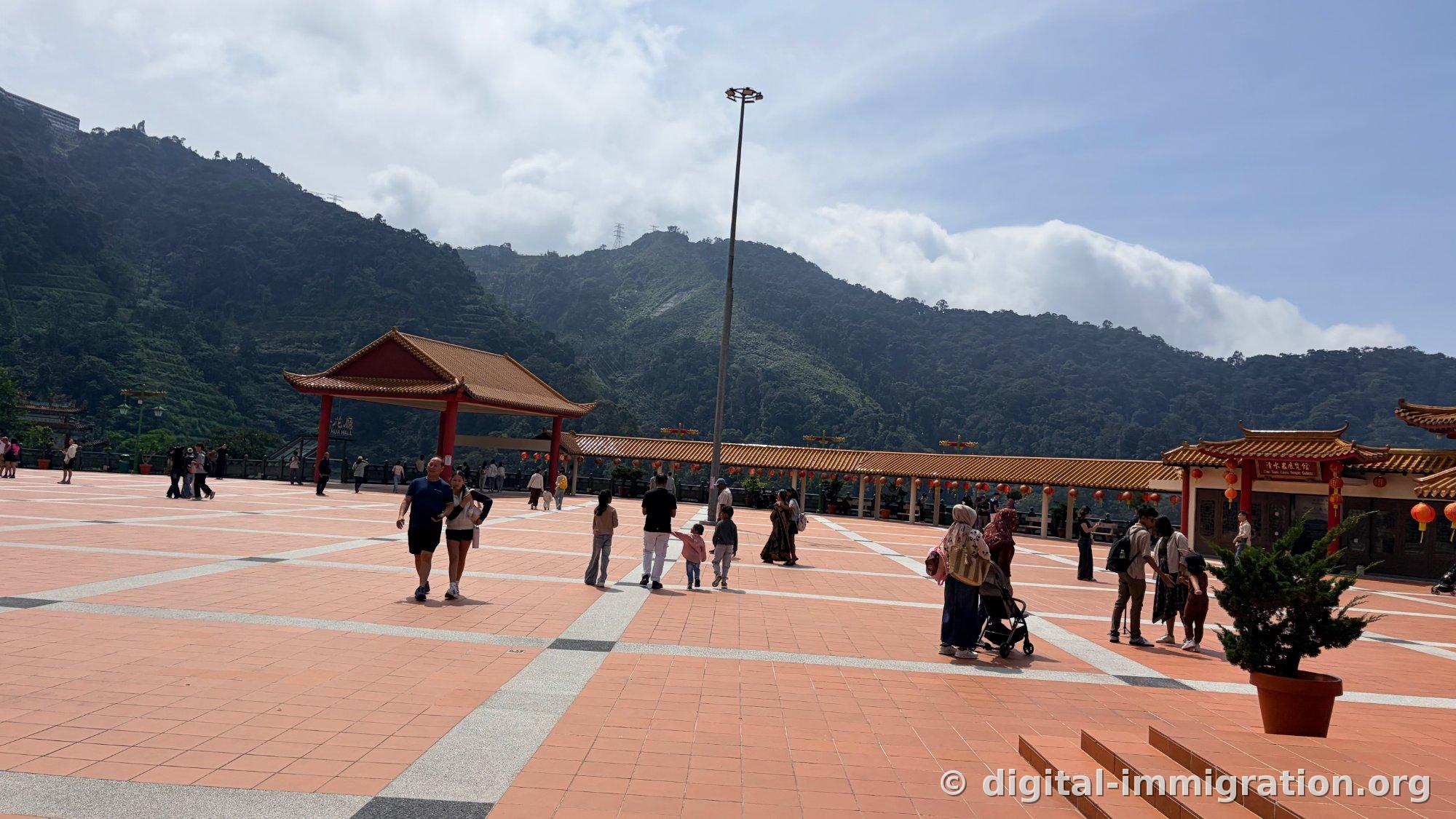
At the far end of the opposite side of the plaza is a pavilion labeled 'HUA HALL,' with a long covered corridor hung with red lanterns extending from it. There are benches in the corridor where people rest. As you circle the plaza, this was the only spot where you could sit comfortably in shade.
How to Get There and Practical Tips
Chin Swee Caves Temple is not at the summit of Genting but midway up the mountain road to the summit. So if you take the cable car directly to the summit, you'll pass by this place entirely. When taking the Awana SkyWay, you can get off and back on at the Chin Swee Caves Temple station midway, so when purchasing tickets, it's safest to confirm whether your route stops at this station. If you drive up, there's a parking lot in front of the temple.
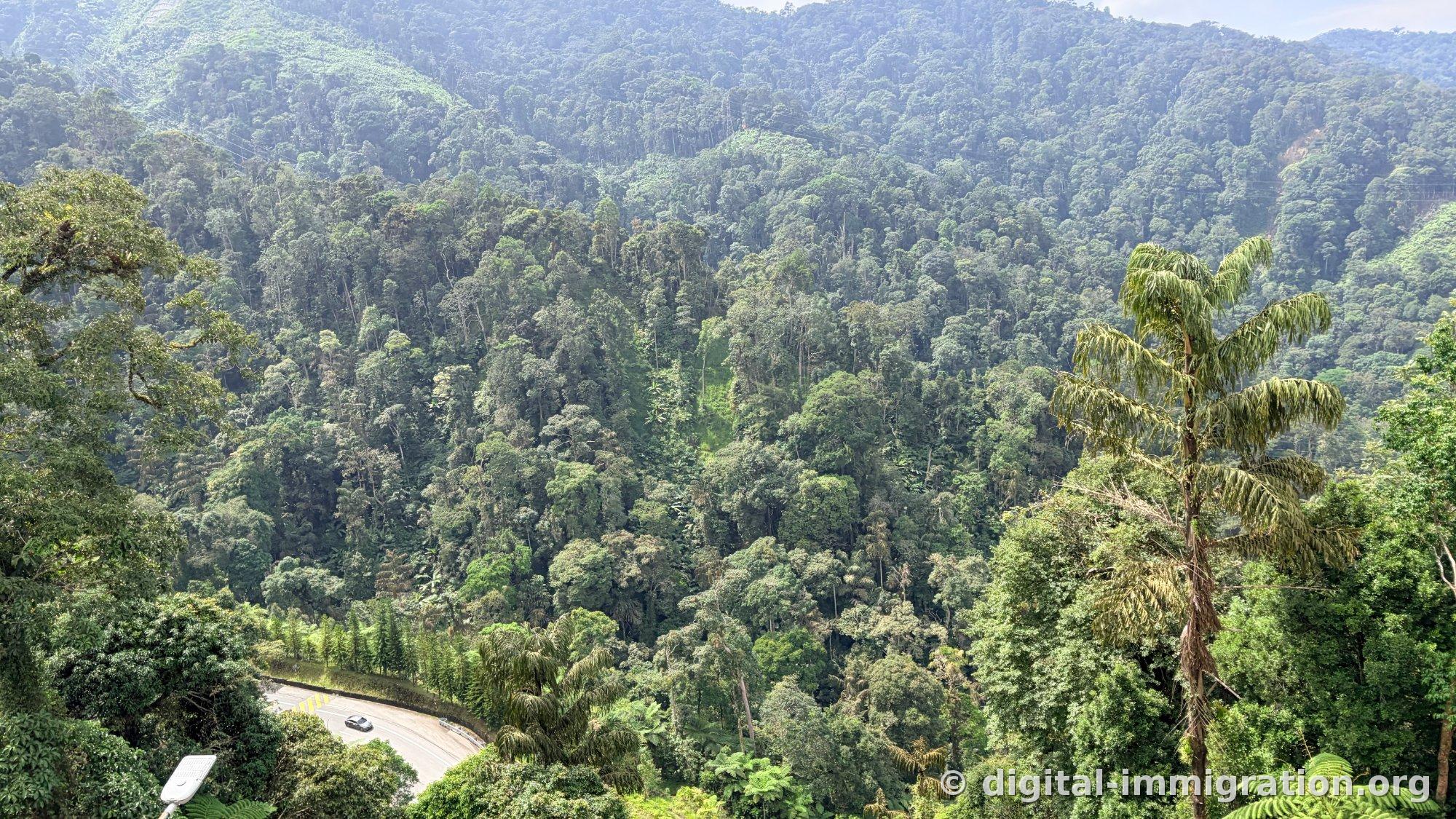
The mountain road itself is worth seeing. This dense jungle continues past the windows, and each time the road bends in a hairpin turn, the entire mountainside across the ravine comes into view. Those prone to car sickness should be prepared—there are really many curves.
Here are some useful things to keep in mind as you visit:
- Clothing: The high altitude makes it noticeably cooler than downtown KL. When clouds roll in, it suddenly turns chilly, so bring a light outer layer. However, the plaza has strong sunlight and gets hot. Layering that you can add and remove is the way to go.
- Footwear: The hell path section has narrow, wet stone steps. Sneakers are better than slippers.
- Route: Descending in the order of pagoda → hell path → Ksitigarbha → great Buddha plaza → Guanyin and main hall minimizes climbing up and down stairs.
- Time Required: A quick tour takes about 40 minutes, but if you read each sculpture carefully, even two hours feels short.
- Admission & Hours: I don't recall paying a separate entry fee when I visited, but charges and hours may change, so I recommend confirming at the site information boards or cable car ticket office.
I'll also note some shortcomings. First, most sculpture descriptions are in Chinese, so without background knowledge, you easily miss the scene's context. Second, maintenance is inconsistent—some sculptures have broken arms or peeling paint. Third, during times when tour buses arrive in groups, both the pagoda stairs and hell path get congested simultaneously. Nevertheless, if I were to spend a day in Genting, I'd reduce my indoor theme park time by an hour to spend more time here. Amid the casinos and shopping malls, this is the one place that preserves what this mountain was originally like.
Read next
- Morning at the Traditional Market Next to Johor KIP Mall, Mangoes 2kg for RM10
On the outskirts of Johor Bahru, Malaysia, on the way up toward Kulai, there's KIPMall. You walk in expecting an air-conditioned shopping center like a typical mall, but instead yo…
Johor · KIPMall - Kuala Lumpur Monkiara Seng Kee Chicken Rice (成記雞飯) — Weekend Lunch Incomplete Without Oil Rice
Whenever I have business near Monkiara Solaris on the weekend, my feet almost automatically head to this place. Chicken rice signs hang on every street corner in Kuala Lumpur, but…
Kuala Lumpur · Seng Kee Chicken Rice - A Morning at Kota Tinggi's Traditional Market — Mountains of Green Mango and RM3.50 Waffles
Kota Tinggi, Johor State, Malaysia. A town you reach driving east from Johor Bahru—one that appears in travel guides only for its waterfall. But this time, instead of the waterfall…
Kota Tinggi