Vientiane's Patuxai, Lane Xang Avenue from the top of the stairs — A record from 3 PM
When you come to Vientiane, you inevitably pass by Patuxai at least once. Walk northeast along Lane Xang Avenue from the city center and there it stands, a gray mass in the middle…
Vientiane Capital · Patuxai
When you come to Vientiane, you inevitably pass by Patuxai at least once. Walk northeast along Lane Xang Avenue from the city center and there it stands, a gray mass in the middle of the road. In Laos it's called the 'Gate of Victory,' but travelers just call it the 'Laotian Arc de Triomphe.' I came back this time because I regretted only taking photos from below on my last visit. To put it plainly, this building is worth climbing more than seeing from the ground.
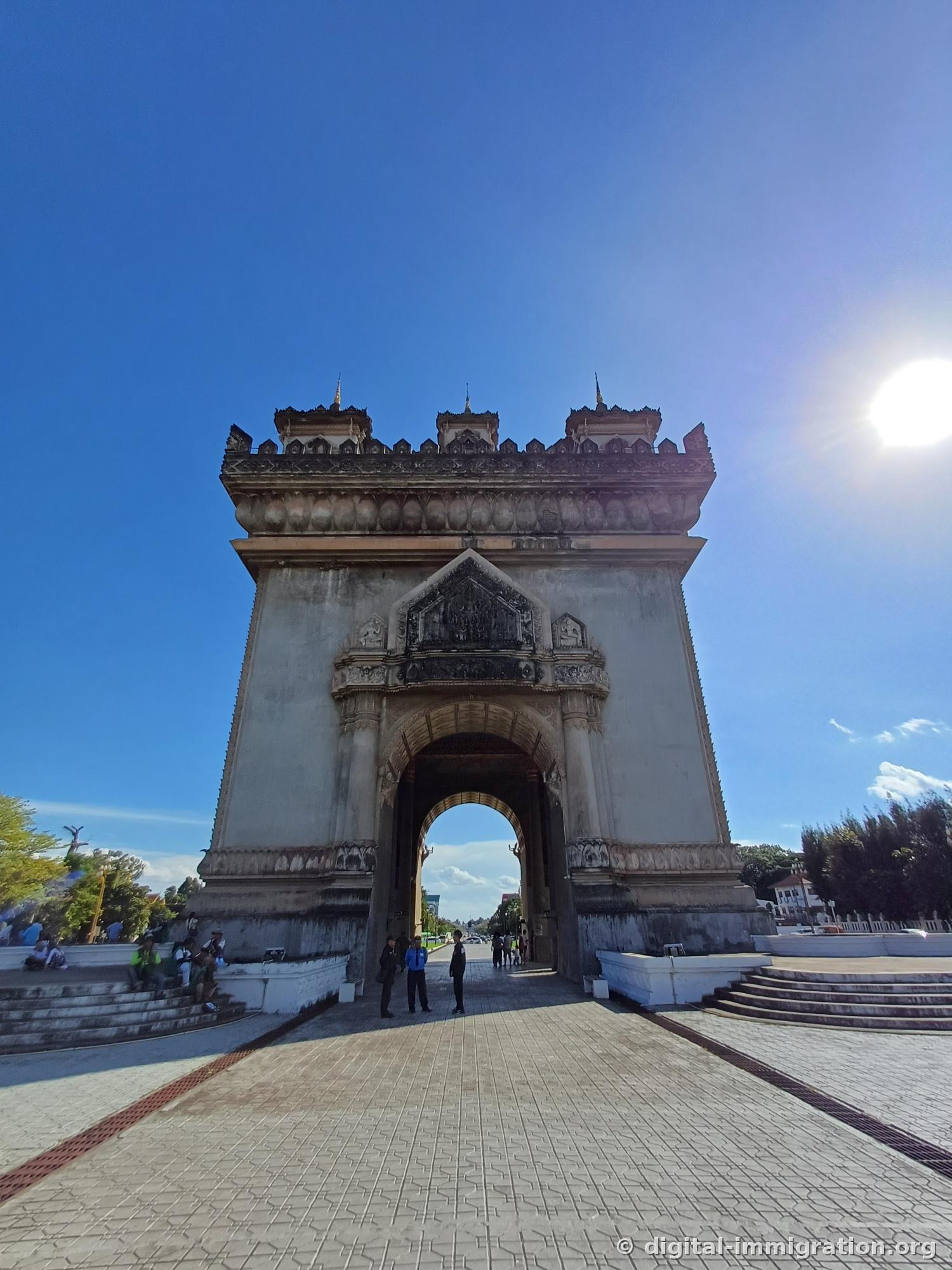
You might be startled by the real thing at first. It doesn't have the smooth feel of the Paris Arc de Triomphe you see in photos—bare concrete is exposed, and water stains and mold streaks run down the walls. But that is this building's identity. Not a monument completed and fully painted, but something standing there in an unfinished state. The Laotian people don't try to hide it.
The ceiling beneath the arch — you'll miss half if you don't look up
When you stand under the arch on the front stairs, you must tilt your head back. There's a completely different world above the blunt gray concrete outside. A turquoise ceiling painting with gold leaf, in the center a deity riding an elephant with three heads (Erawan), and celestial beings like apsaras flying all around. The corridor ceiling inside the arch is divided into a grid pattern with reliefs set in each compartment, and if you look closely, the iconography is different in each section.
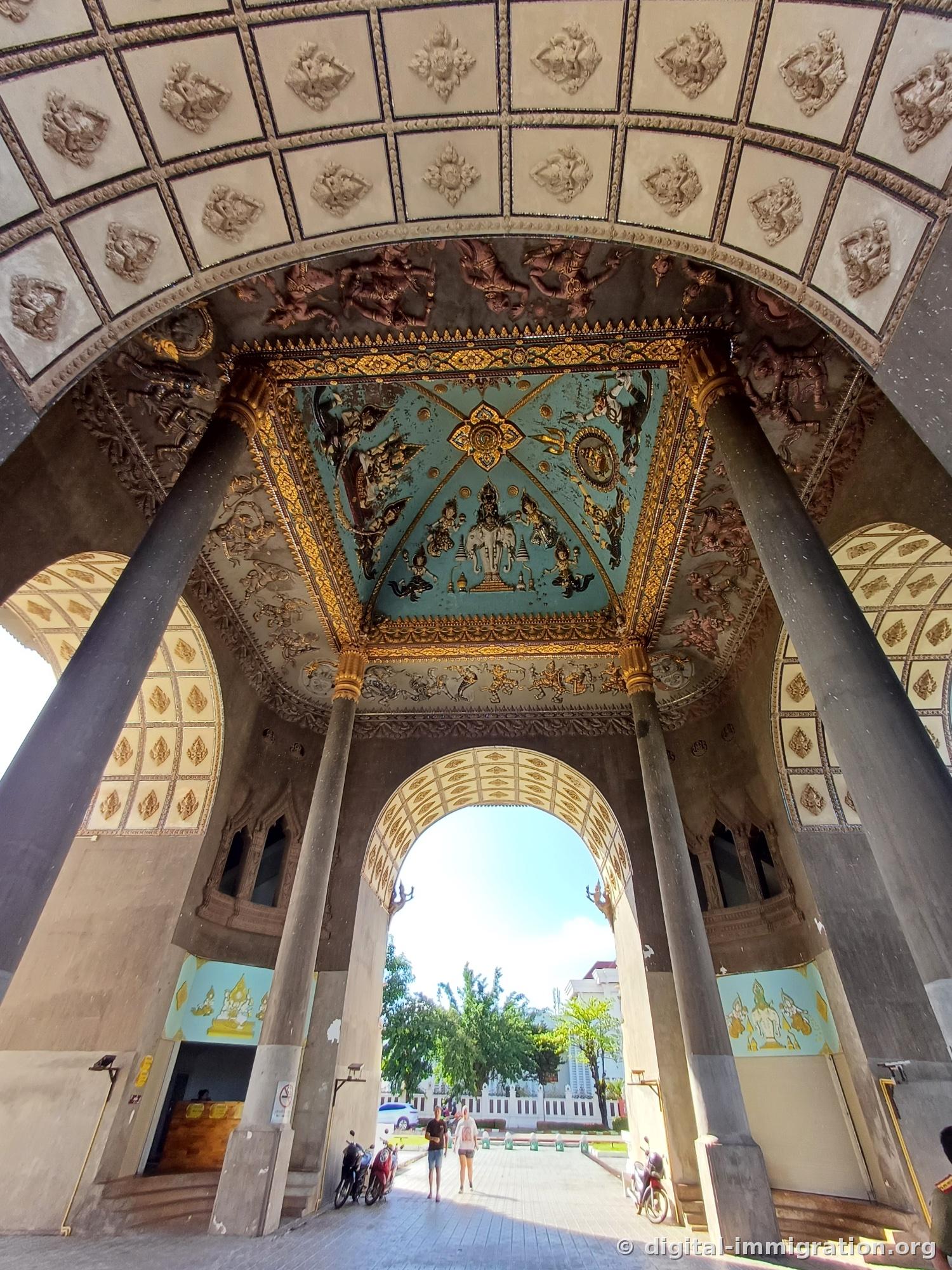
The shade here might seem cool, but it actually isn't. The concrete has been baking all day, so even under the arch it's humid. What does circulate is the breeze. You can see bicycles and motorcycles parked on the lower right of the photo, and this space below is less of a tourist site and more like a passageway where local people shelter from the sun.
Upper floor exhibition rooms — lower expectations and it's not so bad
Once you pay admission and enter, you climb up stairs level by level, with middle floors serving as exhibition spaces. To be honest, this is the most disappointing part of the building. A large hall with gray carpet, a few bilingual panels in Lao and English on the walls. There's almost no artifact or artifact displays.
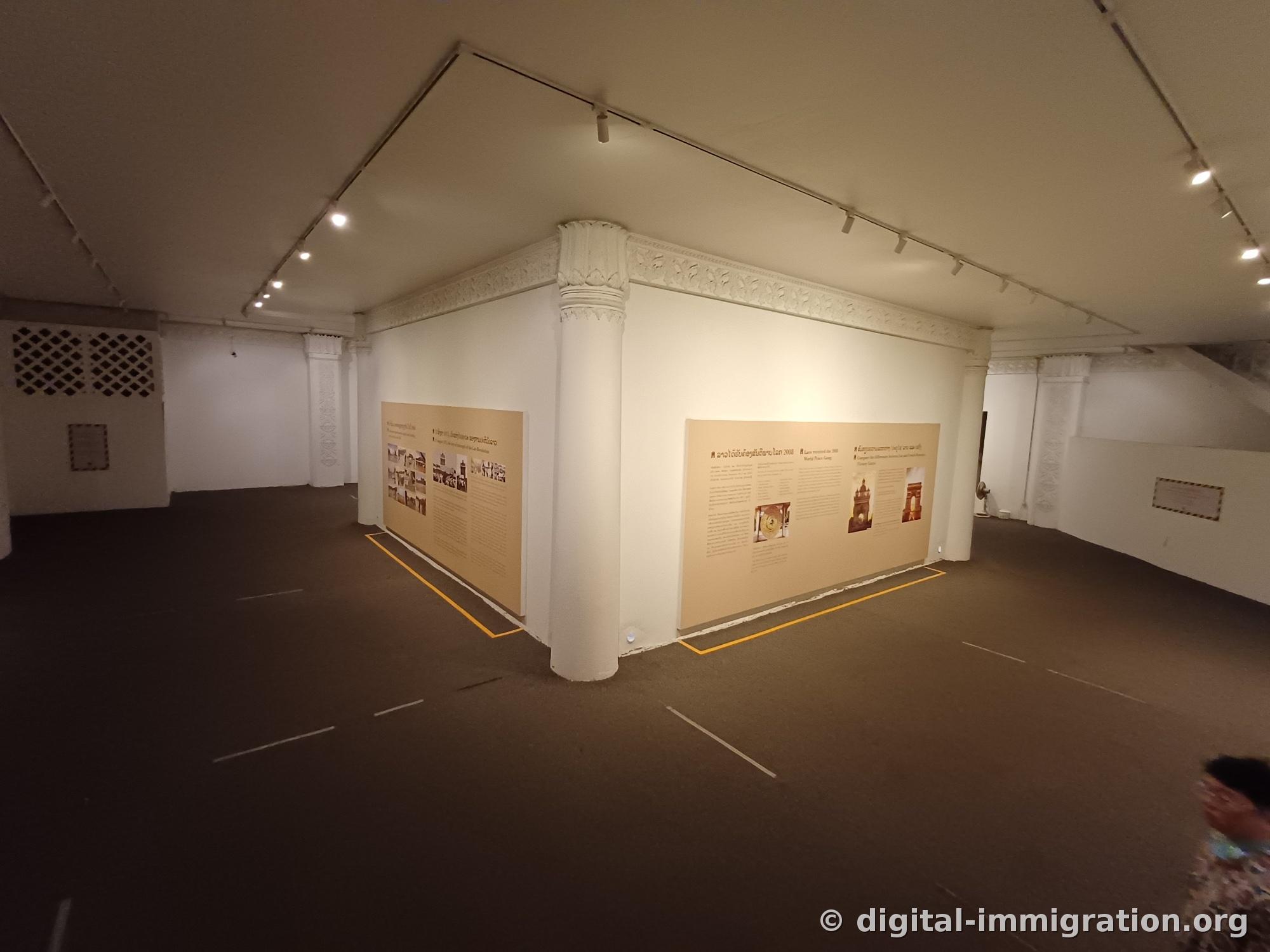
Still, there was something worth reading. A panel that openly compared Laos's Patuxai with the French monument. The logic was this: the form comes from the Arc de Triomphe, but all the decoration is filled with Laotian Buddhist and Hindu iconography. Reading this panel right after seeing that turquoise elephant on the upper ceiling makes it click. There's a yellow tape on the floor marking a route, but it's less of a viewing path and more of a line keeping people away from the walls.
Apply for the Digital Immigration Form (LDIF)
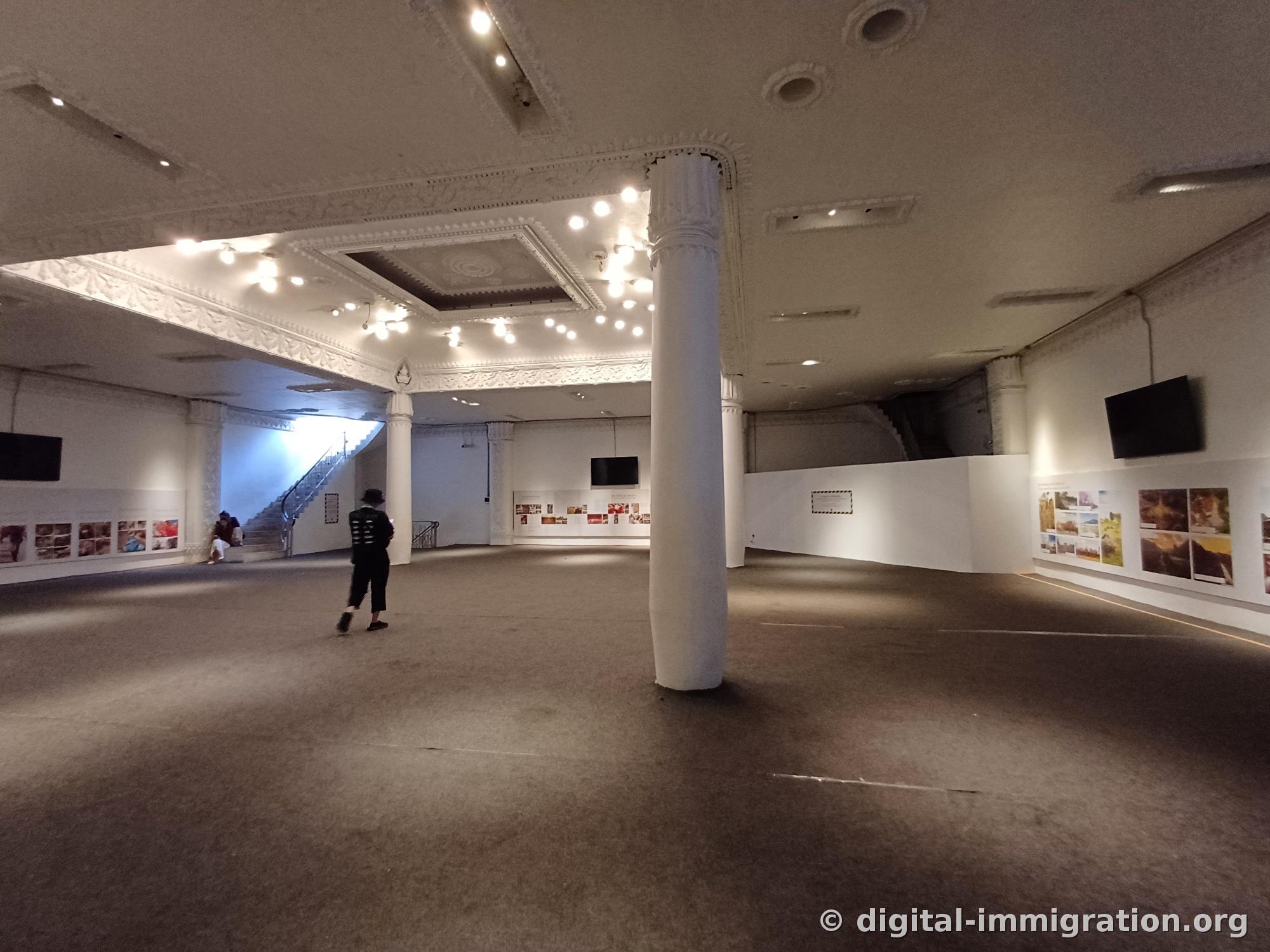
The ceiling plaster decoration on each floor is quite carefully made. The lighting is dim and the carpet worn, but the Laotian lotus and vine patterns on the pillar capitals and ceiling molding are not sloppily done. If you think of this level as enjoying observing the building itself rather than the exhibition content, you'll be less disappointed. One note: the stairs between floors are narrow, steep, and have low railings. Shoes that fully cover your feet are better than slippers.
The terrace below the rooftop and the summit
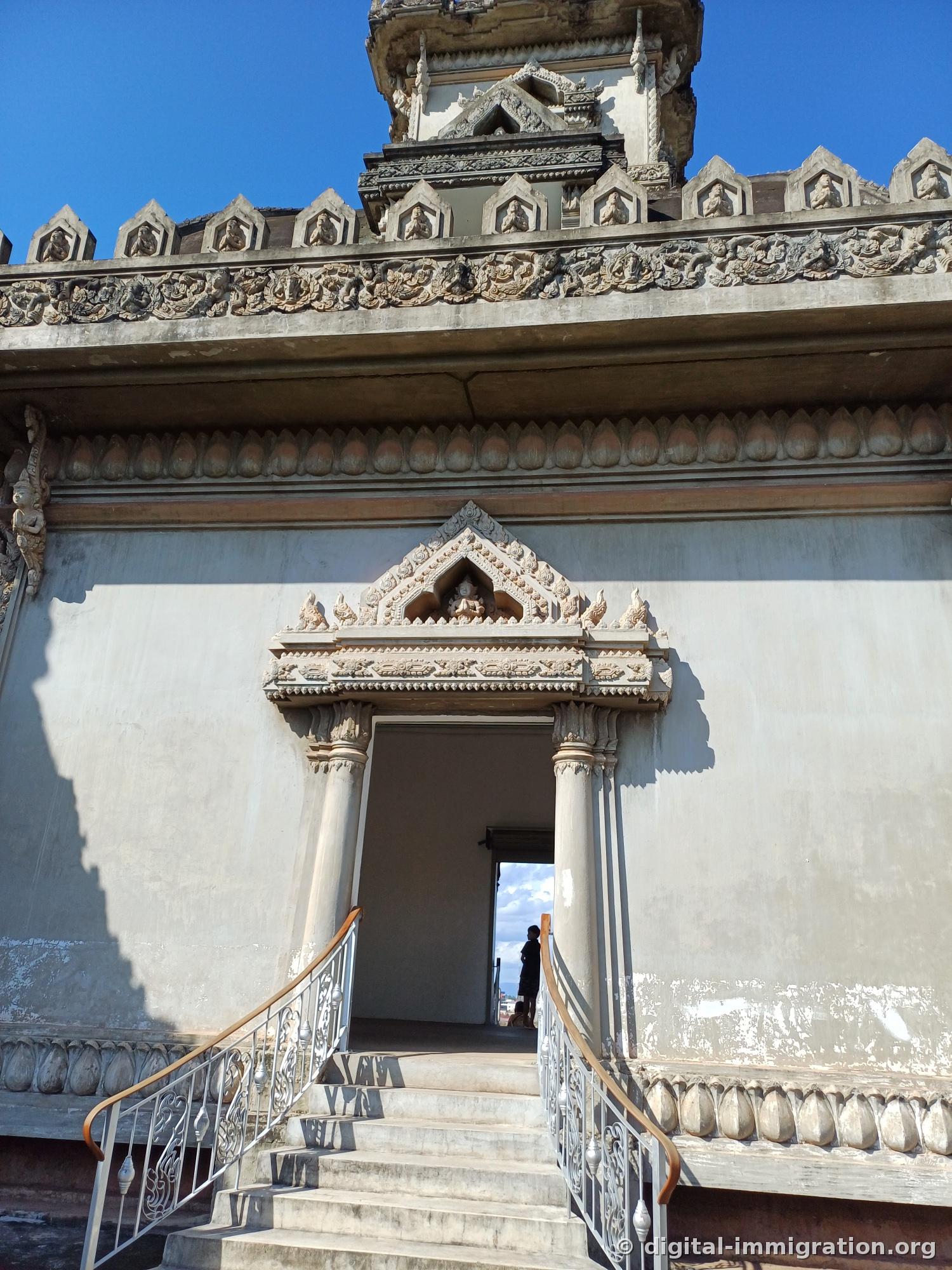
Halfway up you come out onto an exterior terrace where you can look straight up at the upper part of the building. Under the eaves runs a molding of lotus buds, and above it on each railing is a relief of a praying figure. A seated Buddha is carved in the gable above the door. These are details you never see from the square below.
When you reach the summit, you're on an open roof on all sides. A castle-like crenellated railing runs around it, and through the gaps you see the city. The railing height is about chest level, so if you bring children, don't let go of their hands.
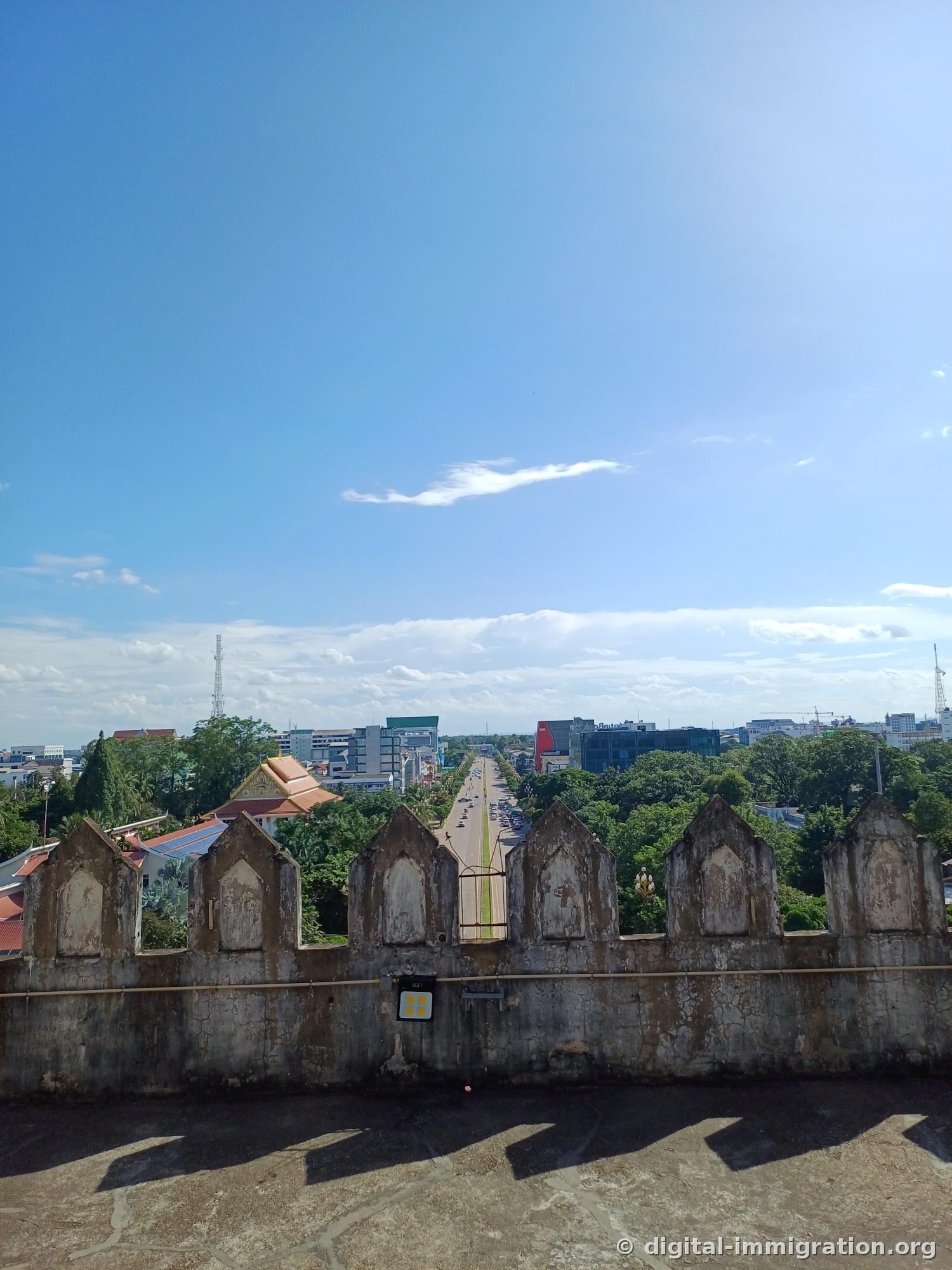
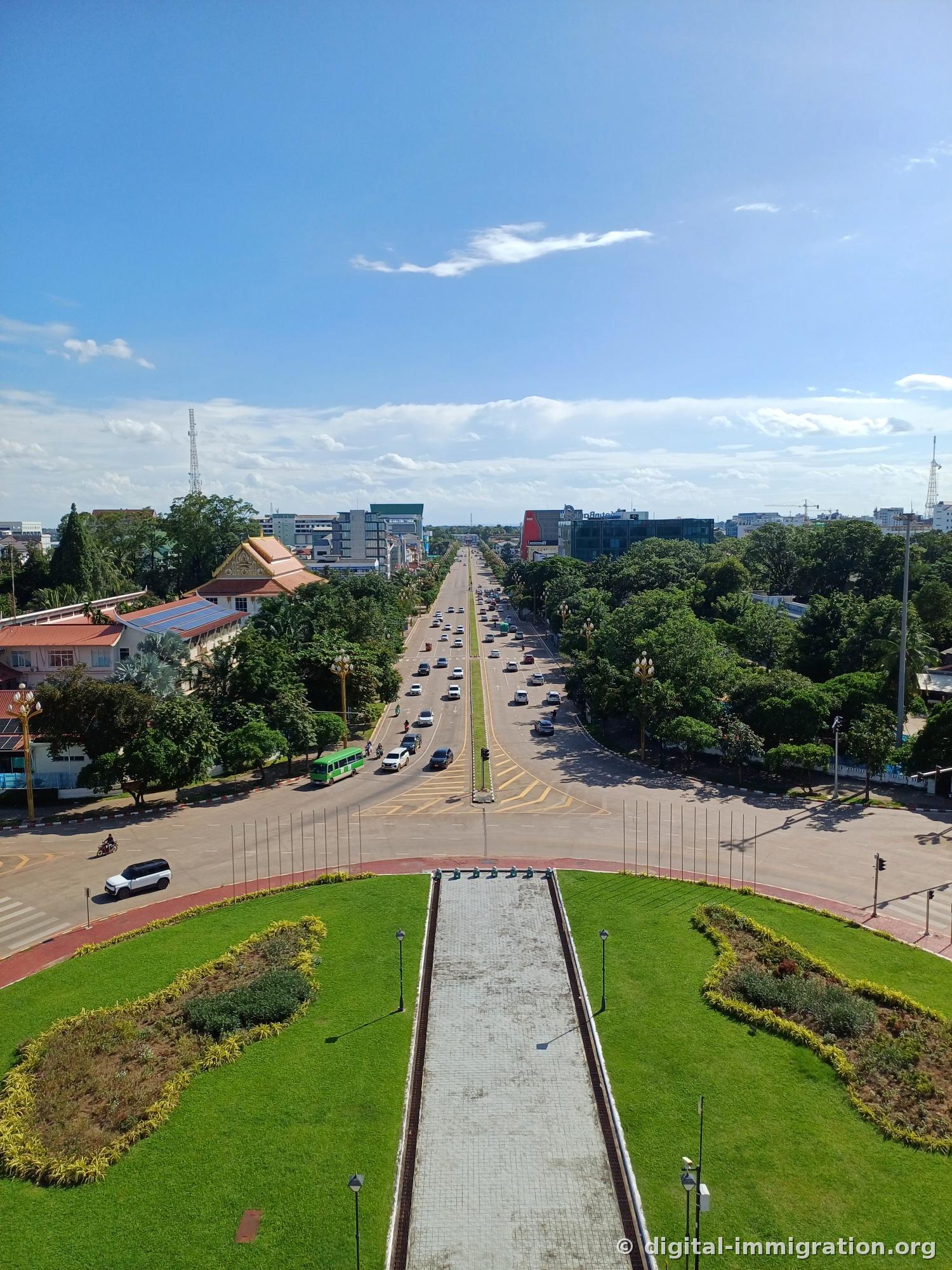
The real reason to climb here — Lane Xang Avenue pierces through in a straight line
Turn your body to the southwest of the rooftop and the answer to this visit appears. Lane Xang Avenue starting from the foot of Patuxai stretches out like a ruler's line all the way into the city center and disappears in the direction of the Mekong. Traffic flows on both sides separated by a median, orange-roofed buildings with gold gables on the left, glass-walled new offices and red-signed buildings on the right. The road is wide but traffic isn't heavy. This is Vientiane's pace.
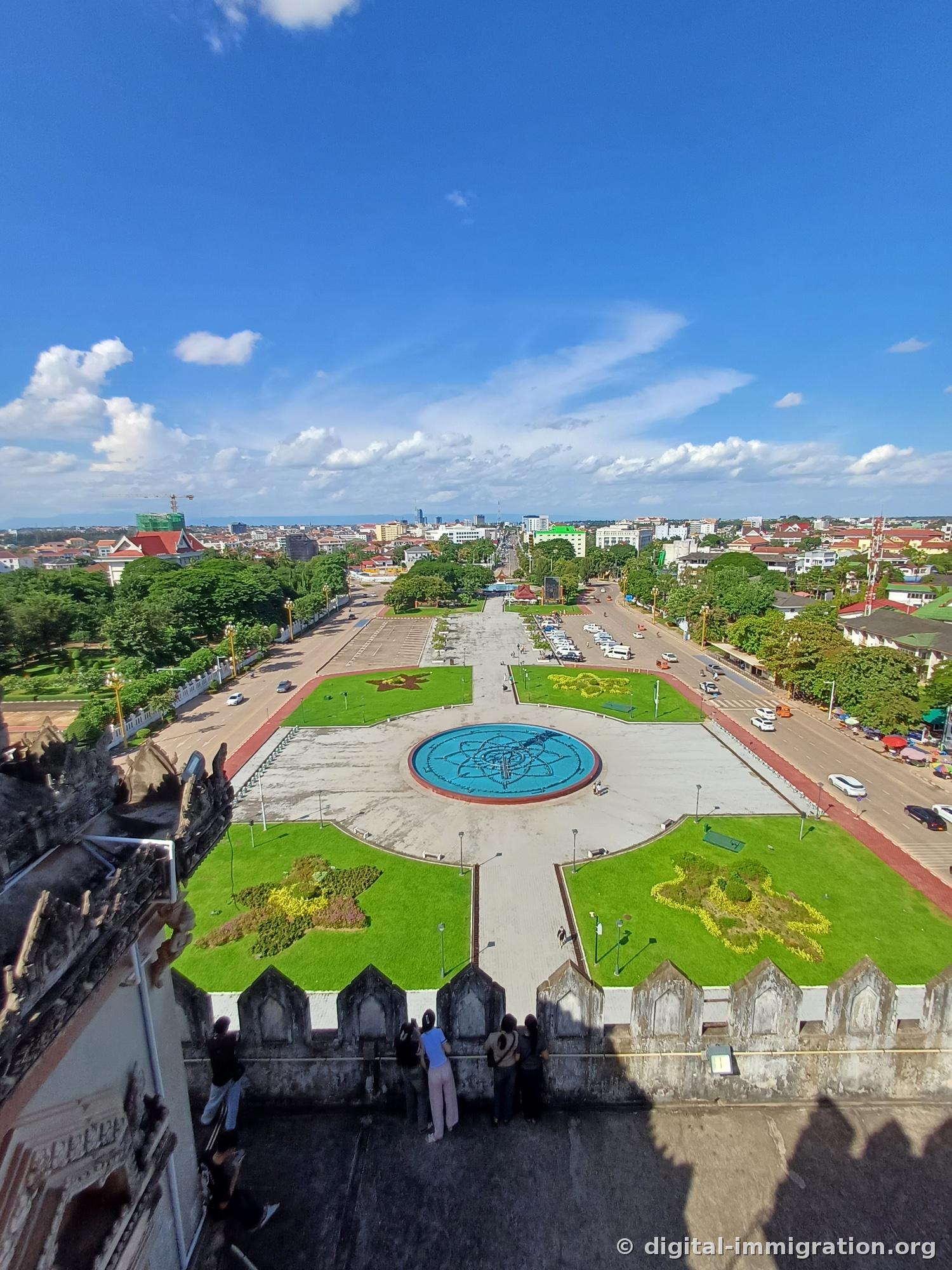
Turn to the opposite side, to the northeast, and Patuxai Park (the square right in front of the gate, not Chao Anuong) is visible below in its entirety. A light blue circular fountain, a fan-shaped arrangement of lawns, pathways dividing through them. The symmetry is so precise that the design intent only becomes clear from above. When you walk below, it's just a wide plaza.
Location and access
Patuxai sits inside a roundabout in the heart of Vientiane. If you're staying at a guesthouse near the Namphu fountain, it's a walkable distance along Lane Xang Avenue, but it's a straight road with almost no shade. Walk between noon and 2 PM and you'll be exhausted before you arrive. I called a Grab motorcycle instead of a tuk-tuk and it took just minutes from the city center. If you catch a tuk-tuk, definitely confirm the price before getting in — this area adds tourist prices.
One thing to note. Patuxai sits like an island in the middle of the road, so to cross to the plaza you have to cross the roundabout. There are signals, but motorcycles don't always stop. The safest way is to cross along with locals.
Good to know before you go
- Admission is paid in cash at the window near the stairs entrance. The price changes with time, so check on site. Bring small bills in kip.
- There's no elevator. It's stairs all the way to the top, getting narrower and steeper as you go up.
- There's almost no shade on the rooftop. A hat or umbrella is essential. I went up without one and my neck was burned in 15 minutes.
- The front view is better in the morning. In the afternoon as the sun moves west, the front shot becomes backlit.
- Don't have high expectations for the interior exhibitions. The value of this place is in the ceiling reliefs and the rooftop view.
When I came down, my clothes were soaked with sweat. Yet if I come to Vientiane again, I'll probably climb up one more time. There aren't many places in this city that let you understand how it's laid out all at once, and the Patuxai rooftop is the cheapest option among them. Including the gray concrete stains, this building shows quite honestly where Laos stands right now.
Read next
- Pha That Luang in Vientiane: Walking the Golden Stupa on a Cloudy Afternoon at Five O'Clock
Take a tuk-tuk fifteen minutes northeast from downtown Vientiane and the road suddenly widens, with a golden mass rising abruptly beyond a wall. Pha That Luang. The very stupa that…
Vientiane Capital · That Luang - Kyoto-Style Water Drop Mochi Found in the Heart of Vientiane — KYO Cafe & Meal Record
Vientiane is fiercest at two in the afternoon. Shade does nothing to help, and you can feel your shirt clinging to your back. That day, while walking through downtown, it became un…
Vientiane Capital · KYO Cafe & Meal - A French Evening at Le Vendôme in Vientiane, Laos—Record of Three Plates: Pizza, Carbonara, and Salad
On an evening when the breeze from the Mekong River drifted across the street, I stepped into Le Vendôme Restaurant tucked into an alley near Wat Inpeng. Whenever French cuisine co…
Vientiane Capital · Le Vendôme Restaurant