Kok Kok Mega Mart in Vientiane — The Day I Went to Laos and Came Back with Busan Fish Cakes and King-Size Dumplings
Every time I come to Vientiane, where I shop changes a little. In the past I used to make the rounds of the traditional market near Talat Sao or the small minimarts on Simuang Road…
Vientiane Capital · Kokkok Mega Mart
Every time I come to Vientiane, where I shop changes a little. In the past I used to make the rounds of the traditional market near Talat Sao or the small minimarts on Simuang Road, but this time I headed to Kok Kok Mega Mart, newly opened behind the Muong Thanh Vientiane Hotel. It's a retail brand built by KOLAO Group, the company famous in Laos for cars and motorbikes. Seeing the bold orange logo on the sign and the slogan "KNOCK KNOCK ON YOUR LIFE," it struck me all over again how far this company is expanding into everyday life in Laos.
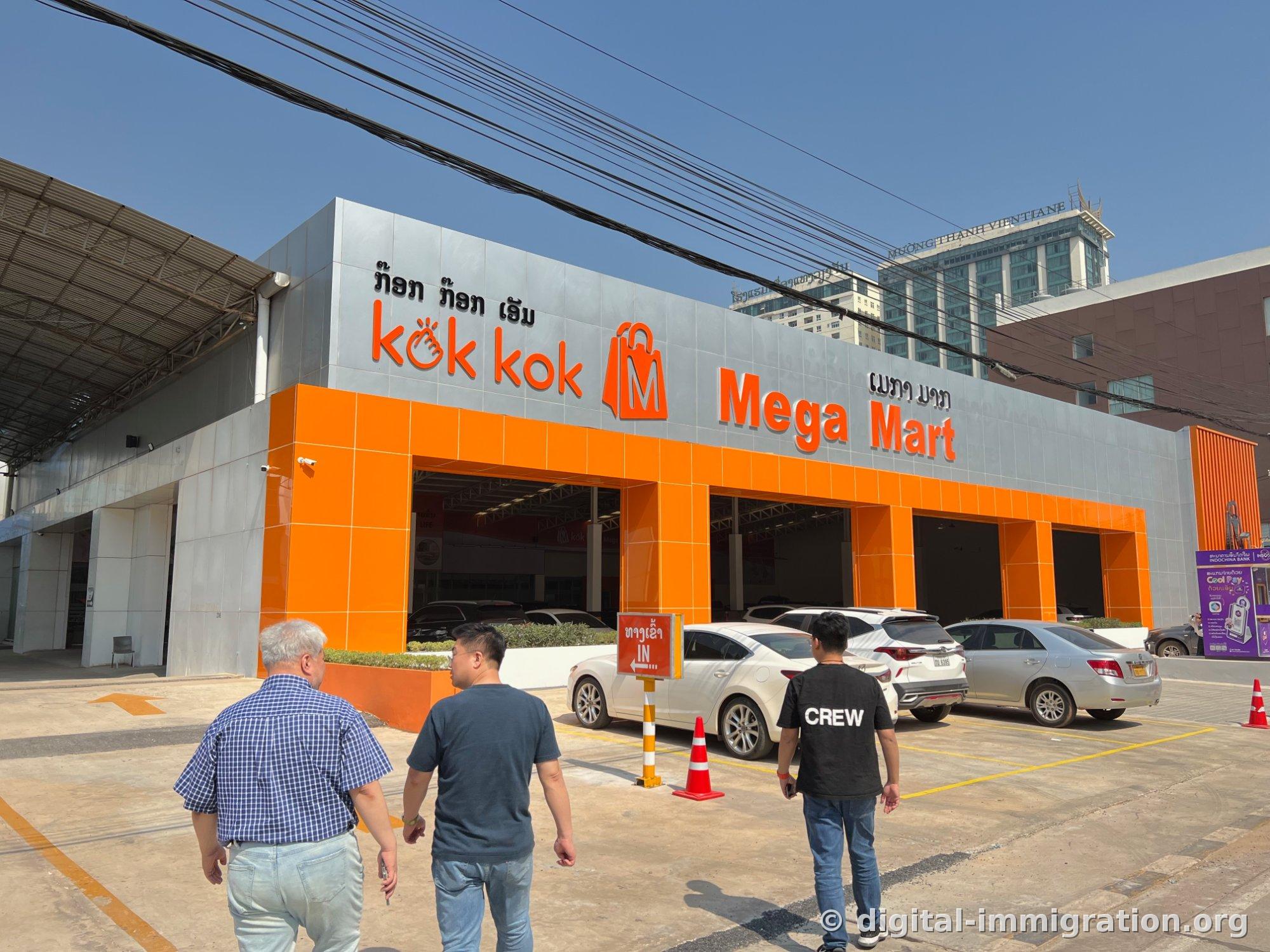
The Building Itself Feels Unusually Spacious for Laos
My first thought was, "Is a parking lot allowed to be this big?" Most marts in Laos sit right up against the street, barely room for two cars, but here the entire front of the store is a flat, open parking lot. Cars streamed in following a red IN sign marked "ທາງເຂົ້າ" (entrance) in Lao, while a staff member in a black T-shirt printed with CREW moved between the cones directing traffic. Around midday, the heat rising off the concrete was intense — the thirty seconds walking from the car to the entrance was honestly the hardest part.
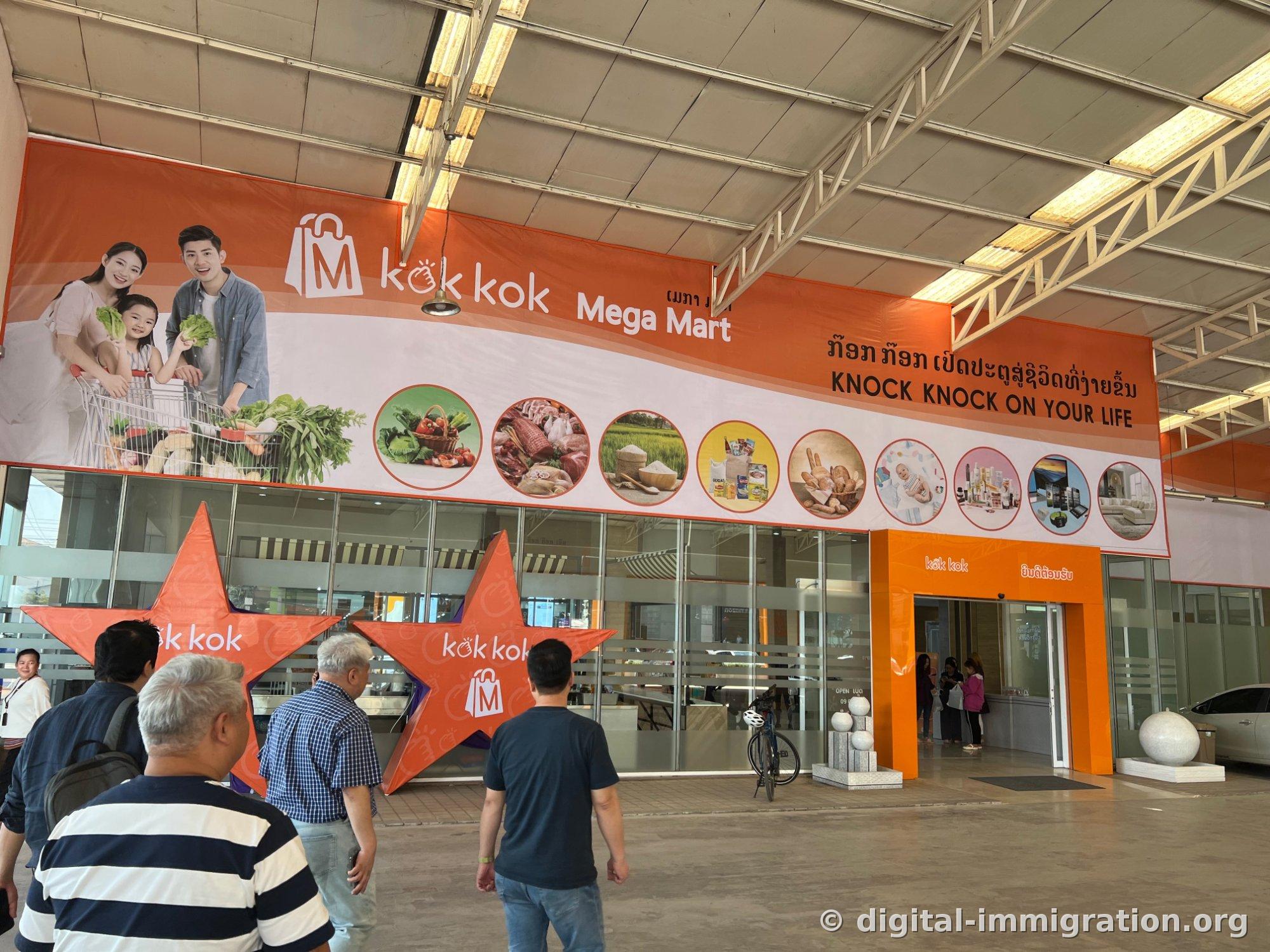
The entrance isn't on the front face of the building — it's tucked to the right, inside the covered walkway. First-timers might hesitate for a moment, staring at the glass wall wondering where to go in, but just look for the orange-painted door frame. The banner overhead is lined with icons for vegetables, meat, rice, seasonings, bakery, baby goods, cosmetics, appliances, and furniture — and that's genuinely how the store is laid out. This isn't just a grocery store.
Ground Floor — Wide Aisles, Spotlessly Clean
Step through the doors and a blast of cold air hits you. The ceiling is lined edge to edge with fluorescent lights in a tight grid, and the floor is bright gray epoxy — bright enough that in photos the lighting reflects right off it. A store this bright and this spacious is rare in Vientiane. The aisles are wide enough for two carts to pass comfortably, so none of the usual "squeezing past each other between narrow shelves" stress you get at typical Lao marts.
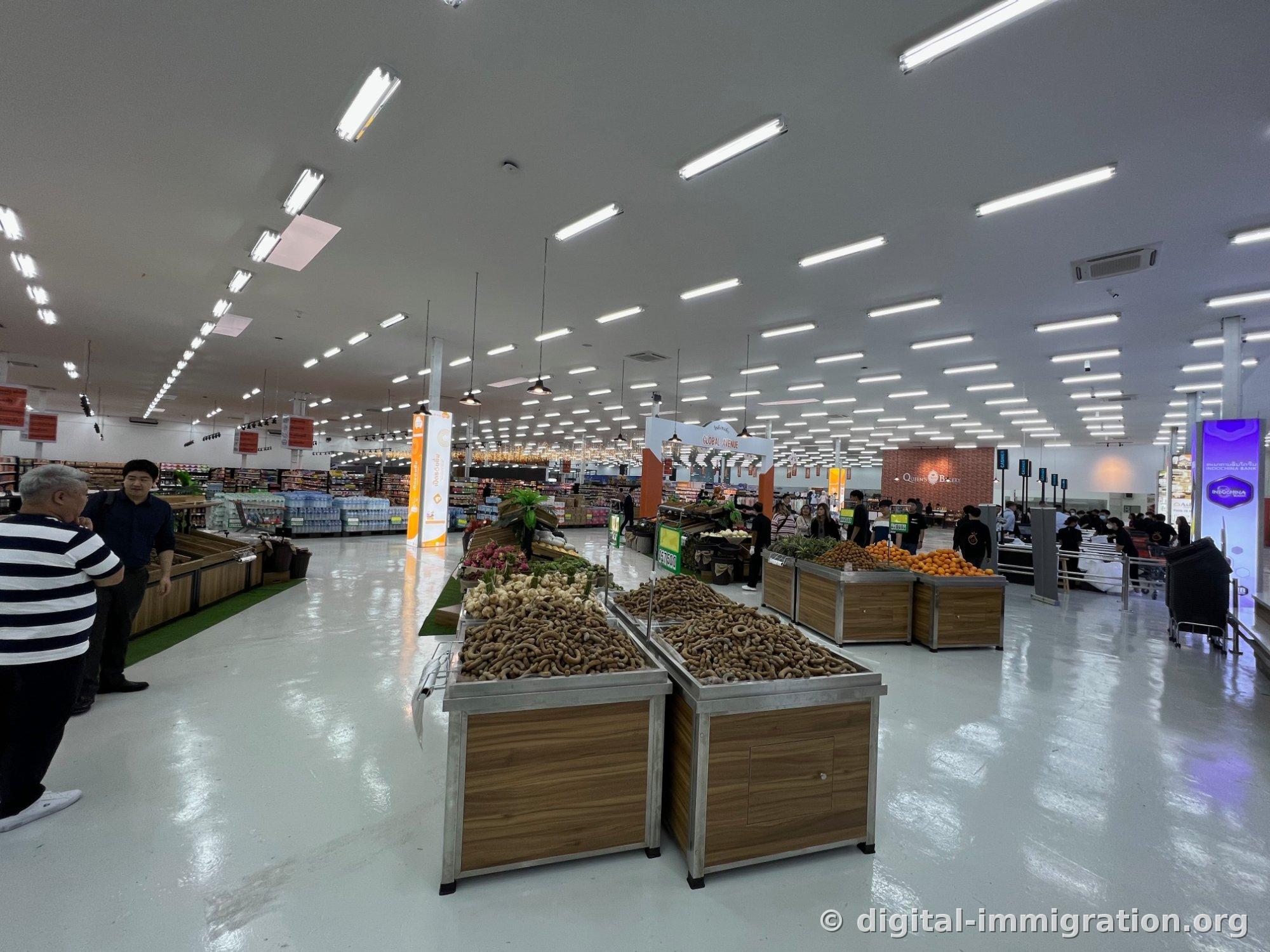
Right near the entrance is the fruit and vegetable section. What caught my eye first was a mountain of tamarind filling two stainless steel bins, with garlic, dragon fruit, pineapple, and citrus arranged behind it. That's a layout you'll find at almost any mart in Laos, but what's different here is that everything is loose and weighed individually, so you can take exactly as much as you want. Further inside is a standalone Queen's Bakery counter, and next to the checkout stands an Indochina Bank booth — so you can handle a currency exchange or a card question while you're doing your grocery run.
GLOBAL AVENUE — The Heart of This Mart's Imported Food Section
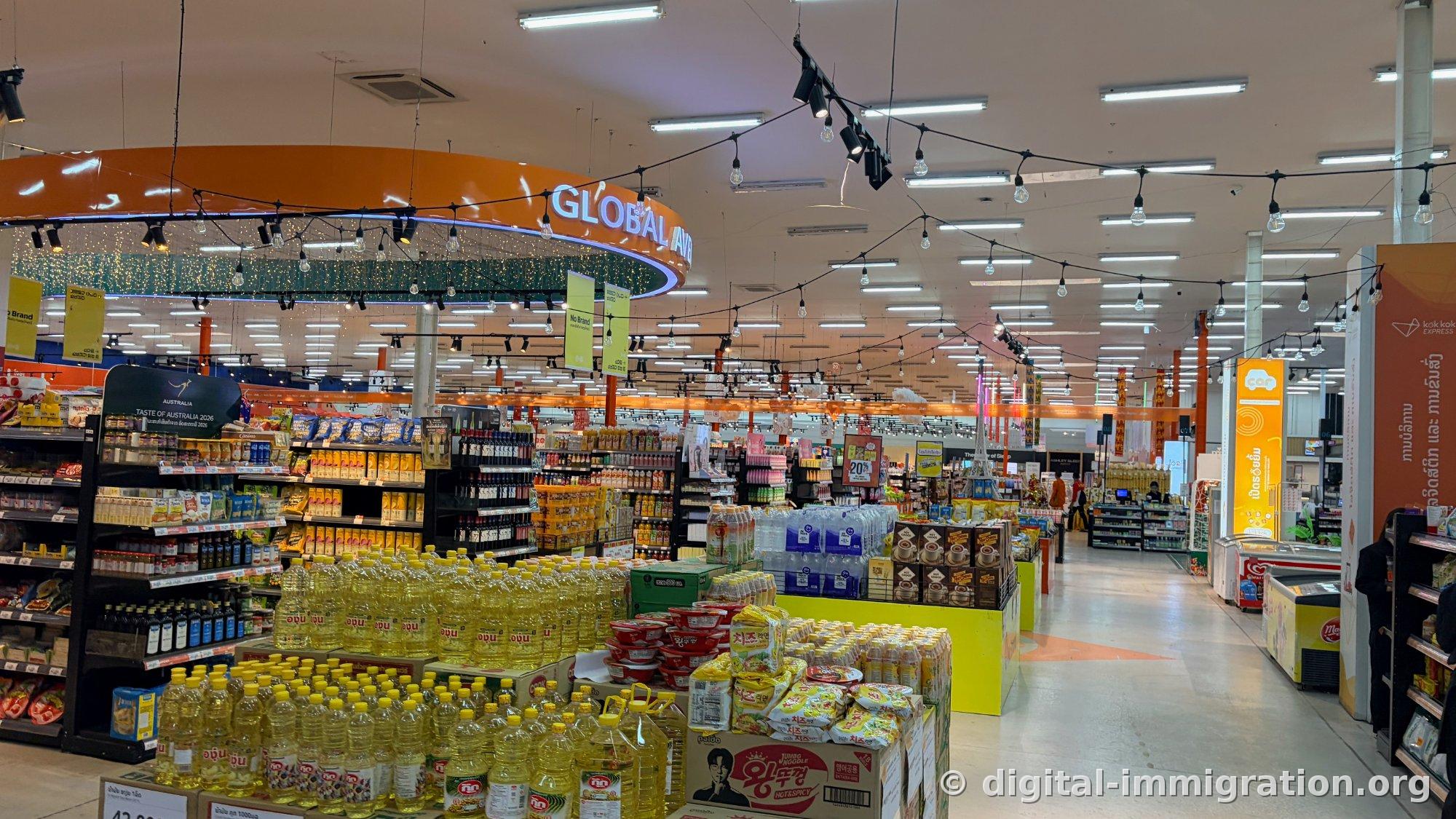
Right in the center of the store hangs a round orange arch that reads GLOBAL AVENUE. Strings of bulbs give it a night-market feel, and underneath is the imported foods zone. There's an Australian corner with a "TASTE OF AUSTRALIA 2026" banner, a shelf of French seasonings, and a European section complete with a model Eiffel Tower — and tucked among them, Korean instant noodles and cooking oil stacked pallet by pallet.
Apply for the Digital Immigration Form (LDIF)
What's interesting is how it's displayed. Instead of neatly slotting Korean cup noodles onto shelves, they've just torn open the boxes and stacked them. A heap of Wangdukkeong cup noodles, bundles of cheese ramyeon bags — all sitting right on the pallet. It's a layout built for customers buying in bulk. At the far right there's also a separate kok kok EXPRESS counter, which looked like a delivery/pickup desk (worth confirming on-site how it actually operates).
Korean Products — This Is What Really Surprised Me
Finding Korean groceries in Vientiane used to be a fair bit of a hassle — you'd make the rounds of a few Korean marts and just grab whatever they happened to have. But here, there's an entire section labeled in big letters, KOREA. In front of it stands a special "Wando — Island of Health" display, with a TV playing footage of Wando's scenery on loop. I never expected to be watching a Wando promotional video in the middle of Laos.
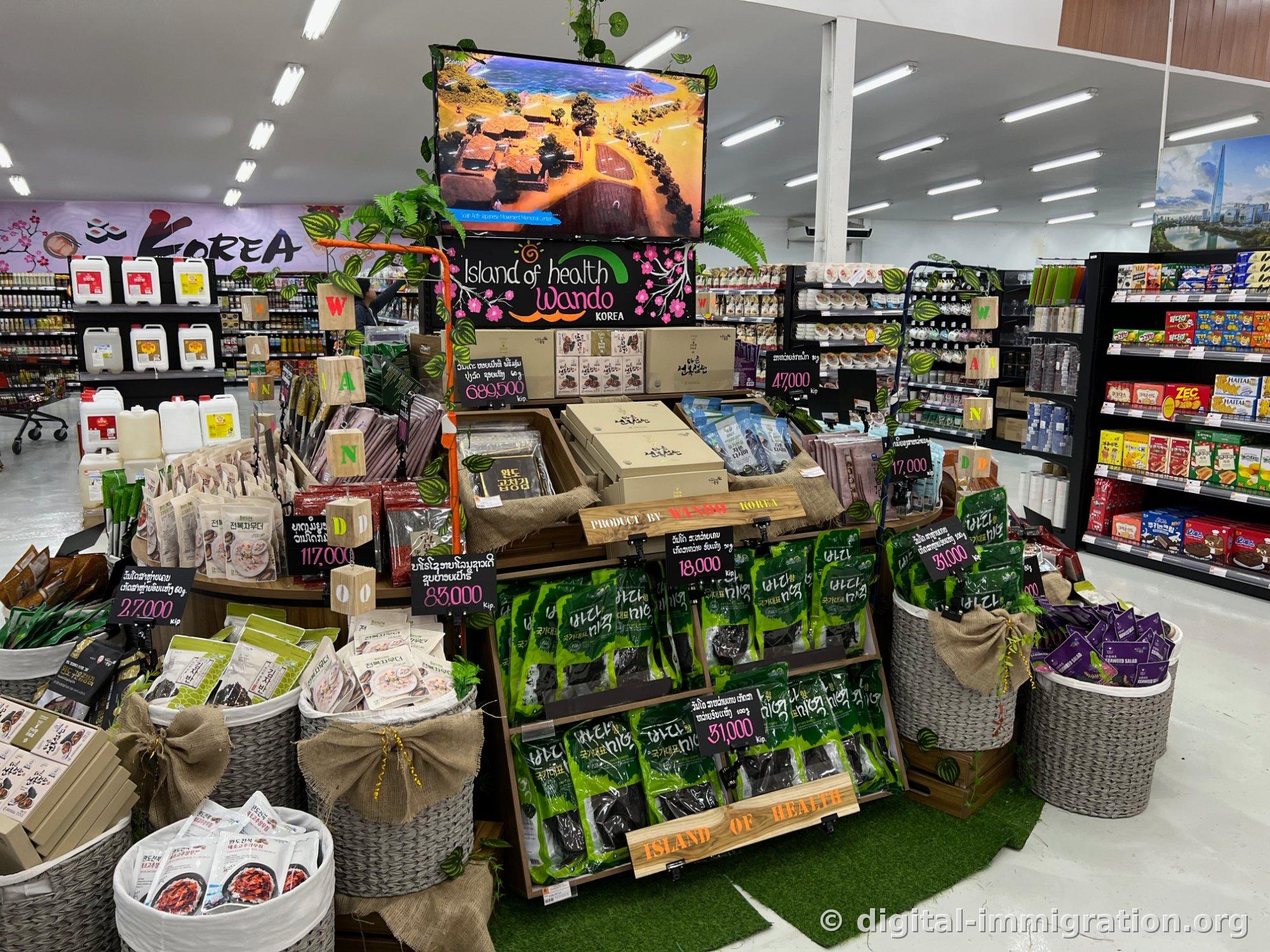
All the price tags were in kip, which made it easy to get a sense of the cost. Some of what I noted down — dried seaweed at 31,000 kip, small-packaged abalone items at 27,000 kip, a gim (dried laver) set at 17,000 kip, a gift set at 47,000 kip, and even a premium gift box at 689,500 kip. That last one feels like something straight out of a Korean department store's holiday gift lineup — I found myself wondering who'd buy it, then realized a Korean expat here to pay a courtesy visit to a local Lao company would absolutely need one. On the shelf next to it, snacks like Haetae Oh Yes, Kukdas, and Jack crackers were priced close to what you'd pay back home.
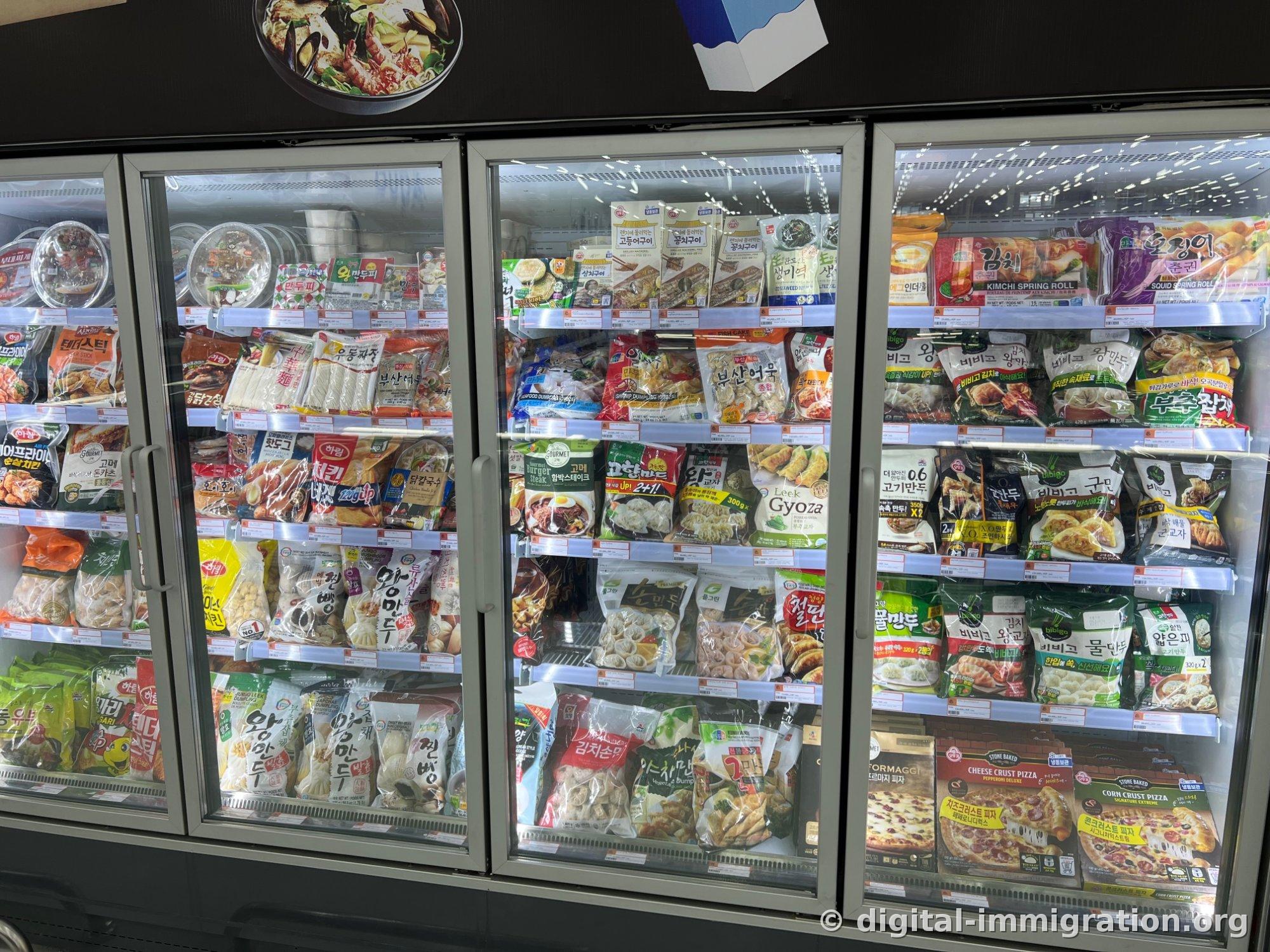
The frozen section was even more of a shock (in a good way). All three glass-door freezers were packed floor to ceiling with Korean frozen food. Bibigo king-size mandu, kimchi wang-gyoza, water dumplings, an assortment of Busan fish cakes, steamed buns, individually packaged grilled mackerel and grilled saury, udon noodles, chicken kalguksu, salisbury steak, even budae-jjigae meal kits and cheese-crust pizza. The freezer temperature was properly maintained, and I didn't see any packages with heavy frost buildup. If you're staying long-term, one trip here basically settles a month's worth of "what am I going to cook" worries.
To be honest, though, the prices are noticeably higher than back in Korea — figure roughly 1.5 to 2 times Korean retail for the imported frozen goods. This isn't something a tourist would pick up as a souvenir; it's more for someone staying in Vientiane for several months who buys it simply out of relief that "this is actually available here." Stock also varied a lot by item — there were tons of dumpling varieties, but the frozen tteok (rice cakes for tteokguk) I was specifically looking for was nowhere to be found.
Grabbing a Meal at the Food Court
It would be a shame to just shop and leave, because there's a food court attached to the store. Separate from the bakery (Queen's Bakery), there's a dedicated dining section, so you can do your morning shopping and just stay for lunch. Food courts at Lao marts usually offer no more than a noodle dish or two, but here there were several options and plenty of seating. Simply sitting down in air-conditioned comfort is worth it on its own — anyone who knows Vientiane's daytime heat will understand exactly what I mean. The menu and prices change from time to time, so it's best to check in person.
Location and How to Get There
Location is this mart's biggest advantage. It sits right next to the Muong Thanh Vientiane Hotel — smack in the middle of the neighborhood where Korean residents cluster. With Korean restaurants and Korean guesthouses dense in the area, plenty of people walk over, and if you're coming from the city center (around the Nam Phu Fountain) by tuk-tuk or the LOCA app, it's about a 10-minute ride. Since your bags are bound to get heavy, I'd recommend walking there but calling a car for the way back.
A few practical tips. First, paying in kip cash is the safest bet. There are card terminals and signage for Lao-style QR payment (like ColPay), but foreign-issued cards fail from time to time. Second, there's an Indochina Bank booth inside the store, so if you're short on kip you can try to sort it out on the spot. Third, bring your own shopping bag — the bags at Lao marts are thin, and the handles stretch out fast if you load them up with cans or bottles. Fourth, if you're buying frozen food, plan to grab it last and head straight back to your accommodation — given the outside temperature, the surface starts thawing within 30 minutes.
In short, this is less a "tourist attraction" than "everyday infrastructure." If you're just breezing through Vientiane on a two-night trip, there's no real need to make a special trip here. But if you're staying a week or more, cooking for yourself at your accommodation, or scouting the city as a place to live longer-term, that changes things. There's also nowhere better to get a feel for prices in Laos — walk through scanning the kip price tags, and within half a day you'll have an intuitive sense of what's expensive and what's cheap in this country.
Read next
- Pha That Luang in Vientiane: Walking the Golden Stupa on a Cloudy Afternoon at Five O'Clock
Take a tuk-tuk fifteen minutes northeast from downtown Vientiane and the road suddenly widens, with a golden mass rising abruptly beyond a wall. Pha That Luang. The very stupa that…
Vientiane Capital · That Luang - Kyoto-Style Water Drop Mochi Found in the Heart of Vientiane — KYO Cafe & Meal Record
Vientiane is fiercest at two in the afternoon. Shade does nothing to help, and you can feel your shirt clinging to your back. That day, while walking through downtown, it became un…
Vientiane Capital · KYO Cafe & Meal - A French Evening at Le Vendôme in Vientiane, Laos—Record of Three Plates: Pizza, Carbonara, and Salad
On an evening when the breeze from the Mekong River drifted across the street, I stepped into Le Vendôme Restaurant tucked into an alley near Wat Inpeng. Whenever French cuisine co…
Vientiane Capital · Le Vendôme Restaurant