Wat Xieng Khuan in Vientiane (Buddha Park) — I spent three hours walking among gods molded from cement
As you drive from downtown Vientiane toward the Thai border, the road gradually becomes more desolate. Just past the Friendship Bridge and a bit further along the riverside road, y…
Vientiane Capital · ຖະໜົນ ທ່າເດື່ອ
As you drive from downtown Vientiane toward the Thai border, the road gradually becomes more desolate. Just past the Friendship Bridge and a bit further along the riverside road, you arrive at Wat Xieng Khuan, a sculpture park commonly known as Buddha Park. Laos is a socialist state that doesn't officially promote religion, but Buddhism is recognized as an exception. When you visit this park, you can feel in your bones how the entire nation's religious energy is concentrated in that one exception. For what is officially a government-managed tourist destination, the effort invested in each individual sculpture is oddly excessive.
First, let me say this: an umbrella is not optional but essential. There is almost no shade in the park. All the sculptures stand outdoors, and the palm trees planted around them are tall but cast no shadows. I went in around 11 a.m. and within thirty minutes, the back of my neck was cooked. A hat wasn't enough. There's a reason all the local ladies carry umbrellas.
Overwhelmed immediately upon entering
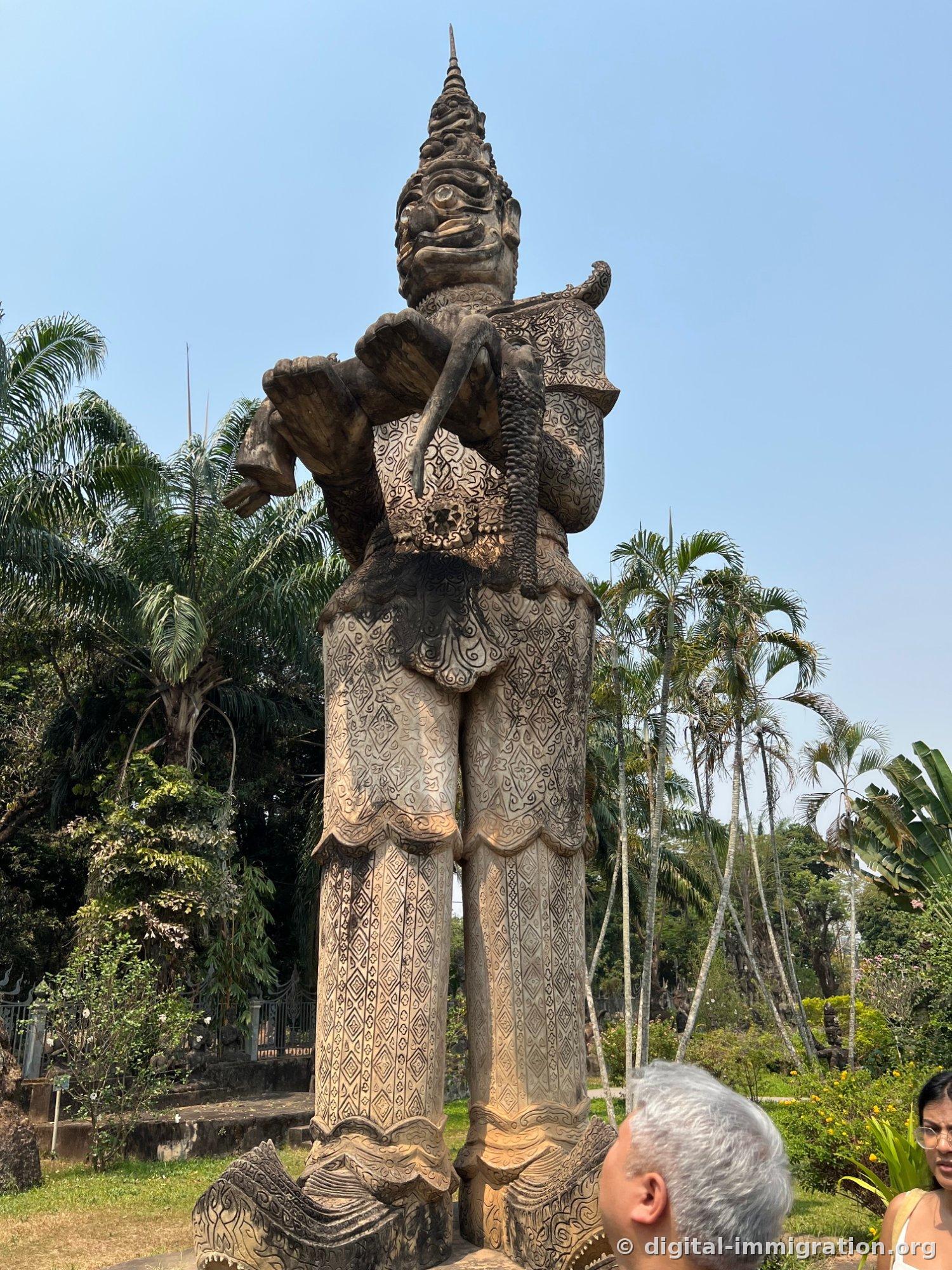
Just past the entrance, you encounter a guardian statue about three times your height. When you look up from below, you can't see the face—only the diamond-patterned hem of its pants blocking the sky. It's made of poured cement, but the detail in the clothing folds and pattern density is remarkable. The elderly tour group next to me just stood there with their heads tilted back.
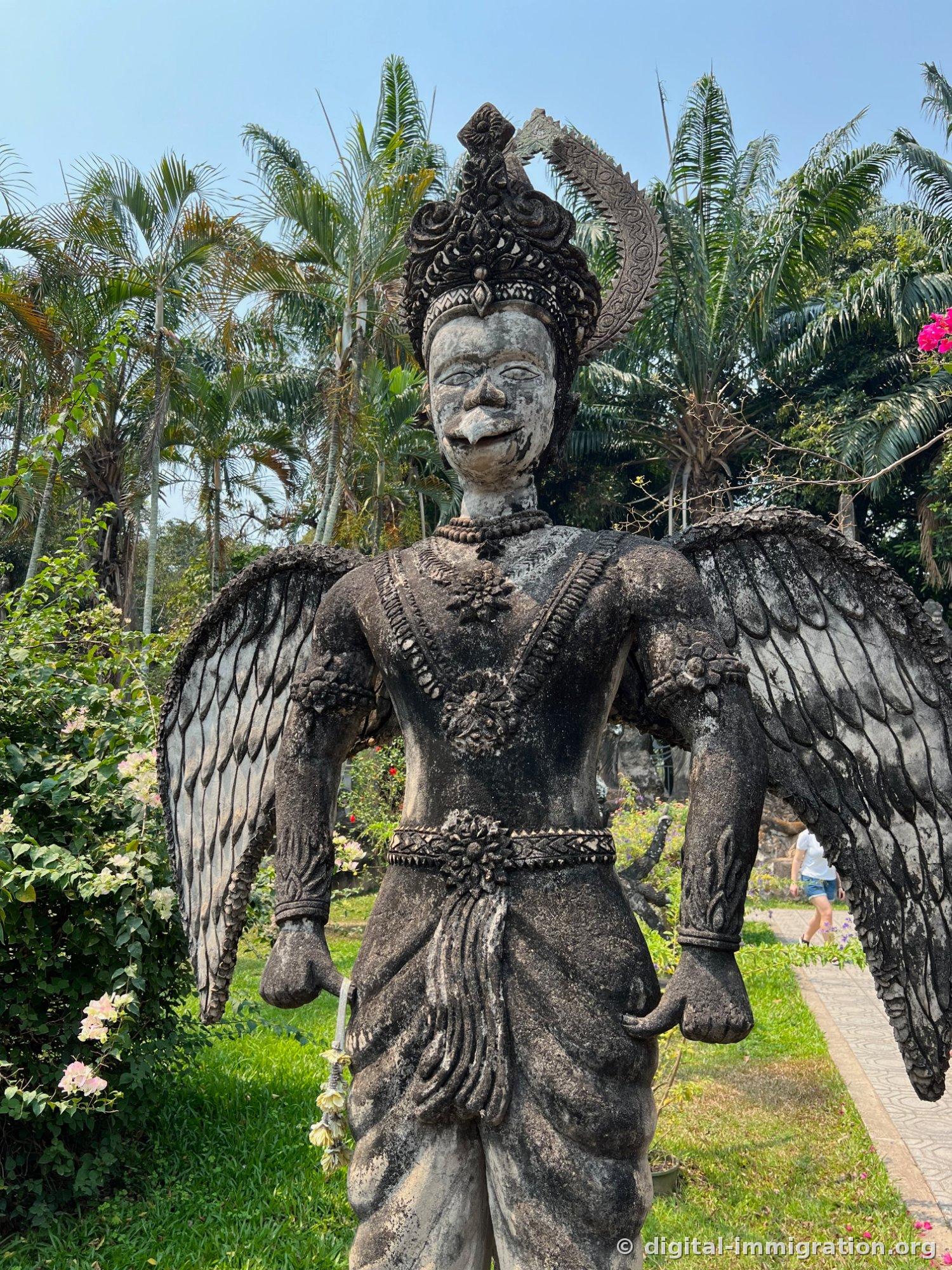
A bit further in stands a winged figure along the path. Its face looks like it's almost smiling, and the crown is intricate, but the torso and arms have turned jet black with moss and age. This is characteristic of the sculptures here. They were created around the 1950s, so the surfaces are all weathered, and oddly, that decay brings out the form better. If they had been repainted to look new, this wouldn't have the same charm.
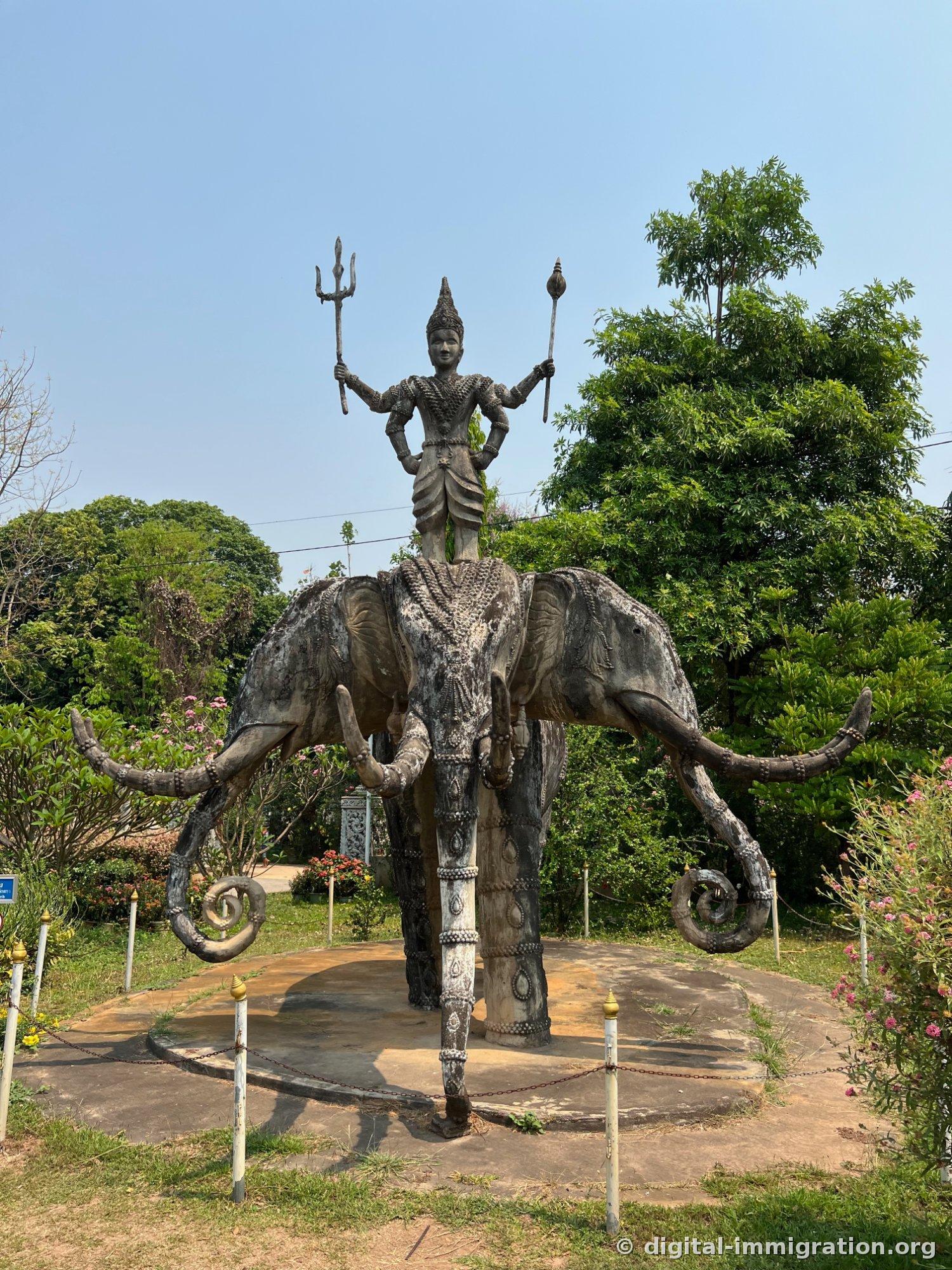
One of the most photogenic sculptures in the park shows a figure holding a trident, standing on a three-headed elephant. The three elephant trunks curl in different directions, with the ivory tips curled inward. A chain-link fence surrounds it, but the ground is concrete, so midday heat radiates up intensely.
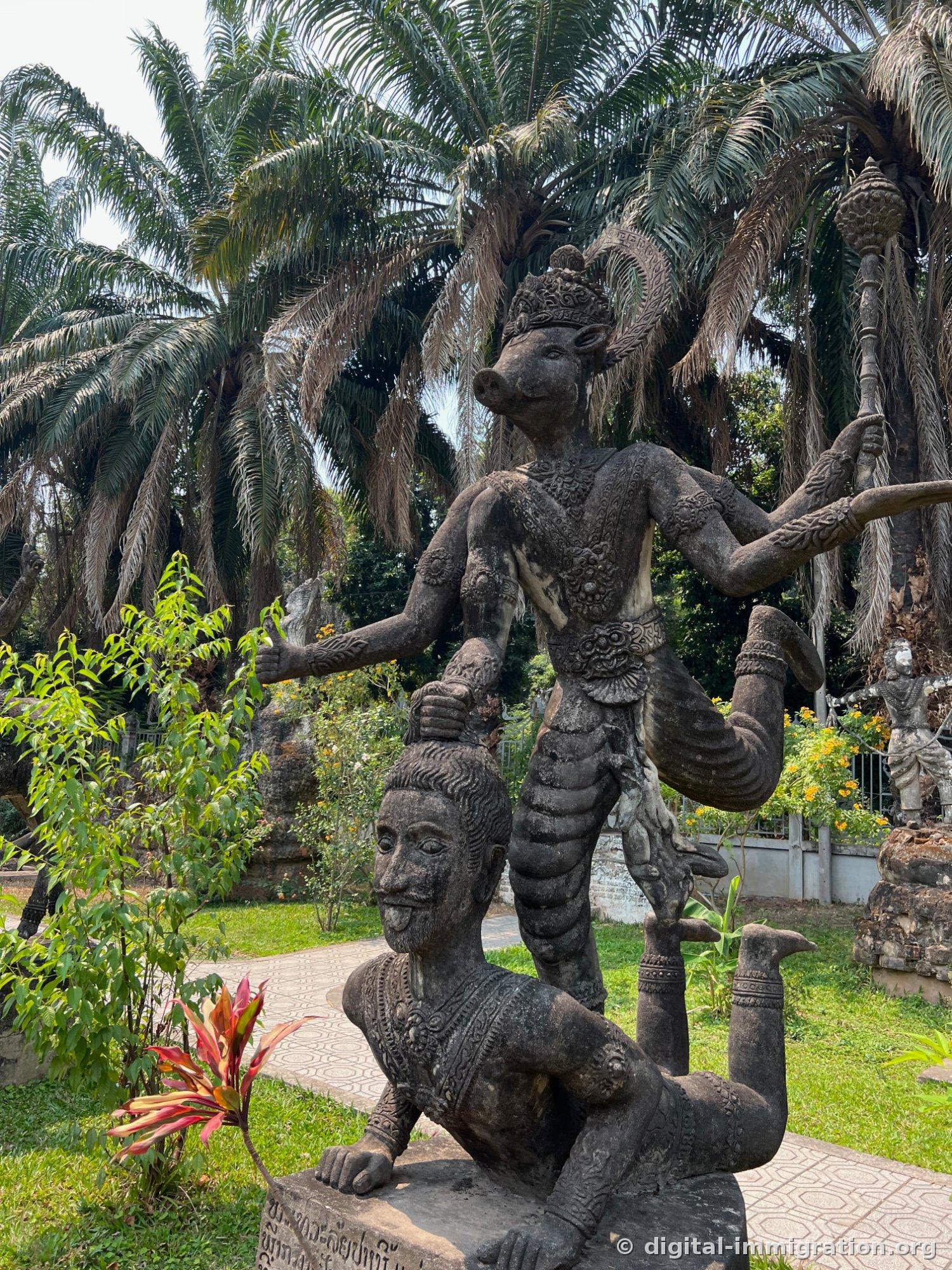
What I stared at the longest was a sculpture of a pig-faced deity standing on a fallen figure. The pedestal has a Lao inscription I couldn't read. What made it stranger was that the expression on the face being stepped on wasn't pained but calm instead. About half the sculptures in this park are like this—"What on earth is this scene supposed to be?"
Location and how to get there — Thailand is across the river
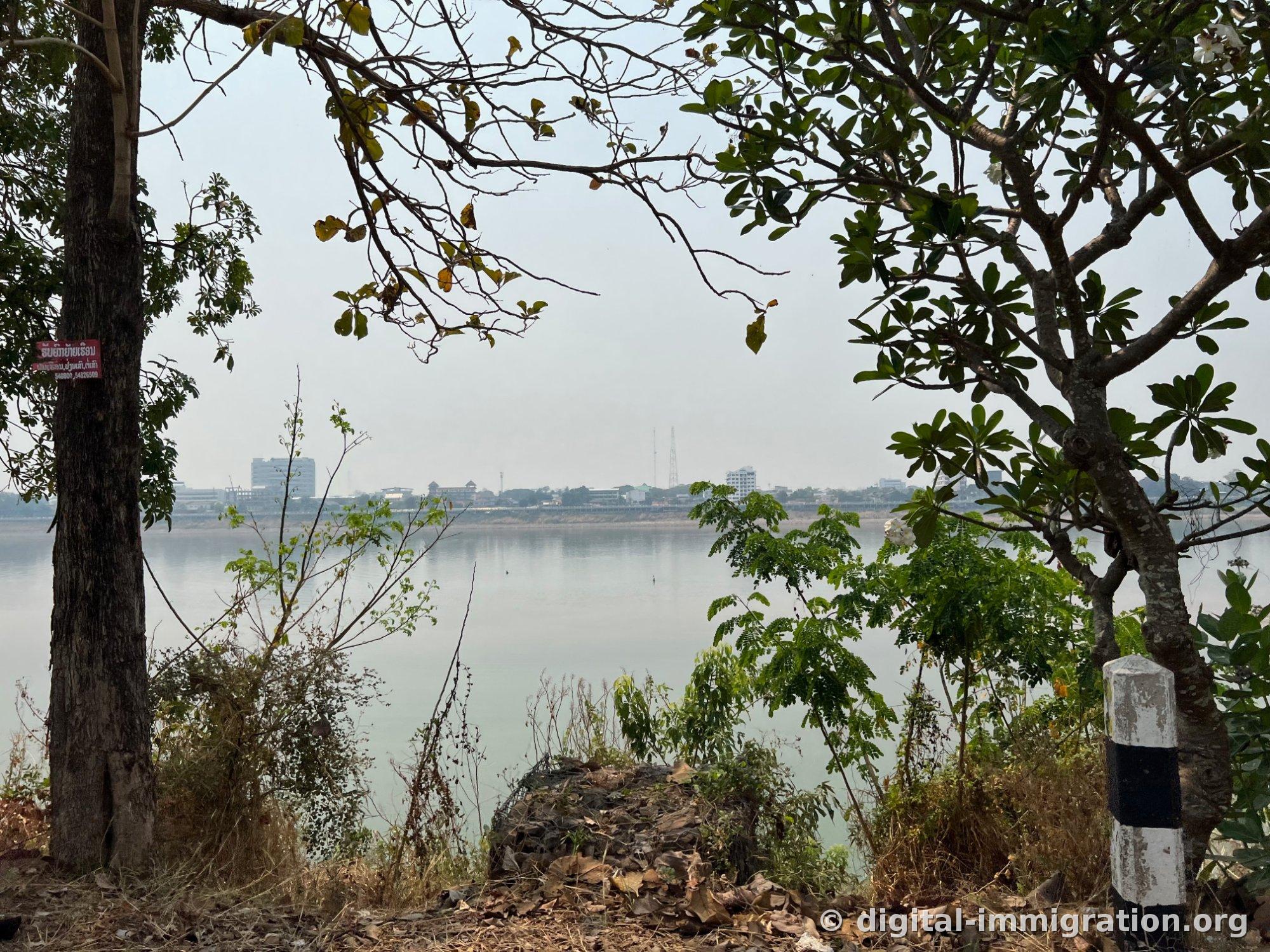
The park sits right beside the Mekong River. Walking through the sculptures and heading toward the riverbank, you glimpse the far shore through the trees—those buildings are on the Thai side in Nong Khai. It was dry season, so the water level was low and the river looked narrower than it actually is, and the sky was hazy. In this region from February to April, heavy haze from slash-and-burn farming is common.
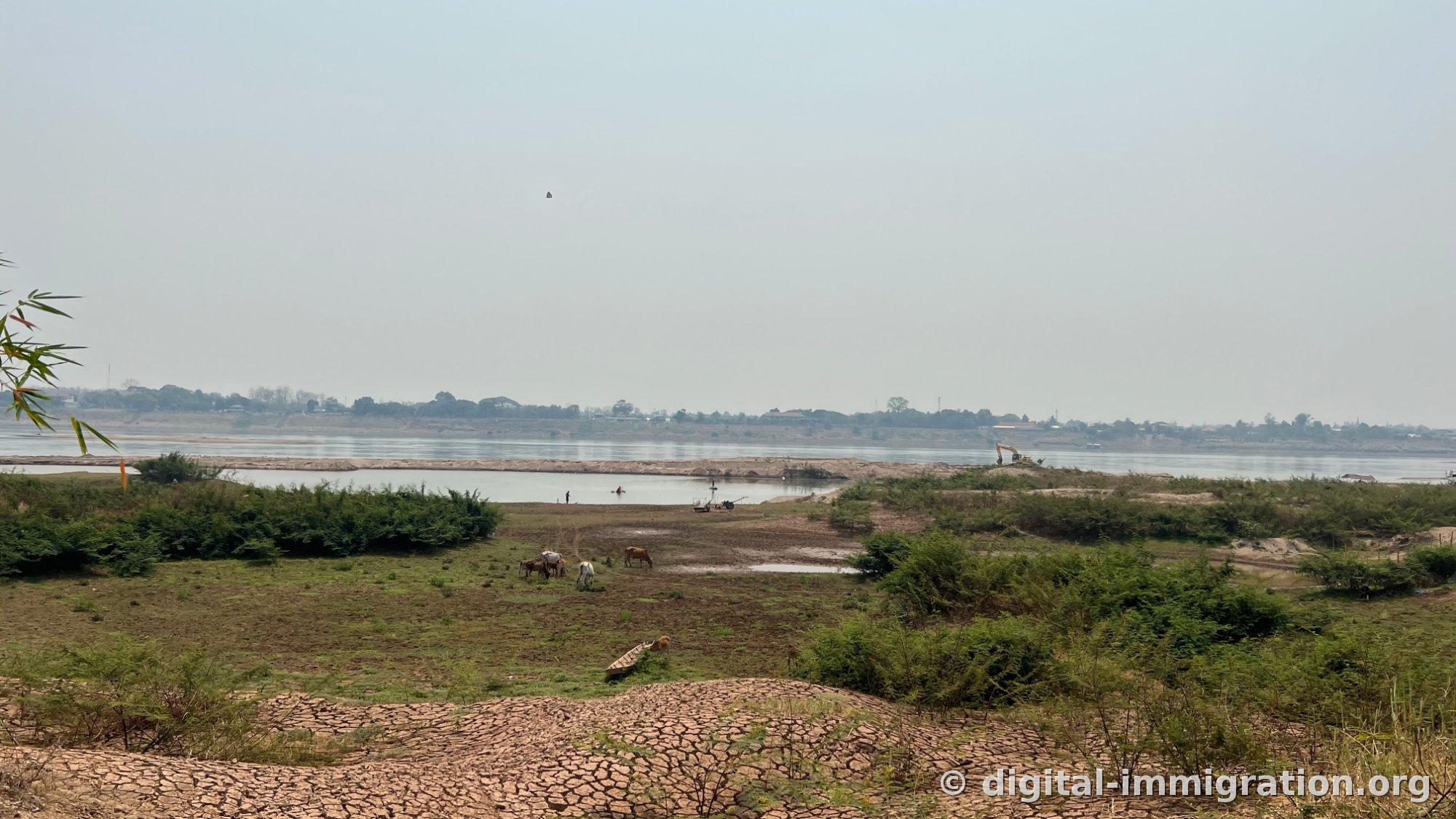
Further up, the riverbank was completely exposed sandbar. A few cattle grazed on the cracked mud flats, and in the distance, an excavator was dredging sand. It looked less like a tourist attraction and more like just a living riverside. That's what I came to see, so I spent more time here than looking at sculptures.
From downtown, you can charter a taxi or tuk-tuk or take bus 14. The bus is cheap but takes longer and don't expect air conditioning. I chartered a taxi for the round trip, and it's good to tell the driver upfront that it takes two and a half hours. Many people assume they can see everything in an hour and end up spending all their time in the pumpkin building. Fares vary widely depending on negotiation and timing, so I'd recommend confirming on the spot.
The park's centerpiece — the three-level "pumpkin building"
In the center of the park sits an enigmatic round concrete lump. Everyone calls it the pumpkin building. A gigantic demon face is attached to the front, and its gaping mouth is the only entrance. You have to crouch to enter through it. The appearance is surprisingly charming thanks to flowering plants arranged on both sides of the mouth.
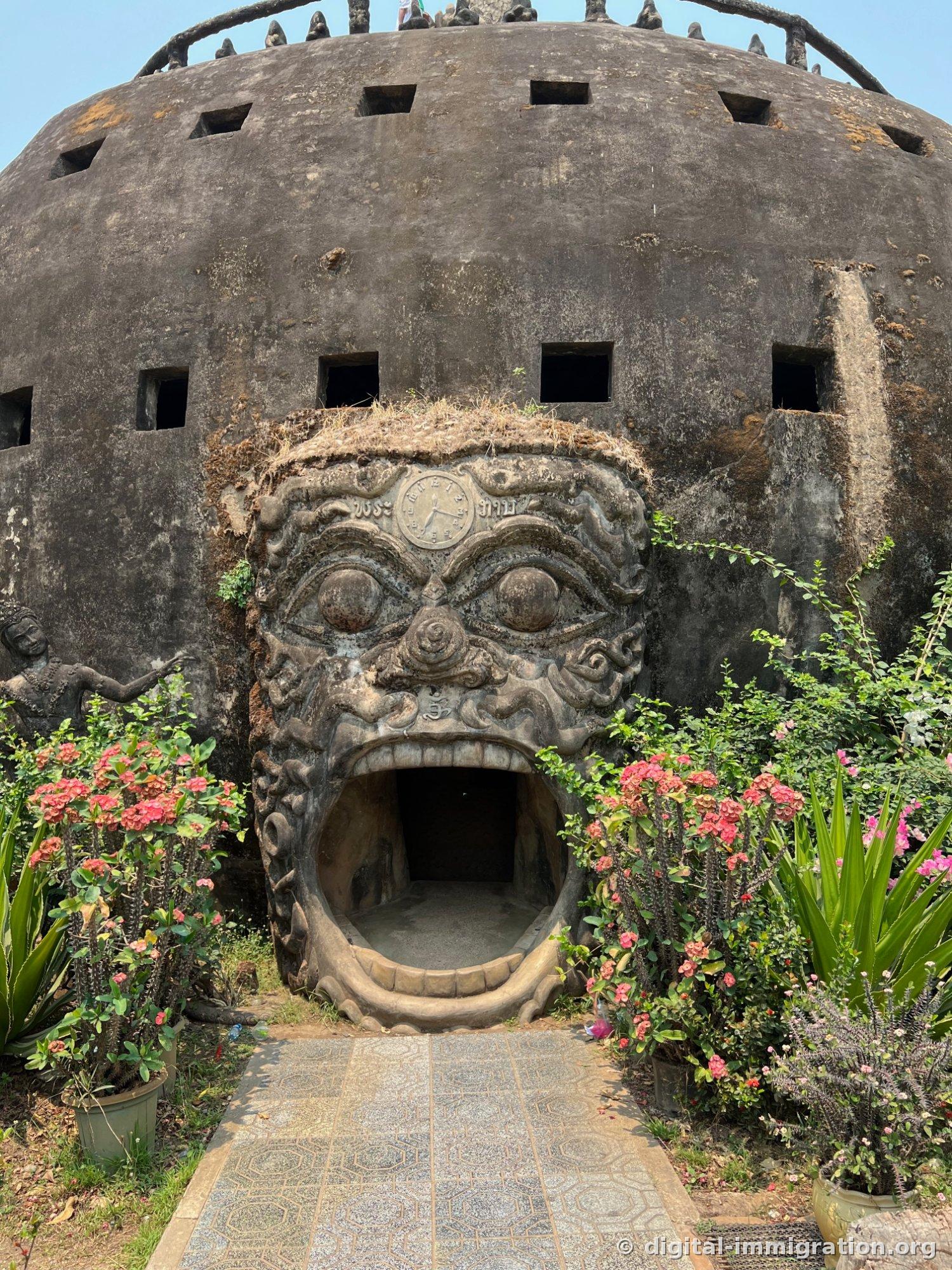
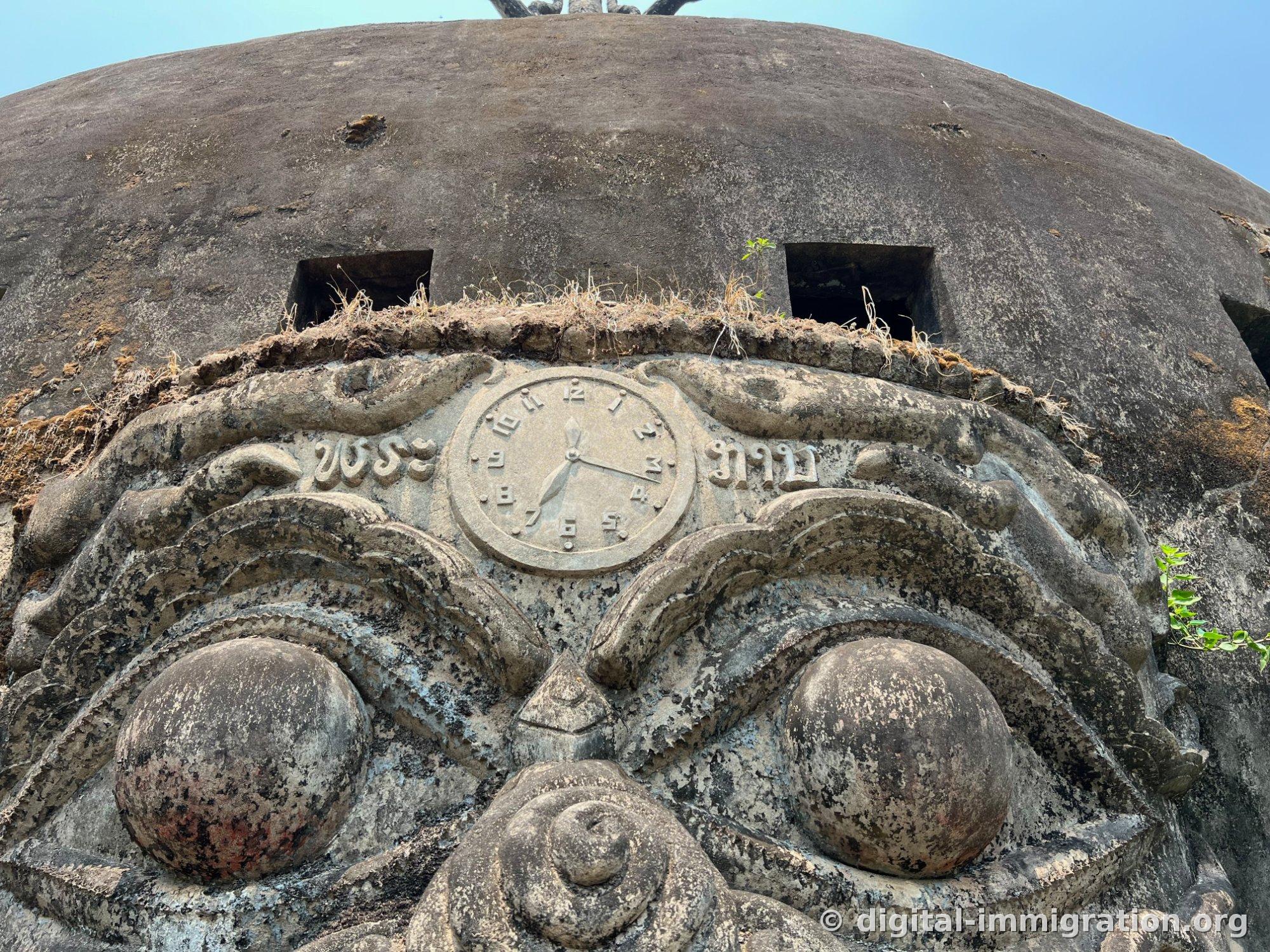
I recommend looking closely at the face before entering. There's a clock relief carved into the center of the forehead with Lao characters on both sides. The clock numbers are in Lao numerals, so at first I thought they were just patterns. Above the eye sockets, dried grass has grown like eyebrows.
Ground floor is hell, ascending toward heaven
As you enter, the smell hits you first. A humid earthy smell mixed with dust envelops you. The only light comes from square holes cut into the walls and a single incandescent bulb. It takes a while for your eyes to adjust. The ground floor depicts hell—skulls are piled across the floor and skeletal wood formations have figures hanging from them. It looks less disturbing in photos, but in person it's quite unsettling.
Apply for the Digital Immigration Form (LDIF)
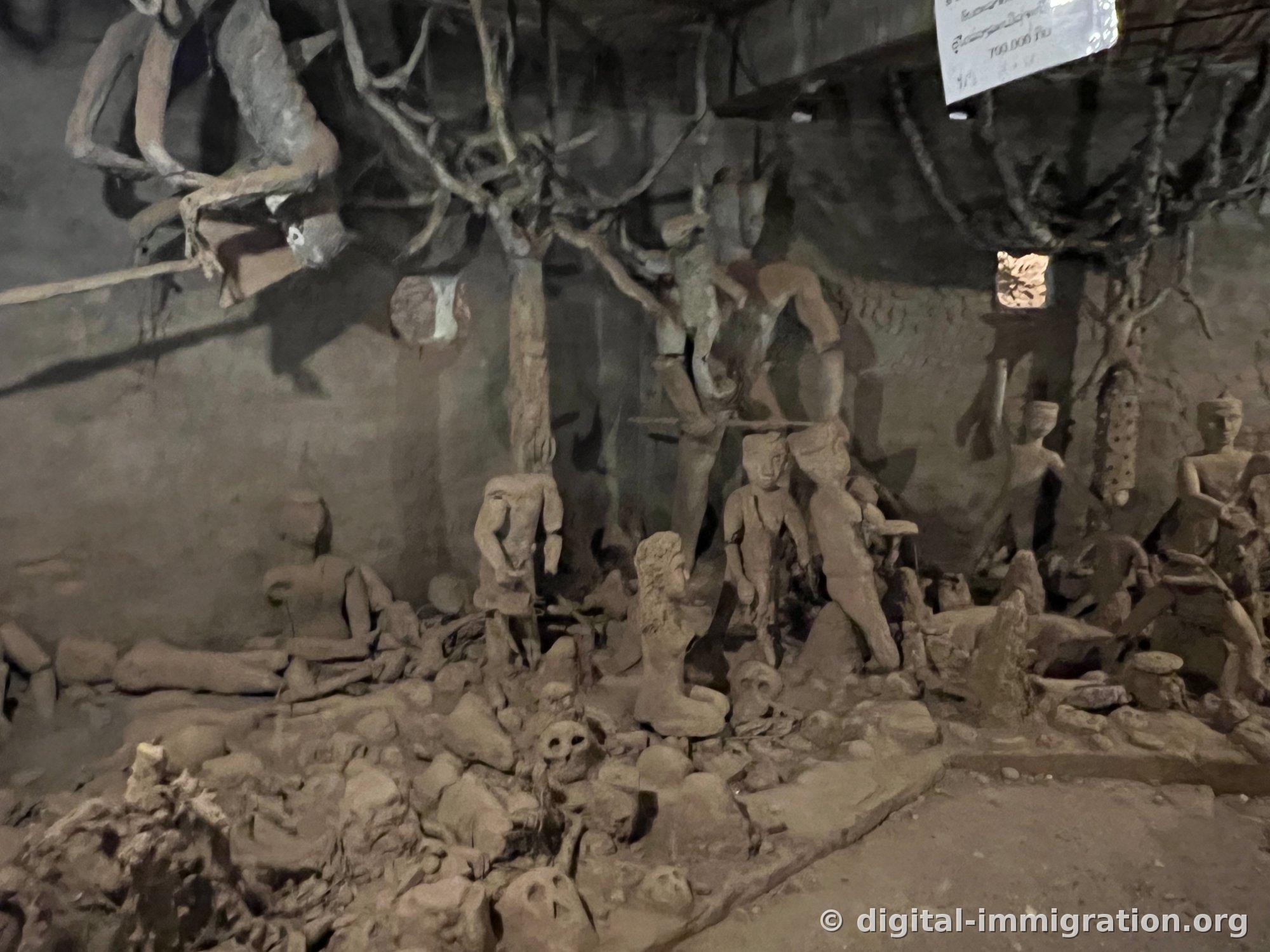
Behind the pillars, three reclining Buddhas sit in a row before a pile of skulls. Dangling root formations from the ceiling, cobwebs, and light rays streaming through wall holes overlap to create a stageset-like atmosphere. What's even more astounding is that these were actually put together by human hands in the 1950s and 60s, piece by piece.
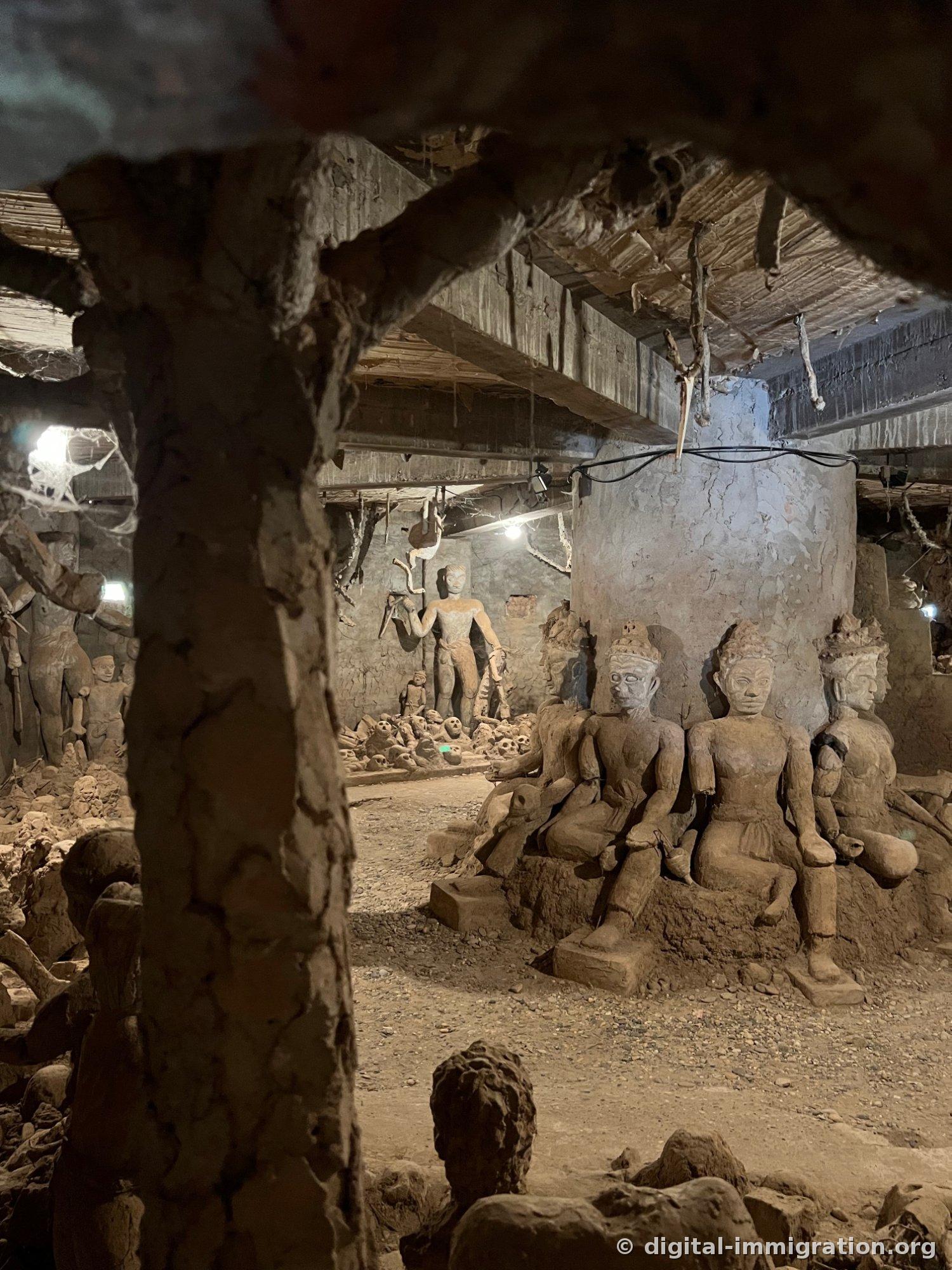
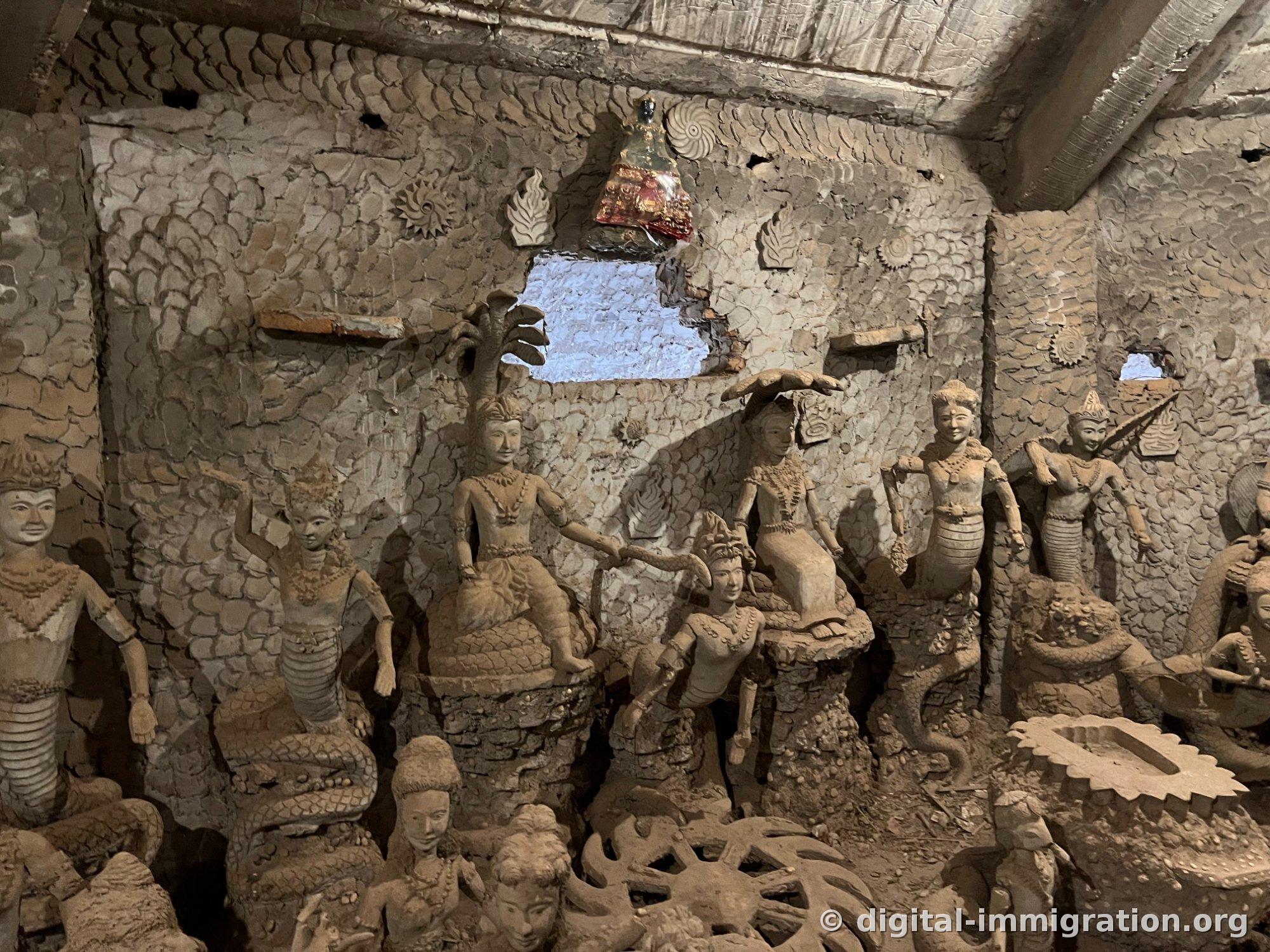
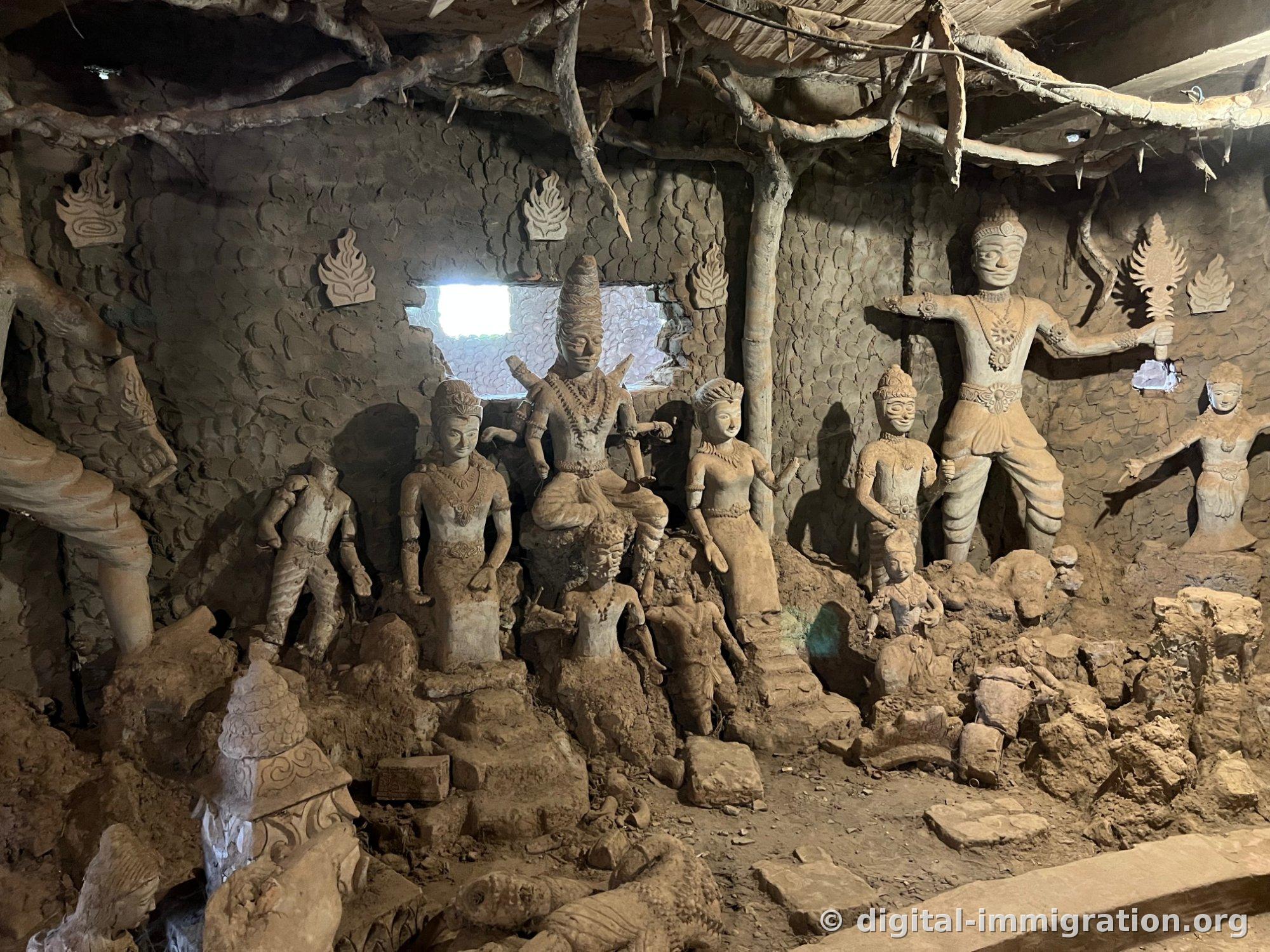
Climbing the narrow stairs to the next level, the atmosphere changes. The walls are covered in a fish-scale pattern, and figures sit in a row on naga (serpent) bodies. The light coming through the upper-level windows makes photography possible here.
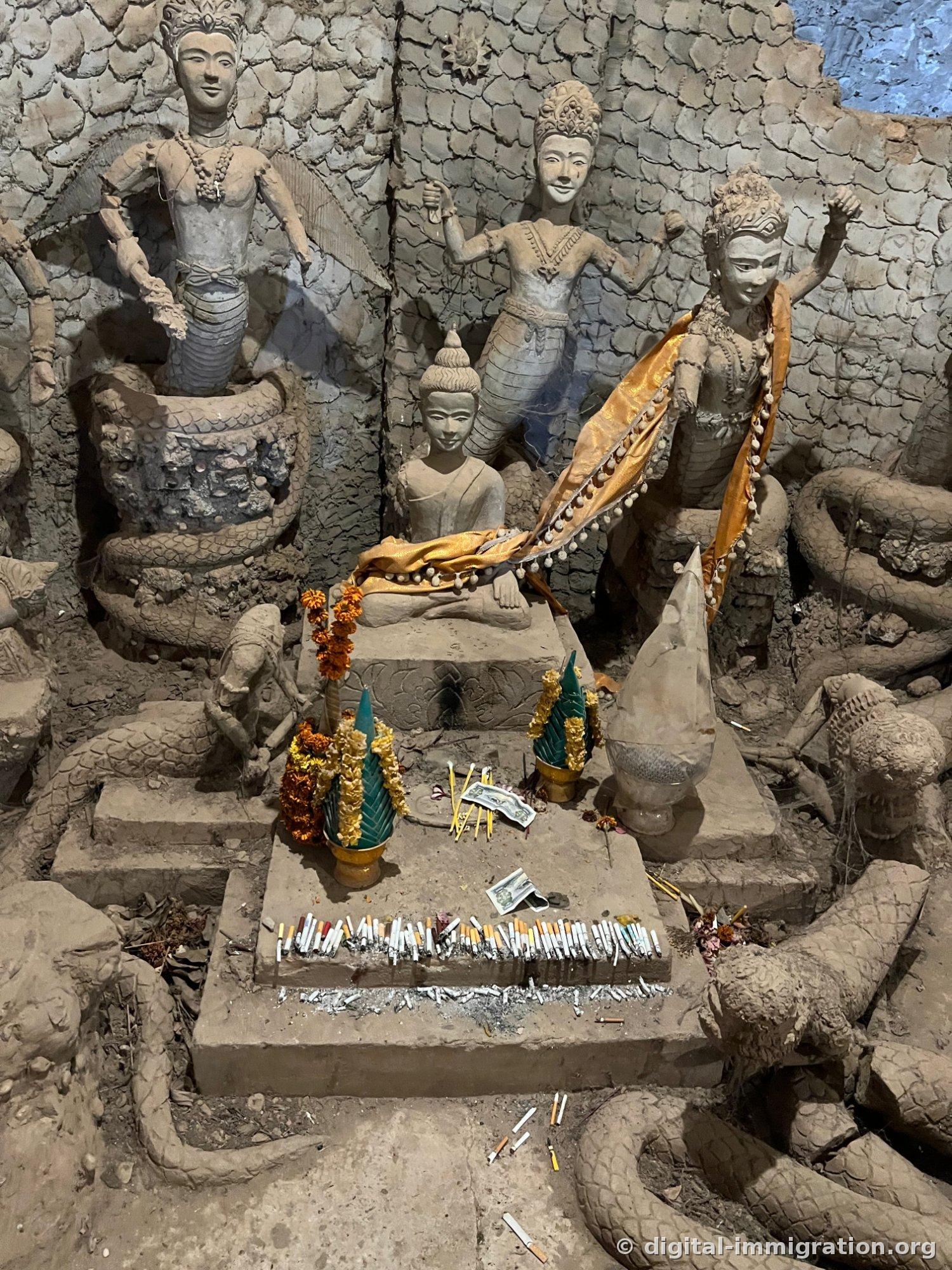
In one corner sits an altar where people still make offerings. In front of the image draped in gold cloth are marigold flowers, cone-shaped offerings made from banana leaves, incense, and rows of dozens of cigarettes standing upright. A few banknotes are also placed there. This cigarette offering appears throughout Laos, and it's somewhat startling at first. It's evidence that this is not merely a sculpture exhibition but an actual place where people come to pray.
Definitely go up to the rooftop
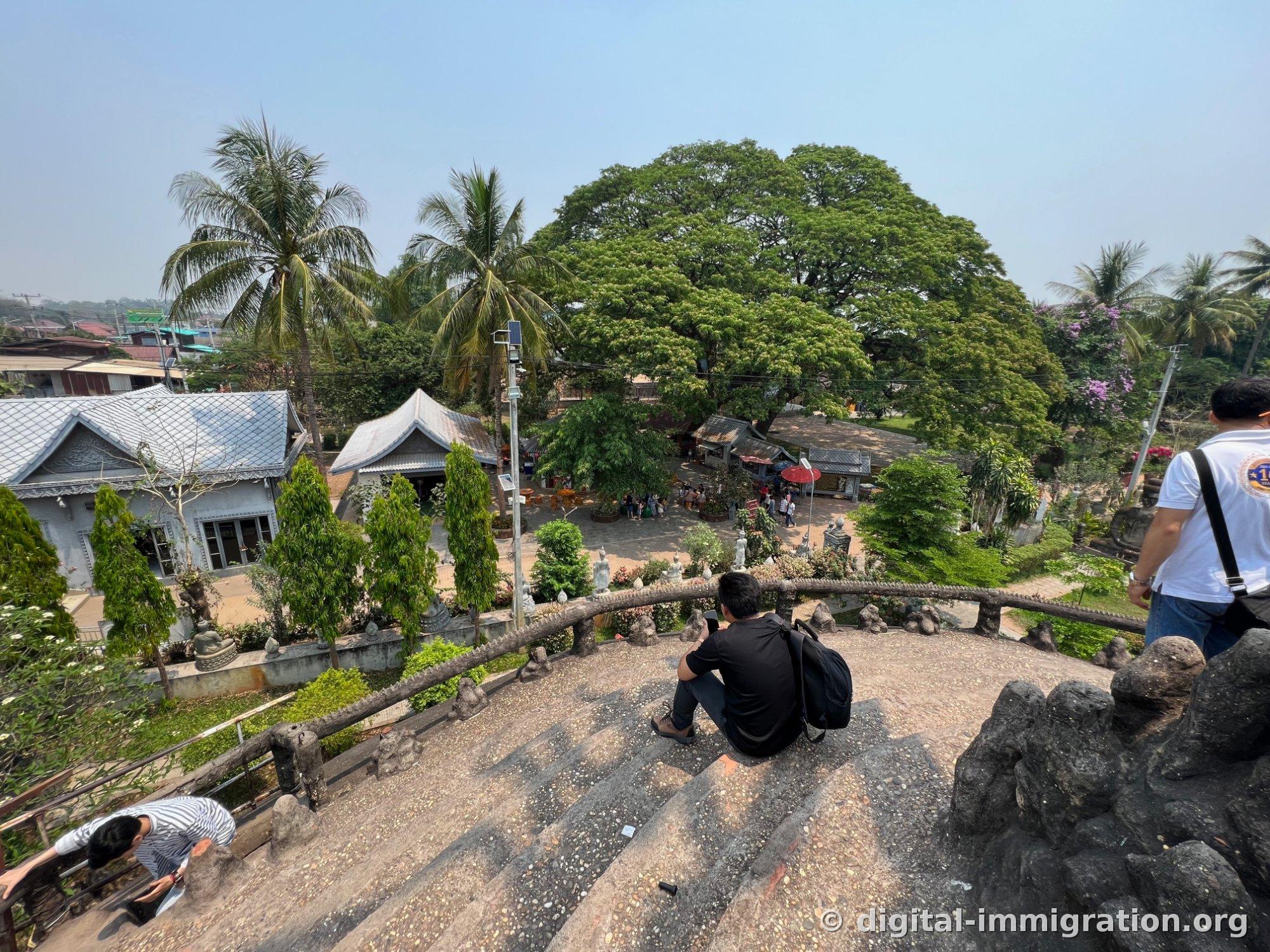
Though the stairs are narrow and dark, reaching the top brings you to the rooftop—the observation point of this park. On one side you see the ticket booth, restaurant area, and a gigantic umbrella-shaped tree that covers the entire courtyard. You can see all the people gathered in its shade from above.
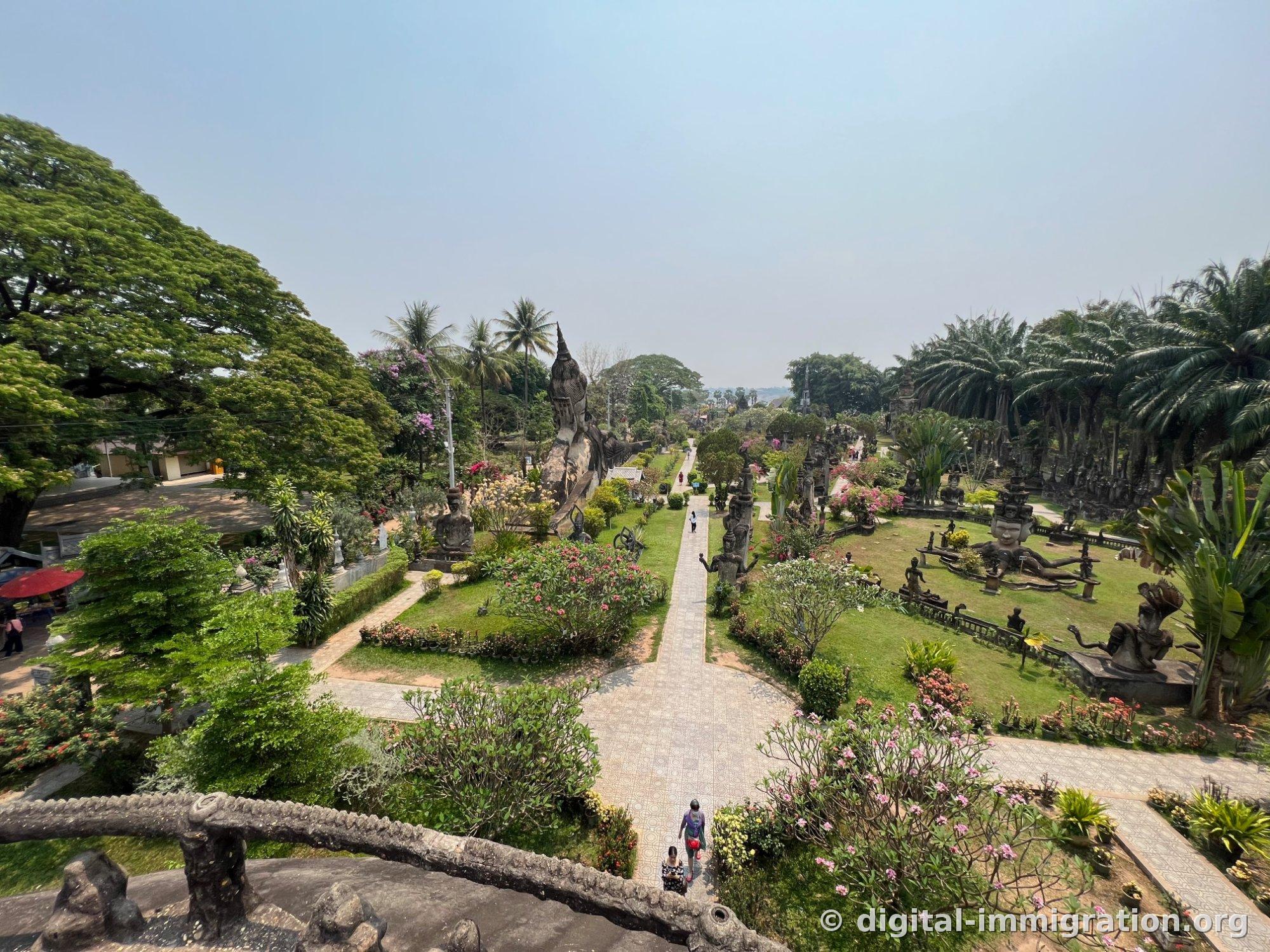
Turning to the other side, the entire park comes into view. The central promenade stretches in a straight line with sculptures arranged on both sides—a layout that only makes sense from here. The gray mass lying in the distance to the left is the reclining Buddha. From ground level, the sculptures seemed scattered chaotically, but from above you can see there's an underlying axis.
The reclining Buddha and scattered treasures in the garden
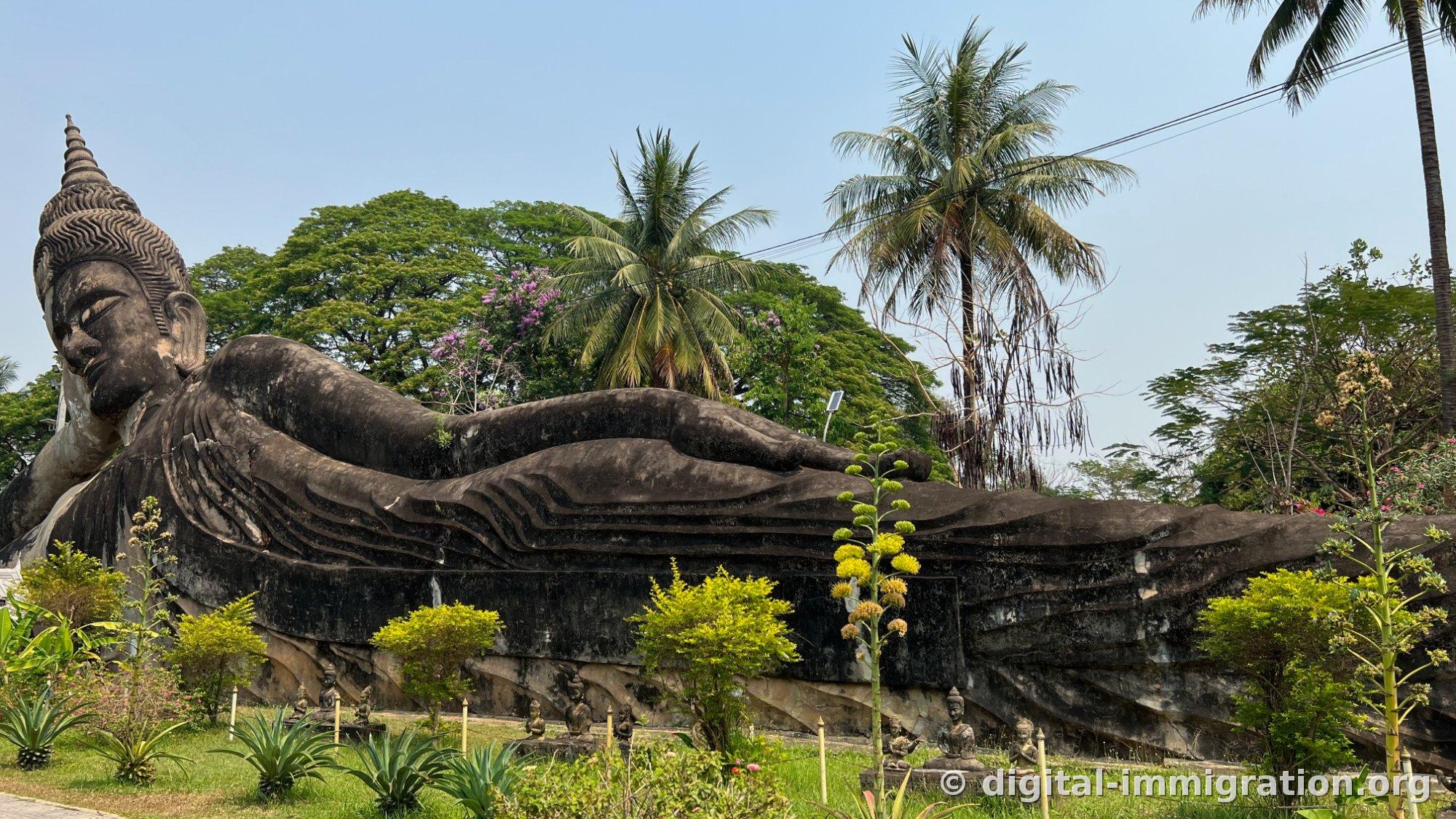
At the western end of the park lies a reclining Buddha about 40 meters long. It takes a while just to walk from the head to the feet. Along the underside of the body, small statues are densely attached to the pedestal—you have to bend down to see them. The face catches backlighting in the morning, so afternoon is better if you want a front-facing portrait.
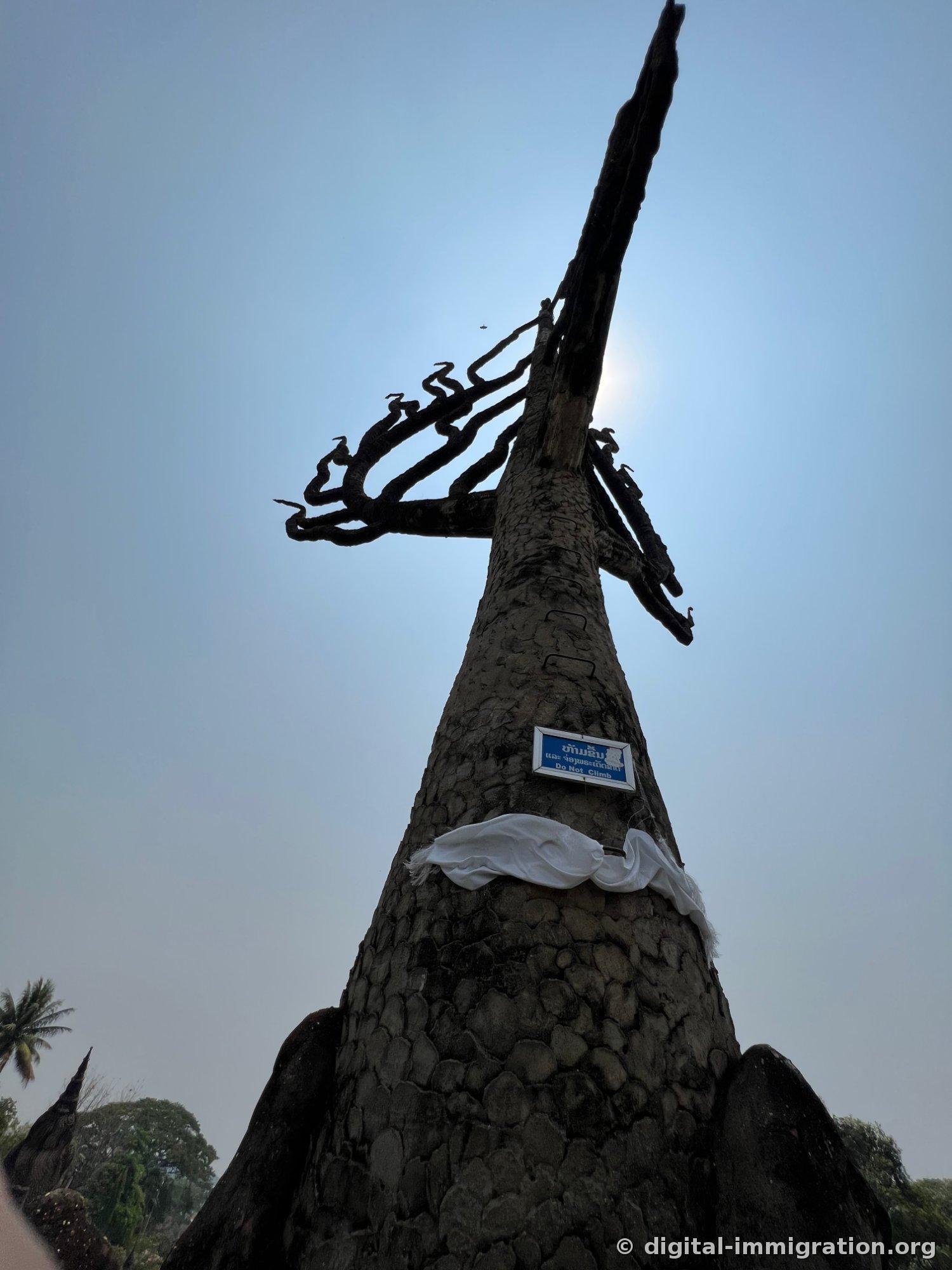
Throughout the park are several naga spires reaching upward. They're wrapped with white cloth and marked with blue "Do Not Climb" signs. The fact that these signs were necessary proves people have climbed them. Most sculptures are within arm's reach and fences are low, so you do see people climbing and touching them. Since they're weathered cement, once broken they're hard to restore.
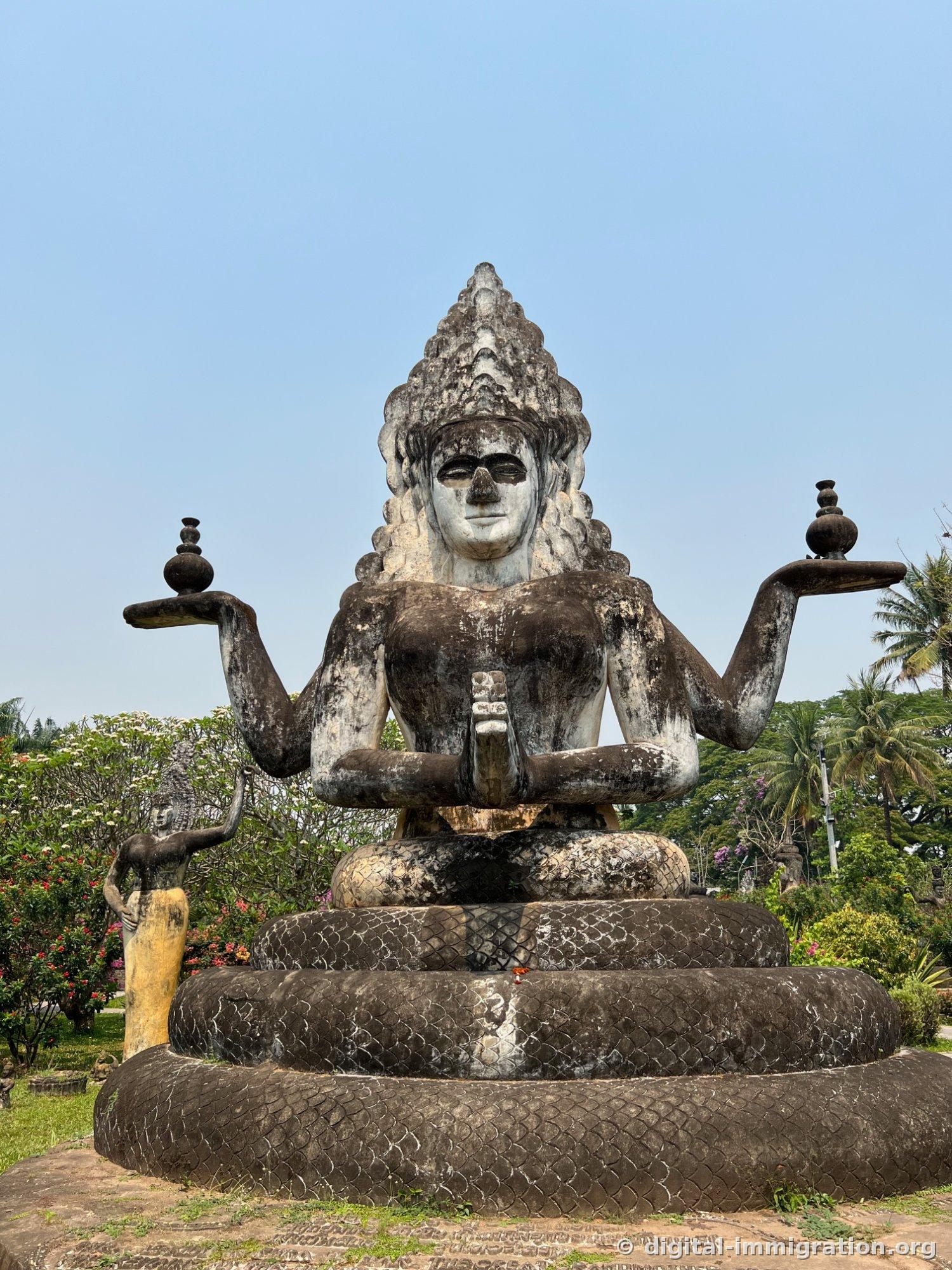
Also impressive was the many-armed Buddha sitting on coiled naga. Only the face remains white while the body has turned jet black, making the expression stand out dramatically. The naga body beneath has three large coils of scales, and a red flower someone left sits in front.
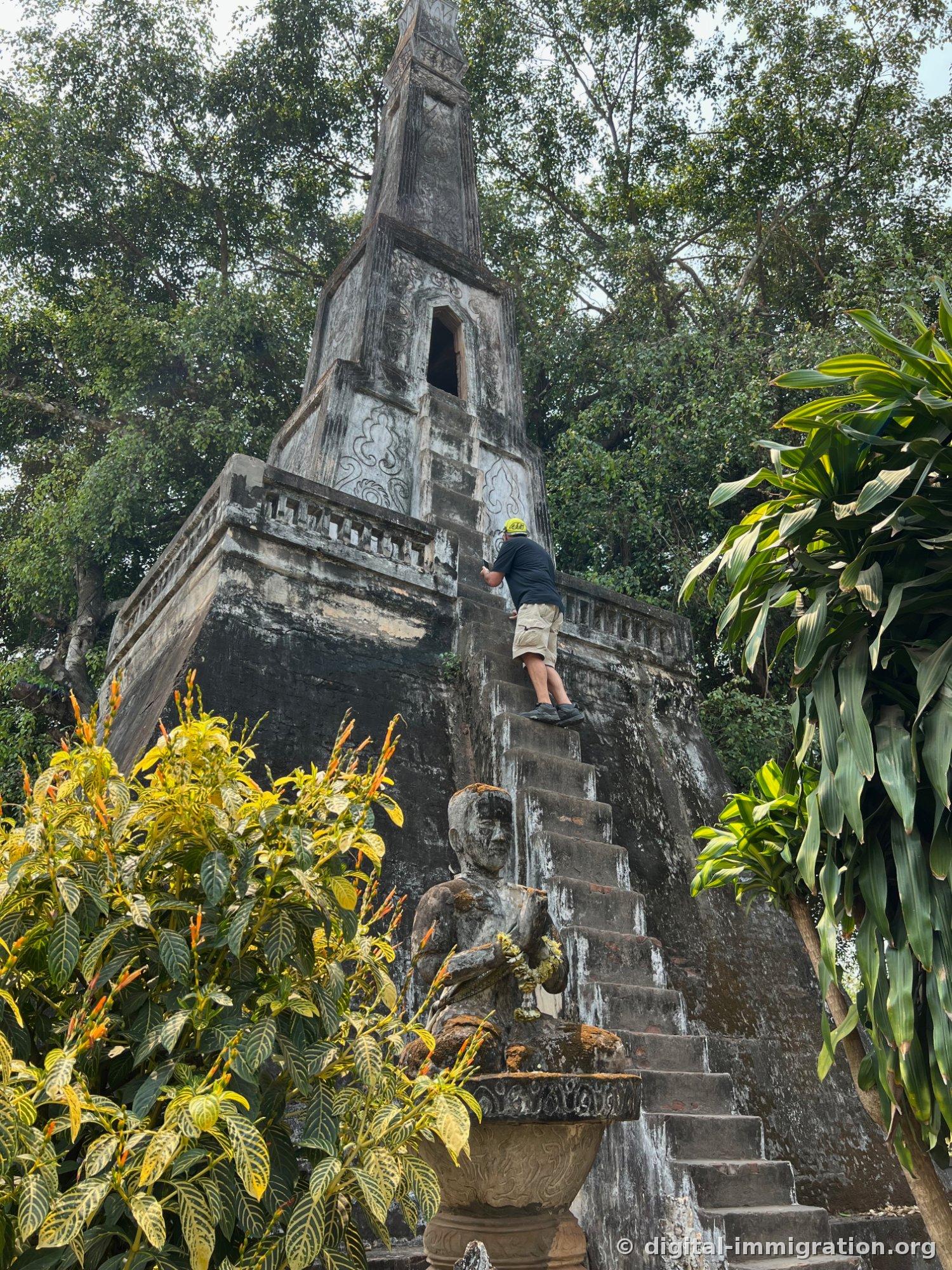
There's also a tower-like structure with stairs attached. A man in a yellow hat was climbing the narrow steps, and without railings it looked even more dizzying from where I stood. The stairs are narrow and slippery. I don't think it's worth climbing.
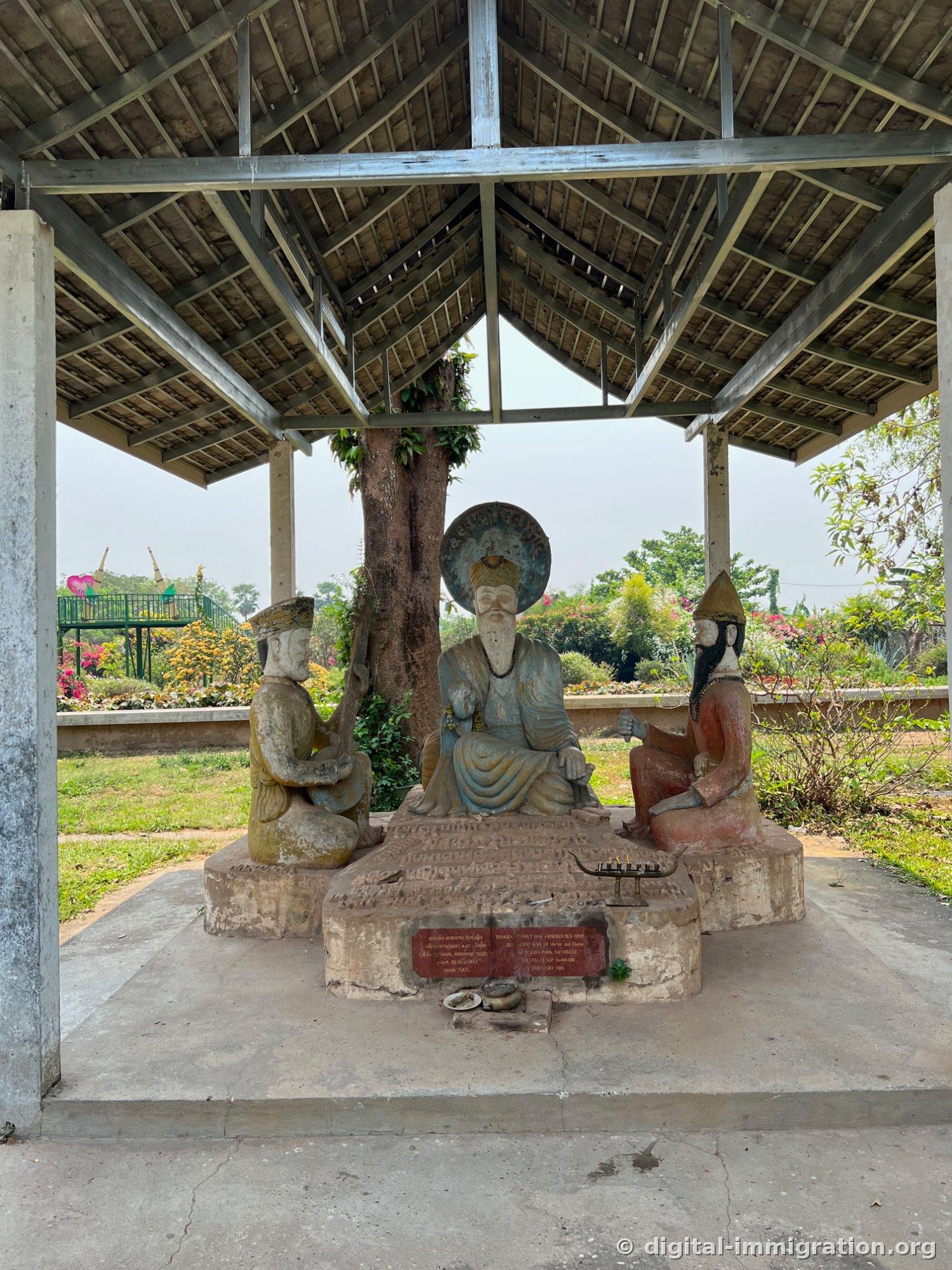
Beneath a tin-roofed pavilion is a sculpture group with a long-bearded figure seated in the center and two figures kneeling on either side. The red plaque in front lists the sponsorship details in Lao and English—in February 2005, someone donated 10 million kip to construct a shrine and flower beds. These plaques tell more about how the park is maintained than the sculptures themselves. It's a structure where the government built it and individuals contribute bit by bit to maintain it.
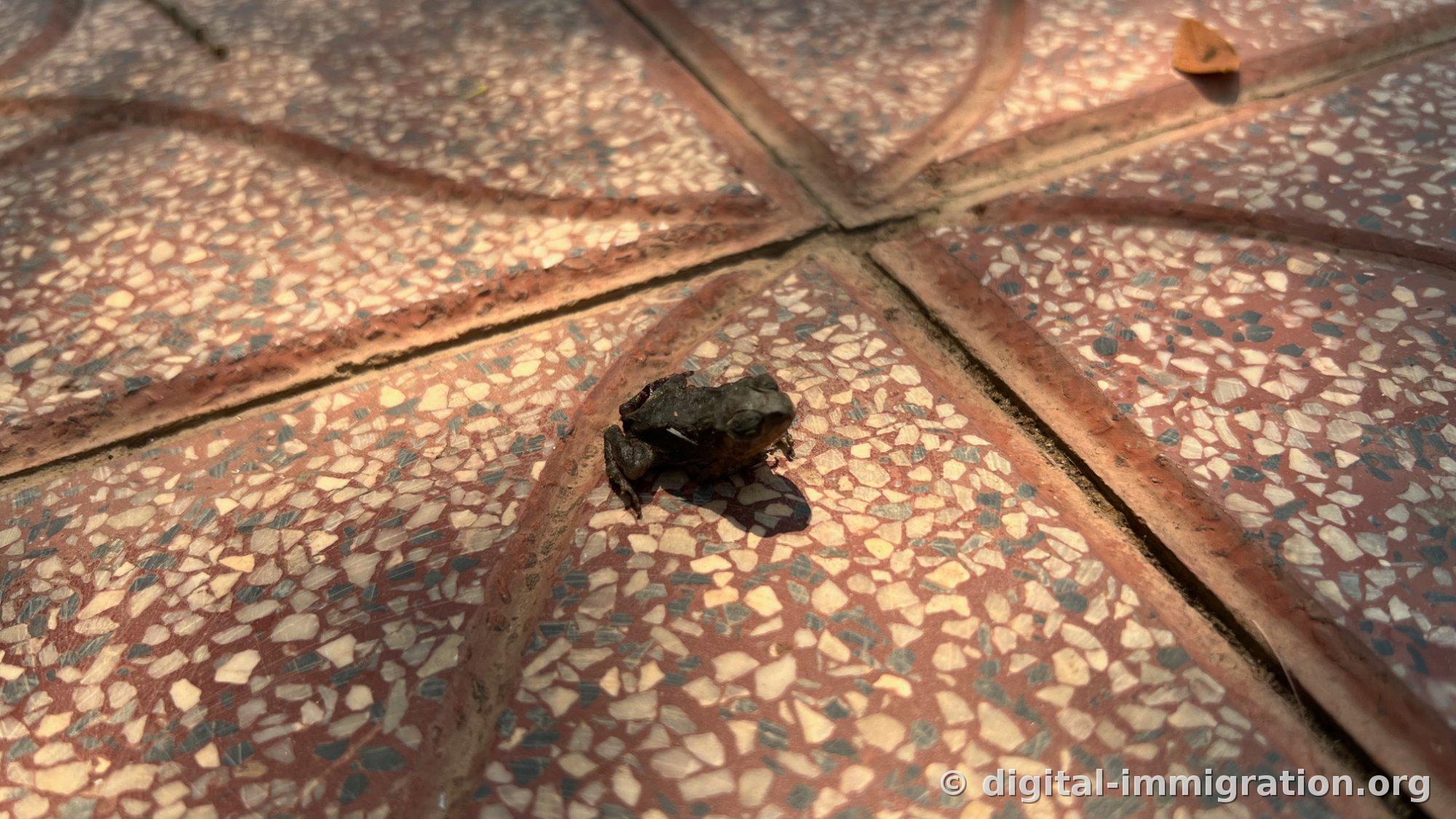
And this is just a record of that day: while walking, I found a fingernail-sized frog sitting on the tiled promenade. It didn't run away even as people passed. I have no idea why it was out on the hot tiles near noon. I carefully made my way around it so as not to step on it.
Roasted bananas and coconut — you absolutely must eat these
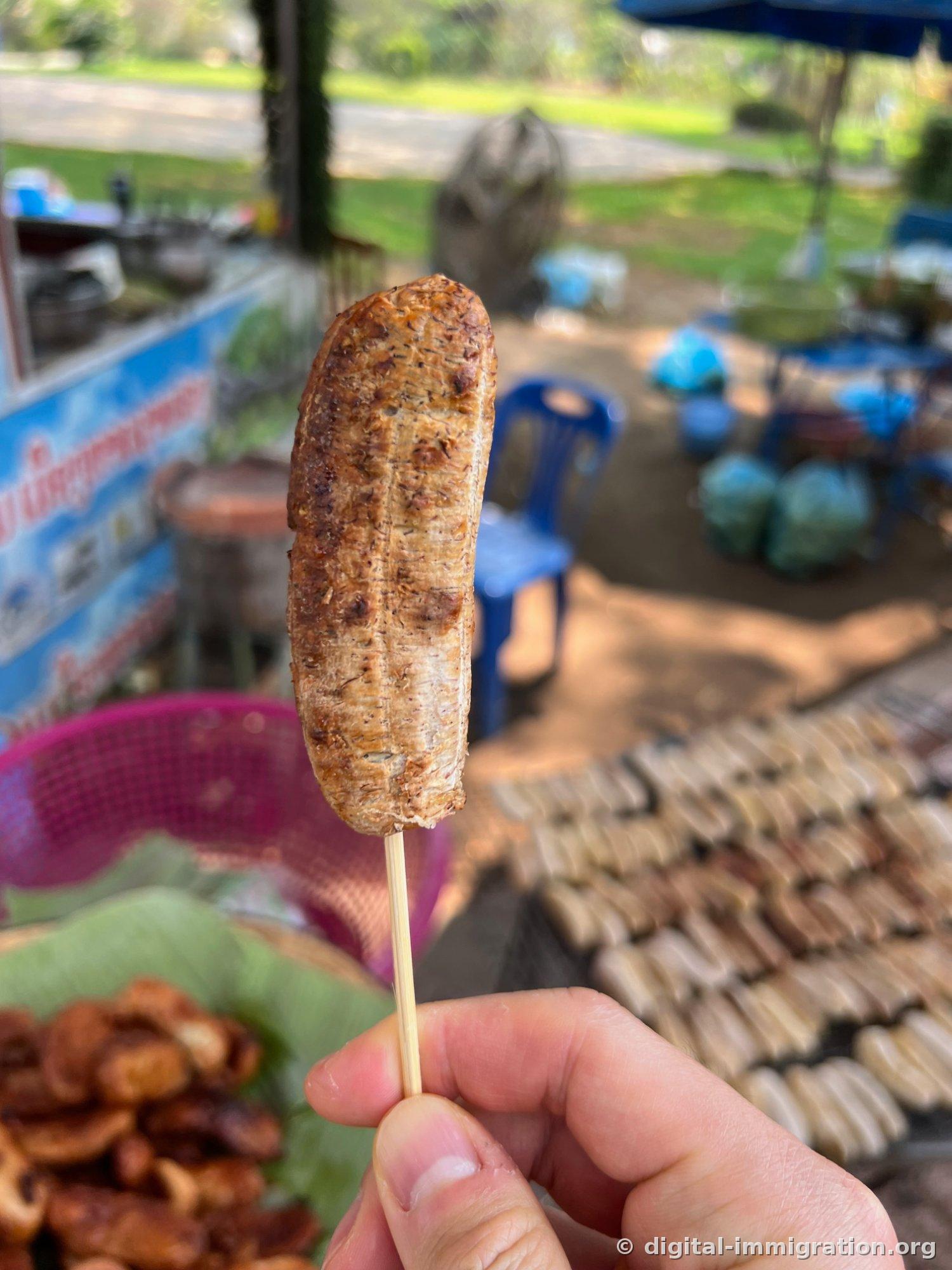
Inside the park, under blue parasols, there are several food stalls. This is where they roast bananas over charcoal. About twenty flattened bananas sit in a row on a grill, and when you order, they skewer them. The outside is caramelized brown and the inside is hot and chewy. The natural moisture disappears and the sweetness intensifies. There are also fried ones stacked on banana leaves beside. Prices run to just a few thousand kip—affordable—though they vary by stall, so it's worth asking.
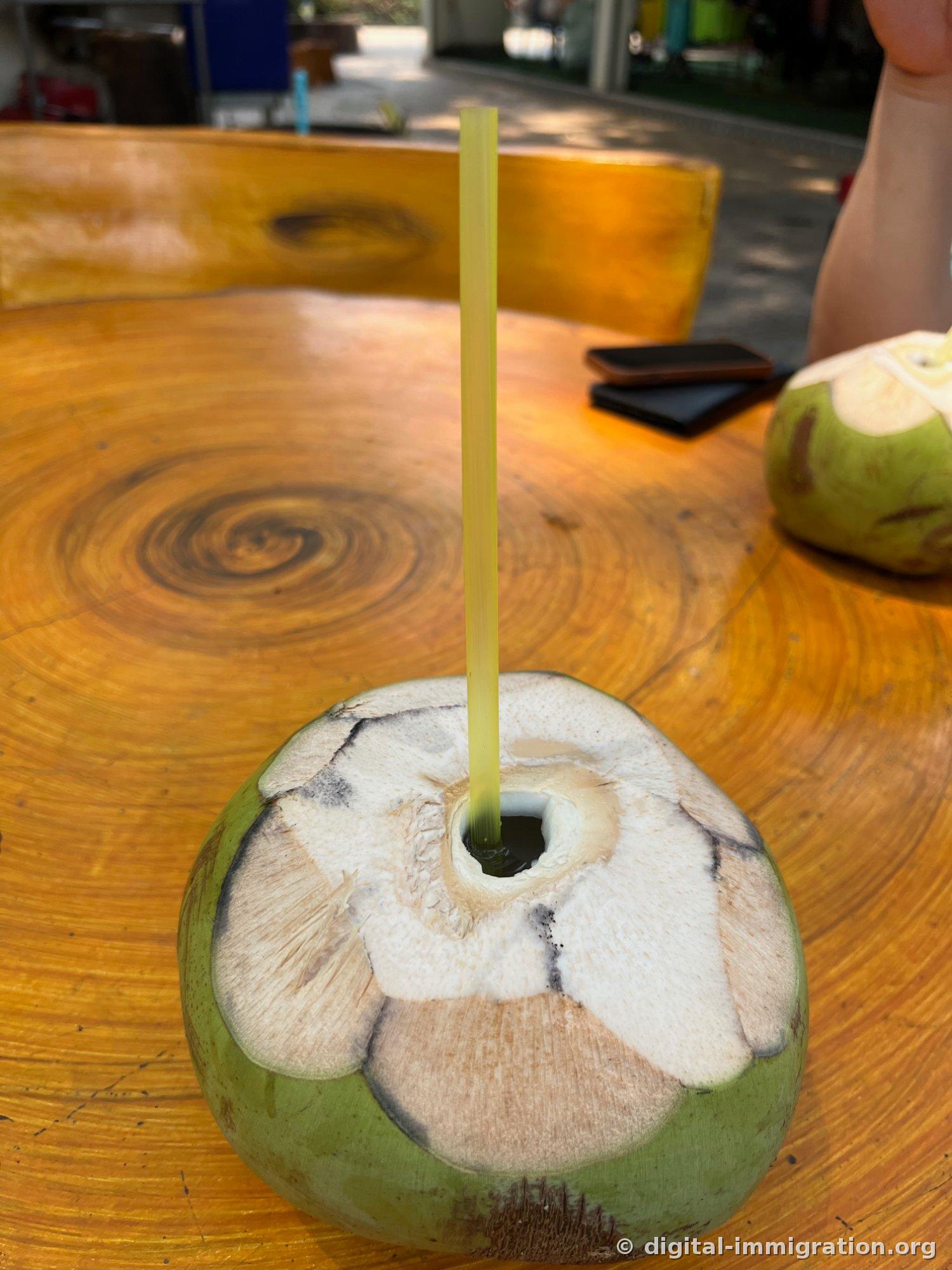
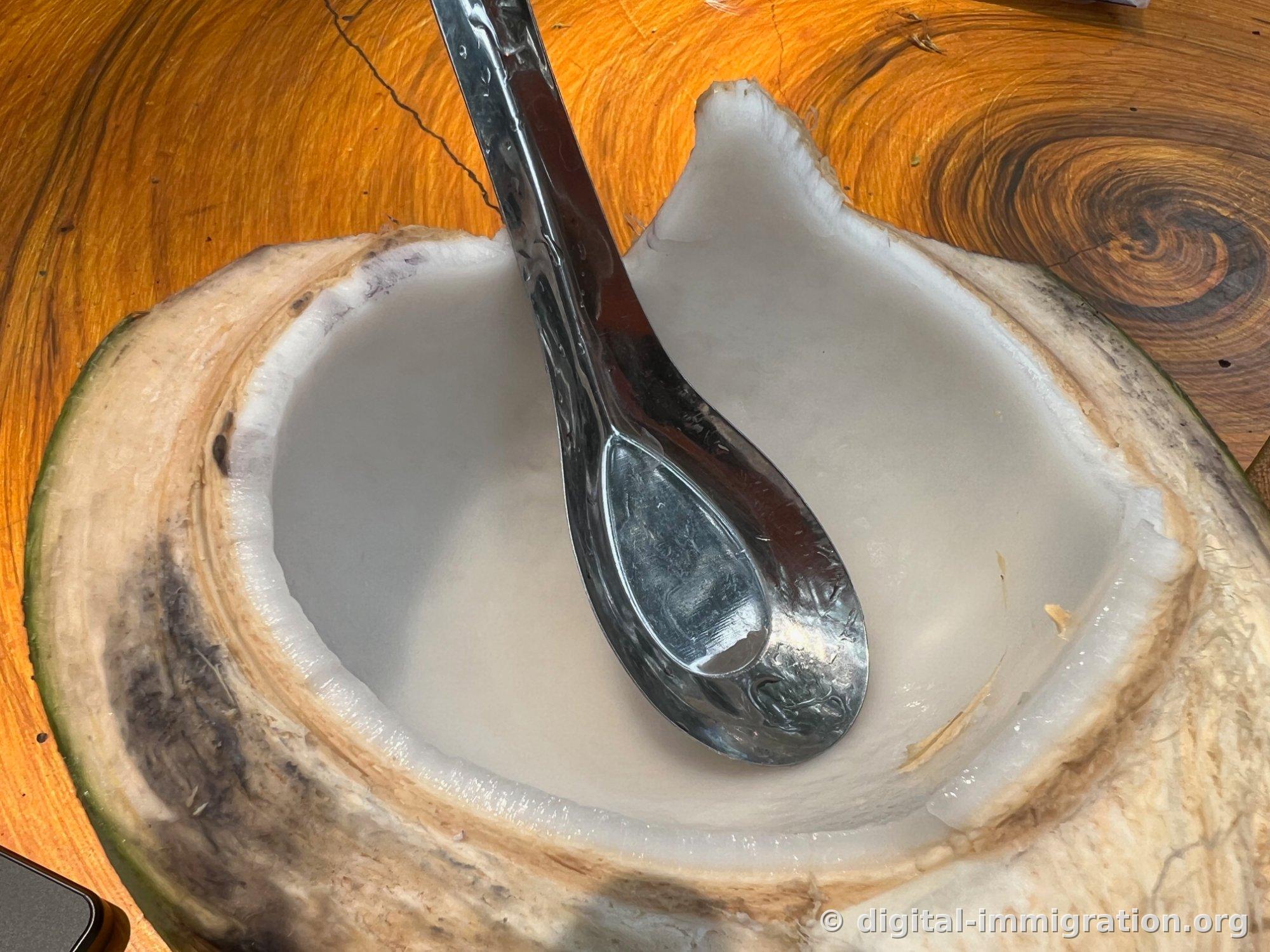
And coconut. At the same spot, they take a green coconut, hack it open with a machete, and stick in a straw. It's served at room temperature without ice, which is actually better. After walking an hour in blazing sun, when you drink it, the salty mineral taste comes before the sweetness. Once you finish at the wooden table, bring the shell back to the vendor and they'll split it in half and give you a spoon. Many people don't know this and just throw it away.
Summary
- Umbrella is essential. There's almost no shade and all sculptures are outdoors. A hat alone isn't enough.
- Go through the entire pumpkin building from ground floor to rooftop. The rooftop view is how you finish this park. Wear sneakers rather than sandals since the stairs are narrow and dark.
- The interior is truly dark. If you want to shoot without flash, prepare for camera shake. I lost about half my shots.
- Get roasted bananas and coconut from the stalls in the park. Don't forget to ask them to split open the coconut after you drink it.
- Budget at least two and a half hours. If you only plan for an hour, you'll spend it all in the pumpkin building.
- Entrance fee, camera fee, and tuk-tuk round-trip costs vary by season and negotiation, so I recommend confirming on the spot.
Some regrets to note: most sculptures have no explanatory plaques. Only a few have Lao inscriptions, so you pass by without knowing what you're looking at. And maintenance is uneven. Some sculptures have flowers planted in front while the ones right next to them are buried in weeds. Yet somehow this imbalance seems to capture the park's true character. In a nation where the government permits only one religion, here you see how people hold onto that one faith in their own ways. That evidence was the dark altar with dozens of cigarettes left behind.
Read next
- Pha That Luang in Vientiane: Walking the Golden Stupa on a Cloudy Afternoon at Five O'Clock
Take a tuk-tuk fifteen minutes northeast from downtown Vientiane and the road suddenly widens, with a golden mass rising abruptly beyond a wall. Pha That Luang. The very stupa that…
Vientiane Capital · That Luang - Kyoto-Style Water Drop Mochi Found in the Heart of Vientiane — KYO Cafe & Meal Record
Vientiane is fiercest at two in the afternoon. Shade does nothing to help, and you can feel your shirt clinging to your back. That day, while walking through downtown, it became un…
Vientiane Capital · KYO Cafe & Meal - A French Evening at Le Vendôme in Vientiane, Laos—Record of Three Plates: Pizza, Carbonara, and Salad
On an evening when the breeze from the Mekong River drifted across the street, I stepped into Le Vendôme Restaurant tucked into an alley near Wat Inpeng. Whenever French cuisine co…
Vientiane Capital · Le Vendôme Restaurant