Record of Taking a Number at Hamasushi (はま寿司) in Tokyo at 8 PM — Pepper Robot, 100-Yen Plates, and Three Types of Tuna
When you decide to have conveyor belt sushi in Tokyo, you choose between Susiro, Kurasushi, or Hamasushi, and that evening, there was a Hamasushi within walking distance from my ac…
Tokyo · Hamazushi
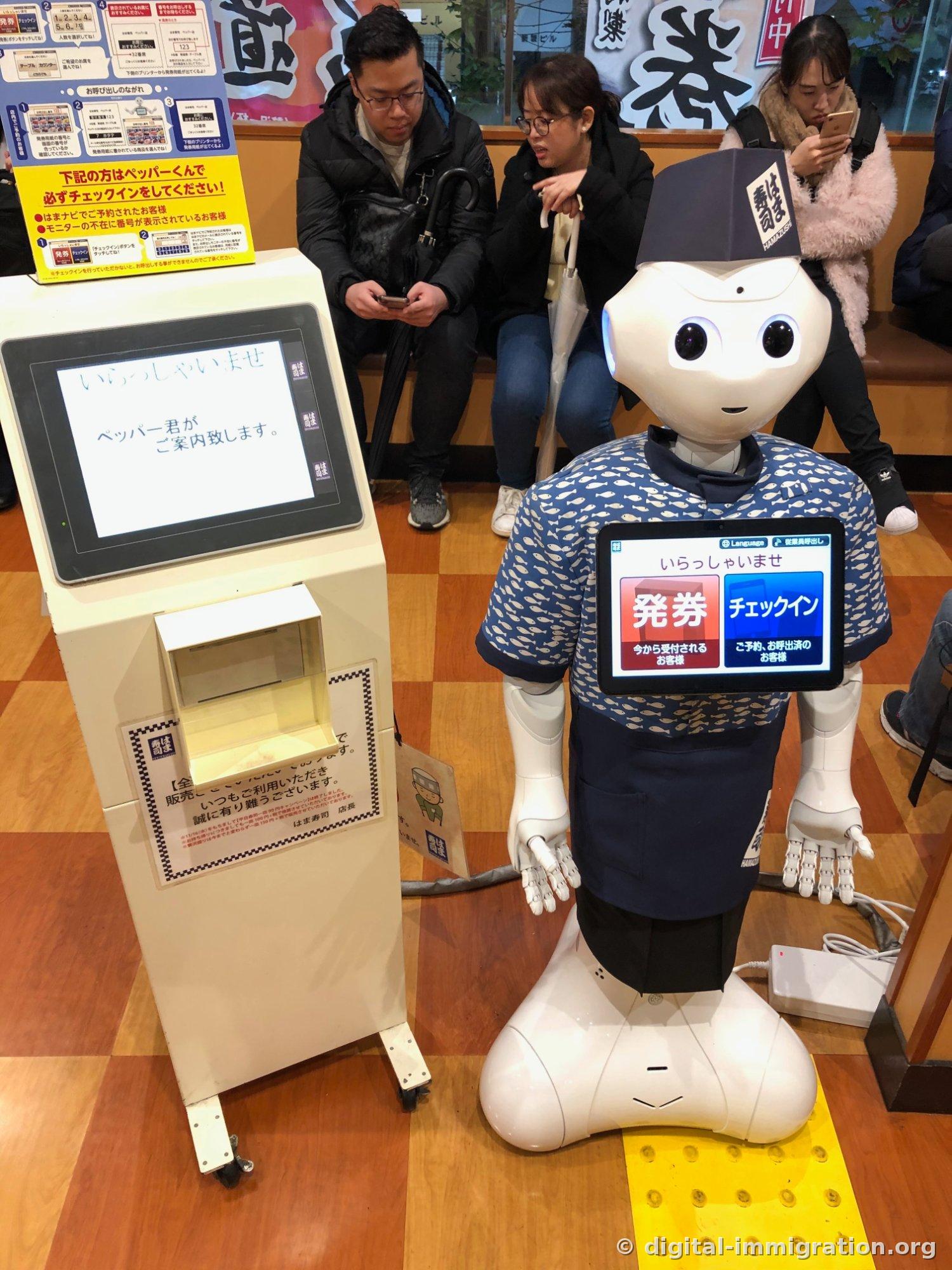
When you decide to have conveyor belt sushi in Tokyo, you choose between Susiro, Kurasushi, or Hamasushi, and that evening, there was a Hamasushi within walking distance from my accommodation. The moment the door opened, the first thing to greet me wasn't a staff member but a Pepper robot wearing a blue fish-patterned apron. It wore a paper hat with the Hamasushi logo on its head and stood with a red '発券' button and a blue 'チェックイン' button displayed on the tablet on its chest. A couple next to me was pointing at the screen with their fingers asking each other which button to press, and I stood frozen with the same expression for about three seconds.
Number Ticket at the Entrance — The Pepper Robot Actually Takes Your Order
To summarize: if you just walk in without a reservation, you press the red '発券' button to get a number ticket, and if you've made a reservation through the app (はまナビ), you need to press the blue 'チェックイン' button. There's a yellow notice posted on the wall in bold letters saying "If you don't check in, we cannot call you," but I actually saw someone who didn't read this, just sat down and waited, and had their turn skipped entirely. If you came with a reservation, just check in as soon as you arrive—that's all you need to remember.
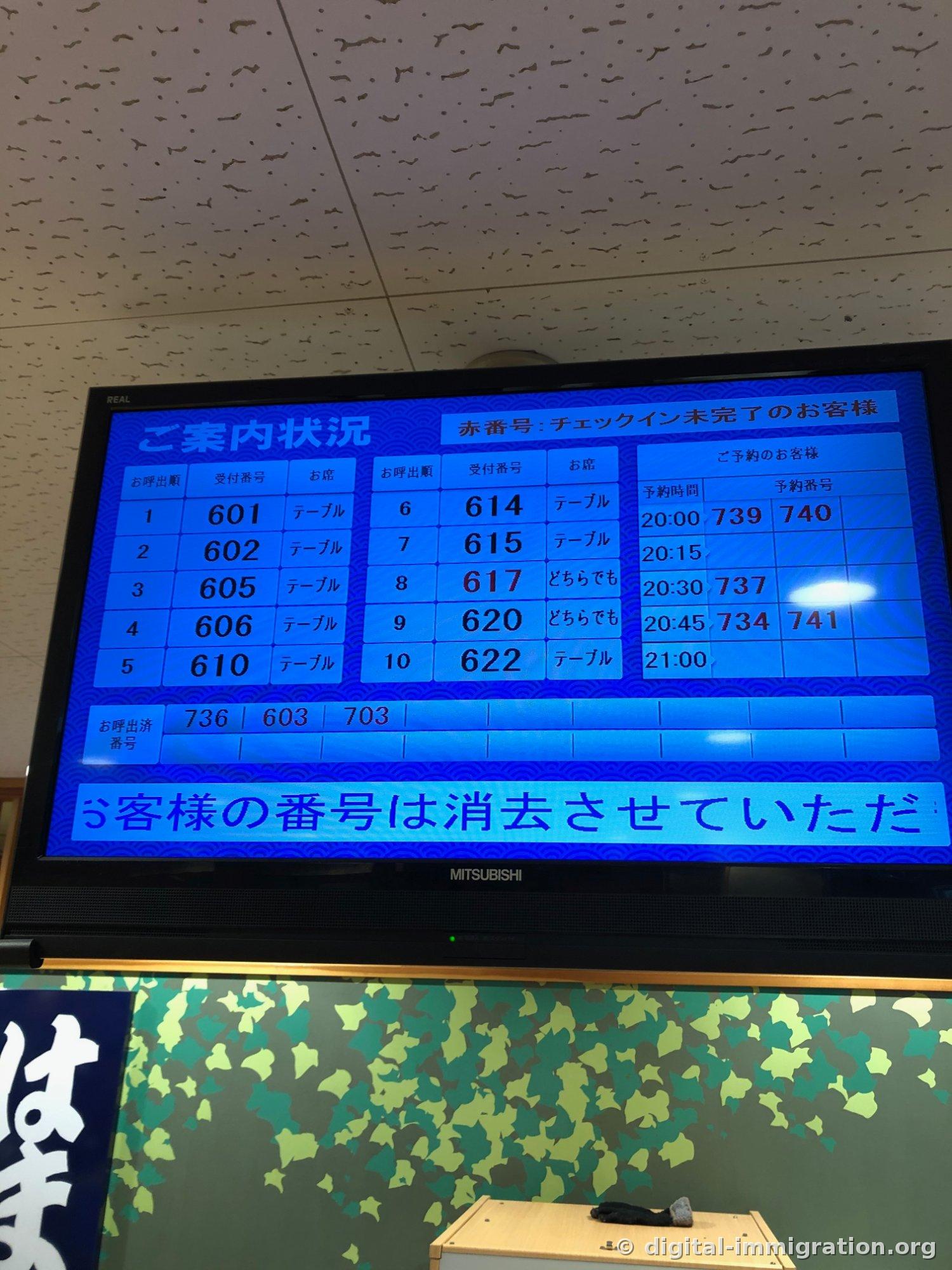
Once you have your number, you just need to watch the 'ご案内状況' screen displayed on the Mitsubishi TV above the waiting area. When I went, calling order #1 was ticket 601 and #10 was 622, and on the right reservation section, there were 739·740 at 20:00, 737 at 20:30, and 734·741 at 20:45. At the top of the screen, there's guidance in red letters saying '赤番号: Customers who haven't completed check-in,' so if my number appears in red, it means I haven't finished checking in yet. Below, a ticker scrolls the numbers that have already been called (736, 603, 703).
The wait was just over 20 minutes. At a Tokyo conveyor belt sushi restaurant at 8 PM, 20 minutes is actually on the shorter side—I've stood for over 40 minutes when going on weekend evenings between 6 and 7 PM. If you insist on a 'table' for seating, of course it takes longer. If you're alone or with one other person, pressing 'どちらでも' (anywhere) gets you seated much faster.
The Restaurant Is Bigger Than Expected — A Hall with Tables Up to Number 54
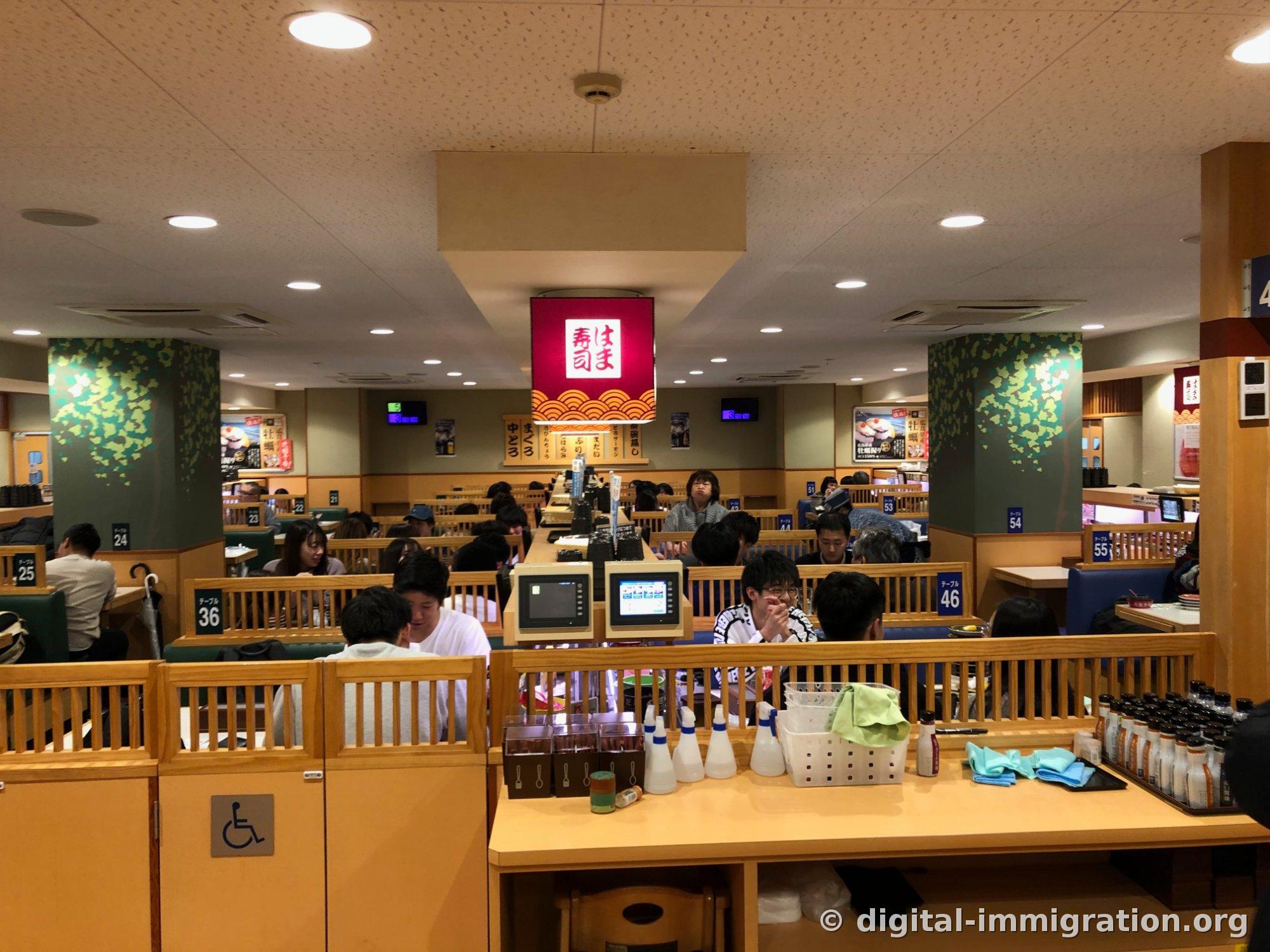
When I was shown in, the hall was quite spacious. Red Hamasushi lanterns hung from the center of the ceiling, and below them, table number plates 24·25·36·46·53·54 were lined up in a row. There were families, students in school uniforms, and solo office workers mixed together, and the noise was more of a murmur than actually loud. Green leaf graphics were painted on the wall pillars, so even under fluorescent lights, it didn't feel stuffy. There was also a separate corridor marked for wheelchairs.
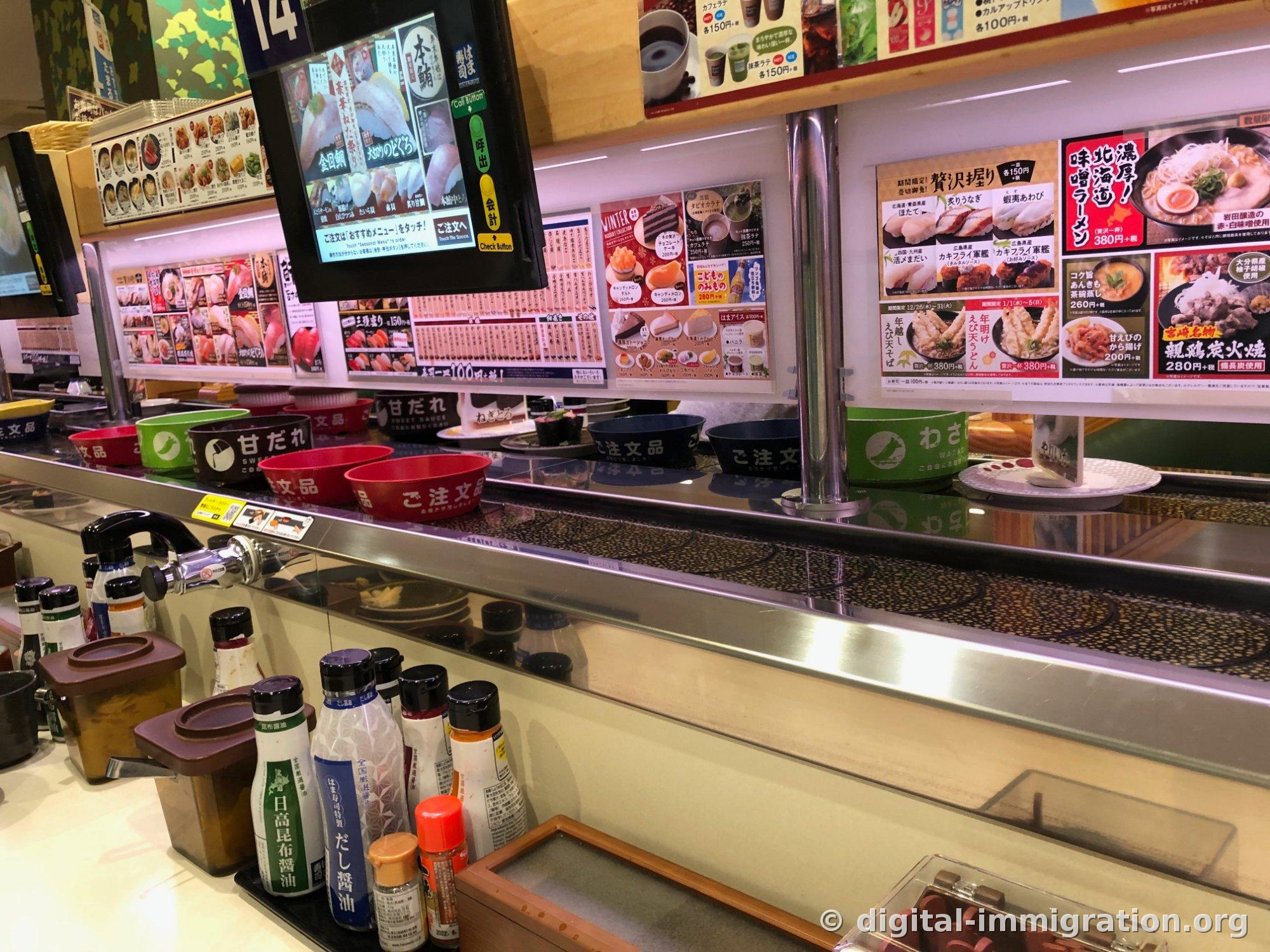
I was seated at counter 15. Above the conveyor lane, there's a row of seasoning bottles—this is where Hamasushi's real charm lies. There's a green-topped わさび jar, a 甘だれ (sweet soy sauce) jar, and red and blue bowls labeled ご注文品, and various types of soy sauce are lined up within arm's reach. Each bottle has a different flavor—Hidaka Kombu Soy Sauce (日高昆布醤油), Hamasushi's Special Dashi Soy Sauce (だし醤油), and so on. At other chains, you usually have just one type of soy sauce, but here you can order the same white fish sushi twice and enjoy the difference by changing only the soy sauce. The kombu soy sauce is definitely less salty and leaves a slight sweetness at the end.
Location and How to Get There
This location is in the northwest central Tokyo area, one block in from the main street. You can plot the coordinates below on a map and walk there, but since Hamasushi has many roadside-type locations, they're often situated deep in alleys or on the second floor of buildings. Even if the signage is large, the entrance might be on the side, so you could end up walking in circles—it's better to keep the map open. Since business hours vary by location, checking in person is recommended.
All Orders Are Made via Touch Panel — English Display Available
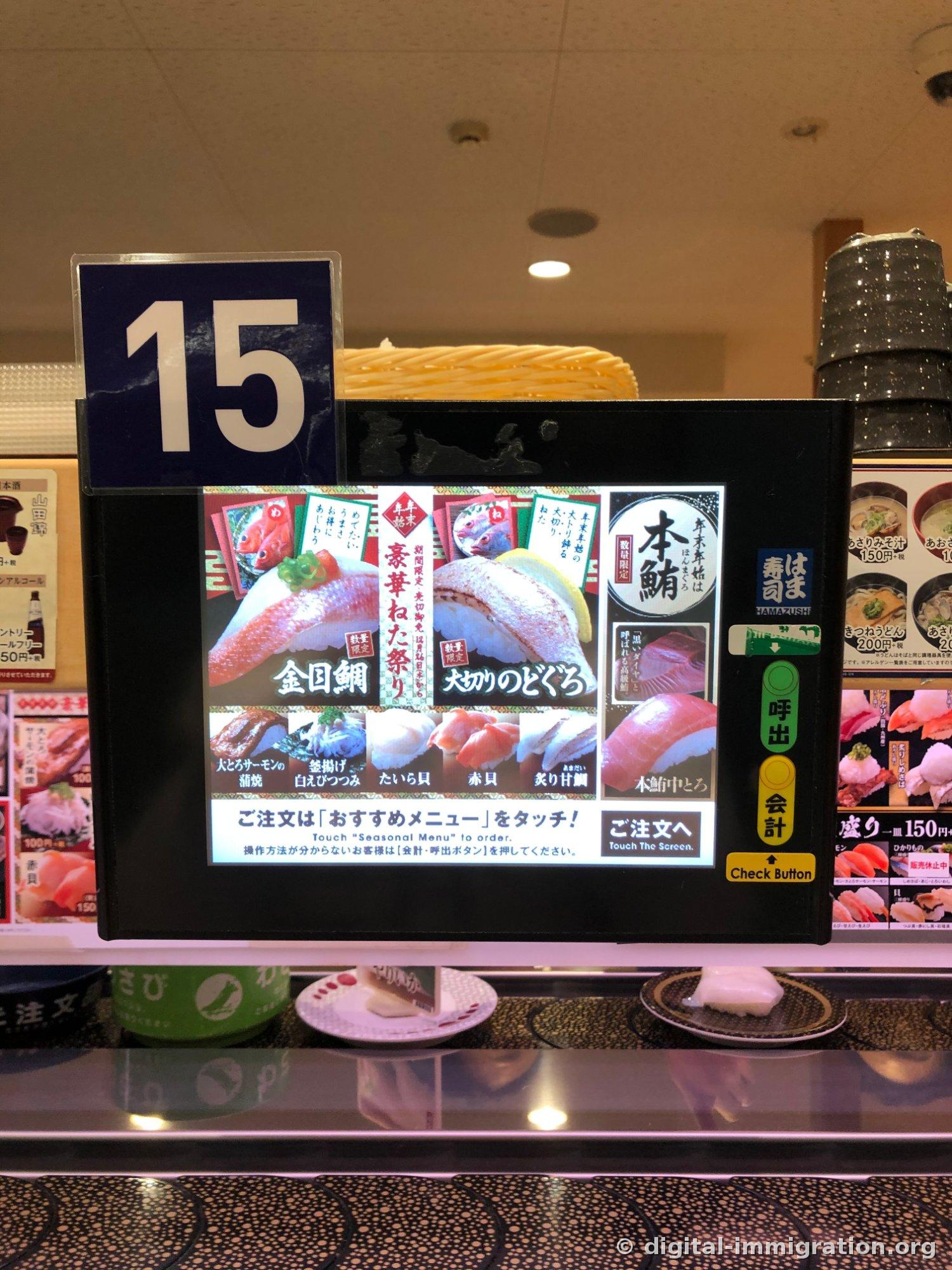
Once seated, there's a touch panel right in front of you. When I visited, it was the year-end season, and the '豪華ねた祭り (Luxury Neta Matsuri)' screen was displayed. They were featuring limited-quantity items: 金目鯛 (golden-eye snapper), 大切りのどぐろ (thickly sliced blackthroat seaperch), and what's called the 'black diamond,' 本鮪中とろ (bluefin tuna chu-toro). Below were 大とろサーモンの蒲焼, 釜揚げ白えびつつみ, たいら貝, 赤貝, and 炙り甘鯛 lined up, and on the right side of the screen were a green 呼出 (call) button and a yellow 会計 (billing) button as physical buttons. If you're unsure how to operate it, the screen explicitly tells you to press these two buttons.
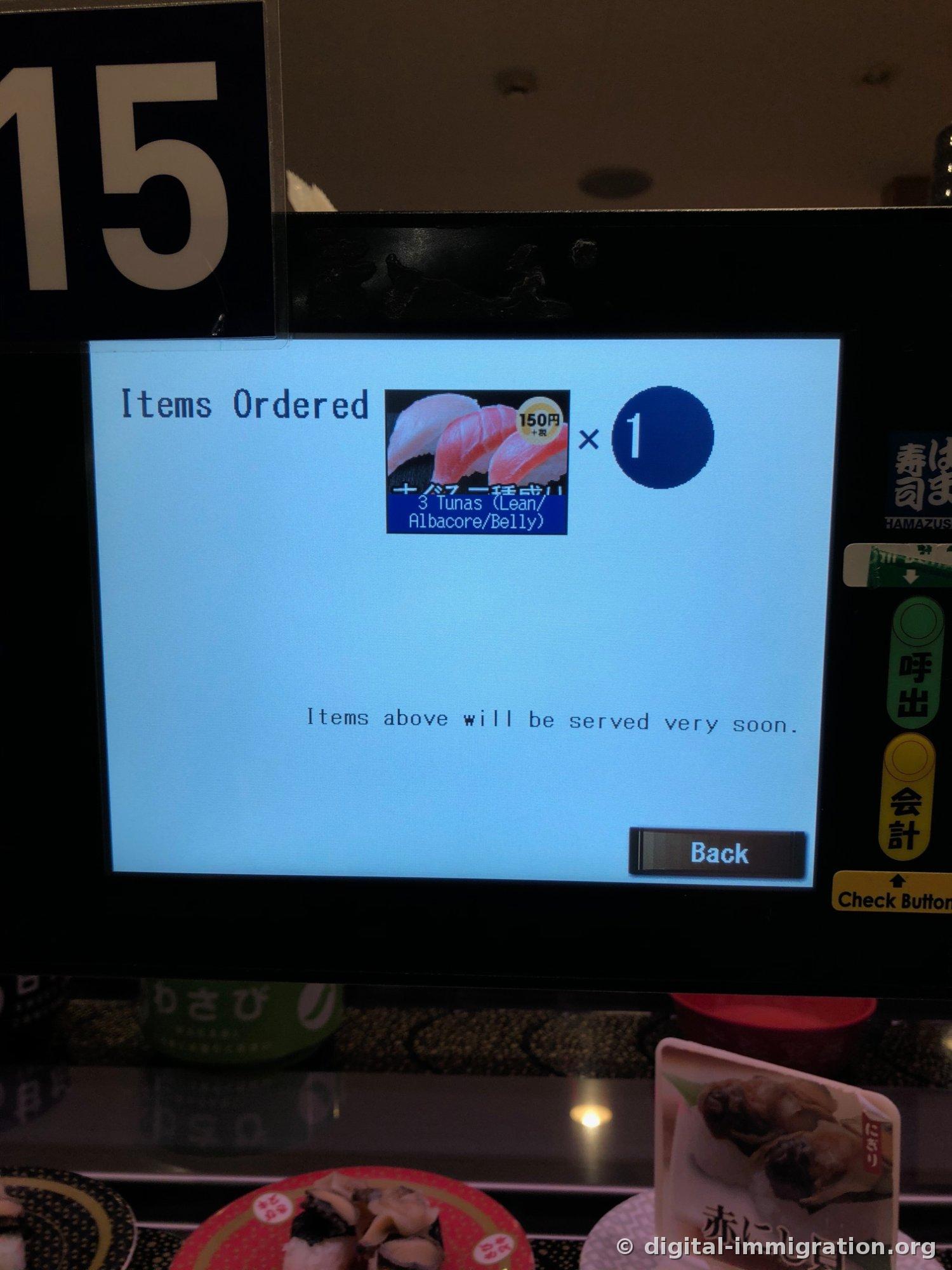
There's a 'Language' button at the top of the panel, so you can switch to English. If you don't know the Japanese menu names, pressing this is faster. When I pressed the 3-Tuna Assortment (まぐろ三種盛り) for my first order, the screen changed to "Items Ordered — 3 Tunas (Lean/Albacore/Belly) ×1, Items above will be served very soon." The price is 150 yen + tax. At a place where basic plates are 100 yen + tax, getting three types on one plate is almost like cheating.
What I Ate
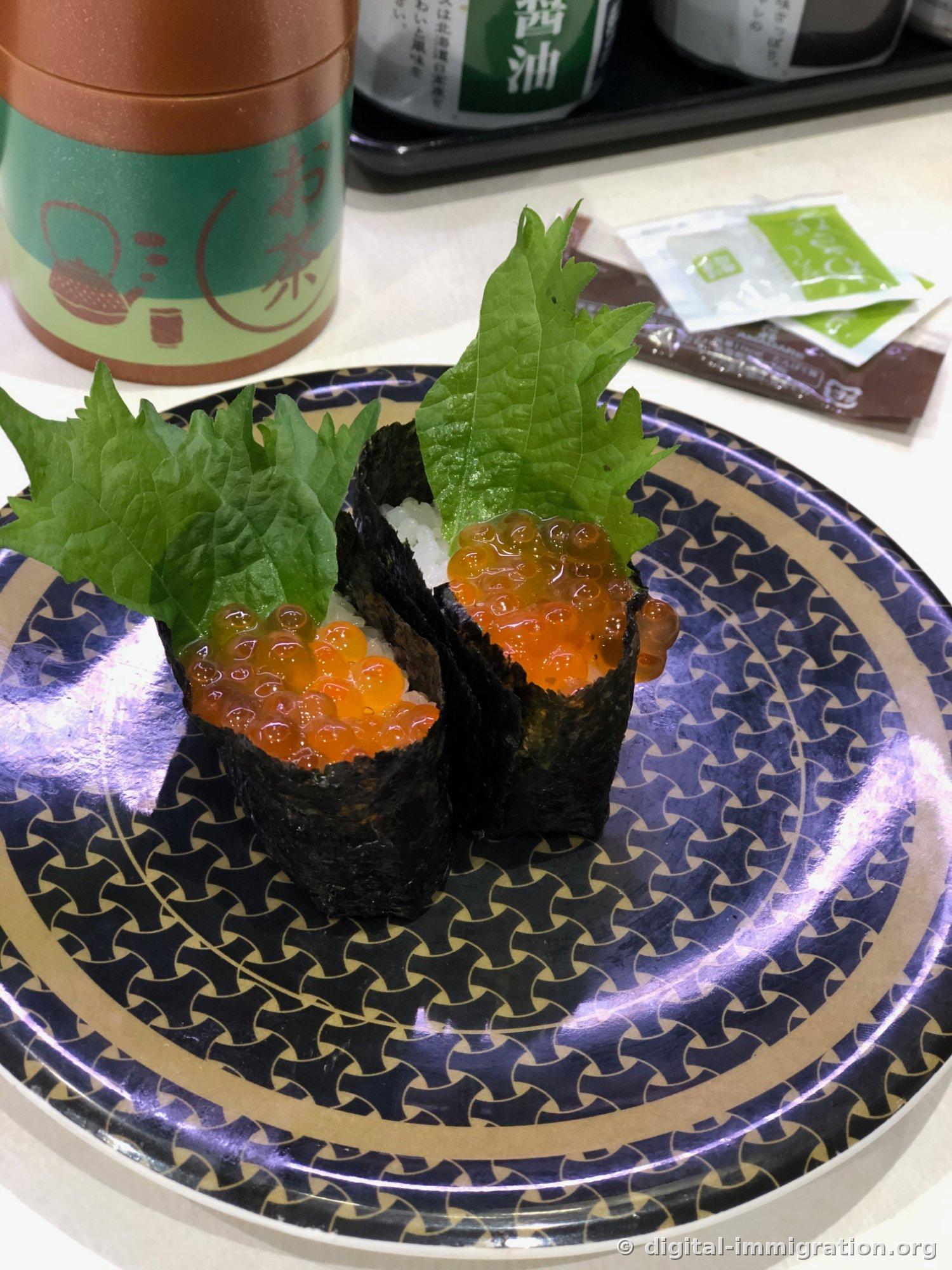
The 3-tuna assortment was actually larger in person than in the photo. The akami (lean), bincho-maguro (albacore), and a piece of chu-toro (belly) sat so generously that they covered the rice completely. The lean meat was subdued as expected, and the albacore in the middle left a slight oiliness on the tongue. The belly on the right was almost pink in color, but when I chewed it, perhaps due to the temperature, the fat didn't spread out as dramatically. If you expect perfection for 150 yen, you'll be disappointed. The right way to think of it is as a "plate for comparing three different textures at once."
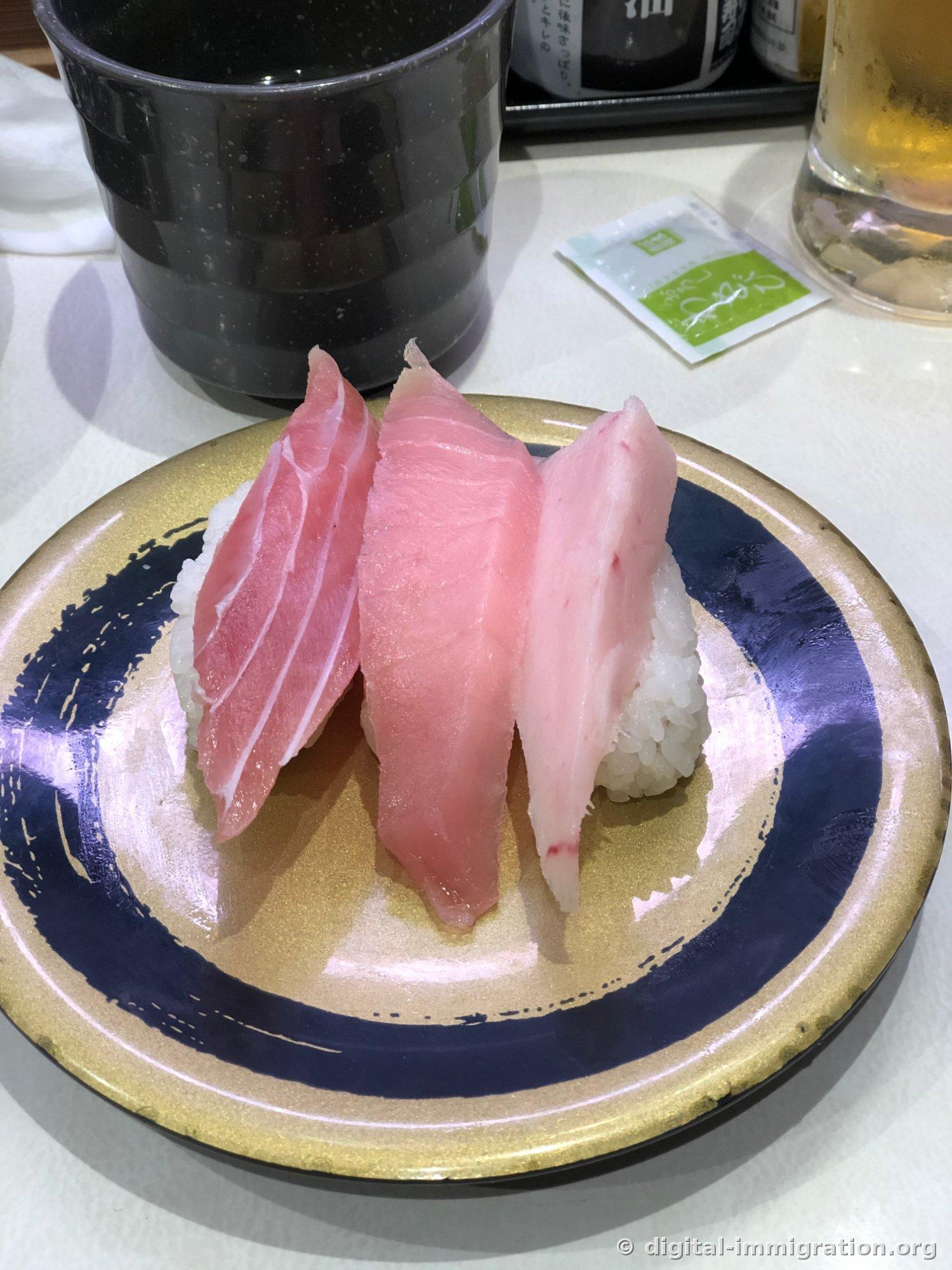
Next was an ikura battleship. The presentation with the shiso leaf stood up so beautifully that I took a photo before picking up my chopsticks. The roe is plump and the membrane firm, bursting with a pop when chewed. The saltiness wasn't overpowering, so I ate it without dipping it in soy sauce. The green packet next to it is powdered green tea—each seat has a hot water tap, so you put the powder in a cup and steep it yourself. There's no separate charge for the tea.
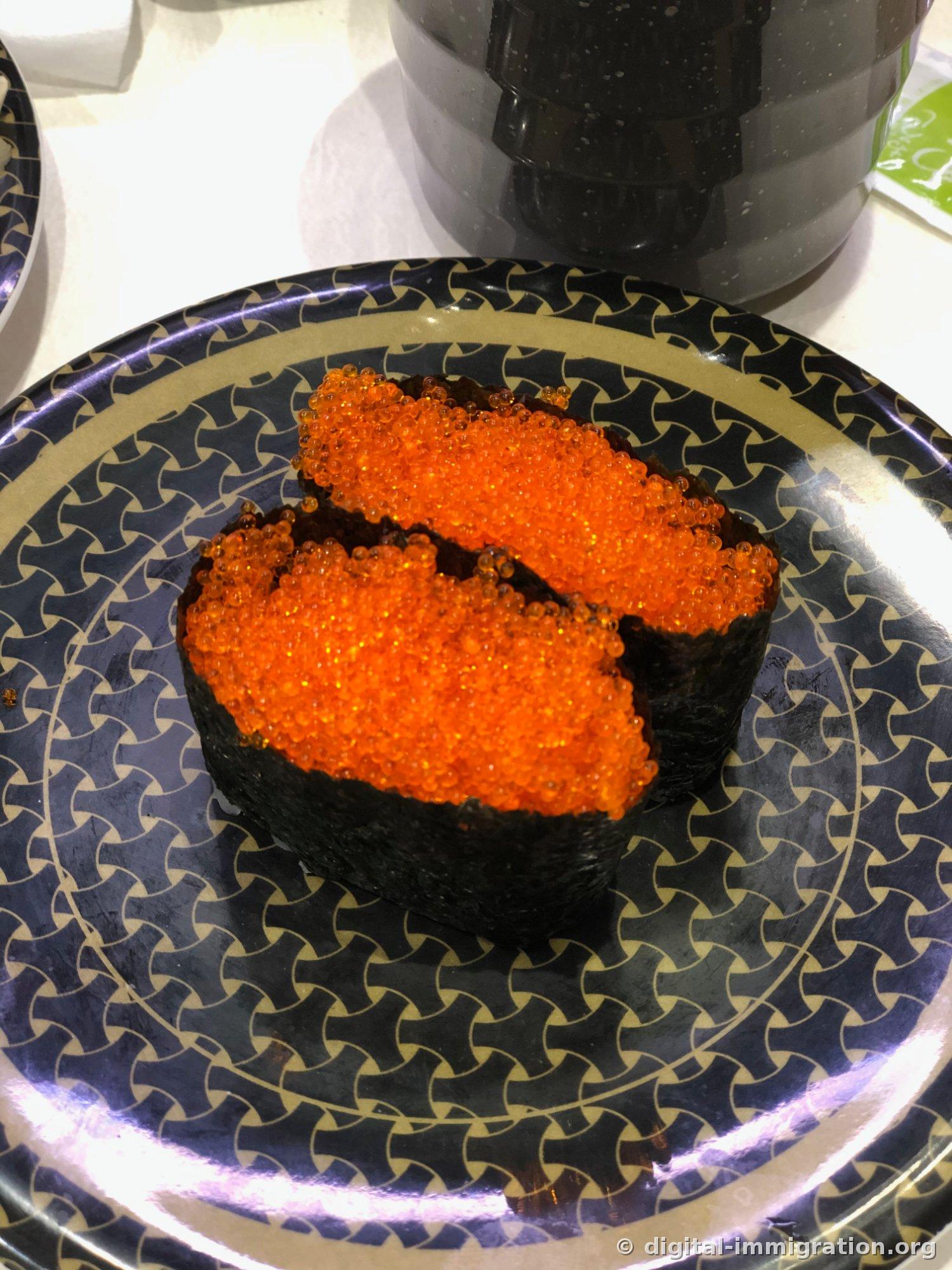
I also ordered a tobiko (flying fish roe) battleship. When placed side by side with the ikura, the difference in roe size is obvious. The orange sparkles with a nearly neon brightness, and when you put it in your mouth, there's a crunchy sound. While ikura is the "popping" type, tobiko is the "shattering" type. You need to eat it before the nori gets soggy to keep this texture alive.
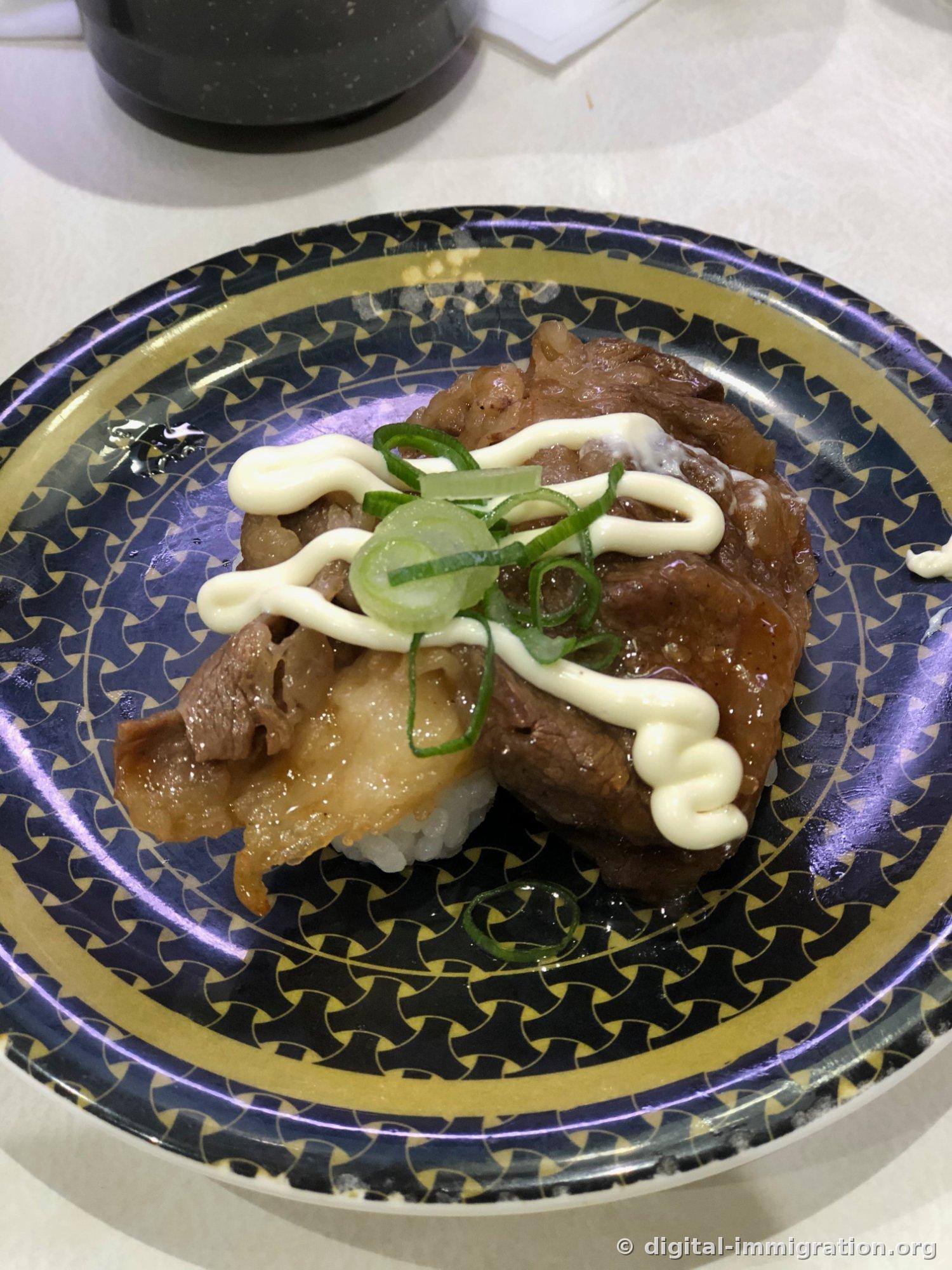
I used to think ordering meat sushi at a conveyor belt sushi restaurant was uncouth, but today I saw a student at the neighboring seat eating it and decided to try it too. Sweetly braised beef topped with a zigzag of mayonnaise and scattered green onion. The meat has a thick layer of fat underneath, so when you pop it in your mouth, the fat comes first before the rice. It tastes good, but if you order this after eating about ten plates of sushi, your mouth feels heavy. I got the order wrong. Next time, I'll intersperse one in the middle.
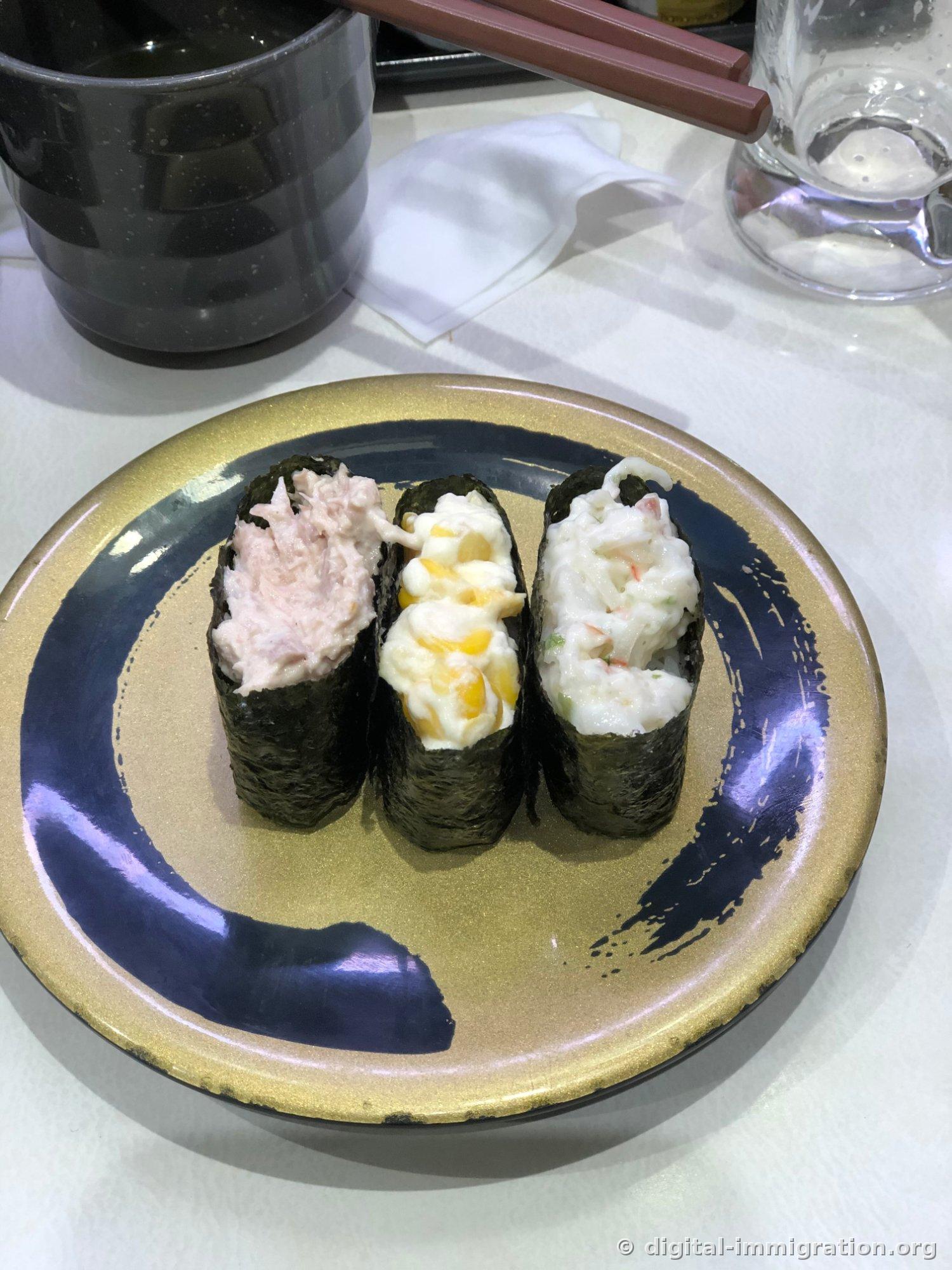
Finally, three mayo-based battleships. From left to right: tuna mayo, corn mayo, and crab salad. In Japanese conveyor belt sushi restaurants, these three are practically kids' menu items, which means there's really no way to go wrong with them. The corn mayo had corn that wasn't mushy and its sweetness intact, and the crab salad had green crispness—whether cucumber or celery, I'm not sure—that cut through the richness. The tuna mayo was as expected. If your goal is to fill your belly at around 100 yen + tax per plate, this line is the most efficient.
Things First-Time Visitors Easily Miss
- If you don't check in with the robot at the entrance, you won't be called no matter how long you sit. If you have an app reservation, check in immediately upon arrival.
- If you select 'どちらでも' (anywhere) for seat type, the wait is noticeably shorter.
- You can switch to English using the Language button on the touch panel. You don't need to open a translation app.
- There are multiple types of soy sauce. Try dashi soy sauce or kombu soy sauce with white fish—the taste difference is clear.
- Green tea is self-serve powder + hot water. Since the cup is hot, hold the handleless black teacup by the rim.
- To pay, press the yellow 会計 (billing) button and a staff member will come to count your plates. Hamasushi isn't based on plate color pricing—most items are uniform price—so billing is fast.
- Seasonal limited menu items often have limited quantities. If you go late, you might see a "Sale Suspended" sign already posted.
Prices vary by time and location, so please consider the amounts in the photos as based only on the date of my visit. On a day when you want to have dinner in Tokyo in the 1,000–1,500 yen range, if you're willing to stand in line and wait 20 minutes, Hamasushi is quite a reliable choice. However, you shouldn't expect fancy sushi. This is a casual rice restaurant that Tokyo residents walk into on weekday evenings without a second thought, and the best approach is to eat it at that temperature and leave.
Read next
- From Akihabara's Chuo-dori to the Kanda River: A Record of Tokyo's Electronics District Revisited Multiple Times
Tokyo's Akihabara is a neighborhood where it's hard to say you've seen everything in a single visit. I've come multiple times across different seasons, and each time the signs chan…
Tokyo · Akihabara - Buying a Single ¥300 Year-End Jumbo Lottery Ticket at Nishi-Ginza Chance Center in Tokyo
Exit from the Hibiya exit of Tokyo's Shimbashi Station, walk toward the elevated highway for about three minutes, and suddenly you'll see a line of people stretching along the side…
Tokyo · Nishi-Ginza Chance Center - Ueno Ameyoko, the real magic starts after sunset — an evening walk from the Okachimachi Gate to Ueno Station
Every time I come to Tokyo, my feet find their way to Ueno Ameyoko (アメ横) without fail. This time I entered from the Okachimachi side and worked my way toward Ueno Station. I've met…
Tokyo · Ameya Yokocho Market