Meguro Kats Midori Headquarters: Waiting 3 Hours on a Friday Evening
When you exit the west exit of Tokyo's Meguro Station and enter the Atoré building, you'll see a shop with red lettering on a wooden sign reading 「回し寿司 活 活美登利」. This is a conveyor…
Tokyo · Katsu Midori
When you exit the west exit of Tokyo's Meguro Station and enter the Atoré building, you'll see a shop with red lettering on a wooden sign reading 「回し寿司 活 活美登利」. This is a conveyor belt sushi restaurant commonly called 'Kats Midori' in Korea. While the Shinjuku branch is more famous, this Meguro location is the original. This was my third visit to this restaurant, with the previous two being on weekday afternoons. This was my first time coming on a Friday evening, and to get straight to the point: I waited 3 hours.
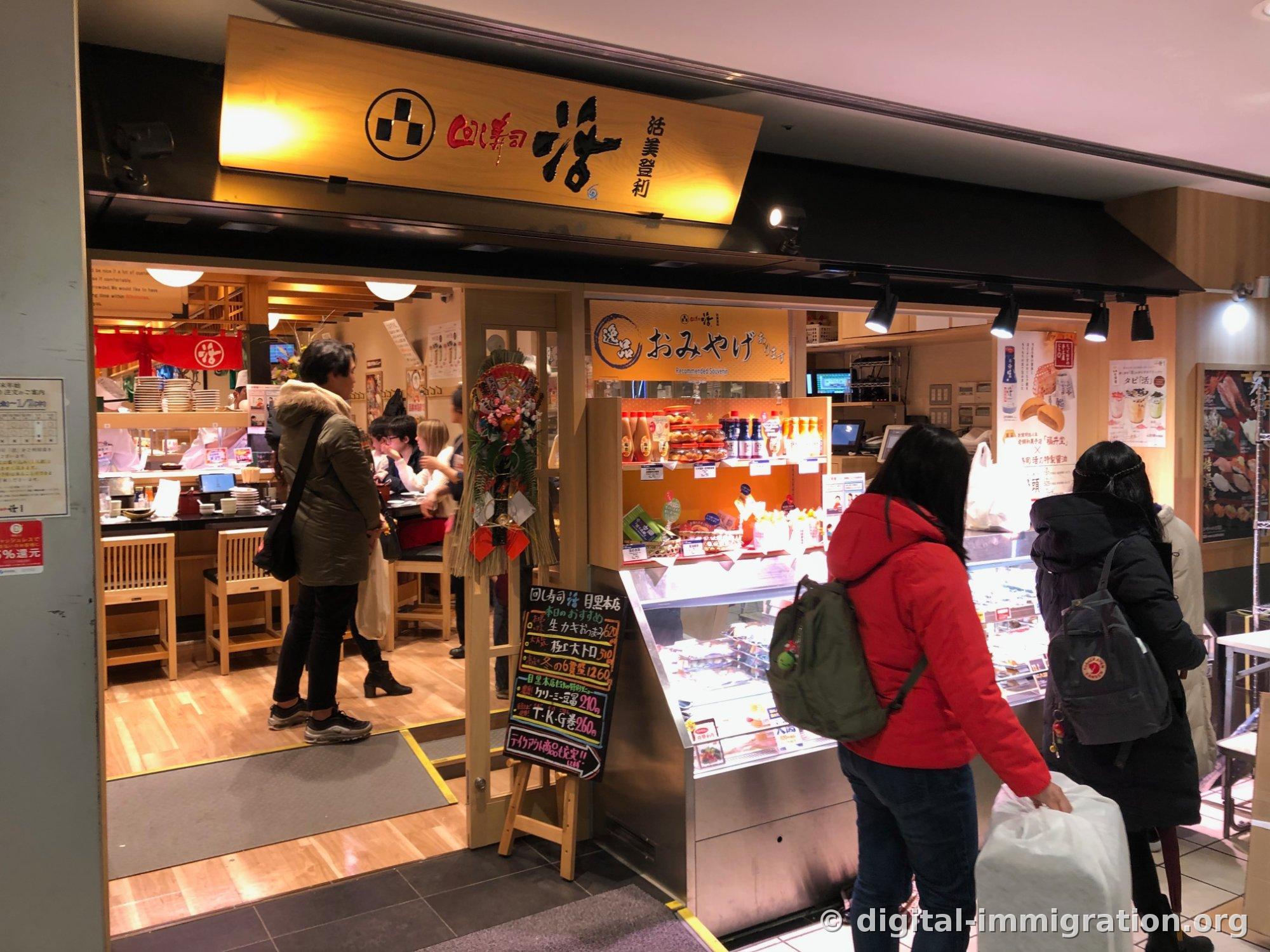
Enduring a 3-Hour Wait
I arrived around 6:40 PM. I grabbed a ticket number from the machine by the entrance, and there were over 60 groups ahead of me. When a staff member calmly said "sanzi kan kurai (about 3 hours)," I thought I'd misheard and asked again. I hadn't. My name was actually called after 9:40 PM.
While waiting, I passed by the waiting area multiple times. There was a small garden with bamboo and decorative rocks, a red belt barrier, and a digital information sign posted next to it. The screen alternated between sake and dessert advertisements. The premium soft serve ice cream featured on the screen that day was 310 yen (pre-tax), and fried items were 140 yen. The Amazon Pay and Uber Eats stickers placed side by side somehow captured the essence of this establishment. It has the face of an old-fashioned sushi restaurant, but operates on a thoroughly efficient high-volume turnover system.
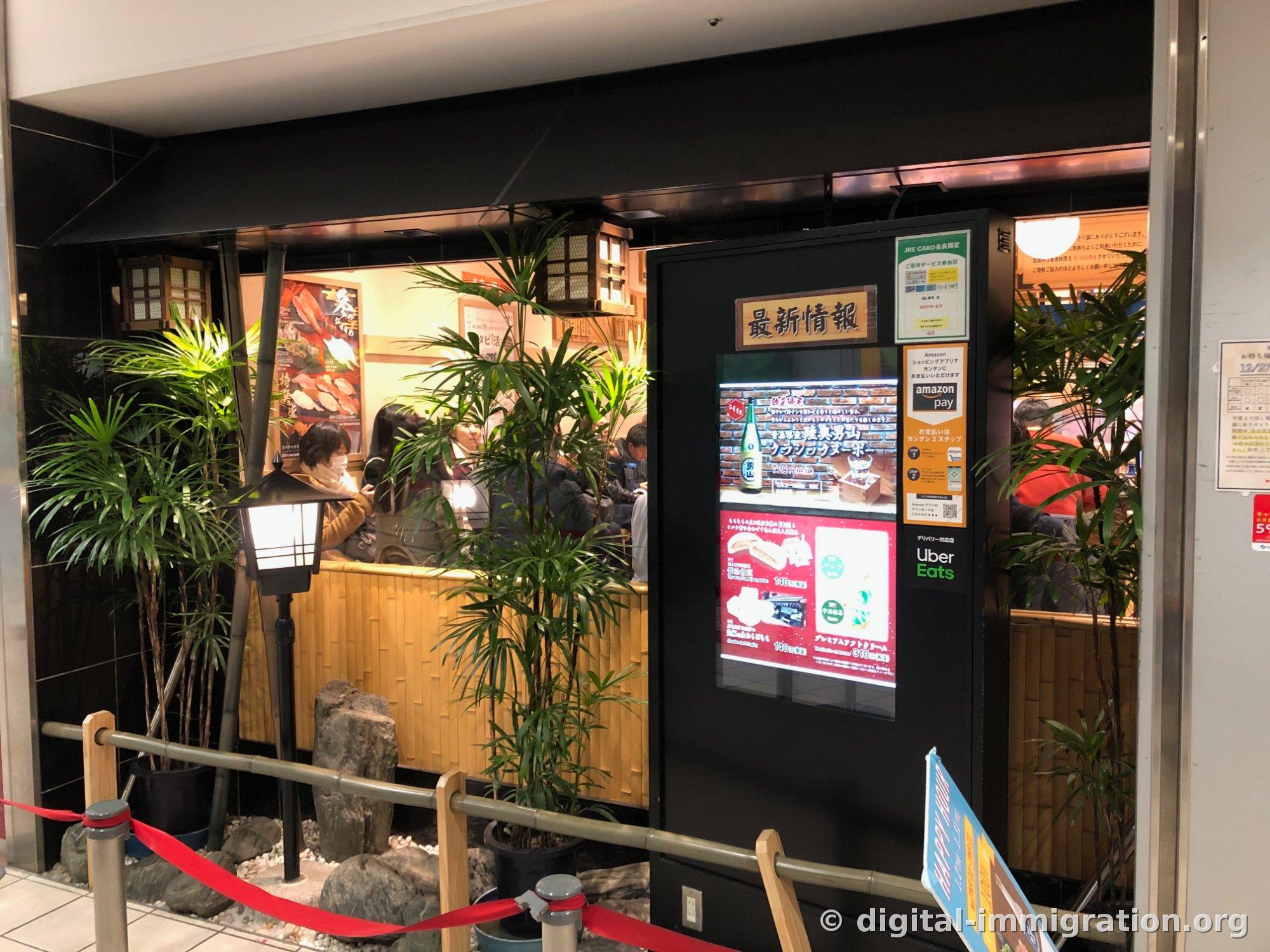
You can't simply stand and wait for 3 hours straight. The realistic option is to grab your ticket number and walk around Atoré Meguro or take a stroll toward Meguro River, then return when your turn approaches. However, there's a notice that you'll be moved back if you miss your call, so you need to be nearby when your number gets close. Waiting times and calling methods can change depending on the time of visit, so it's best to check with staff on-site.
Once Seated, the 90-Minute Timer Starts
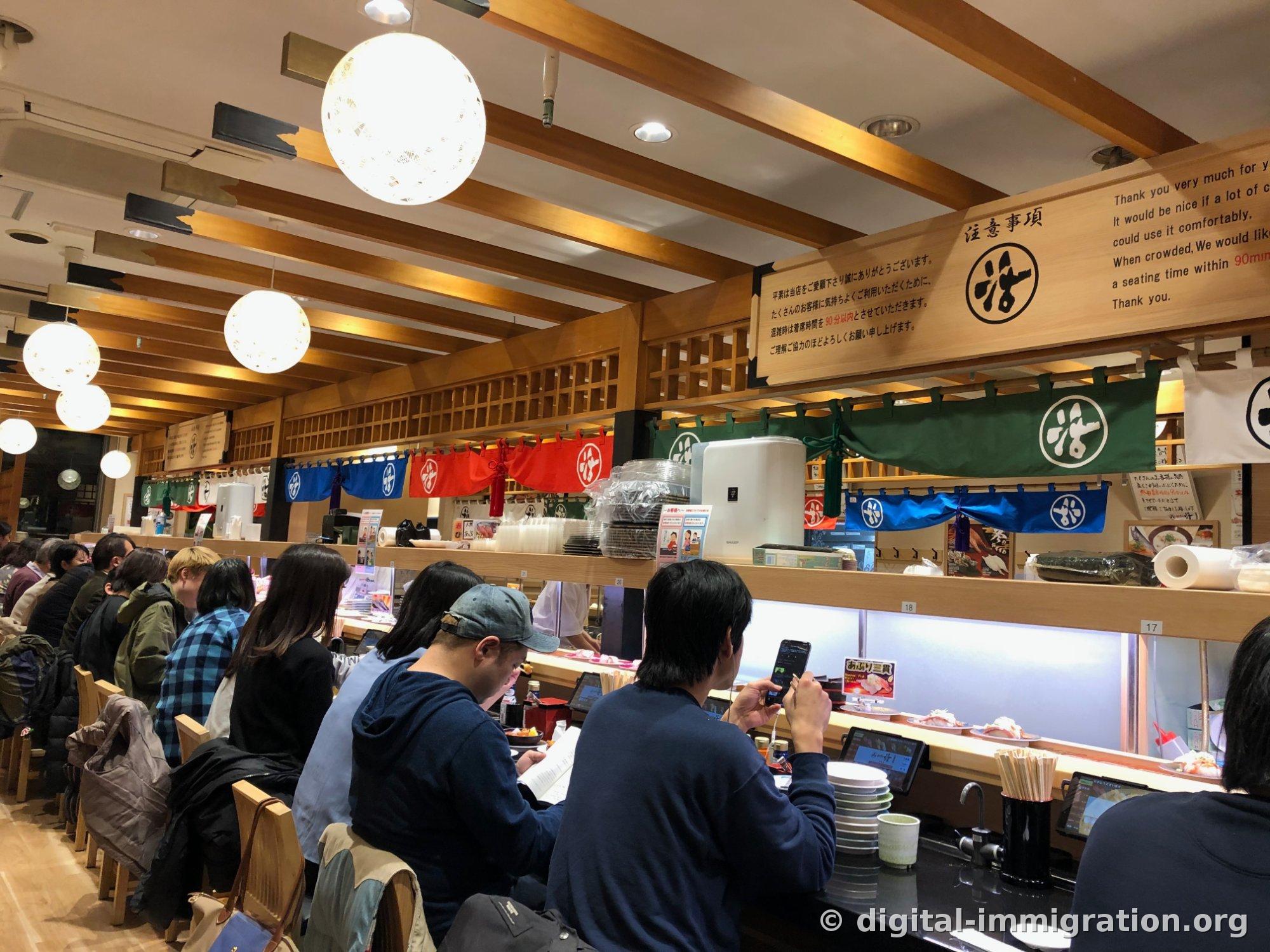
Once you enter, you immediately understand why the turnover is so fast. On the 「注意事項」 notice board hanging from the ceiling, there's the same message in both Japanese and English: they ask that you finish within 90 minutes during busy periods. The '90 minutes' is highlighted in red lettering. You wait 3 hours to eat for 90 minutes—but once seated, this rule actually feels appreciated. After all, everyone in front of you left for this reason too.
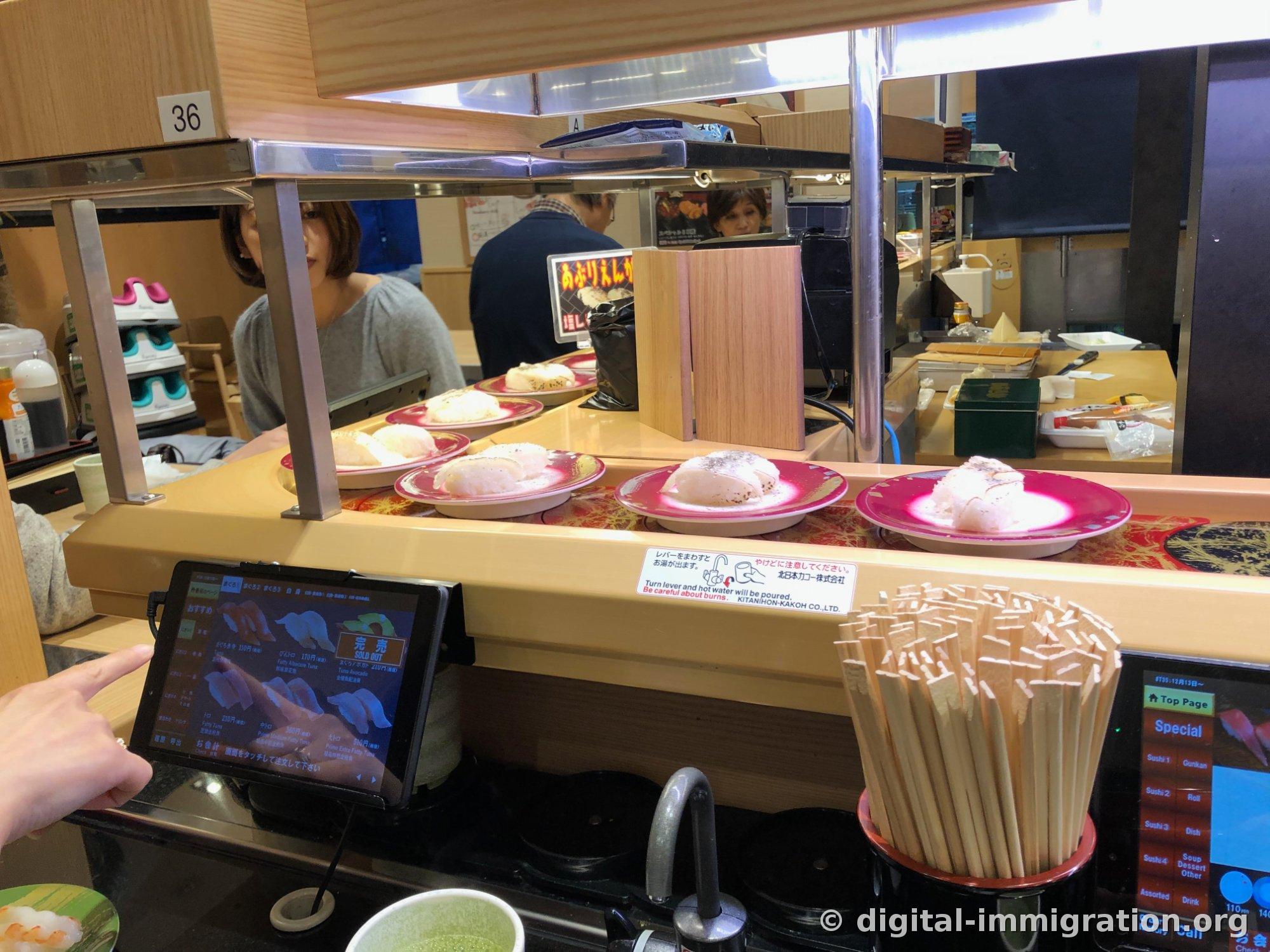
Ordering is done via tablet at each seat. You can choose between Japanese, English, and Chinese, so there's no barrier even if you don't speak Japanese. On the left side of the screen, the categories line up vertically: Sushi 1–4, Gunkan, Roll, Dish, Soup/Dessert, Assorted, Drink. Below that is a price guide organized by plate color. Twelve price tiers from 110 yen to 610 yen, all marked as pre-tax. Once you memorize the plate patterns, you get a rough sense of the price as you eat.
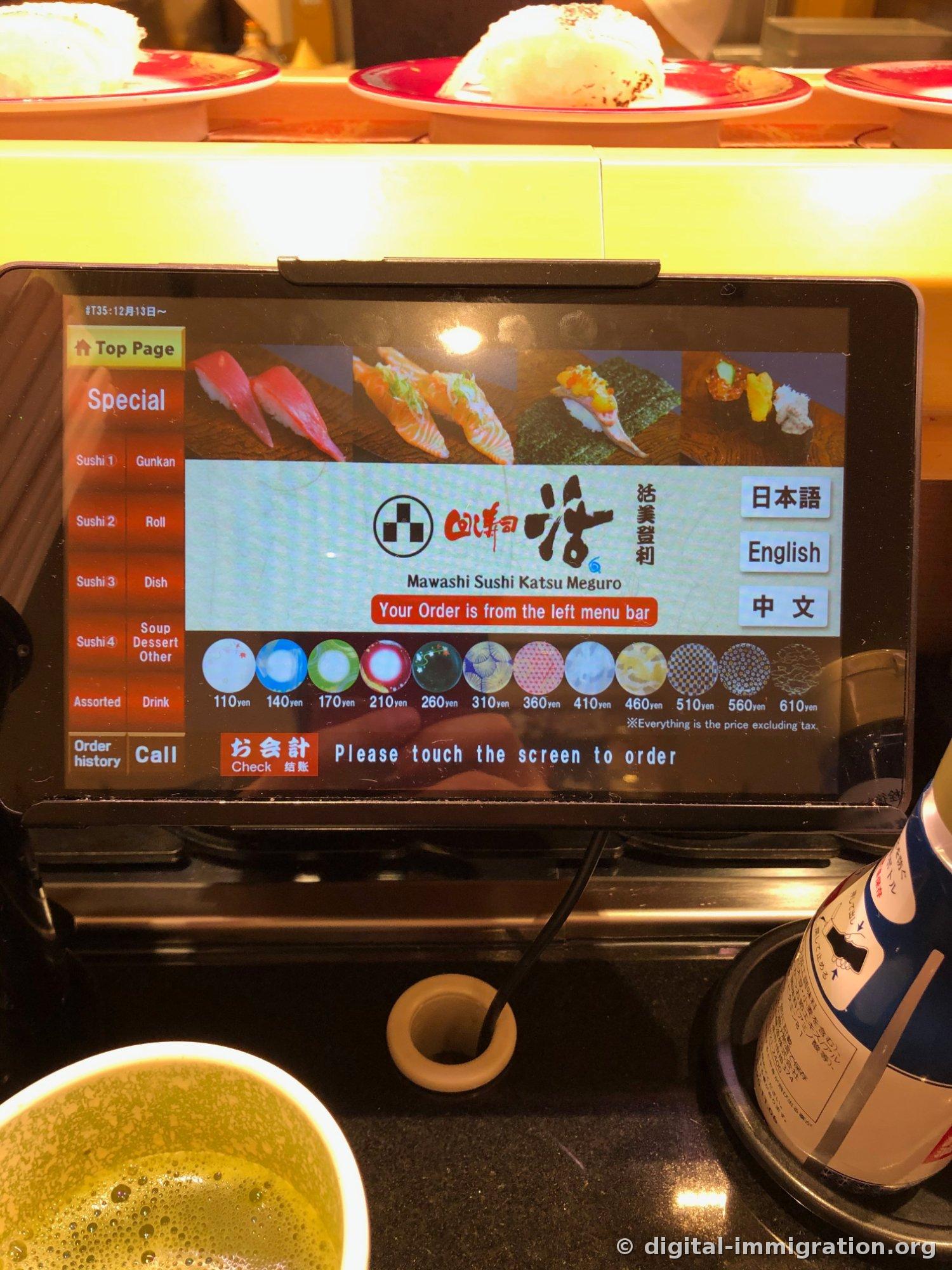
Real sushi still actually moves around on the conveyor belt. Many conveyor belt sushi places in Japan nowadays have eliminated the belt and only take orders, but this place still has it. However, ordering via tablet is far better than grabbing from the belt. You get fresh pieces made to order. There's a sticker on the conveyor next to the belt that reads "Turning the lever releases hot water. Caution: burns," and that hot water really is quite hot. You just take a spoonful from the green tea powder container, add it to a cup, and turn the lever for hot water.
Tuna, Tuna, and More Tuna
It's clear where your money goes in this restaurant: tuna. When you open the maguro page on the tablet, the options step up like this: maguro akami 110 yen, bintoro 170 yen, chu-toro 210 yen, toro 210 yen, premium chu-toro 360 yen, o-toro 510 yen (all pre-tax, prices at the time of my visit). Some items show as sold out depending on the time of day. When I was seated, the tuna and avocado was already gone.
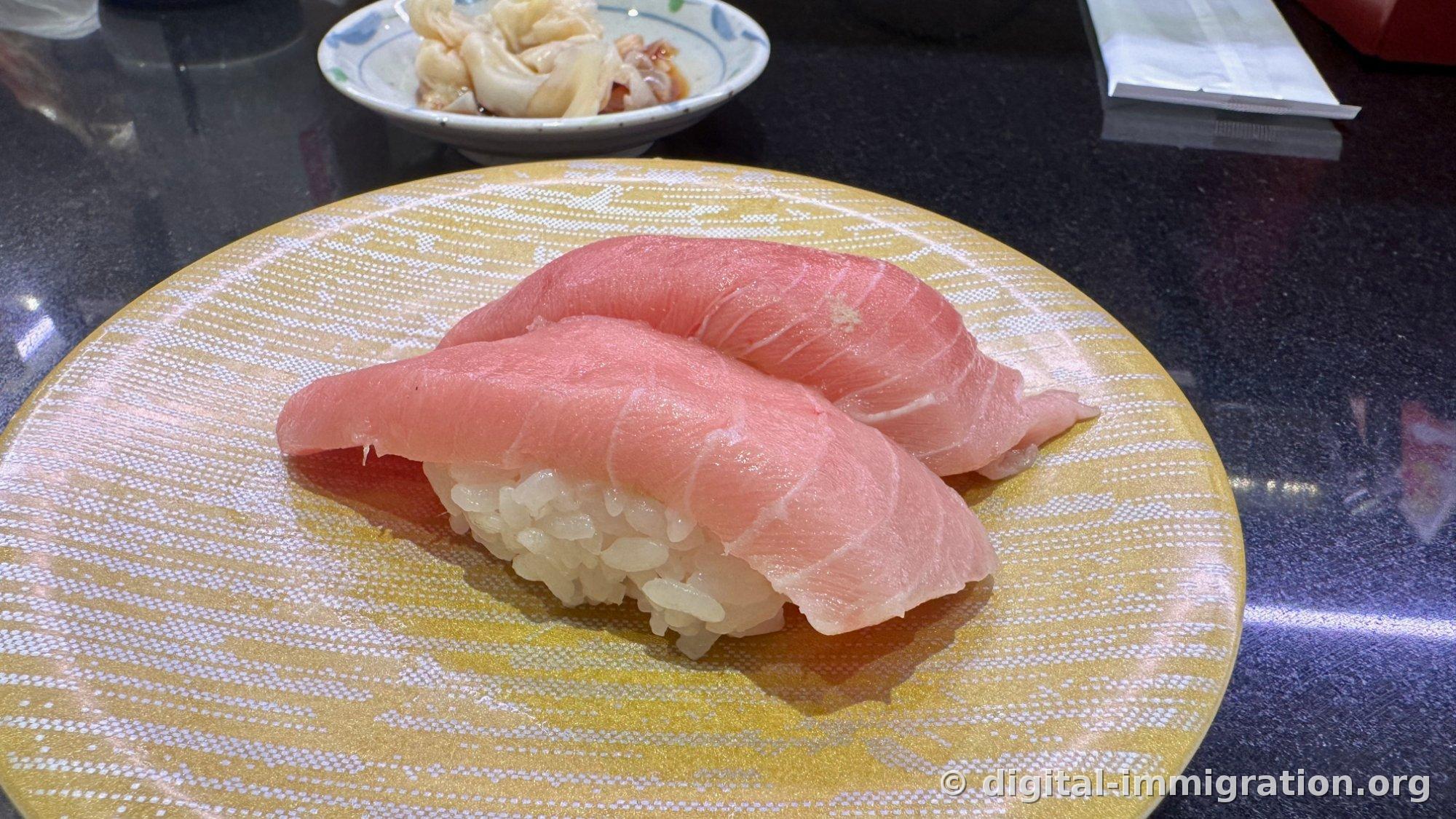
I ordered the chu-toro first. Two pieces on a yellow plate. The vibrant red flesh was webbed with white fatty lines like a fan, and it was so soft that the edges bent under their own weight sitting on top of the rice. Rather than a chewing sensation, it dissolved on my tongue. There was a moment when the 3-hour wait felt completely justified by a single piece of sushi, and honestly, this was it.
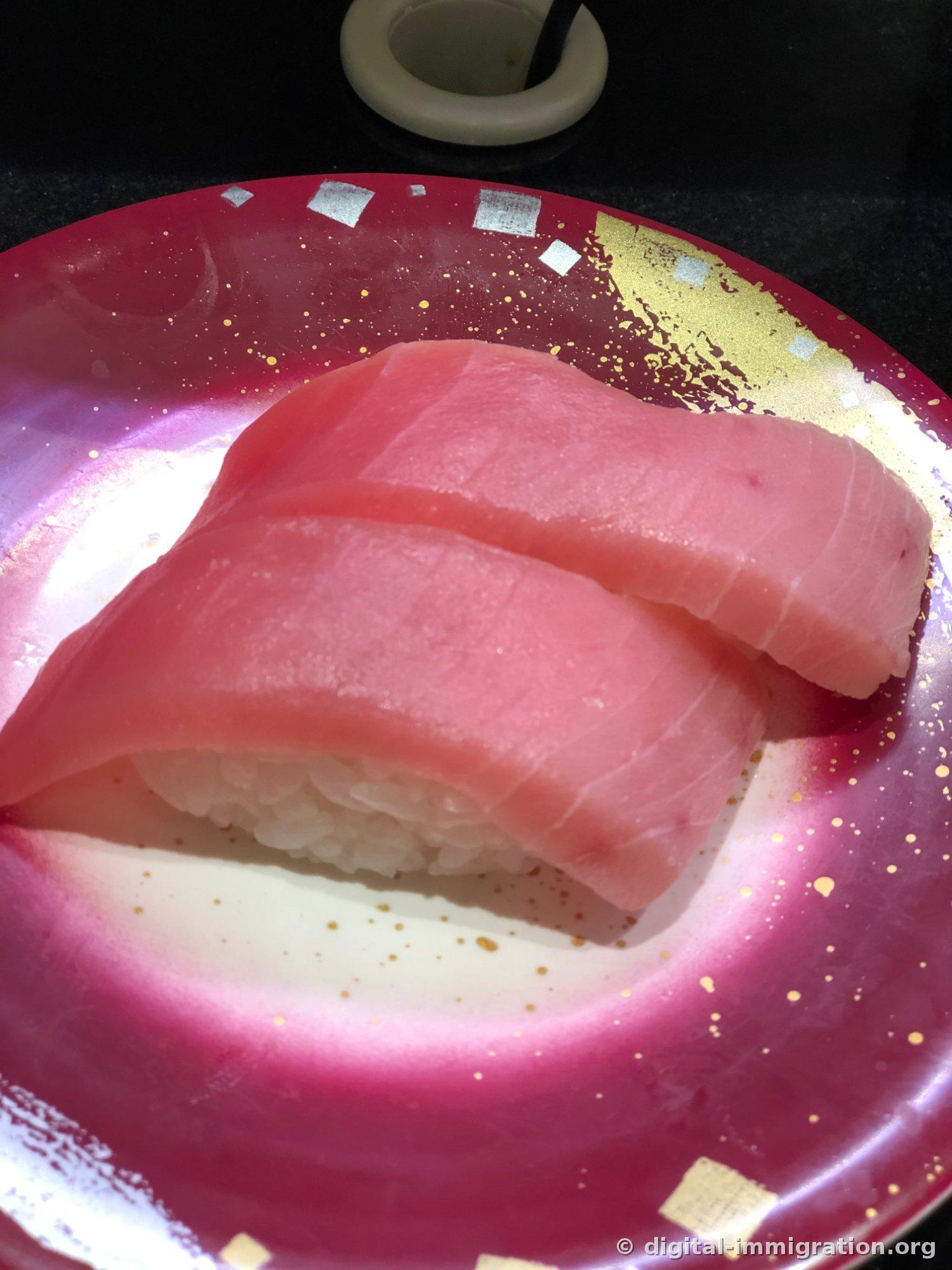
I also tried the redder variety with coarser texture. With this one, you feel the muscle fiber before the fat. There's a chew to it, and a subtle metallic note characteristic of tuna lingers on the finish. Eating only the soft pieces gets tiresome quickly, so mixing in something like this in between is good.
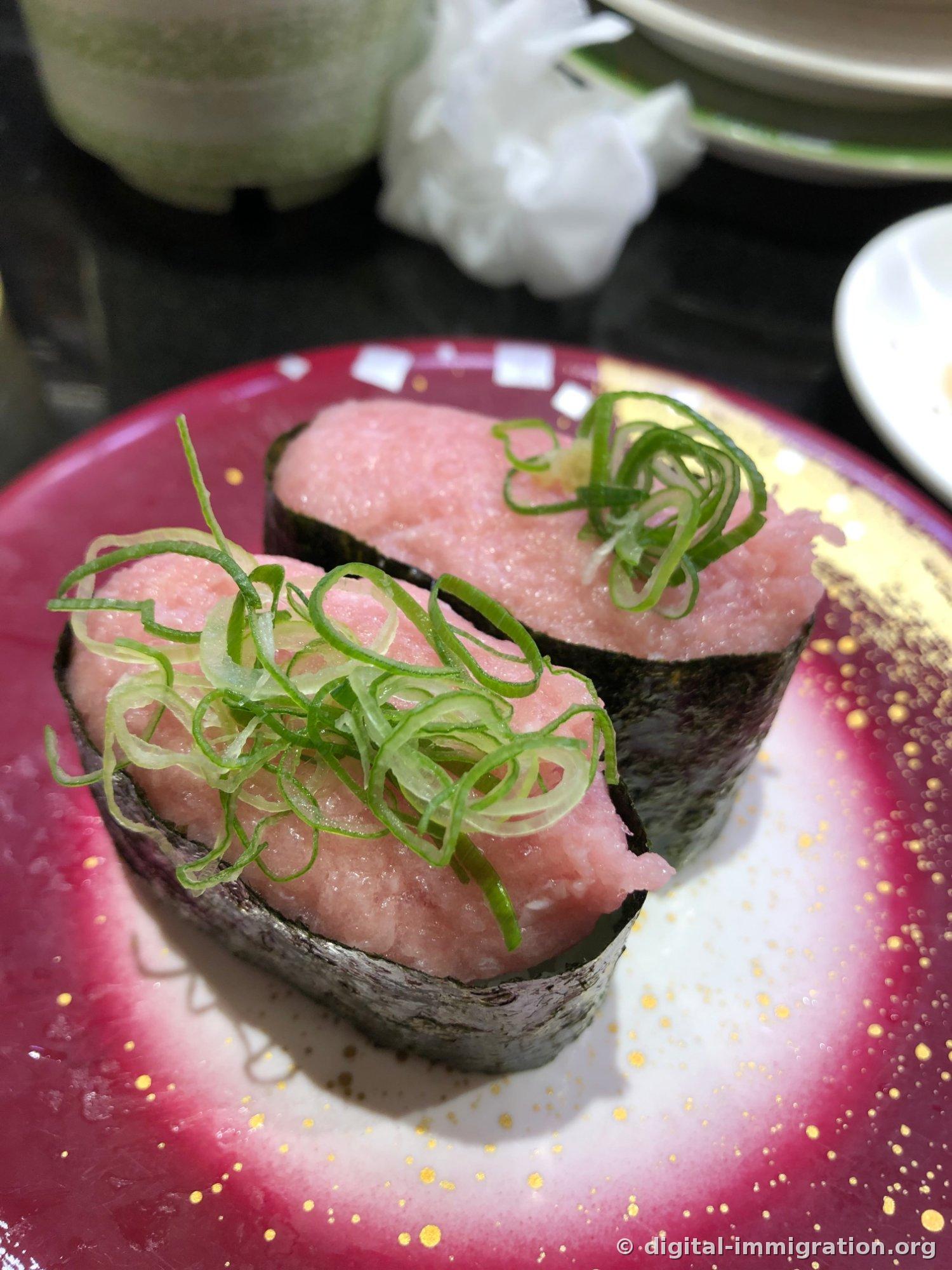
You can't skip the negitoro gunkan either. Finely minced toro topped with a generous handful of negi (green onions)—it's rare to find a place that doesn't skimp on the onions. The sharpness of the onions cuts through the richness, so you can eat two in a row without it feeling heavy.
Things I Ordered Besides Tuna
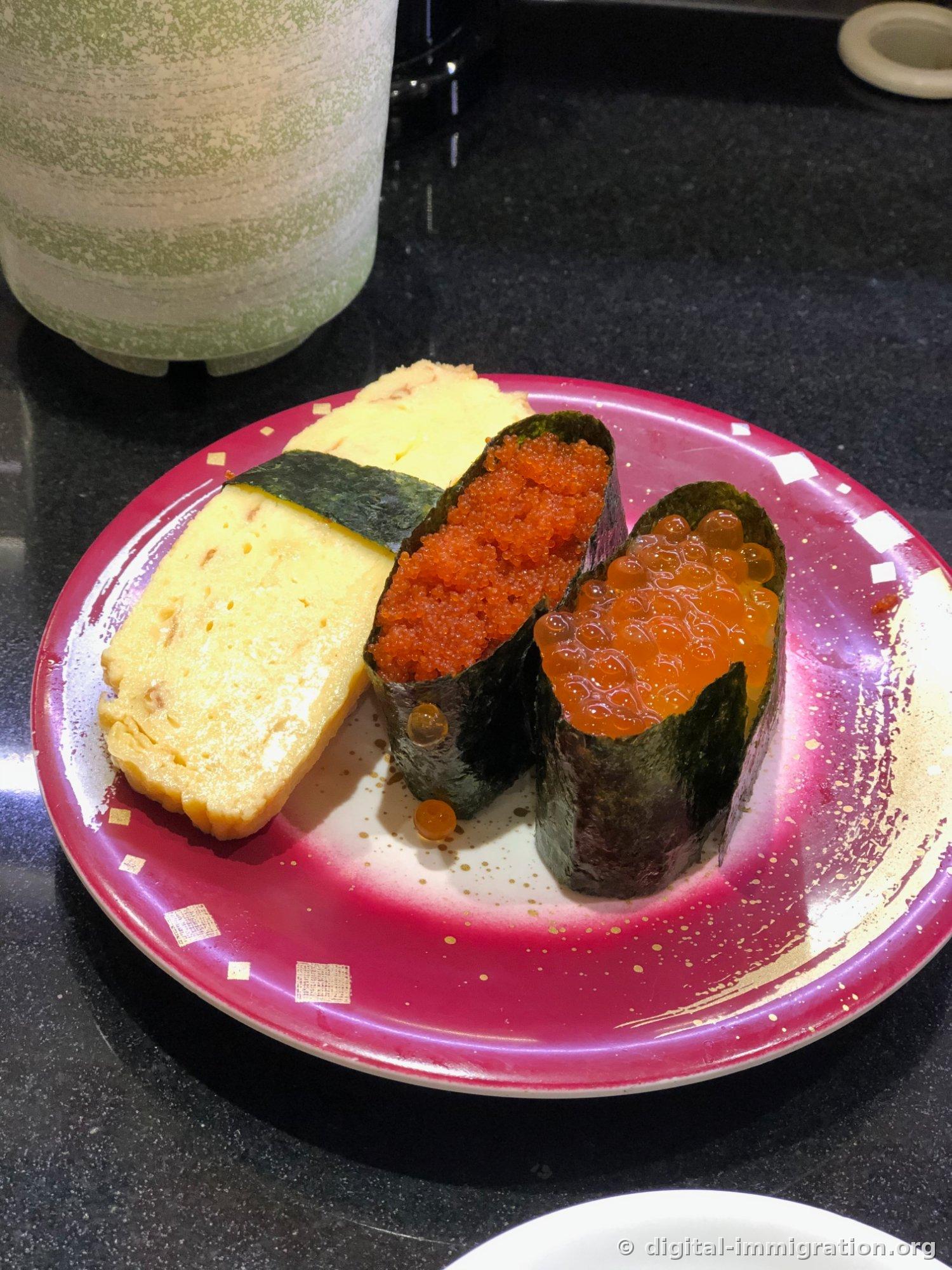
I ordered roe and egg preparations on one plate. On a red plate came dashimaki tamago (rolled omelet), tobiko (flying fish roe) gunkan, and ikura (salmon roe) gunkan lined up together. The omelet wasn't overly sweet; it had a subtle dashi flavor, making it good for a palate cleanser between pieces. The ikura has large, firm roe that bursts with a strong salty punch. The tobiko was all about the crispy crunch, so one piece was enough for me.
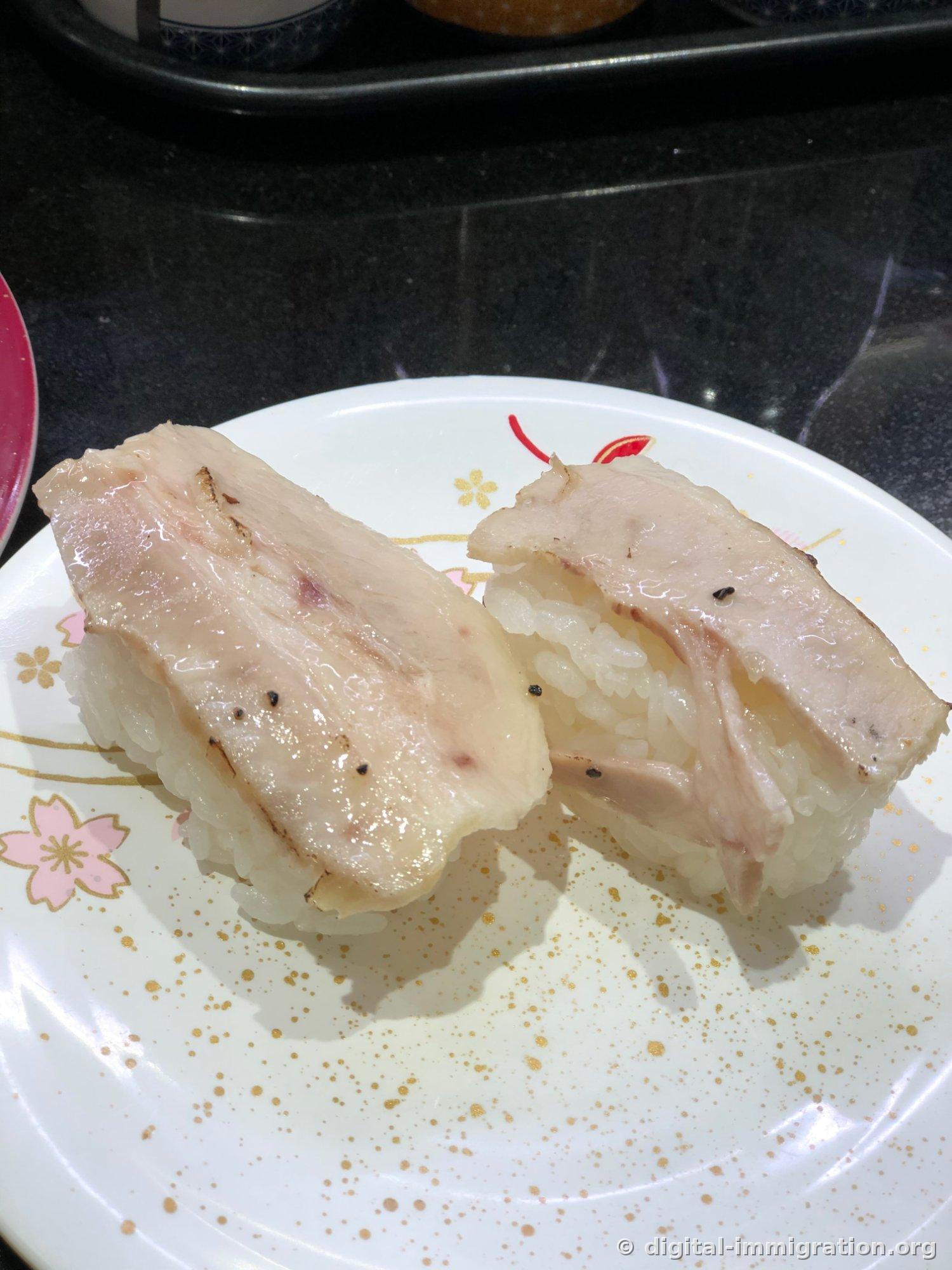
I also ordered two pieces of aburi white fish (lightly seared). The surface is gently torched until the oil renders and black pepper specks are embedded. The outside is rich and savory while the inside remains rare, creating an interesting textural contrast. However, the rice was pressed a bit loosely, and one piece crumbled as I picked it up. Given the fast-paced service, it's understandable, but it was still disappointing.
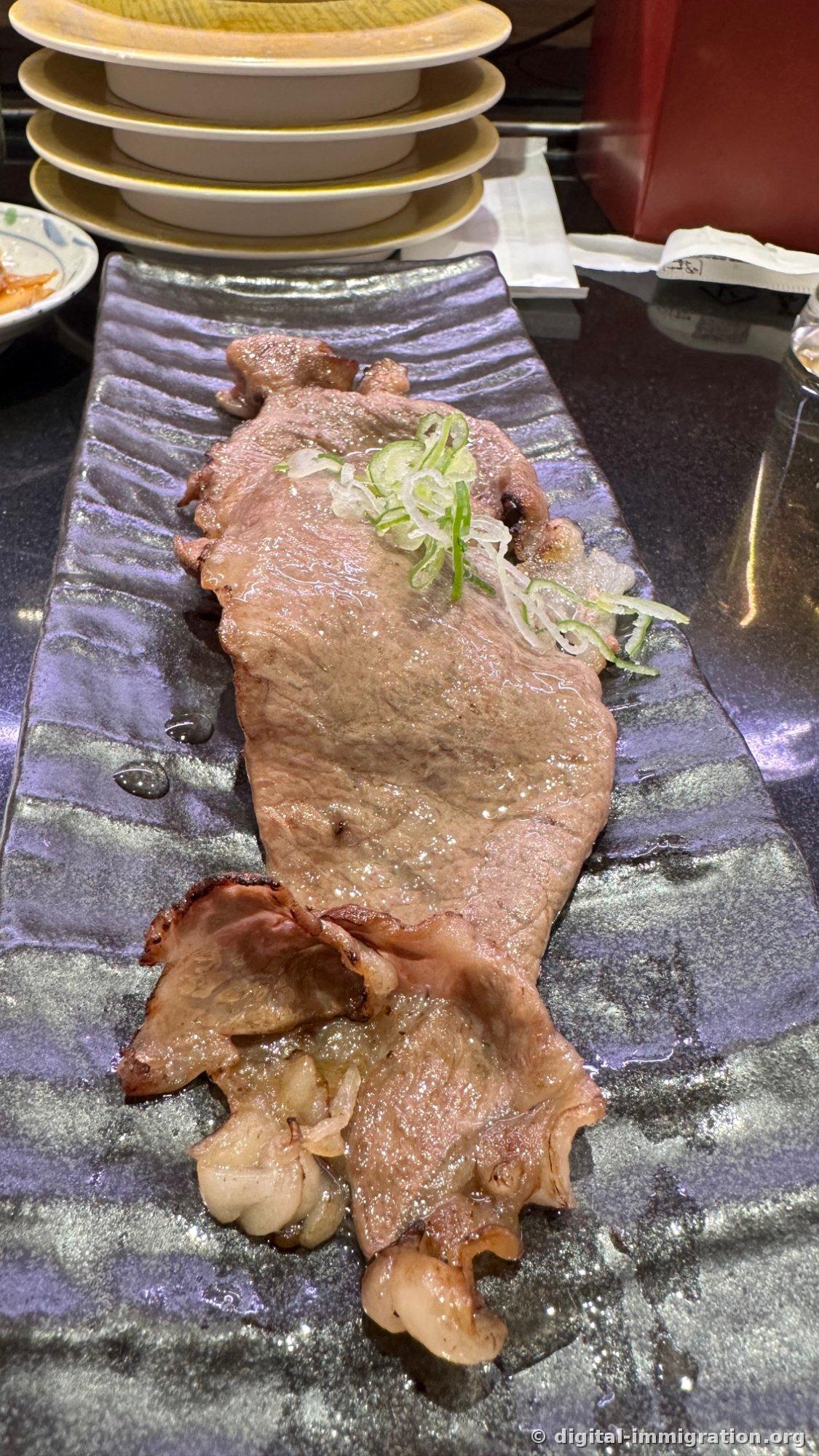
The final order wasn't sushi. A plate of grilled beef. Thinly sliced meat arranged on a long, rectangular navy blue plate, topped with green onion strips and minced onion. The meat is well-marbled with fat and has a salty base, making it more of a drinking dish than something to eat with rice. I wondered why a sushi restaurant would serve this, but it turned out to be a perfectly practical choice for someone who needs to fill their stomach within 90 minutes. The four yellow plates stacked nearby tell the story of how much tuna I consumed that day.
Location and Practical Tips
The restaurant is located inside Atoré Meguro, which is attached to JR Meguro Station. Simply follow the signs from the ticket gates and you'll arrive within minutes. Being inside the station means you won't get wet on rainy days, and being able to endure a 3-hour wait is thanks to the shopping center location offering plenty of ways to pass the time.
If I go again, here's how I'd do it:
- Avoid Friday and Saturday evenings. If you must go, aim for right when they open, or come in the late afternoon instead of evening.
- Grab your ticket number first, then walk around Atoré Meguro or take a walk toward Meguro River. Return to the area when your turn approaches.
- Once seated, the 90-minute timer starts, so don't waste time fumbling with the tablet. Decide what to order while you're waiting.
- Order a mix of two or three tuna grades, and punctuate with omelet or roe to cleanse your palate between pieces.
- The listed prices are pre-tax. Watching the plates stack up gives you a sense of the bill so you don't get shocked later.
Prices, menu composition, and availability change with each visit. The numbers in this article reflect what was displayed on the tablet and chalkboard the day I visited. I recommend checking operating hours and waiting procedures on-site. Just seeing "3 hours" might make you hesitant, but when I bit into that chu-toro, I thought I'd definitely come back. Though next time, on a weekday afternoon.
Read next
- From Akihabara's Chuo-dori to the Kanda River: A Record of Tokyo's Electronics District Revisited Multiple Times
Tokyo's Akihabara is a neighborhood where it's hard to say you've seen everything in a single visit. I've come multiple times across different seasons, and each time the signs chan…
Tokyo · Akihabara - Buying a Single ¥300 Year-End Jumbo Lottery Ticket at Nishi-Ginza Chance Center in Tokyo
Exit from the Hibiya exit of Tokyo's Shimbashi Station, walk toward the elevated highway for about three minutes, and suddenly you'll see a line of people stretching along the side…
Tokyo · Nishi-Ginza Chance Center - Ueno Ameyoko, the real magic starts after sunset — an evening walk from the Okachimachi Gate to Ueno Station
Every time I come to Tokyo, my feet find their way to Ueno Ameyoko (アメ横) without fail. This time I entered from the Okachimachi side and worked my way toward Ueno Station. I've met…
Tokyo · Ameya Yokocho Market