Kanagawa Kamakura: The Day I Ate Katsu Curry Instead of Shirasu at 'Kamakura Shokudo' in a Narrow Alley
The back alley I walked into from Kamakura Station had a different atmosphere from the typical wide pilgrimage paths of tourist destinations. Weathered wooden eaves and freshly pai…
Kanagawa · Rakuen
The back alley I walked into from Kamakura Station had a different atmosphere from the typical wide pilgrimage paths of tourist destinations. Weathered wooden eaves and freshly painted white walls were crammed together barely a hand's width apart, and a single bicycle leaned against one wall. It was evening in Kamakura, Kanagawa Prefecture, when the alley was beginning to darken from the inside. The first thing that caught my eye in that alley wasn't a restaurant—it was a stained glass workshop.
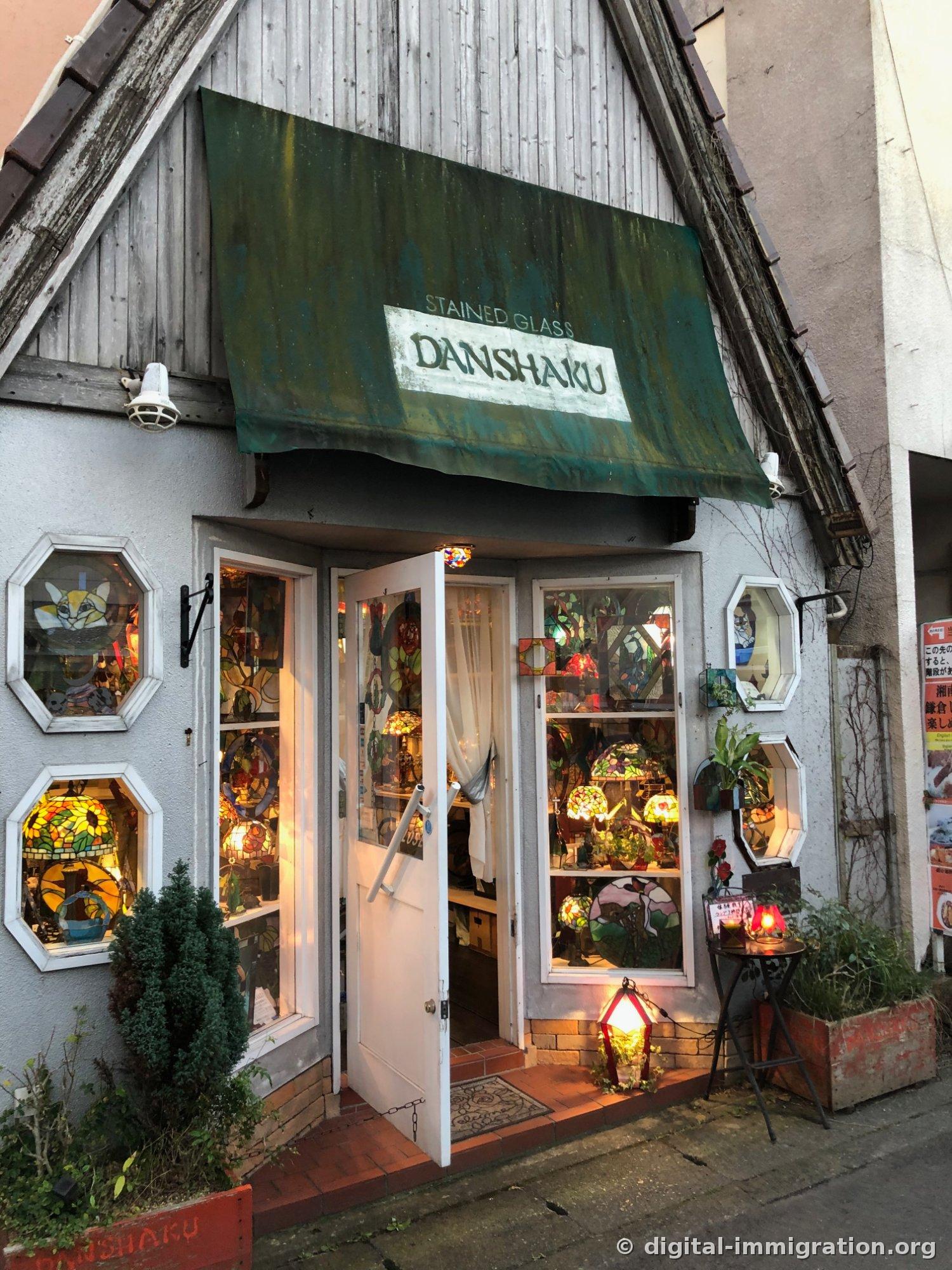
Stained Glass Workshop DANSHAKU with Green Awning at the Alley's Entrance
A triangular gabled roof with green awning, its color faded as if moss had crept over it. A sign that looked handwritten saying 'STAINED GLASS DANSHAKU' hung there. Four octagonal window frames were embedded in the wall, each containing a stained glass piece—a cat's face, a sunflower lamp, a landscape with a deer. The door was half-open, and inside I could see Tiffany-style lamps glowing in layers. Outside it was already growing dim, but beyond the glass it was warm and orange.
Two candle-like lamps were lit on a small iron table in front of the door. They don't show up well in photos, but standing there in person, this is the only point of light in the alley, so your feet naturally stop. On the right wall was a sign saying something like 'There are stairs ahead.' Kamakura alleys often suddenly lead to stairs like this.
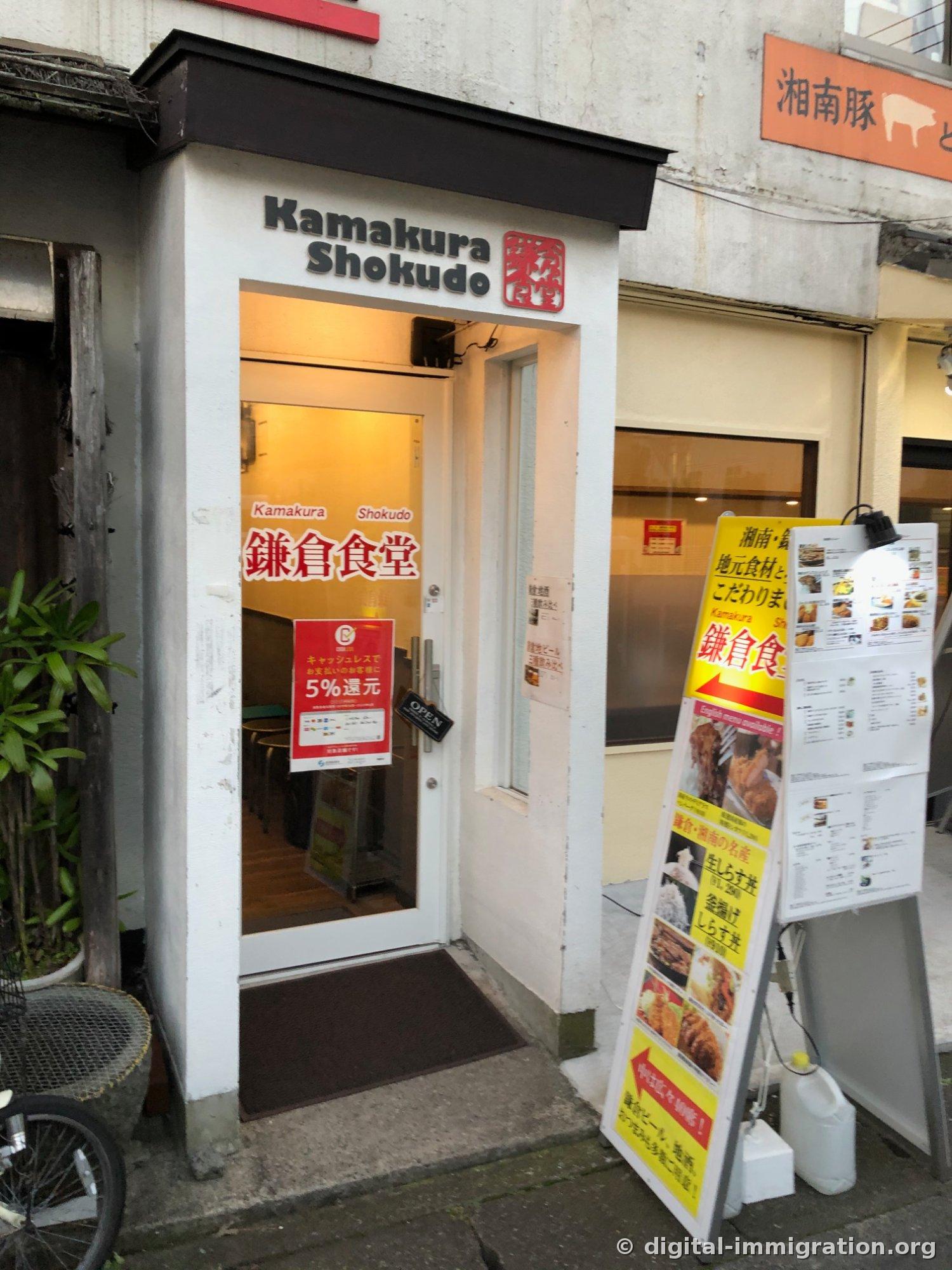
'Kamakura Shokudo' with an English Menu Stand Sign
A few steps past the workshop, a narrow entrance appeared with Kamakura Shokudo in black letters on a white wall, and 鎌倉食堂 in red letters below. It's the kind of shop you could easily walk past—just one door wide. A '5% cashless refund' sticker was on the glass door, and an OPEN sign hung there.
The crucial thing is the stand sign placed outside. Photos of 生しらす丼 and 釜揚げしらす丼 were posted prominently on a yellow background, and on the adjacent panel was a full English menu with photos. Even the phrase 'English menu available.' Anyone who has hesitated in front of a restaurant with only a Japanese menu knows how welcoming this sign is. The orange sign next door was for a '湘南豚' restaurant.
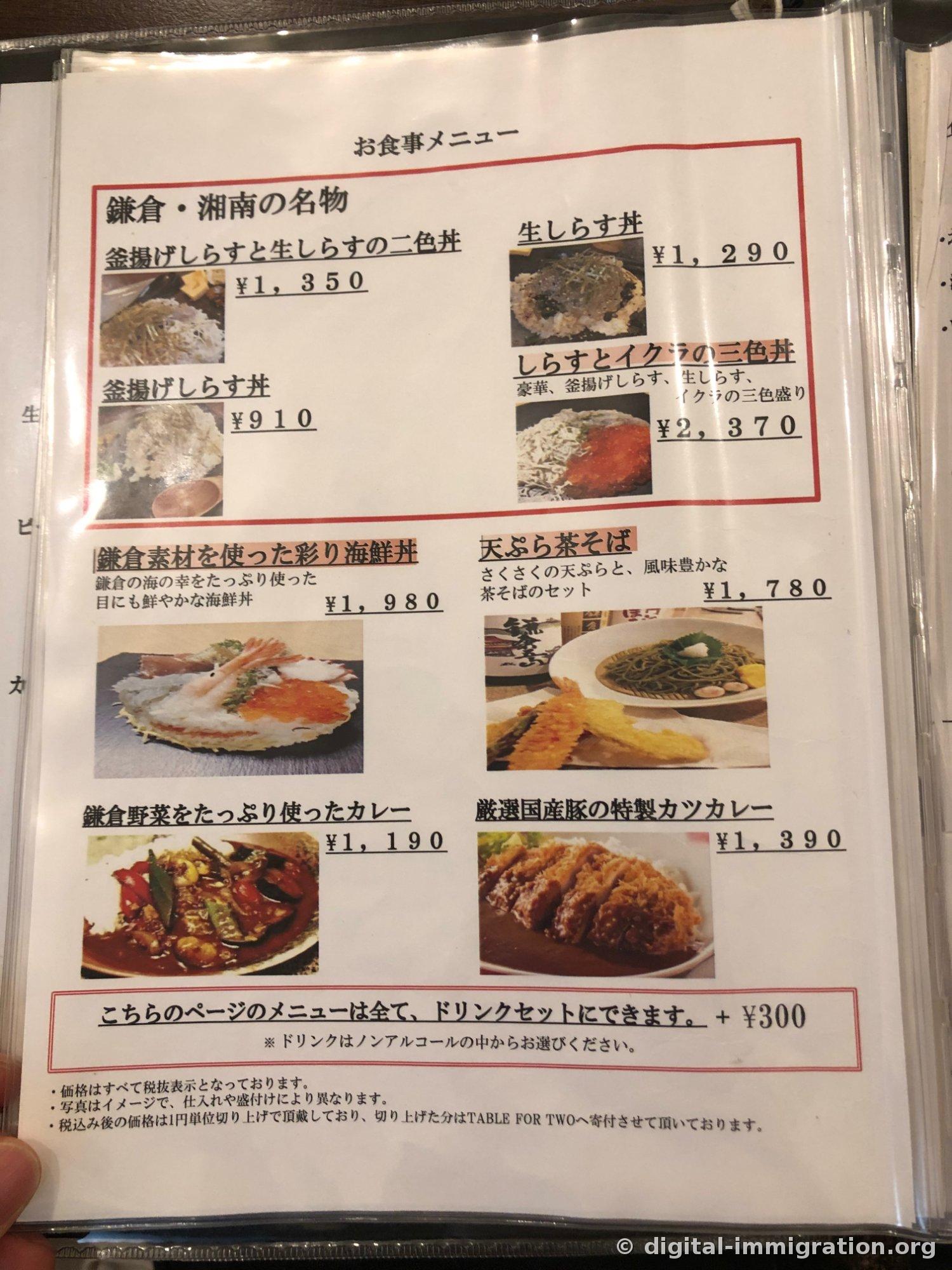
Menu Prices as Written
The first page of the laminated menu I received after sitting down was the 'Specialties of Kamakura and Shonan' section. The prices are exactly as written on the menu that day.
- Two-dish set with boiled shirasu and raw shirasu — ¥1,350
- Raw shirasu rice bowl — ¥1,290
- Boiled shirasu rice bowl — ¥910
- Three-dish set with shirasu and ikura — ¥2,370
- Seafood rice bowl with Kamakura ingredients — ¥1,980
- Tempura + buckwheat noodle set — ¥1,780
- Kamakura vegetable curry — ¥1,190
- Premium Japanese pork cutlet curry — ¥1,390
At the bottom of the menu, it said all prices are listed before tax. The menu items on this page can be changed to a drink set for +¥300, and the beverages are chosen from non-alcoholic options. There was also a small note that any rounding up after tax is donated to TABLE FOR TWO. These are based on the prices when I visited, so I recommend checking current prices on-site.
Raw shirasu is only available on days when they're caught. During fishing closures or if they can't operate that day, even if it's on the menu, you'll hear 'We don't have it today.' I didn't get to eat raw shirasu at this restaurant either. If you come all the way to Kamakura specifically for shirasu, it's better to keep that in mind and decide on an alternative menu item in advance.
Location and Accessibility
The coordinates of the shooting location are marked on the map below. The alleys around Kamakura are so narrow that a car can barely squeeze through, so the train is much more convenient than a rental car. Use JR Kamakura Station or the Enoden, and it's better to explore the alleys on foot. Like the staircase signs I mentioned earlier, the terrain changes suddenly in some places, so dragging a suitcase around will be difficult.
What I Ended Up Ordering — Premium Japanese Pork Cutlet Curry ¥1,390
When the plate arrived, my first thought was 'There's a lot of curry.' Brown curry covered the left half of an oval plate, with rice on the right and a thickly sliced tonkatsu in the middle. Parsley powder was sprinkled on top of the rice. In a small two-compartment dish served separately were potato salad and fukujinzuke (red pickled radish).
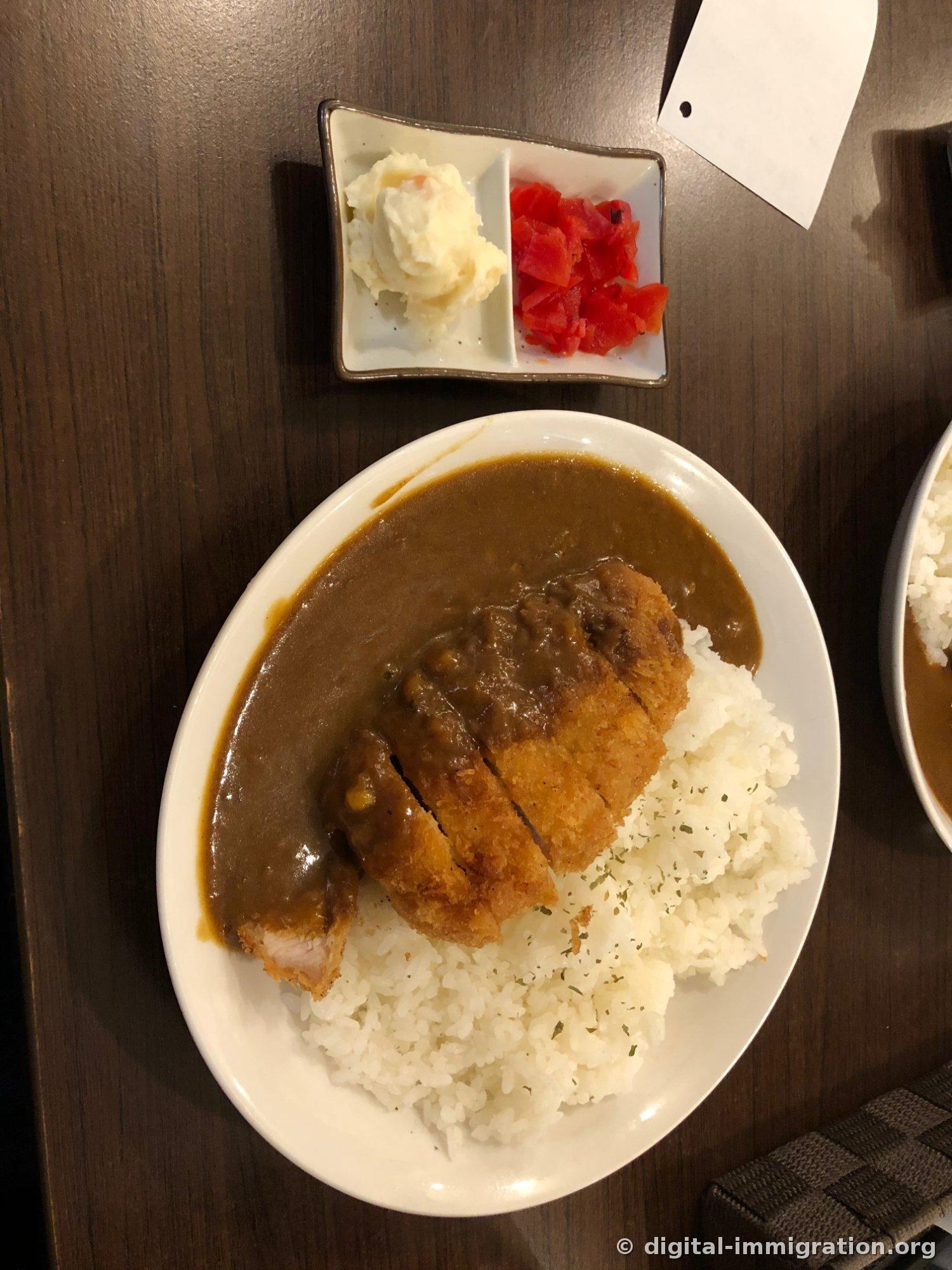
The curry is on the thinner side rather than thick. The color is dark, but the taste emphasizes sweetness and the umami of onions more than spiciness. Small pieces of onion remain mixed in the sauce, so when you pour it over the rice, you feel the texture. Like most Japanese restaurant curries, the intensity is mild. If you're expecting something spicy, you might find it bland.
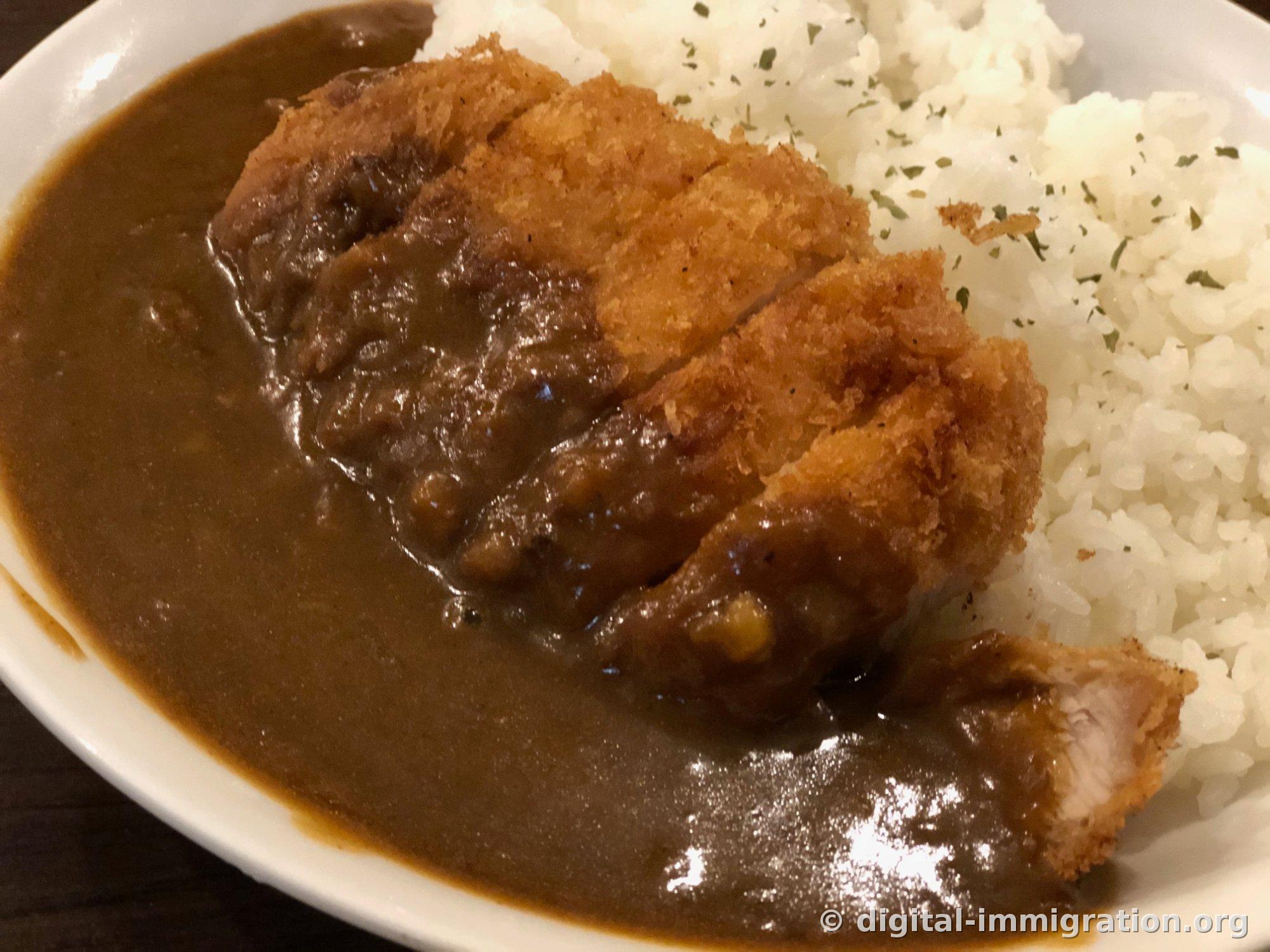
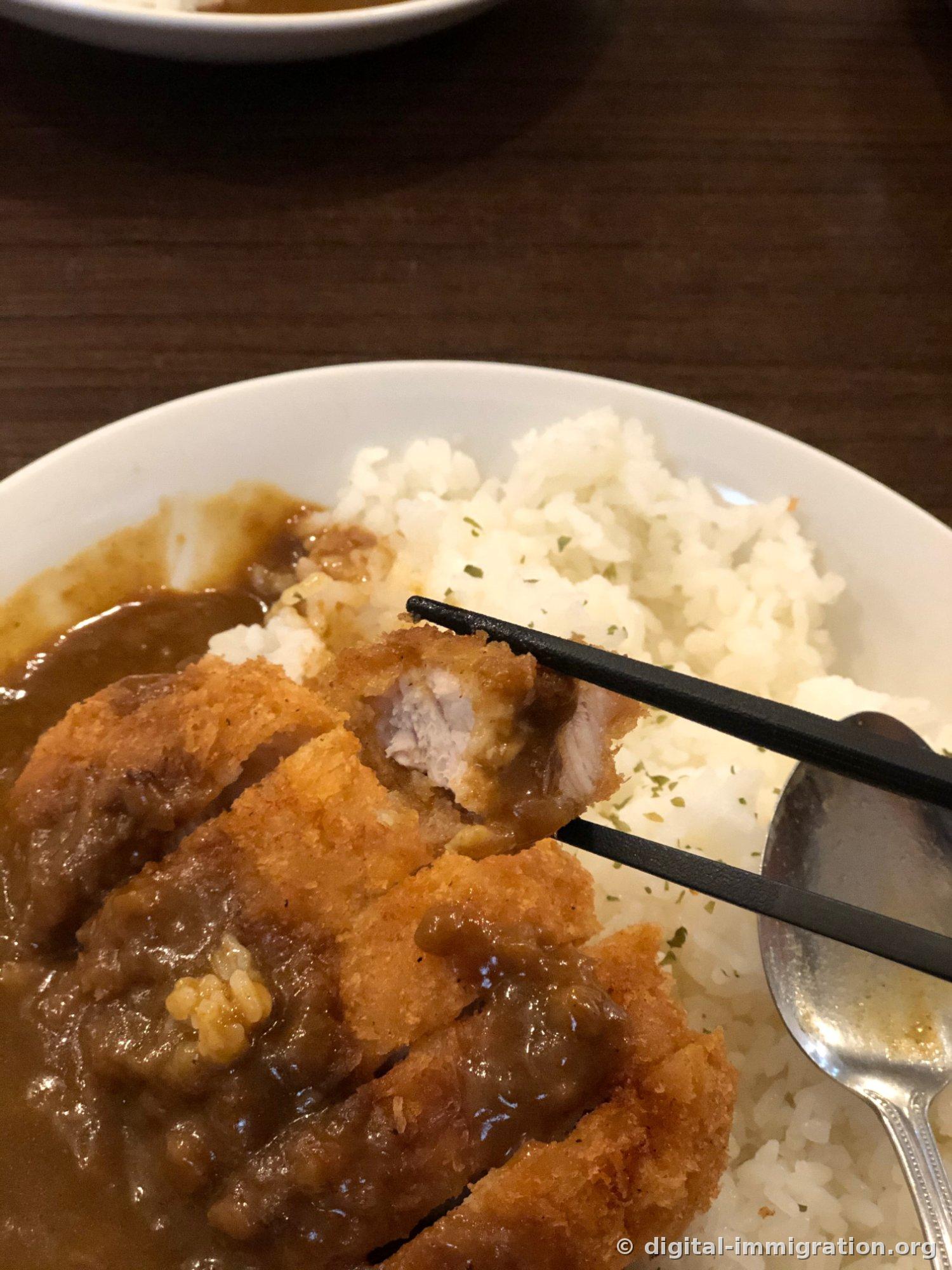
The breading is thick breadcrumbs. When I picked up a piece with chopsticks, the cross-section was cooked white and not dry. It hadn't been fried long, which you could tell from the crispy sound. However, because the curry is poured generously on the plate, if you take your time, the breading at the bottom becomes soggy. I ate the first few pieces with less curry on them, and that turned out to be the right order. The remaining half became completely submerged in curry and turned into something different. That wasn't bad either, but the crispy version was definitely better.
Be Sure to Check the Papers on the Wall
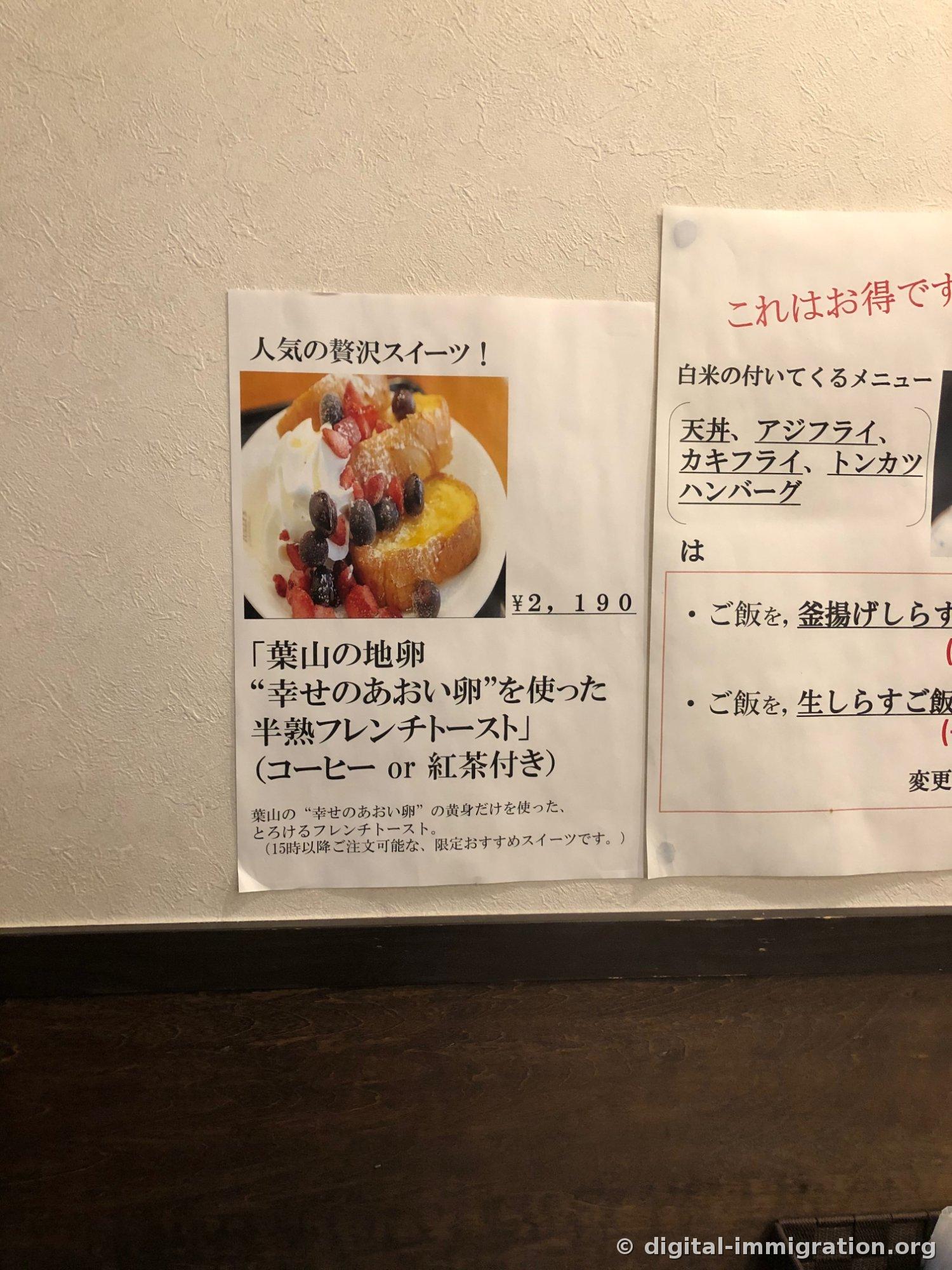
If you only look at the menu board, you'll miss something. Two A4 sheets of paper were posted on the wall.
The left one is for dessert. A soft-boiled French toast made with egg yolks from Hayama's 'Koufunomiaooi Tamago (Egg of Happiness),' at ¥2,190 and comes with coffee or tea. In small print it said limited menu available only after 3 PM. If you came during lunch hours, you wouldn't be able to order it even if you wanted to.
The right sheet is more practical. It explained that for menus that come with white rice—tempura bowl, breaded horse mackerel, fried oysters, pork cutlet, and hamburger—you can change the rice to boiled shirasu rice or raw shirasu rice. The additional charge is hidden in the photo, so it's best to ask when you order. This combination is perfect for people who find ordering a shirasu bowl separately too much but still want to taste shirasu. I discovered this paper after I'd already ordered the katsu curry. Next time I visit, I'm planning to get the breaded horse mackerel set and switch the rice to shirasu rice.
Things Good to Know Before Going
- All prices are listed before tax. Your bill will be slightly higher than the menu numbers.
- Raw shirasu depends on whether they're fishing that day. It's often unavailable.
- French toast orders only after 3 PM. If you come at lunch, you'll need to skip it or come back later.
- An English menu with photos is posted outside, so you can check the prices and decide on your order before you go in.
- The restaurant is narrow. Bringing large luggage makes it awkward to find a seat.
- The prices and conditions listed here are from when I visited. They may have changed, so I recommend checking on-site.
My evening record from the day I couldn't eat shirasu in Kamakura became a katsu curry. After finishing my rice and stepping outside, the alley was completely dark, but that stained glass lamp from earlier was still glowing.
Read next
- From Akihabara's Chuo-dori to the Kanda River: A Record of Tokyo's Electronics District Revisited Multiple Times
Tokyo's Akihabara is a neighborhood where it's hard to say you've seen everything in a single visit. I've come multiple times across different seasons, and each time the signs chan…
Tokyo · Akihabara - Buying a Single ¥300 Year-End Jumbo Lottery Ticket at Nishi-Ginza Chance Center in Tokyo
Exit from the Hibiya exit of Tokyo's Shimbashi Station, walk toward the elevated highway for about three minutes, and suddenly you'll see a line of people stretching along the side…
Tokyo · Nishi-Ginza Chance Center - Ueno Ameyoko, the real magic starts after sunset — an evening walk from the Okachimachi Gate to Ueno Station
Every time I come to Tokyo, my feet find their way to Ueno Ameyoko (アメ横) without fail. This time I entered from the Okachimachi side and worked my way toward Ueno Station. I've met…
Tokyo · Ameya Yokocho Market