Hachiko Square at Shibuya Station: Tokyo Between Cherry Blossoms by Day and Neon by Night
When you exit Shibuya Station through the Hachiko exit in Tokyo, you hit a wall of people within three seconds. You descend a few steps from the ticket gates and there's the square…
Tokyo · Shibuya Station
When you exit Shibuya Station through the Hachiko exit in Tokyo, you hit a wall of people within three seconds. You descend a few steps from the ticket gates and there's the square—and it's become my most frequent standing spot in Tokyo. I've been here once in spring and once on a summer night, and the impressions were completely different. By day, it's people-watching under cherry blossoms; at night, it's waiting at crosswalks under advertising towers. It's the same hundred-some square meters, but it becomes a different neighborhood depending on the time of day.
One Bronze Dog Within a Five-Meter Radius
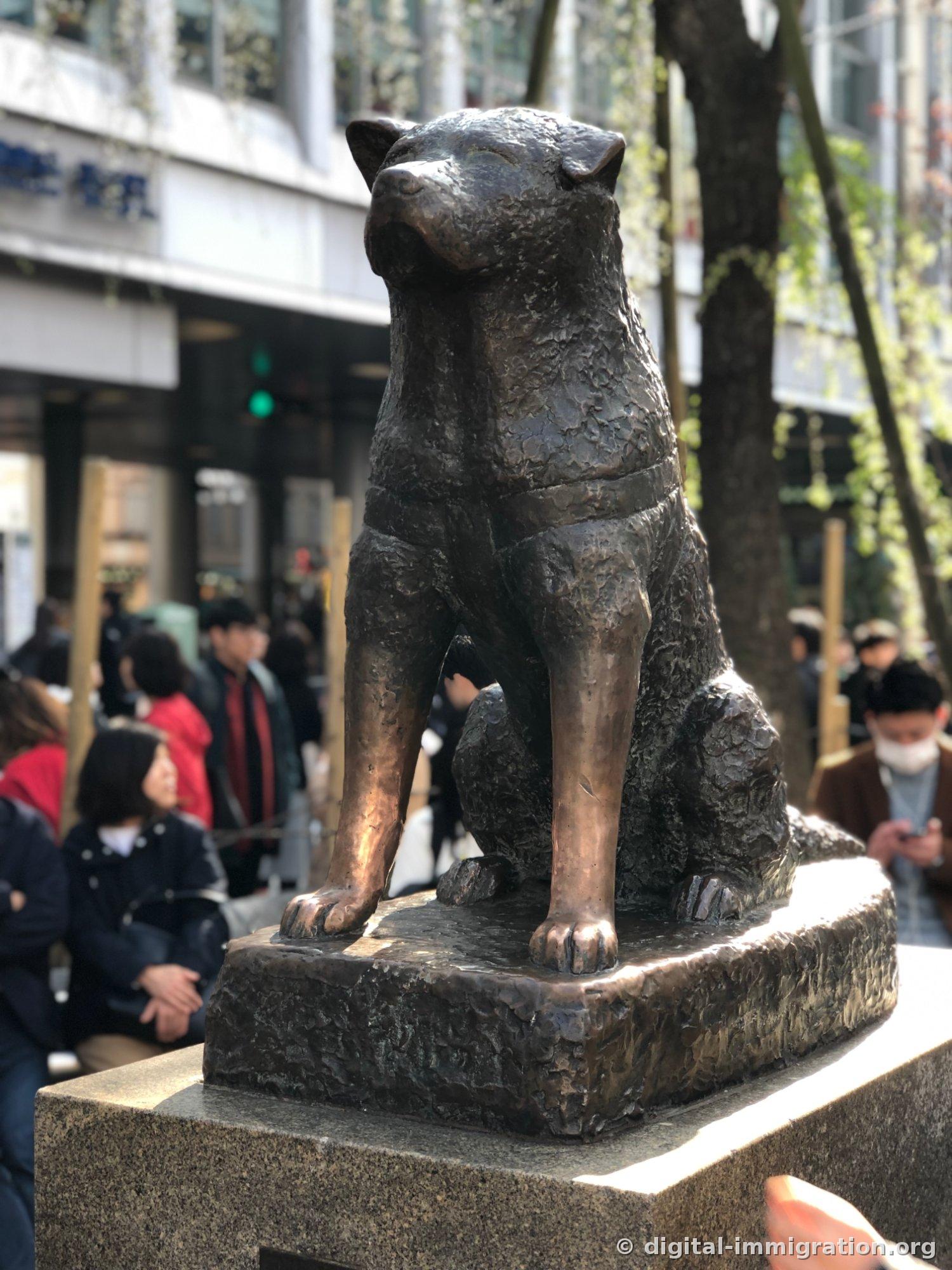
The Hachiko statue is smaller than you'd think. I've watched people who came after seeing photos online make a "That's it?" face in front of the real thing. Its shoulder height reaches about an adult's waist, and it sits on a granite base looking up and to the left. The back and front paws are so worn from being touched by so many hands that they shine brighter than the original bronze color.
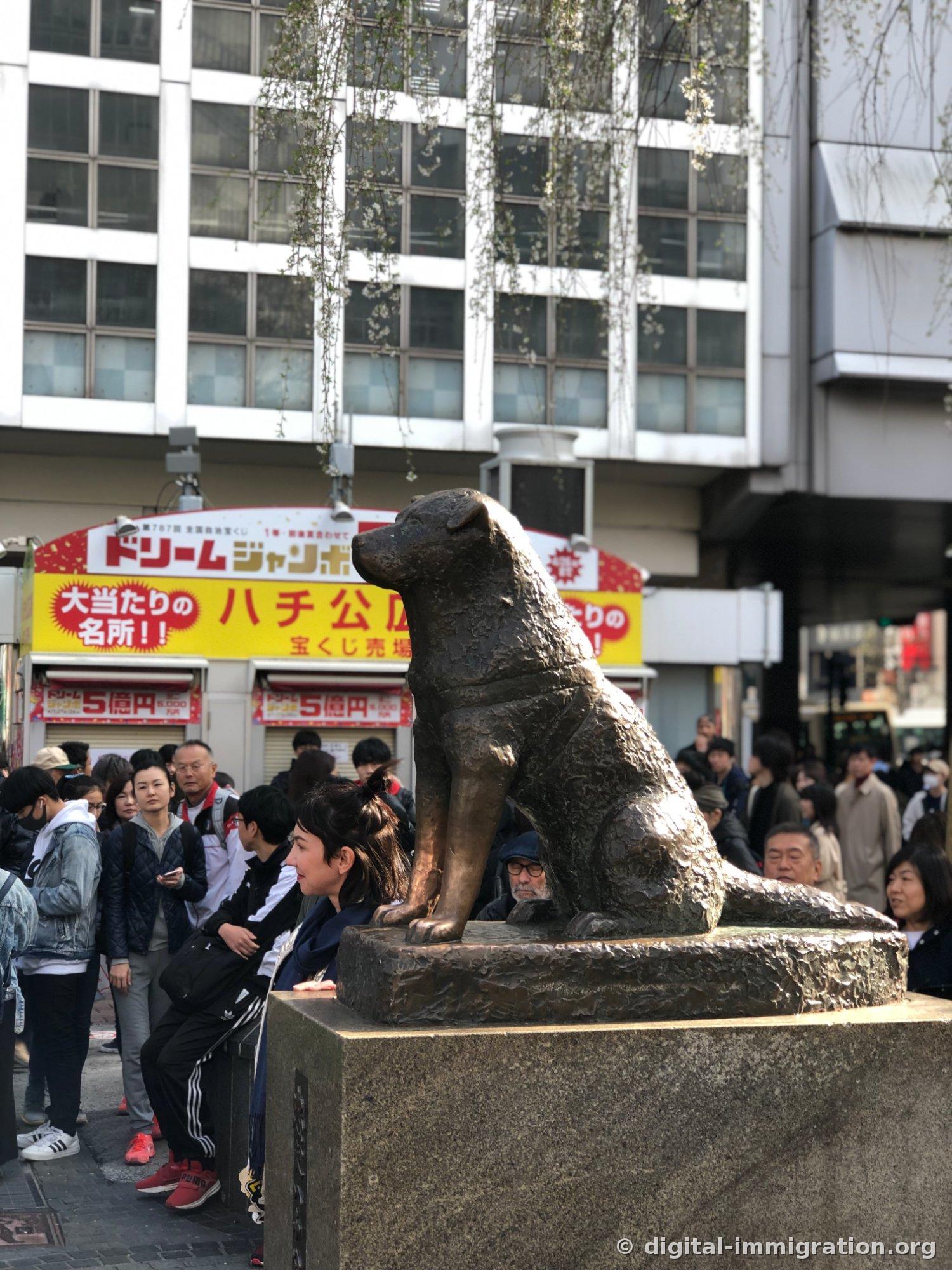
Few people notice the yellow lottery shop stuck right behind the statue. It displays ドリームジャンボ 500 million yen in big letters, complete with its own promotional phrase—"大当たりの名所," a place where big wins happen. The combination of selling lottery tickets next to a loyal dog made me laugh for a while.
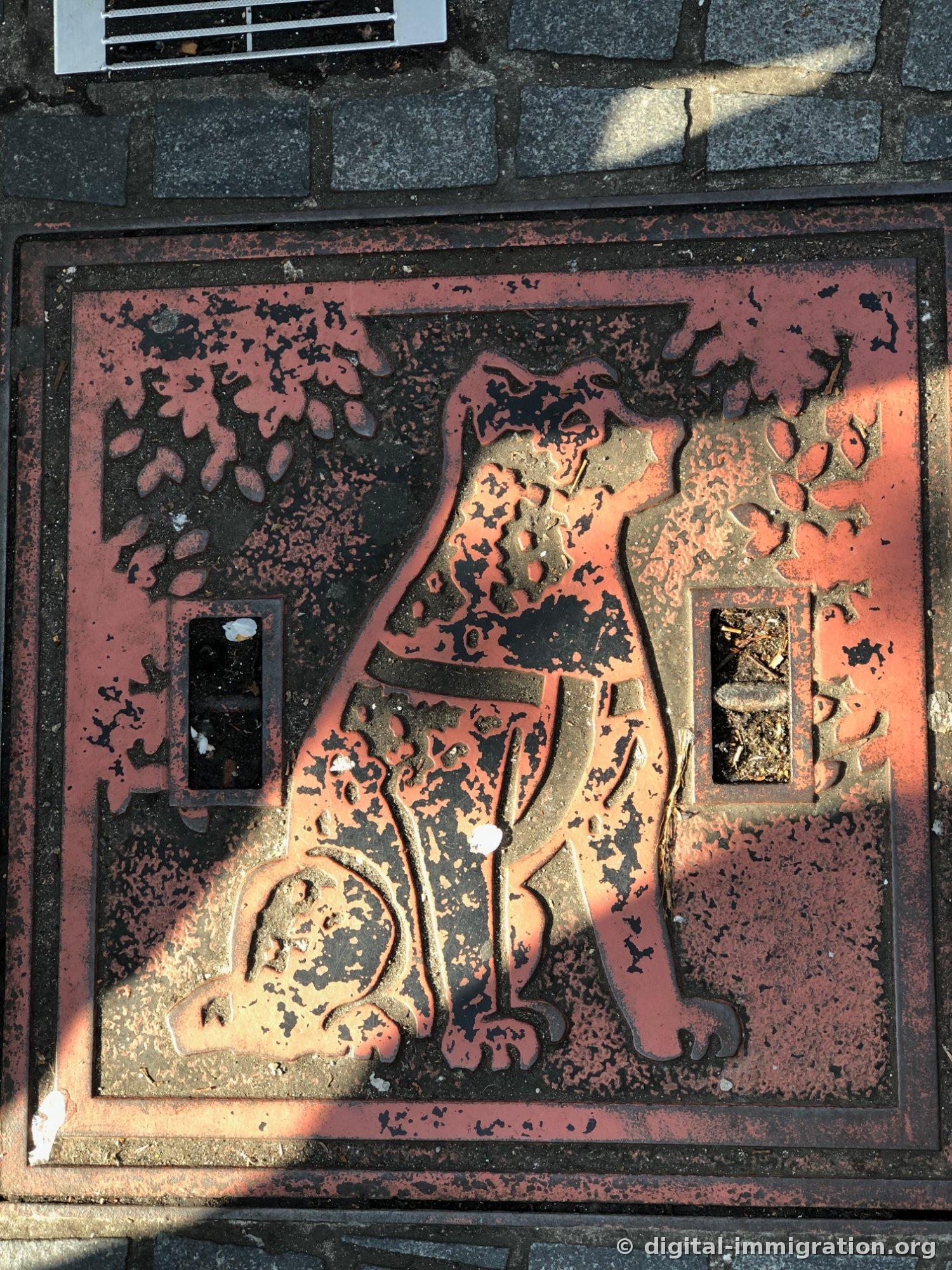
Most people photograph just the statue and leave, but it's worth glancing at your feet. Even the manhole cover on the square's floor has Hachiko engraved on it. The orange stamp has worn and faded, showing a design of a dog sitting under a tree. While I was crouching down to photograph it, two people next to me started taking photos too.
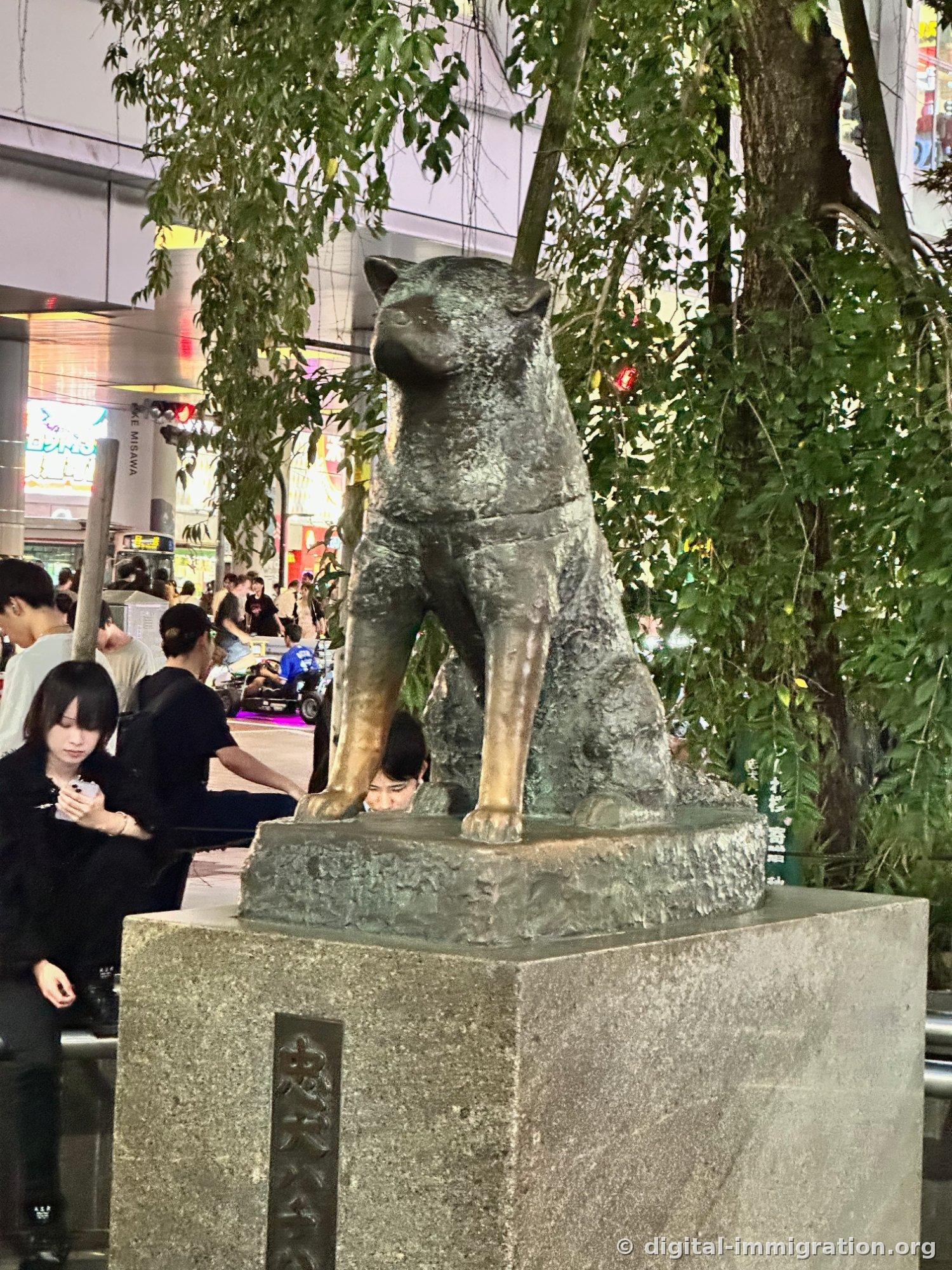
Going at night was much better. Tree lights shine up from below, casting a green glow on the bronze. During the day you have to stand in line to take a photo, but around 9 p.m. there are more people sitting beside the statue just looking at their phones. The name plaque 忠犬ハチ公 on the base is also much easier to read at night.
People Living in the Square—That's the Real Attraction
The real star of Hachiko Square isn't the statue; it's the people. Everything worth seeing and doing ultimately comes down to people, and there are genuinely unusual people here. When I went in spring, there was someone in a full-body gold bodysuit with a white mask sitting on a suitcase under the cherry tree. A whiteboard in their hands read "YouTuber ゲンキTV / チャンネル登録頼む" (subscribe to the channel). They weren't performing anything—just sitting there—but people kept glancing over. Even when an older man walking past openly pointed his camera at them, they didn't budge.
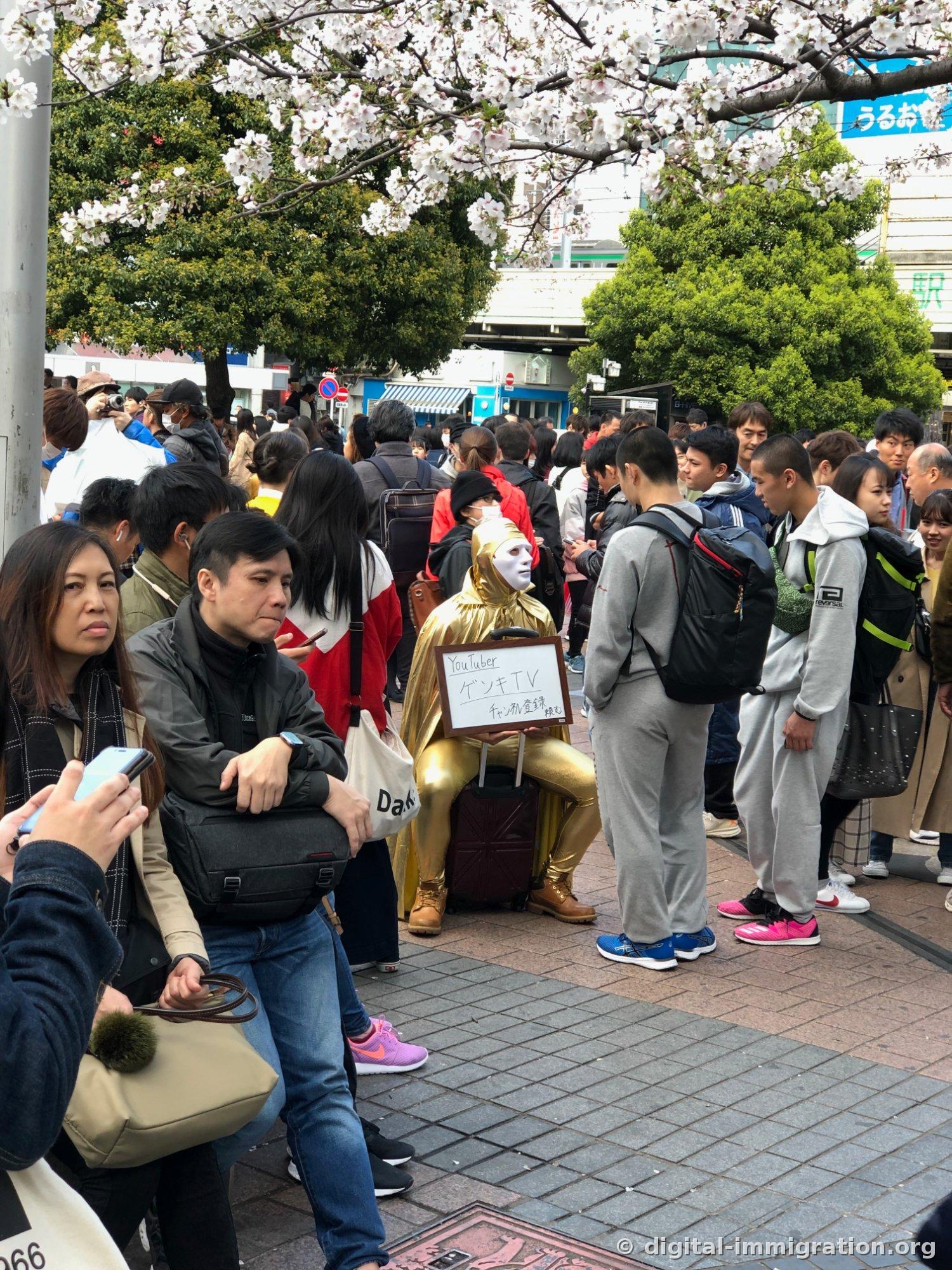
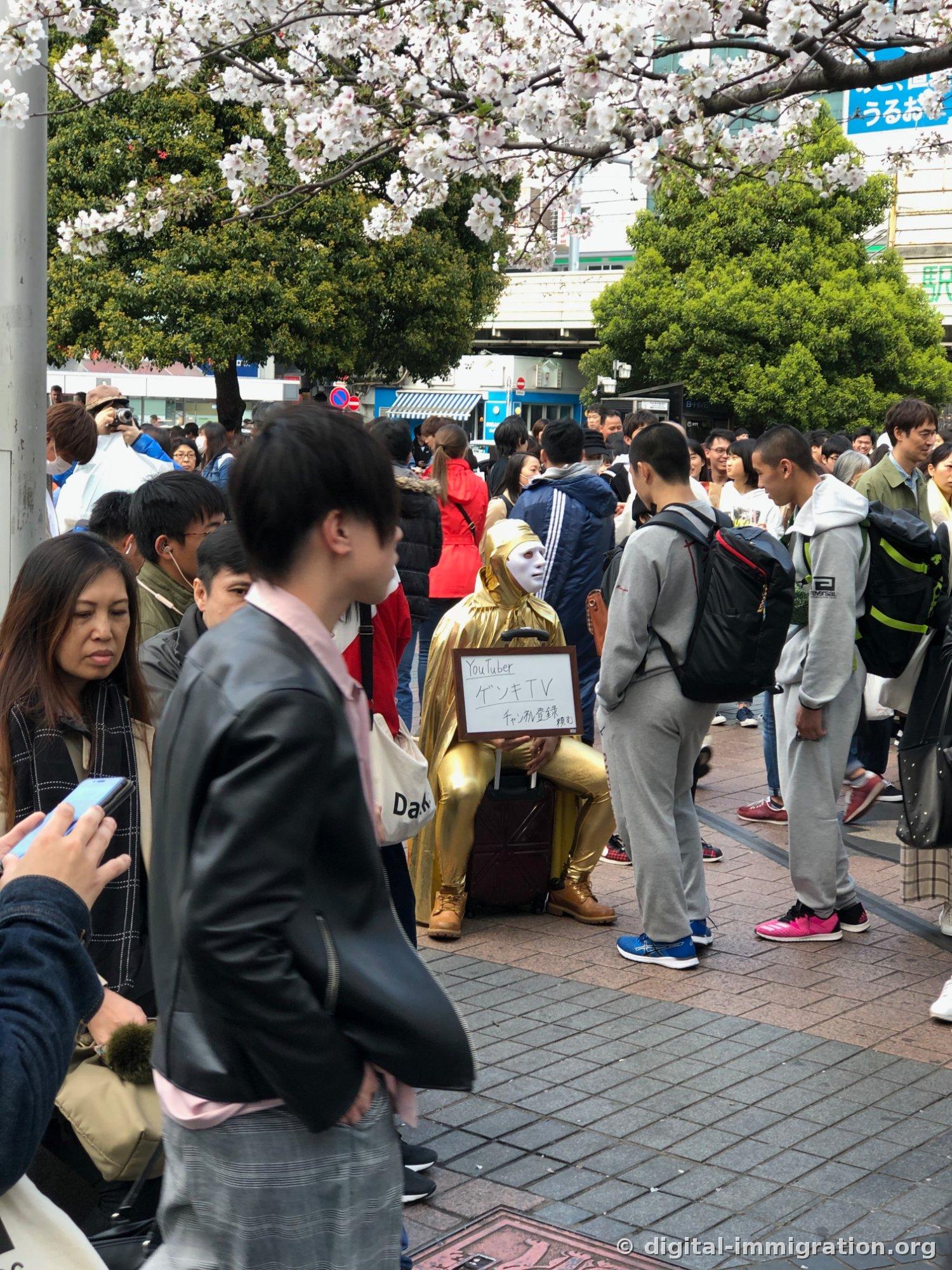
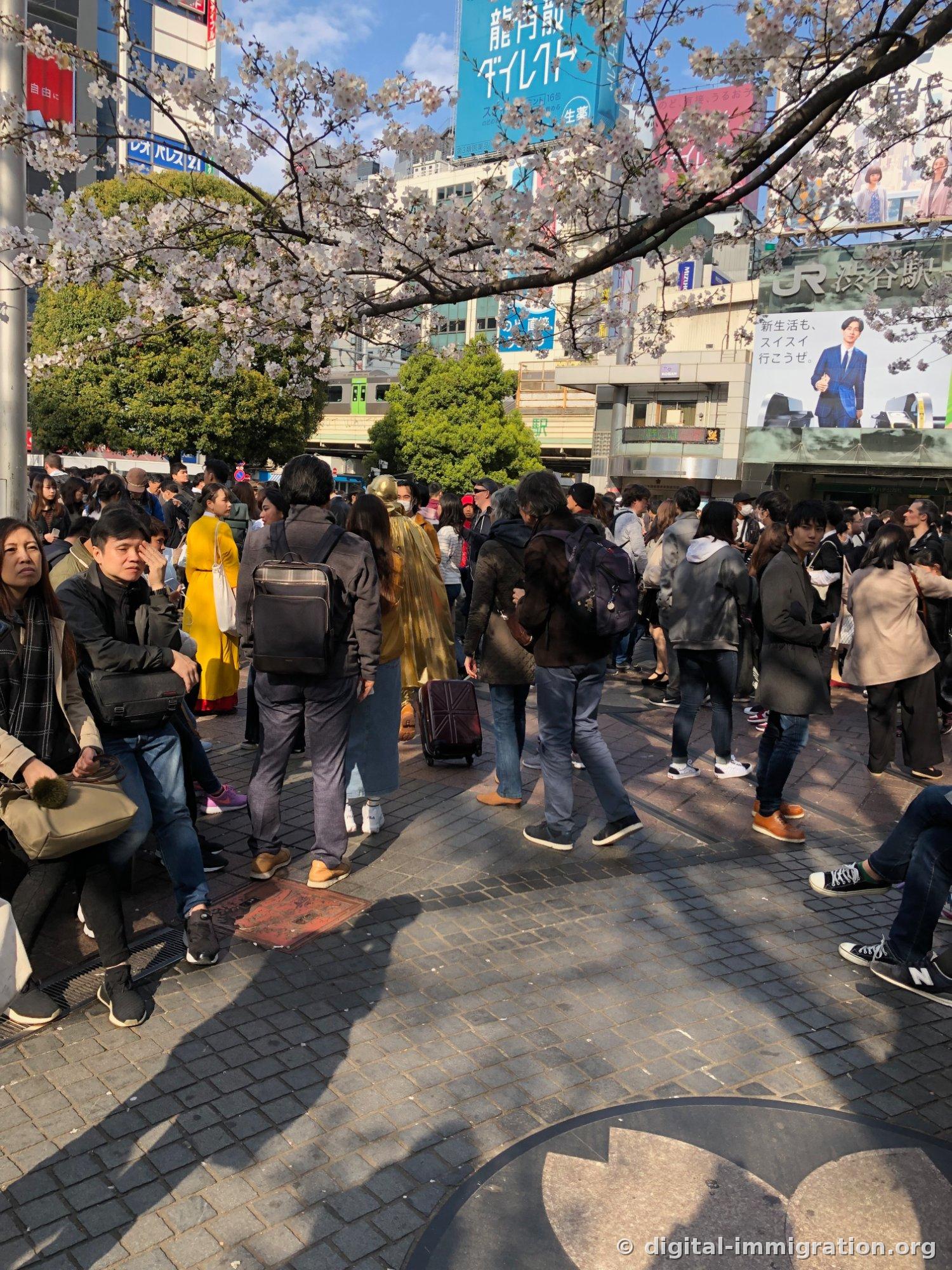
Step back and view the entire square and this is the density you see. Cherry blossom branches cover the top of the frame, and below them are tangled yellow dresses, gold clothing, suitcases, and backpacks. In the upper right, a Yamanote Line green train passes behind the JR Shibuya Station sign. I think this one photo contains all of Shibuya.
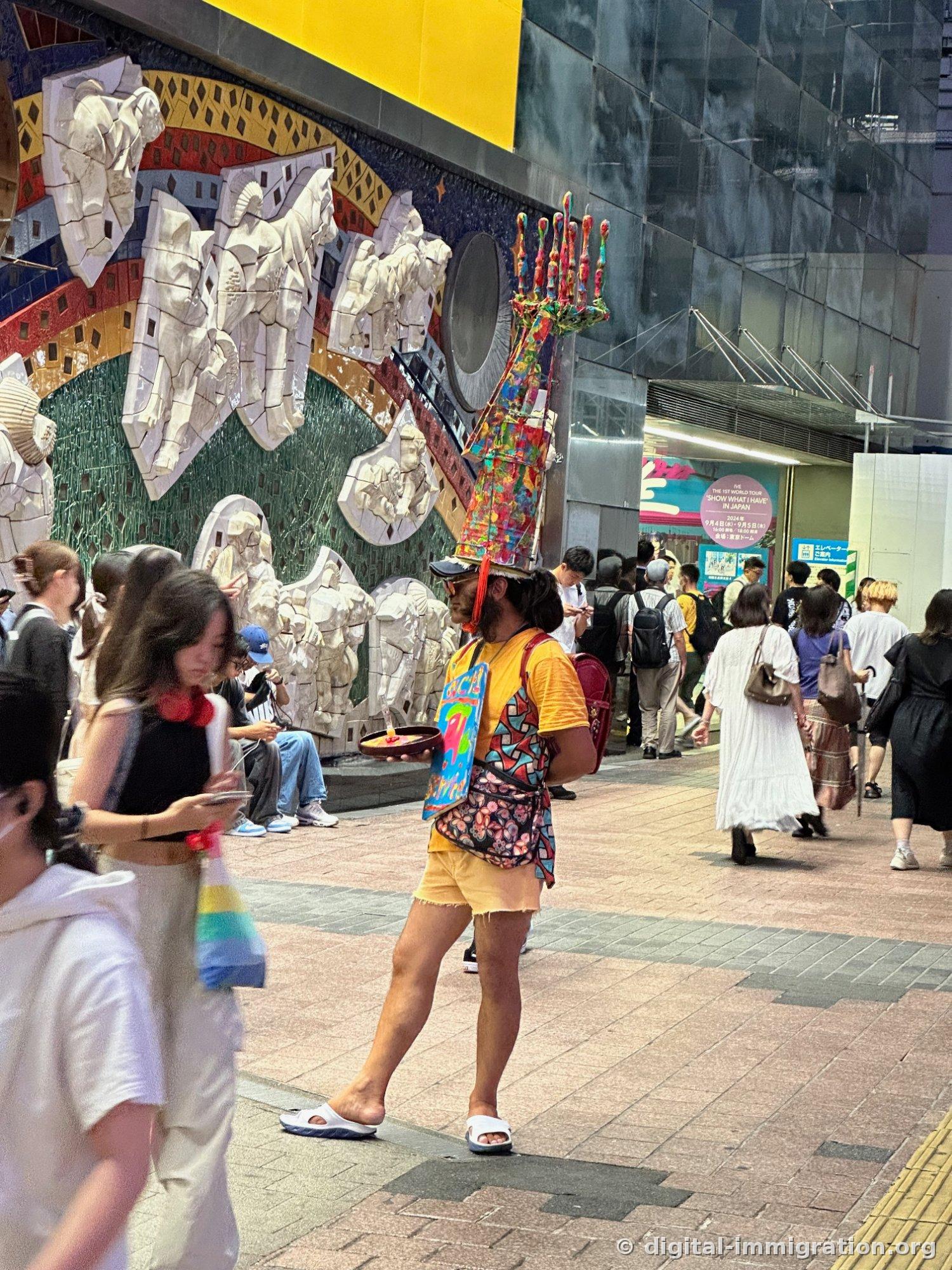
On the day I went in summer, I saw another person in front of the mural. They wore a colorful tower-like structure on their head, a yellow t-shirt, a floral patterned multi-colored bag, and carried a small wooden plate in one hand, walking slowly in slippers. No one paid attention, and they walked by with an expression suggesting they didn't expect anyone to. In Shibuya, this becomes the background.
A Dog Mural No One Sees, and Cherry Blossoms Everyone Looks Up At
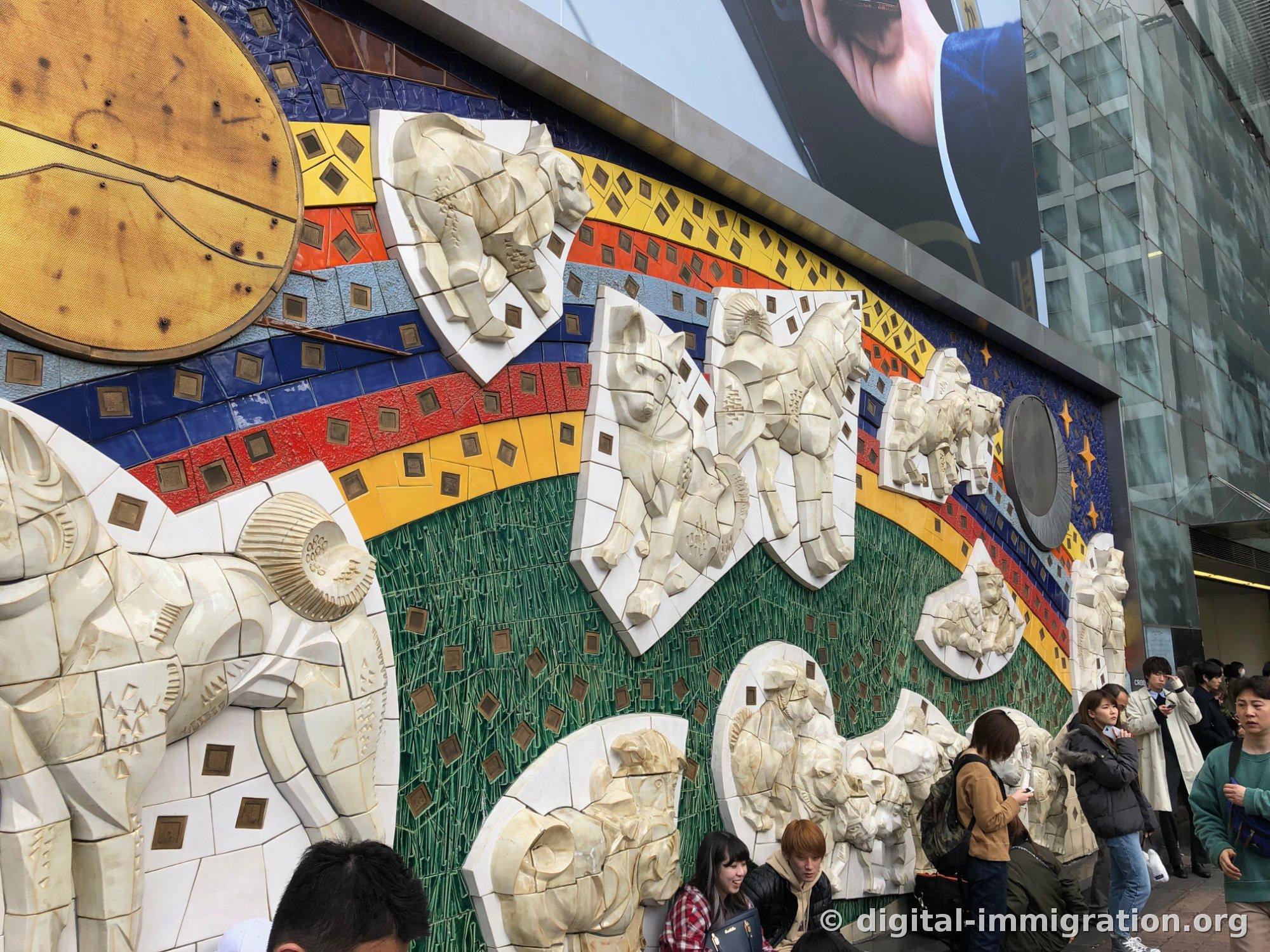
On one wall of Hachiko Square is a large tile mural. Below a rainbow-colored stripe are several white relief dogs arranged across it, with a golden disc set at the far left. Most people sit with their backs to it looking at their phones, so almost no one actually looks up at the mural. Up close, each dog has a different pose and the relief is quite thick.
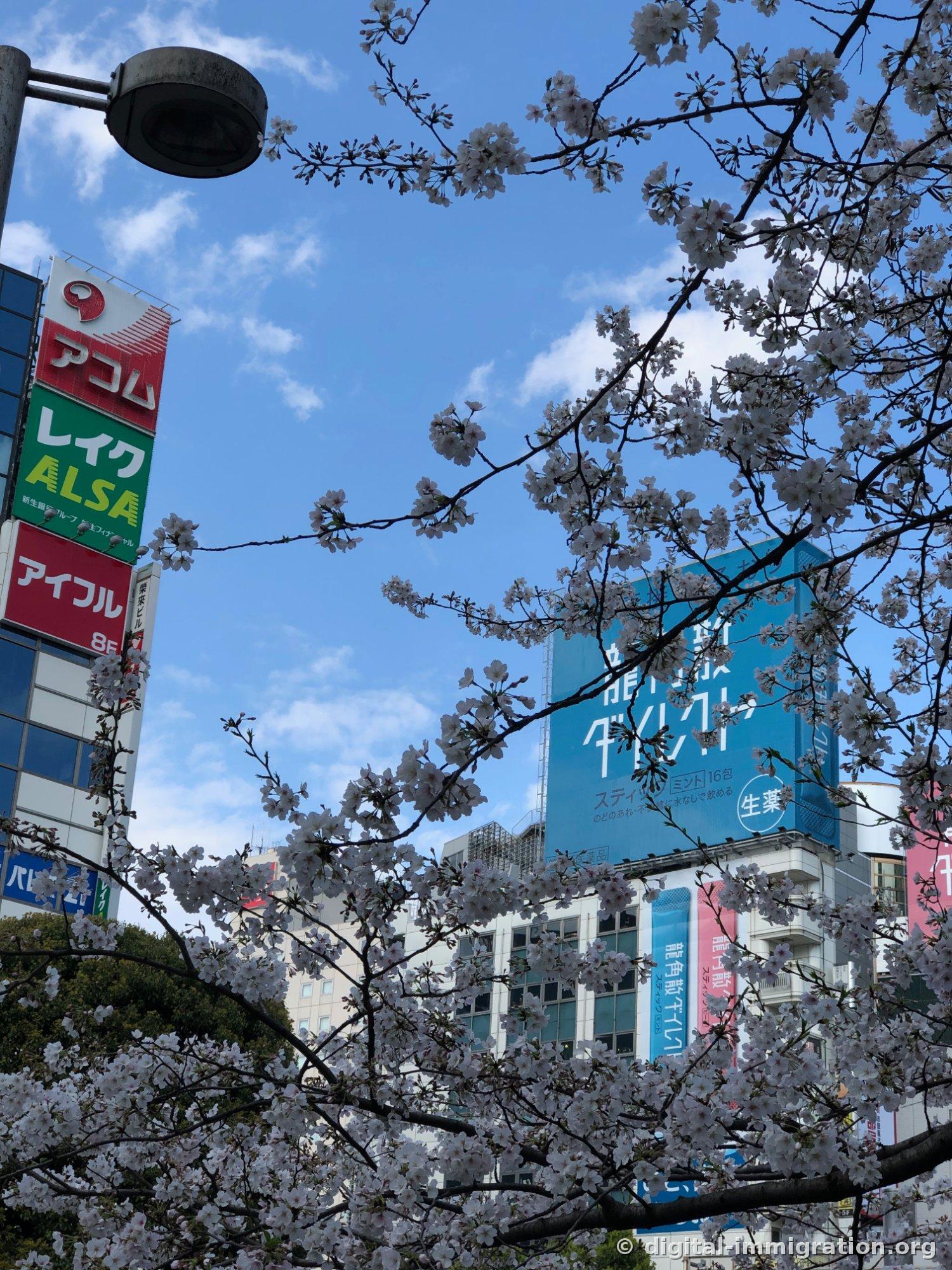
Instead, in spring everyone lifts their heads. When the cherry trees above the square are in full bloom, consumer finance signs (アコム·レイク·アイフル), blue sky, and white cherry blossoms all fit in one frame. This combination is distinctly Tokyo. Looking up from here left a stronger impression than going to a dedicated cherry blossom viewing spot. Since bloom times vary year to year, it's best to check before you go.
Location and Flow—Just Remember the Hachiko Exit
Shibuya Station is tangled with the JR Yamanote Line, Saikyo Line, Tokyo Metro Ginza, Hanzomon, Fukutoshin Lines, Tokyu Line, and Keio Inokashira Line, so the underground structure is quite complex. It's almost a given that first-time visitors get lost, so I just follow the ハチ公口 (Hachiko Exit) sign. Once through the ticket gates, you're right at the square, and the Scramble Crossing is diagonally to the left.
If you're meeting someone, avoid standing in front of the statue. With layers of people, you won't find each other even if you're just three meters apart. I use the corner where the mural ends or the tourist information office on the opposite side of the square as meeting spots. On summer evenings, humidity is high enough that you sweat just standing still, so if you're going to wait, it's better to step into a nearby building.
Scramble Crossing: The Density of One Signal
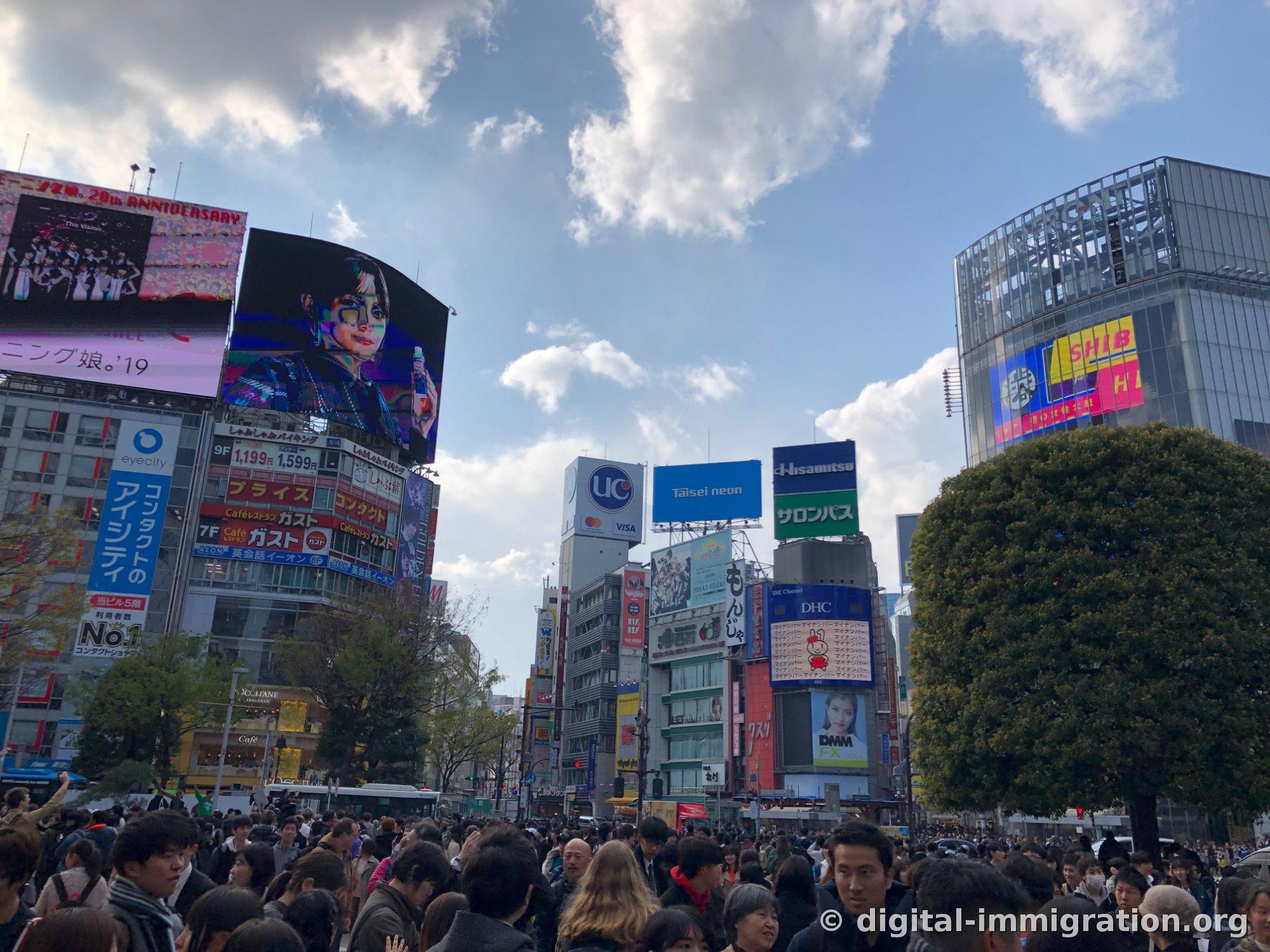
The Scramble Crossing is just a few steps from the square. Looking up at the sky by day, it's covered in advertisements. A Morning Musume 20th anniversary billboard, large LED screens, and on the building below: Shabu-shabu buffet 1,199 yen / 1,599 yen (as marked when I visited; may differ now, so check on-site). Beneath that, human heads line the horizon like a landscape.
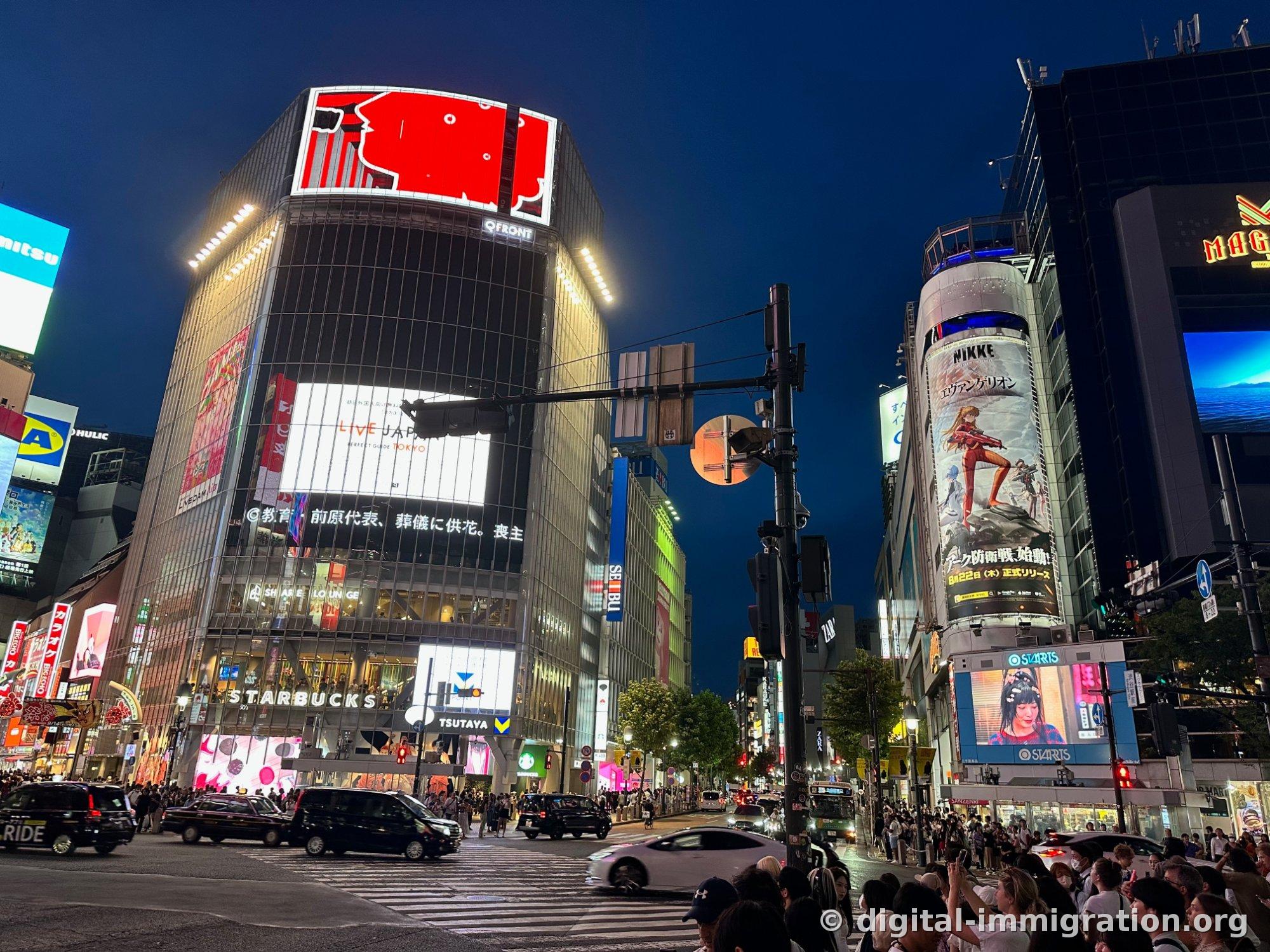
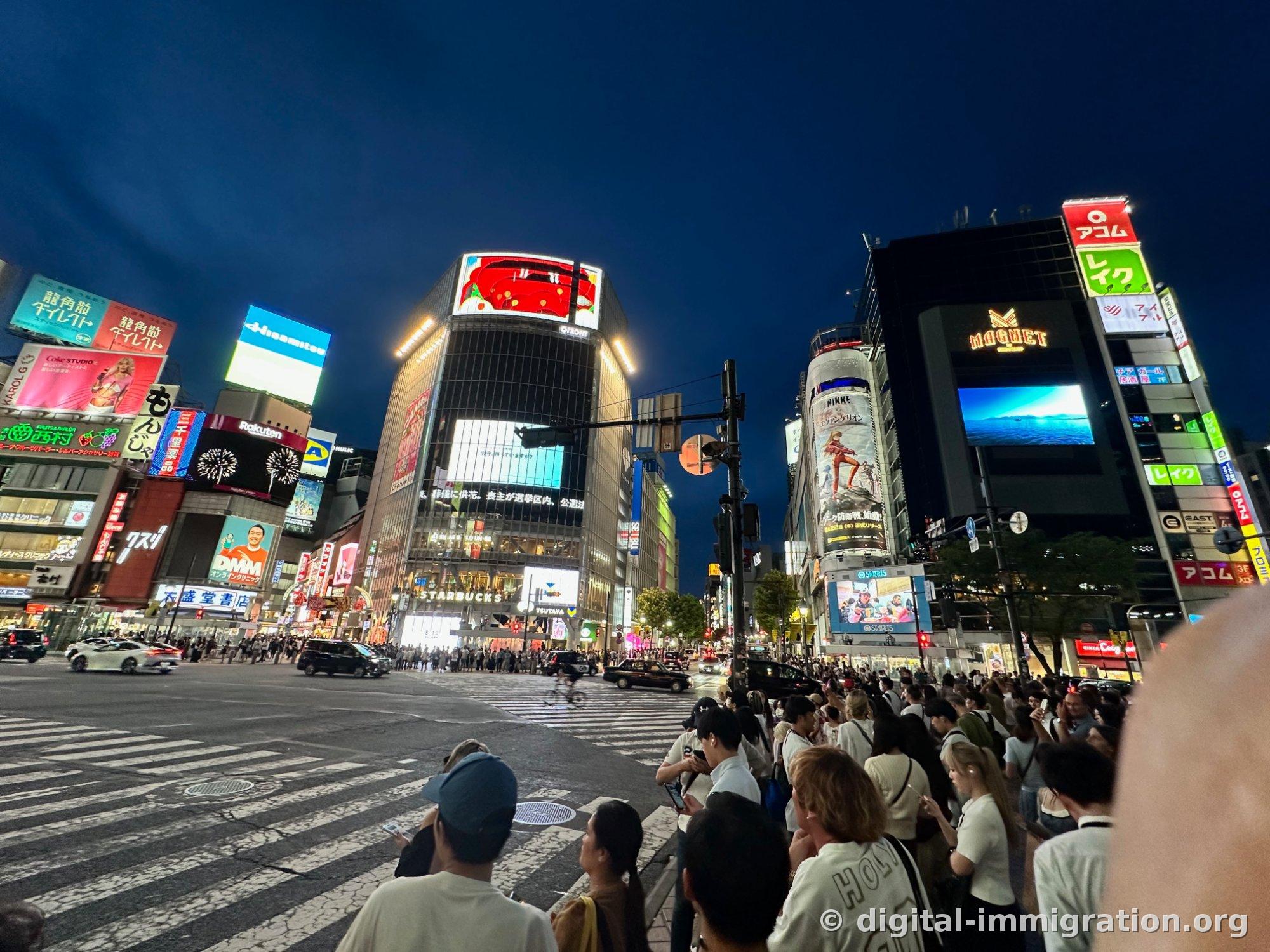
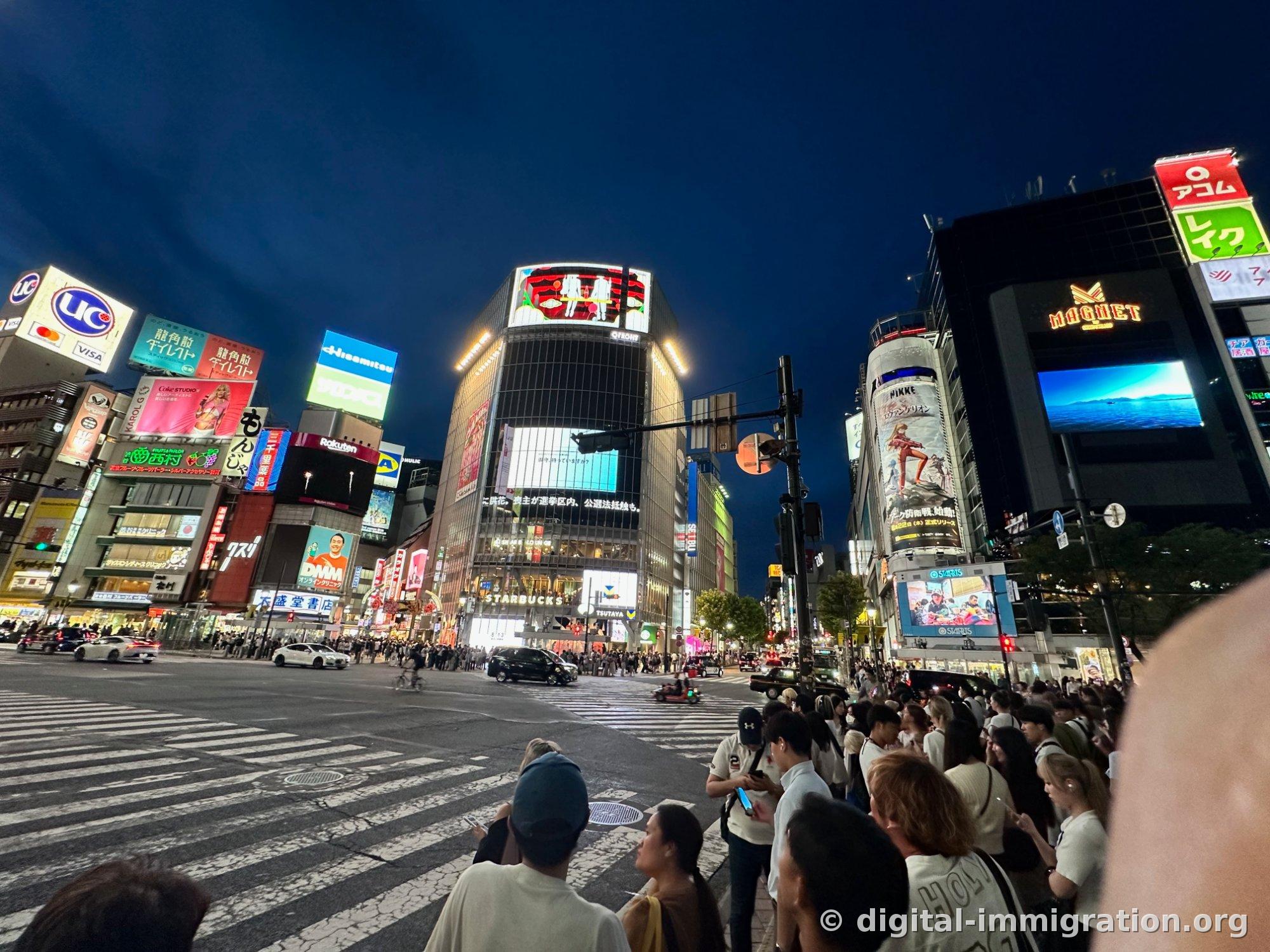
When night comes, it becomes a completely different scene. The large screen atop the QFRONT building lights up, and across the way, MAGNET and a cylindrical advertising tower glow simultaneously. When the signal is red, the sound of people filling the sidewalk—rolling suitcase wheels, footsteps, camera shutters—merges into one low buzz, then abruptly stops when the light turns green, leaving only footsteps. No matter how many times I see this transition, it's entertaining.
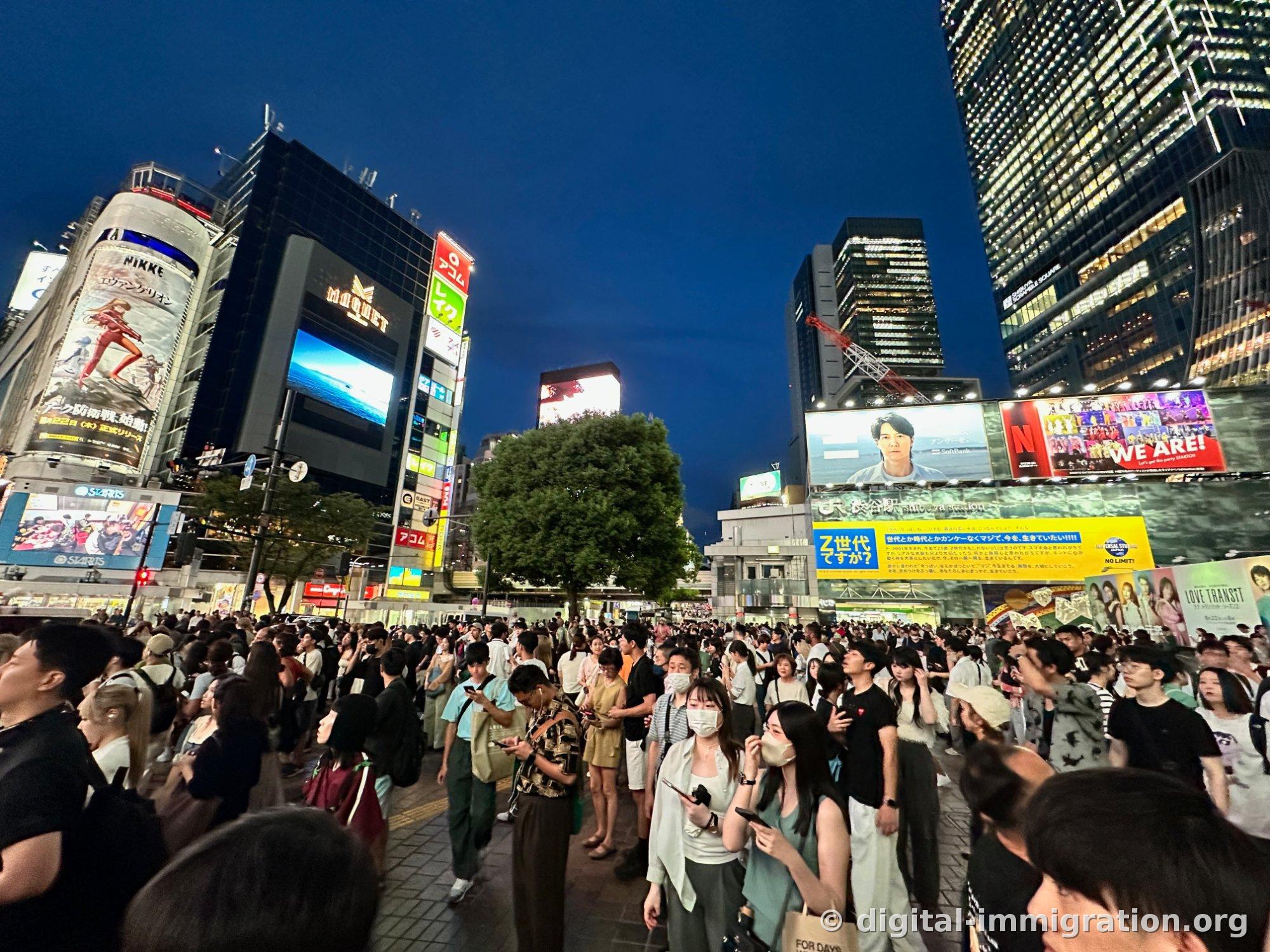
Standing with your back to the crossing, there's another layer of crowds toward the square. A yellow Gen-Z advertising banner, Netflix outdoor ads, and a construction crane all fit in one frame. Shibuya has been under construction for years now, and the skyline changes a little bit each time I visit.
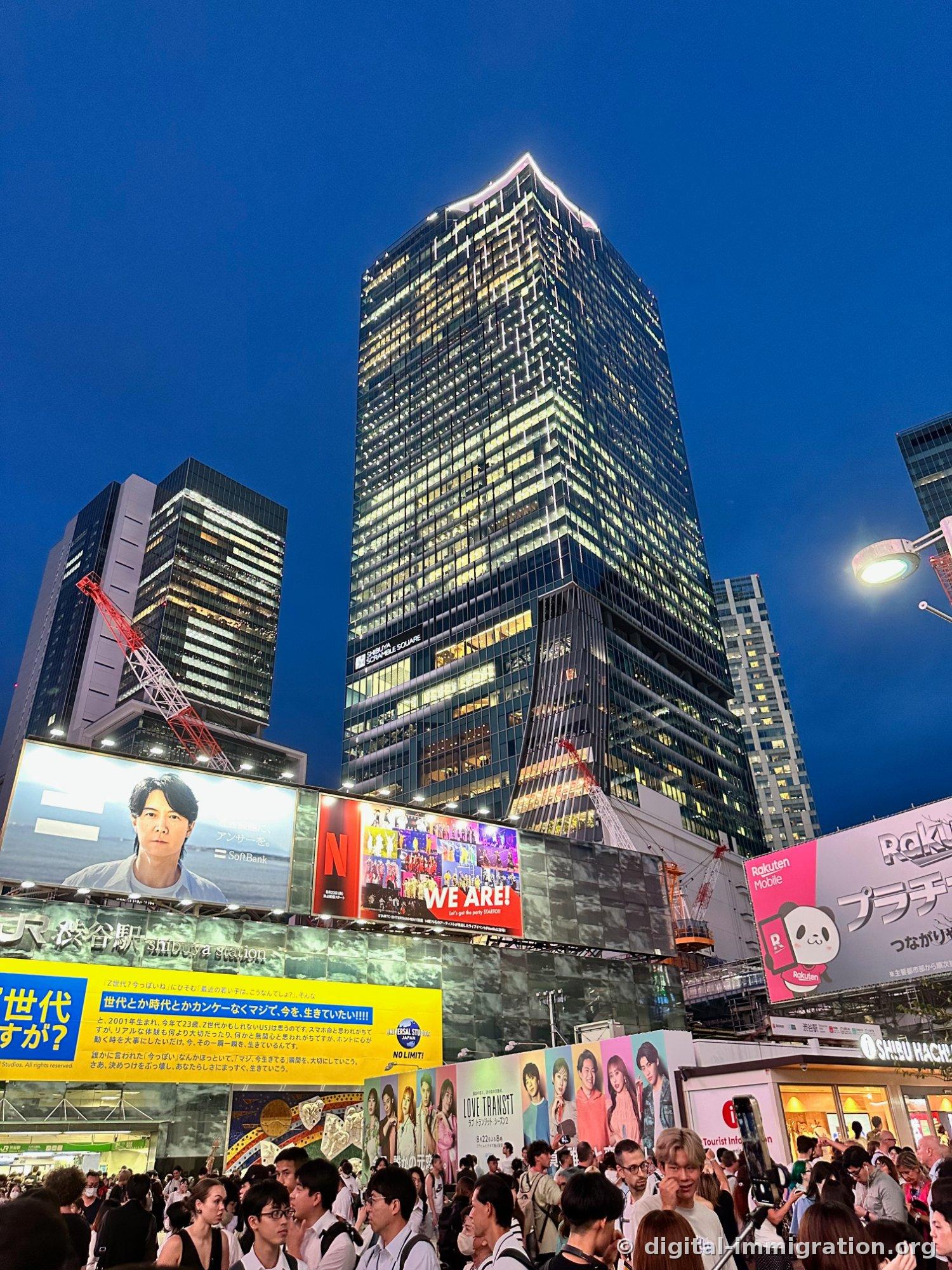
Looking further up, the Shibuya Scramble Square stands. It's a building with an observation deck at the top, but I haven't gone up yet. Just looking up from below until my neck hurt was enough. To the left of it, cranes were still turning.
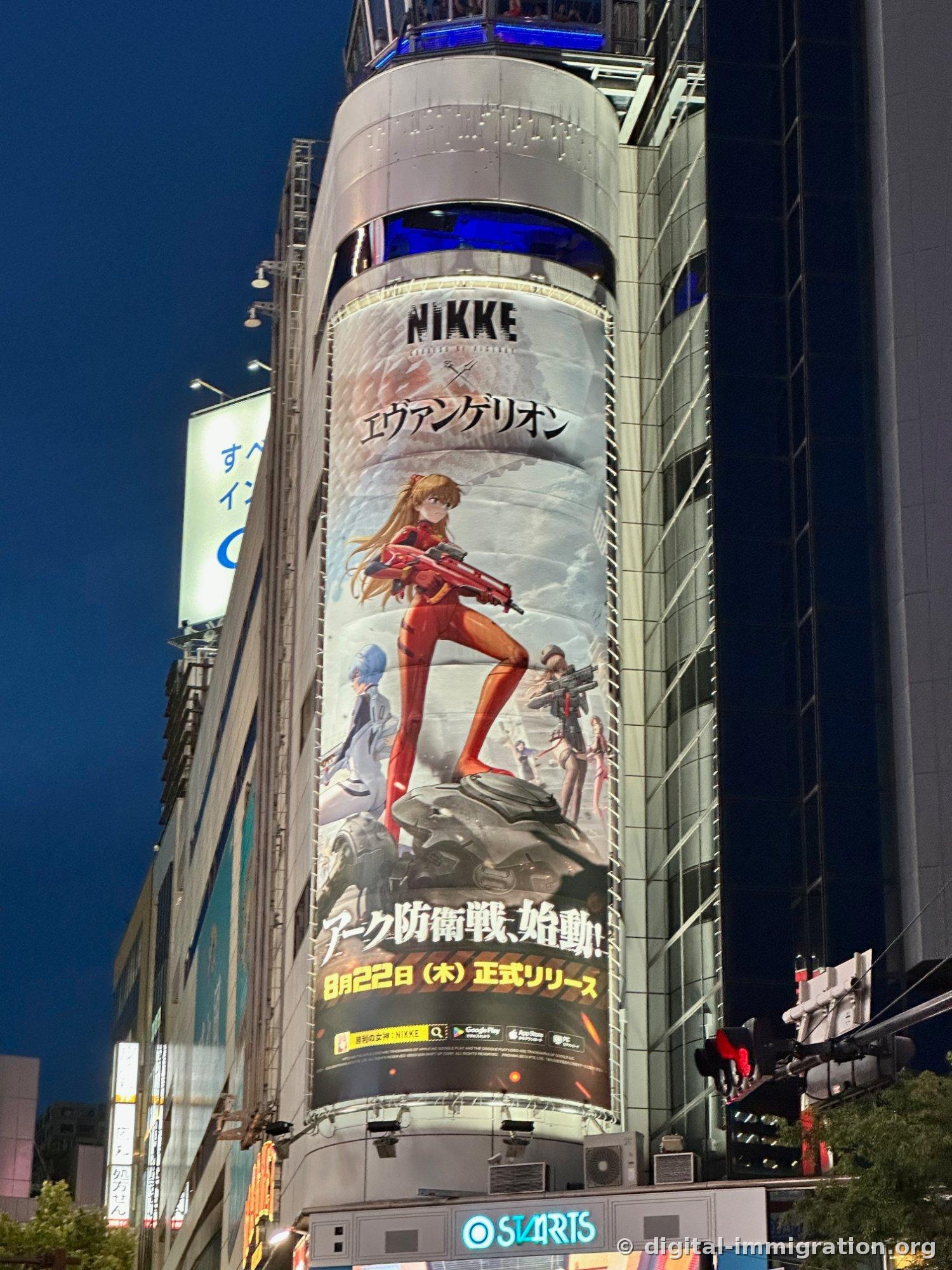
Among the advertising towers, the cylindrical STARTS building advertisement caught my eye most. When I visited, a NIKKE × Evangelion collaboration ad was displayed, completely wrapped with text saying "Official Release August 22nd." Major collaboration ads like this change every few weeks. That's why you get different photos from the same spot each season.
Center Gai Across the Crossing, and Starbucks on the Second Floor
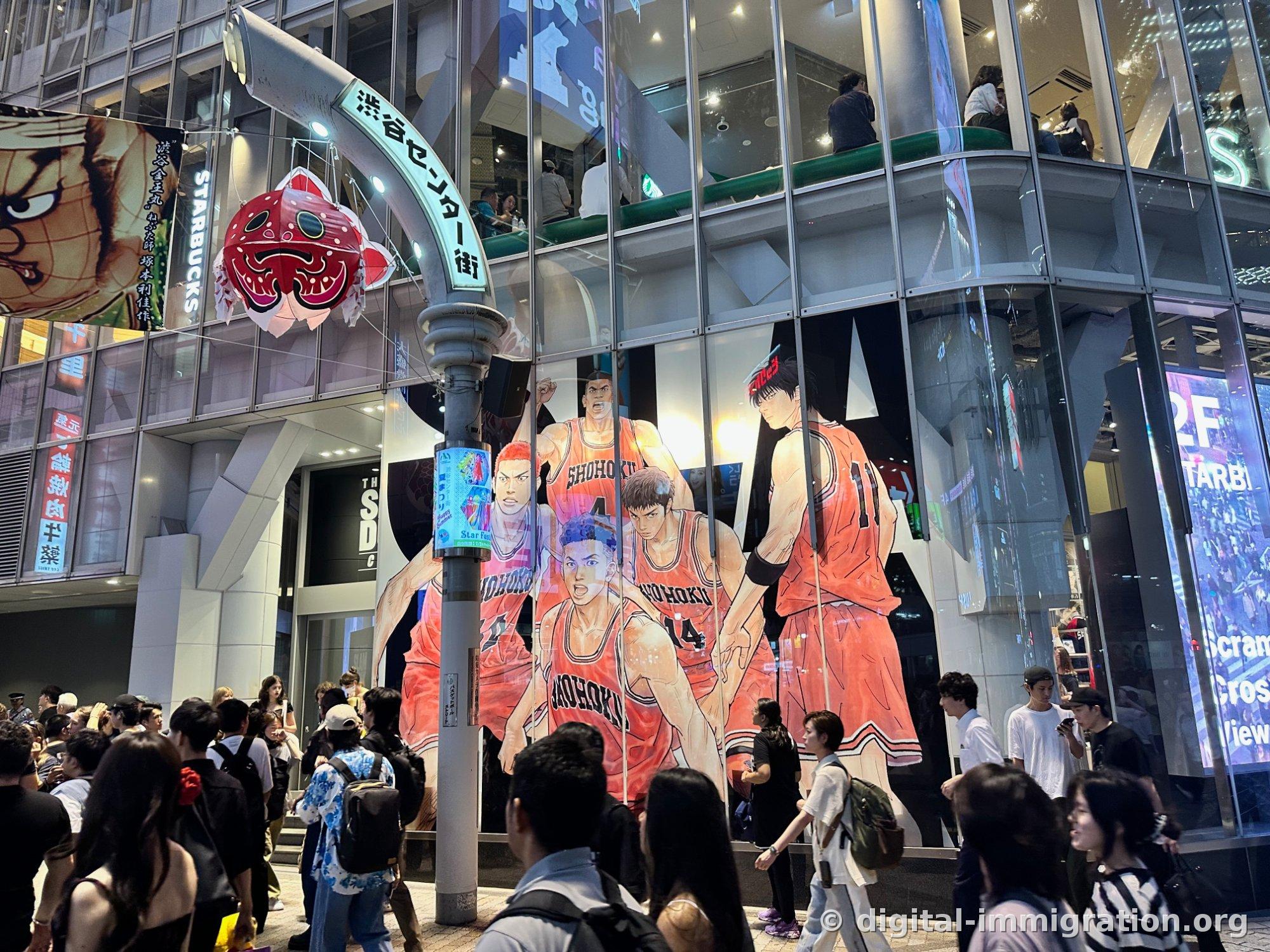
Across the crossing, you immediately see the 渋谷センター街 arch. The day I went, a large red sea bream-shaped nebuta lantern was hanging from the arch, and the entire building wall was covered with Slam Dunk movie illustrations. Players in Shohoku uniforms stood two stories tall, so everyone passing by stopped to take photos. The alley inside has ramen shops, game centers, and convenience stores packed together, and even after 11 p.m. there's still a steady stream of people.
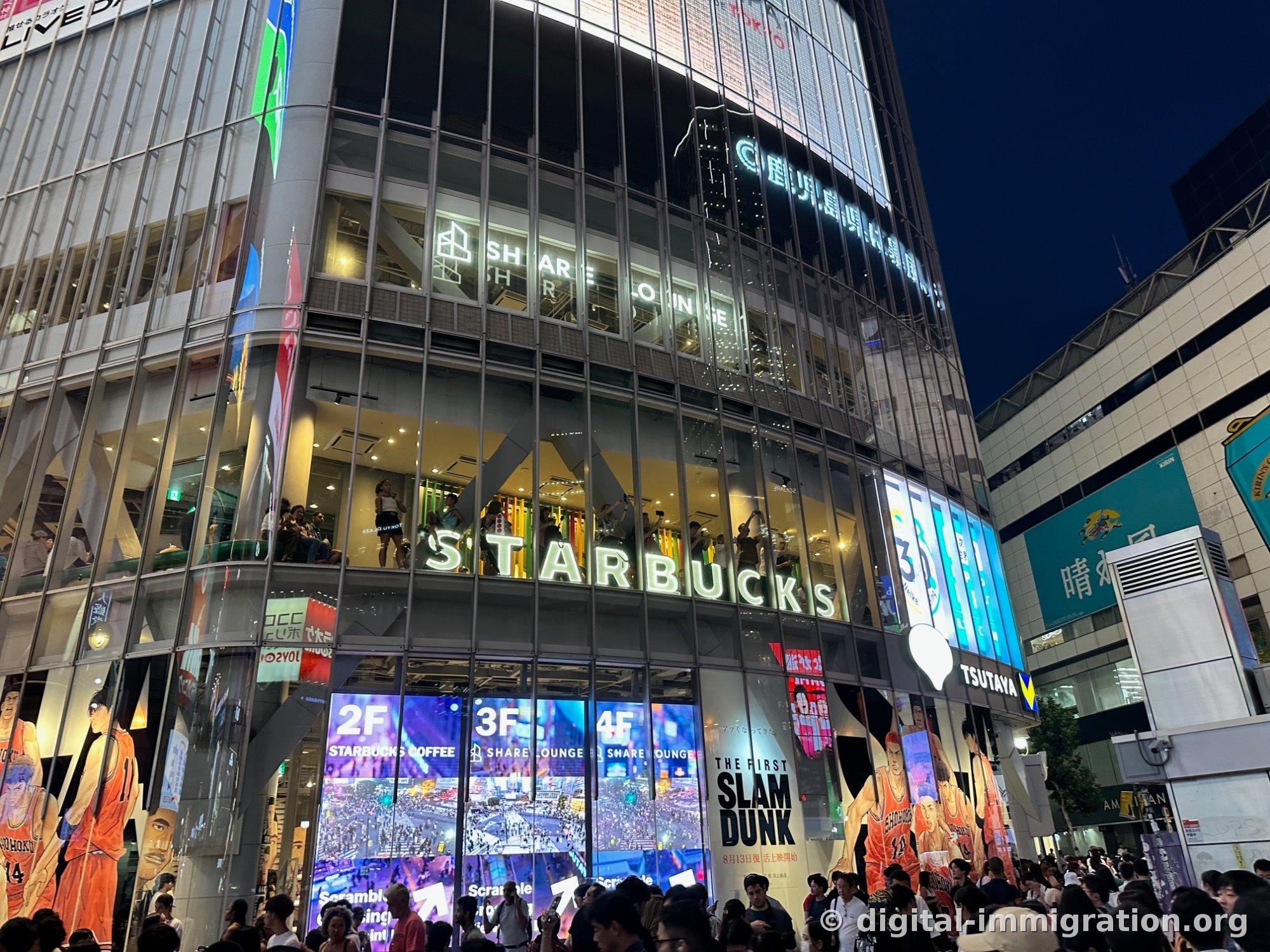
If you want to look down at the crossing from above, the Starbucks on the second floor of QFRONT is your best bet. The window seats are almost always taken, so you need some luck—I tried twice and got a seat once. The upper-floor SHARE LOUNGE requires a separate membership, so it's not a place you can enter just paying for coffee; check the conditions on-site. There's no need to be disappointed if you can't get a seat. Walking across the middle of the crossing itself leaves a much stronger impression.
To really experience Shibuya Station square, you should plan for at least an hour. If you take a photo of the statue and leave after five minutes, you'll miss the most fun part of this neighborhood. Even just standing in a corner of the bench-less square watching people for thirty minutes makes time fly. The YouTuber in a gold suit, the person with a tower on their head, the grandmother touching Hachiko's paw, hundreds of people rushing across on a single signal. Next time, someone else will be standing there.
Read next
- From Akihabara's Chuo-dori to the Kanda River: A Record of Tokyo's Electronics District Revisited Multiple Times
Tokyo's Akihabara is a neighborhood where it's hard to say you've seen everything in a single visit. I've come multiple times across different seasons, and each time the signs chan…
Tokyo · Akihabara - Buying a Single ¥300 Year-End Jumbo Lottery Ticket at Nishi-Ginza Chance Center in Tokyo
Exit from the Hibiya exit of Tokyo's Shimbashi Station, walk toward the elevated highway for about three minutes, and suddenly you'll see a line of people stretching along the side…
Tokyo · Nishi-Ginza Chance Center - Ueno Ameyoko, the real magic starts after sunset — an evening walk from the Okachimachi Gate to Ueno Station
Every time I come to Tokyo, my feet find their way to Ueno Ameyoko (アメ横) without fail. This time I entered from the Okachimachi side and worked my way toward Ueno Station. I've met…
Tokyo · Ameya Yokocho Market