Azabudai Hills: A Two-Hour Walk from Dusk to Night
I arrived at Azabudai Hills (麻布台ヒルズ) in Minato Ward, Tokyo, around 4:30 in the afternoon in winter. Walking down from Tokyo Tower and cresting one hill, my view suddenly opened up,…
Tokyo · Abu Dhabi Hills
I arrived at Azabudai Hills (麻布台ヒルズ) in Minato Ward, Tokyo, around 4:30 in the afternoon in winter. Walking down from Tokyo Tower and cresting one hill, my view suddenly opened up, and terraced gardens unfolded below. After spending a long time in Southeast Asia, the first things you notice when you return to Tokyo after a while are the air temperature and the pace at which people walk—and both were distinctly evident here. A dry wind in a December afternoon, and a leisurely walking pace where no one is in a hurry.
Terraced Gardens — A Village on a Hill, Not a Shopping Mall
The first view from the GardenPlaza deck looking down explains everything about this neighborhood's character. Low-rise glass box buildings scattered about, with dirt paths and stone steps connecting them. The spiral tower visible in the distance straight ahead is the Roppongi skyline, and the massive metal canopy stretching to the upper right is the substructure of Mori JP Tower. Since it's winter, most trees have shed their leaves, which actually made all the pathways between buildings visible.
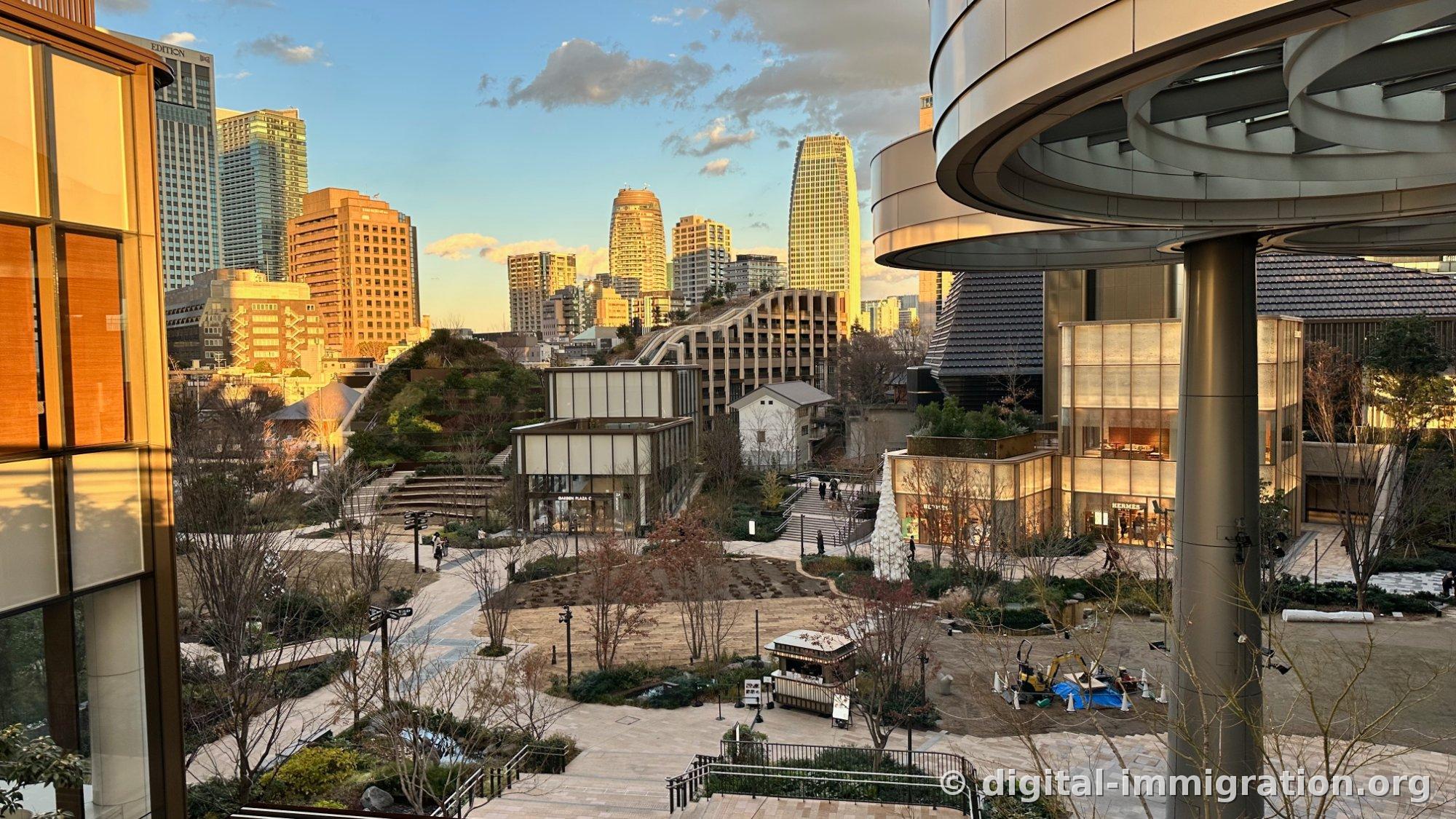
Moving a few steps toward the central lawn plaza, your gaze drops lower. Winding apartment buildings, low structures topped with tile roofs, and oddly standing wooden kiosks. On one side of the plaza sat a small excavator and blue tarps laid out as-is. The area had only recently opened, so work was still ongoing, all of it captured in photos. This stuff never appears in promotional photos.
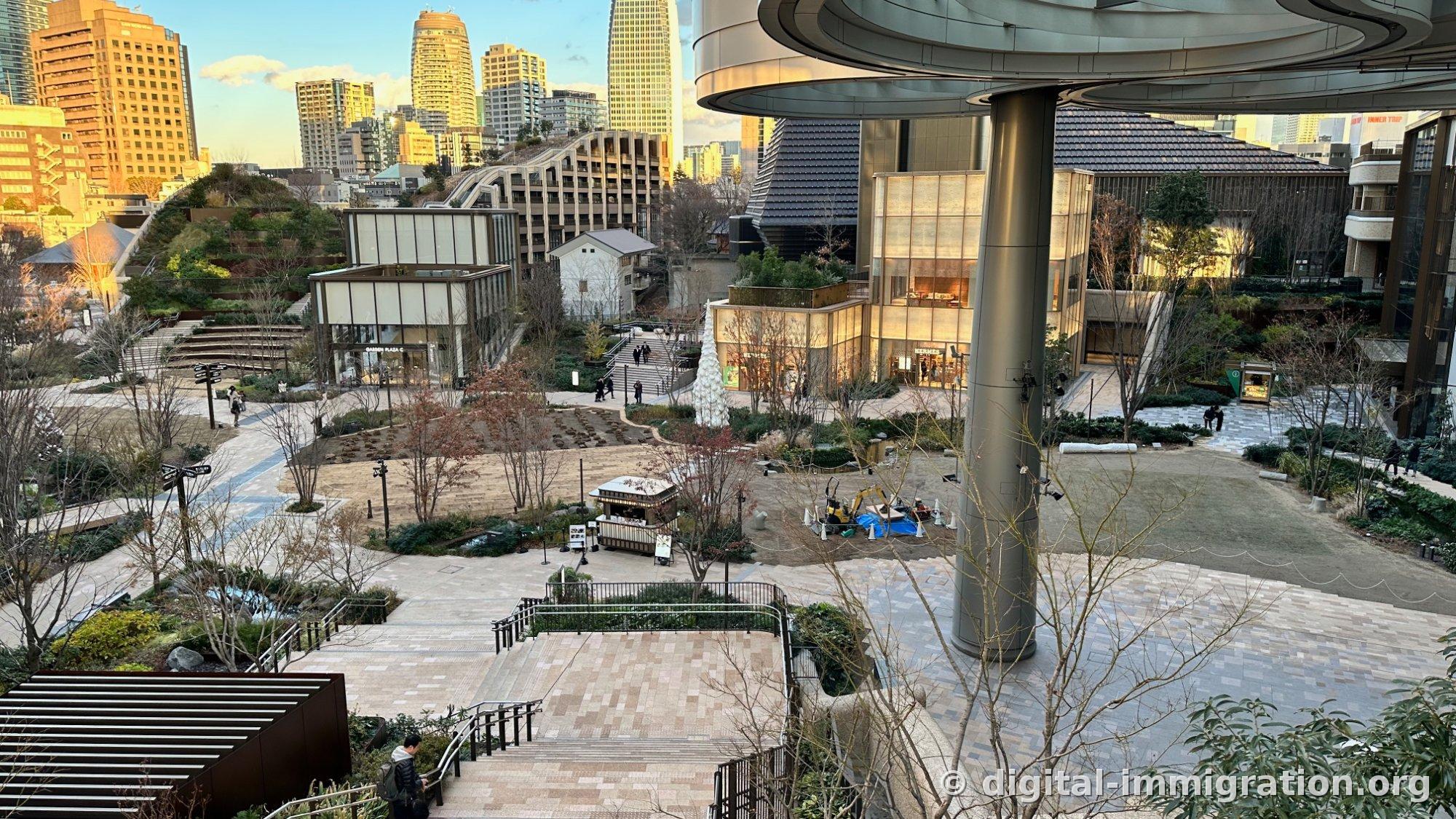
The stone steps have low risers and wide treads, so pulling a suitcase isn't a burden. The dirt path sections are quite long, though. I took a walk in white sneakers the day after rain and got dirt on the sides of the soles.
Easy to Get Lost—Trust the Signage
The first stumbling block for first-time visitors is understanding that this complex is three-dimensional, not flat. The same "first floor" varies in elevation across different zones. Even checking a map app, you can't tell how many meters above ground you're standing, so you end up unable to find the stairs even when your destination is right in front of you.
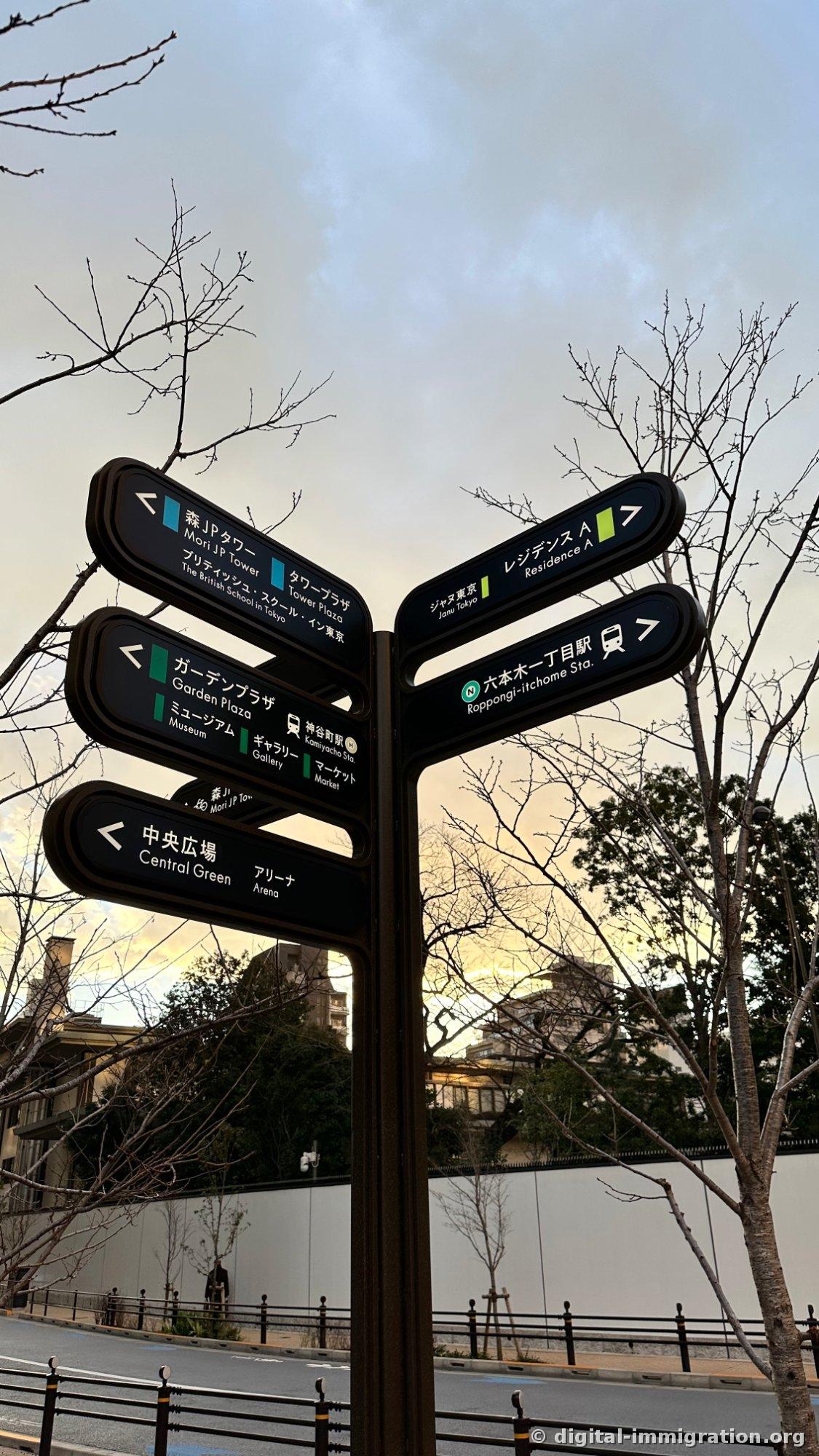
Reading the signage puts the structure into perspective. Left side: Mori JP Tower, Tower Plaza, British School in Tokyo, and GardenPlaza (museum, gallery, market). Right side: Residence A and Janu Tokyo hotel, plus Roppongi-itchome Station. The GardenPlaza sign also has Kamiyacho Station marked. With two stations nearby, the Hibiya Line's Kamiyacho Station is directly connected underground, which is better on rainy days. From the Namboku Line's Roppongi-itchome Station, you come up to ground level and walk a bit up the hill.
I recommend the route from Tokyo Tower. It's just over 15 minutes on foot and downhill, so it's not strenuous. Conversely, if you're heading from here to Tokyo Tower, you'd be going uphill, so it's better to plan the route this way.
When the Sun Sets, This Neighborhood Changes Character
Shortly after 5 p.m., the sky darkened rapidly. The Tokyo winter sun really does set fast. And then lights came on in the Hermès building across the plaza. There were more than a few people who waited until dusk specifically to see this building.
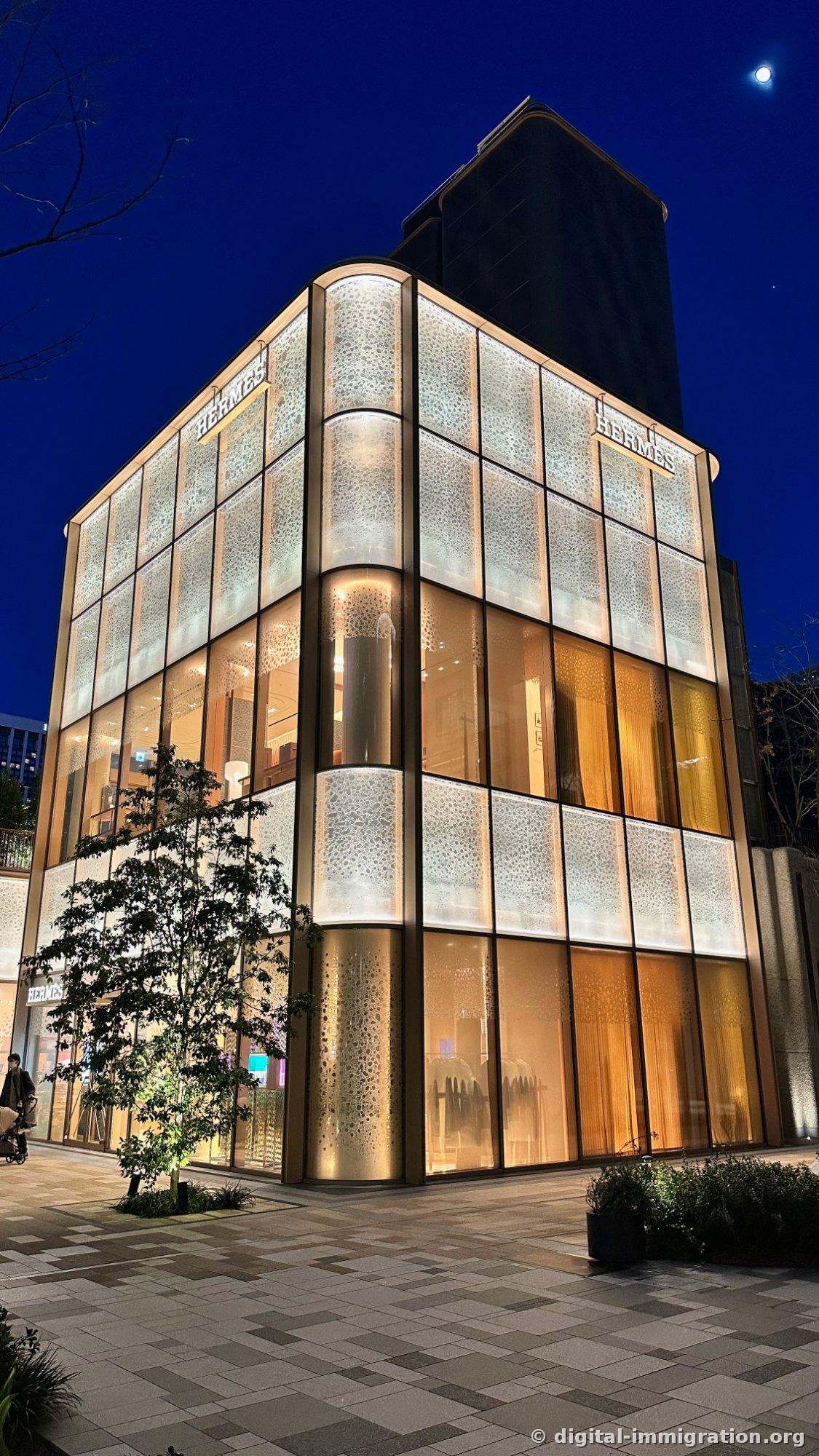
An irregular dot pattern is printed across the entire glass surface, so during the day it's just frosted glass, but at night the interior lighting illuminates each dot individually. The rounded corner treatment becomes apparent too. You can see straight through to the clothing racks and lighting fixtures inside the second-floor store. I stepped back a few paces to photograph it, and the person behind me moved to the same spot.
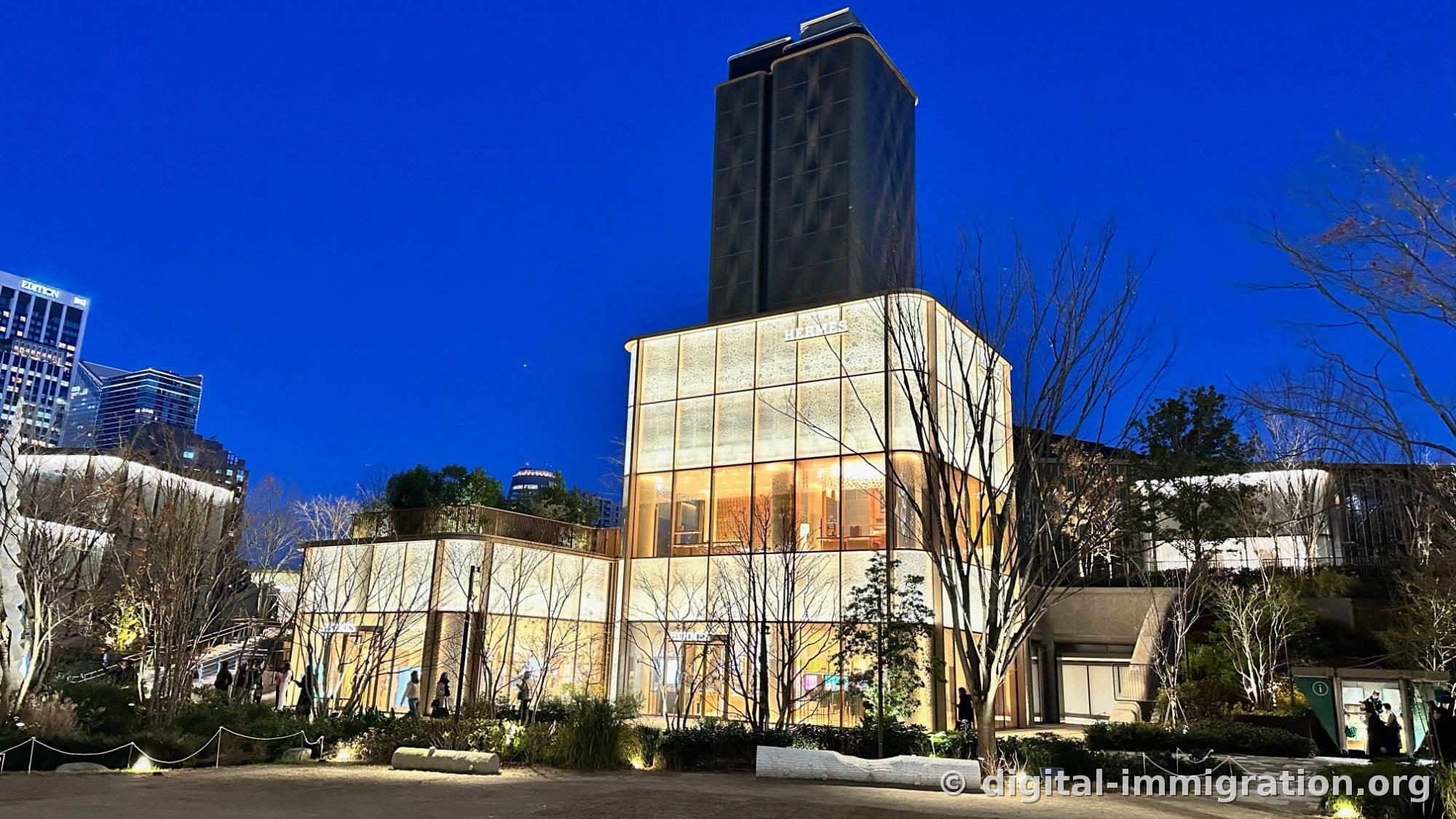
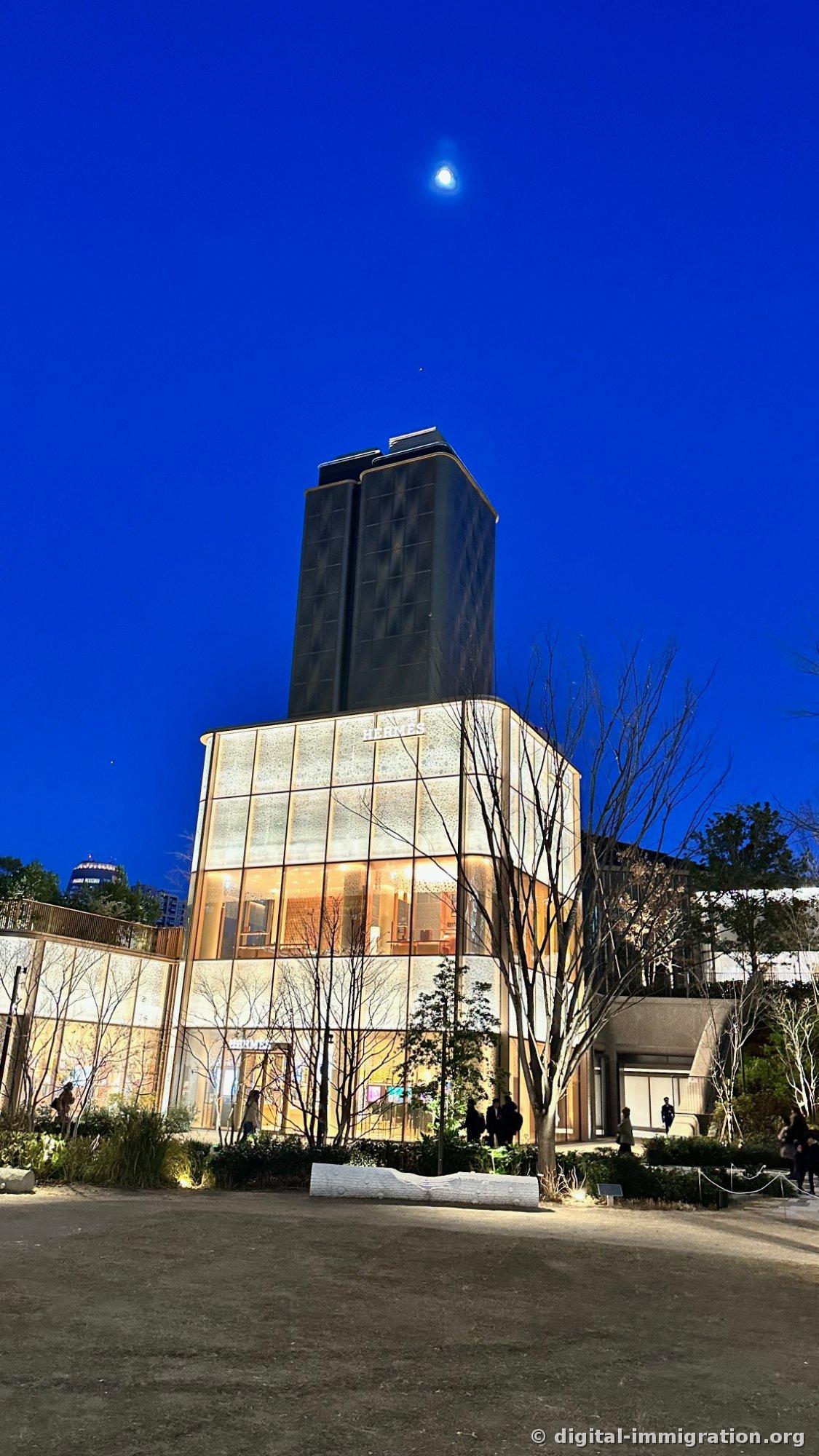
Stepping out to the middle of the plaza, the angle changes completely. A high-rise tower with a black diamond pattern rises seamlessly above the bright glass lower level, with the bottom brightly lit and the top barely visible as silhouette. The plaza floor being compacted dirt rather than pavement meant footsteps made no sound—a striking feature. It's rare to feel this kind of surface underfoot in central Tokyo.
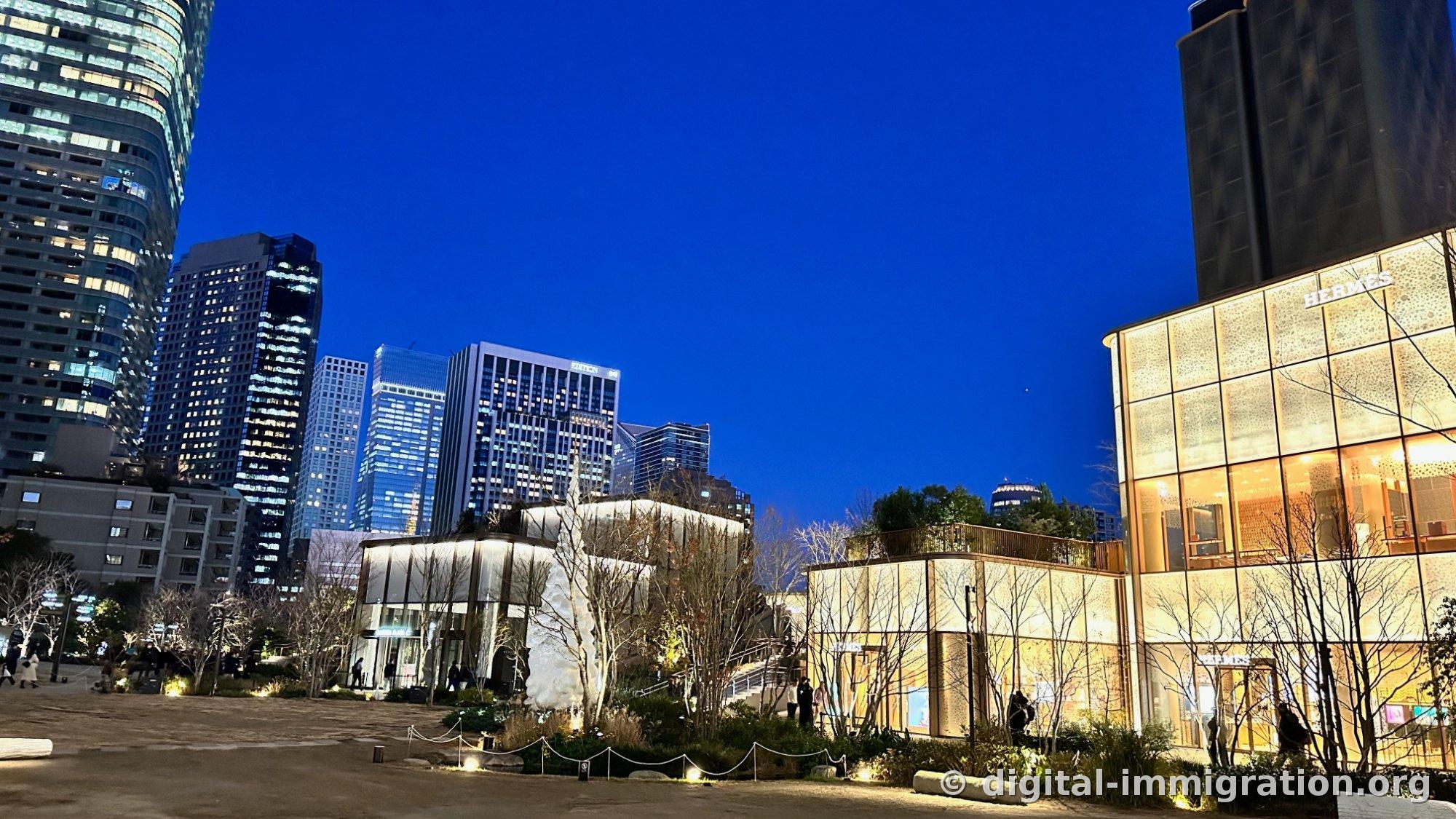
Turning your body to face west across the plaza, rows of office buildings in the Toranomon direction stand lined up. It wasn't even 6 p.m. yet, but every window had its lights on. Sitting here, you see two versions of Tokyo in one frame. Tokyo still at work, and Tokyo strolling dirt paths.
You Can Sit at the Tables Without Ordering
On the way back, I discovered an outdoor seating area under the canopy. Over twenty white metal tables and rattan-woven chairs were arranged, and they're public seating—no purchase necessary. I pulled out my laptop and sat for about thirty minutes. My fingers got cold in the winter evening, but with almost no other people around, I had plenty of choice spots.
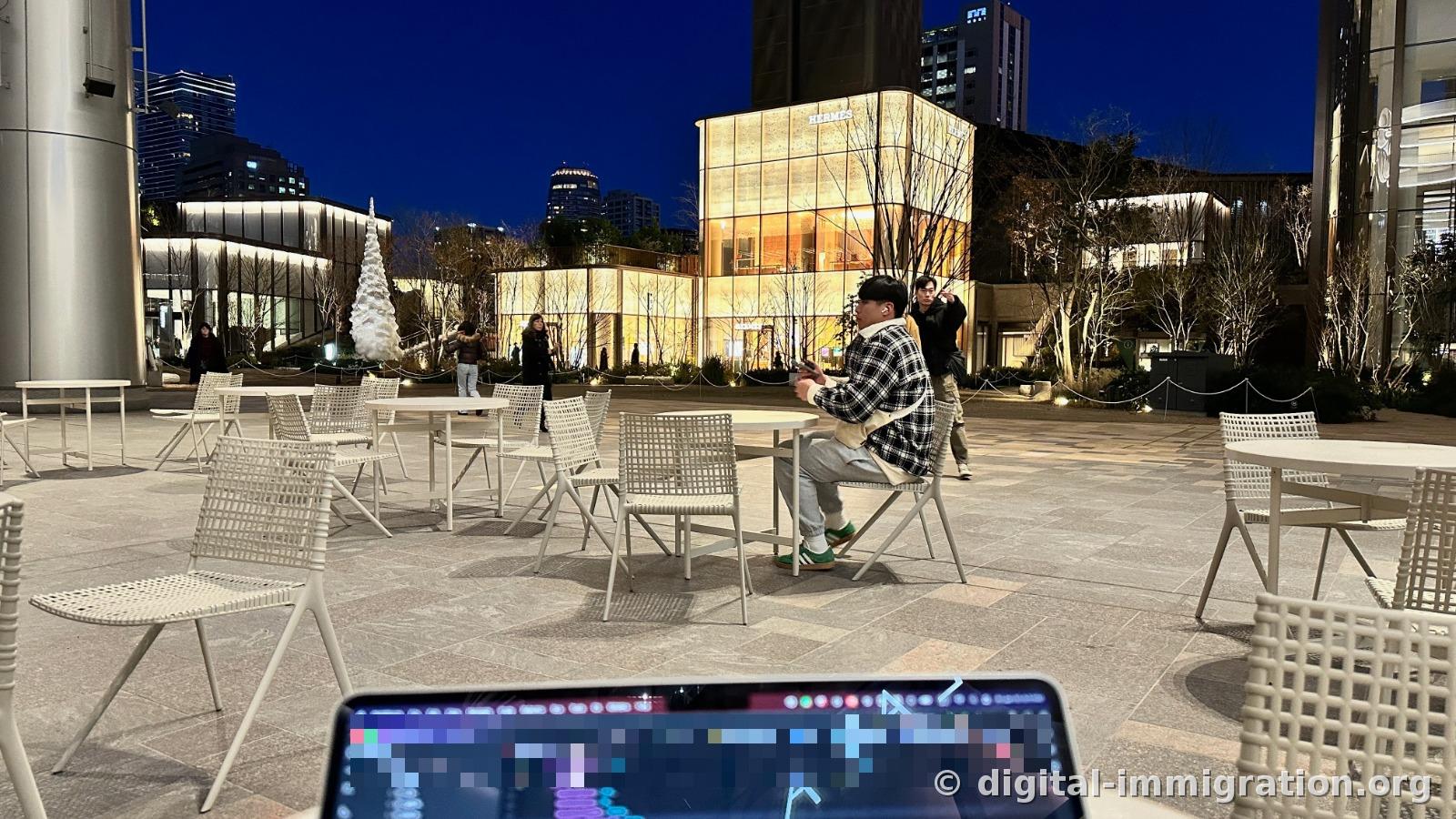
Someone sitting near my table was just looking at their phone without coffee either. The fact that this isn't a space where you have to buy something to sit is this complex's most practical virtue. I couldn't find any power outlets though, and in a December evening at 6 p.m., your fingertips go numb after just fifteen minutes of sitting. If you plan to stay longer, it's better to head into the indoor Tower Plaza.
Good to Know Before You Go
- Arriving 40 minutes before sunset is ideal. You'll see both the sunset reflection and nighttime lighting at once. In winter, that's around 3:40 to 4 p.m.
- Route flows downward: GardenPlaza deck → stairs → central plaza gives continuous expanding views.
- Kamiyacho Station via underground connection is most convenient, Roppongi-itchome Station is ground-level walking. From Tokyo Tower is around 15 minutes downhill on foot.
- The plaza floor is dirt, so it's better to avoid light-colored shoes.
- Operating hours and store operations vary by zone, so check the directional signs on-site.
Two hours pass easily here without buying or eating anything. The design of turning the hillside into stairs and cutting dirt paths between them ultimately keeps people walking. Next time I want to come when the cherry blossoms are in bloom and see how those leafless trees transform.
Read next
- From Akihabara's Chuo-dori to the Kanda River: A Record of Tokyo's Electronics District Revisited Multiple Times
Tokyo's Akihabara is a neighborhood where it's hard to say you've seen everything in a single visit. I've come multiple times across different seasons, and each time the signs chan…
Tokyo · Akihabara - Buying a Single ¥300 Year-End Jumbo Lottery Ticket at Nishi-Ginza Chance Center in Tokyo
Exit from the Hibiya exit of Tokyo's Shimbashi Station, walk toward the elevated highway for about three minutes, and suddenly you'll see a line of people stretching along the side…
Tokyo · Nishi-Ginza Chance Center - Ueno Ameyoko, the real magic starts after sunset — an evening walk from the Okachimachi Gate to Ueno Station
Every time I come to Tokyo, my feet find their way to Ueno Ameyoko (アメ横) without fail. This time I entered from the Okachimachi side and worked my way toward Ueno Station. I've met…
Tokyo · Ameya Yokocho Market