Kyoto Hirano Shrine (平野神社) — Walking Through the Grounds in January Without Cherry Blossoms, Where Baekje-descended Ancestor Deities Are Enshrined
About a 5-minute walk north from Kitano Tenmangu, tucked away in an alley where tour buses don't stop, sits Hirano Shrine (平野神社). Located in Kita Ward, Kyoto, near Nishioji (西大路).…
เกียวโต · Hirano Shrine
About a 5-minute walk north from Kitano Tenmangu, tucked away in an alley where tour buses don't stop, sits Hirano Shrine (平野神社). Located in Kita Ward, Kyoto, near Nishioji (西大路). During cherry blossom season, this area gets packed with visitors, but the morning I visited was an early January weekday. There were only about a dozen worshippers. The footsteps on the gravel were the only sound.
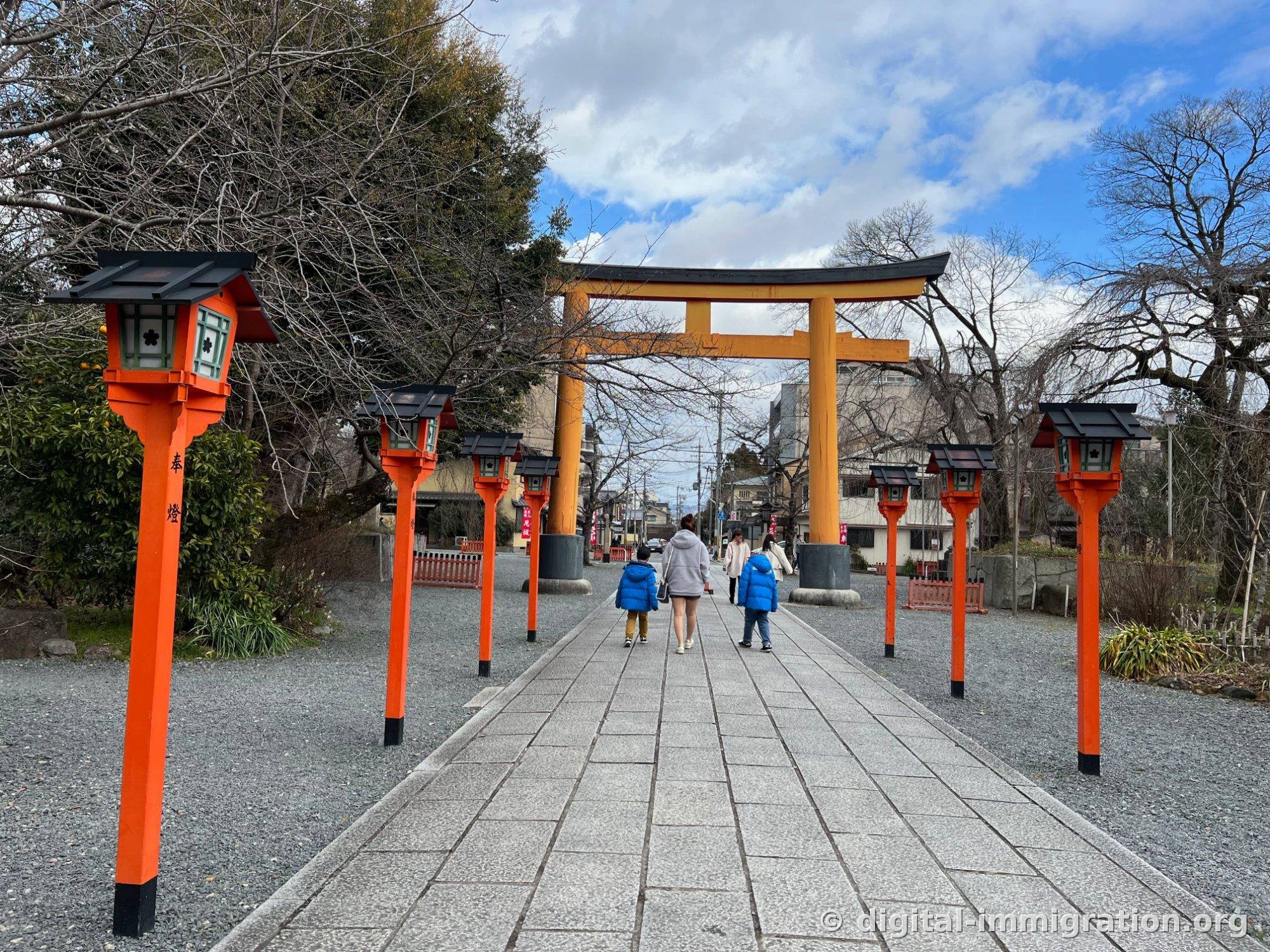
This photo captures the essence of Hirano Shrine. Outside the torii gate isn't a tourist attraction but a living neighborhood. Traffic lights, power lines, white apartment buildings. Walk all the way down the approach path and you're right at a crosswalk. Unlike Kyoto's famous temples tucked away in the mountains, this shrine sits squarely in the middle of an ordinary neighborhood.
A Sacred Site Devoted to Baekje-descended Royal Ancestor Deities
This is what makes Hirano Shrine fundamentally different from other Kyoto shrines. The four principal deities, led by Imakino-no-kami (今木神), were originally enshrined within the Heijō Palace in Nara. When the capital moved to Heian in 794, they were brought along to this location. Tracing these deities back to their roots leads to Takanononiigasa (高野新笠), the biological mother of Emperor Kanmu. She came from the Yamato-no-Fumi (和史) clan, a Baekje-descended immigrant family that claimed descent from King Muraeryeong of Baekje. In other words, the Japanese imperial court enshrined these ancestor deities of Baekje descent within the palace, and when moving to a new capital, granted them a home here.
The very name "Imaki (今木)" reads as "just crossed over," suggesting the character of being a deity of immigrants. Whether you know this fact or not completely changes how the shrine grounds feel to you. I knew it before arriving, and standing before the main hall gave me an odd feeling. It struck me as strange that this place barely appears in Korean tourist itineraries.
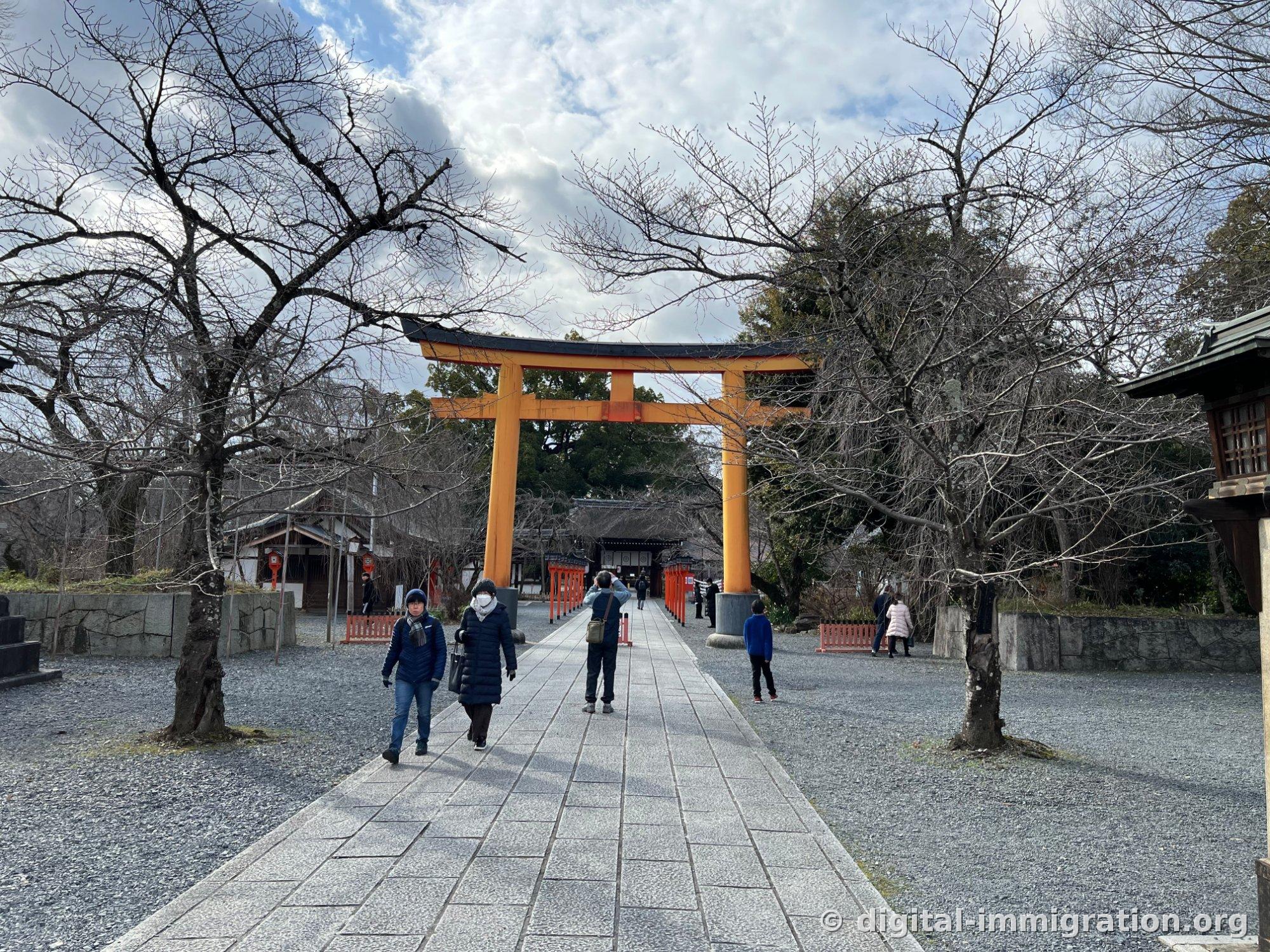
The leafless trees in the photo are the cherry trees that made Hirano Shrine famous. About 60 varieties, nearly 400 trees total, planted here to bloom at staggered intervals from mid-March through late April. Visiting in winter means, naturally, nothing is blooming. But you can see exactly how much space the trees occupy and the span of their branches, so you can imagine how densely packed it will be when flowers appear. I didn't dislike this bare version.
The South Gate and Main Hall — Where Imperial Crests Hang
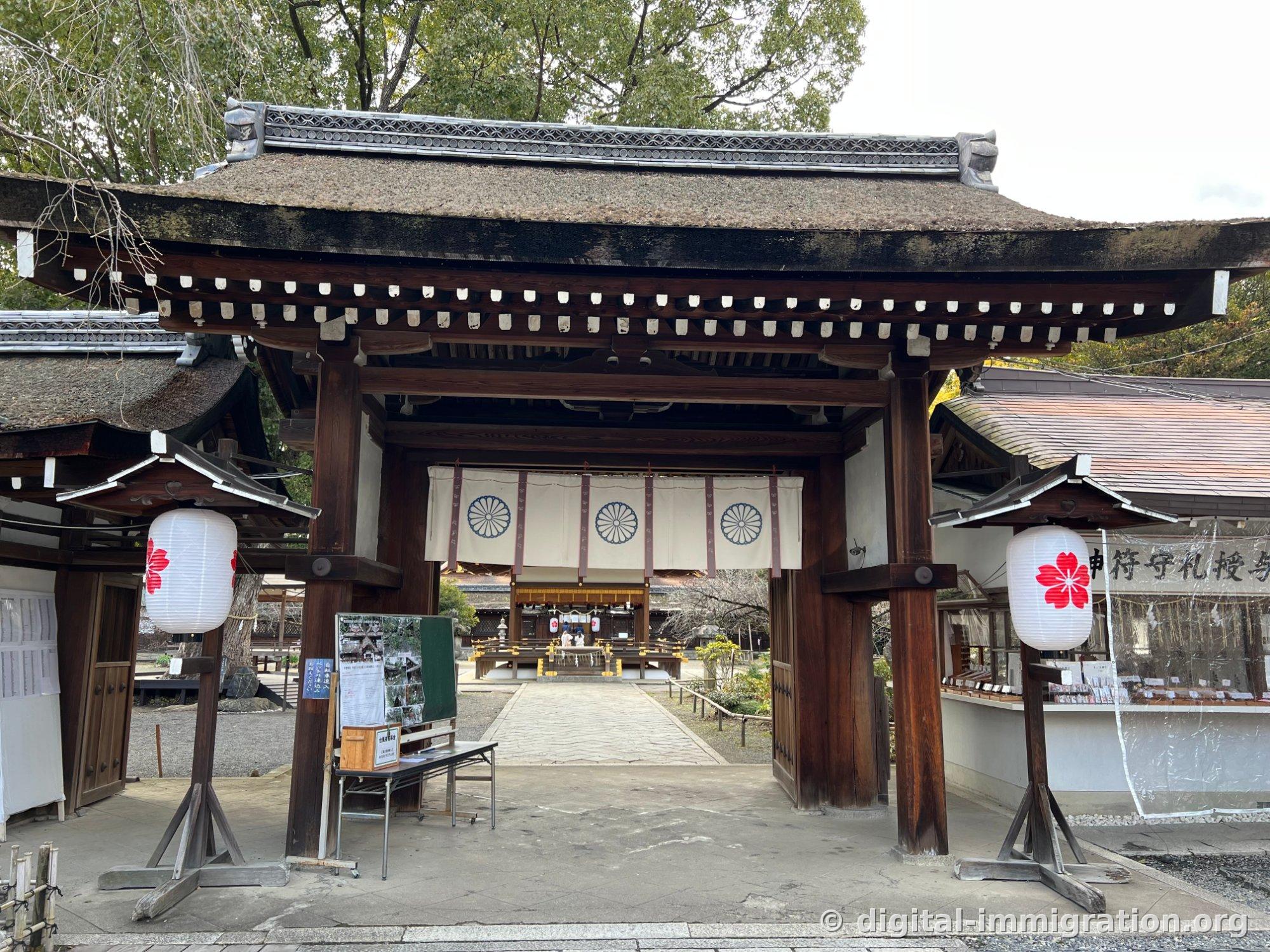
Don't overlook the chrysanthemum crest on the white curtain hanging from the gate. That single design carries the history of these deities being moved from within the palace. The red flowers depicted on the lanterns are cherry blossoms, this shrine's sacred crest. The composition of chrysanthemum and cherry blossom together on one gate compresses the identity of Hirano Shrine.
A fee notice board and a wooden offering box sit on the left side of the gate, but this isn't an entrance fee — it's information related to specific areas (like Sakuraen during cherry blossom season). Regular grounds access is free. Fees may vary depending on timing and area, so check the on-site notice boards. The distribution booth on the right was operating behind plastic sheeting, and it appeared there were times when no one was staffing it.
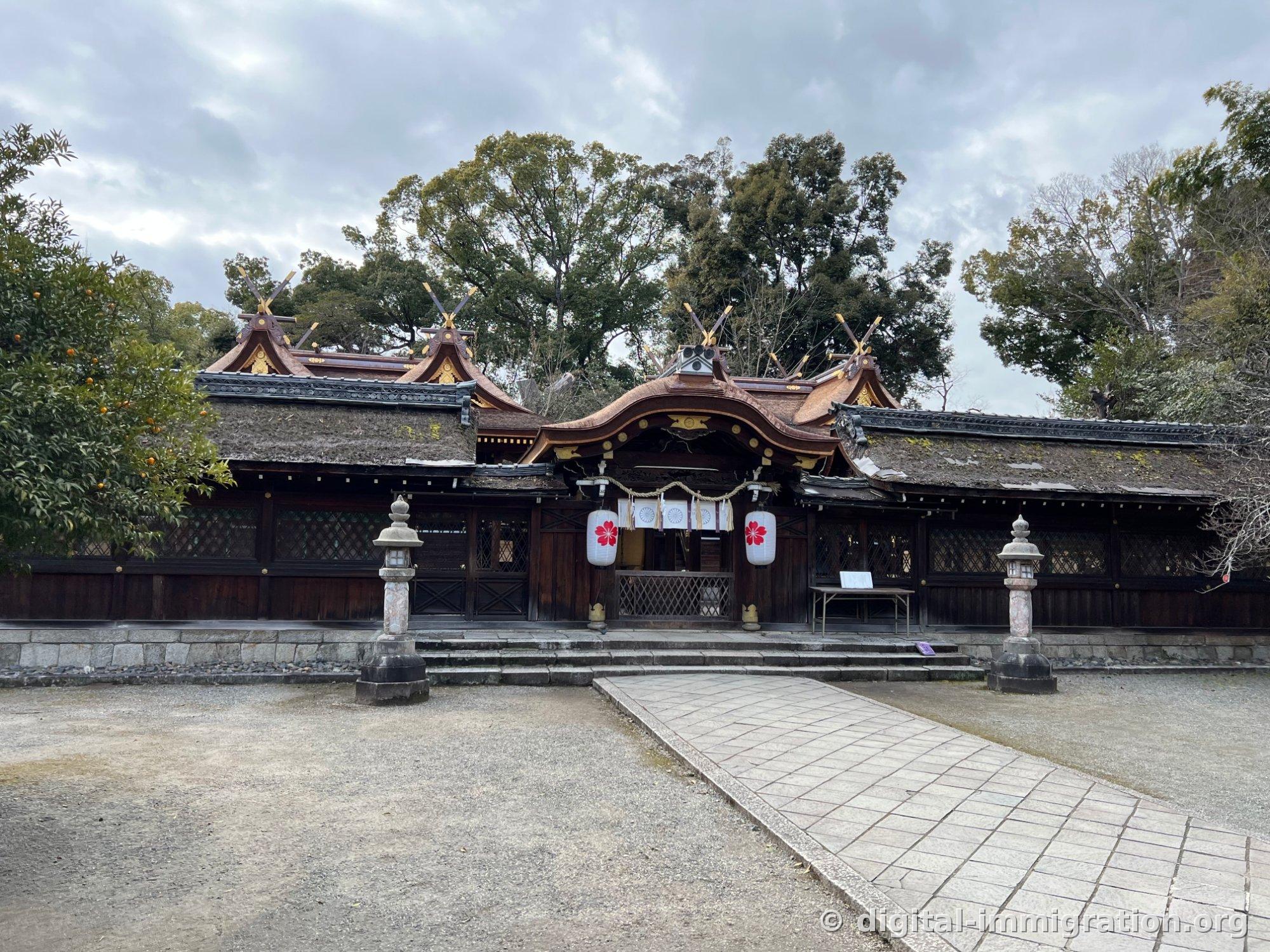
This building is the heart of Hirano Shrine. Looking at the roof, you see multiple pairs of golden chigi (千木) rising up — the structure combines two shrine buildings devoted to the four principal deities. This particular style is called "Hirano-zukuri" (比翼春日造), a roof style found nowhere else. Architecture lovers will spend a good while studying it. I photographed from the front, then moved left to capture the angle where the rooflines overlap. You can see in the photos that parts of the thatch under the eaves have worn away, suggesting it was awaiting repairs.
The worship form is two bows, two claps, one bow. Being a winter morning, the water at the purification fountain was frozen solid. My hands got cold, so I just gave them a quick rinse, but I felt a bit self-conscious when I watched an elderly Japanese woman who came after me properly soak both hands and even rinse the ladle handle itself.
Susanoo and Kusunoki — Small Things Deep in the Grounds
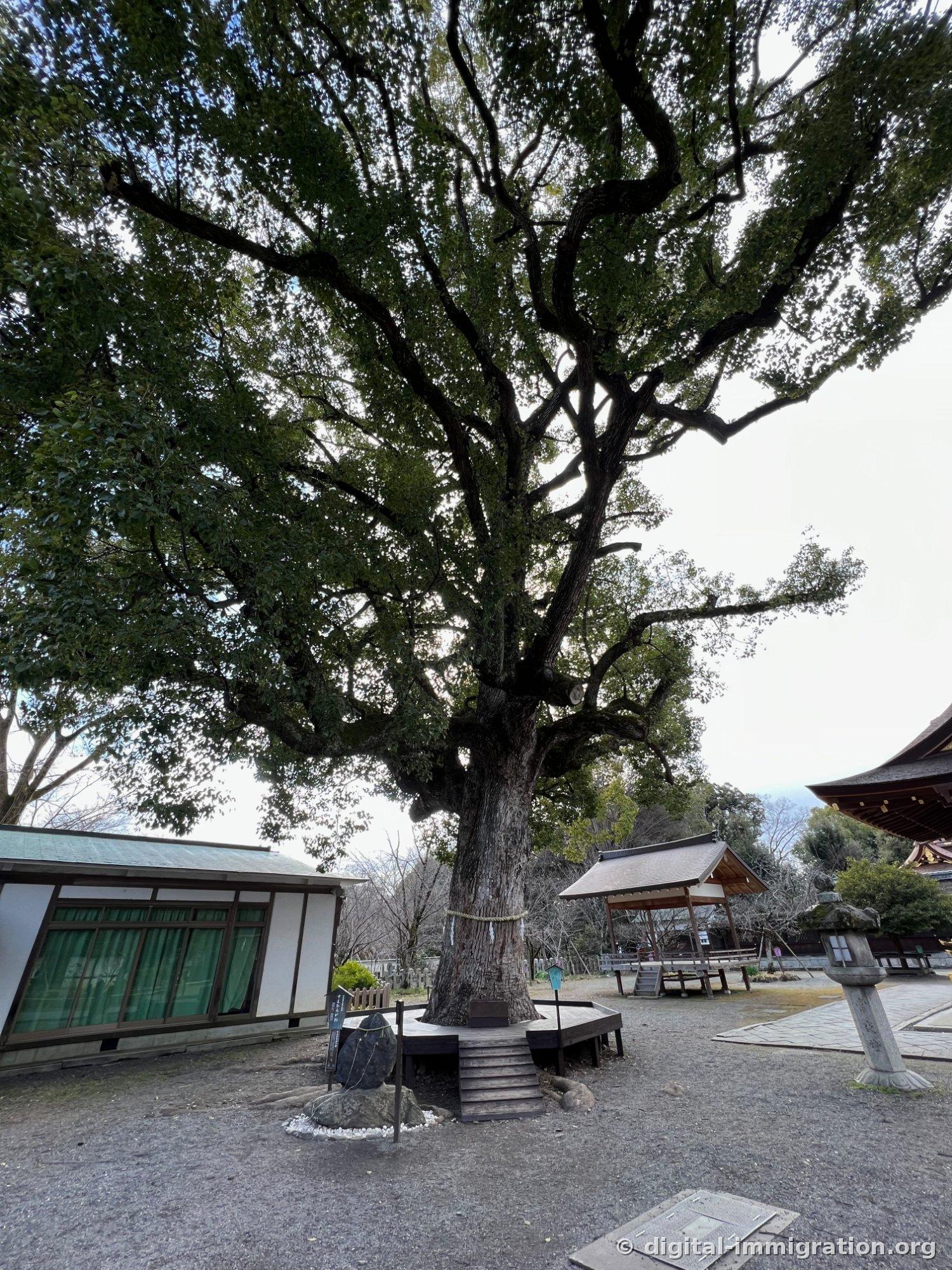
Walking around the side of the main hall, you encounter this tree. The base is so thick it takes several adults spreading their arms to reach around it. The rope festoon marks it as a sacred tree, and a wooden deck has been built around it so you can walk full circle without stepping on the roots. Even in winter, this evergreen remains full of foliage, making this spot uniquely shaded with different air. If you want to escape the crowds during cherry blossom season, the shade beneath this tree is your answer.
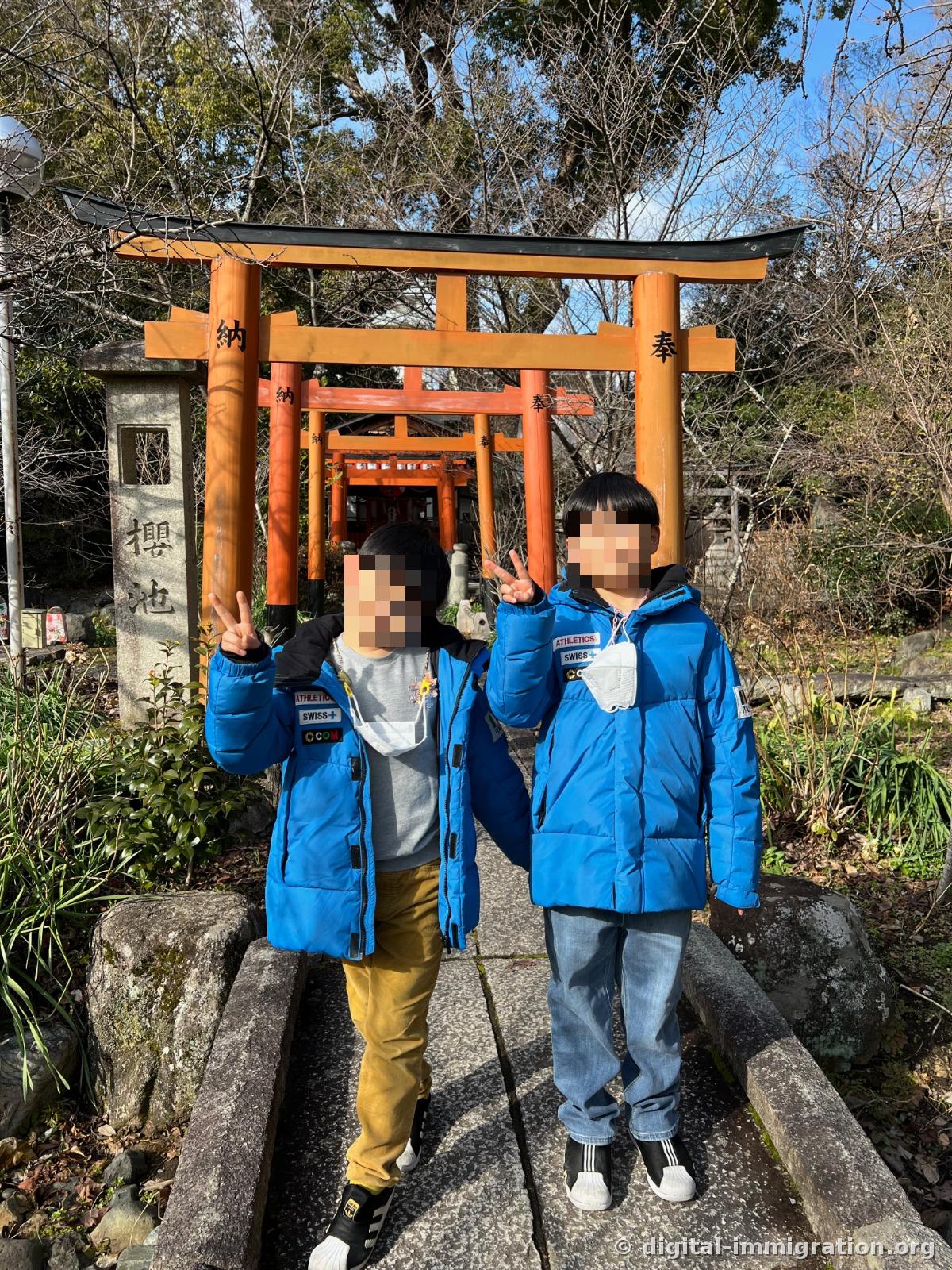
This was my personal favorite spot. Deep in the grounds, you find a narrow path with roughly a dozen small torii gates inscribed with "奉納" (donated offering). It's like a miniature version of Fushimi Inari's Senbon Torii, but the passage is so short you can walk through in ten seconds. The difference is there are no crowds. If you're someone who couldn't get a photo at Fushimi because you were jostled by the masses, you can take all the photos you want here. Our kids were most excited about this spot. At the end of the torii path sits a small red shrine, and the "櫻池" inscribed on the left stone pillar means Cherry Blossom Pond.
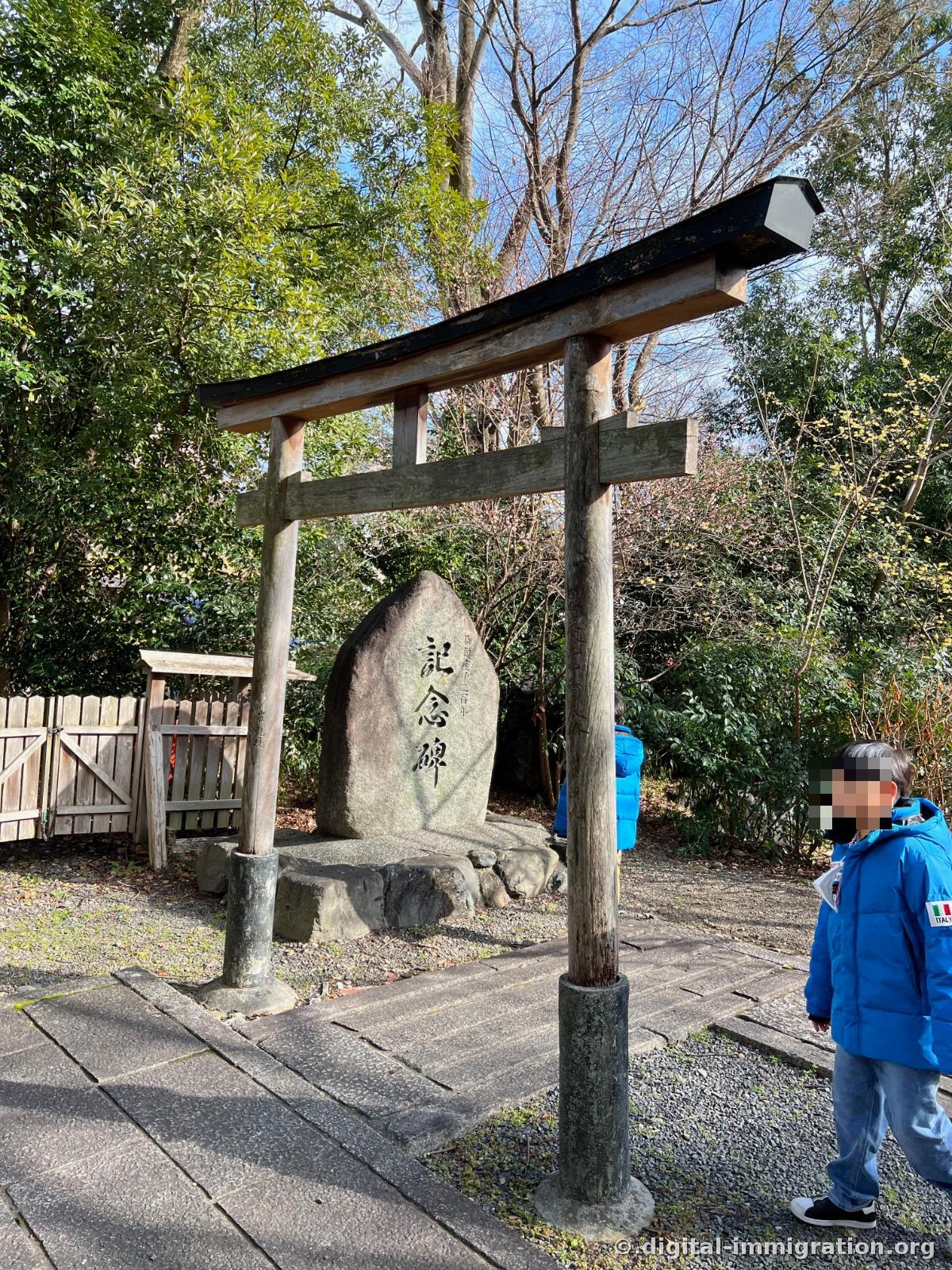
Same grounds, but this torii gate's paint is completely stripped away, revealing the gray wood grain underneath. Standing these beside the bright orange torii gates ahead, the passage of time feels very real. The stone monument inside bears only three large characters: "記念碑" (Memorial Stone), with smaller vertical text on the right that I couldn't make out due to moss and weathering. I left without learning what it commemorated, having only taken photos. This is one of the frustrating aspects — Hirano Shrine even lacks Japanese-language signage in many places, and English or Korean explanations are virtually nonexistent.
How to Get There and Genuinely Helpful Information
- Combine it with Kitano Tenmangu. It's a 5-minute walk away. If you come to the city just to see Hirano Shrine, your route will be inefficient. The standard approach is to visit Tenmangu first, then walk north.
- From central Kyoto, the city bus is convenient. Take the line heading toward Nishioji (西大路) and get off at Kitano Tenmangu-mae, then walk. Bus stop and route numbers change frequently, so check the app on the day.
- The nearest railway station is Kitano-Hakubaicho on the Randen Kitano Line. It's also within a 10-minute walk from there.
- Most of the grounds are flat gravel paths, so strollers can be pushed through. However, the gravel is coarse, so it may be difficult for small-wheeled strollers.
- There are restrooms on the grounds. Vending machines were also available.
- During cherry blossom season (late March to April), nighttime illuminations and food stalls transform the atmosphere completely, and certain areas become paid entry. If your goal is quiet worship, it's better to avoid that period.
Hirano Shrine in winter isn't a place with abundant sights. You can see everything in an hour. Yet I want to return, because the fact that ancestor deities of Baekje descent have been enshrined here for over 1,200 years exists not as a tourist attraction explanation but simply as part of this neighborhood shrine's daily life. Step on gravel, pass the chrysanthemum crest, wash your hands in cold water, bow twice. That's all there is. Next time, I want to come when the cherry blossoms bloom and see how these bare branches transform.
อ่านต่อไป
- From Akihabara's Chuo-dori to the Kanda River: A Record of Tokyo's Electronics District Revisited Multiple Times
Tokyo's Akihabara is a neighborhood where it's hard to say you've seen everything in a single visit. I've come multiple times across different seasons, and each time the signs chan…
โตเกียว · Akihabara - Buying a Single ¥300 Year-End Jumbo Lottery Ticket at Nishi-Ginza Chance Center in Tokyo
Exit from the Hibiya exit of Tokyo's Shimbashi Station, walk toward the elevated highway for about three minutes, and suddenly you'll see a line of people stretching along the side…
โตเกียว · Nishi-Ginza Chance Center - Ueno Ameyoko, the real magic starts after sunset — an evening walk from the Okachimachi Gate to Ueno Station
Every time I come to Tokyo, my feet find their way to Ueno Ameyoko (アメ横) without fail. This time I entered from the Okachimachi side and worked my way toward Ueno Station. I've met…
โตเกียว · ตลาดอเมะโยโกะ