Sukhothai Historical Park, Exploring Wat Mahathat and Wat Si Sawai by Bicycle Starting at 8:30 AM
After taking a bus from Bangkok's northern Mo Chit Terminal and driving for six hours, I arrived at Thailand's Sukhothai. On the map, it's about 427 km north of Bangkok. It was her…
Сукхотай
After taking a bus from Bangkok's northern Mo Chit Terminal and driving for six hours, I arrived at Thailand's Sukhothai. On the map, it's about 427 km north of Bangkok. It was here that Thailand's first unified kingdom was established in the 13th century, and the city's name itself means "the dawn of happiness." The capital of that kingdom was located at what is now Sukhothai Historical Park, and it was registered as a UNESCO World Heritage Site in 1991. To be honest, what surprised me more than the name was the scale. Unlike Ayutthaya, where ruins are embedded in the middle of the city, brick temples are scattered throughout a manicured park, and a day is not enough to see everything on foot.
The day I arrived was the tail end of the rainy season, but I never expected the sky to be this brilliantly blue. The price was clear, though. Once it passes 10 AM, the bricks emit heat, and even just standing still to take a photo becomes an ordeal. That's why I went in both days around 8:30 AM and left before 11 AM.
Wat Mahathat — The Heart of the Park, and a Quiet Morning Without Crowds
The center of the central zone is Wat Mahathat. On a wide ground surrounded by a moat, a lotus-bud-shaped spire stands tall, with a standing Buddha on both sides in front and behind. From the grass across the moat, the composition of this temple comes into view at a glance — the main spire in the center, standing Buddhas in brick niches on both sides, and a mountain ridge in the back. Most first-time visitors go straight in through the main gate, but I'd recommend walking around the water's edge first and viewing it from the outside. This full silhouette can never be captured from inside.
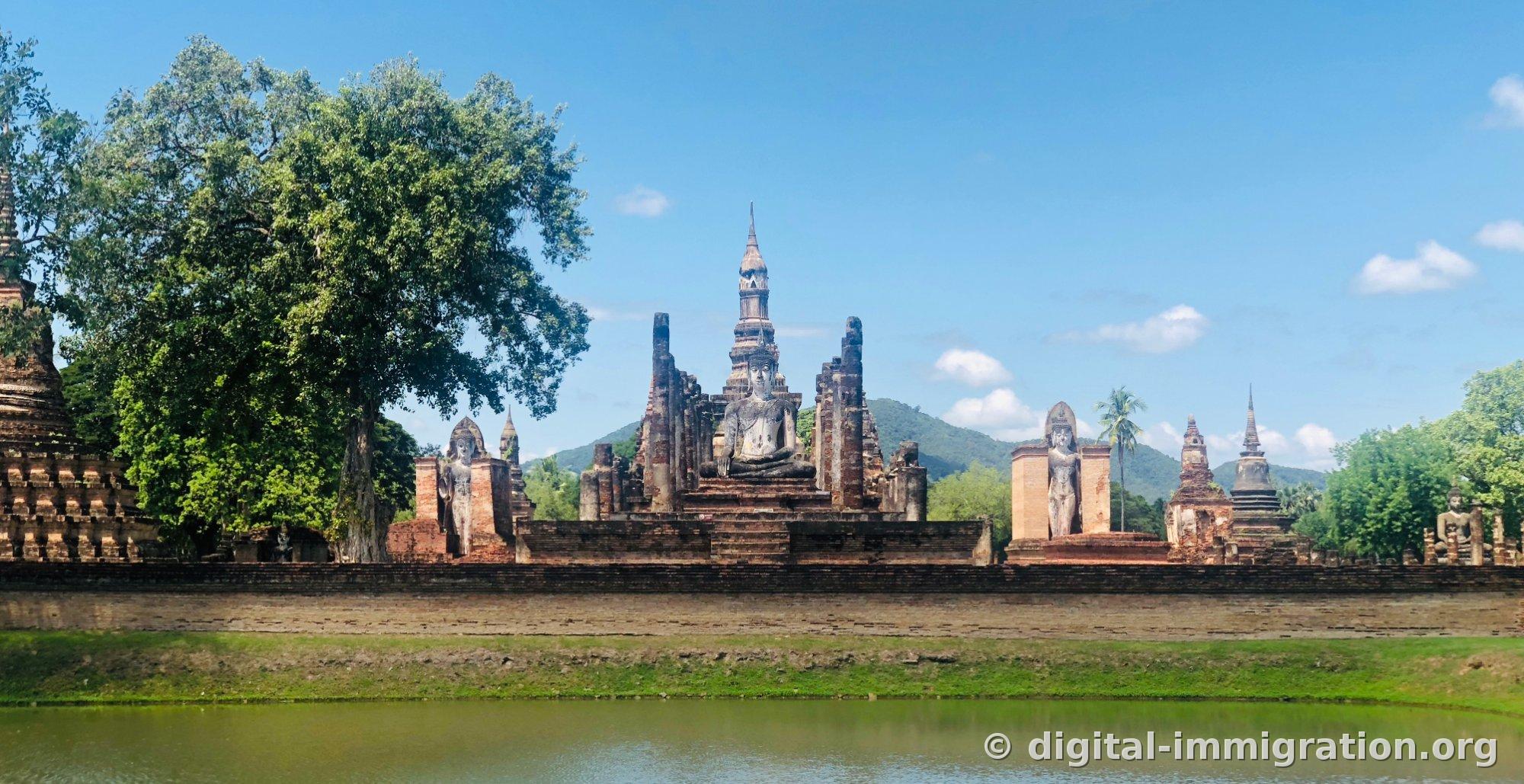
Moving further back toward the grass field, the entire temple stretches out like a horizon. The spot where I took this photo was my favorite location in the park. Yellow flowers bloom in the flowerbed in front, and beyond them, a forest of columns and spires stands in a single line. It's so vast that a couple of visitors look like dots.
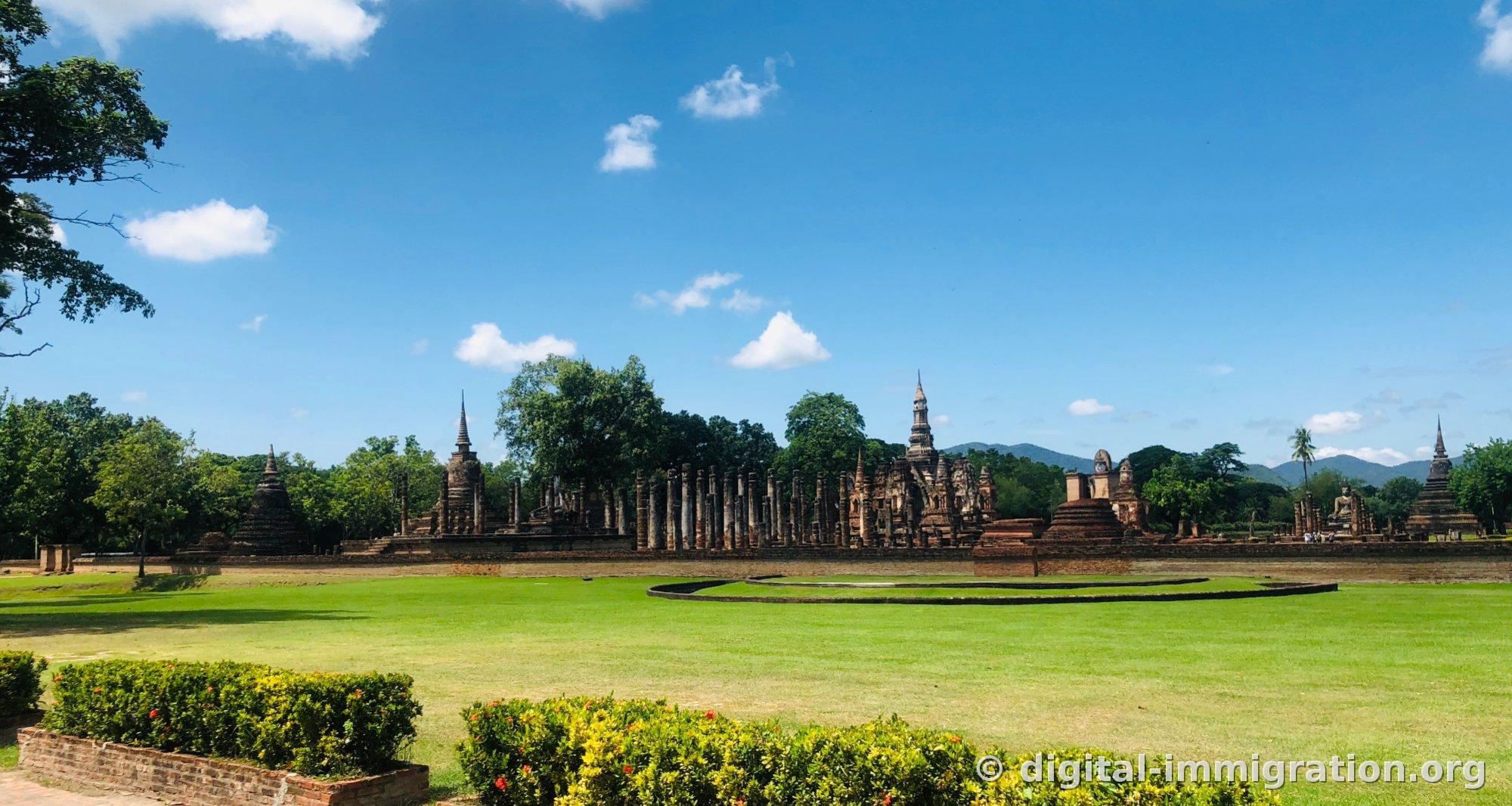
Once you step inside, the impression changes completely. On the grounds of the chapel with the roof gone, only stone columns remain in two rows, and a spire is visible at the end. Walking through the space between the columns is the true path of this temple. Around 9 AM, the shadows of the columns stretch long across the brick floor, and the sensation of walking over them remained in my memory for quite a long time. I can see one person in white clothes ahead, and that was the only person I encountered in all this vast space.

Moving around to the back of the columns, the carved details of the central spire come into view. Beneath the spire shaft, small Buddha statues are arranged like a band, and to the right, a standing Buddha sits separately in a brick niche. The brick staircase layers remain in ruins just as they were, and the fact that restoration wasn't overdone was actually refreshing.

Wat Sa Si and the Bodhi Tree — A Temple on the Water
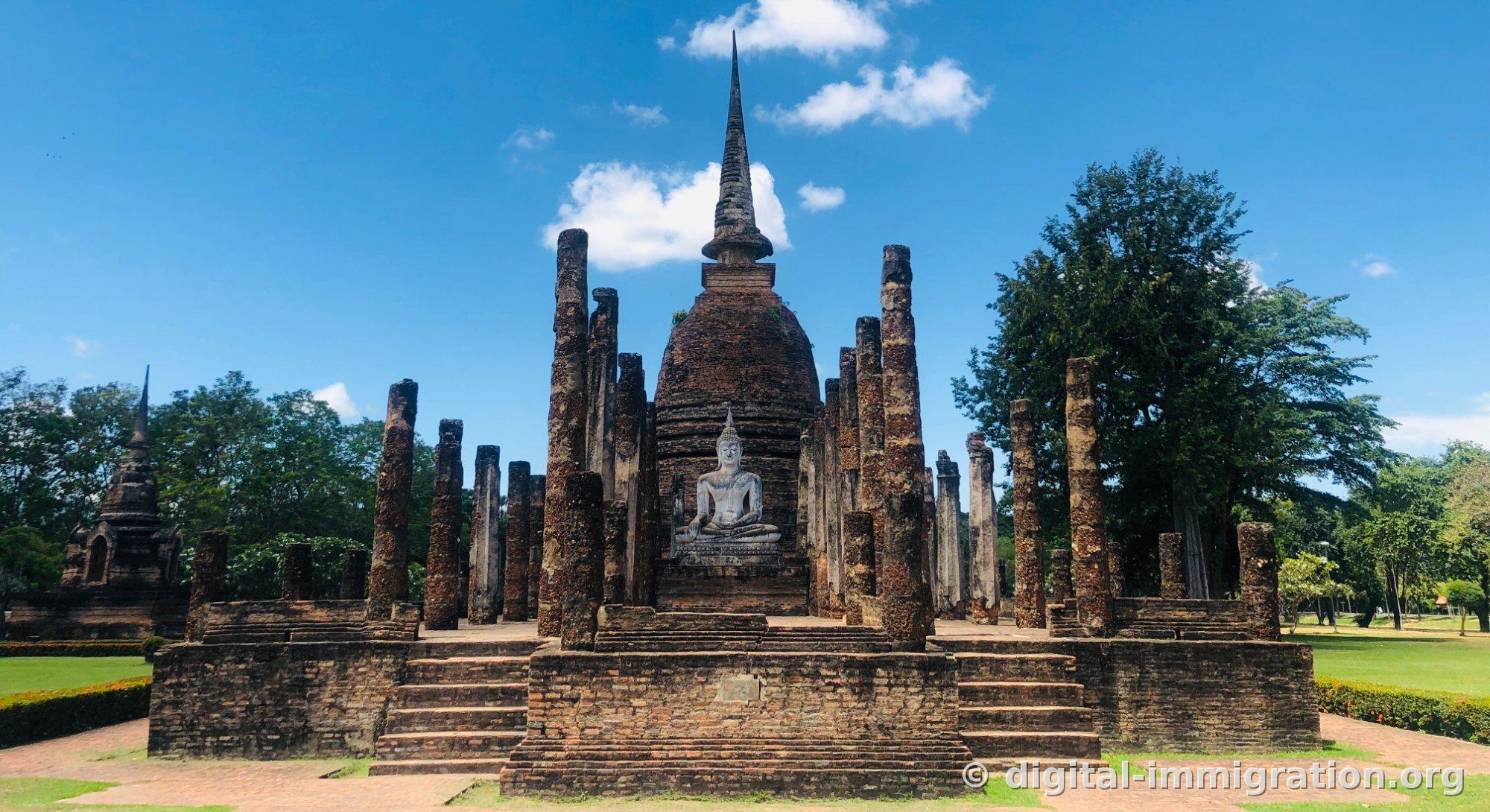
Going a bit west from Wat Mahathat, Wat Sa Si appears, sitting on an island in a pond. There's a bell-shaped (Sri Lankan style) spire and a row of columns where the chapel once stood, with a white seated Buddha between them. When viewed from the front, the columns stand as if guarding the Buddha from both sides, and this is the most commonly seen angle in Sukhothai photos. In reality, standing there, it feels much smaller and quieter than in photographs.
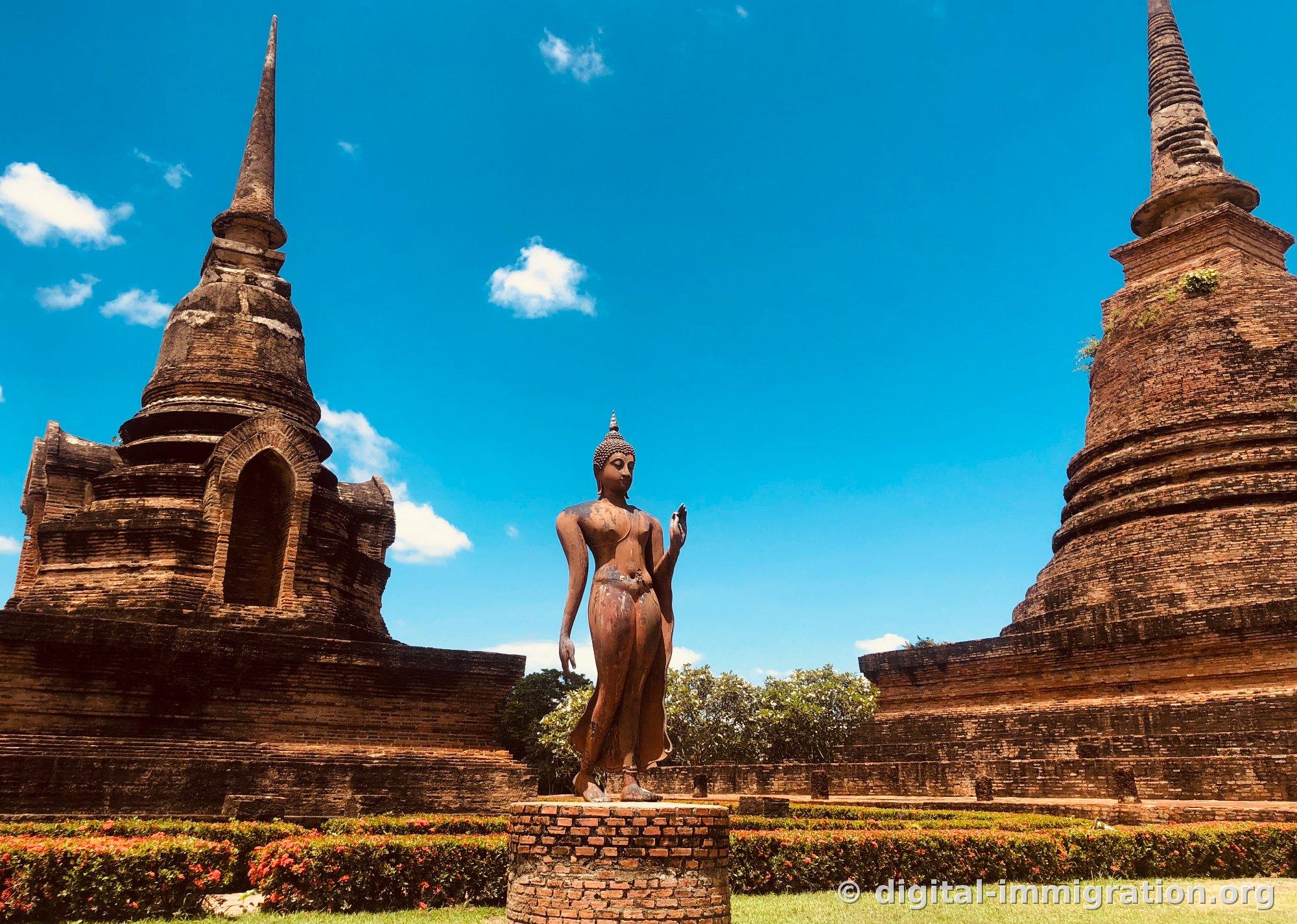
In the same area, between two spires, stands a walking Buddha. It's in the pose of a Ushnisha Buddha with the right hand raised, and the way the robe clings to the legs is characteristic of Sukhothai style. The surface has red stains flowing down and is broken in places, so the actual condition looks much more weathered than in photographs. That weathering was actually the charm of this statue.
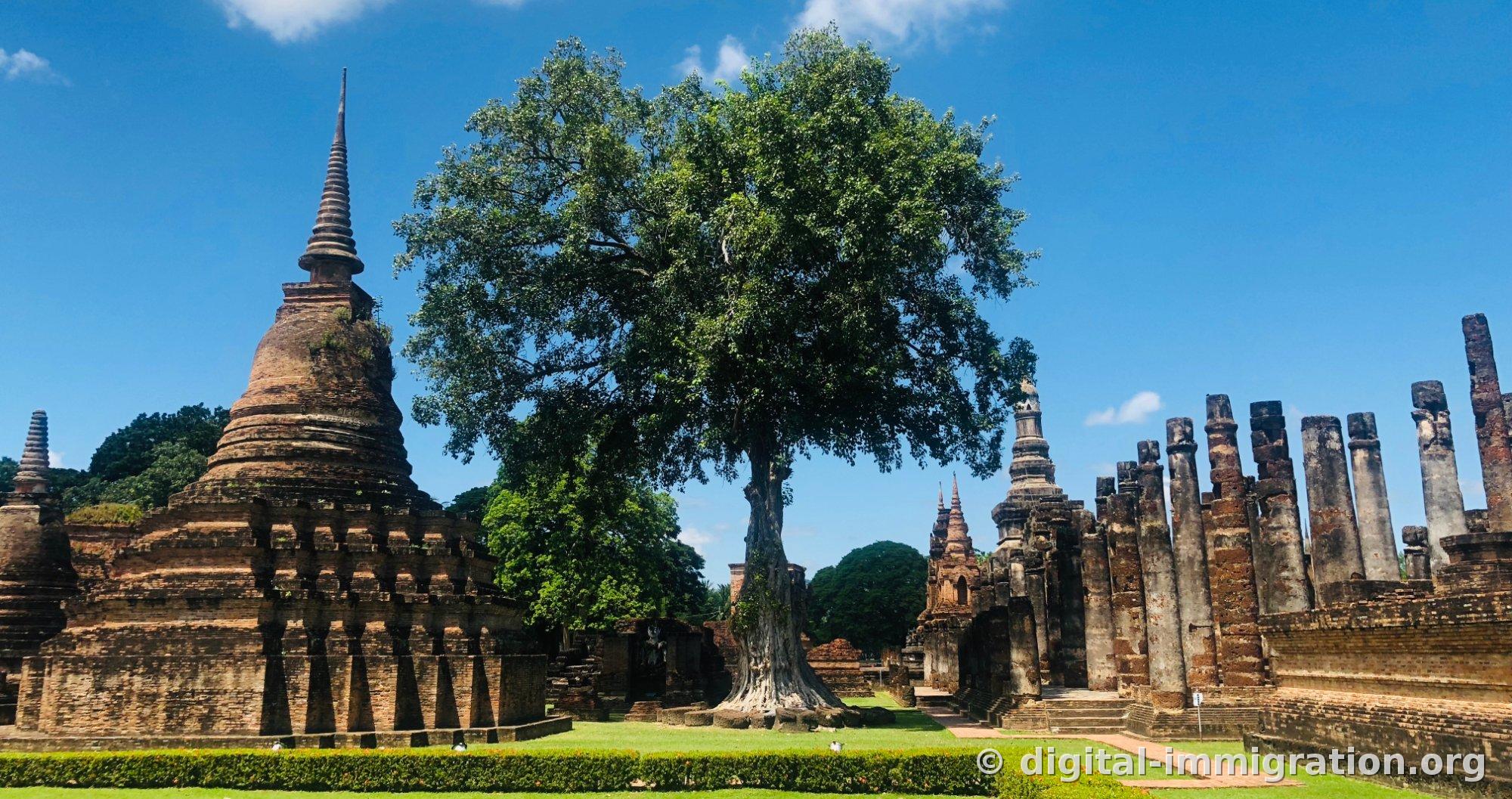
As you walk through the park, there's a moment when trees catch your eye before temples do. A large bodhi tree stands between a bell-shaped spire and a row of columns, its roots extending to the brick foundation. The shade is vast, making it the coolest spot in the park. Carrying a bottle of water and resting here for ten minutes became my routine.
Wat Si Sawai — Three Khmer-Style Prangs
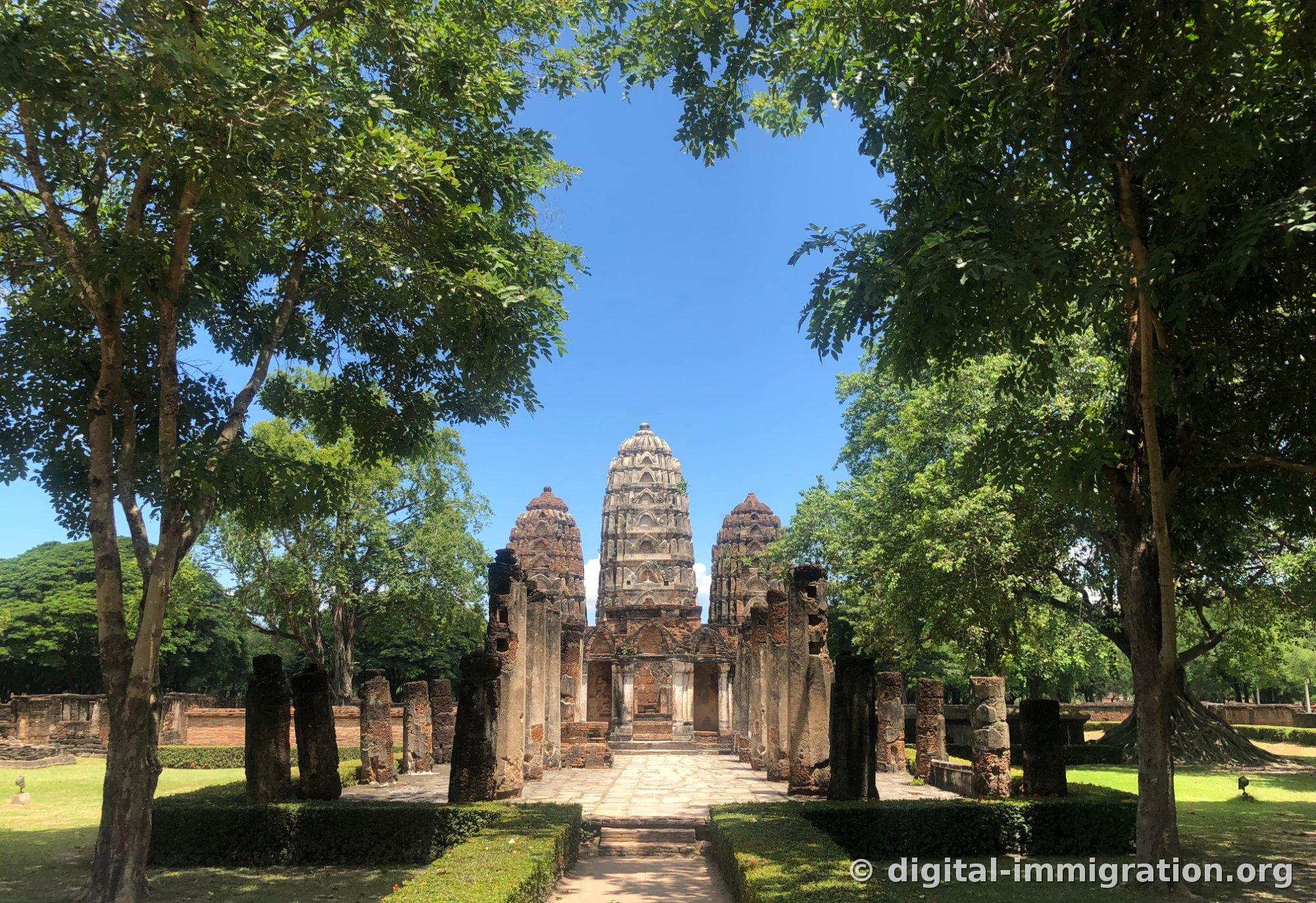
Wat Si Sawai to the southwest of the central zone has a completely different atmosphere. Instead of Thai lotus-bud spires, three Khmer-style prangs stacked like corn stand in a row. I heard it was originally built as a Hindu temple and later converted to a Buddhist temple. A worship path stretches straight through the trees, so that taking a shot from the front entrance naturally creates a frame with the leaves.
The Standing Buddha of Wat Mahathat and Phra Achana of Wat Si Chum
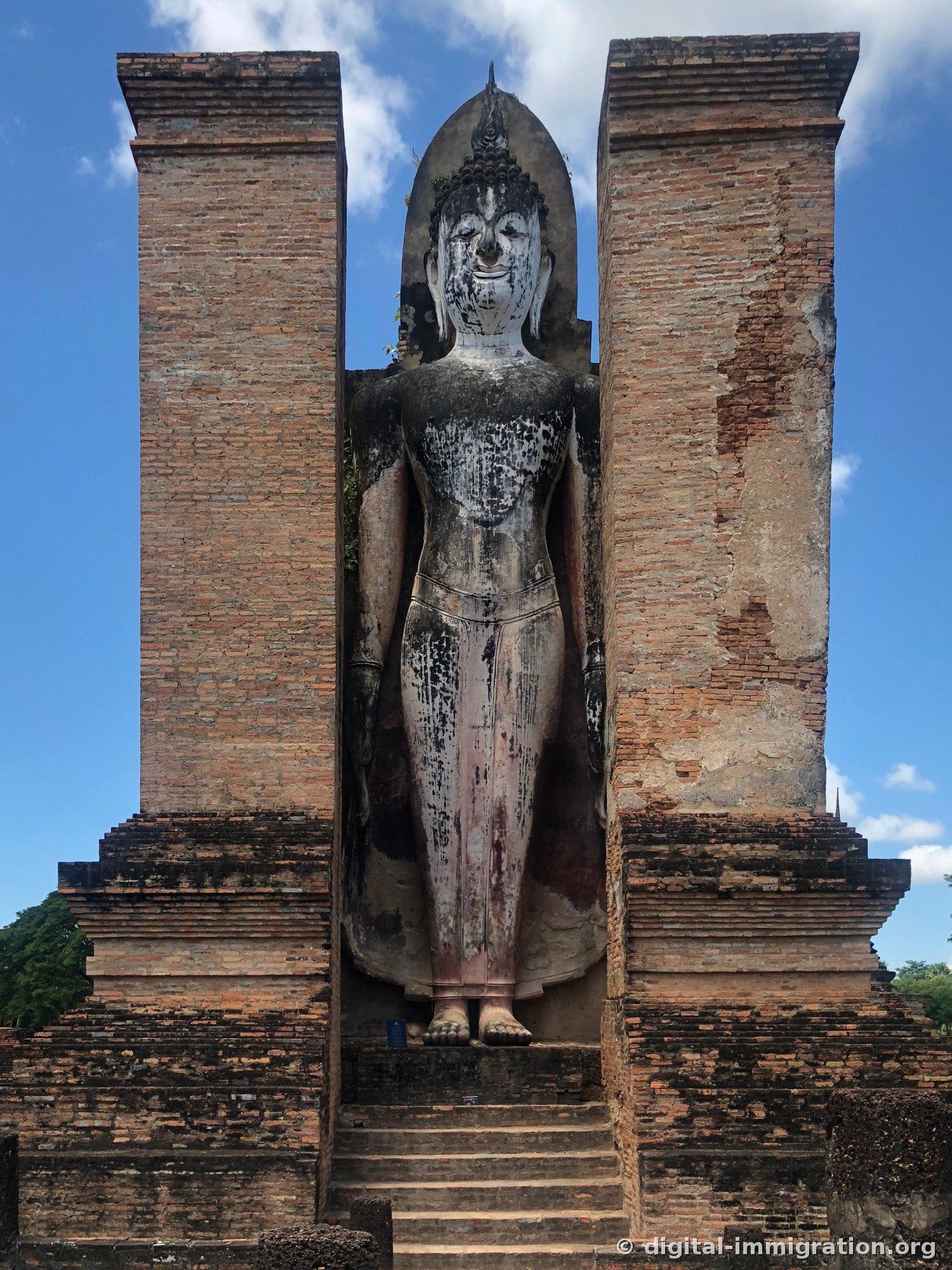
The most overwhelming thing in the park is ultimately the large Buddha statues. Standing before the enormous standing Buddha wedged between two brick columns at the back of Wat Mahathat, you crane your neck to the point of pain. Black water stains flow vertically down the face and upper body, with almost no folds in the robes—they cling directly to the body. The toes are the size of a human head. In photographs, it looks neat, but in reality, the surface is peeled and stained just as it is.
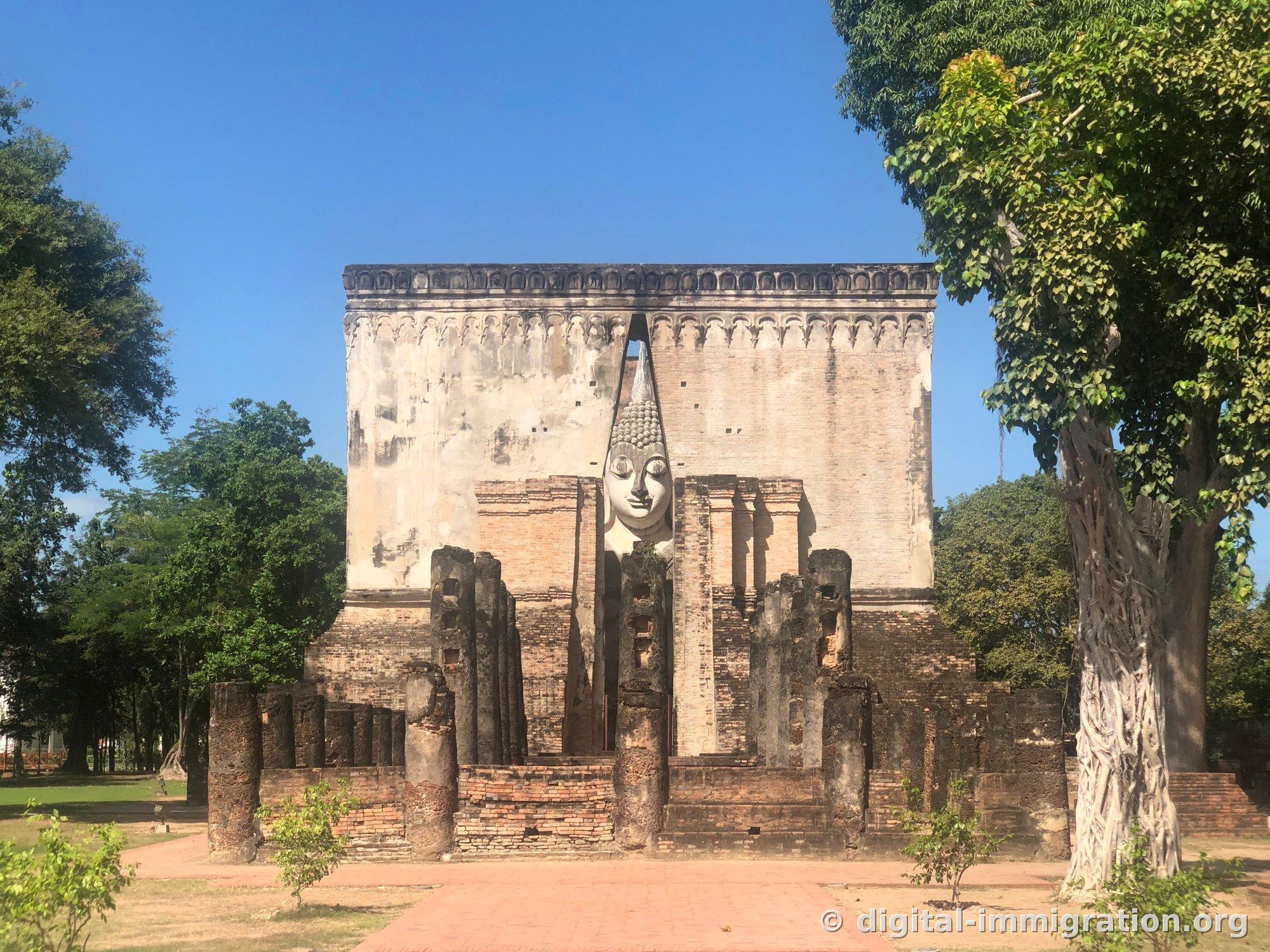
Going to the northern zone of the park, you find Wat Si Chum. From the outside, it's just a plain rectangular brick box with no windows, but with a narrow vertical gap in the center of the front, through which you can see the face of a seated Buddha inside. This structure itself is all that this temple is. If you go in the late afternoon, the wall is in shadow and the face isn't visible; it's better to go when the sun shines straight on it.
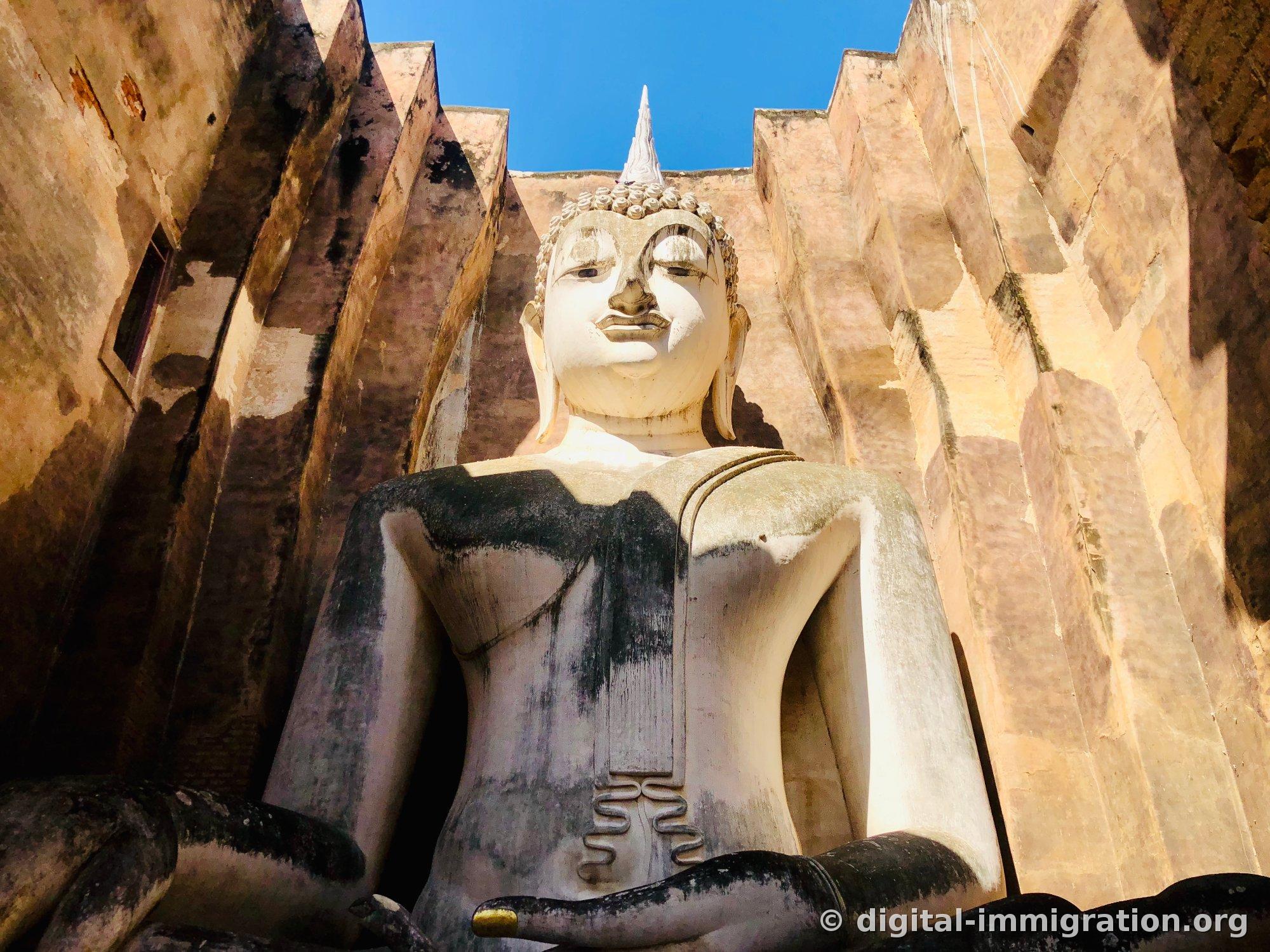
Once inside looking up, the story changes. A narrow space enclosed on all sides is completely filled with Phra Achana, a seated Buddha, with the sky opening narrowly above. The face is white, the body is darkly stained, creating extreme contrast. Pieces of gold leaf stick to the tip of the right hand, applied by worshippers. I stood silently before it for a long time. Of everything I saw all day, this single scene was the most powerful.
How to Get There and Practical Tips
The park's location is on the map below. It's about 12 km west of the new city (New Sukhothai), so it's not a walkable distance. Songthaews (converted truck shared taxis) run from the city center to the entrance of the historical park, and I rented a scooter from my accommodation and rode there. Renting a bicycle in the park is the answer — even just seeing the central zone takes a couple of hours on foot, and walking to Wat Si Chum in the north requires a long trek in the blazing sun.
To summarize only what I actually experienced:
- The zones are separate. The central, northern, and western zones are separate, and entrance tickets are sold by zone. Prices vary by season, so it's best to confirm at the ticket office. There's an additional vehicle fee when bringing a bicycle or motorcycle, so knowing this in advance prevents any surprises.
- Go in the morning. Bricks and laterite retain heat, and after 10 AM the radiant heat kicks in. I went in the afternoon on the second day and left after 30 minutes.
- There's almost no shade. Apart from a few bodhi trees, there's nowhere to escape. A hat and water are not optional.
- Dress code. As it's an outdoor ruin, temple dress codes aren't strict, but people remove their shoes in front of Buddha statues out of respect. Taking selfies with your back to a Buddha statue is considered impolite in Thailand.
- What was disappointing. The explanatory plaques are brief and English is lacking in many places. Knowing when and why each temple was built makes a completely different experience, but the on-site information alone doesn't provide that. If you read up on just three places — Wat Mahathat, Wat Si Sawai, and Wat Si Chum — before visiting, the experience is entirely different.
Sukhothai has worse accessibility than Ayutthaya, and because of that, fewer people visit. I think that's the city's greatest asset. Walking between the columns alone, feeling the presence of those 700 years ago when this place was filled with people, is a rare experience.
Читайте дальше
- A Day at Karahill Anona (Karahill Anona) on the 1st Floor of Phuket Karon Anona Beachfront Resort Until Midnight
It's my fourth day in Phuket's Karon area. My lower back was sore from riding a long-tail boat in the afternoon and hitting some rough waves. Thai massage shops are everywhere in t…
Пхукет · Карахилл Анона - Karahill Nail & Beauty in Phuket — A nail salon on the 2nd floor above an Indian restaurant, declaring itself from the staircase
Getting nails done in Phuket is usually spontaneous. You notice a sign on the way back from the beach, pop in, spend about 200 baht having your nails trimmed, and leave. But this p…
Пхукет · Карахилл Наиль - Phuket Patong Karahill Massage — Thai Massage 400 Baht, Saw a Shiba Inu During a Foot Massage
As you walk through the alleys of Patong, you see a massage shop sign every ten steps. I stopped in front of Karahill Massage because the interior was clearly visible through the g…
Пхукет · Карахилл массаж