Tokyo's Kōkyo (皇居), Fortunately the Gate Was Open That Day — A Half Day After Passing Through Baggage Inspection
Exiting Tokyo Station from the Marunouchi side and crossing one traffic light, you immediately reach the Imperial Palace Outer Gardens (皇居外苑). I'd originally planned to walk around…
Токио · Токио
Exiting Tokyo Station from the Marunouchi side and crossing one traffic light, you immediately reach the Imperial Palace Outer Gardens (皇居外苑). I'd originally planned to walk around the moat and take a photo of Nijubashi before heading home. But as I walked toward the Sakashitamon side, I noticed an unusually large crowd. As it turned out, this was one of those special periods when part of the imperial grounds (宮内) opens to the public. I hadn't timed my visit deliberately—I just happened to arrive on an open day. Despite visiting Tokyo many times, this was my first time inside the compound walls.
Morning at the Outer Gardens, Just Before the Ginkgos Fall
Late November mornings in Tokyo are noticeably less biting than Seoul. A thin puffer jacket is enough, and once the sun comes out, you actually want to take it off. The ginkgo trees lining Uchibori-dori had just passed their peak and were beginning to shed. Yellow leaves scattered across the pavement, and someone pulling a suitcase stopped on the far side of the street to gaze at the trees for a while. They must have come straight from the airport.
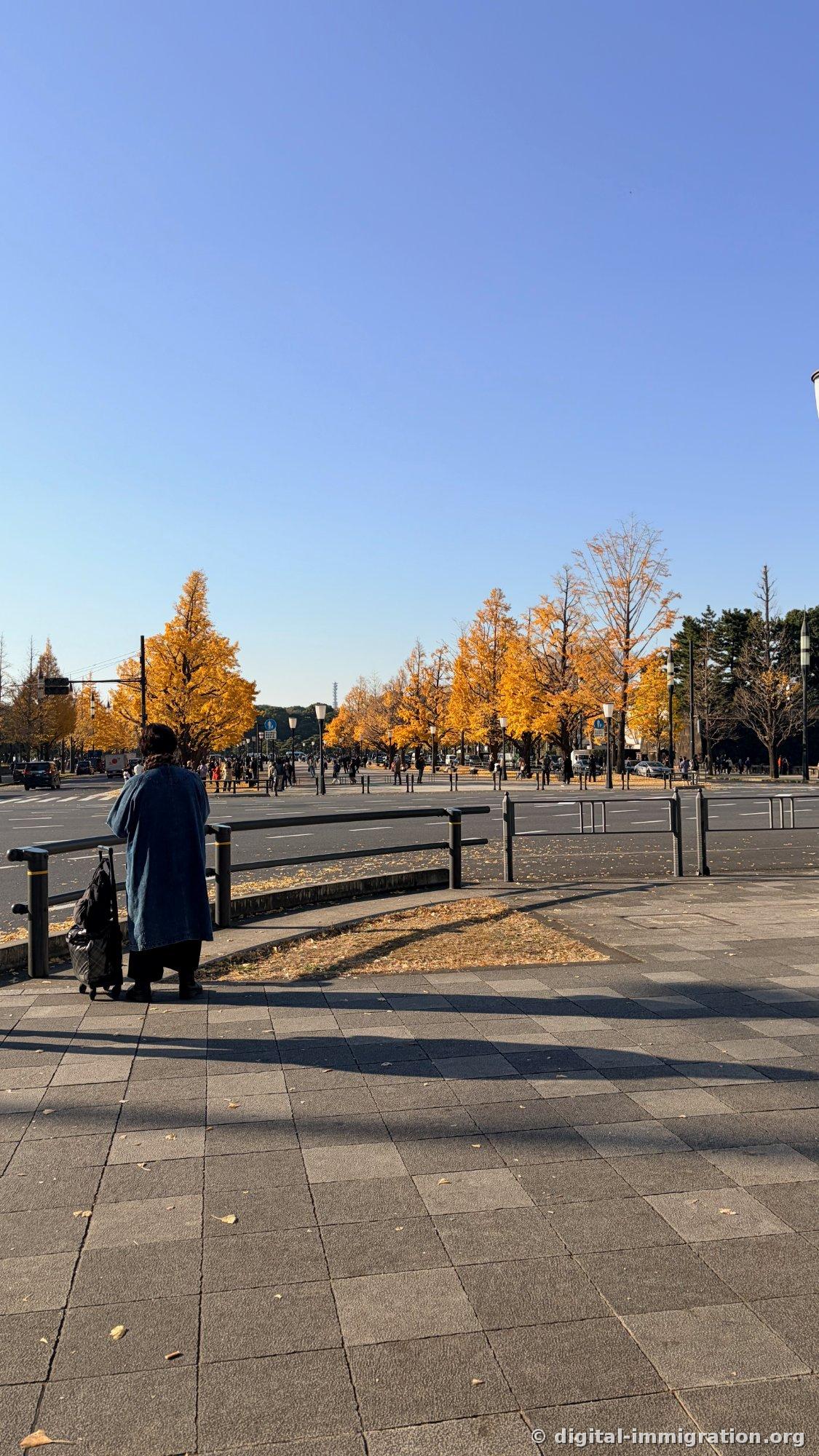
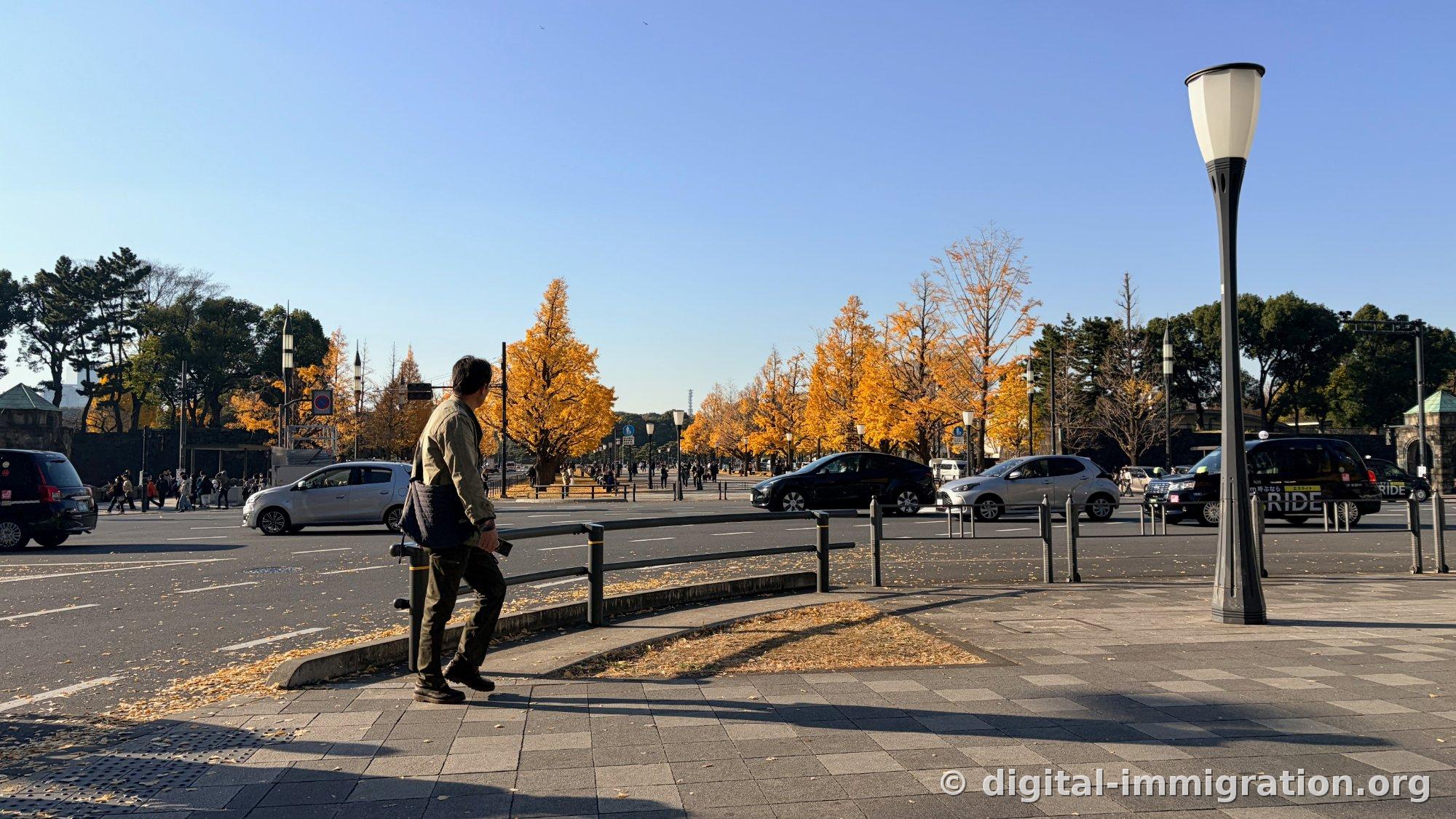
Shifting position slightly from the same spot, you can see just how wide the road is. Taxis line up in both lanes, and beyond them the yellow tree-lined avenue continues. It's only about five minutes' walk from Tokyo Station to here, but in those five minutes the scene transforms completely from an office building forest to one fronted by ancient walls.
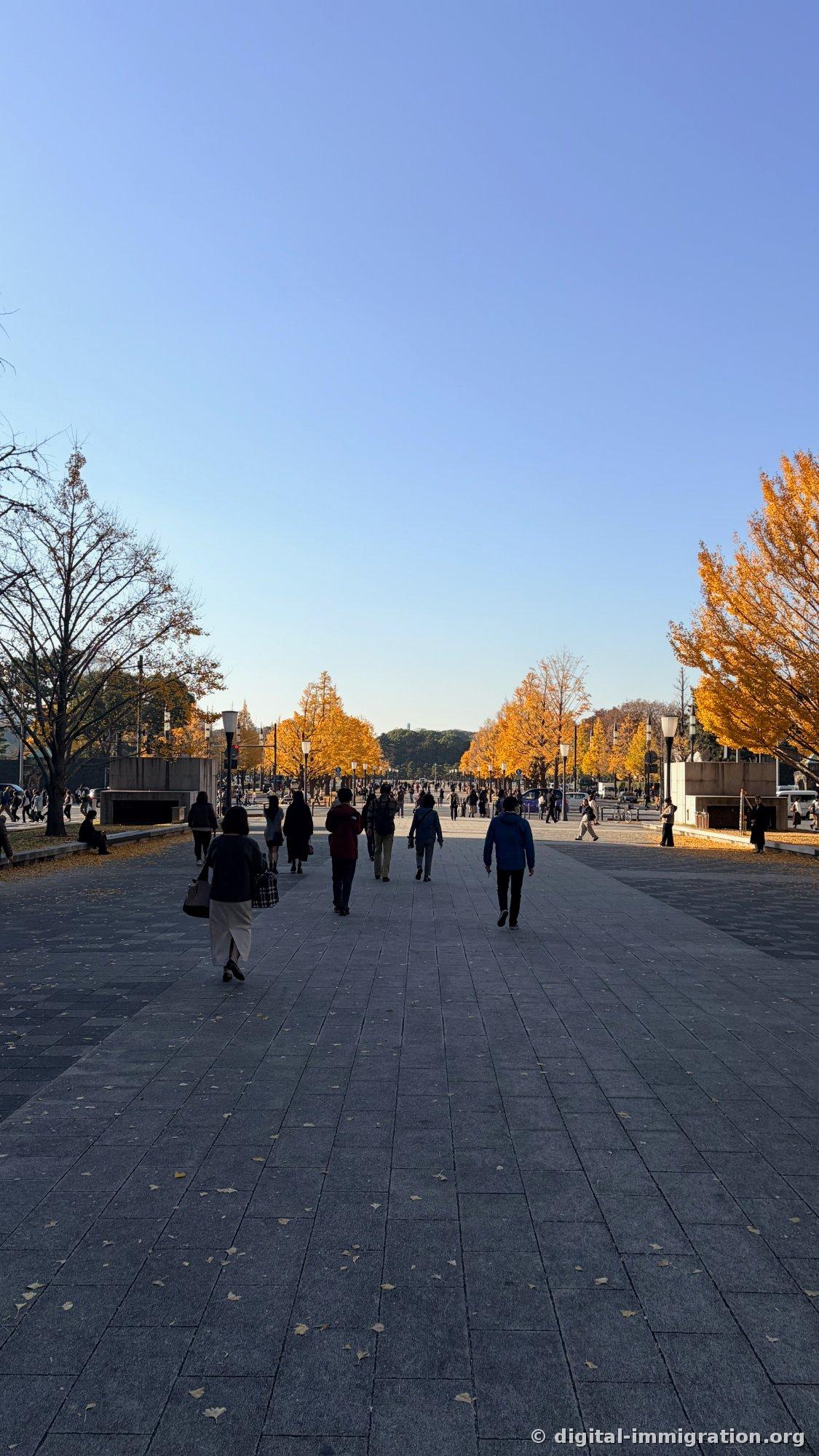
The most straightforward route is to walk straight west from Tokyo Station's Marunouchi Central Exit. By subway, Nijubashimae Station on the Chiyoda Line or Otemachi Station on the Mita Line are closest, and no matter which exit you take, you end up on this spacious walkway. Everyone walking in the same direction meant there was no way to get lost.
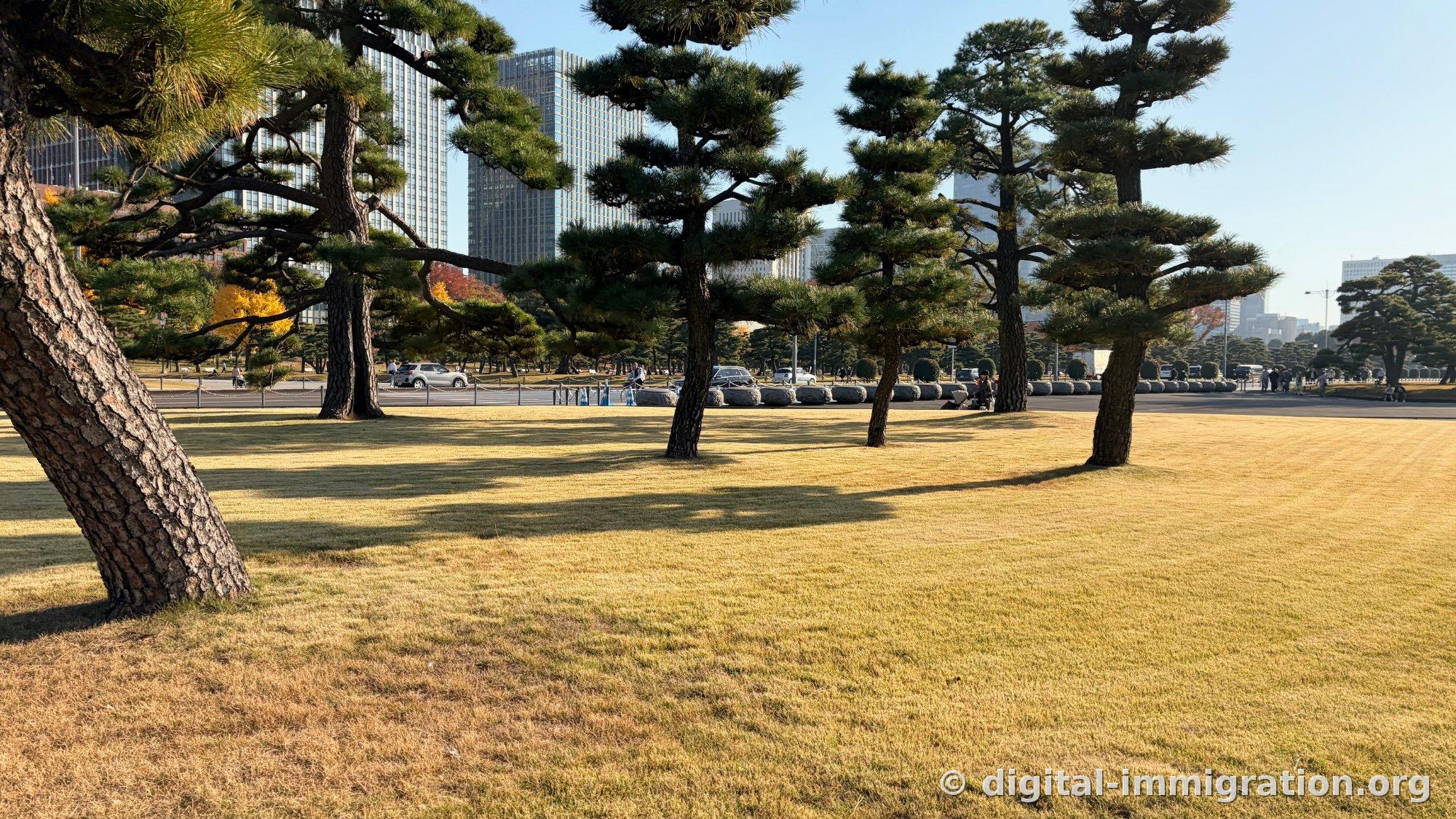
Entering the gardens proper, you're greeted by the famous black pine (kuromatsutree-lined lawn. From photos it looked like a traditional garden, but standing there in person, the scale is entirely different. The grass has turned brown as winter approaches, and hundreds of pine trees stand in various postures. It was hard to imagine that people maintain each one individually.
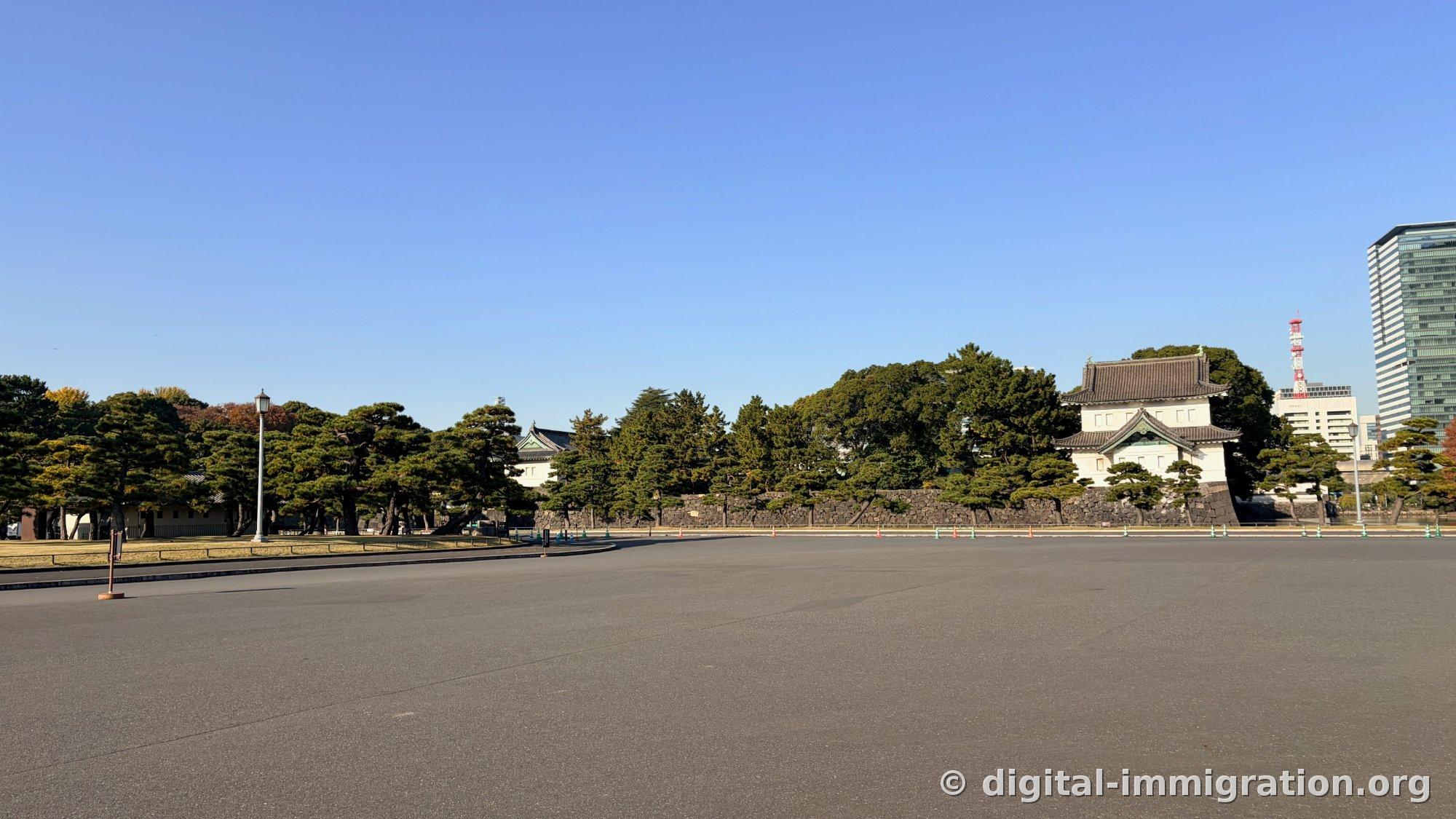
The plaza deeper inside is completely bare asphalt. With no shade at all, summer would be rough here. Beyond the trees, a watchtower with white walls and black tile roof is visible. From this angle, you realize there are surprisingly few old structures remaining inside the castle grounds.
Walking Along the Moat—This Section Is Actually the Best
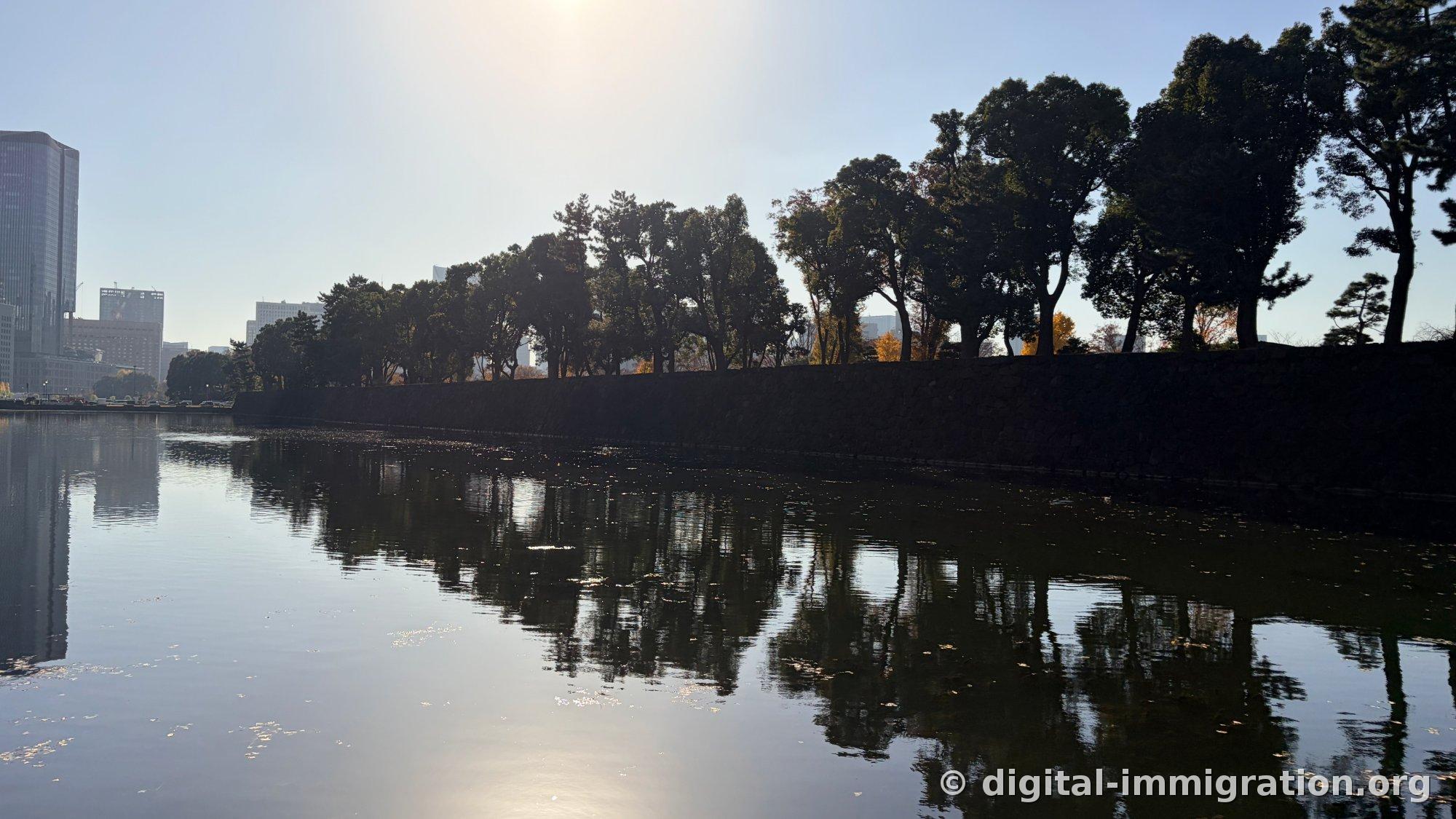
The most underrated feature of Kōkyo is the moat. Everyone takes their photo at Nijubashi and leaves, but the time spent walking along the water's edge stayed with me the most. Walking toward the sunrise and facing into the light, the water turns silver while the castle walls and trees become complete silhouettes. It's one of those sections that photographs beautifully no matter how you expose it.
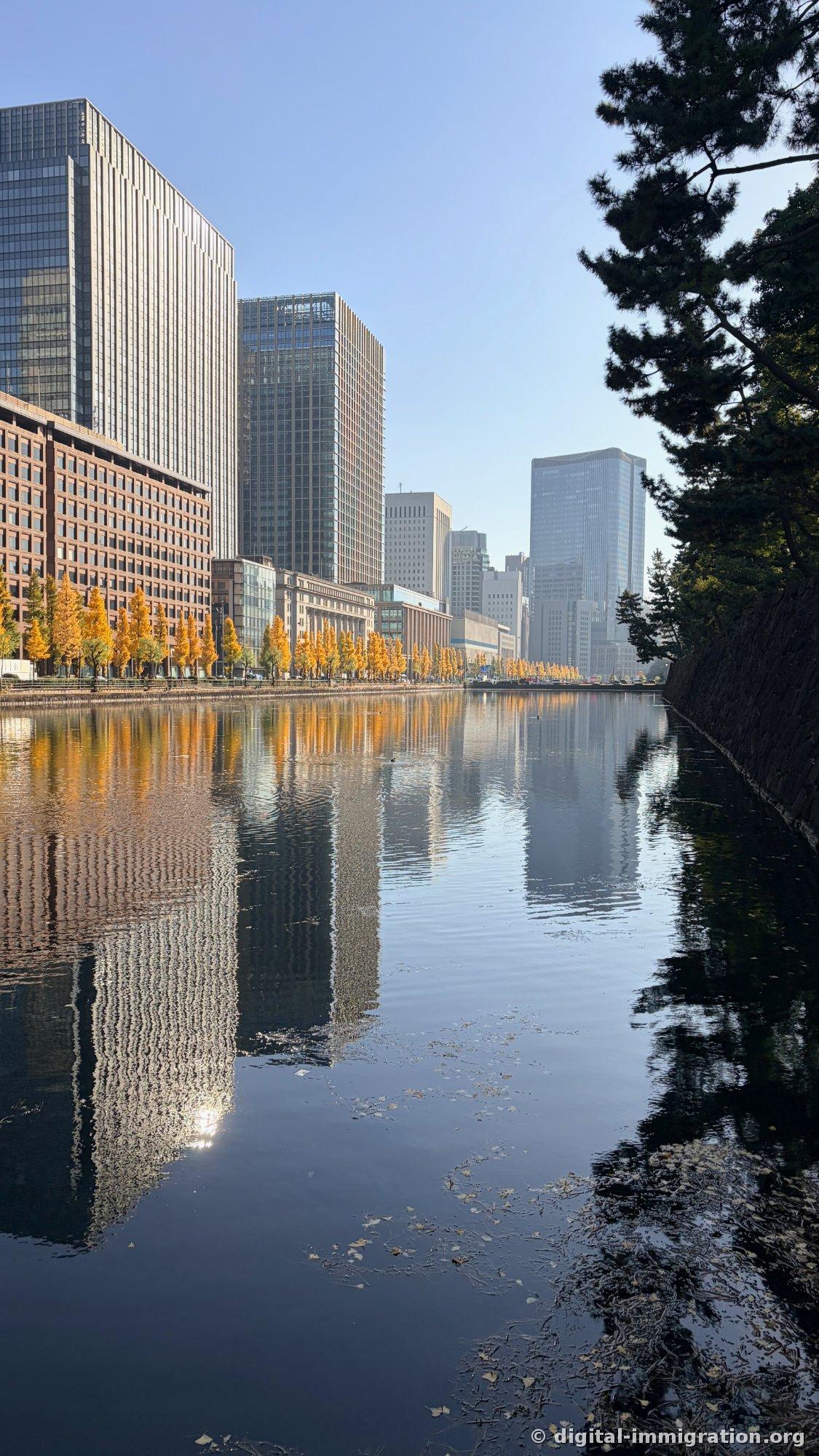
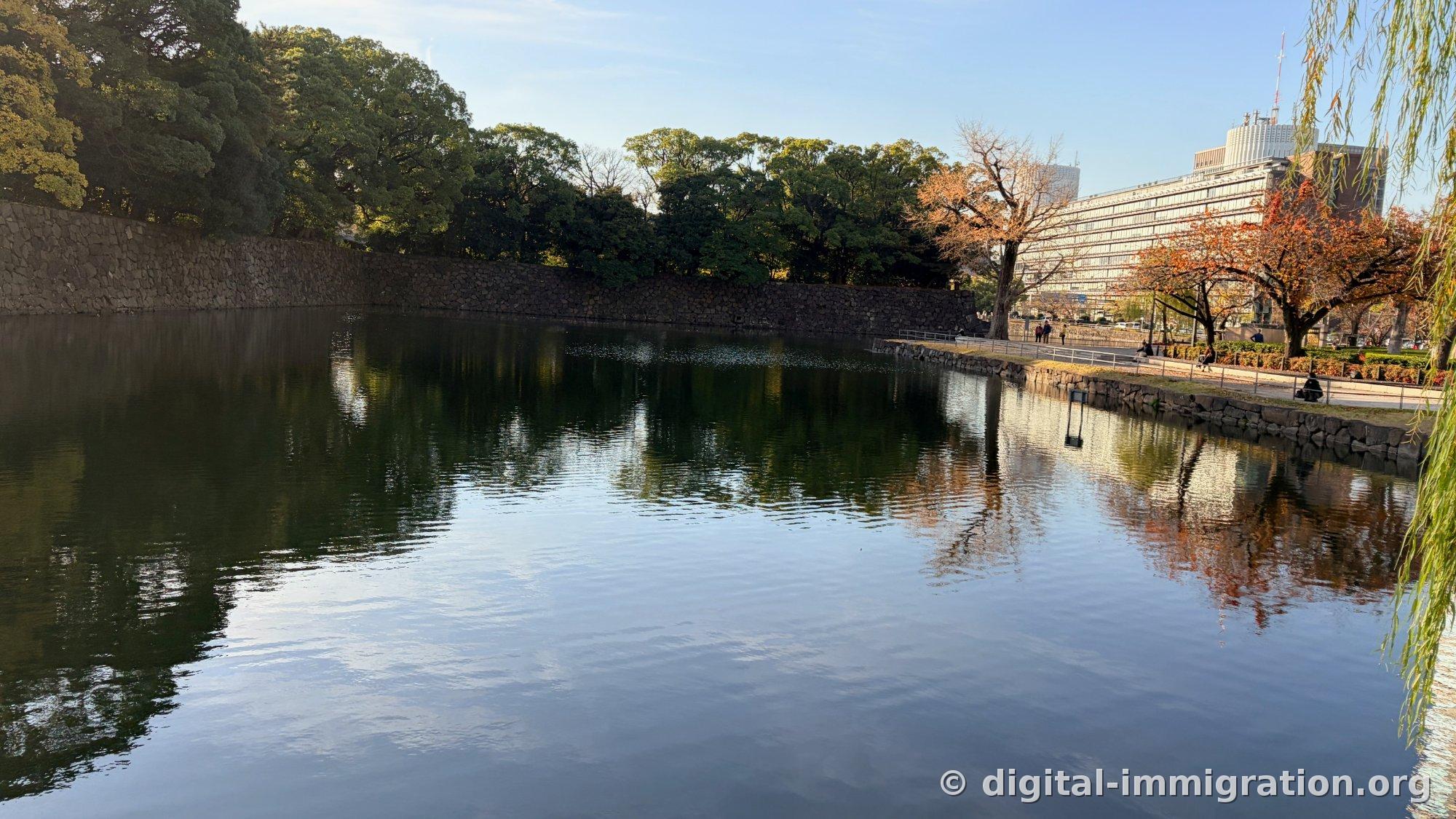
Turn around and face the opposite direction, and it's a completely different picture. The water is so still that the entire Marunouchi building cluster is reflected perfectly upside down. A line of ginkgo trees stretches across the water like a yellow ribbon, and fallen leaves drift slowly on the surface. I think this is where Tokyo's past and present most cleanly frame together in a single view.
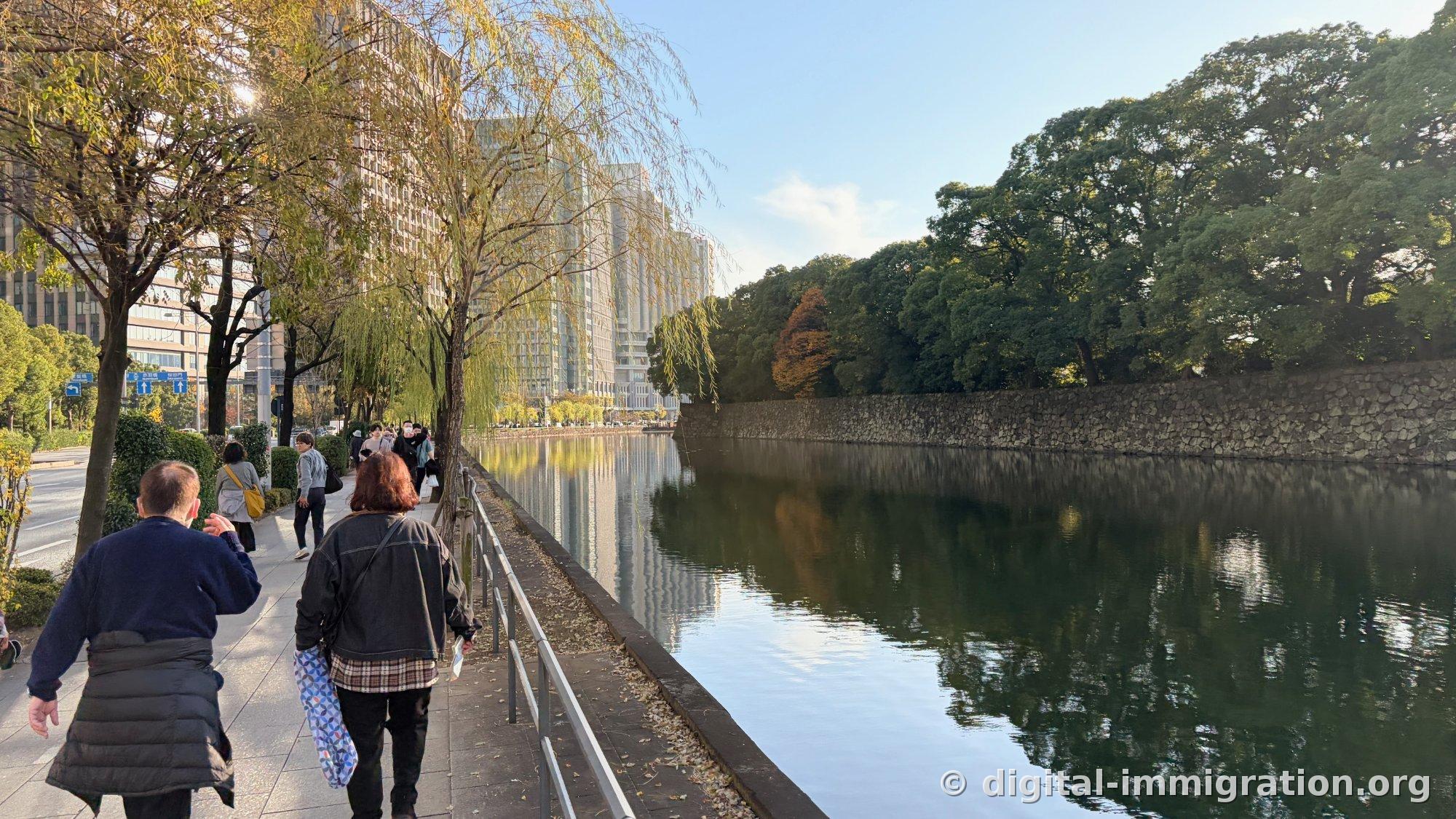
The outer bank of the moat is lined with willows, so there's continuous shade even in summer. The path is wide enough that joggers and tourists pass without colliding. You could easily spend an hour just walking this route.
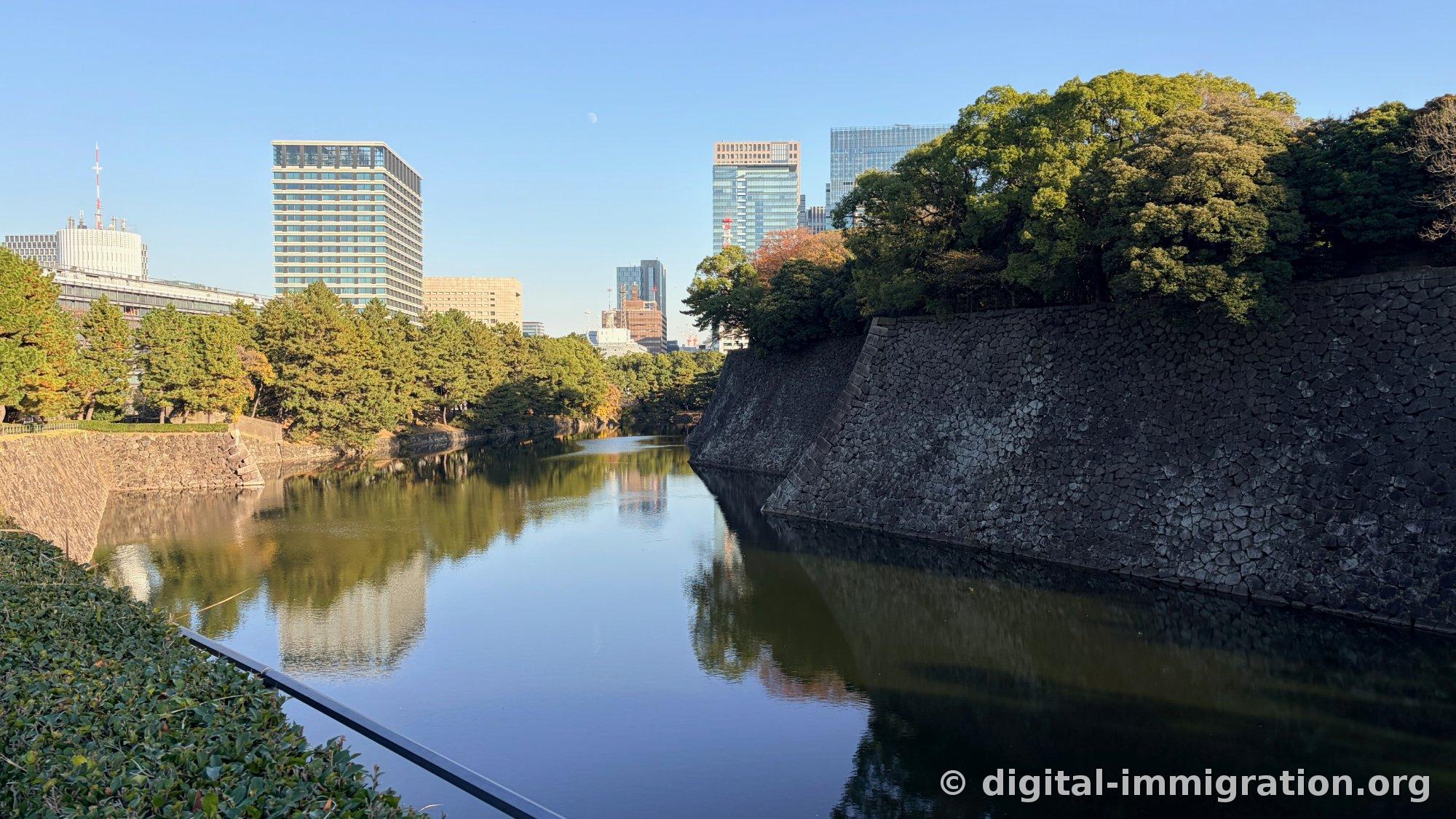
Coming back to the moat side late afternoon, there was a daylight moon in the sky. The castle stone changes color from gray to brown as afternoon sunlight hits it. I recommend walking the same spot twice—once in the morning and once in the afternoon.
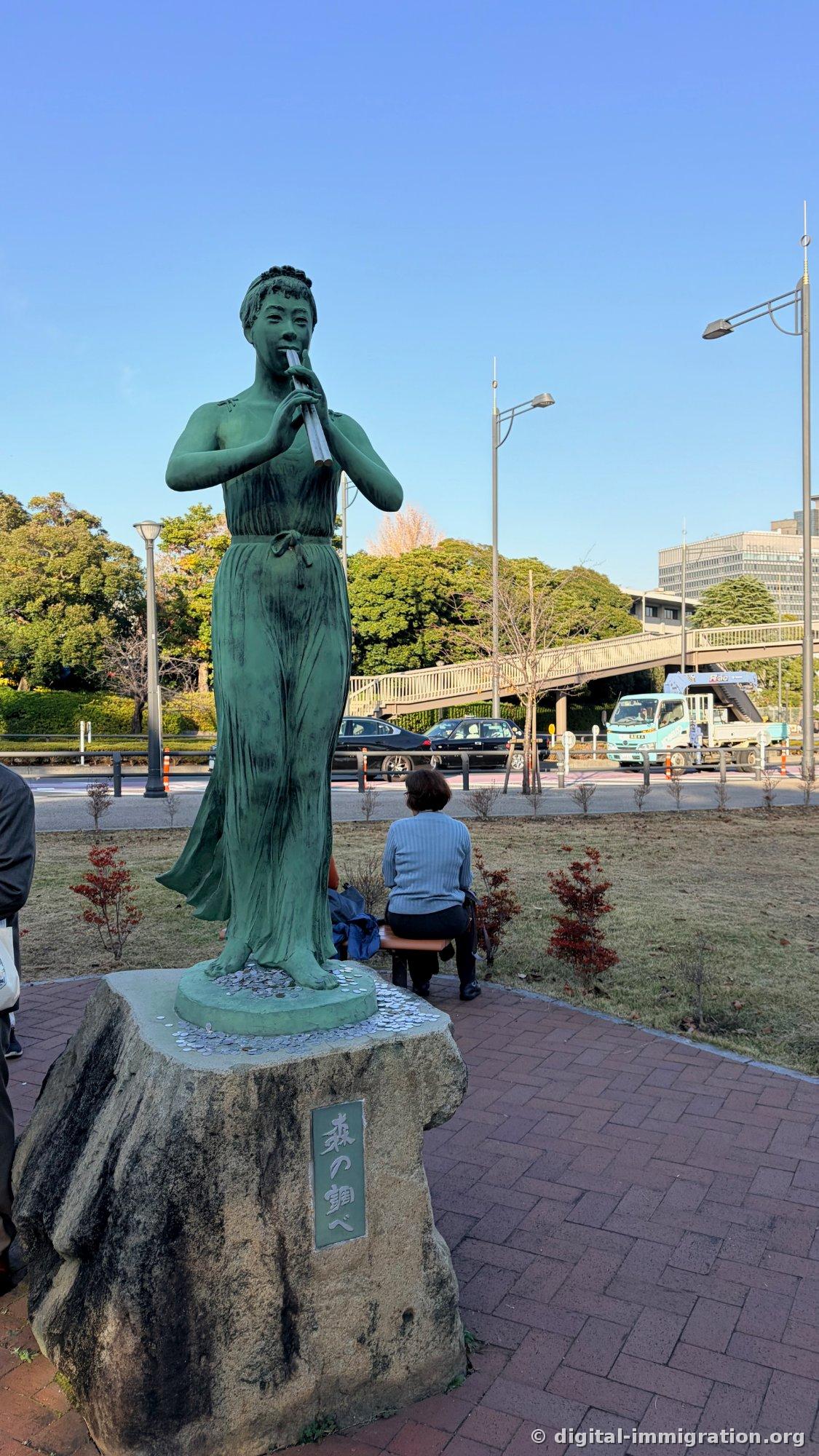
On a grassy bank stands a bronze statue of a woman with a nameplate reading 「森の調べ」. She's in a flute-playing pose, and coins are piled thick at her feet. I'm not sure who started it, but everyone seems to follow suit. There's no explanatory sign, so it's easy to walk right past.
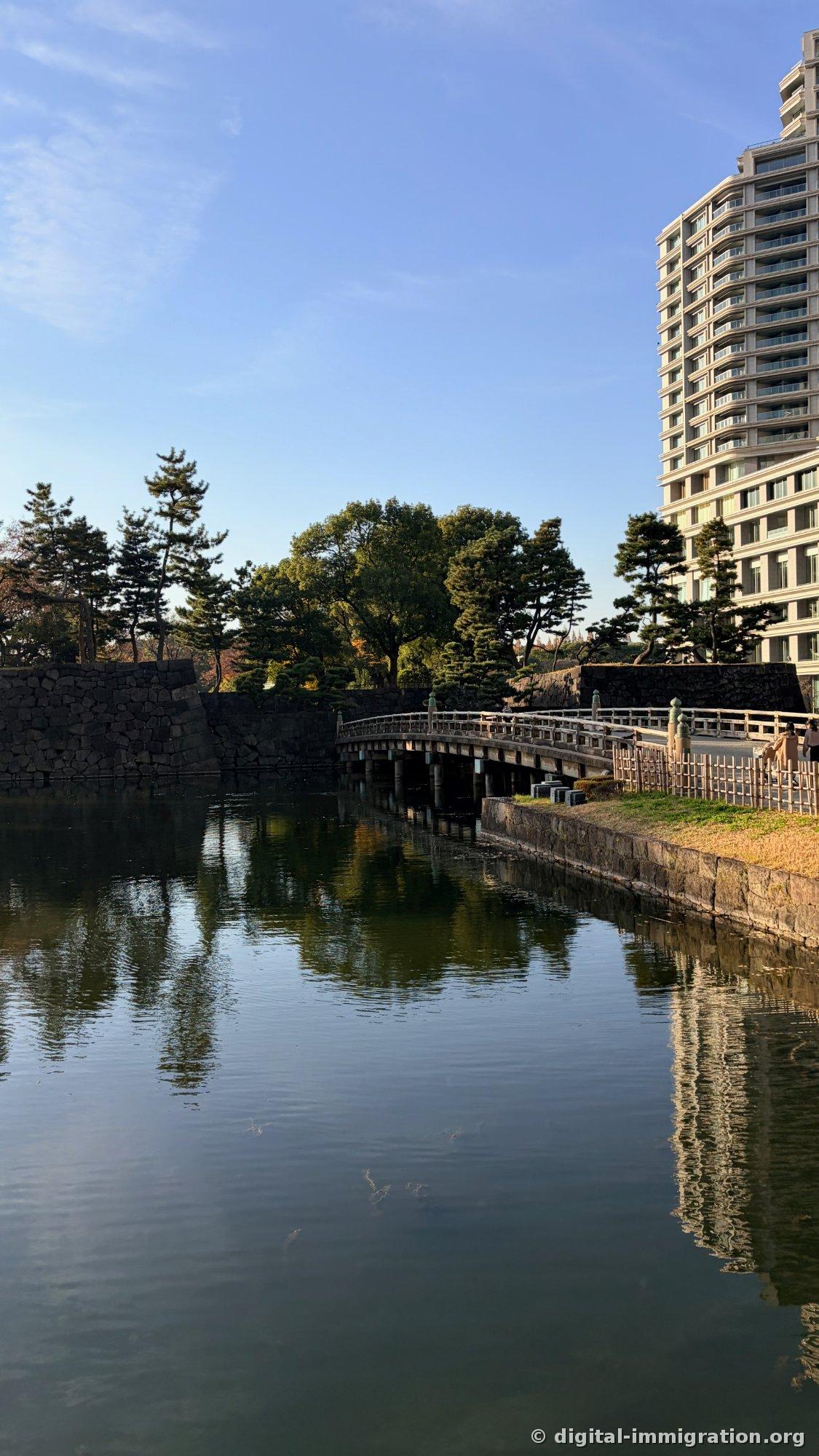
Inside the moat is a wooden arched bridge. It has the old style with bronze fittings on the railings, but directly behind it stands a white modern high-rise apartment, creating an oddly time-blended image. Some might dislike this contrast, but I think it's quintessentially Tokyo.
At Nijubashi—This Is Where Everyone Stops
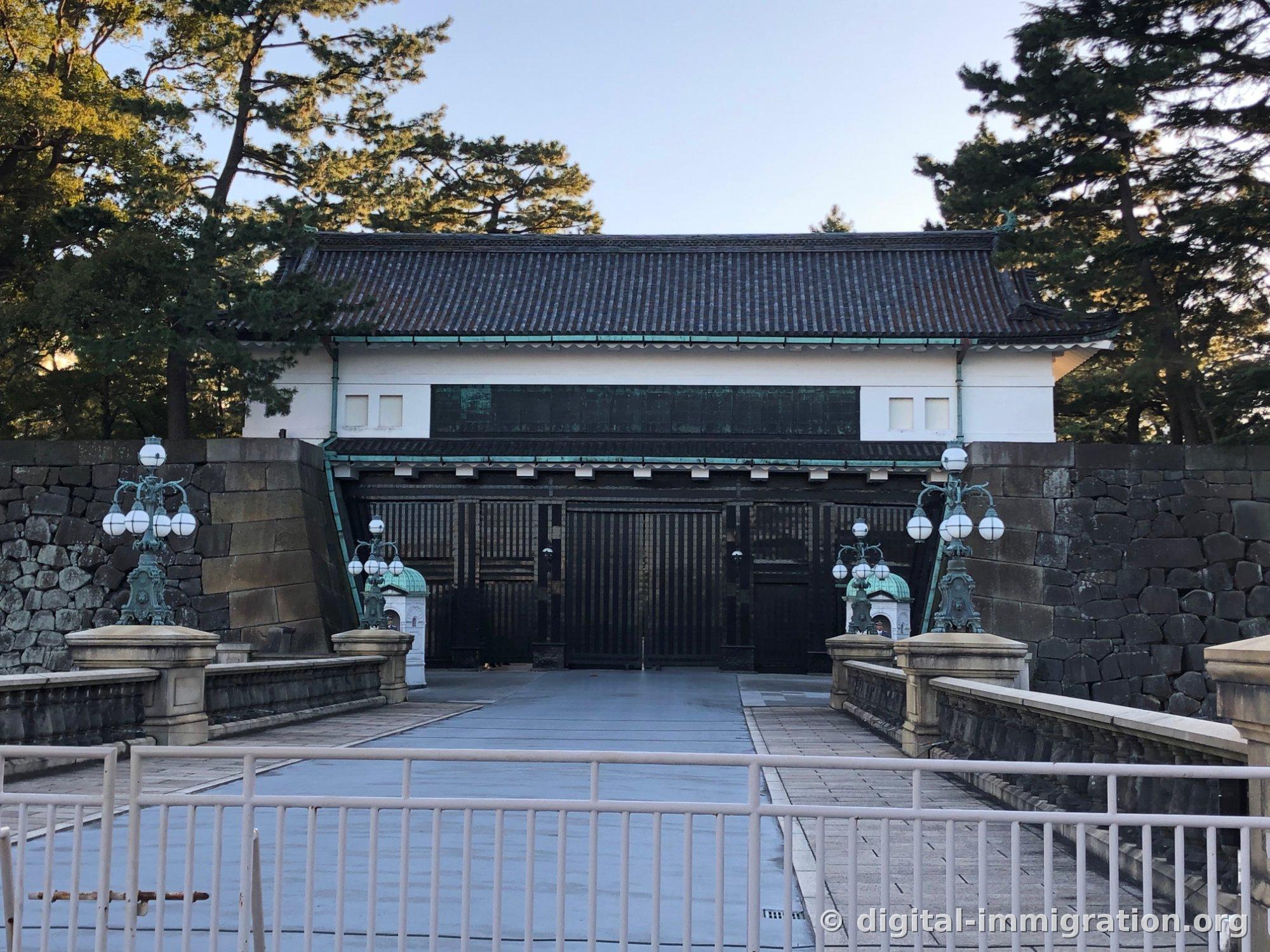
The black main gate that appears after crossing the stone bridge is firmly closed during normal times. A white fence in front prevents even reaching the middle of the bridge. Bronze lampposts stand on either side of the gate, and a guard is visible inside the gatehouse. This is as far as the general public can normally go.
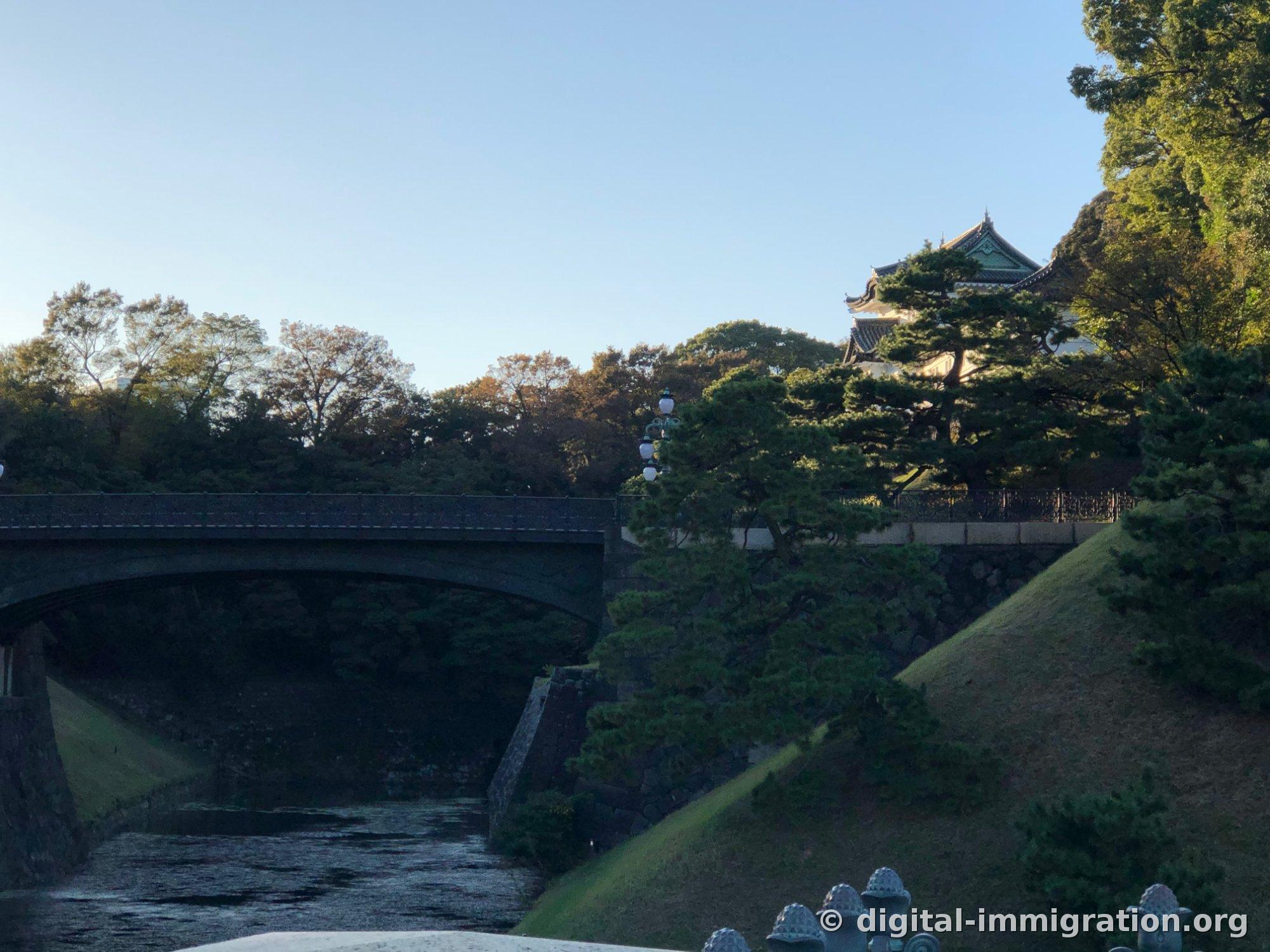
The famous photogenic angle requires moving slightly to the side. The composition shows the Fushimi Yagura watchtower roof peeking over the hill beyond the arched steel bridge, but trees have grown enough that the watchtower appears smaller than expected. It's better to keep your expectations modest.
Fortunate Timing—A Public Opening, Complete With Baggage Inspection
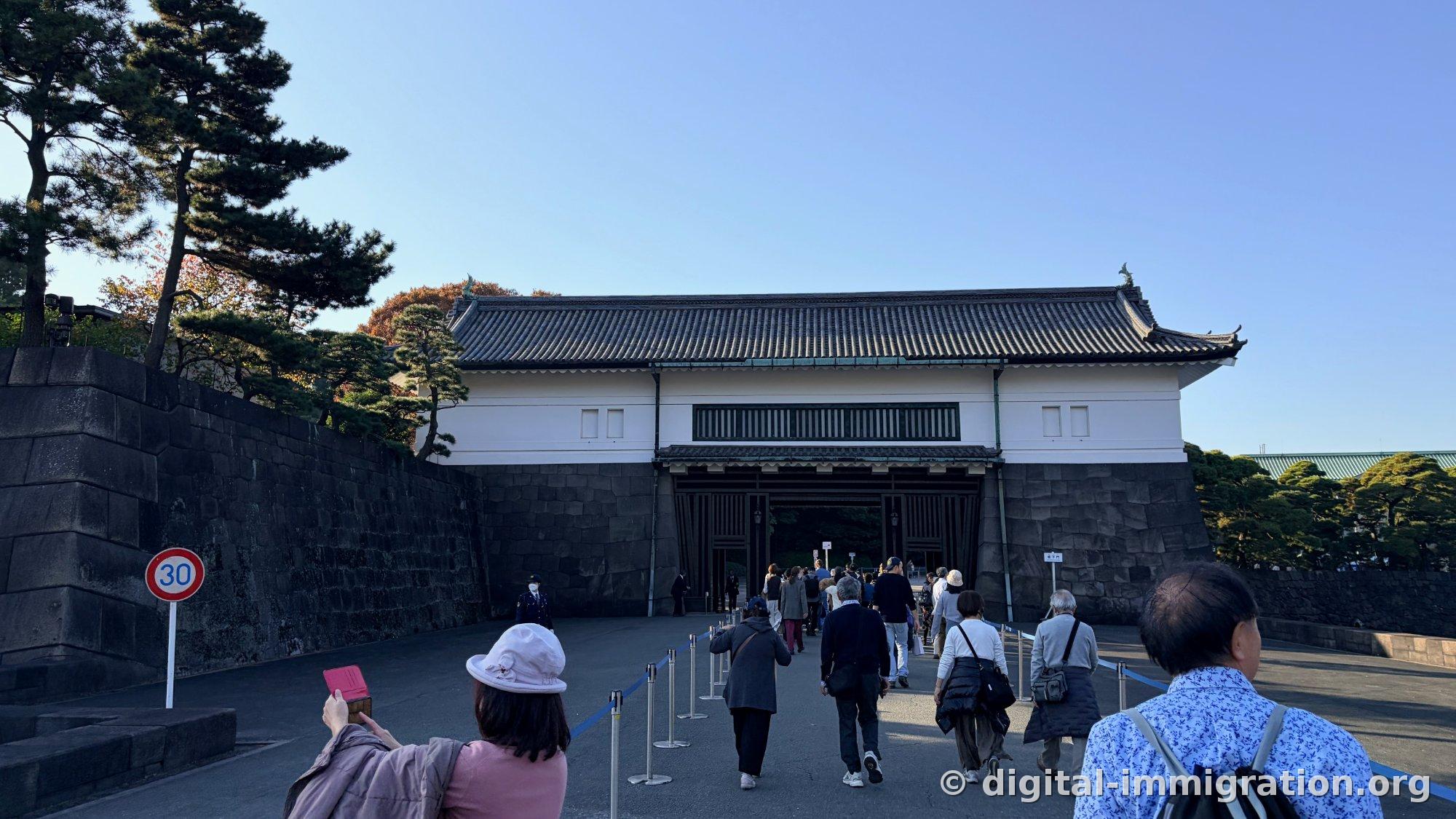
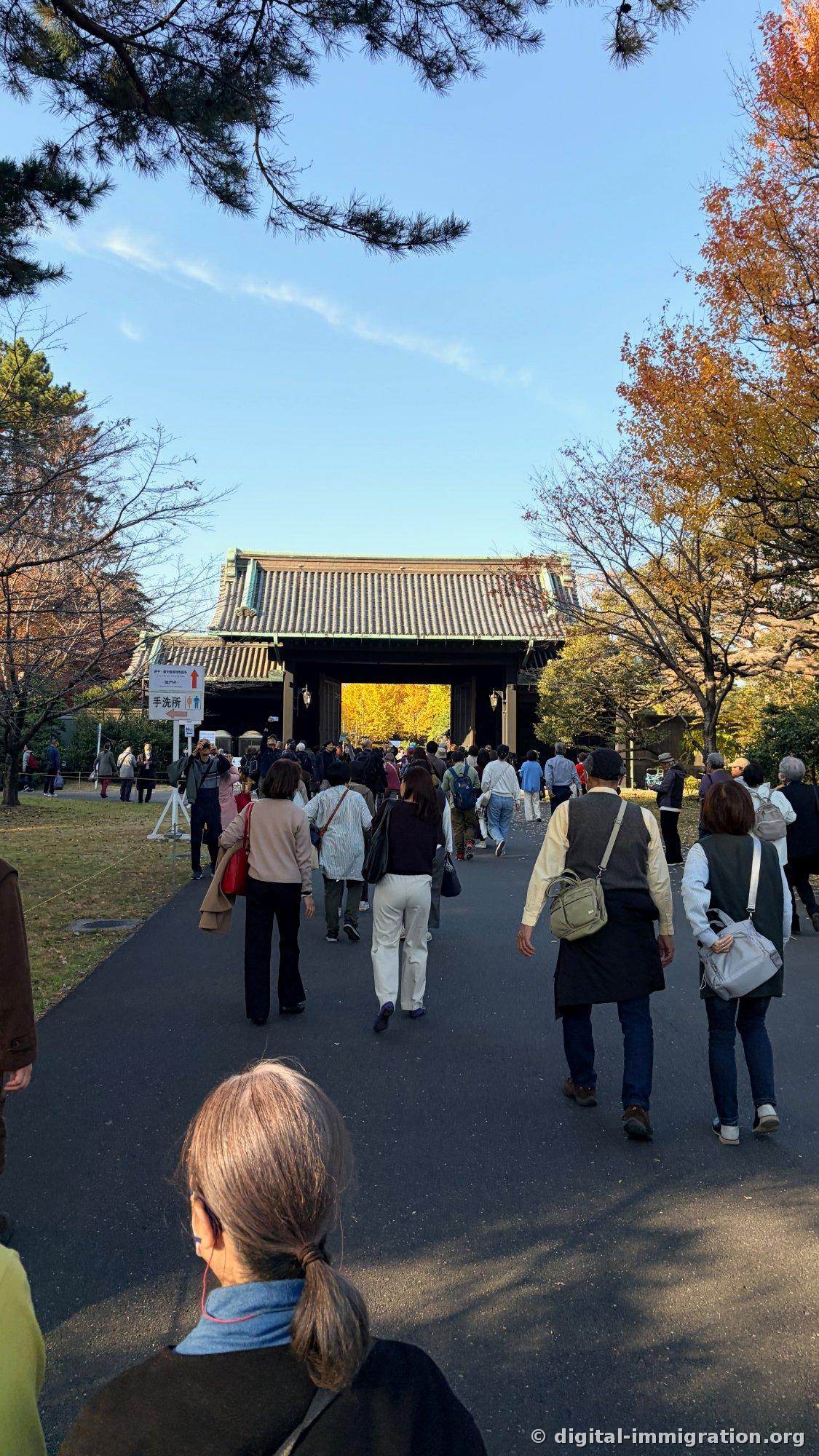
I noticed people continuously flowing in one direction and decided to follow. Blue ropes were set up to direct foot traffic, and security guards in uniforms were dividing visitors into groups. The speed-limit sign still stands on the road—this is normally a thoroughfare for vehicles.
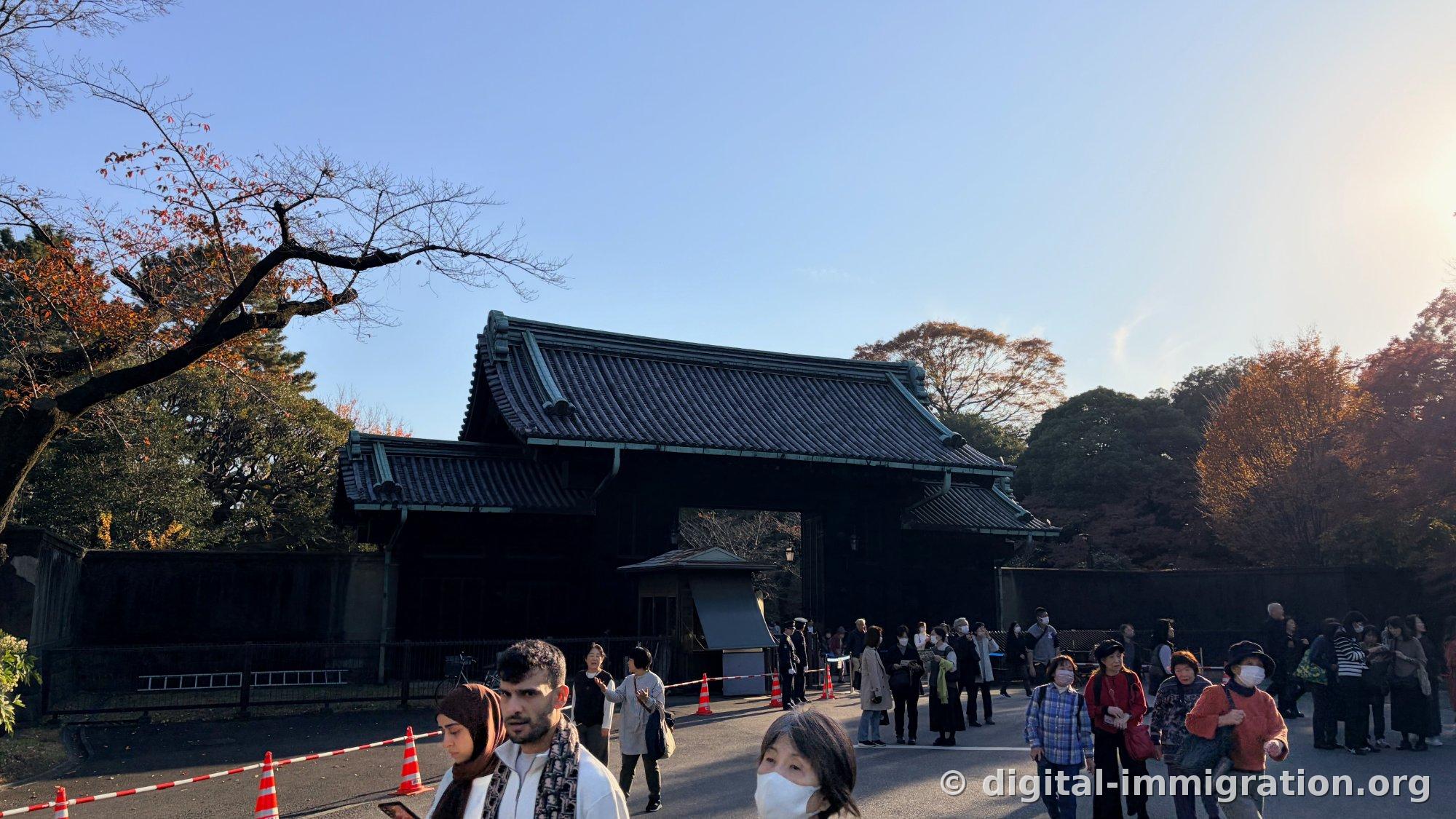
Proceeding deeper, a large gate with a steeply curved roof appears. The road in front is cordoned off with barrier cones and red tape, and police are managing the crowd. This section gets the most congestion, so movement slowed frequently.
Following the ropes, several white tents stand in front of a stone government building with a green roof. This is where you have to open your bag and show what's inside. Lines are separated by gender, backpacks require full zipper opening to show contents, and a light body check is conducted. At first I was annoyed about photos, but thinking about where we were going, it's a natural procedure. In fact, I was surprised they let us through with just this level of screening. From waiting to passing through took less than 10 minutes, and water bottles were allowed through. I saw a few people stopped for umbrellas or tripods, so it's best to travel light.
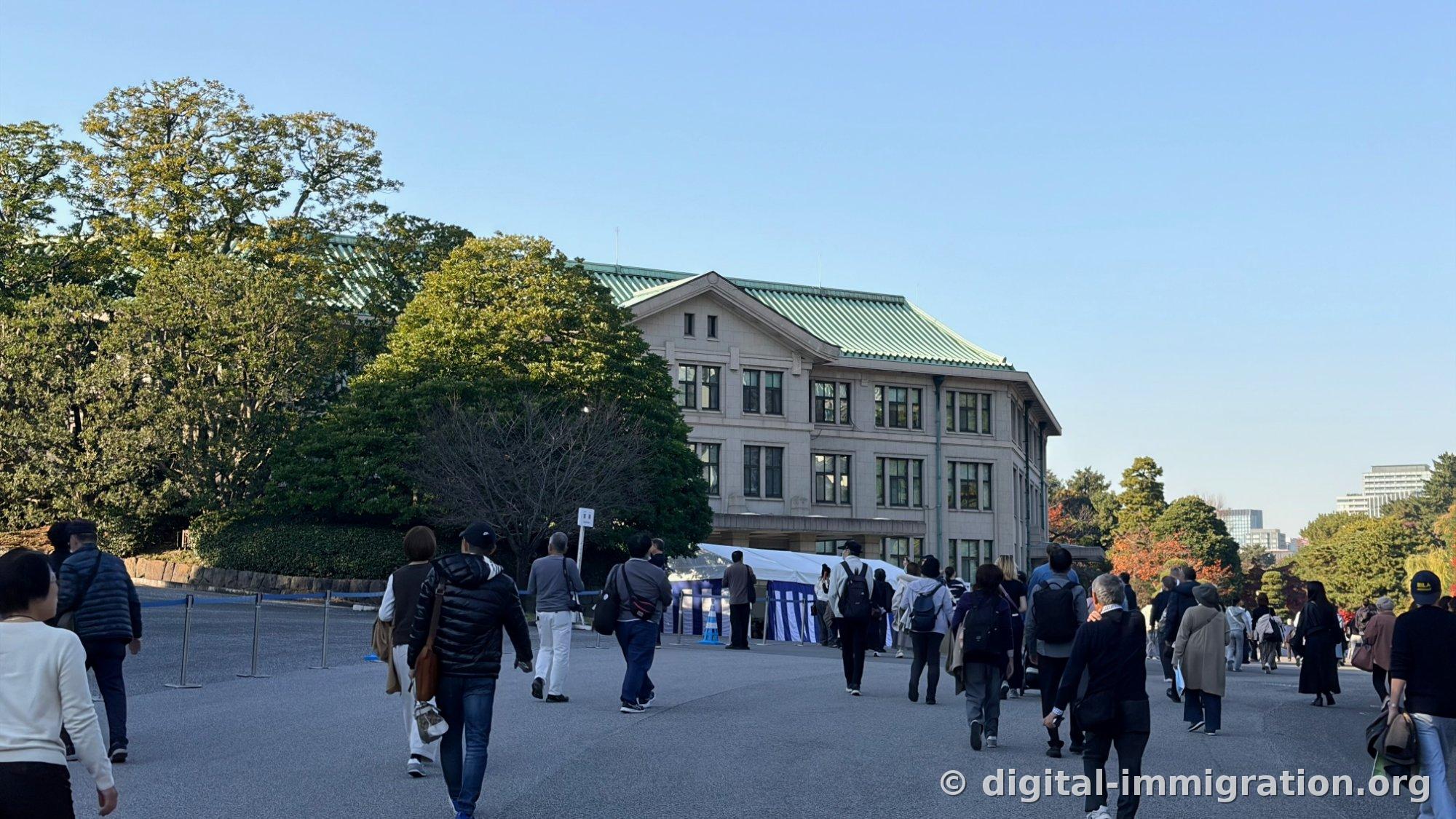
After clearing screening, a wide path continues ahead. People continuously fill the space before and behind, so solo photography without crowds isn't possible. To get empty-space shots, you'd need to time it for early morning right after opening.
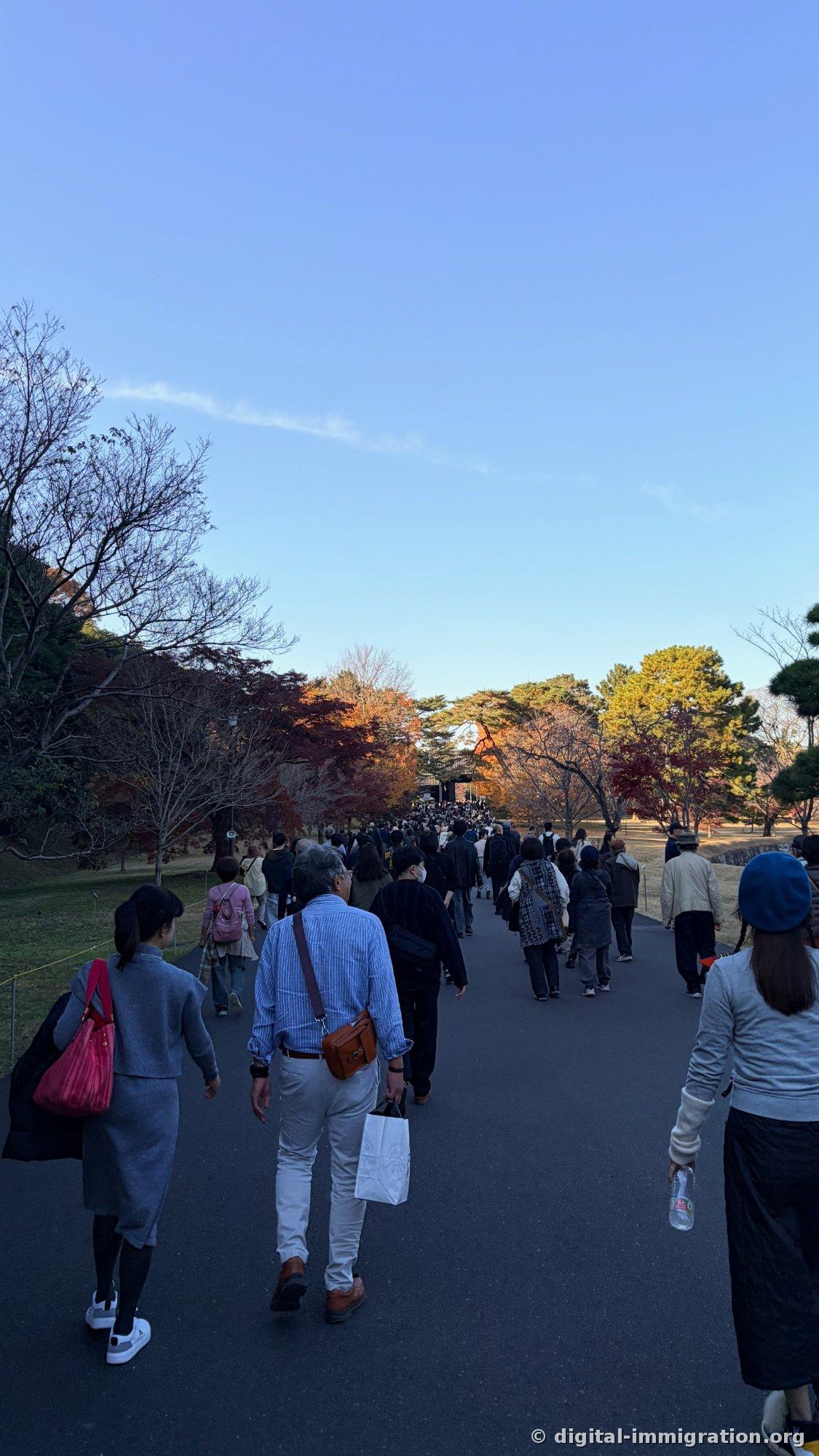
Inside the Compound Walls
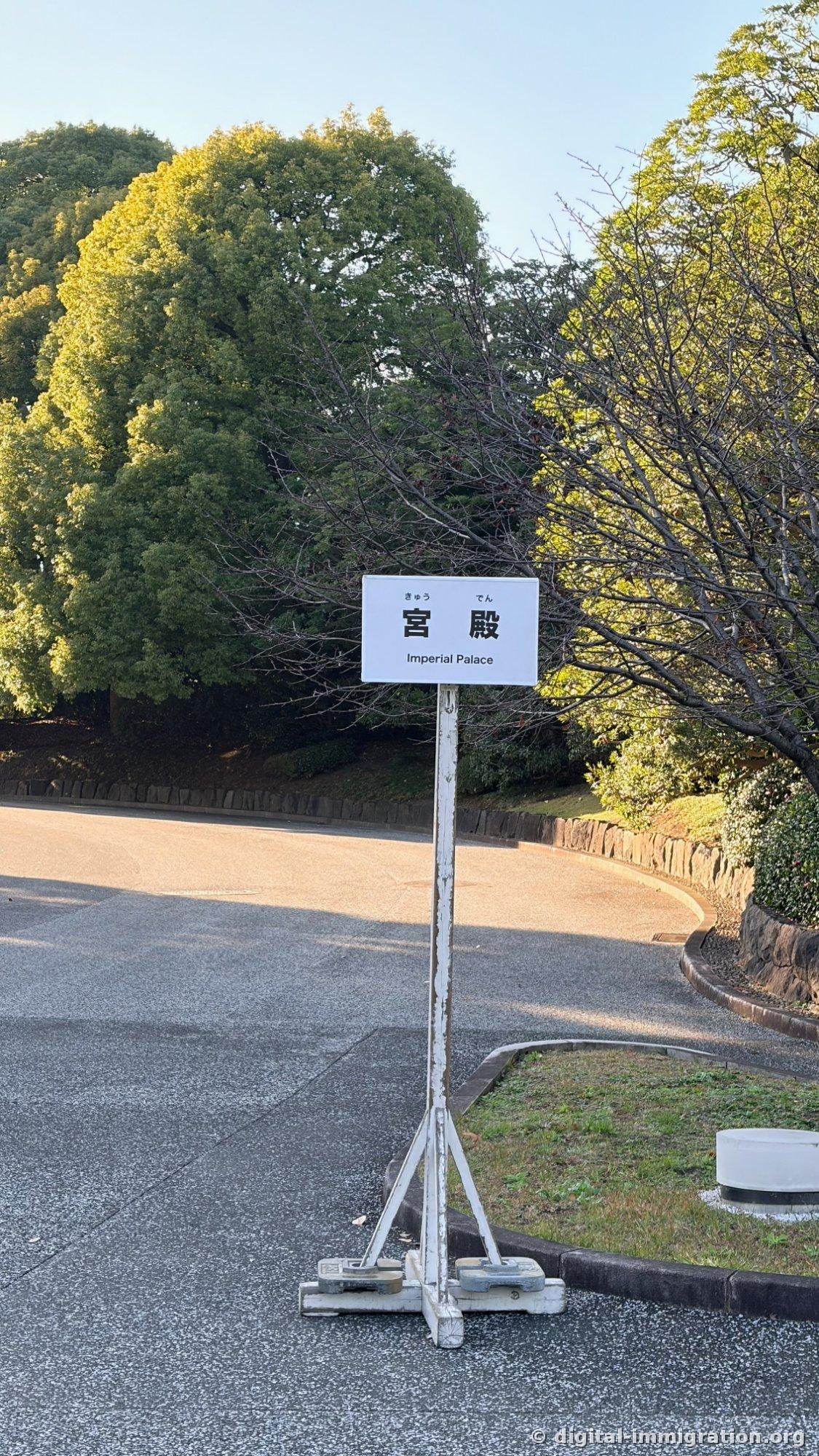
A white sign stands at a fork in the path. 宮殿(きゅうでん) / Imperial Palace. No arrows, no explanation—just this single word. Rather than a tourist sign, it has the simple quality of an operational marker.
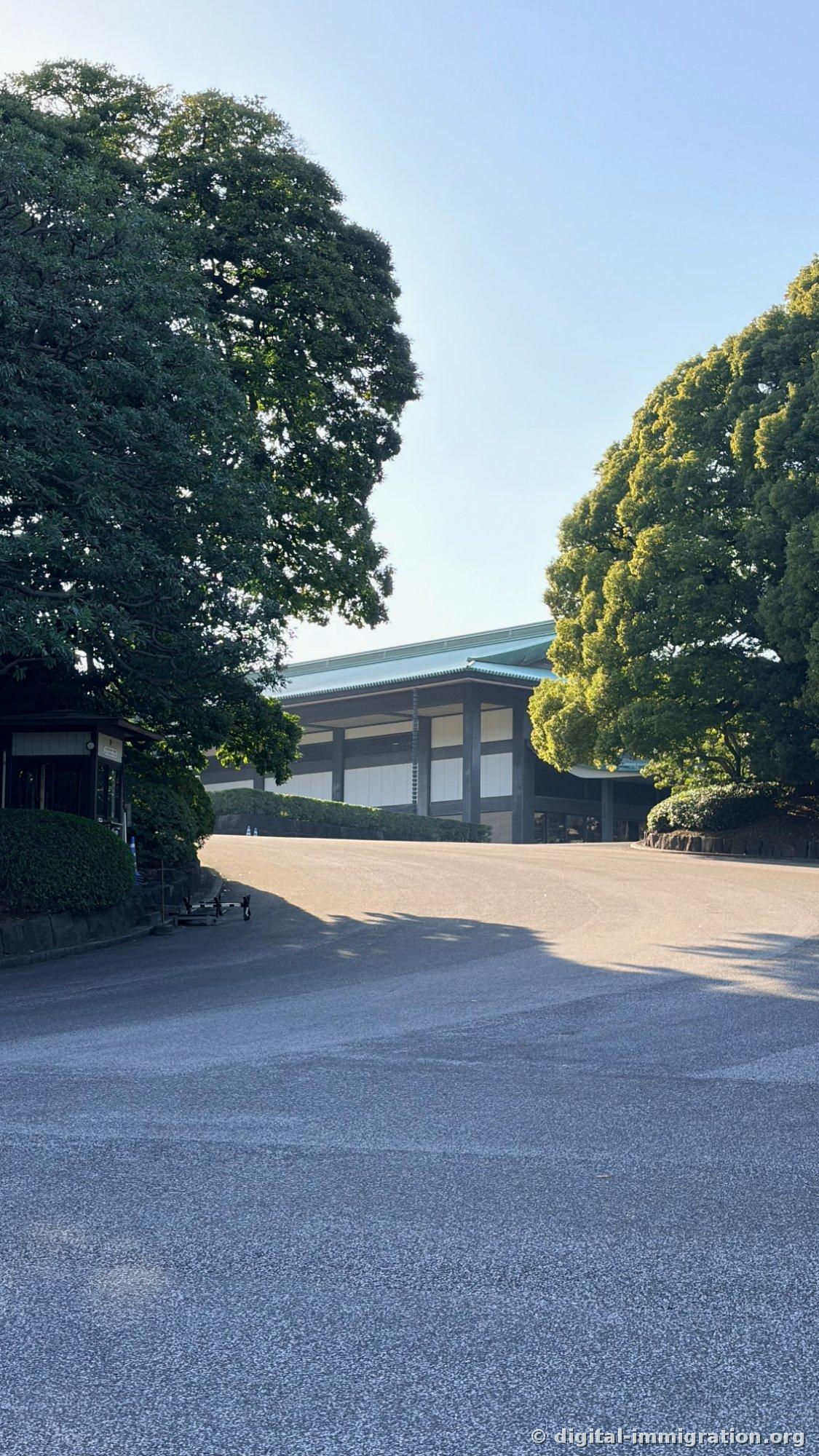
Following the sign's direction, the green roof of a low, long building appears through the trees. It's modern architecture with deep eaves and thick columns, but the asphalt forecourt is remarkably clean. You can't go further in this direction, so this was the closest view available.
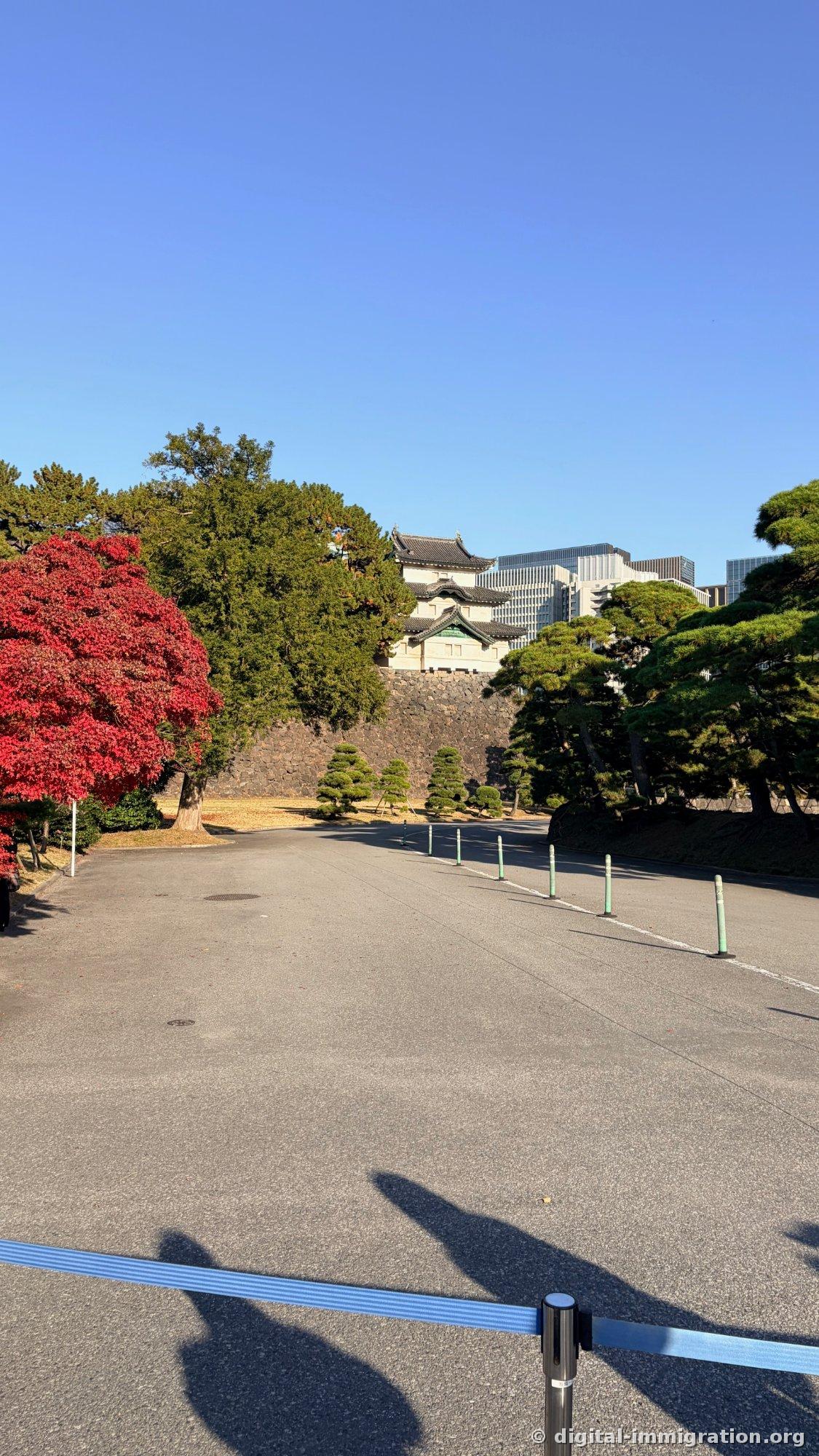
On the opposite side of the path, a white-walled watchtower stands behind red autumn maples. A blue rope strung at the bottom indicates you can't proceed further. The composition of maples, watchtower, and the building behind it in a single frame won't be visible except during these few days.
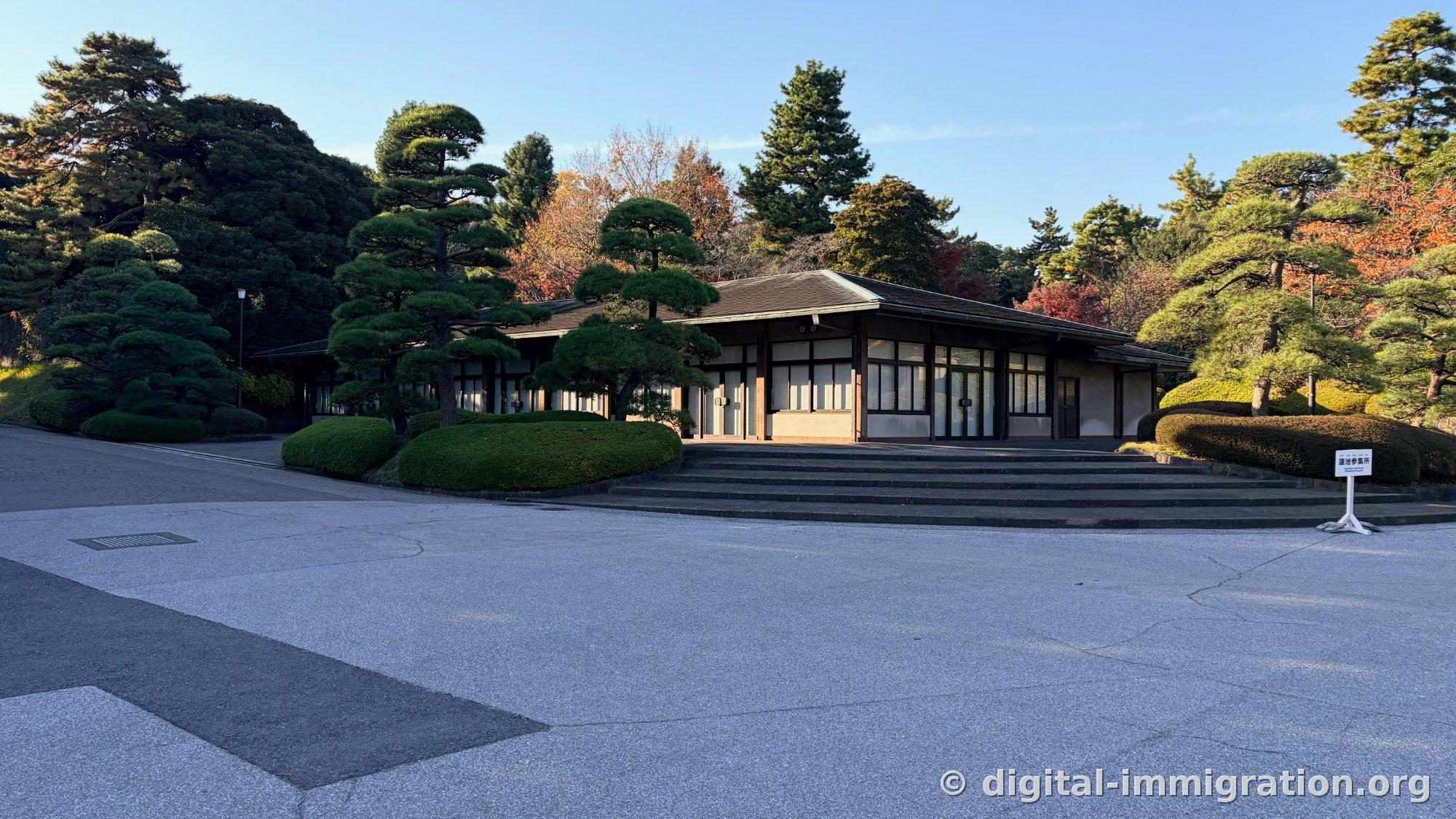
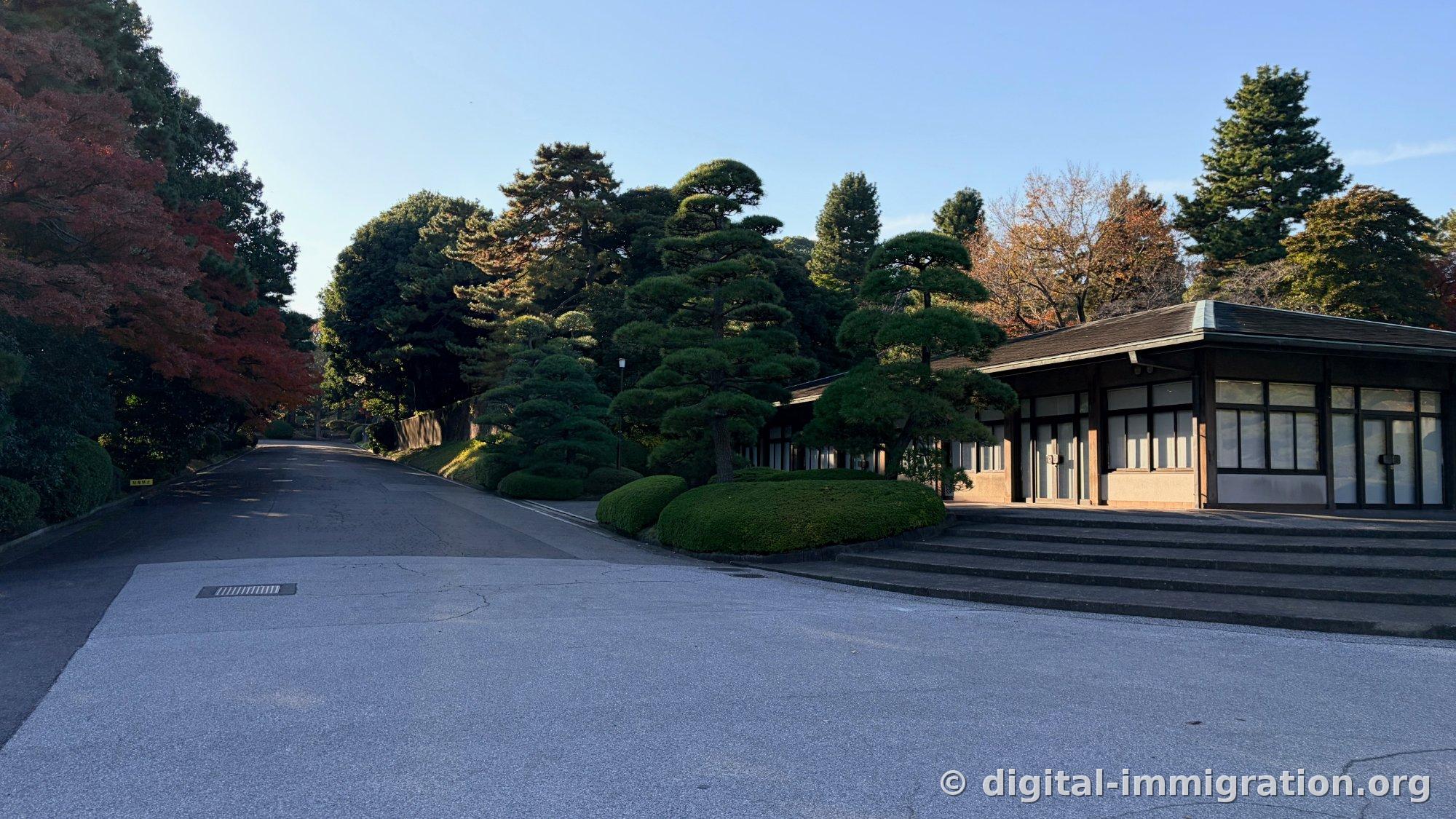
Walking a bit further, a single-story wooden building appears inside a wide rotary. A small sign reading 「蓮池参集所」stood in front. The landscaping of pines was remarkable enough to stop and stare. Rounded juniper shrubs and layered pines frame the steps leading up to the building in perfect symmetry.
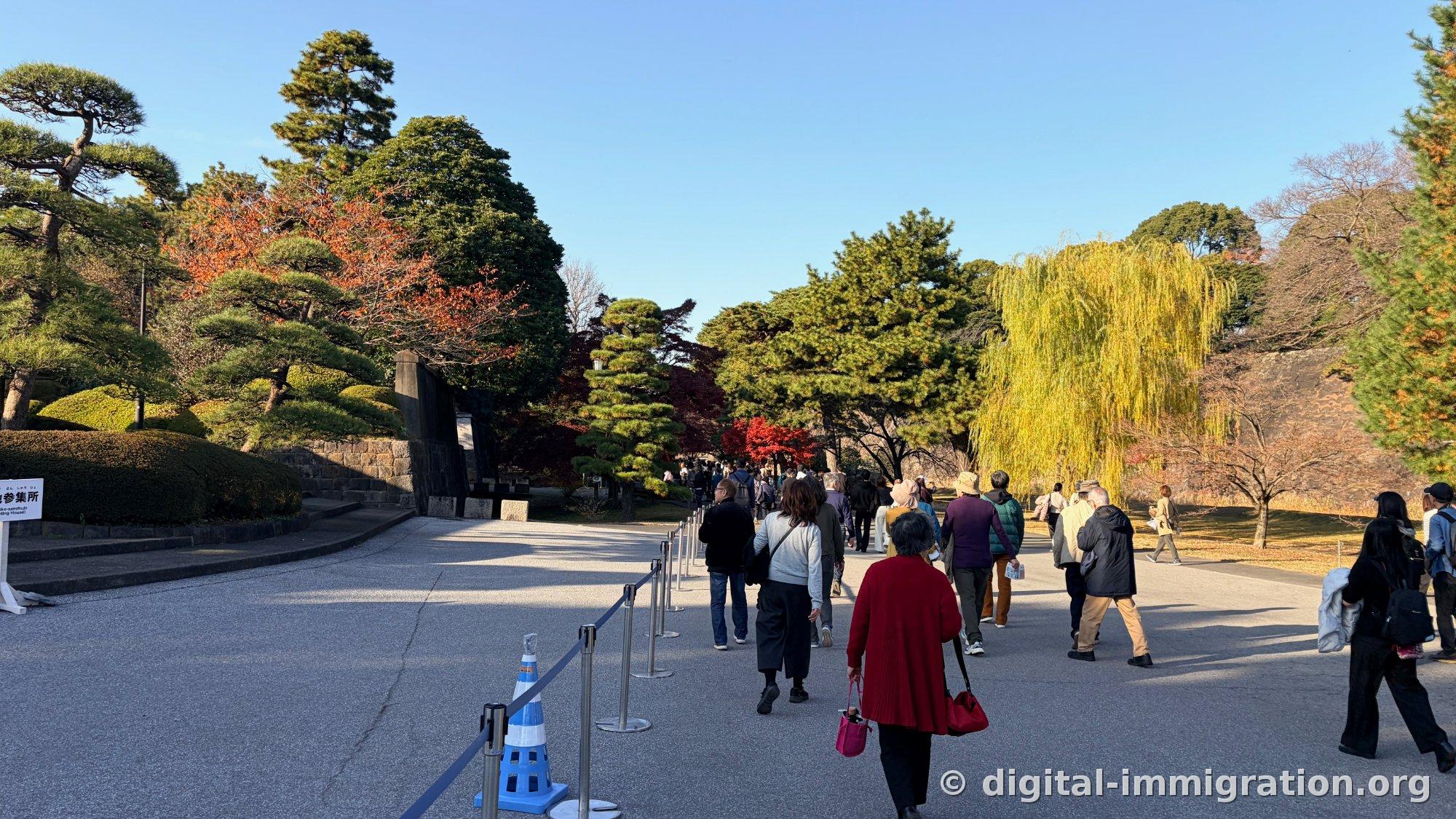
Visitors continue flowing past the sign in front of the building. A large weeping willow hangs bright yellow, making this section particularly luminous. The grass on the left has already turned winter brown, so yellow and brown mingle.
A black wooden gate stands along the path. The sign in front reads 局門(つぼねもん). Metal fittings and tile patterns remain intact on the gate panels, but you get the sense it will never actually open. A "No Entry" sign is attached beside it.
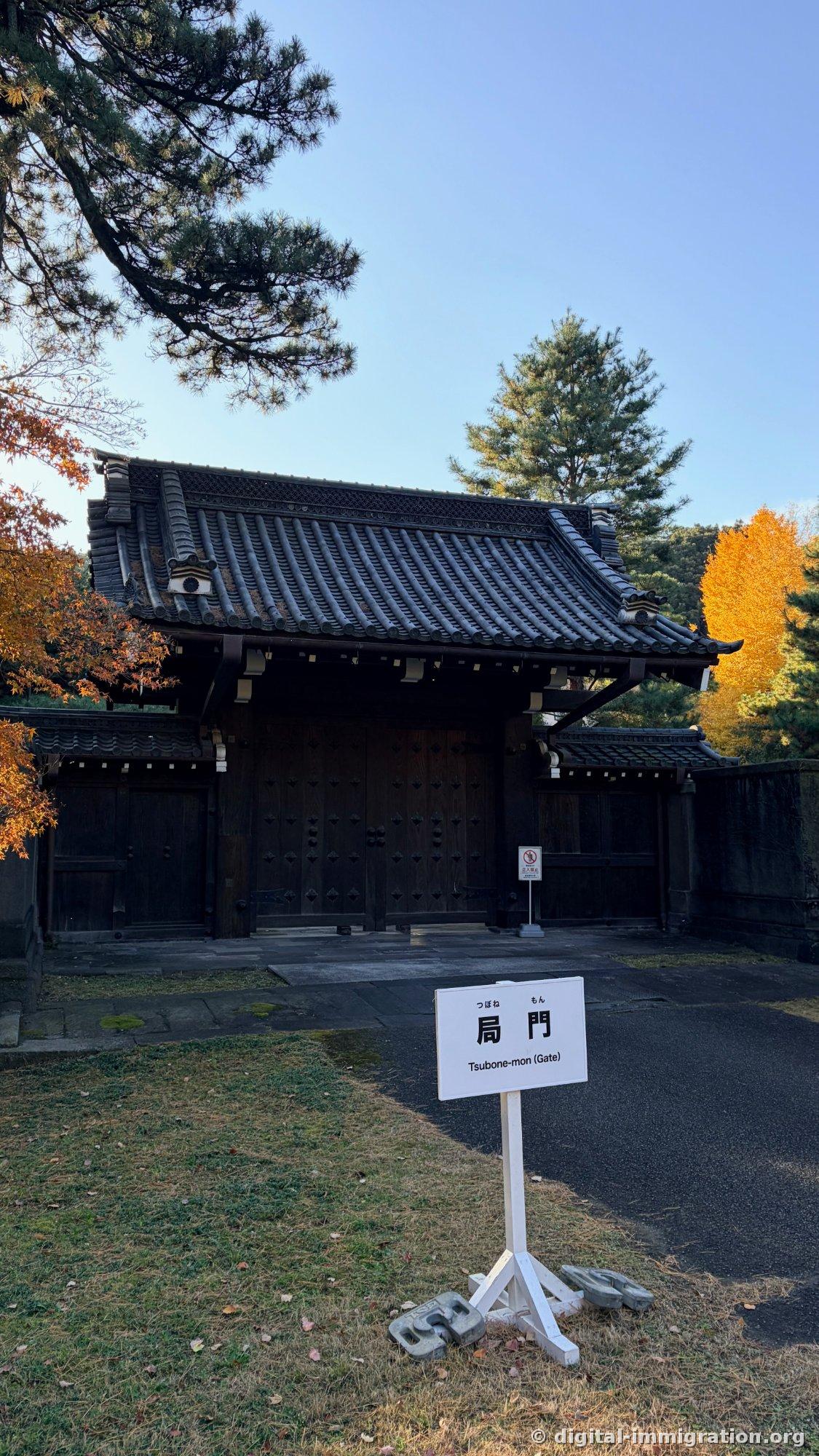
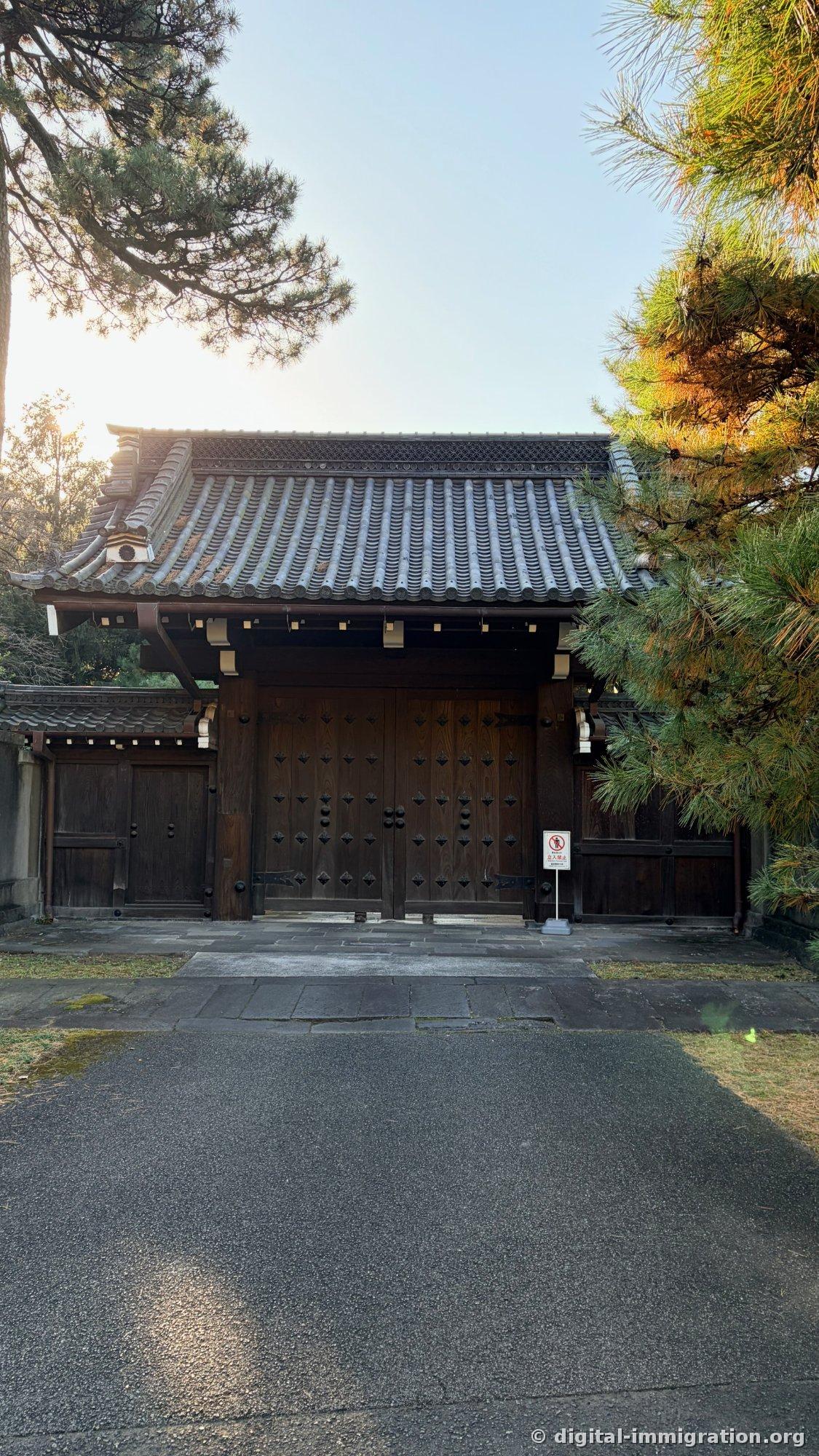
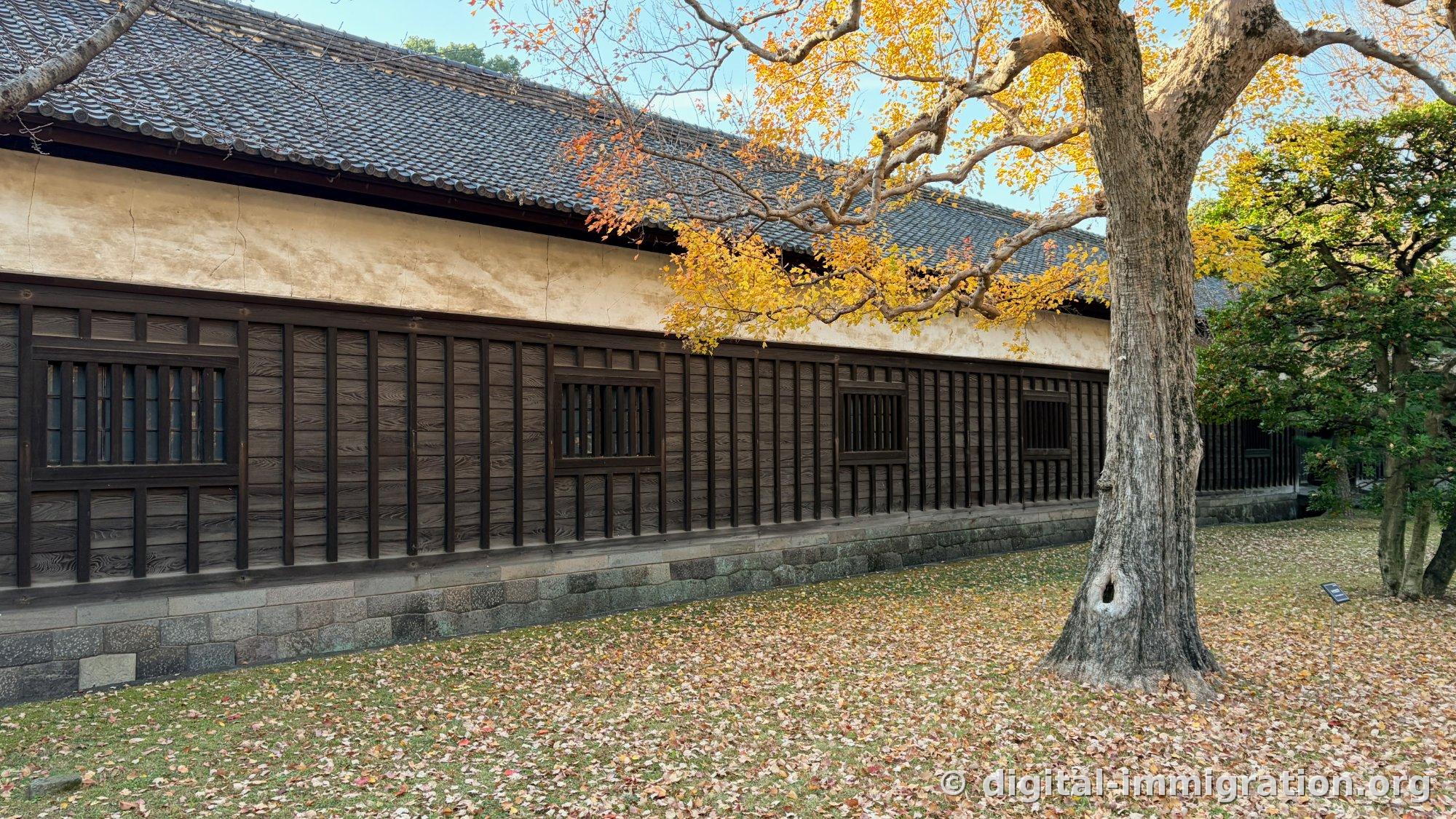
Beyond the gate, a long building with tightly packed wooden lattice continues. Below are finished stones, above earth walls with wooden lattice. In front of it on the grass sits a large ginkgo tree that has shed nearly all its leaves, completely carpeting the ground in yellow. It crackled underfoot.
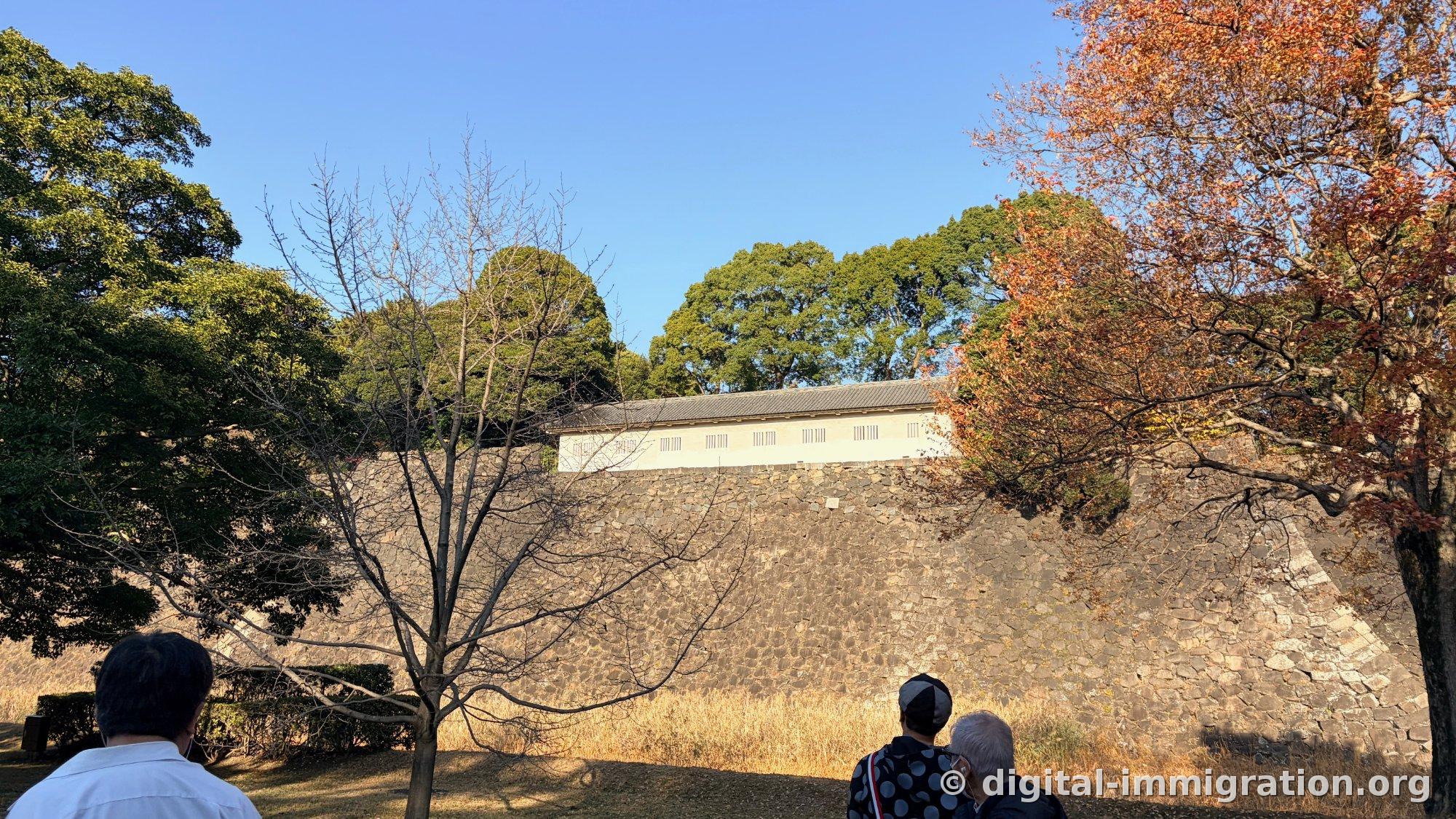
Along a massive stone foundation rises a white-plastered building. The gun emplacements remain visible. An elderly couple standing in front looked up at it for a long time, talking, and I found myself doing the same, neck aching.
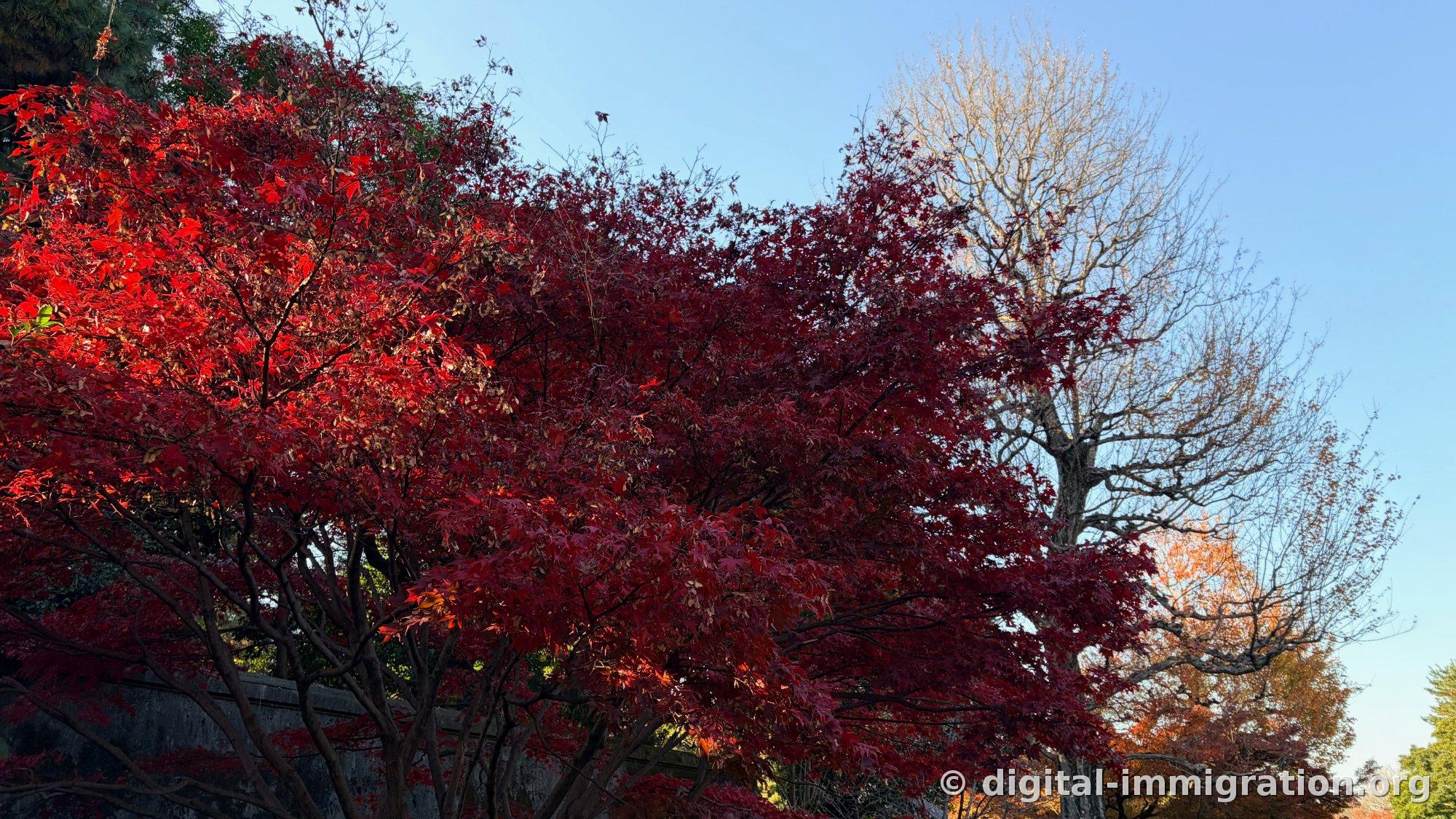
Autumn color varied from tree to tree. This one had bright orange at the bottom while already turning deep red at the top. The sky was so blue that the colors appeared even more vivid.
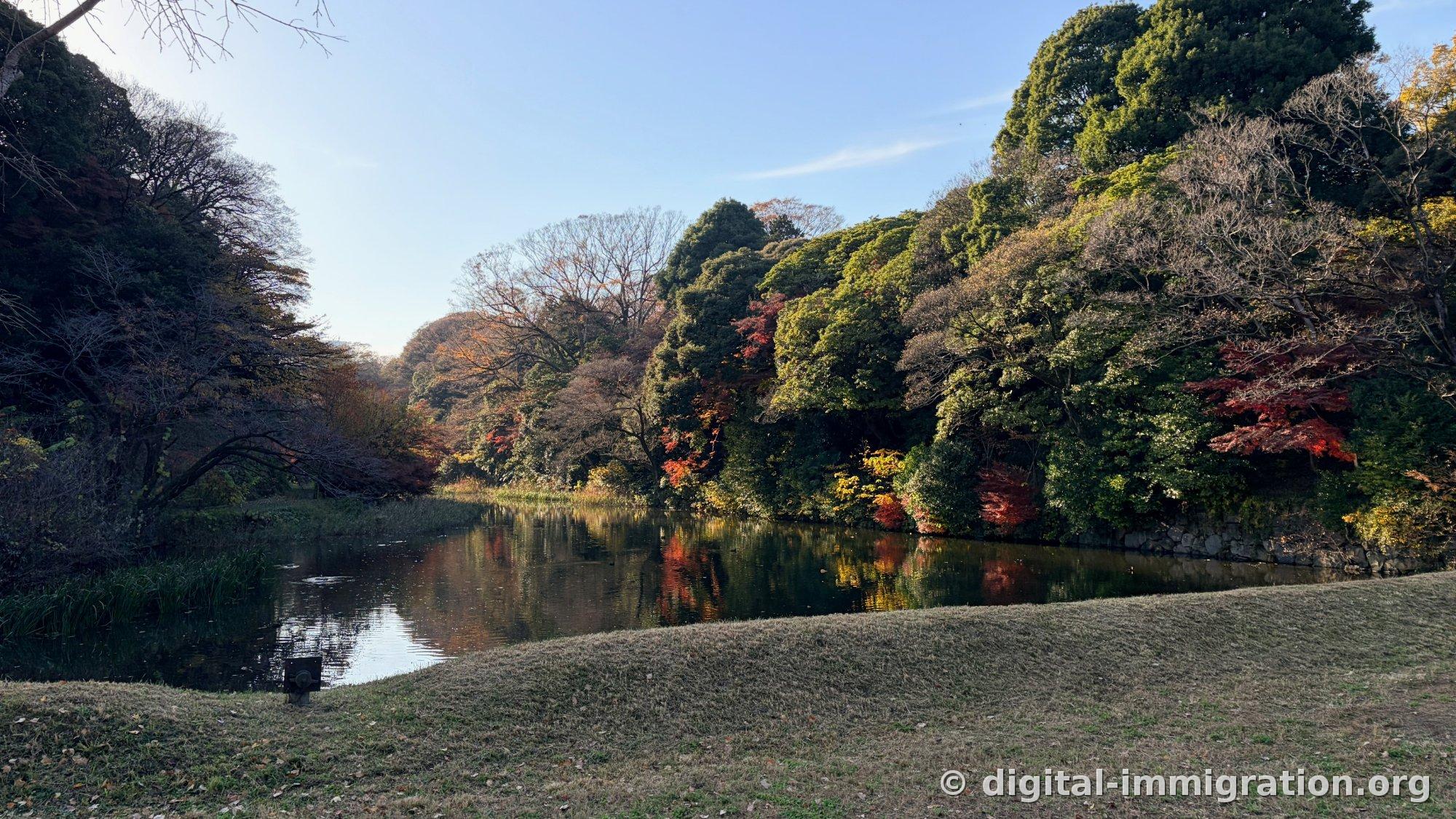
At a bend in the path, a pond appears. Reeds line the water's edge, and the opposite hillside—green, orange, and red mixed together—reflects perfectly in the water. Inside here, city noise is almost entirely absent. Only then did I realize how strange it is to hear no traffic sounds in central Tokyo.
Through gaps in the trees, the moat and stone walls overlap. The water appears a murky ochre as afternoon light hits it, though this isn't actual water quality but rather bottom reflection. You're not allowed to cross the railing.
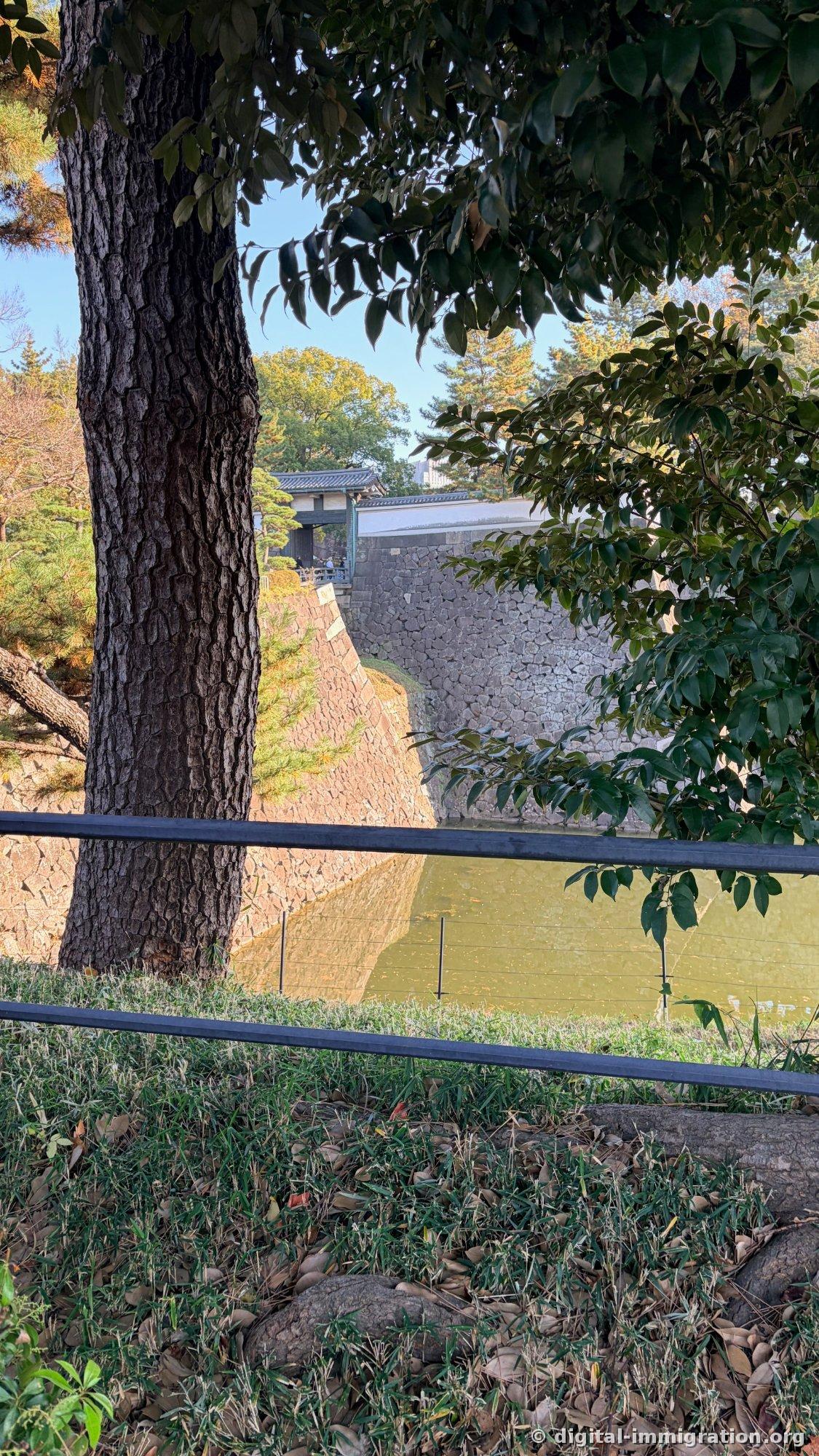
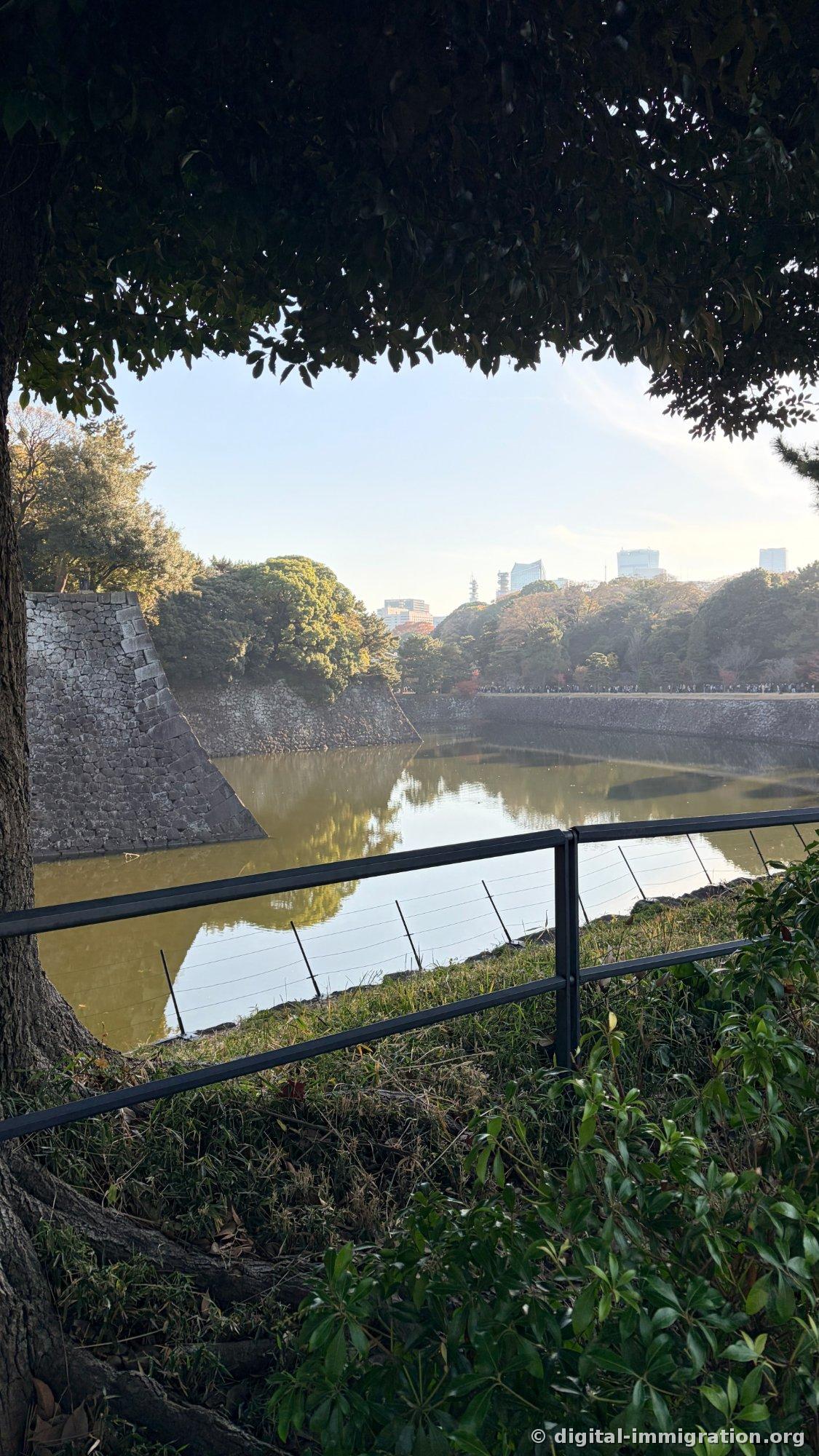
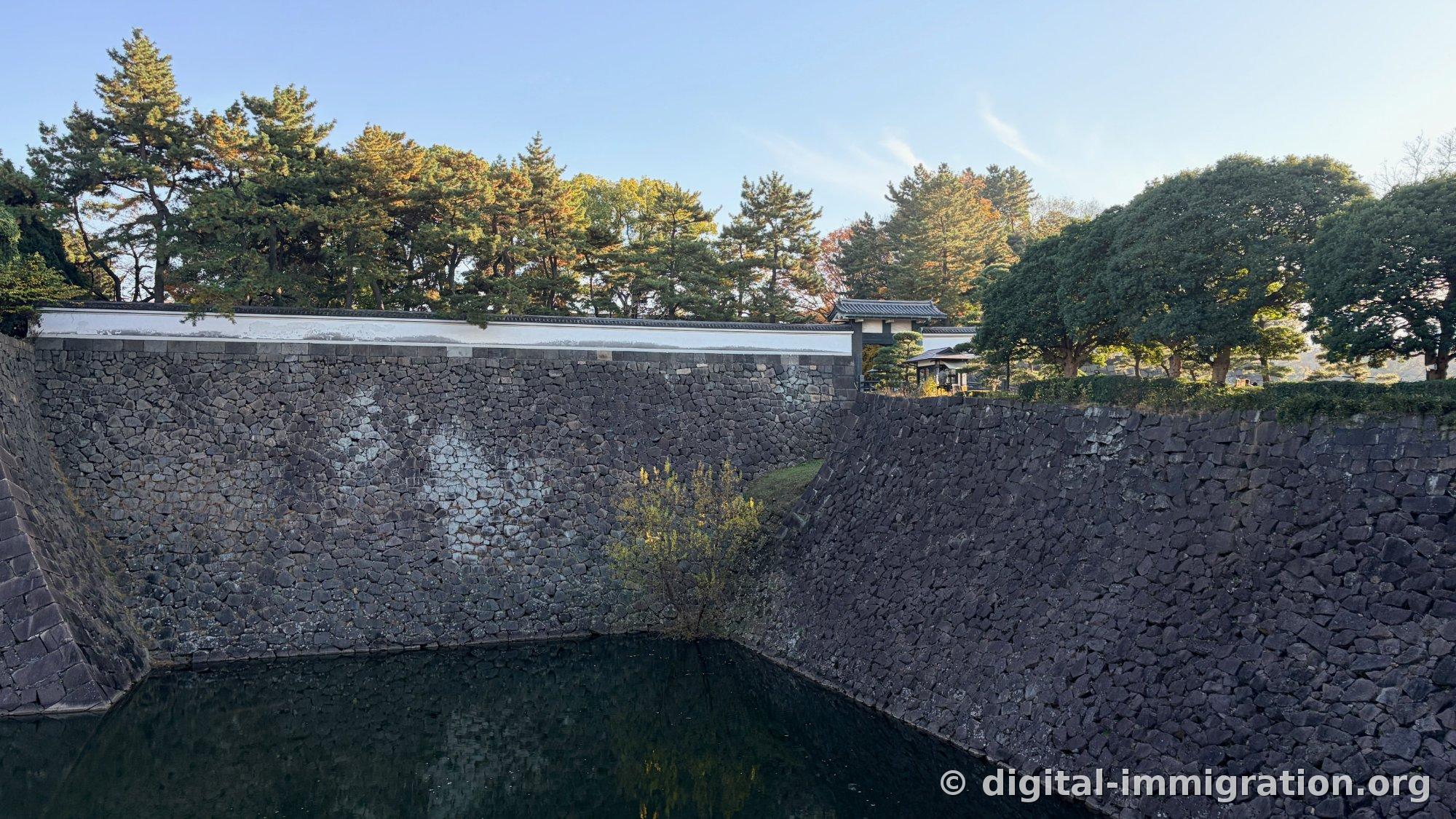
Most striking was where the stone walls meet the white plaster walls. The lower stones are dark and rough, the upper plaster pure white—the line cut as sharp as a knife. A small tile roof tops the plaster wall's end, and the water below barely stirs.
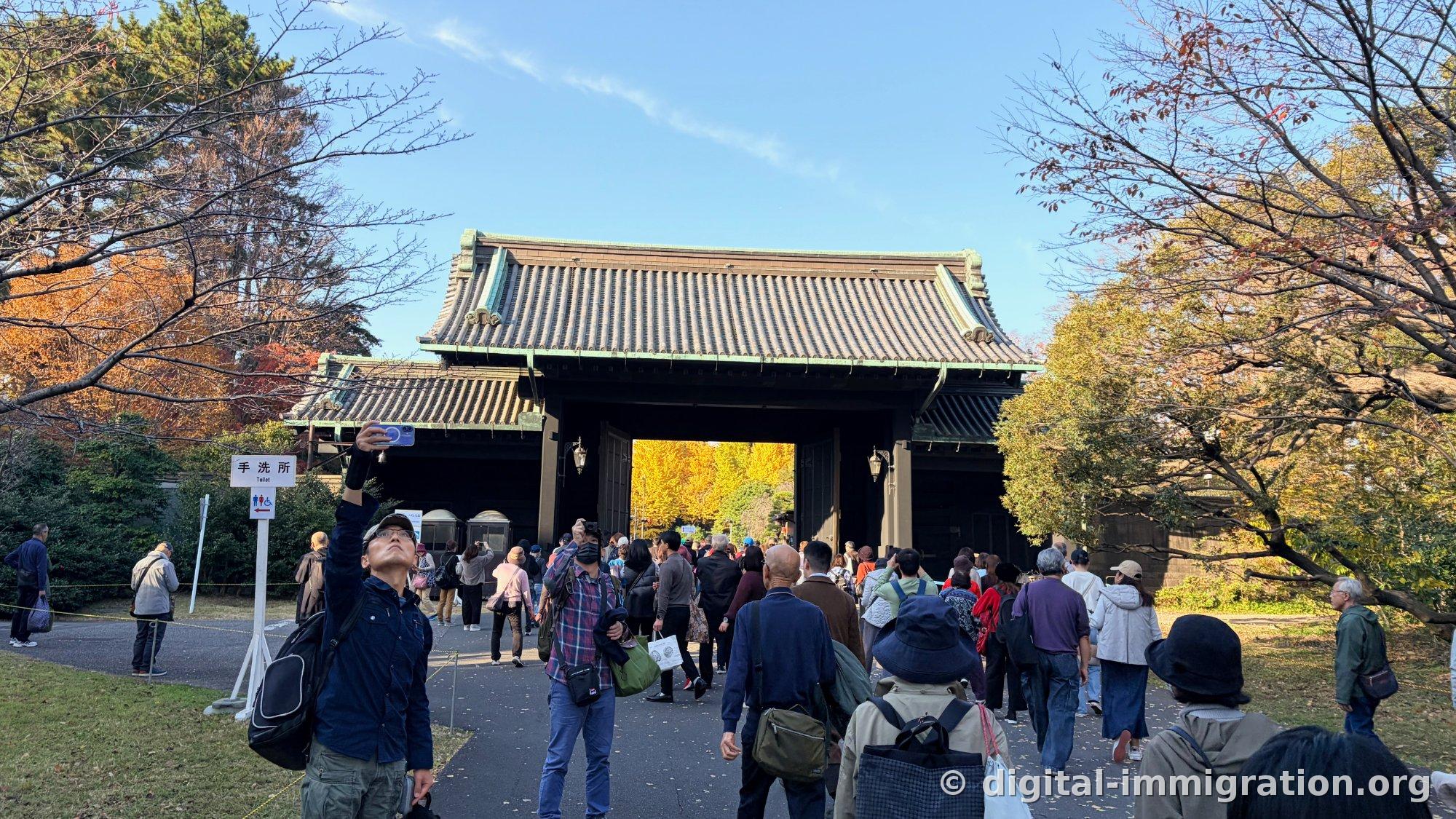
The highlight of this route was passing through the final gate. Through the gate's arch, the yellow ginkgo tree is framed like a painting. Everyone stops in front to take photos, creating a bottleneck. I was no exception. The 「手洗所」(Toilet) arrow is posted nearby, so this is a good place to handle that.
Good to Know Before You Go
- Interior path openings are seasonal, not year-round—spring and fall only on specific dates. Dates change yearly, so check the Imperial Household Agency announcement for current dates. I happened to luck into it.
- No admission fee. No advance registration either—just line up for baggage screening and enter.
- Baggage screening requires opening your bag to show contents. Large backpacks, tripods, and umbrellas take longer. Travel light.
- The route is one-way with no backtracking. To revisit a spot, you'd have to exit and make a large detour.
- About 10 minutes' walk from Tokyo Station Marunouchi Central Exit. Closest subway: Nijubashimae or Sakuradamon stations.
- No shops inside. Bring water, and grab lunch afterward at the Marunouchi Underground Mall shops.
- Toilet access is posted near the end. Expect almost none during earlier sections.
If I'd only seen Nijubashi from outside the walls and left, it would have been a day of "saw the castle plaza once." But ten minutes inside after screening changed everything—even the sounds were different. Next time I come to Tokyo, I'll plan to time my visit with the open dates.
Читайте дальше
- From Akihabara's Chuo-dori to the Kanda River: A Record of Tokyo's Electronics District Revisited Multiple Times
Tokyo's Akihabara is a neighborhood where it's hard to say you've seen everything in a single visit. I've come multiple times across different seasons, and each time the signs chan…
Токио · Акихабара - Buying a Single ¥300 Year-End Jumbo Lottery Ticket at Nishi-Ginza Chance Center in Tokyo
Exit from the Hibiya exit of Tokyo's Shimbashi Station, walk toward the elevated highway for about three minutes, and suddenly you'll see a line of people stretching along the side…
Токио · Нишигинза Центр Шансов - Ueno Ameyoko, the real magic starts after sunset — an evening walk from the Okachimachi Gate to Ueno Station
Every time I come to Tokyo, my feet find their way to Ueno Ameyoko (アメ横) without fail. This time I entered from the Okachimachi side and worked my way toward Ueno Station. I've met…
Токио · Амэёко рынок