Antalya Mevlevihane: The Sufi Lodge at the End of Kaleici Alley, Guarded by a Cat
Walking through Kaleici, the old city of Antalya in Turkey, you'll reach a point where the tourist trail suddenly ends. Rather than descending the stairs toward the harbor, venture…
Antalya · Antalya Mevlevihane
Walking through Kaleici, the old city of Antalya in Turkey, you'll reach a point where the tourist trail suddenly ends. Rather than descending the stairs toward the harbor, venture one more block deeper into the side alleys and you'll encounter a low stone wall and a wooden door. This is the Antalya Mevlevihane (Antalya Mevlevihane Müzesi), labeled on English signage as The Mawlawi Museum of Antalya. The Mevlevi are a Sufi order following the teachings of Jalal ad-Din Rumi, and a Mevlevihane is a building where they gathered for spiritual practice. In other words, this is not a museum built for exhibition, but rather a former place of spiritual practice that now houses artifacts. That distinction becomes immediately apparent once you step inside.
A Black Cat at the Entrance
The day I arrived was overcast and nearly empty. In front of the door, a young woman—whether staff or volunteer, I couldn't tell—was playing with a black cat using a feather toy. The cat stood up on its hind legs against the wooden door, reaching for the feathers. Above the door hung a blue nazar boncugu (evil eye amulet) suspended in glass. The door bore a no-smoking sign and a red fire inspection sticker. The floor was covered with red-yellow-black striped kilim, and a fire extinguisher stood beside the wall—a perfectly typical combination for an old Turkish building.
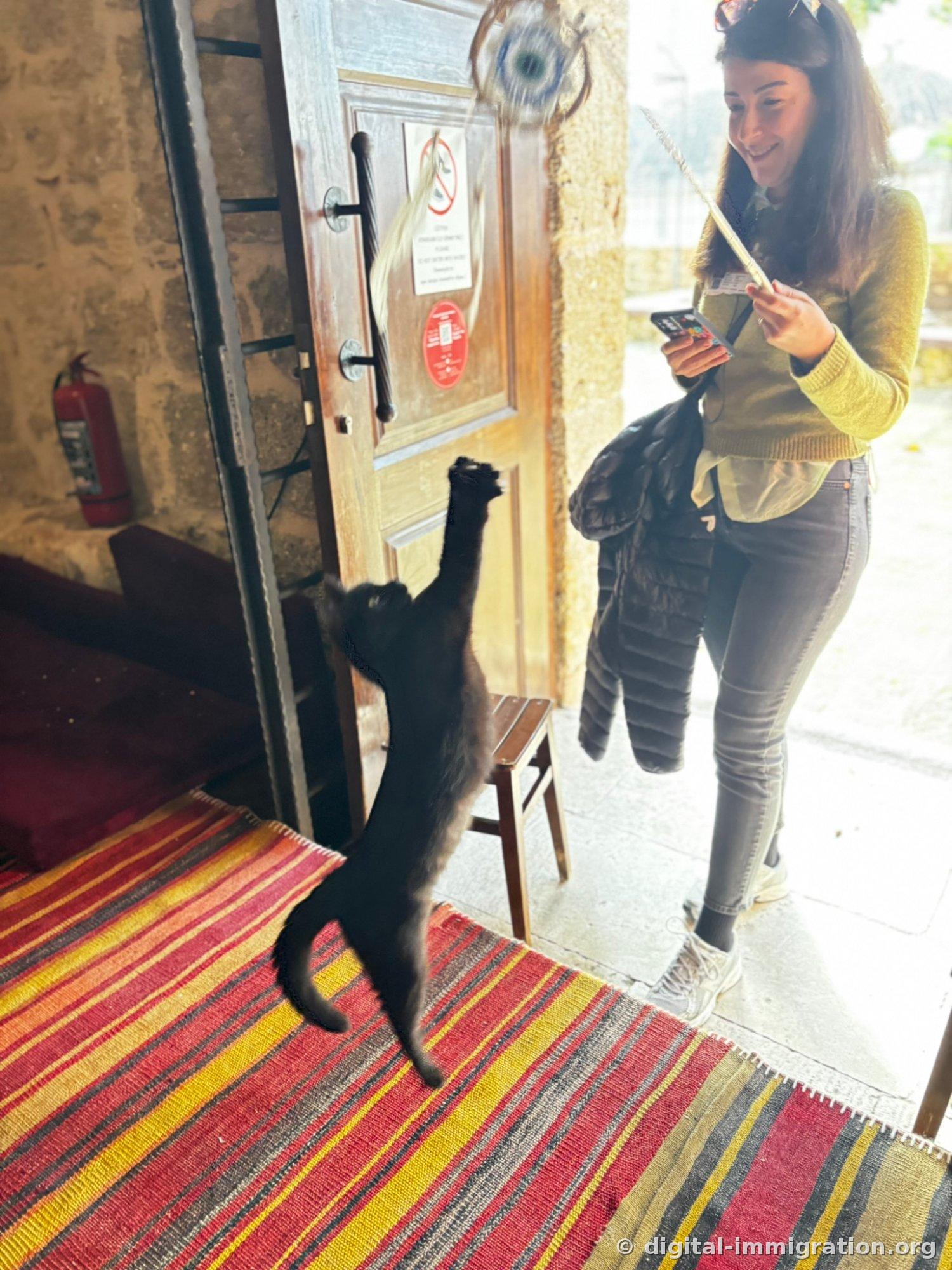
Honestly, this scene is what stuck with me about this museum. I remember the cat better than most of the exhibits. Kaleici has no shortage of cats, but this one didn't beg food from tourists—it already acted like it owned the place.
The Vaulted Room Inside—The Heart of This Building
Step through the door and the ceiling suddenly rises. A barrel vault, constructed from tightly stacked dressed stone, spans the entire room, with a single wooden-framed window set high in the far wall. Below it stand five glass display cases in a row, each containing a long green robe, a black hirka (cloak), and a siked (sikke), the cylindrical felt hat that is the symbol of the Mevlevi. The floor before the cases is covered with purple mats and kilim cushions, and a low mother-of-pearl inlaid circular table occupies the center. The arrangement is a clear invitation to remove your shoes and sit.
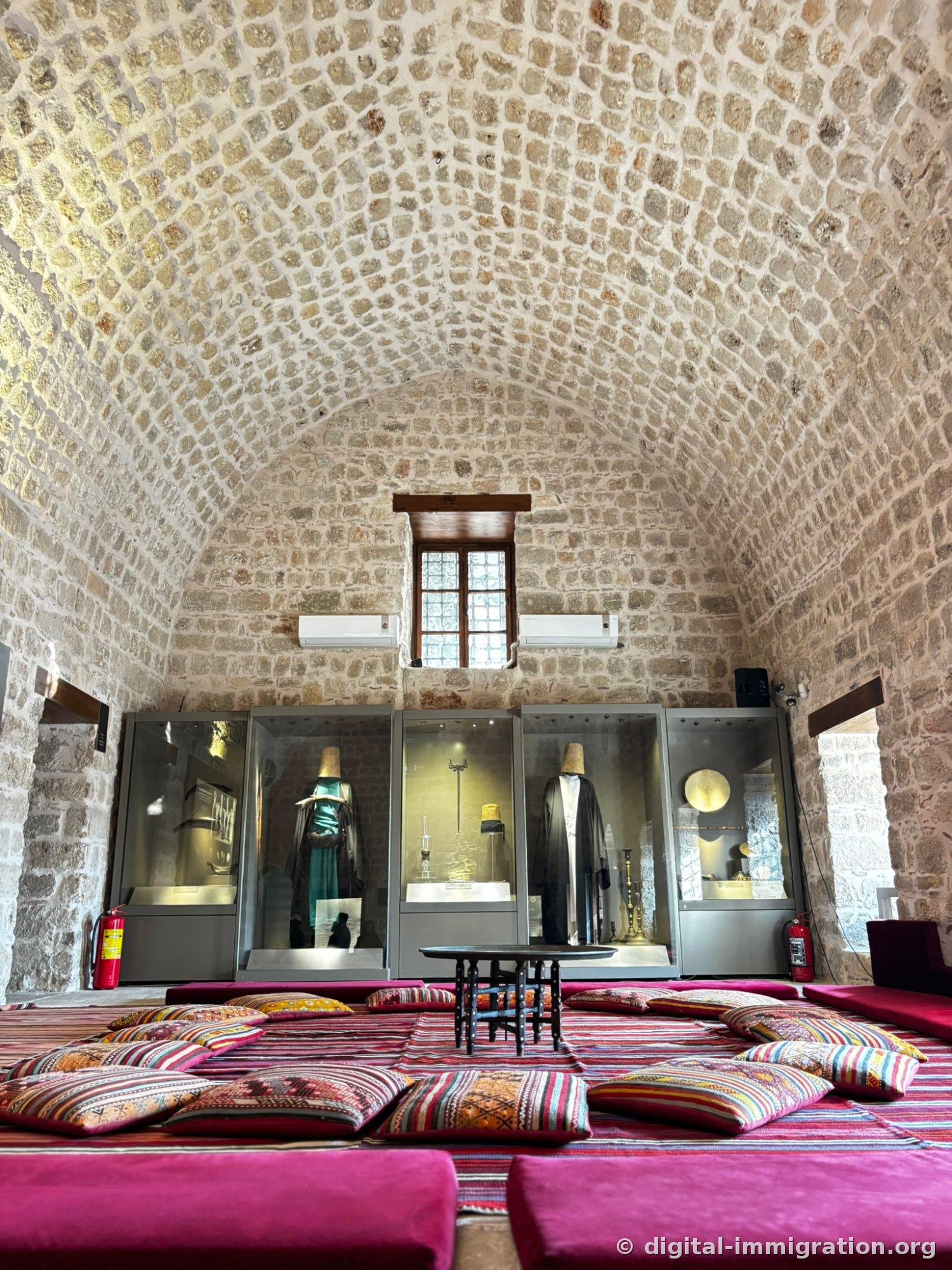
Looking up at the ceiling, you'll spot two wall-mounted air conditioning units bolted high on the walls. Aesthetically unfortunate, perhaps, but necessary—without them, you couldn't linger here during Antalya's summer heat. Even on the overcast spring day I visited, the stone walls held warmth and the interior felt lukewarm despite the season.
What's Inside the Display Cases
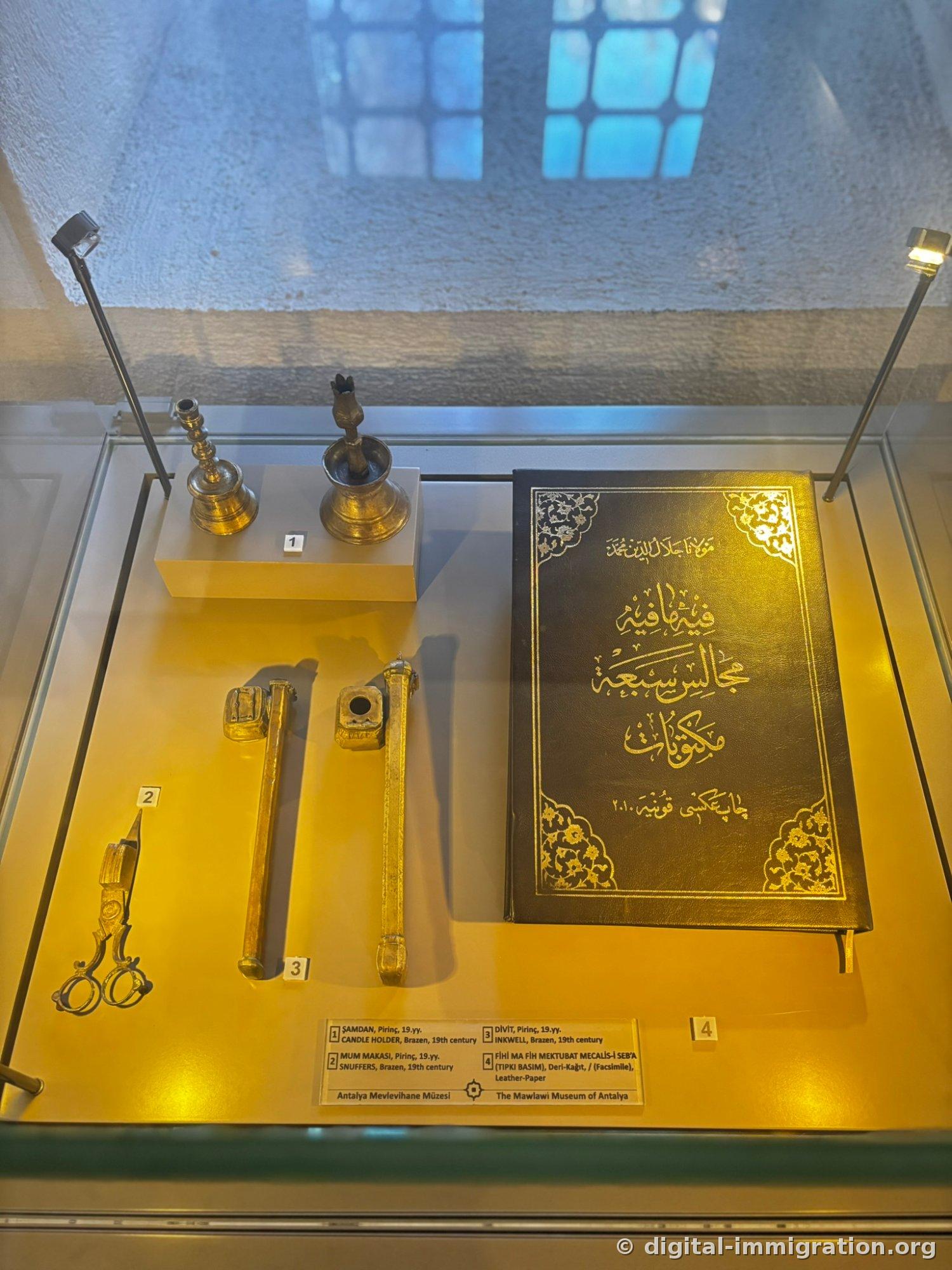
The collection of artifacts is modest. The labels, however, are bilingual in Turkish and English, so it's always clear what you're viewing. Most striking is the display of brass writing and lighting implements under yellow spotlights. Reading the labels: ŞAMDAN (candlestick, brass, 19th century), MUM MAKASI (wick trimmer, brass, 19th century), DİVİT (portable writing case and inkwell, brass, 19th century), and a single book with a black leather binding and gold-embossed Arabic script—a facsimile edition (TIPKI BASIM) of "Fihi Ma Fihi / Mektubat / Mecalisi Seba," collections of Rumi's prose, letters, and sermons. I had never seen an actual wick trimmer before and discovered it's truly a small scissors with two handle rings.
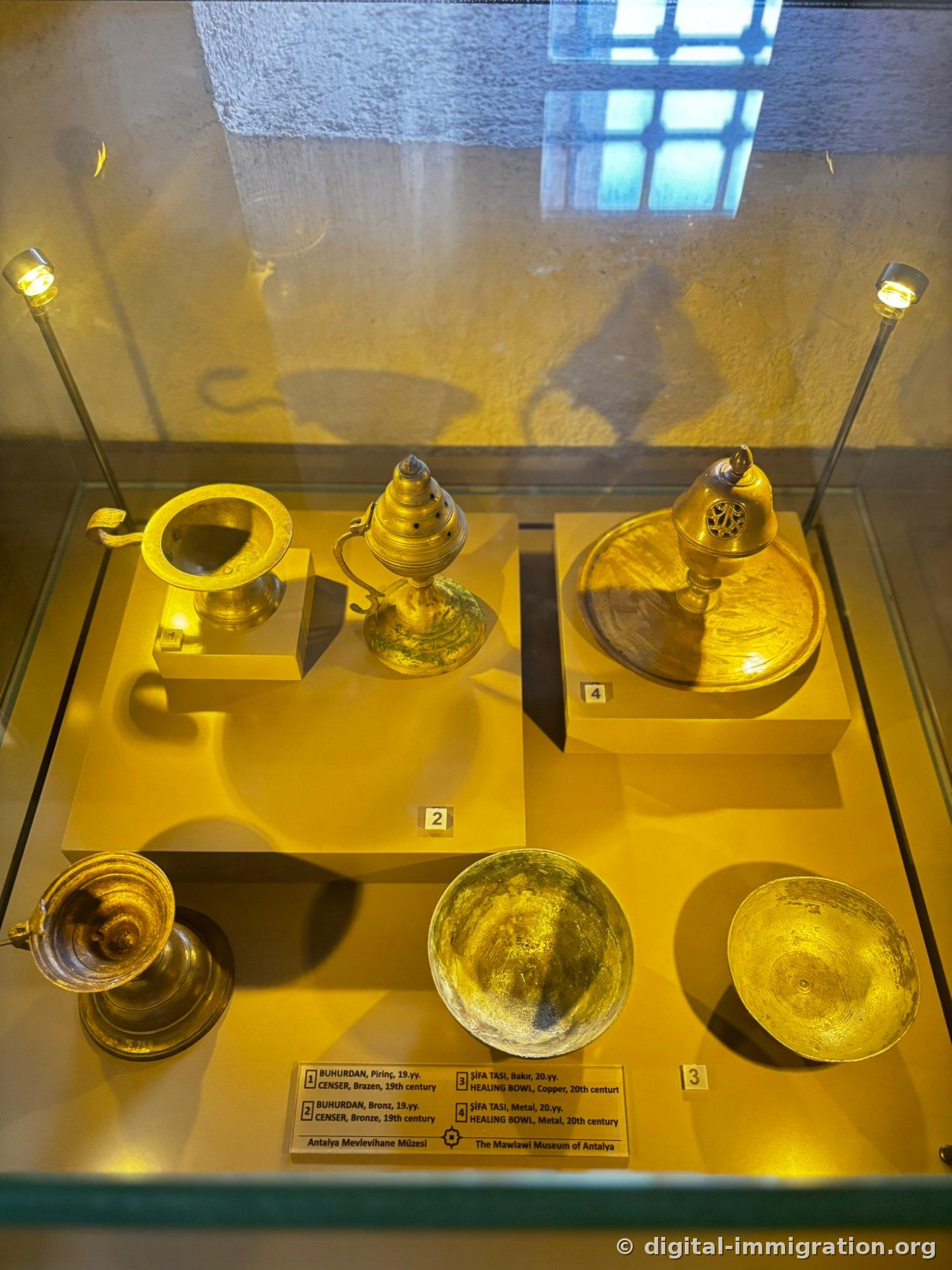
The adjacent case holds items related to incense and fragrance. Two BUHURDAN (incense burners)—one 19th-century brass, one 19th-century bronze, its stand still showing the original green patina, lending it an authenticity that photograph cannot convey. Then three 20th-century copper and metal vessels labeled ŞİFA TASI in Turkish and HEALING BOWL in English. These are traditional healing vessels—you fill them with water and drink from the inscribed interior. The bright yellow lighting makes everything photograph as gold, but in person they're far darker, worn from generations of use.
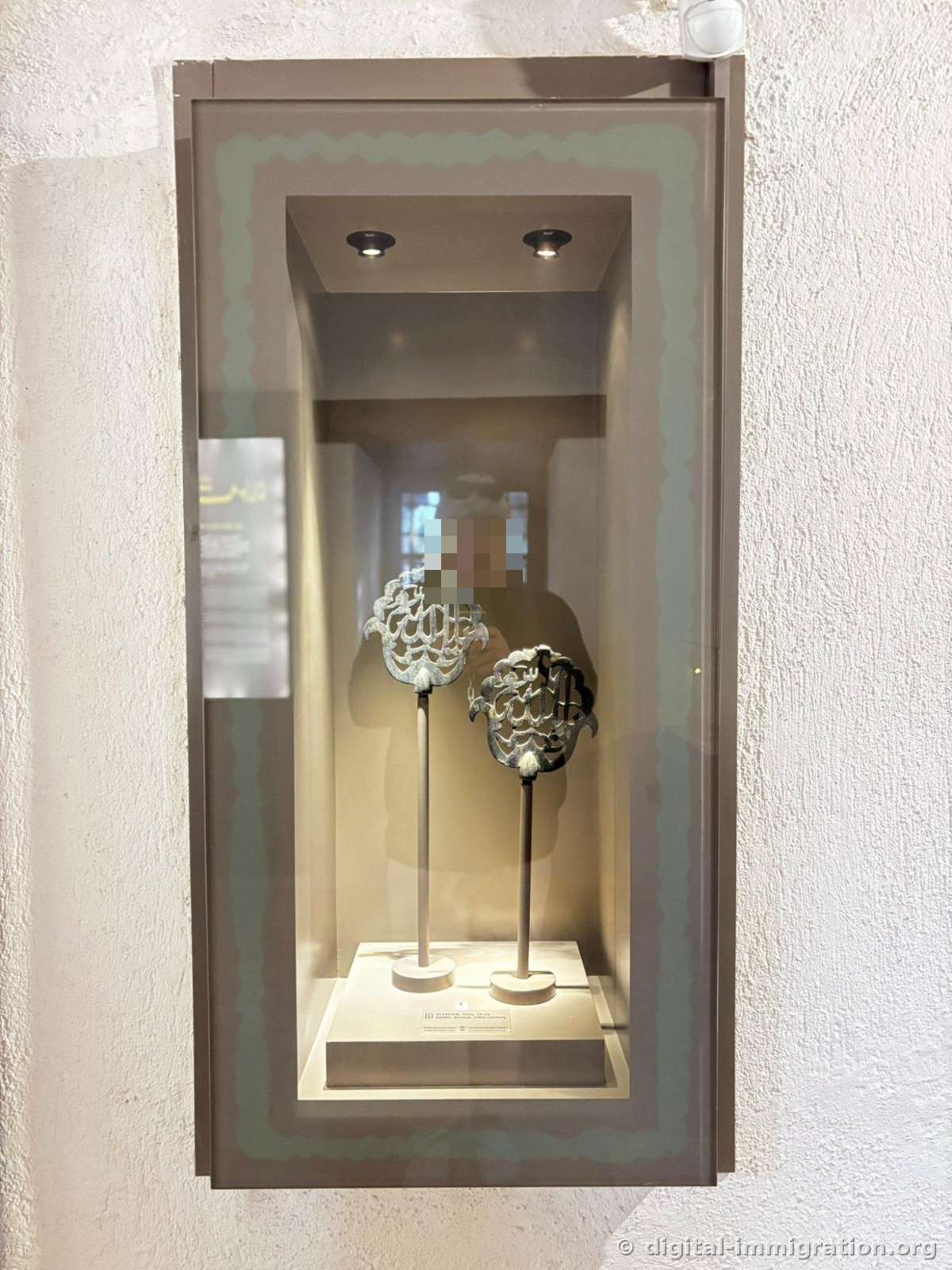
Along the corridor wall is a small glass case recessed into an alcove. Inside, illuminated by two spotlights, stands an ALEMLER (English label: SIGNS), bronze, 19th century—a decorative finial meant to crown a building or flagpole. It features Arabic calligraphy pierced through as openwork within a circular frame, one topped with a crescent moon. Glass glare is intense; your reflection appears directly over the artifacts in photographs. To photograph anything here, you must practically press yourself against the case and shift angles carefully to eliminate reflections. Flash only amplifies the problem.
The Wax Figure Room—The True Explanation of This Museum
In an inner room stand two life-sized wax figures seated facing each other. Both wear black hirkas and brown sikeds, with wooden reles (Quran stands) set before them, their books open in front. The figure on the right holds a tesbih (prayer beads) in hand. They sit on low platforms covered in red-and-yellow striped kilim. A glass railing separates them, but the distance is near enough to see facial expressions and beard texture clearly.
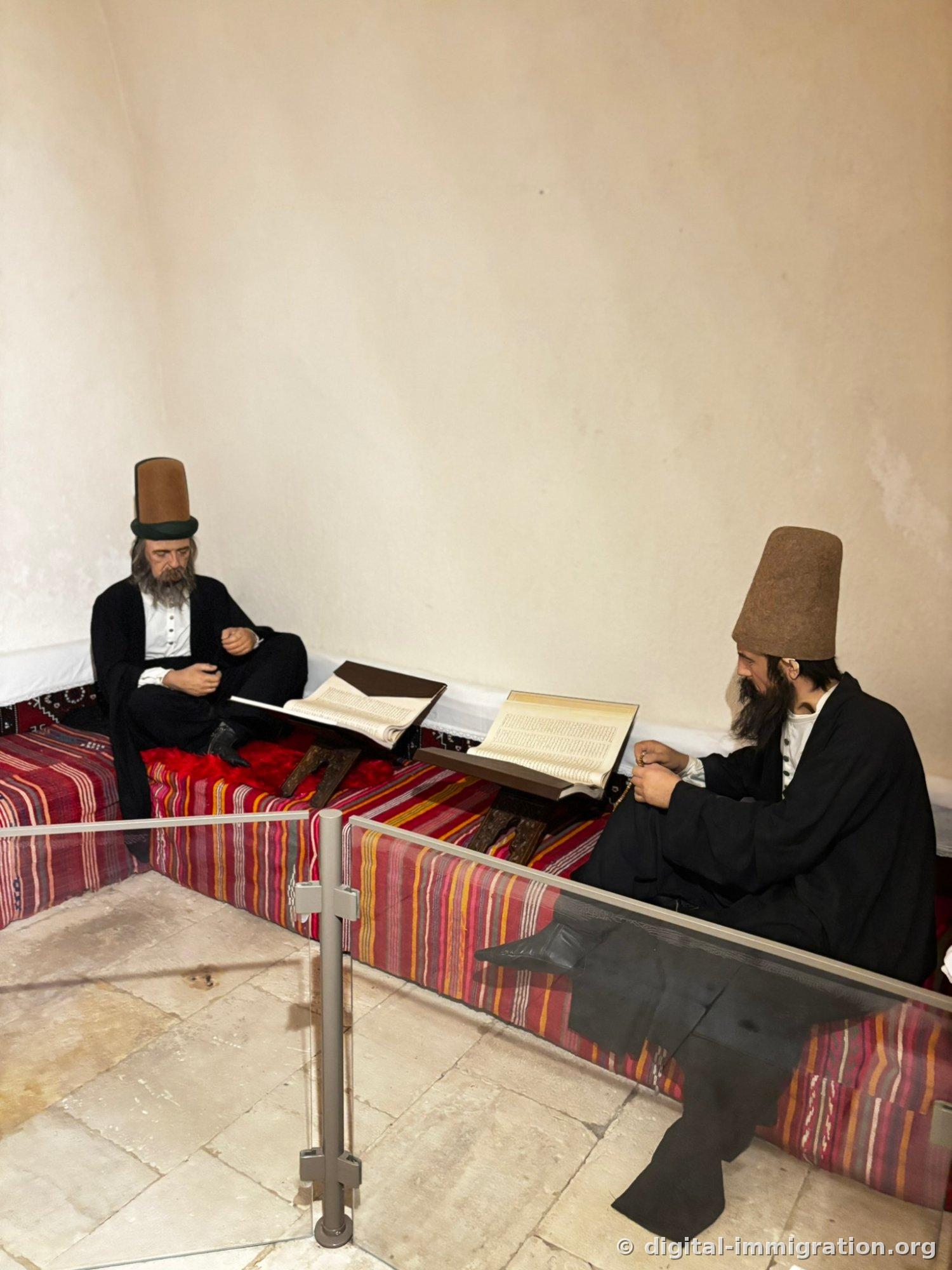
Wax recreations like this easily risk kitsch, but here the lighting is kept dim and the background is simply left blank, resulting in something spare and understated instead. Rather than elaborate staging of a sema (whirling ceremony), they've chosen to show the act of reading. I found that choice meaningful. This room more than any other conveys that the Mevlevihane was never a performance space, but a place for study and spiritual work.
The Empty Room Along the Colonnade and the Building Structure
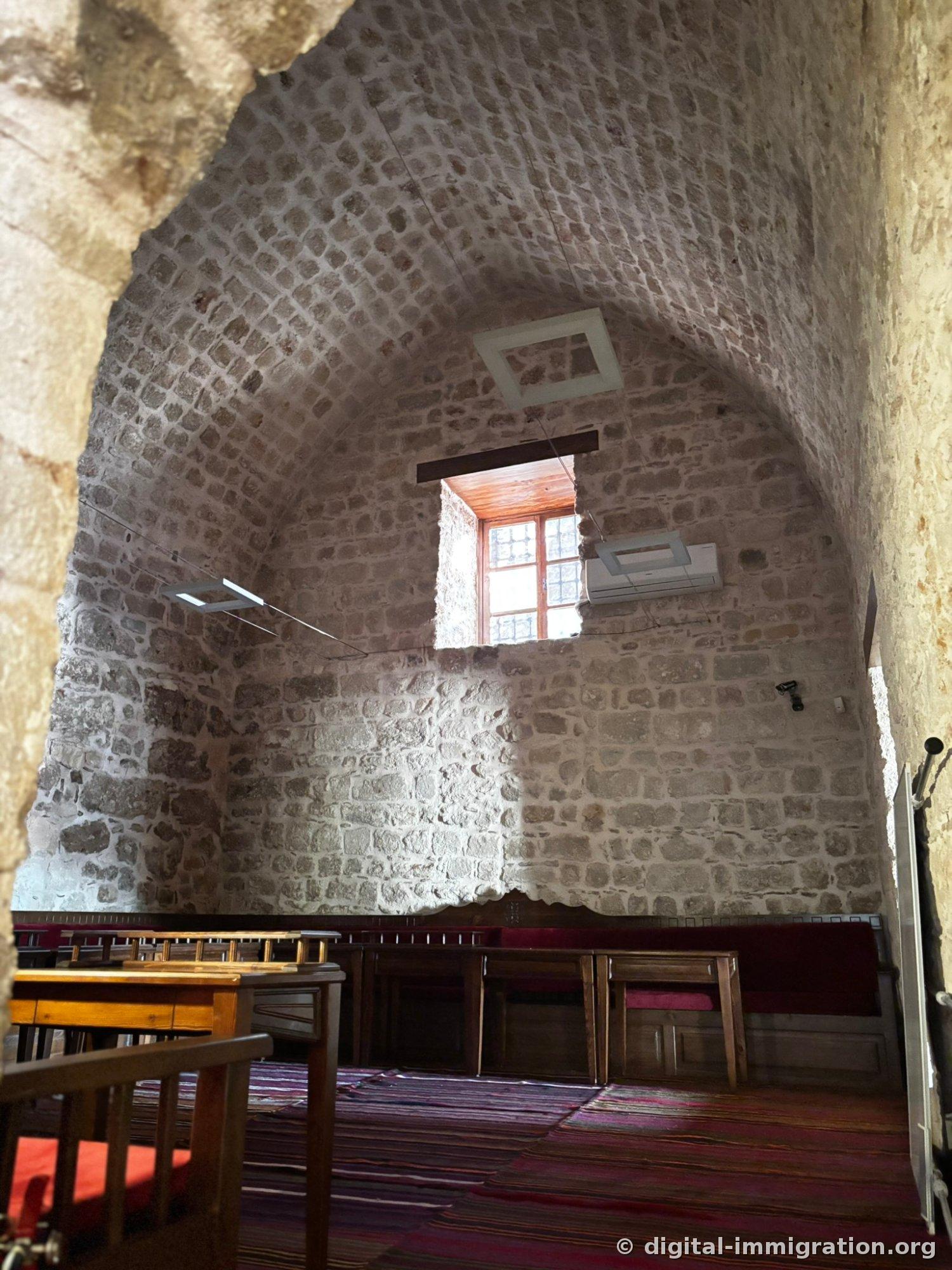
Beside the main hall is another vaulted room, but it holds no artifacts—only wooden benches, low platforms, and purple cushioned backrests. The walls show exposed stone where plaster has fallen away, and light from a single window lands as a rectangle on the opposite wall. The only modern addition is a thin rectangular fixture suspended from the ceiling. Sitting on these benches when alone, the sounds of the alley outside feel very distant indeed. Quiet interior spaces like this are rare in Kaleici.
Location and How to Find It
Tucked away inside Kaleici, it's not visible from the main streets. Whether you approach from Hadrian's Gate or the Yivli Minaret side, the narrow branching alleys mean you'll miss it without a map app. I circled the same alley twice myself. The coordinates below mark exactly where I stood to take these photographs.
Let me be straightforward about a few practical matters. Admission fees and opening hours are information I can only verify from my own visit, so I won't state figures here—Turkish museum fees have risen frequently in recent years, and for small institutions like this one, management changes can bring different holiday closures. I recommend checking current information before visiting. What I can say with certainty is this:
- The interior has floor-level seating areas, so slip-on shoes are highly recommended. I arrived in laced hiking boots and struggled alone at the door trying to untie them.
- The interior is dim and the display lighting is a strong yellow, so smartphone auto white-balance renders everything gold-colored. For artifact photographs, reducing exposure by one stop helps.
- Glass reflection is severe. You must press against the case and angle your view carefully to avoid reflections. Flash only makes glare worse.
- Viewing time is 30–40 minutes. There aren't many artifacts. If you come only for this, it might feel like a wasted trip, so I'd recommend working it into a larger Kaleici walk or harbor visit.
What I Wish Was Different
Honestly, the exhibition explanations are thin. Labels state only the artifact name, material, and century, with little narrative about why the Mevlevi order established itself in Antalya, when this building was constructed, or how it came to be a museum. Without prior knowledge, you might leave with only "a few brass vessels and two figures." Reading even a paragraph about Rumi and the Mevlevi beforehand entirely transforms the experience.
That said, I appreciated the modest scale. Kaleici is a neighborhood where carpet vendors and restaurant touts never cease, yet inside this door there is none of that. Only the barrel-vaulted ceiling, the yellow glow of the display lights, and that black cat chasing feathers at the entrance. As I left, I saw it sprawled asleep across the kilim rug.
Baca seterusnya
- Cerita merebus Shin Ramyun Black di bukit depan Zemi Hotel Cappadocia, Goreme pada bulan Februari
Musim panas adalah musim puncak di Goreme, Cappadocia, Turki. Saya pergi pada bulan Februari. Suhu pagi turun di bawah nol, dan ada lapisan putih halus—entah embun beku atau salju—…
Göreme - Menghabiskan petang di Yuvam Shisha Nargile Kafe di atas tebing Kaleici Antalya, memandang pelabuhan
Kota tua Kaleiçi di Antalya, Turki, memiliki gang-gang berlapis di dalam tembok benteng yang berbelit seperti labirin, sehingga ketika pertama kali datang, sulit mengetahui di mana…
Antalya · Yuvam Shisha Nargile Kafe - Pelabuhan Yacht Kaleiçi Antalya — Sehari Melihat Pelabuhan di Bawah Tembok Benteng dari Tiga Sudut Pandang Berbeda
Kaleiçi, kota tua di Antalya Turki, memiliki tembok benteng yang tetap kokoh di atas tebing, dan di bawah tebing itu sepenuhnya adalah pelabuhan yacht. Di peta terlihat seperti 'sa…
Antalya · Yuvam