Hanayashiki in Asakusa, Tokyo — Japan's First Amusement Park Opened in 1853, Where a Roller Coaster Brushes Past Someone Else's Window
When you emerge from the alley behind Sensoji Temple, the sound suddenly changes. Instead of the murmur of worshippers, you hear the clank of metal and screams, along with musty ba…
Tokyo · Asakusa Hanayashiki
When you emerge from the alley behind Sensoji Temple, the sound suddenly changes. Instead of the murmur of worshippers, you hear the clank of metal and screams, along with musty background music from old speakers. Hanayashiki (浅草花やしき) in Asakusa, Tokyo appeared like this, without announcement. It's Japan's oldest amusement park, having started as a botanical garden in 1853 and gradually gained rides to become what it is today. Thinking that it opened the same year Perry's fleet arrived at Uraga makes your sense of time feel a bit odd.
The area is roughly the size of a school athletic field. It takes less than 3 minutes to walk from the main entrance to the far end. If you come expecting a size like Tokyo Disneyland, you'll be disappointed within the first 5 minutes. I think differently — this smallness is what defines this park.
What You Should Read First at the Ticket Counter
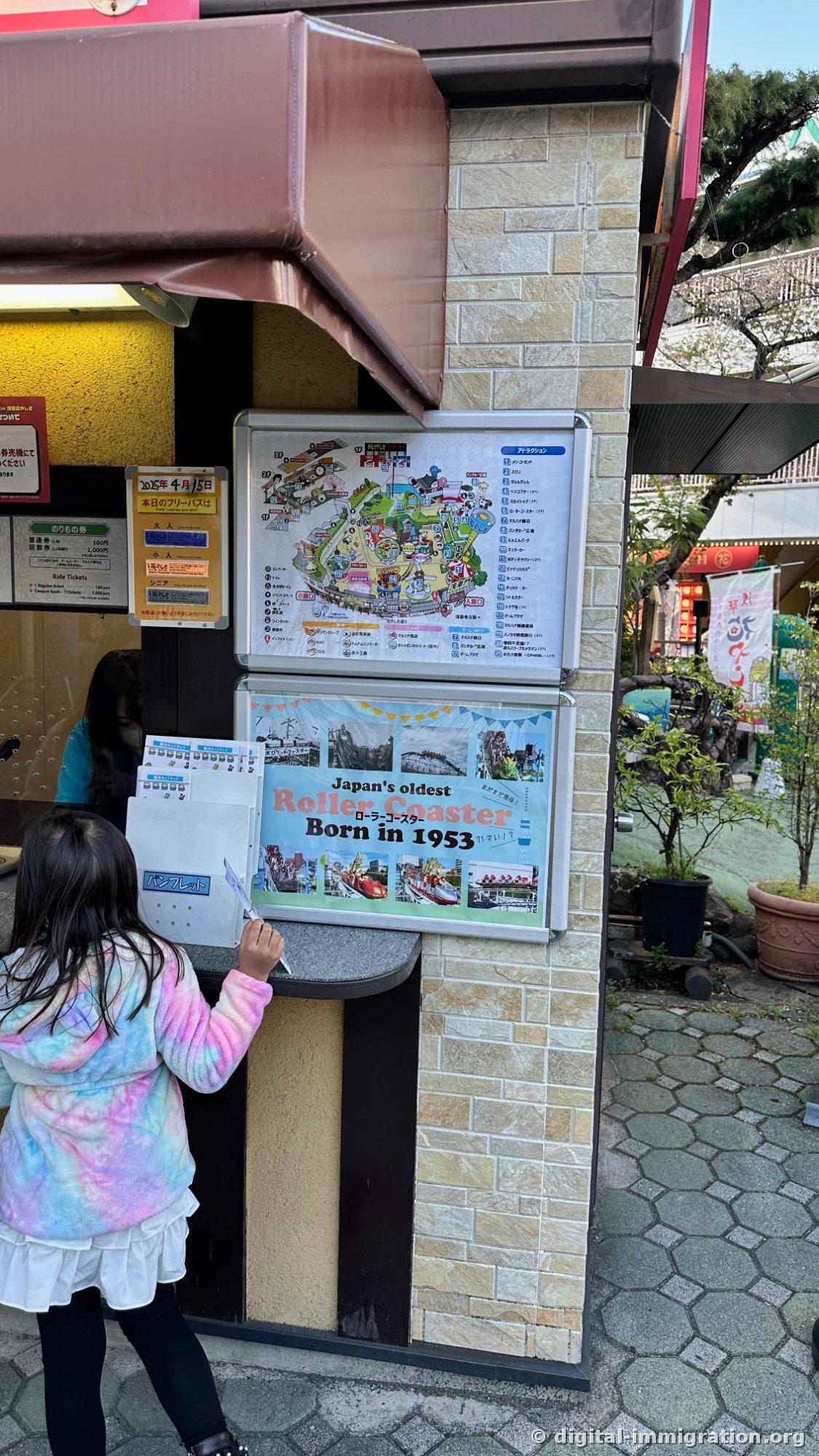
Next to the ticket window on the right side of the entrance, there's a park map and a fee schedule posted on a pillar. Ride tickets (のりもの券) are 100 yen per ride, or an 11-ticket book for 1,000 yen. The day's pass price is written separately on a yellow sheet that's rewritten by hand each day, so it's better to check it on-site rather than calculating in advance. The fact that admission and ride fees are separate can be confusing.
The poster below is this park's pride. "Japan's oldest Roller Coaster — Born in 1953." Born in 1953, now 71 years old. I stared at that number for a long time while standing next to a child pulling pamphlets from the holder.
The 1953-born Roller Coaster: What It's Actually Like to Ride
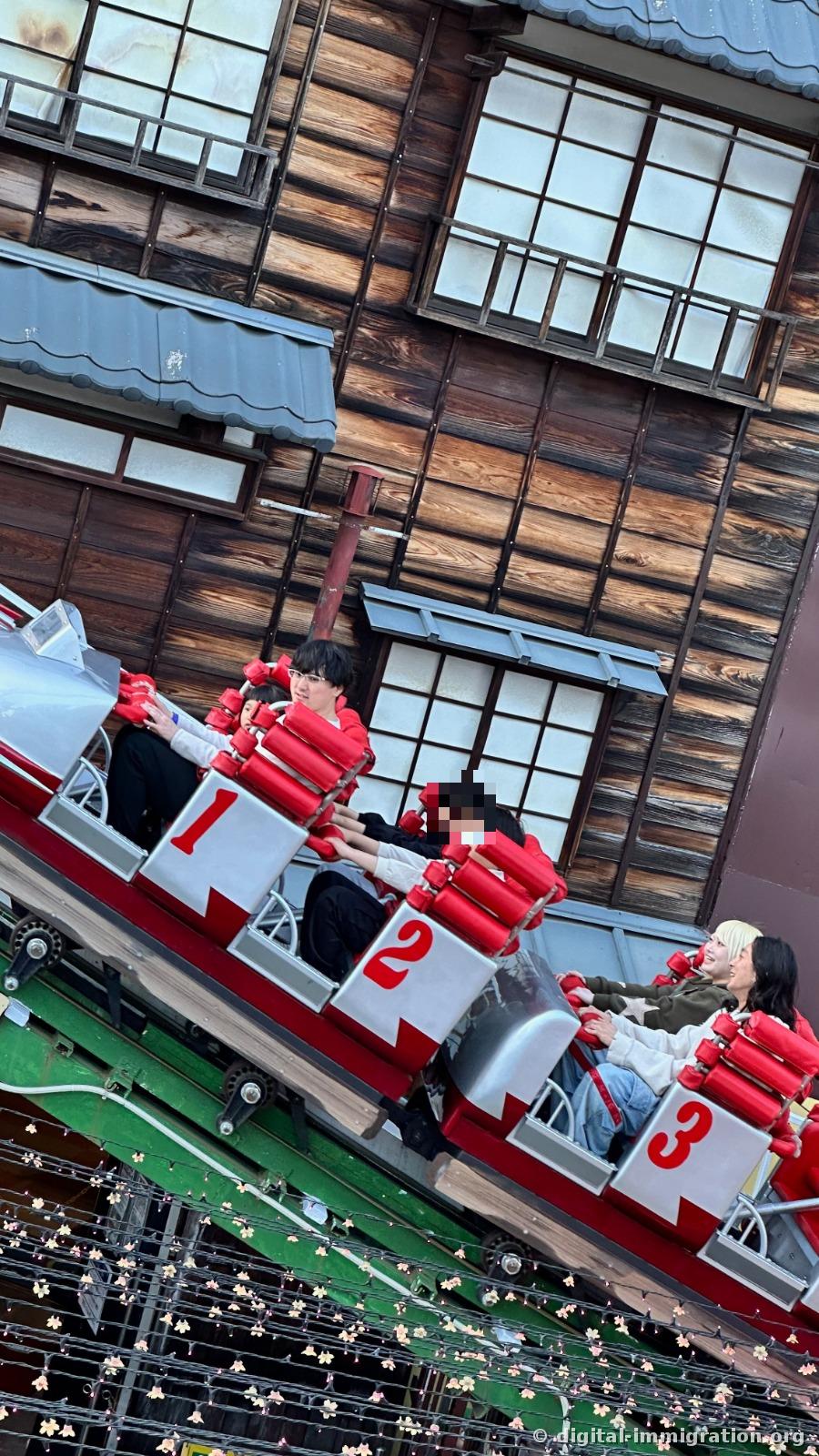
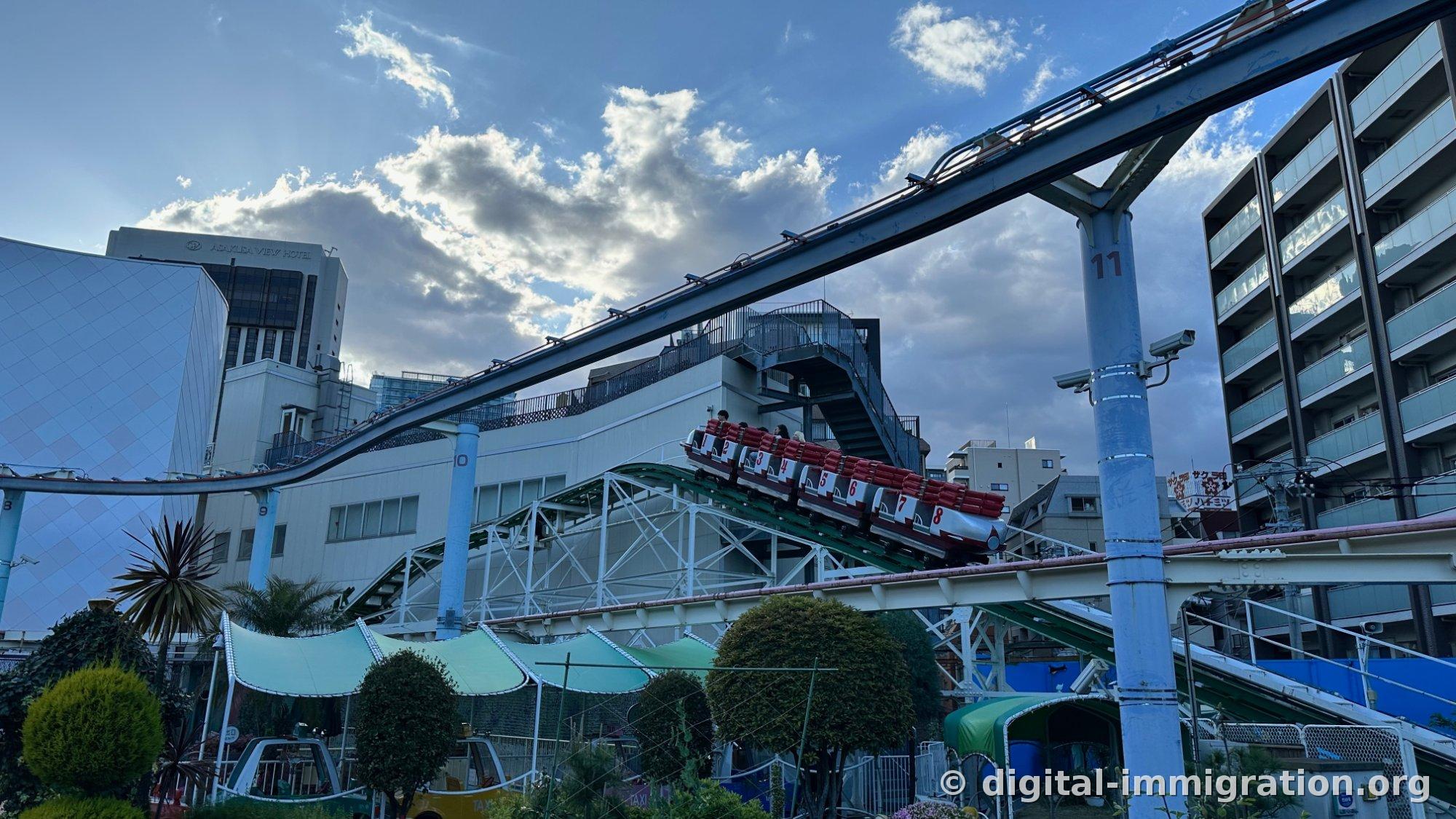
The park's roller coaster has a short total length and a top speed of around 40 kilometers per hour, according to the guide. The numbers alone sound underwhelming. But riding it is a different story. Because the plot is narrow, the track leaves the park and winds between adjacent buildings before returning. It passes through spaces so close you could almost touch the window frames of nearby homes.
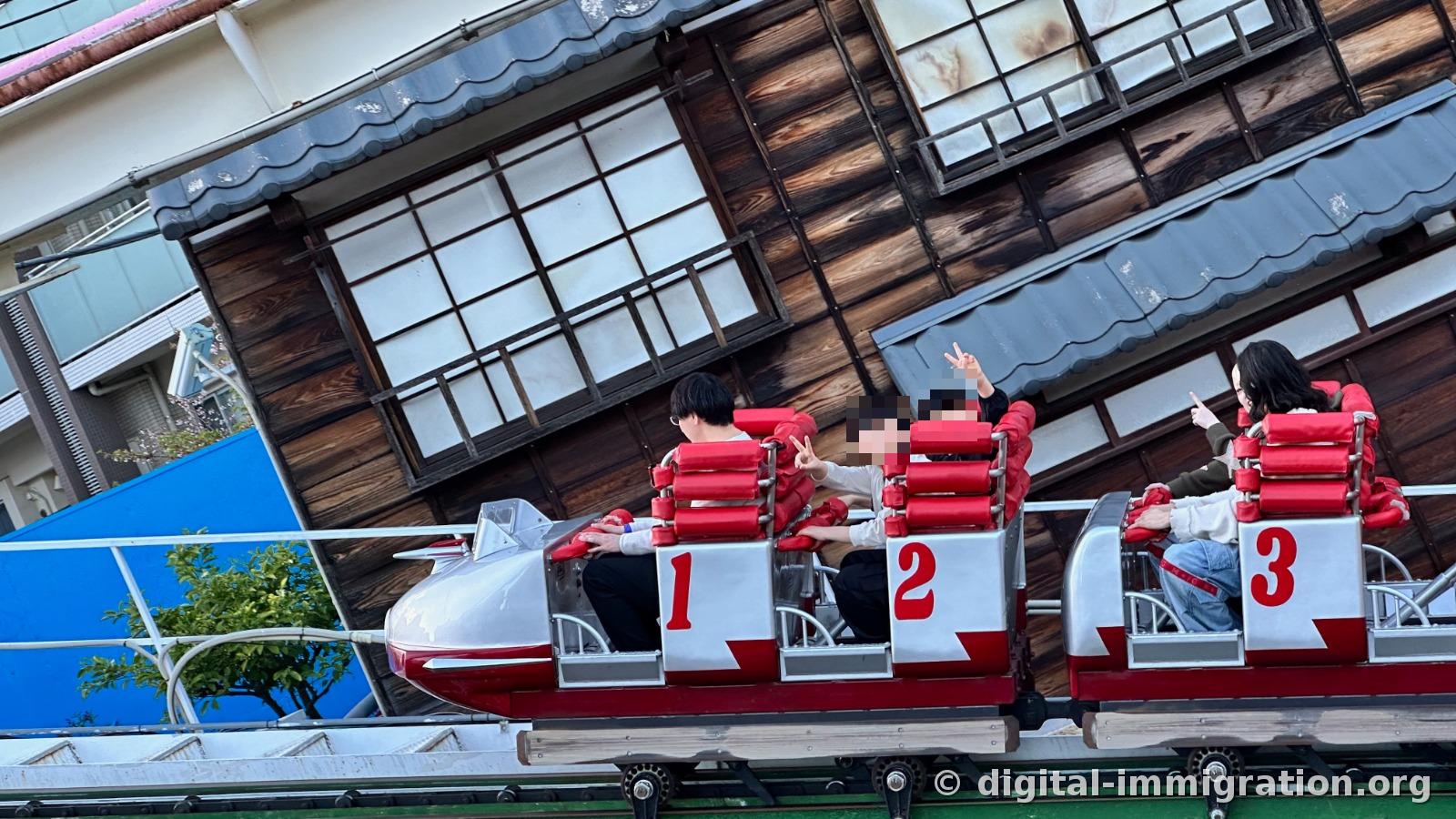
The safety bar isn't the shoulder-embracing type found on modern rides — just one red padded bar crossing the abdomen. The seat back also has an old red cushion of the same material attached, which has the dry feel of aged leather when you touch it. On the side of the car, seat numbers 1 through 8 are printed in large red digits on a white background.
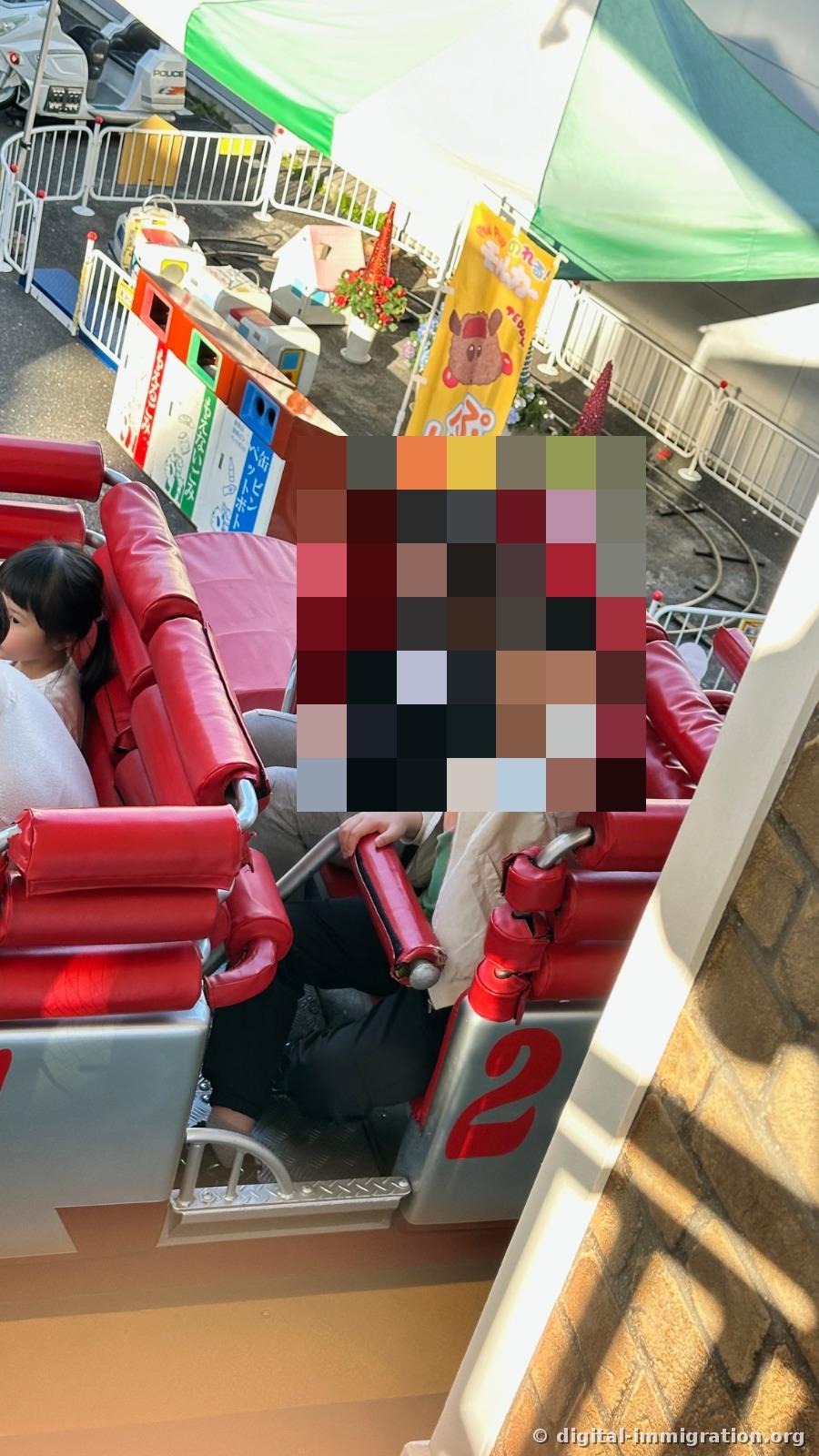
From the waiting area just before boarding, looking down reveals the coaster's true face. Recycling bins, a folding tent, a white metal fence, and a patrol car beyond it. The ride and the neighborhood's everyday life are separated by just one fence. The yellow vertical flags had character drawings beckoning customers. This very disorder stayed with me.
Looking up from outside the park, the structure becomes clearer. Numbers 9, 10, 11 are painted on the support columns extending to the sky, with surveillance cameras placed between them. In the distance, the white building of the ASAKUSA VIEW HOTEL frames the background. When the 8-car train passes over the green steel framework, it's nearly at the same height as the nearby apartment balconies.
A Taxi Running on Rails, and a Carousel
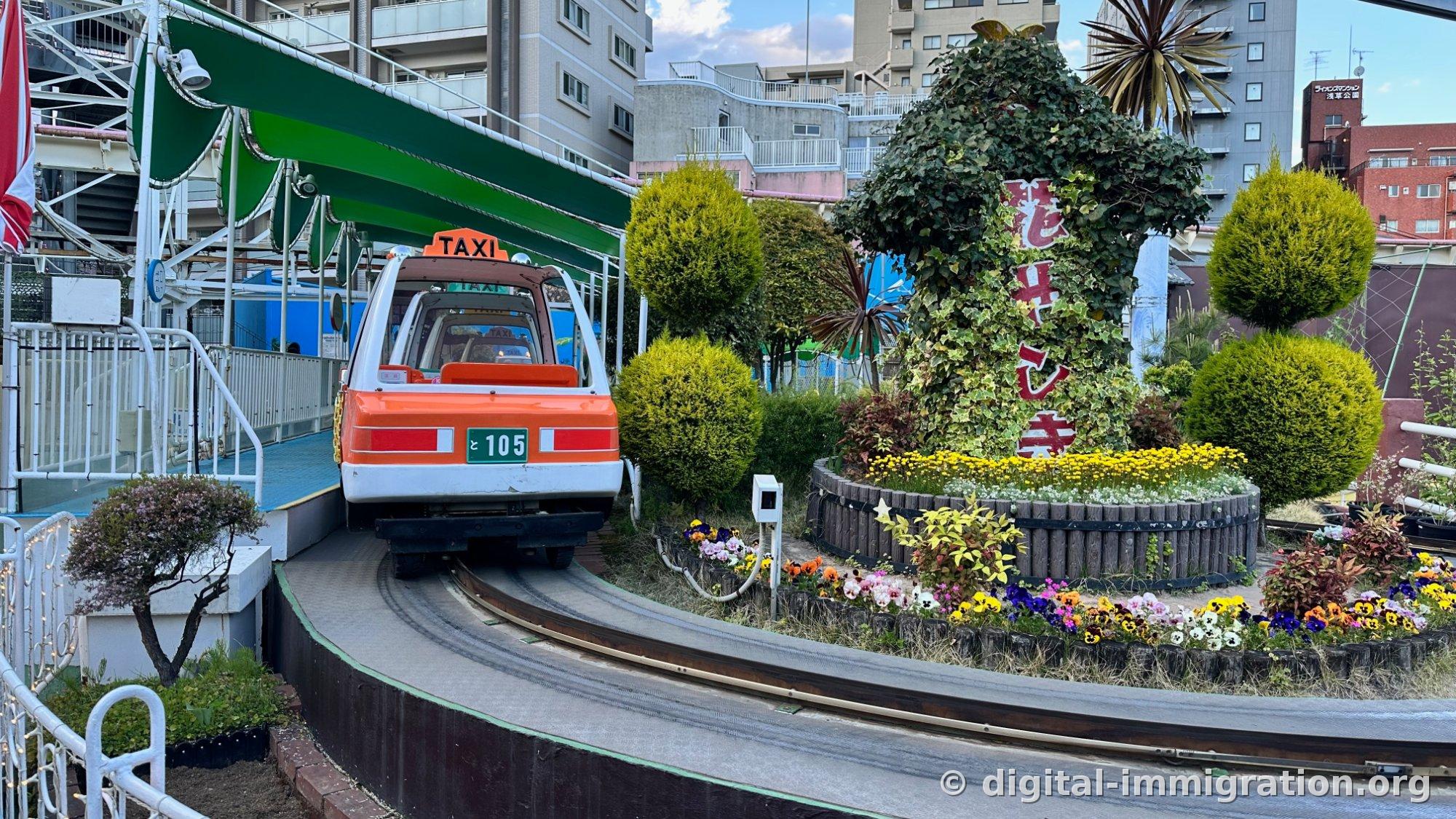
Under a green canopy, there's one ride that slowly circles along the rails. An orange and white car with a 'TAXI' sign on the roof, and a license plate reading 「と105」. It looks like a miniature Tokyo taxi. In the center of the flower bed inside is a pillar covered with ivy, on which 「花やしき」 is written vertically in red letters, surrounded by colorful pansies at its base. The flower bed maintenance is surprisingly meticulous. The place's history as a botanical garden shows through here.
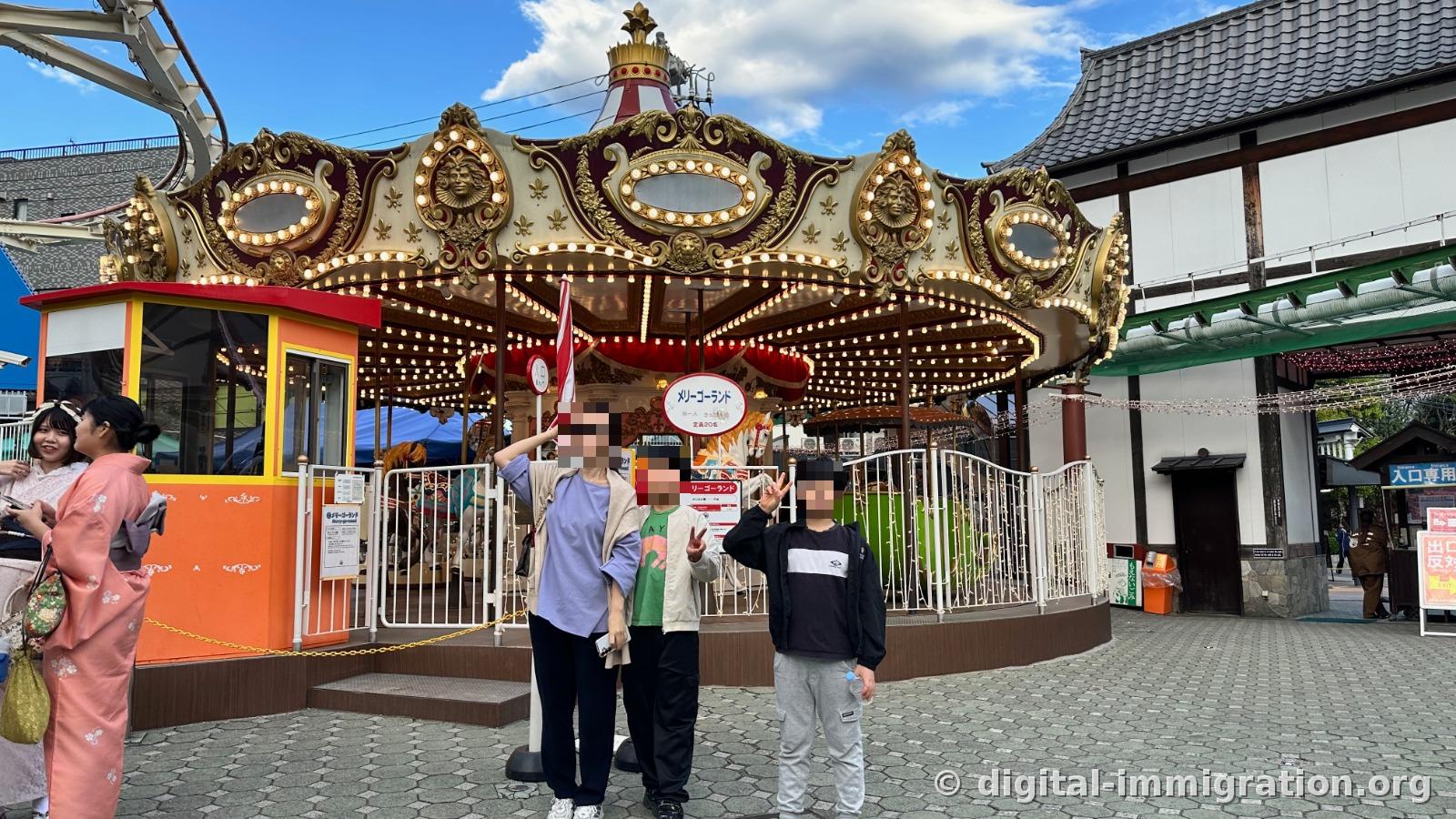
The carousel (メリーゴーランド) in the park's center is ornately decorated, perhaps excessively so for its size. A canopy densely packed with gilded reliefs and light bulbs, crowned with decorative crowns at the top. The sign indicated a capacity of 20 people. Directly beside it stands a wooden building with a tiled roof, creating a frame where European-style carousel and Japanese tile roof coexist. This combination is hard to find elsewhere.
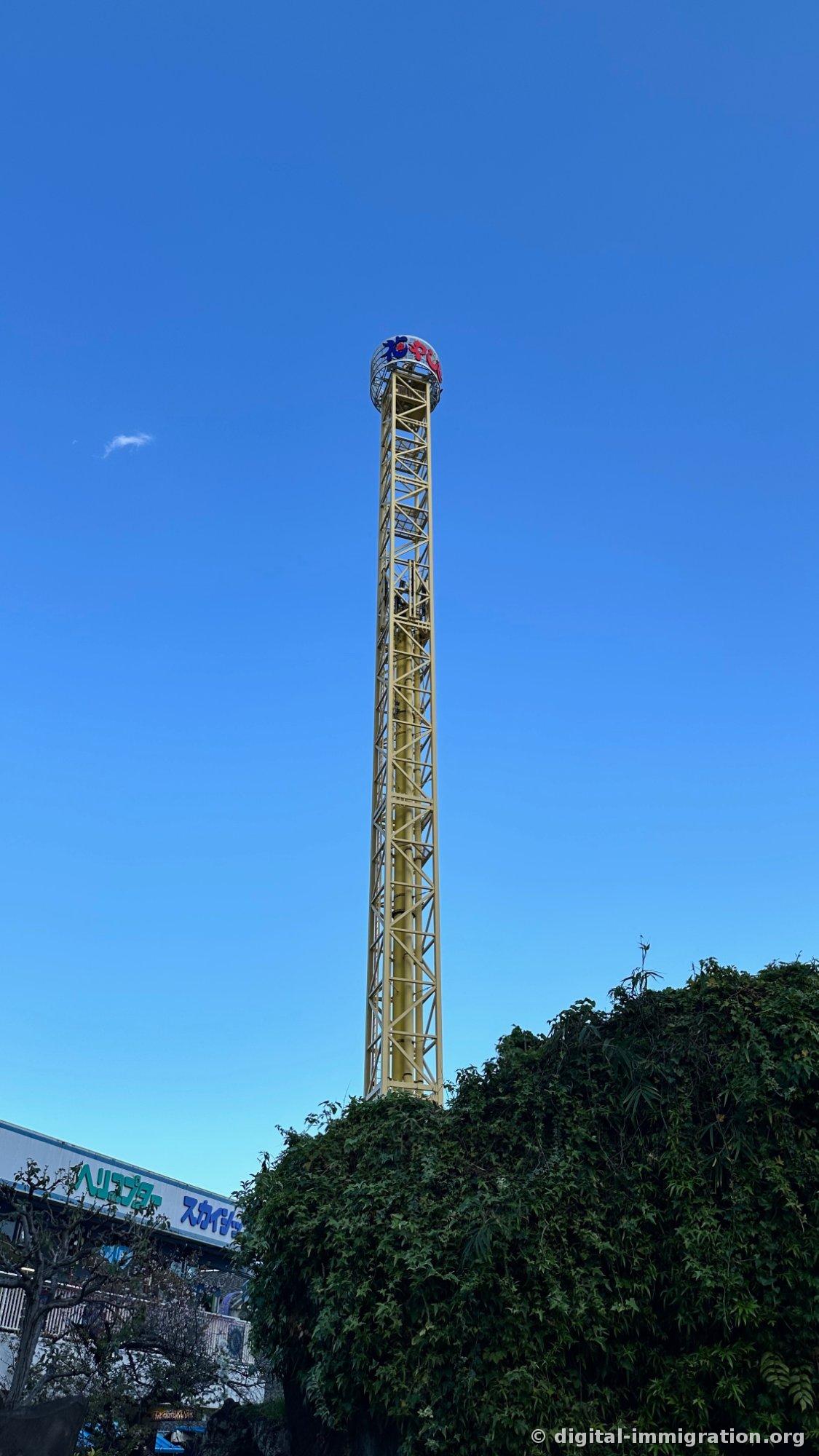
The most striking structure is the yellow steel tower of the Space Shot type. Being the only thing that extends vertically on this cramped plot, it's visible from anywhere in the Asakusa alley if you look up. The 「花やしき」 logo is attached to the circular structure at the top, and below on the blue building hang signs for 「ヘリコプター」(Helicopter) and 「スカイシップ」(Sky Ship).
Location and Practical Advice
It's about a 5-minute walk west from the main Sensoji Temple building. From the Asakusa subway station, it's about 10 minutes walking through Nakamise-dori. The alley is narrow and the signs are small, so you might pass it once if you're visiting for the first time. If you use the yellow steel tower I mentioned earlier as a landmark, you won't get lost.
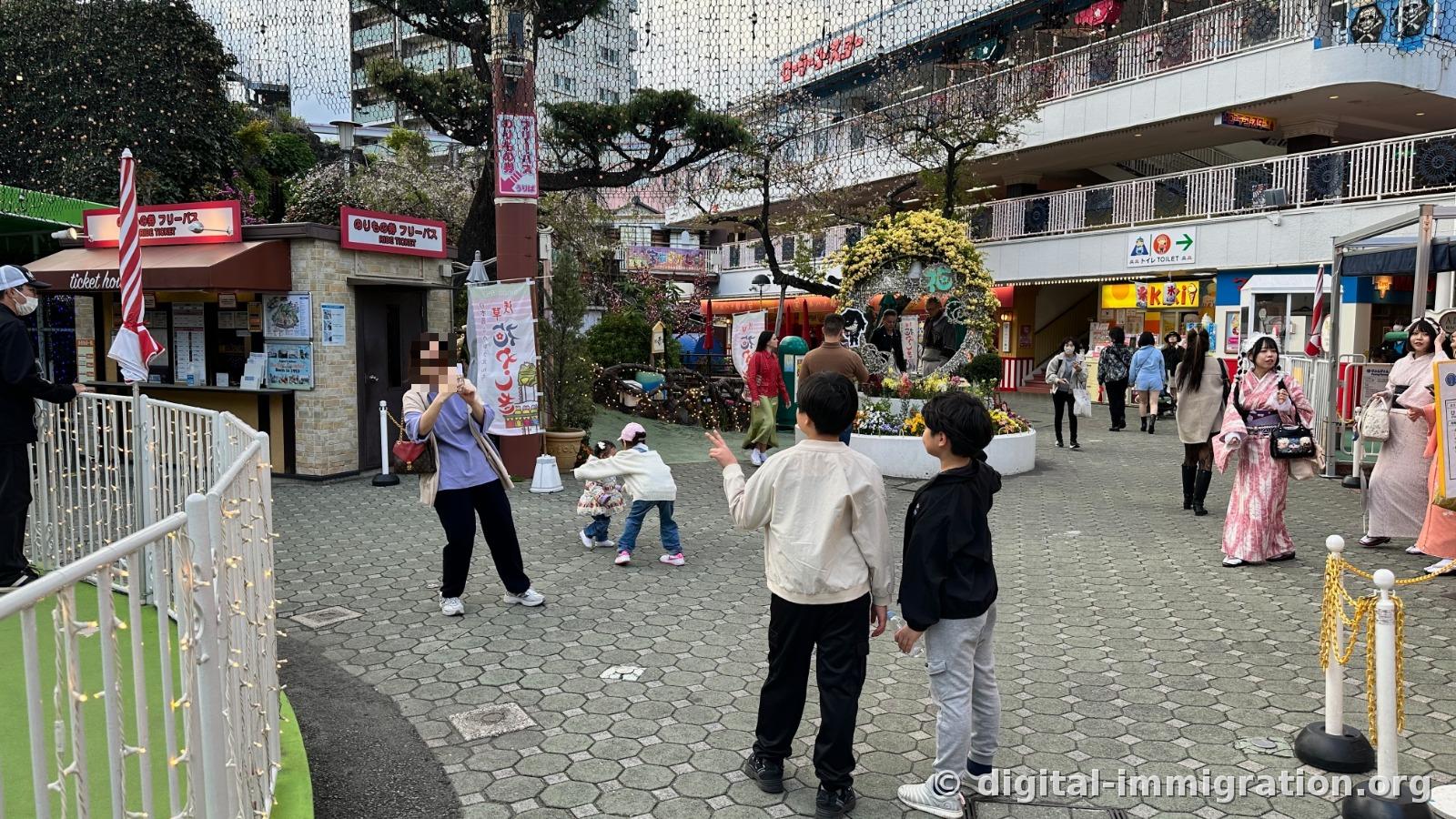
The plaza inside the park becomes much more crowded in the afternoon. There are two pass (フリーパス) sales booths, and visitors in rented kimonos pass in front of them. The flow is typically: renting a kimono from shops around Asakusa, visiting Sensoji Temple, and then coming here. Restroom (トイレ TOILET) guidance is posted with arrows in the inner corridor.
A few things learned from actual experience:
- If you plan to ride three or more rides, a ticket book or pass is better. For two or fewer, individual 100-yen tickets are cheaper.
- Each ride is short. Even the roller coaster's circuit ends in seconds. Rather than planning a half-day visit, scheduling 1-2 hours gives better satisfaction.
- During crowded times, strollers don't navigate the narrow passages well. Right after opening in the morning is much easier.
- Height and age restrictions vary by ride, and signage is mostly in Japanese. If you're with children, it's safer to check each ride's entrance information.
- Operating hours and pass prices vary by season and day. It's recommended to check on-site or with official information before visiting.
To be honest, there are some disappointing aspects. Paint chipping off railings, faded signage, cramped pathways. For those expecting the polish of modern theme parks, it might only leave an impression of being old-fashioned. I actually heard someone next to me say "it's smaller than I thought" several times.
But I think I'll come back to see this age-worn place again. The fact that rails built in 1953 still carry passengers daily, that those rails pass beside neighbors' windows, and that the neighborhood has simply accepted this for 71 years. While the oldest thing in Asakusa may be Sensoji Temple, the thing that has endured longest might just be this narrow amusement park.
Baca seterusnya
- From Akihabara's Chuo-dori to the Kanda River: A Record of Tokyo's Electronics District Revisited Multiple Times
Tokyo's Akihabara is a neighborhood where it's hard to say you've seen everything in a single visit. I've come multiple times across different seasons, and each time the signs chan…
Tokyo · Akihabara - Buying a Single ¥300 Year-End Jumbo Lottery Ticket at Nishi-Ginza Chance Center in Tokyo
Exit from the Hibiya exit of Tokyo's Shimbashi Station, walk toward the elevated highway for about three minutes, and suddenly you'll see a line of people stretching along the side…
Tokyo · Nishi-Ginza Chance Center - Ueno Ameyoko, the real magic starts after sunset — an evening walk from the Okachimachi Gate to Ueno Station
Every time I come to Tokyo, my feet find their way to Ueno Ameyoko (アメ横) without fail. This time I entered from the Okachimachi side and worked my way toward Ueno Station. I've met…
Tokyo · Ameya Yokocho Market