Ban Rak Thai, Mae Hong Son: Two Days in a Lakeside Village on Myanmar's Border
From Pai, taking Highway 1095 through Mae Hong Son's downtown, then driving another 40 minutes deeper into the mountain roads, tea plantations suddenly unfold before you, and a lak…
Mae Hong Son
From Pai, taking Highway 1095 through Mae Hong Son's downtown, then driving another 40 minutes deeper into the mountain roads, tea plantations suddenly unfold before you, and a lake appears below. Ban Rak Thai—a village so close to Myanmar's border that you can walk there—sits in northern Thailand's Mae Hong Son Province. Since 1949, descendants of KMT Chinese Nationalist troops from Yunnan who crossed the border have settled here to form a Chinese diaspora village, the name itself meaning "the village that loves Thailand." Though situated in Thailand, half the storefronts display Chinese characters, and restaurants serve Yunnan-style braised pork rather than pad thai. I have a fondness for these ambiguous border towns while traveling Southeast Asia, and Ban Rak Thai stands out as having one of the clearest identities among them.
Twenty Minutes to Circle the Lake, But Hours Disappear
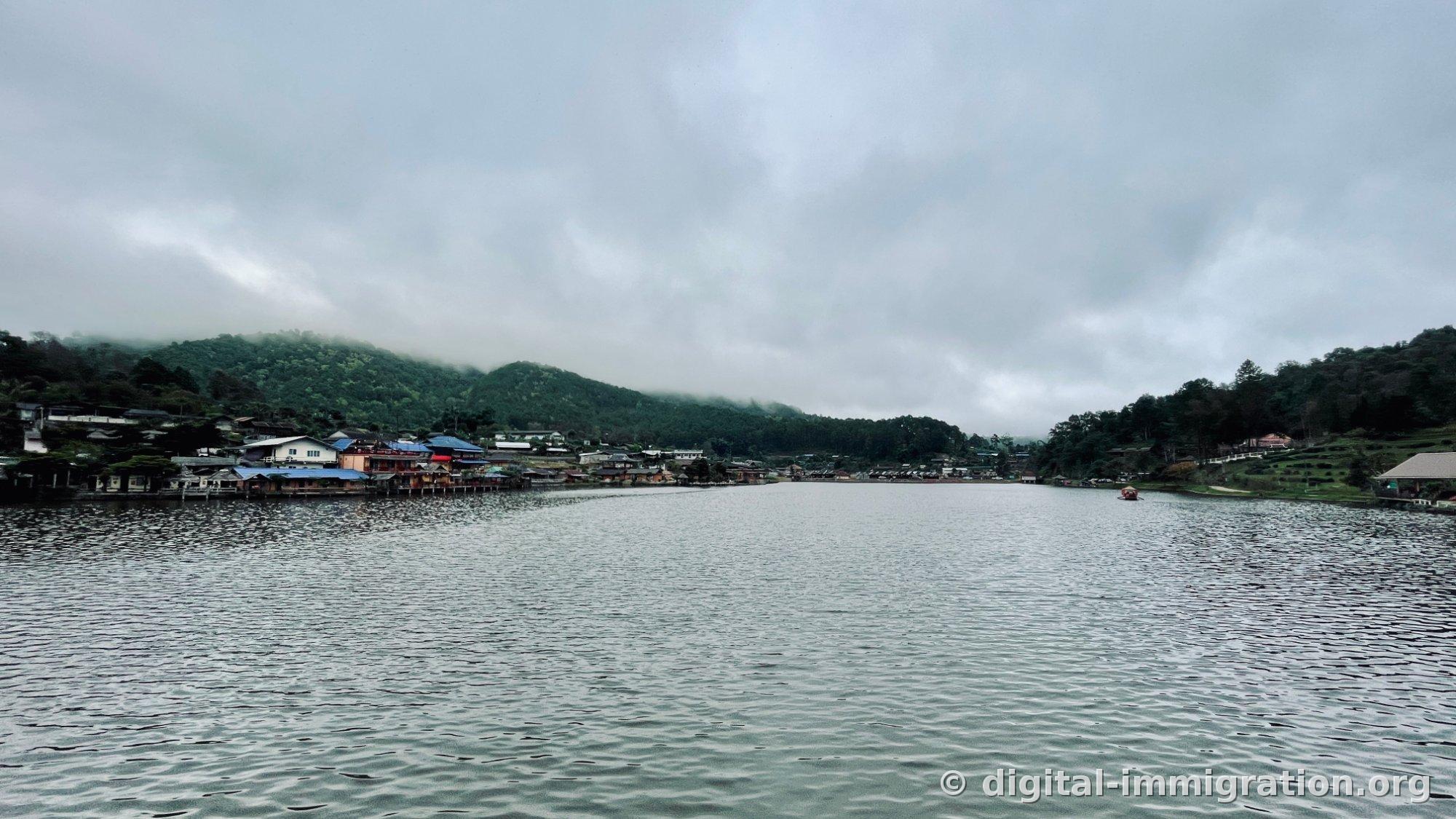
The lake is the village's heart. On a map it's tiny, and walking around it slowly takes only 20-25 minutes, but here's the catch—those 20 minutes never actually remain 20. Tea shops line the waterfront, and sitting at just one of them, two hours vanish. On my first afternoon, the sky hung entirely gray. Clouds draped across the mountain ridge like a blanket, and only ripples disturbed the lake's surface. Some might call it dreary in photos, but standing there in person, what hits you first is the silence. Bird calls, water splashing, a motorcycle in the distance. That's all.
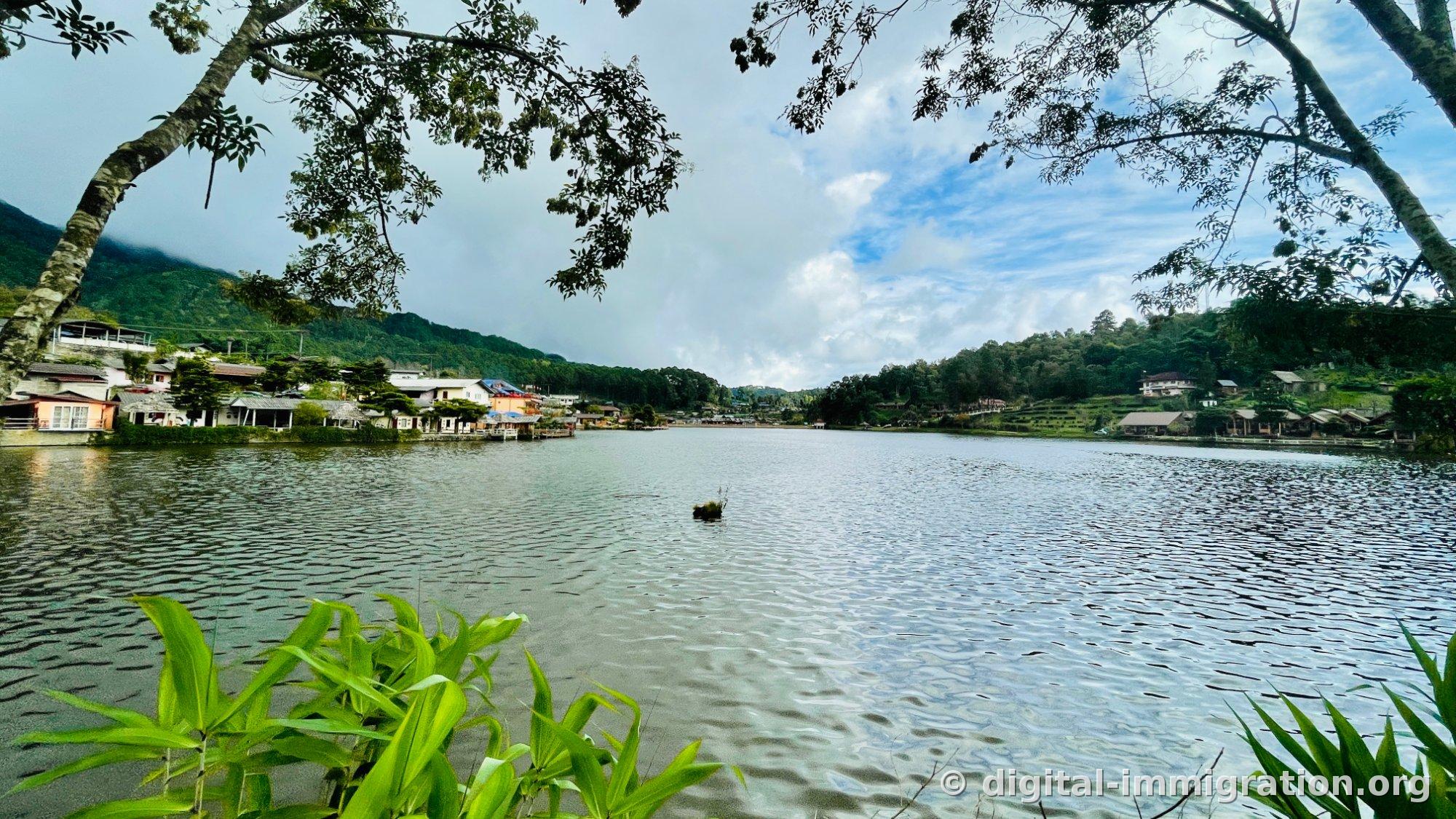
By morning, the clouds had partially lifted and blue holes appeared in the sky. Same lake, but the water color was completely different. In a photo taken beneath tree shade, something small floats in the lake's center—like a branch protruding from the water—which a neighborhood dog on its morning walk had been intently watching. The reason I mention weather at Ban Rak Thai is that most visitors stay just a night or two expecting to capture that "foggy lake" photo. But that fog only appears briefly around 6 a.m. and vanishes by 8. Sleep late, and you'll miss it.
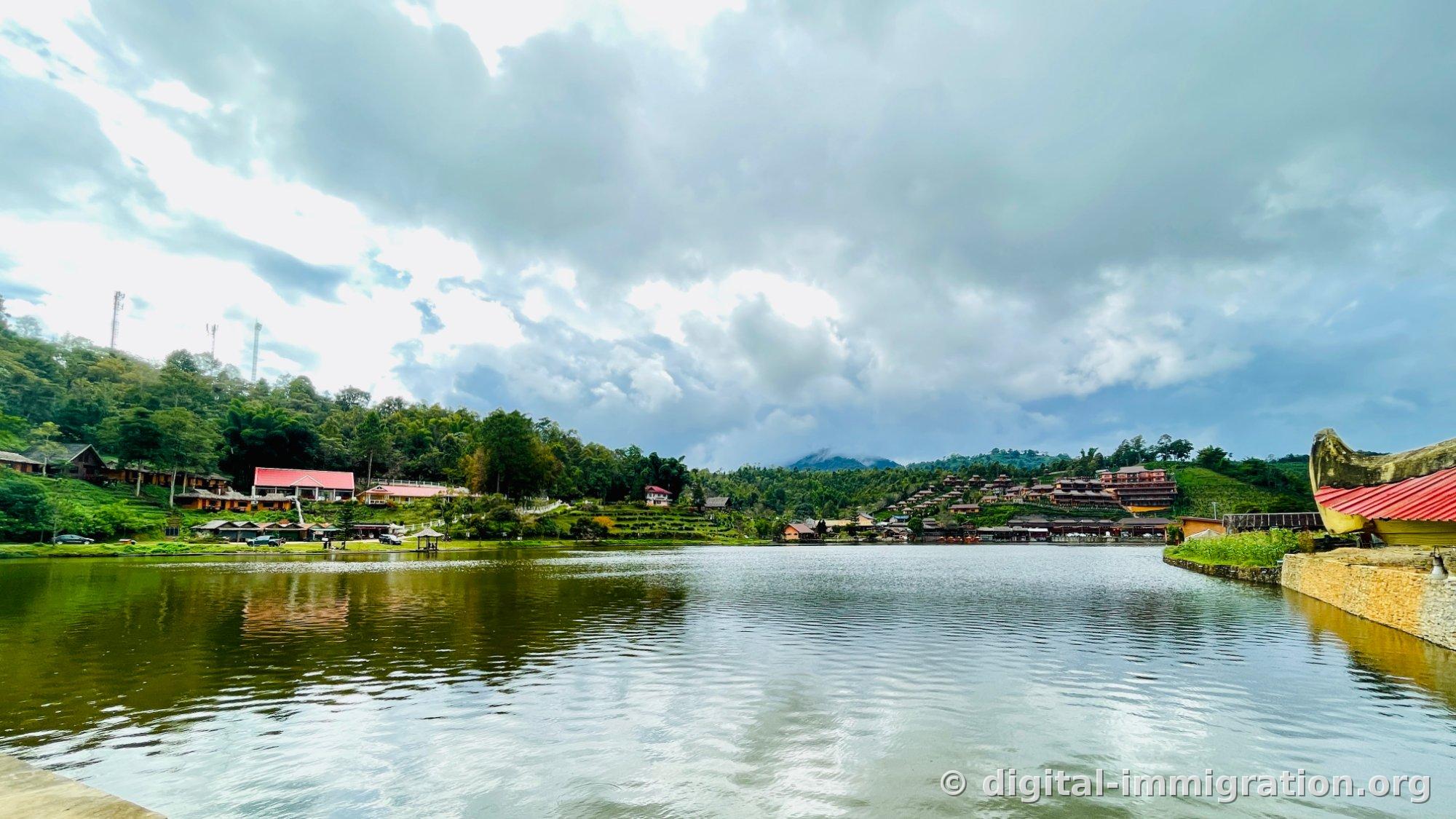
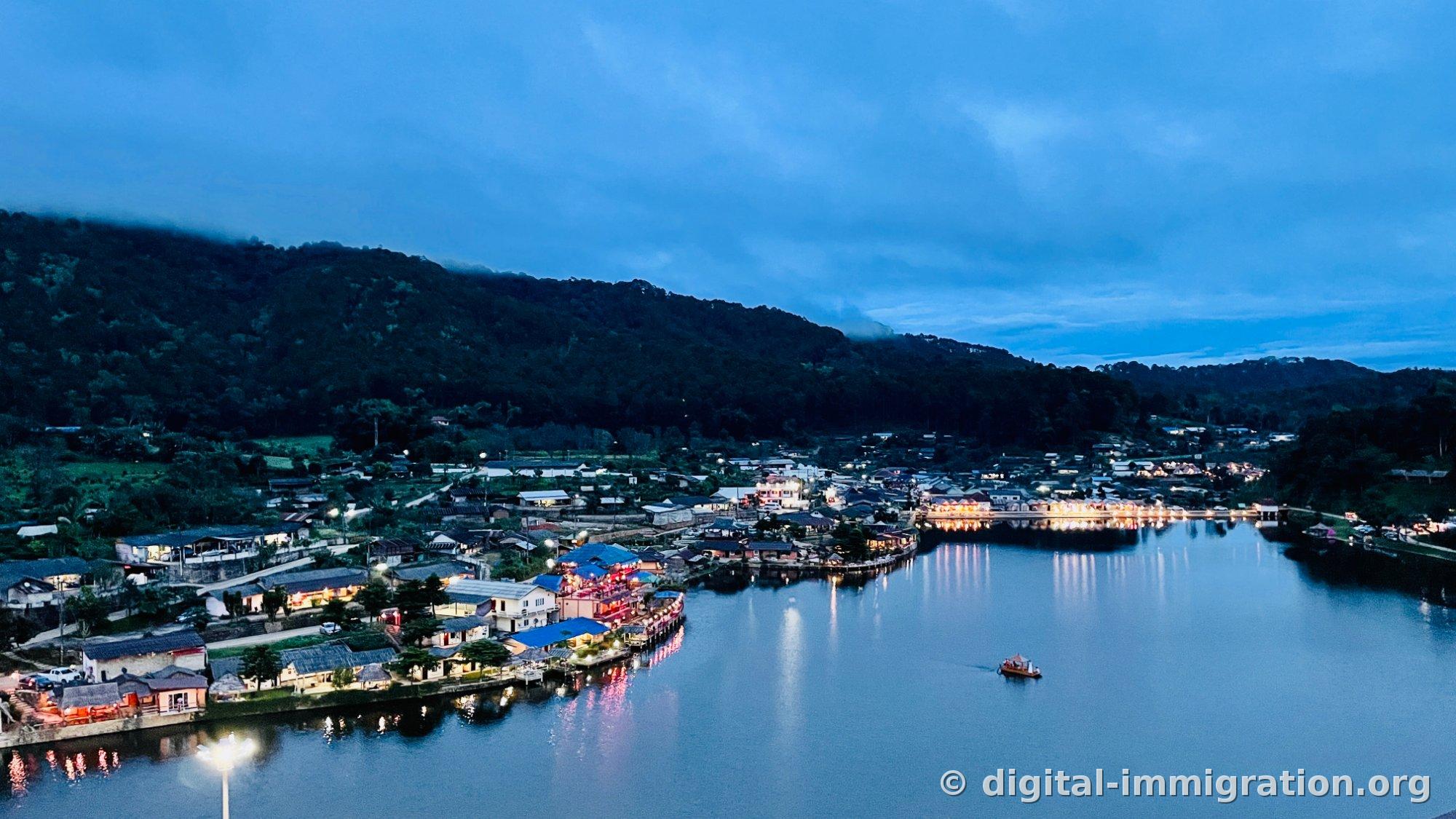
From the opposite side of the lake—the parking area side—viewing the village straight ahead, the entire town fits into one frame. From the red-roofed building on the left hillside to the resort complex on the right ridge, with cascading tea plantations filling the space between. The large boat-shaped structure visible in the right foreground is a sculpture installed by the lakeside, popular enough as a photo spot that lines sometimes form during peak hours.
Earth Houses on the Tea Terraces—The Village's True Face
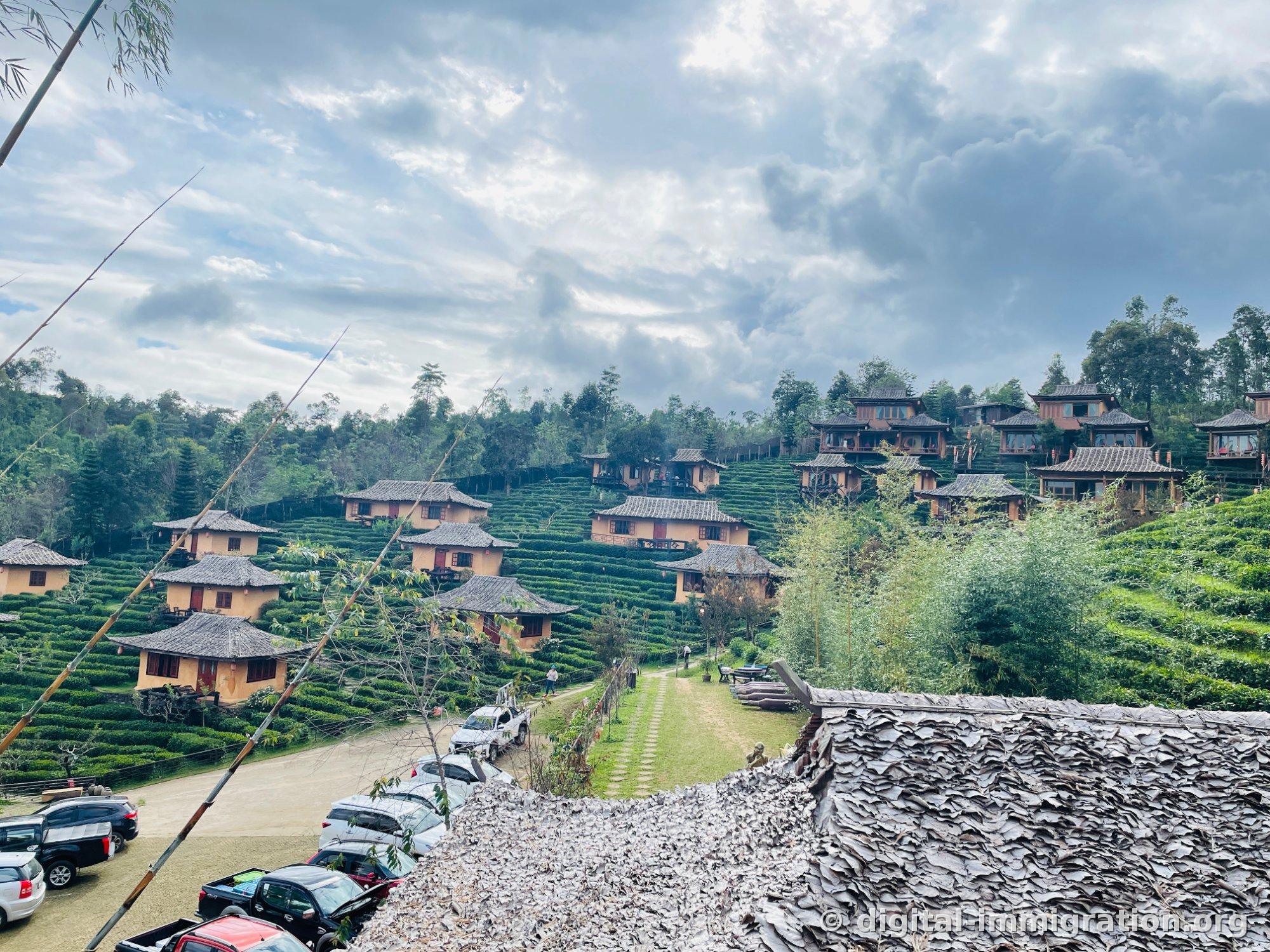
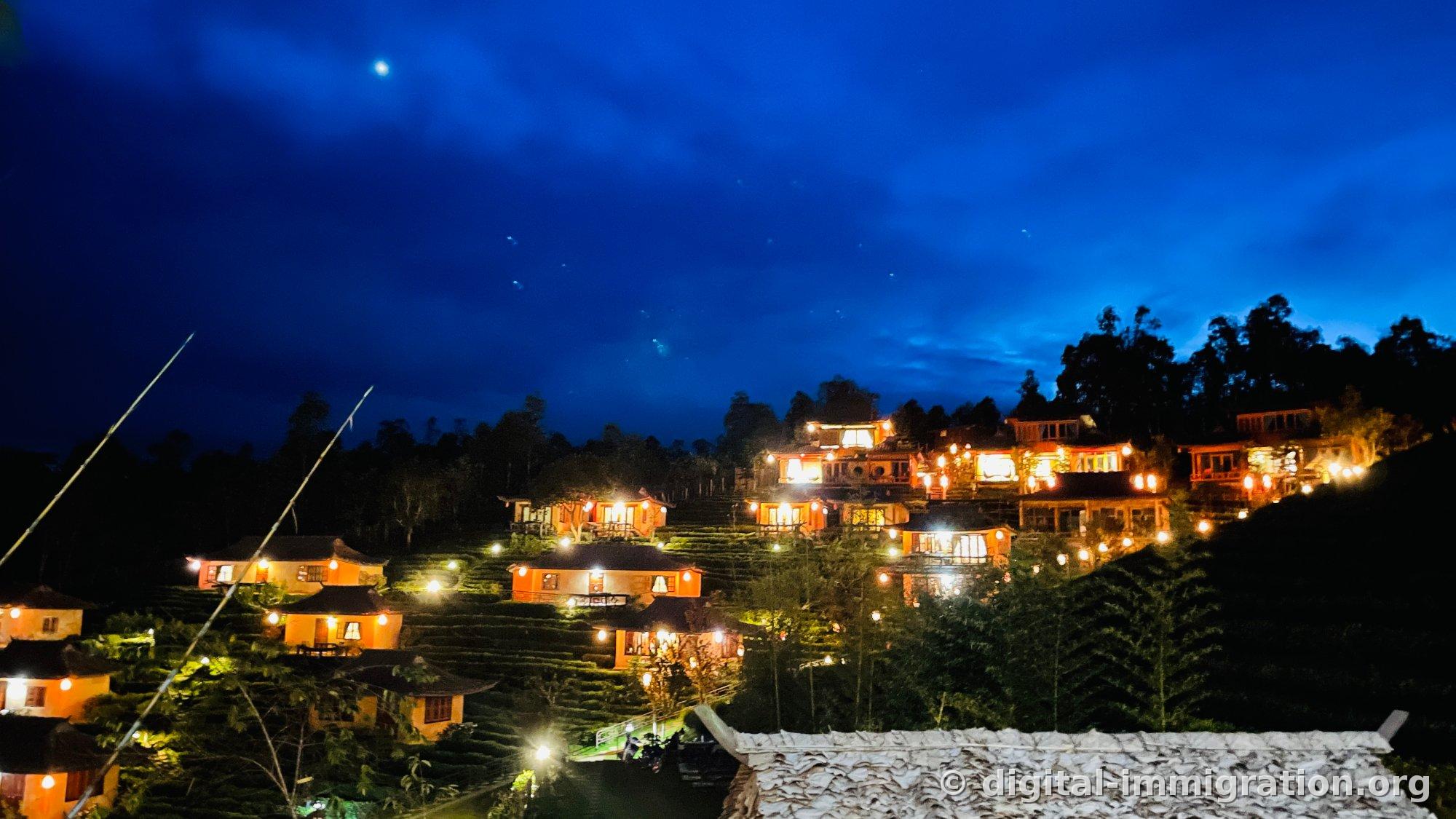
The defining difference between Ban Rak Thai and other Thai mountain villages is the architecture. Hillsides are terraced for tea cultivation, and wedged between the tea rows are Chinese-style earth houses with ochre walls and gray tile roofs. Looking up from the parking area during the day, each house is surrounded by tea rows following the contours like topographic lines. The gray shapes piled in front are drying racks where leaves are spread out to dry like tobacco leaves—up close, the scent of dried grass hits you. The long bamboo poles jutting up on the photo's left are flags planted throughout the village.
But these earth houses truly reveal themselves after sunset. Around 7 p.m., when the sky hasn't fully darkened but remains a deep navy blue, orange lights illuminate each house. Combined with lights planted between the tea rows, the entire hillside becomes a twinkling landscape. A moon rose in the upper sky with a few stars visible below it. Without a camera, just standing and watching felt better. But to be honest—this night view is a landscape created as the village developed into a tourist destination, not the original appearance when KMT descendants first settled here. Knowing that, it's still beautiful.
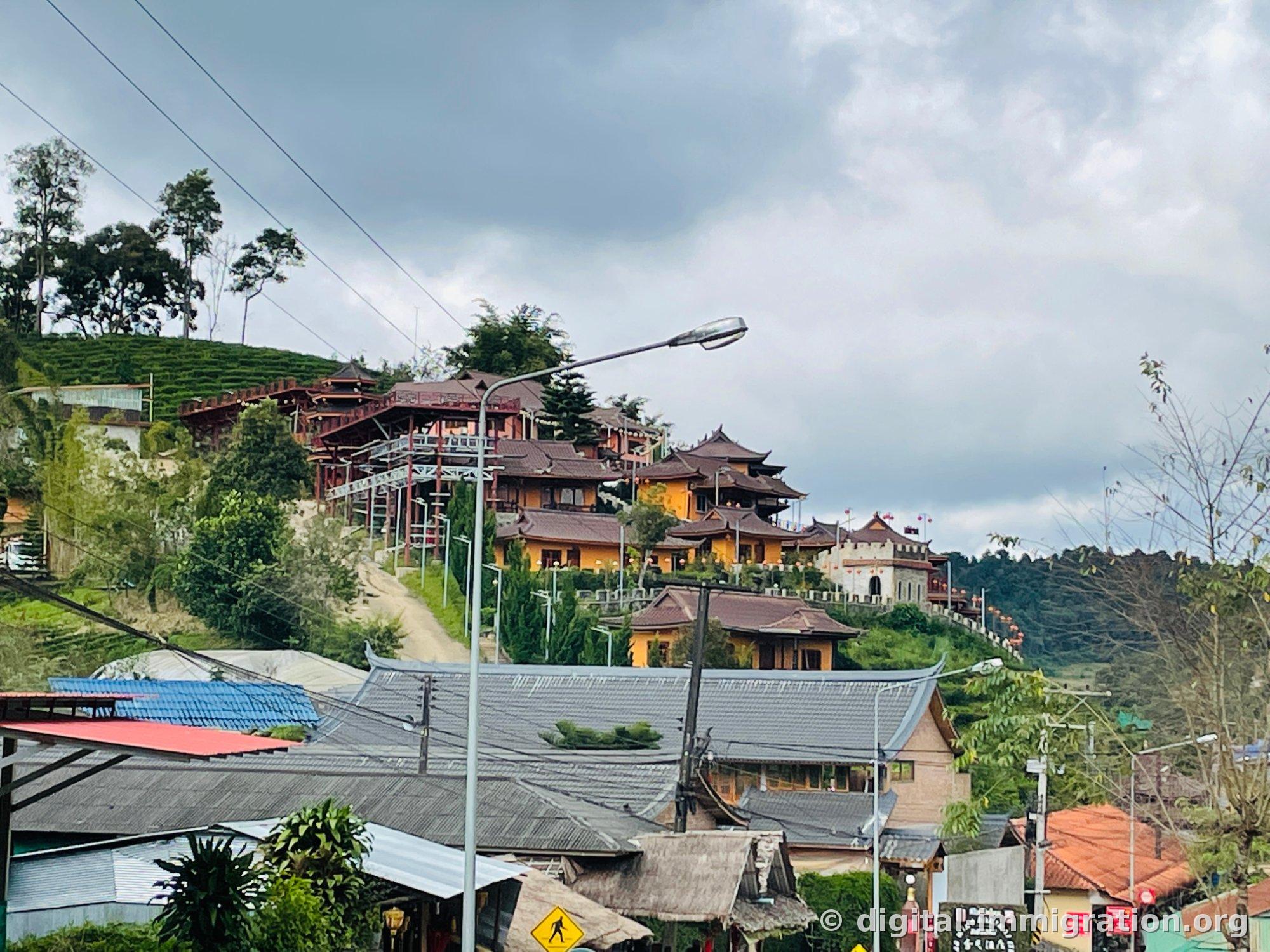
Looking up at the village center from the lake side reveals another layer. Below are older residential buildings and shops with gray tile roofs, and above on the hillside sit yellow-walled buildings with sharply upturned eaves, walls adorned with strings of red lanterns, and white structures resembling fortress walls. Ban Rak Thai today is a screen where new resorts and the old village overlap.
Where People Actually Live in This Village
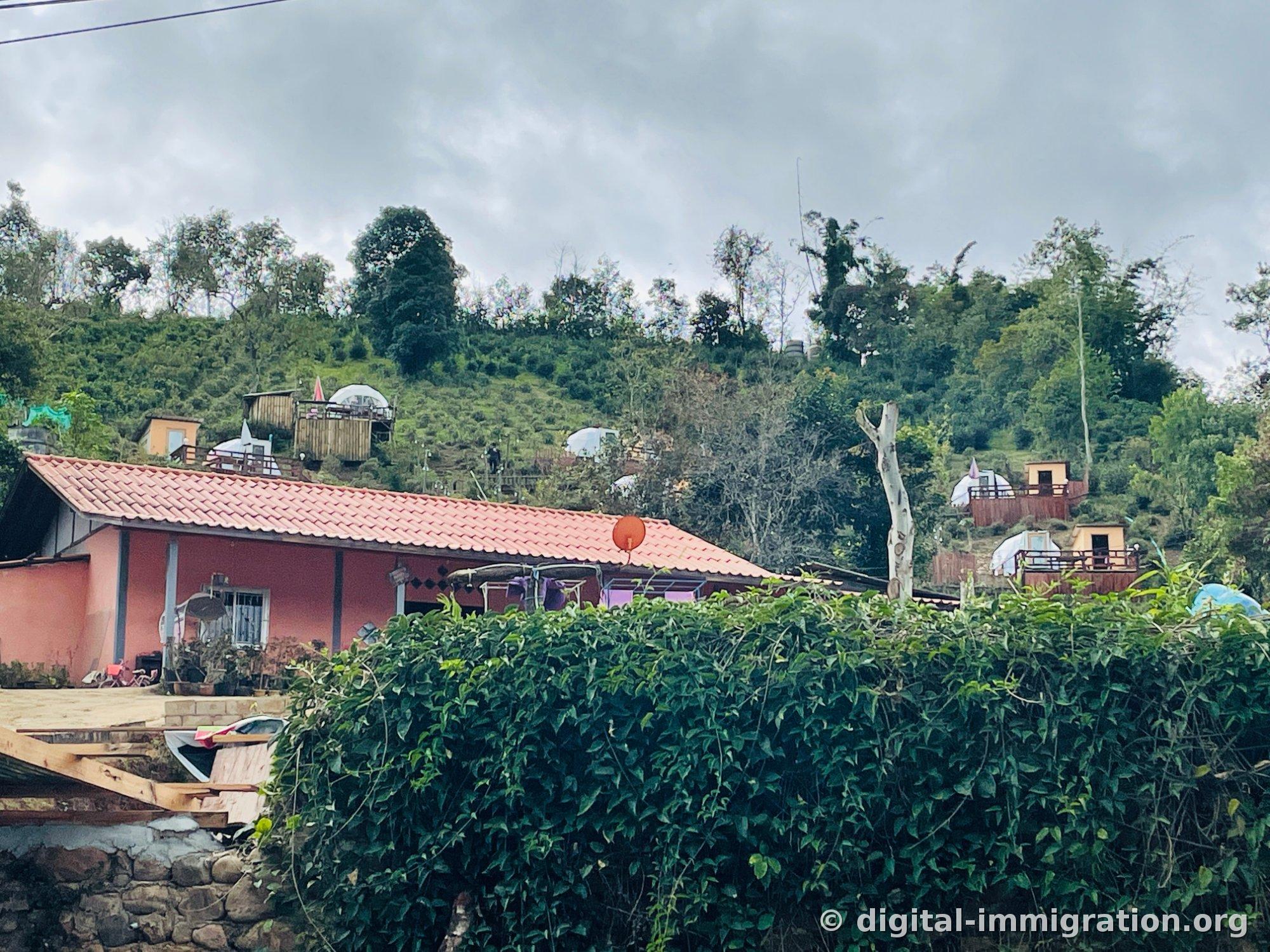
There are directions tourists rarely walk. Entering a south-side alley off the lake, pink residential houses appear with red tile roofs and orange satellite antennas on top, purple laundry hanging beneath the eaves. Further up the hill, several white dome glamping tents are being erected, and wooden deck construction is underway. This is the real current state of Ban Rak Thai. The image of a quiet mountain village and the reality of continuously cutting into hillsides to accommodate peak-season demand coexist side by side. From the first night, I heard concrete-mixing sounds from the adjacent hillside starting at 8 a.m. If you come expecting complete silence, you might feel slightly betrayed.
Location, How to Get There, and Practical Advice
Ban Rak Thai is about 44 km northwest of Mae Hong Son town via mountain roads, taking roughly 1.5 to 1.5 hours by car. The distance is short but the drive is long because endless hairpin turns climb the hillsides. I went by scooter, and 125cc was clearly underpowered on the steep sections. If it's your first time and you're uncertain, it's better to hire a songthaew or charter a vehicle from Mae Hong Son. During the rainy season (roughly June to October), roads are wet and fog can reduce visibility to mere tens of meters. Don't attempt this road for the first time after dark.
At the village entrance, earth houses stack upward against a backdrop of tea plantations. This photo captures the daytime scene through bamboo poles, and when the parking area below is this full of cars, you know it's peak tourist season. This region is indeed a popular winter destination among Thai travelers, with accommodations fully booked months in advance for weekend visits in December and January.
After visiting, here are a few practical tips.
- One night is essential. A day trip only shows you the daytime tea plantations. The evening lights and dawn fog require an overnight stay, and together they're the village's essence.
- It gets cold at night. The high altitude means the nighttime air feels noticeably colder in the dry season. Bring a light puffer jacket or hoodie. I wore a t-shirt during the day and was shivering by evening.
- Cash. Many small tea shops and vendors don't accept cards. QR payments require a Thai bank account, so cash is more convenient for foreigners. Withdraw money in Mae Hong Son town beforehand.
- Tea. Most tea shops offer oolong tea tastings free of charge, and there's no pressure after you sit down. If you plan to buy some to take home, compare packaging sizes and prices at a few shops. Prices vary by shop and change frequently, so checking on-site is most accurate.
- Don't expect to swim. This isn't a lake for swimming but for sitting and viewing. There are raft boat experiences available, but operating hours and fees vary by season, so ask when you arrive.
On the morning of departure, after loading my bags, I walked around the lake one more time. A tea shop owner's grandmother sat in a chair by the door, still before opening hours, drinking tea, and said something to me in Chinese—neither Thai nor English. I couldn't understand, but I smiled and waved back. The feeling that all of Yunnan has been transplanted into the mountains next to the border—that's what stays with you from Ban Rak Thai.
Baca juga
- A Day at Karahill Anona (Karahill Anona) on the 1st Floor of Phuket Karon Anona Beachfront Resort Until Midnight
It's my fourth day in Phuket's Karon area. My lower back was sore from riding a long-tail boat in the afternoon and hitting some rough waves. Thai massage shops are everywhere in t…
Phuket · Karahill Anona - Karahill Nail & Beauty in Phuket — A nail salon on the 2nd floor above an Indian restaurant, declaring itself from the staircase
Getting nails done in Phuket is usually spontaneous. You notice a sign on the way back from the beach, pop in, spend about 200 baht having your nails trimmed, and leave. But this p…
Phuket · Karahill Nail - Phuket Patong Karahill Massage — Thai Massage 400 Baht, Saw a Shiba Inu During a Foot Massage
As you walk through the alleys of Patong, you see a massage shop sign every ten steps. I stopped in front of Karahill Massage because the interior was clearly visible through the g…
Phuket · Karahill Massage