A Day at Kura Sushi in Asakusa, Tokyo: Three Tuna Plates and Ending with Castella Cake
Once you exit Nakamise-dori at Senso-ji in Asakusa, there's a stretch where tourist density drops noticeably. That's where I wandered into Kura Sushi Asakusa—purely because the wai…
Tokyo · Kura Sushi Asakusa
Once you exit Nakamise-dori at Senso-ji in Asakusa, there's a stretch where tourist density drops noticeably. That's where I wandered into Kura Sushi Asakusa—purely because the wait looked short. Among Tokyo's conveyor belt sushi chains, Kura Sushi's tourist-area locations tend to be particularly crowded, but since it was an awkward afternoon hour, I got a seat after about a 20-minute wait.
The Entrance Is Already Decked Out Like a Tourist Attraction
As soon as you open the door, a giant white lantern hanging from the ceiling catches your eye. It's roughly the size of a person's torso, with 'KURA' written in black brushstrokes. Below it, smaller lanterns line up in a row, each one labeled with a menu item. There's something charming about reading through items like 生サーモン (fresh salmon), 中とろ (chu-toro), 天然くえ (wild grouper), ひらめ (flounder), and 北ほたて (Hokkaido scallops) one by one. If you can't read Japanese, they're just pretty lights, but if you can, you'll know exactly what the day's featured menu is right from the entrance.
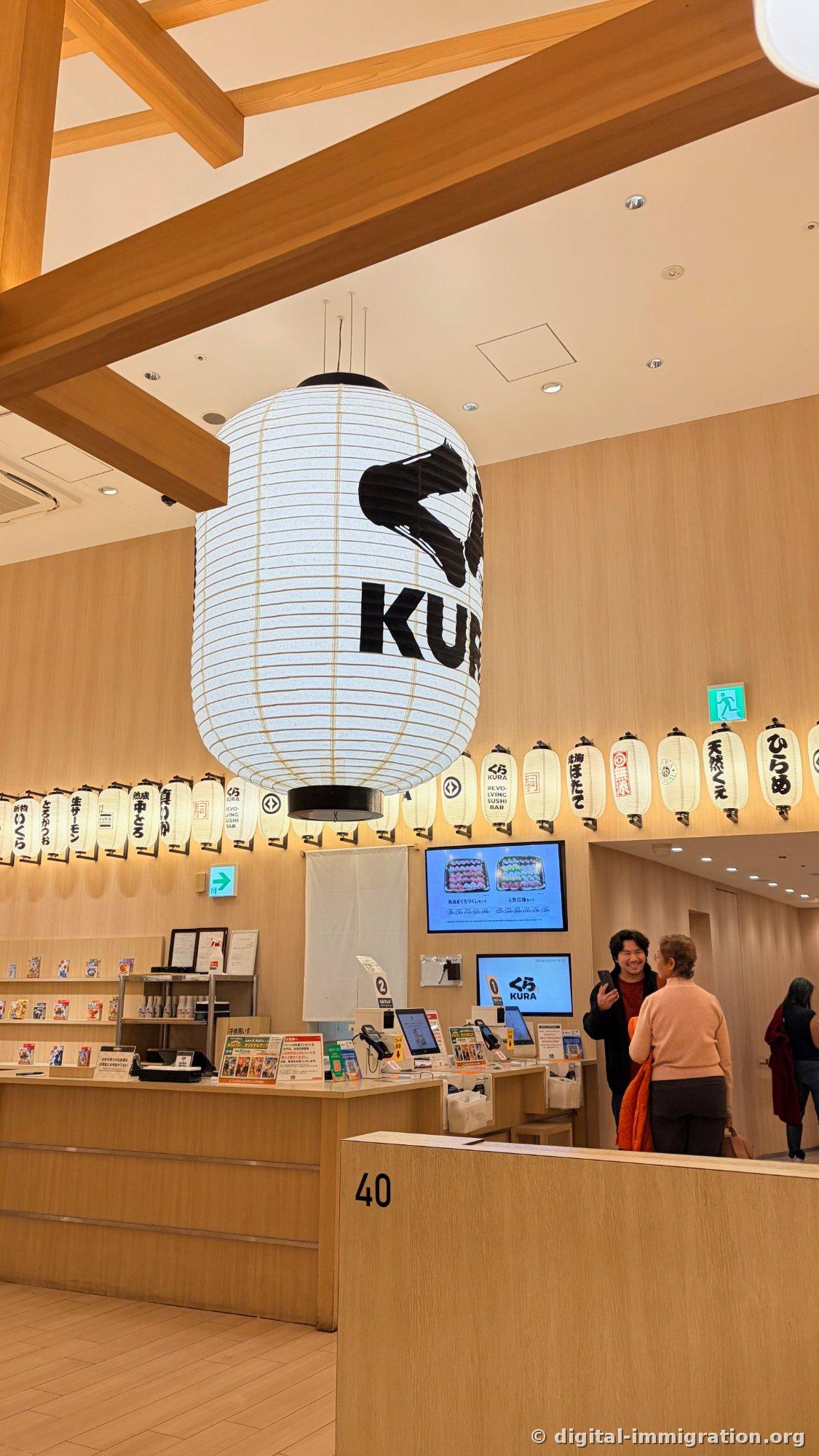
You get your ticket directly from the tablet on the right side of the counter. You choose your party size and seating type (counter or booth), and a ticket is issued with your call number displayed on the monitor above. You barely need to interact with staff. First-timers often get confused here—you don't line up and wait; instead, you get your ticket first and sit in the waiting area. If you stand without a ticket, people who came after you will get seated first.
The Waiting Area Is More Than Just a Waiting Area
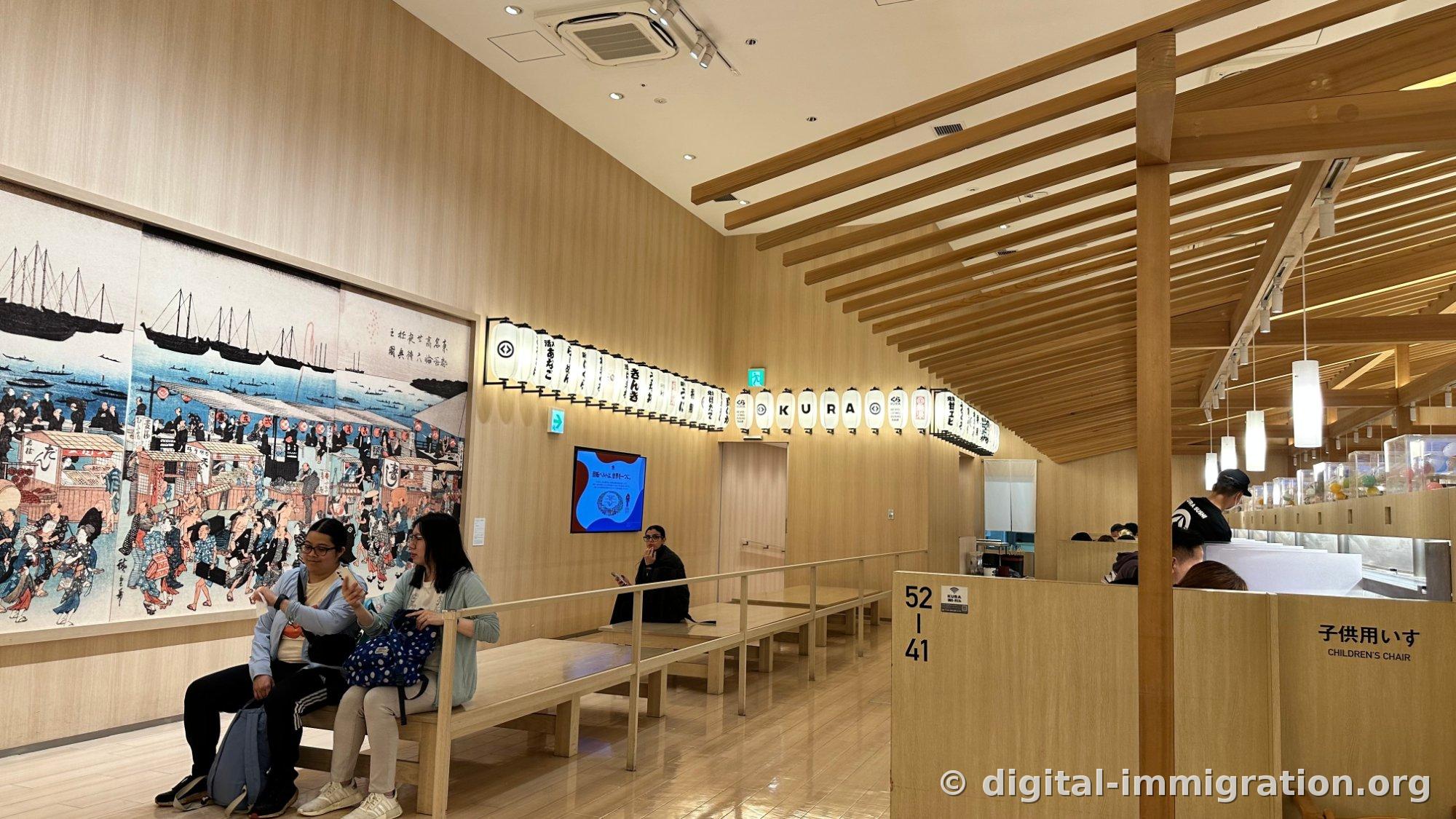
On the waiting area walls hang large ukiyo-e prints from the Edo period. They depict harbors lined with ships and kabuki actors mixed together—clearly chosen to match the Asakusa neighborhood's character. The ceiling is made from wooden beams arranged in a lattice and left exposed, and the walls are in warm wood tones, so there's none of that cheap chain-restaurant feeling. Next to the waiting area is a sign reading '子供用いす / CHILDREN'S CHAIR' in bilingual Japanese-English, and seat numbers like '52-41' are posted in large letters, making it easy to find your spot.
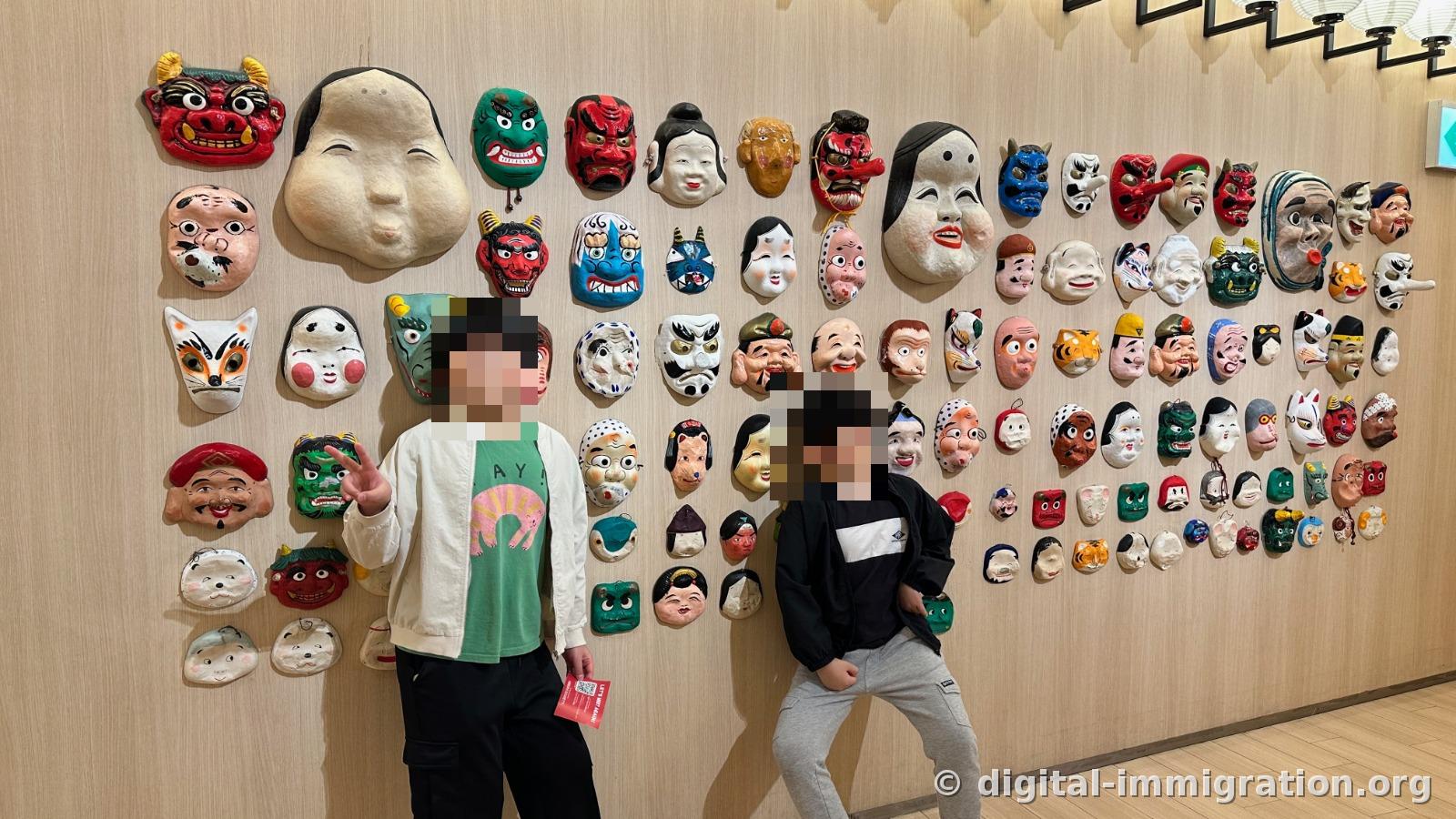
While waiting, my two kids posed for photos in front of a wall-sized display of Japanese traditional masks. Red oni, white okame, fox masks, tengu, even the wide-eyed hyottoko—roughly a hundred masks were crowded densely across the entire wall, arranged so they got progressively smaller from top to bottom. Standing before it, the wall felt completely filled with faces. The kids entertained themselves here for quite a while, which meant the adults could actually sit and rest. That's why even a long wait doesn't wear you down as much.
Location and How to Find It
Coming from Senso-ji's direction, it's tucked into an alley, so the storefront doesn't immediately jump out at you. The coordinates on the map below show where I actually took photos. It's within walking distance from Asakusa Station, and it fits perfectly into a typical tourist itinerary—finish viewing the temple, then grab a late lunch or early dinner. For accurate operating hours and current wait times, I'd recommend checking in person—Kura Sushi does take advance reservations through their app, but many short-term travelers find it faster to just show up and get a ticket, since the app sometimes requires a Japanese phone number or account.
I Ordered Three Tuna Plates
Once seated, there's a tablet at your table, and the conveyor belt runs on two levels. The upper level has plates just rotating around, while the lower level is an express lane where your ordered dishes arrive. The plates have hygienic covers that automatically pop open when you lift them. First-timers often fumble trying to peel the covers off by hand, but if you just lift the plate up, the lid catches and opens automatically.
The first plate that arrived was maguro. The red flesh completely covered the rice and hung down on both sides when I picked it up with chopsticks. At a conveyor belt chain like this, that thickness doesn't feel like a rip-off. The texture was fine and there was no fishiness. The plate next to it already showed signs of having been eaten—ginger slices and soy sauce stains remained.
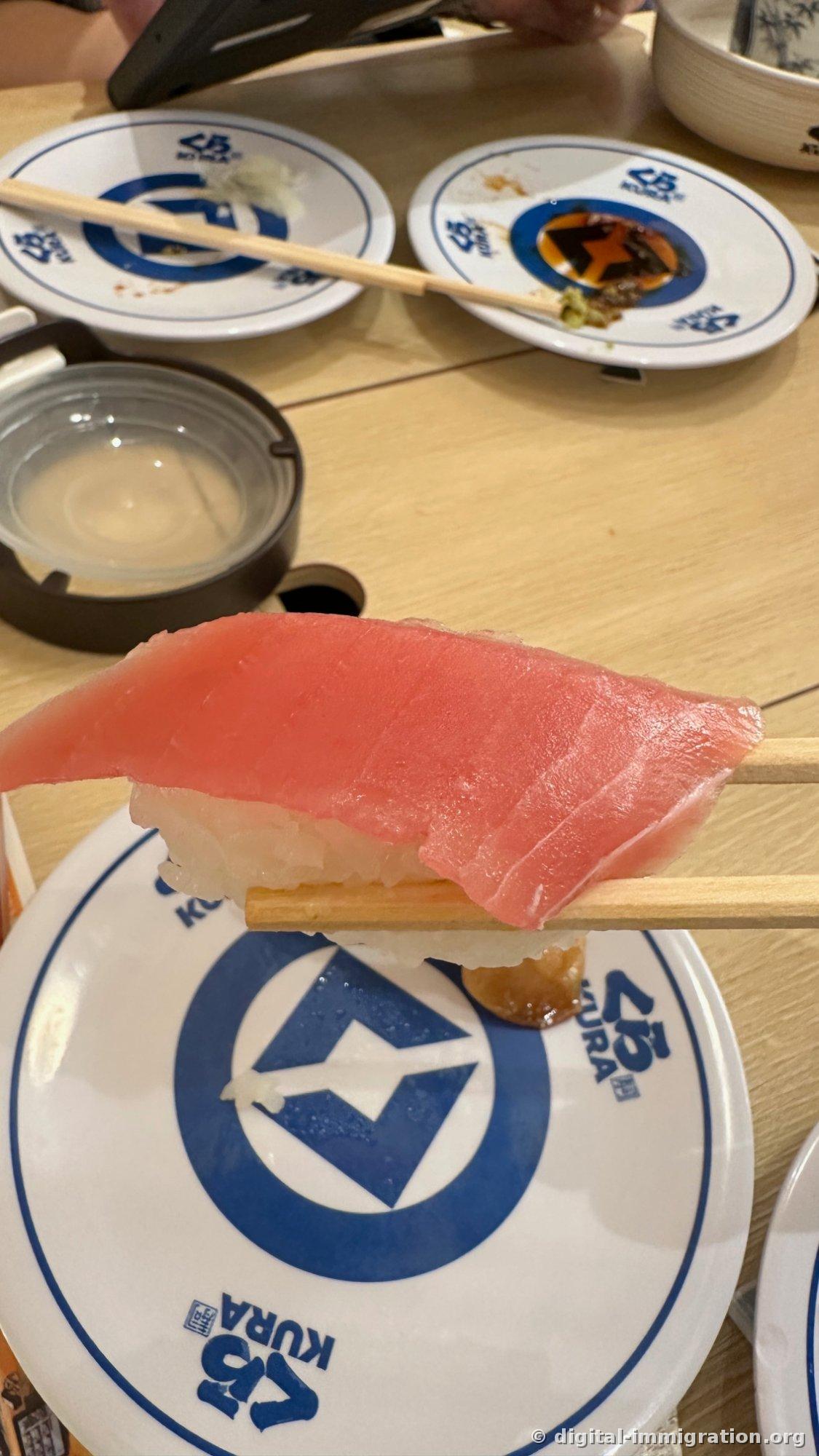
The next plate had a deeper color with an oily sheen on the surface. You could see it glistening under the light—visibly different. The texture when chewing was completely different too. While the first was clean and snapped crisply, this one dissolved in your mouth. I could see another plate in the background with squid, salmon, and ginger—that was what the person next to me had ordered.
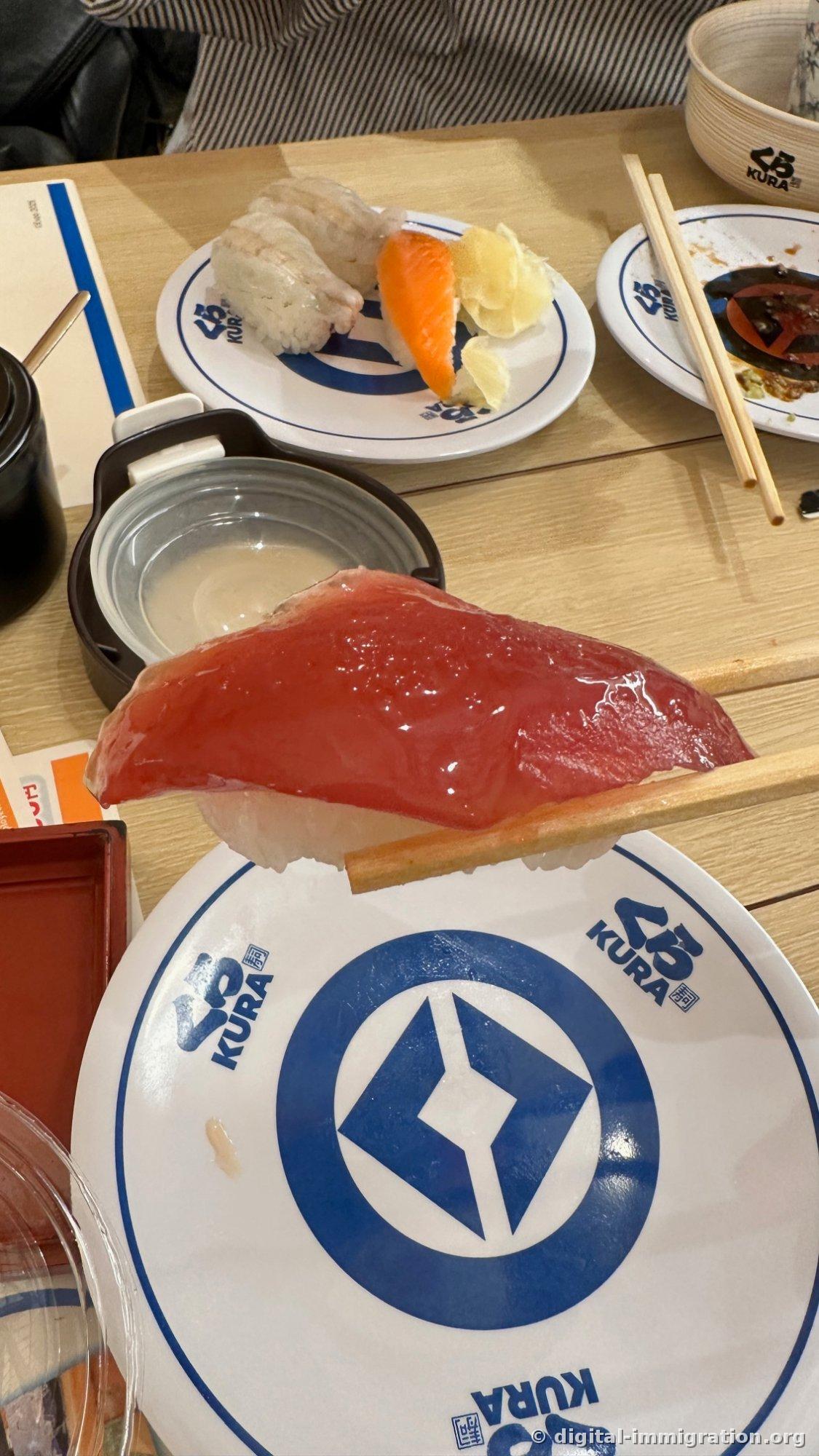
For the third plate, I moved to a counter seat. Sitting right beside the belt's input point, I could see all the dishes passing along the lower express lane. Each rice grain looked perfectly intact, and the tuna was layered on top with clean, angled edges. Next to me was Kura Sushi's proprietary soy sauce bottle—a white bottle labeled 'しょうゆ'—with a spray dispenser, so you don't have to pour it onto each plate. The ginger was already portioned next to the rice.
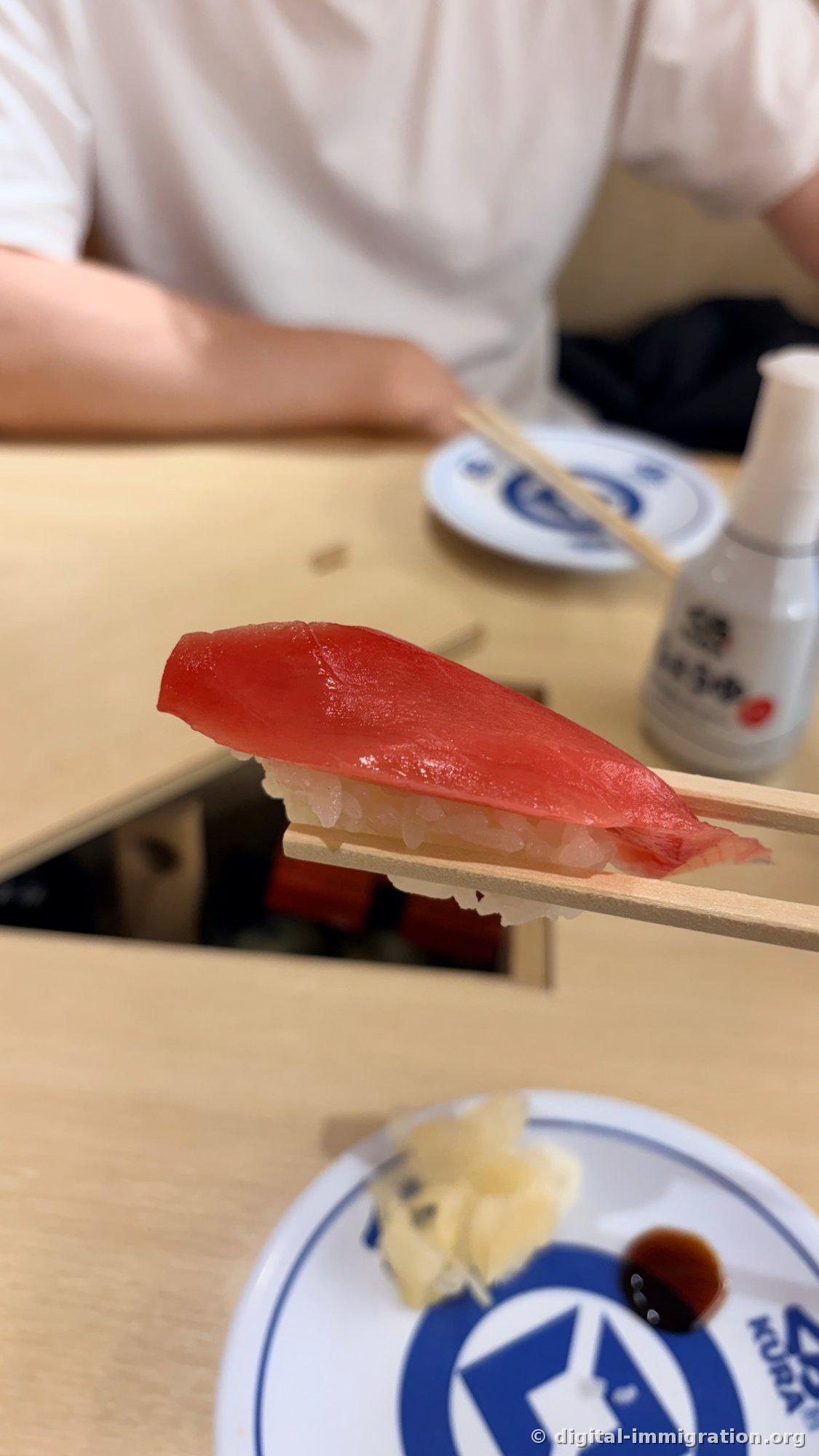
The Grand Finale: Castella Cake
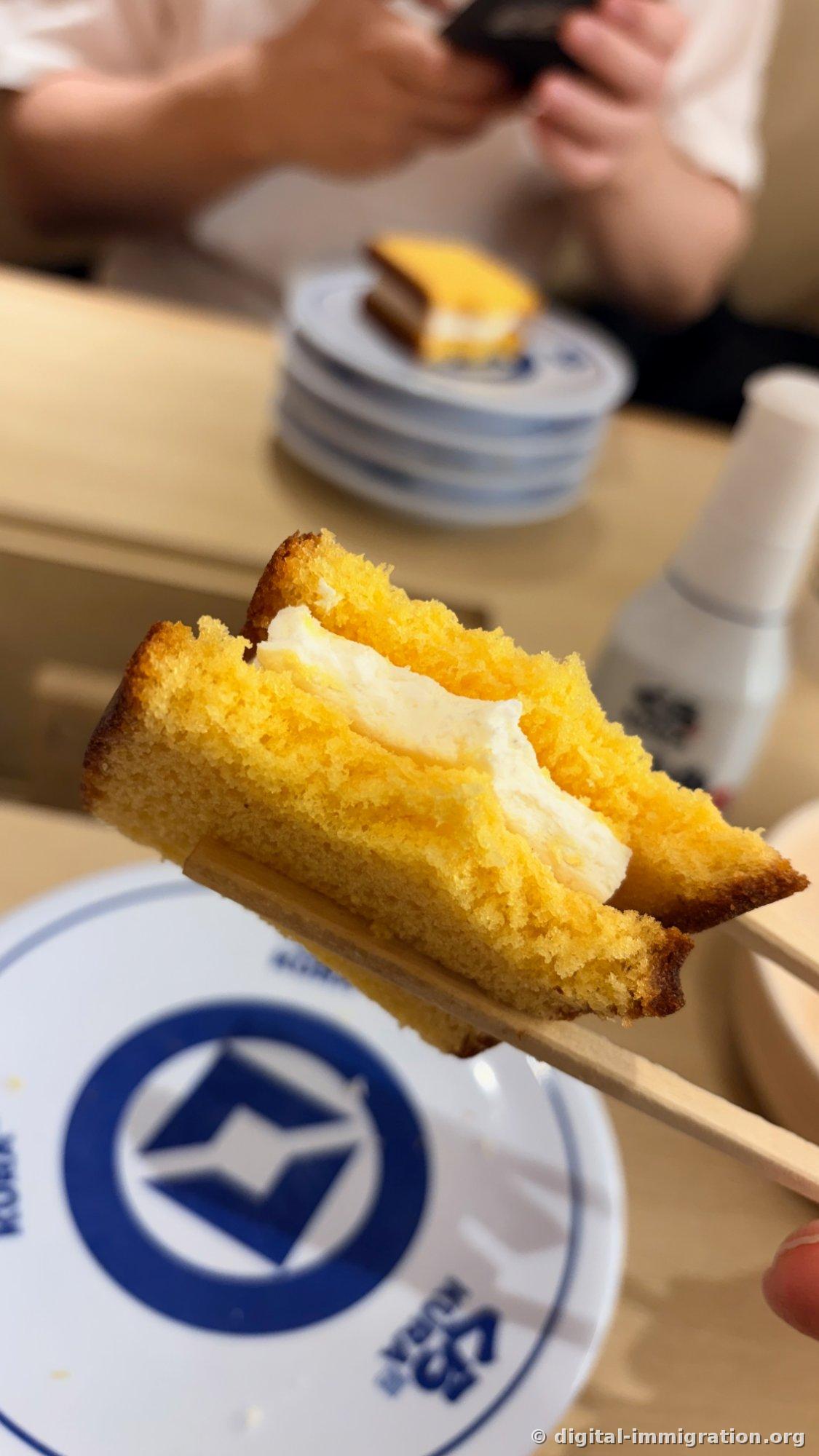
I wasn't expecting much from a sushi restaurant's dessert, but the real discovery of the day was the castella cake. It's two layers of yellow sponge cake with thick cream sandwiched between them—when viewed from the side, you can see it's divided into three perfectly distinct layers. The edges of the castella are darkly caramelized, while the interior has a rich egg-yellow color.
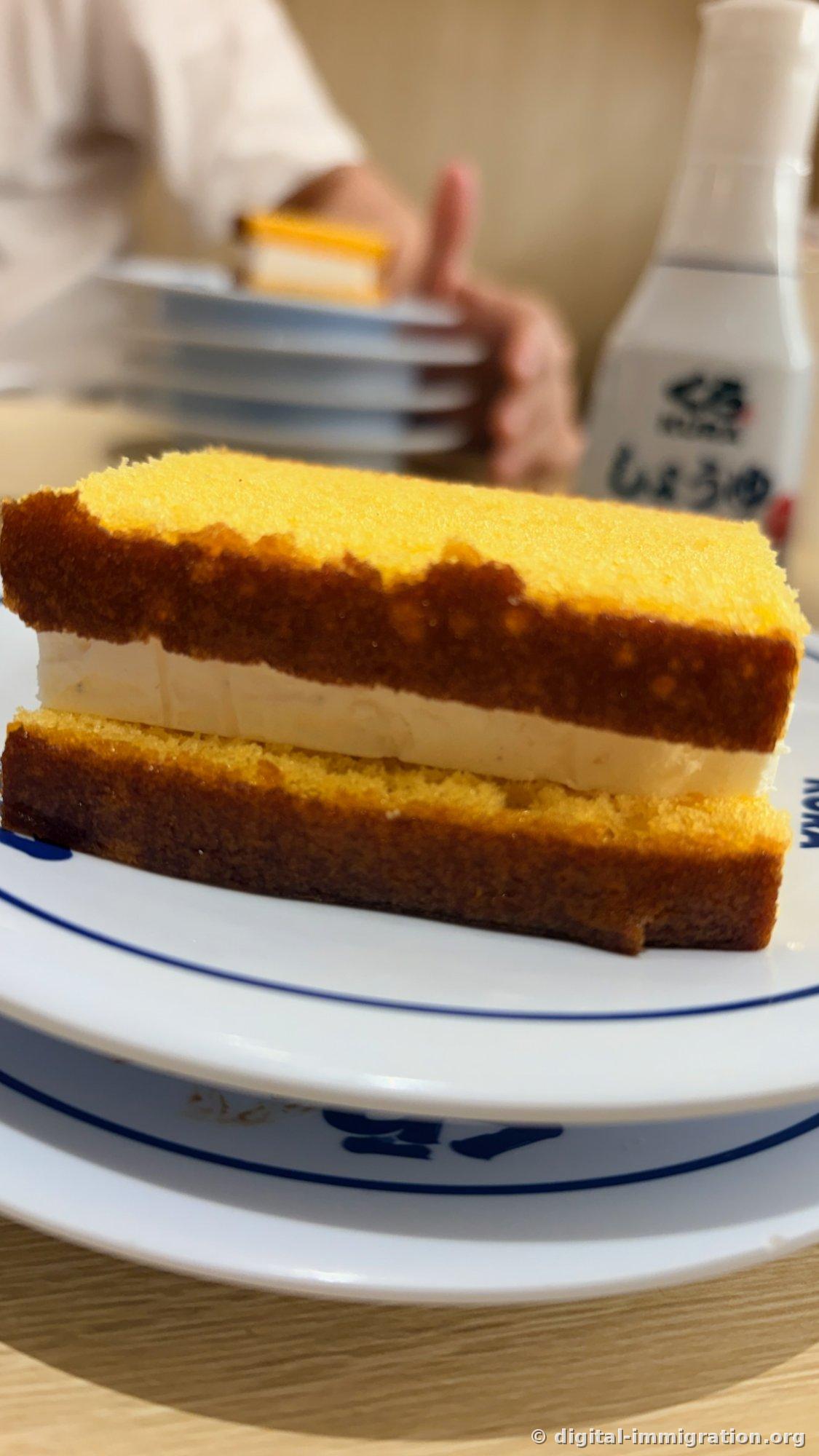
From above, you can see the crumb structure of the sponge cake more clearly. The sponge is fairly coarse, so you can cut it easily with chopsticks rather than a fork. The stack of plates behind serves as evidence of how much I'd eaten, but when you're done, you don't count plates to pay—instead, you put them in the return slot and they're counted automatically. For every five plates, a game appears on screen, and if you win, you get a capsule toy. The kids definitely wanted to order more plates because of this.
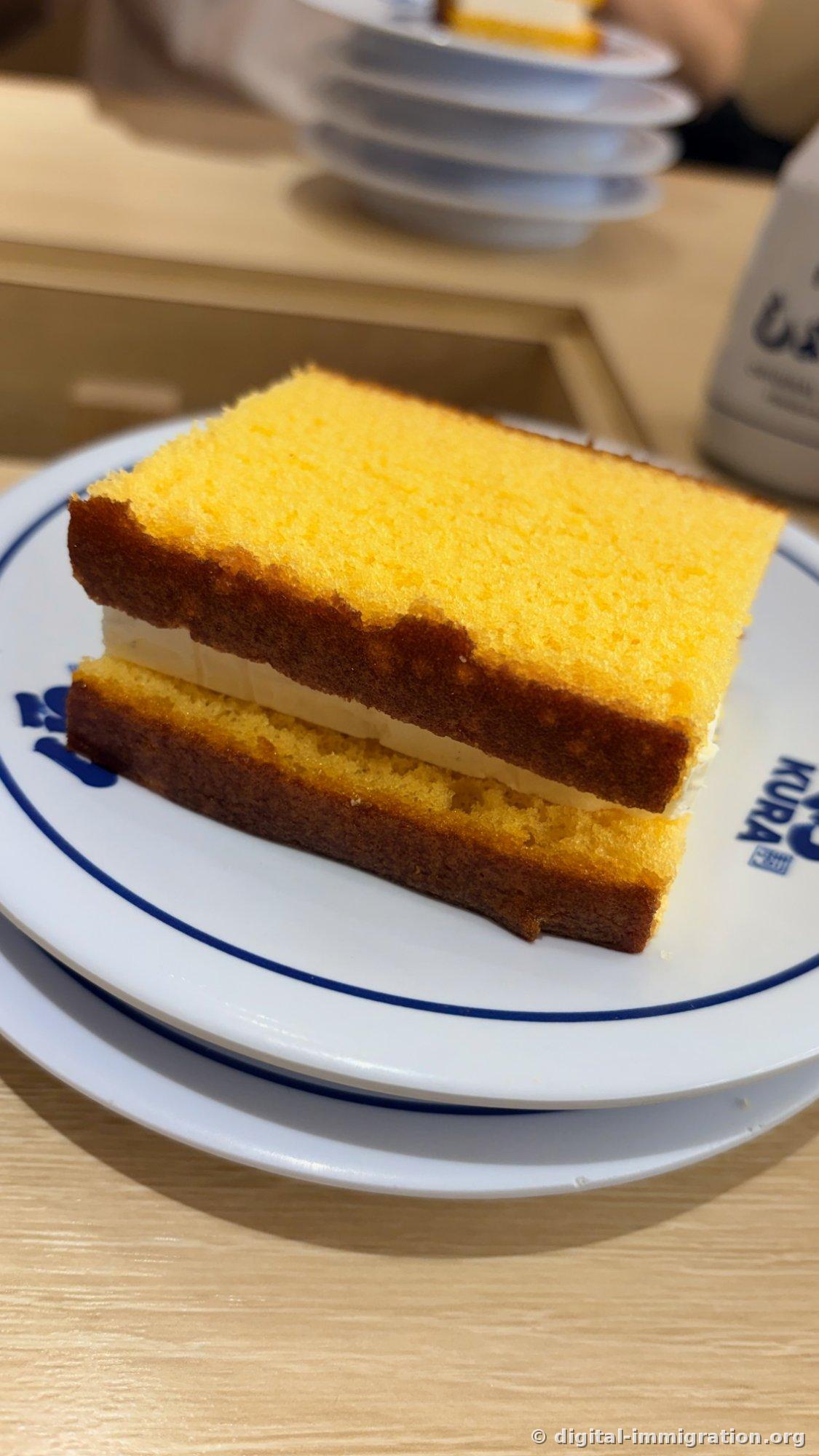
One bite and the cream squishes out the sides. It's less sweet than expected. The texture is closer to custard than whipped cream, and the caramelized edges of the castella add a slightly bitter note when you bite through. Even after eating roughly ten plates of sushi, it didn't feel heavy. The person across from me finished theirs and stacked an extra plate on top of the pile.
If You Come Back, Here's What to Know
- Find the ticket machine first. You grab a number before lining up—that's how it works.
- If you're waiting long, the mask wall becomes a playground for the kids. Adults should just sit on the bench and rest.
- Don't try to peel the plate covers—just lift them and they'll pop right open.
- Order one light tuna and one fatty tuna and compare them—the difference is very clear.
- Don't skip dessert. The castella cake was the most memorable part of the whole meal.
- Prices and hours vary by location, so check in advance before you go.
If someone asks whether you really need to eat conveyor belt sushi in Asakusa, I'd say: on a day when tourist-area prices have worn you down, it's exactly the answer you're looking for. It was definitely cheaper than what we ate in the alleys around the temple, and the kids never got bored.
Baca juga
- From Akihabara's Chuo-dori to the Kanda River: A Record of Tokyo's Electronics District Revisited Multiple Times
Tokyo's Akihabara is a neighborhood where it's hard to say you've seen everything in a single visit. I've come multiple times across different seasons, and each time the signs chan…
Tokyo · Akihabara - Buying a Single ¥300 Year-End Jumbo Lottery Ticket at Nishi-Ginza Chance Center in Tokyo
Exit from the Hibiya exit of Tokyo's Shimbashi Station, walk toward the elevated highway for about three minutes, and suddenly you'll see a line of people stretching along the side…
Tokyo · Nishi-Ginza Chance Center - Ueno Ameyoko, the real magic starts after sunset — an evening walk from the Okachimachi Gate to Ueno Station
Every time I come to Tokyo, my feet find their way to Ueno Ameyoko (アメ横) without fail. This time I entered from the Okachimachi side and worked my way toward Ueno Station. I've met…
Tokyo · Ameya Yokocho Market