Kuala Lumpur Petronas Twin Towers, From the Banyan Tree by Day to the KLCC Fountain at Night — A Full Day's Record
During my stay in Kuala Lumpur, I spent an entire day entirely within one block of KLCC (Kuala Lumpur City Centre). The Petronas Twin Towers are Malaysia's most iconic building, ma…
Kuala Lumpur · Petronas Twin Towers
During my stay in Kuala Lumpur, I spent an entire day entirely within one block of KLCC (Kuala Lumpur City Centre). The Petronas Twin Towers are Malaysia's most iconic building, making it easy to treat it as a quick photo stop, but I entered on foot in the afternoon and stayed until the fountain show ended at night. To put it plainly, this neighborhood is a completely different place by day and night. During the day it's just a hot business district, but the moment the sun sets, the entire city starts revolving around these two towers.
Walking in — Starting with the Giant Tree on Jalan Ampang
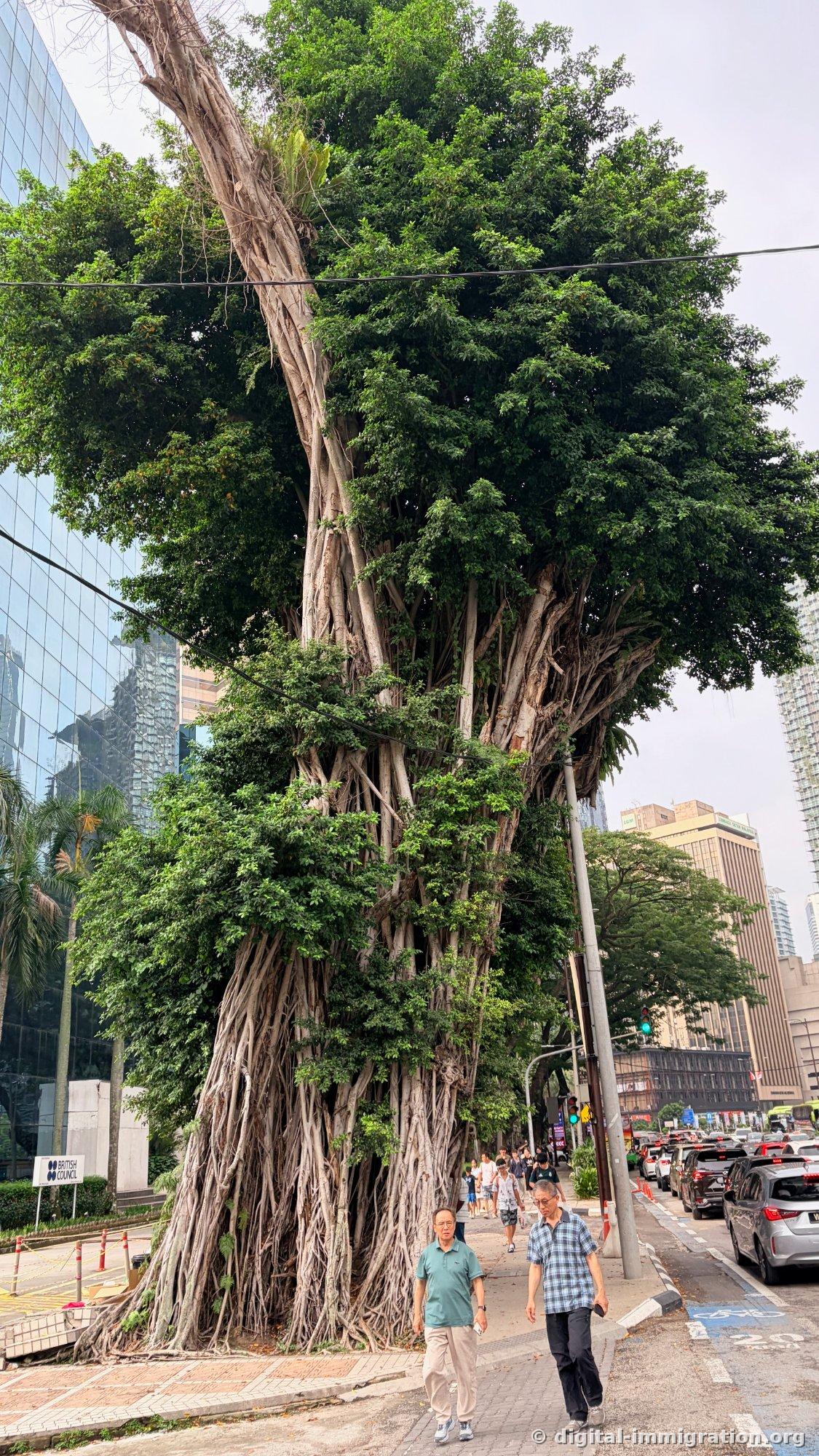
Rather than taking a taxi to the front entrance, I walked from the Jalan Ampang side, and that was the best decision of the day. In the middle of the sidewalk next to a British Council sign, stands a tree with more presence than the glass curtain-wall buildings. It's an ancient fig tree of the Banyan variety, its roots descending in hundreds of strands to wrap around a trunk, and seeing how the sidewalk was rerouted around it, you realize the city was built to avoid this tree. Standing in its shade, the felt temperature dropped noticeably. At around 2 PM, Kuala Lumpur's humidity clings to your body, so knowing where shade like this exists actually becomes a matter of endurance.
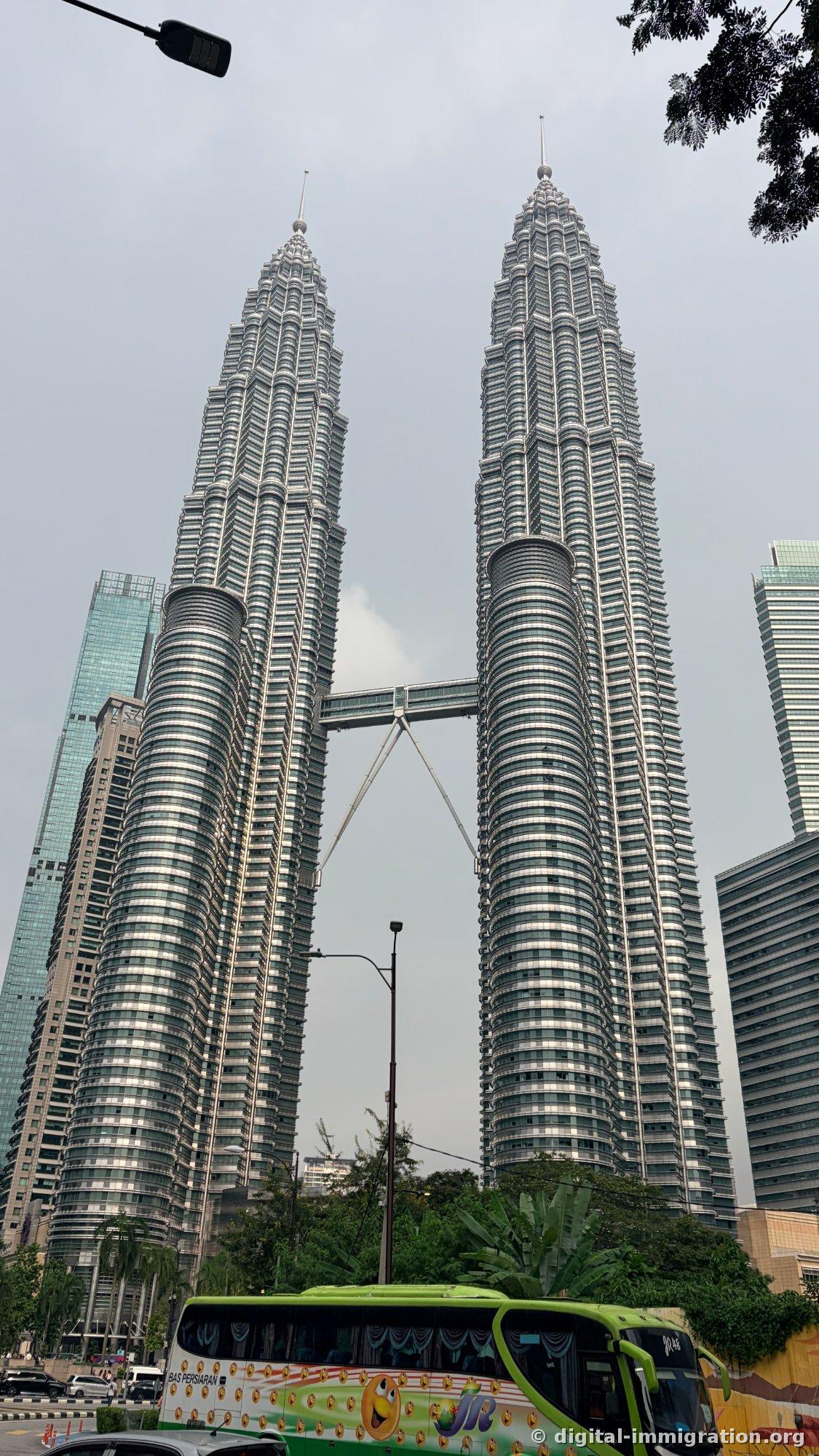
Walking a few minutes further, the view opens up and the two towers come fully into frame. The Twin Towers in daylight aren't silver so much as the color of a cloudy sky. The stainless steel and glass facade reflects the sky directly, so on overcast days the building almost blends into the background. The Skybridge connecting floors 41 and 42 hangs precisely between the two towers, and the V-shaped support structure beneath it is clearly visible to the naked eye.
A Story from Construction — Built as Two Separate Towers, with One Tilting
If you only see this building as a 'tall twin building', there's no fun in it. But actually, these towers were built as separate structures meant to compete with each other. Tower 1 was managed by Japan's Hazama Corporation, while Tower 2 was handled by a consortium of South Korea's Samsung C&T and Kukdong Engineering. The two teams each built their tower, and the story that the Korean team reached the top first, despite starting over a month later, is still recounted in the industry. As a Korean standing beneath these towers, my eye naturally gravitates one more time toward the right tower (Tower 2).
What's more impressive is the foundation work. The original site had poor bedrock conditions, so the building's location was moved approximately 60 meters in total, and instead of reaching the bedrock, it was placed atop barrette piles driven more than 100 meters deep. During construction, one tower was found to deviate slightly from vertical, and it's said the tower was corrected gradually as it rose. This means centimeter-by-centimeter adjustments were made on a 452-meter building. Moreover, the Skybridge connecting the two towers is not fixed on both sides — it's designed to slide and move along with the building's subtle sway caused by wind and temperature. Looking up at the V-shaped support and the bridge junction from below, you suddenly realize that it's not 'attached' but rather 'resting' on the structure, which feels oddly strange.
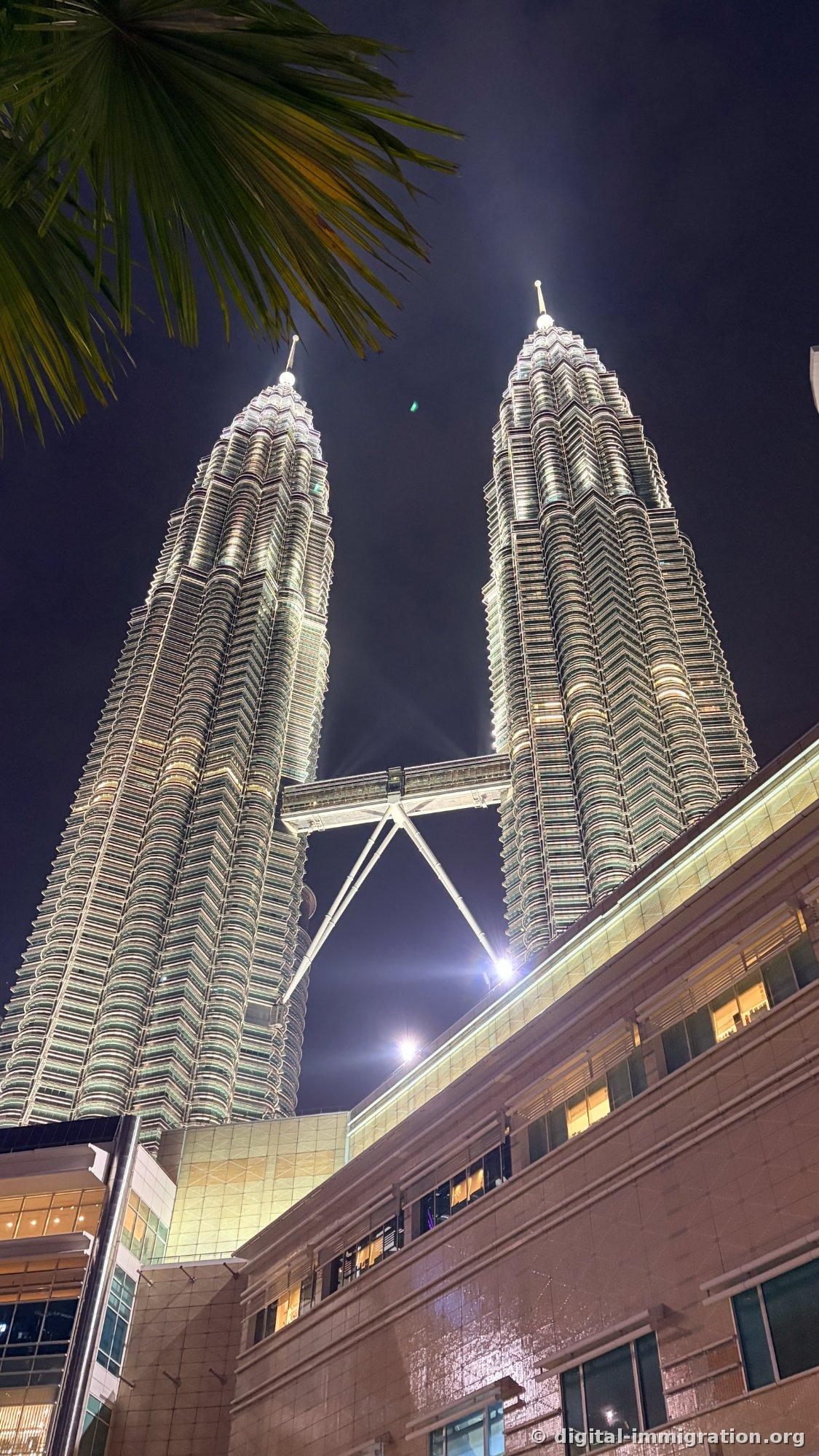
The eight-pointed star-shaped floor plan of the exterior is derived from Islamic geometric patterns (Rub El Hizb). Because of this, the building maintains the same symmetrical silhouette from any angle. When lighting comes on at night, all these layered recesses create shadows, which is why it looks much more like a 'sculpture' at night than during the day.
Accessibility is remarkably convenient in KL. The LRT Kelana Jaya Line's KLCC station connects directly beneath Suria KLCC, and from the Bukit Bintang side, you can walk via the air-conditioned skyway connecting from Pavilion. It's approximately 10–15 minutes on foot, and the ability to walk indoors continuously is a huge advantage in this city. On the other hand, Grab rides often eat up more time looking for pickup points during evening hours. During rush hour, Jalan Ampang really doesn't move.
Suria KLCC — A Mall Where People Density Is the Attraction
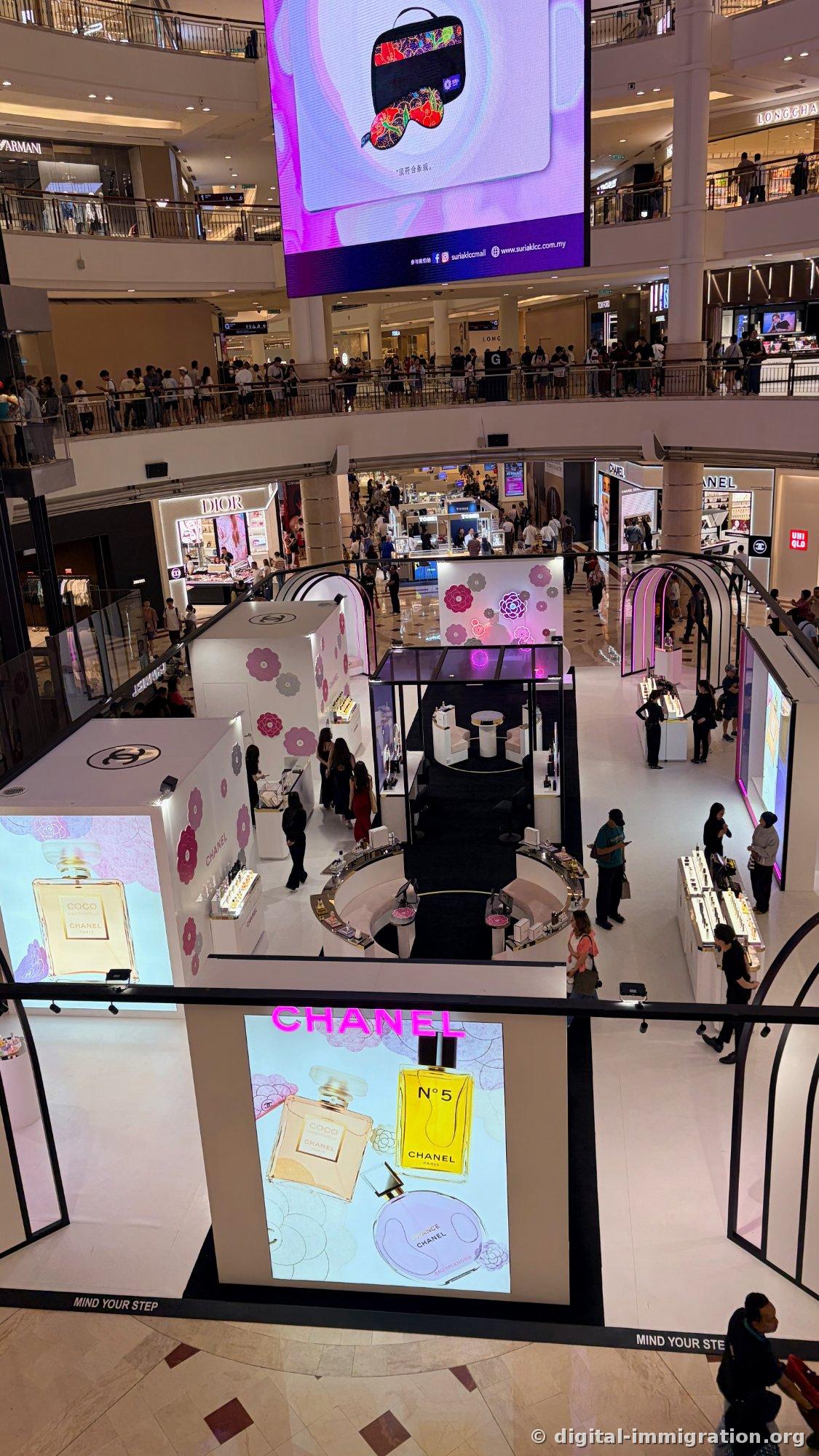
Suria KLCC, attached to the base of the towers, is a shopping mall spanning from basement to 6th floor, and once you step inside, you immediately understand why KL is called Southeast Asia's shopping hub. Looking down at the central atrium from above, people cling to the railings floor after floor, and below on the entire 1st floor plaza, Chanel has rented the entire space for a pop-up booth. White cubes ringed with Camellia flowers, Coco Mademoiselle and No. 5 oversized screens, and then Dior, Armani, and Longchamp stores lined up in succession. Right next to them is a Uniqlo sign, and this combination actually reveals the character of this mall well. Luxury brands and fast fashion sit side by side on the same floor without fuss, and the customers are mixed the same way.
Mag-apply para sa Digital Arrival Card (MDAC)
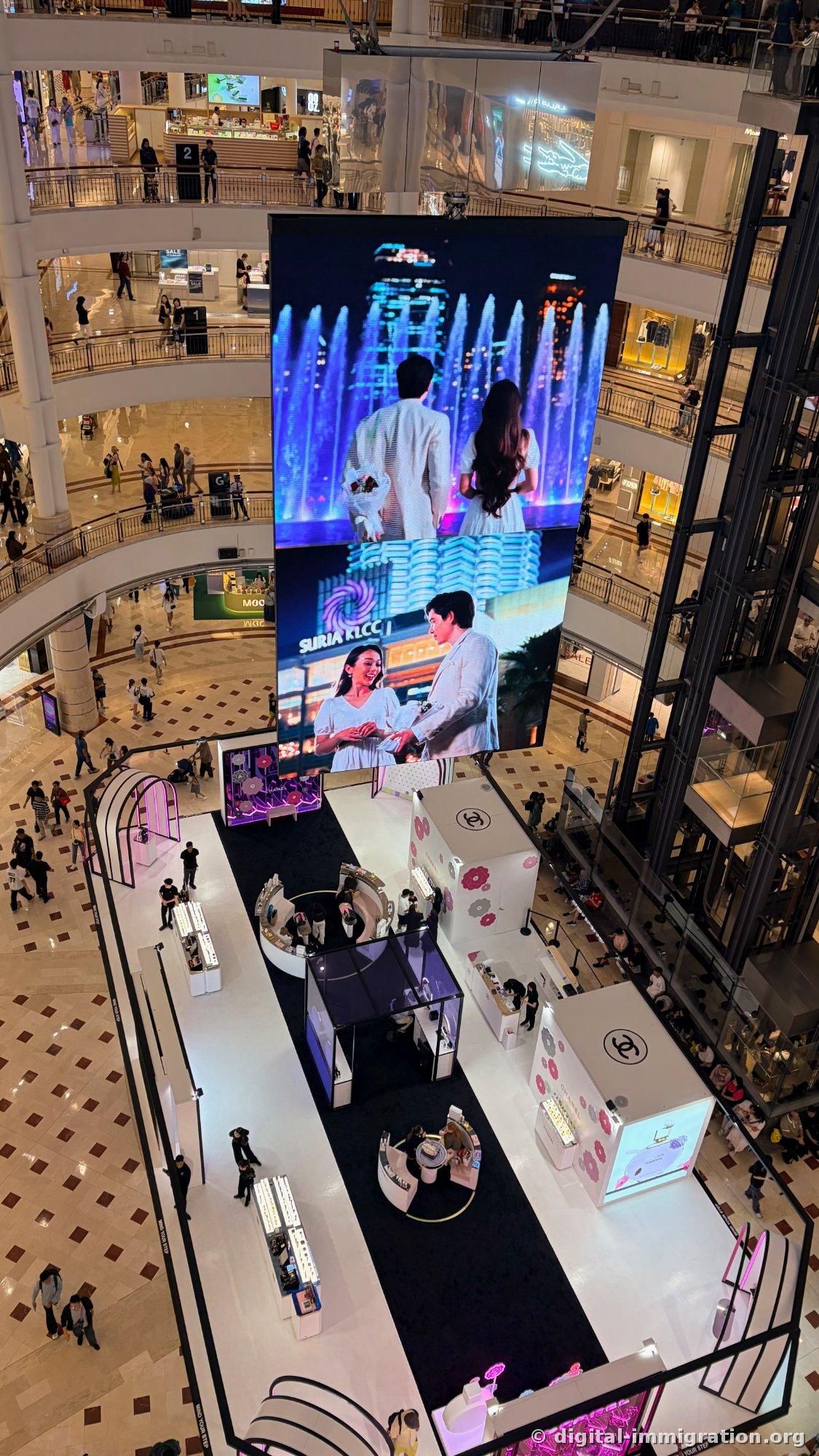
Going up another floor and viewing from a different angle brings the scale into sharper focus. Across the atrium, a massive vertical LED screen plays an advertising video on repeat featuring the 'SURIA KLCC' logo and a couple facing each other in front of the fountain show. You see an ad for the nighttime fountain show inside the mall, and hours later you're standing in front of that actual fountain. The marketing is shrewdly orchestrated.
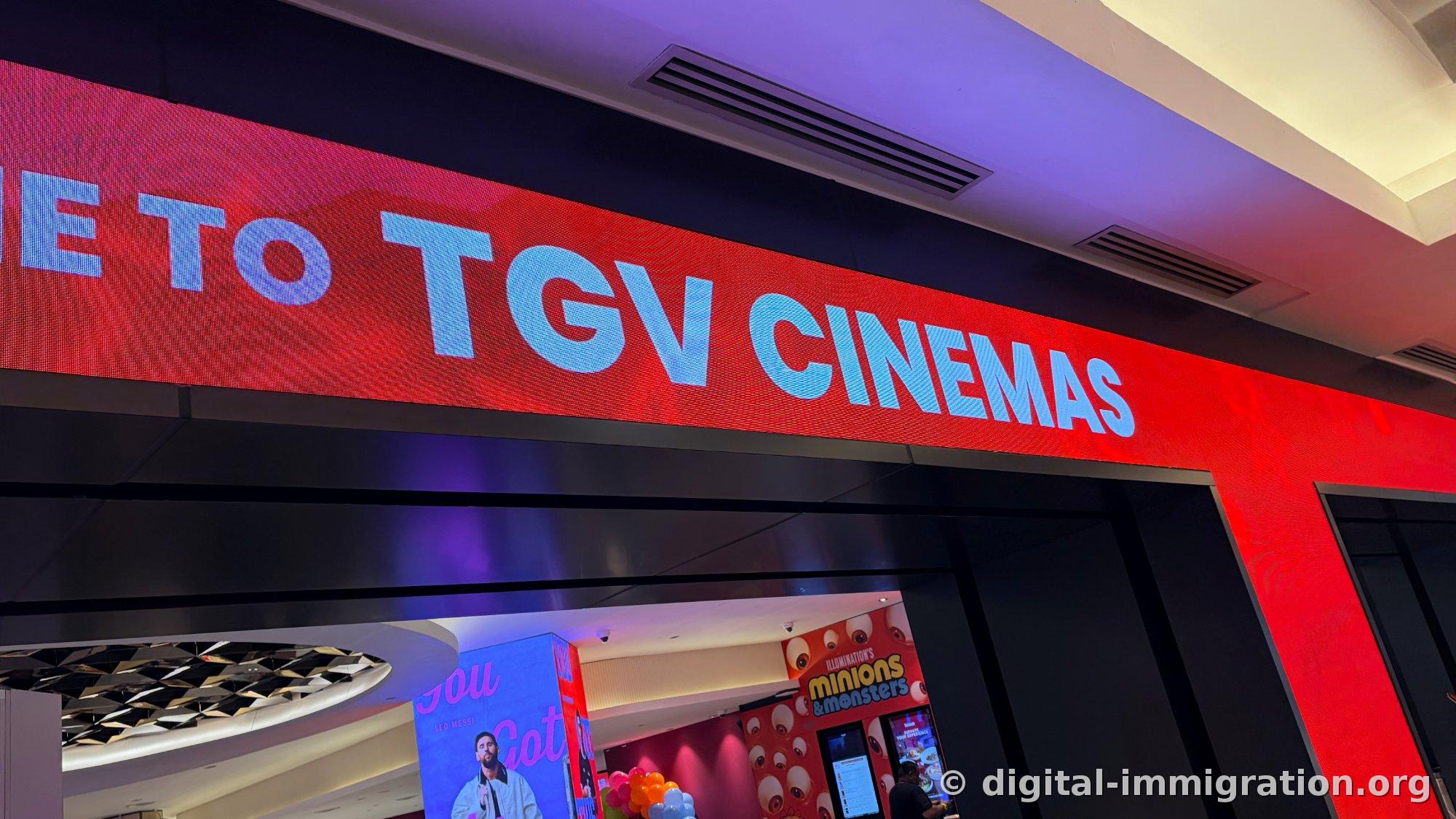
Going up to the next floor, the atmosphere shifts completely. The red LED sign at the TGV Cinemas entrance colors the ceiling, and below it are Minions merchandise booths and balloons. Just two floors up from the luxury section, it feels like an entirely different country. Personally, this floor was the most comfortable. The luxury floor is beautiful, but standing there long makes your shoulders tense.
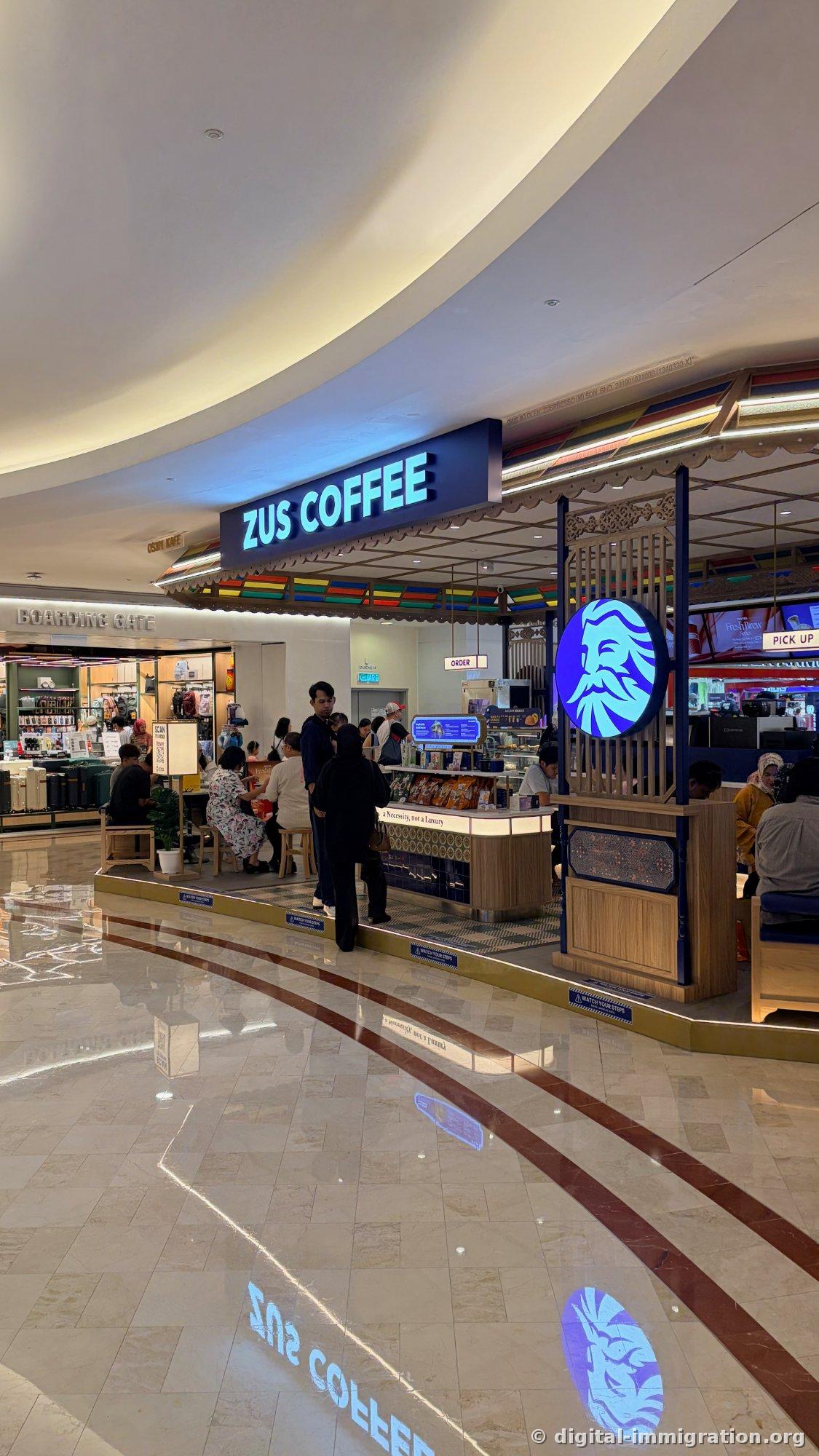
Zeus Coffee (ZUS Coffee) — One Cup of CEO Latte Was Today's Plot Twist
The place I walked into, exhausted from mall-walking, was ZUS COFFEE. That logo with a bearded Zeus face in a blue circle — you see it several times a day around downtown KL. It's a local Malaysian brand that now essentially dominates the country's cafe market. This location is in kiosk form, ringed with Peranakan-style wooden lattice and a colorful stained-glass canopy, floating like an island in the middle of the mall corridor. A phrase next to the counter caught my eye — "...a Necessity, not a Luxury". It means coffee is an essential, not a luxury, and the pricing actually reflects that exactly. By Korean franchise standards, it's surprisingly cheap, and the taste doesn't suffer for it.
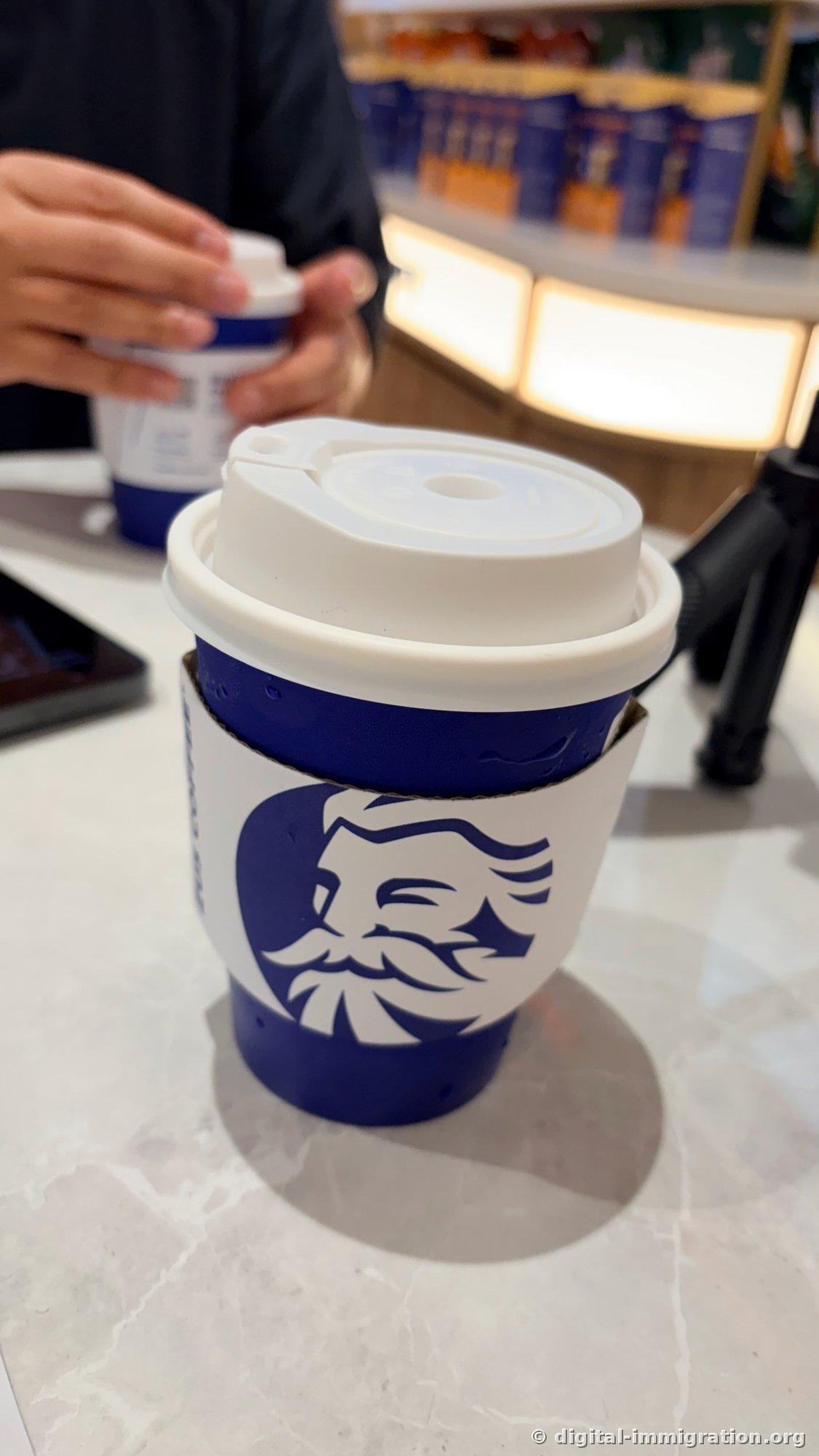
What I ordered here was the CEO Latte (ZUS signature line). Just seeing the name, I assumed it was just a latte, but it was something completely different. The first sip is sweet. But not forced sweetness from syrup—the sweetness from somewhere between caramel and roasted grains rides on the milk's fat, flowing smoothly all the way down the throat. The finish leaves just one layer of espresso's tartness, keeping it from being cloying. I'd walked around the mall for over two hours and my energy was flagging, and this one cup filled that gap perfectly. I still remember the feel of the blue sleeve on my hand as I held the cup, even the sweet aroma that rose up when I opened the lid. The person next to me ordered the same thing, and we both sat there opening our lids in unison.
One honest disappointment though: there's almost nowhere to sit at this location. Being kiosk-style, there are just a few stools beside the counter, and it's right in the middle of the throughway, so even sitting, shoulders keep getting bumped. I gave up on the plan to rest while drinking coffee and walked with the cup instead. Also, ordering is done via QR code on the wall as standard, so when I tried to order verbally at the counter, I fumbled for a beat. Scanning the QR code in advance is much faster. Since promotions change frequently, I recommend checking the menu board on-site.
KLCC at Night — This Neighborhood's True Face
As the sun sets and you step outside again, that silver building that seemed flat by day transforms completely. Viewed from the mall's rooftop garden between the palm fronds, the Twin Towers—with lights embedded in each floor—scrape away the recesses of the eight-pointed star plan one by one, making the entire tower glow like metal lace. The V-shaped support of the Skybridge is also lit, making it look like a triangle floating in the empty space between the towers. The humidity causes the light to blur slightly, which actually looked better. I stared up until my neck ached.
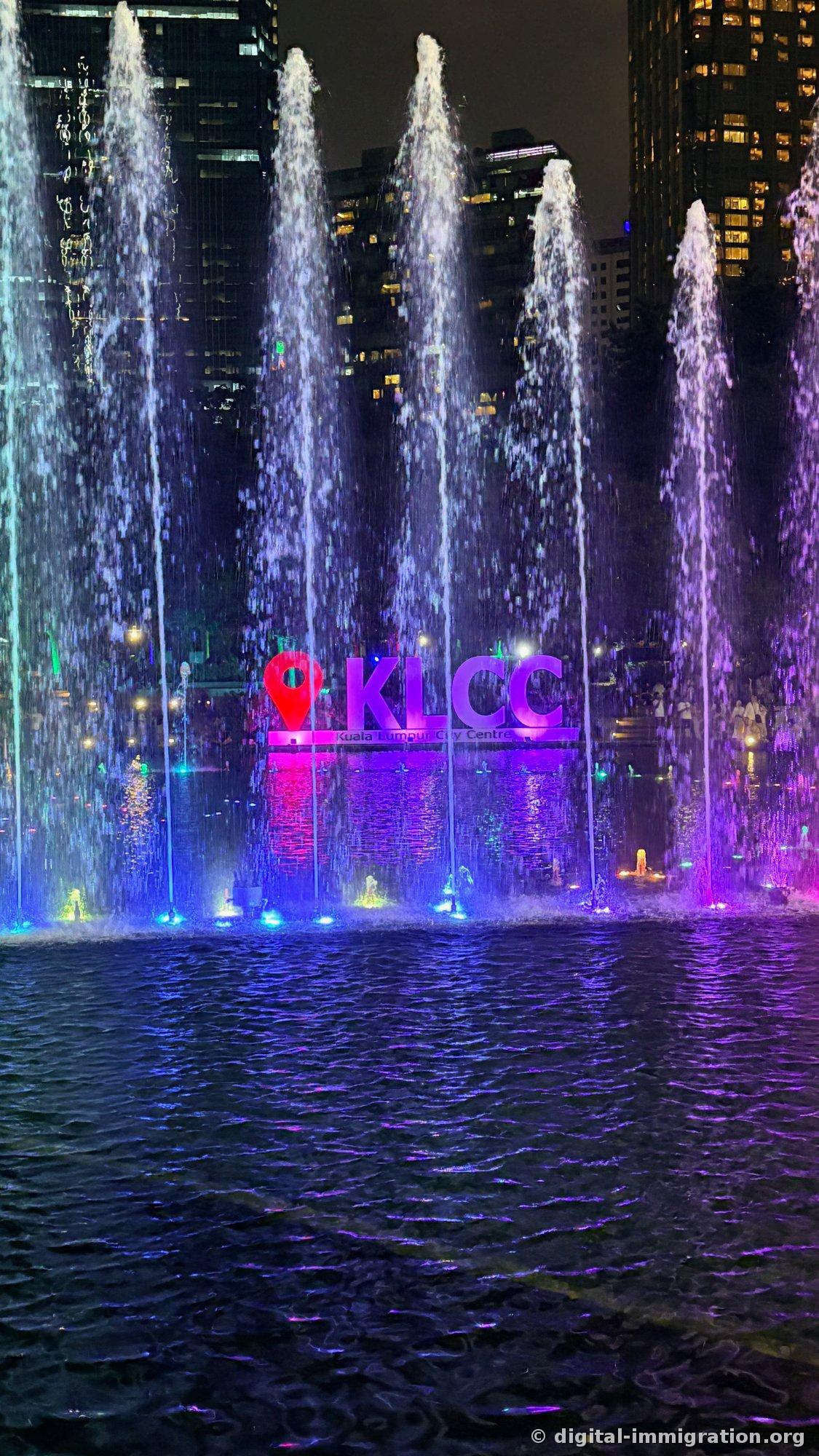
And then there's the Symphony Lake fountain show in KLCC Park. Water jets shoot up over 10 meters high, with lights changing from purple to pink to cyan, and between the jets the 'KLCC — Kuala Lumpur City Centre' sign emerges with a red pin icon. Behind it, yellow lit windows of surrounding condos fill the background. It's artificial extravagance taken to extremes, yet strangely it doesn't feel tacky. As the water falls, fine mist carried by the breeze touches your face, and after being drenched in heat all day, that moment felt the best.
Practical Notes Organized After Visiting
- Go in reverse order. The route of viewing the towers first during the day, then escaping the heat at the mall, and then stepping outside again at sunset is physically much better. I did it this way and have no regrets.
- The fountain show runs multiple times in the evening at 20–30 minute intervals. Even if you miss one session, you can wait for the next, so don't rush frantically. I recommend checking the on-site information board for the exact schedule.
- Photos should be taken from the grass on the other side of the lake. Right beneath the towers, 452 meters won't fit in the frame. It's difficult even with a wide angle.
- Entry to the Skybridge and observation deck requires separate tickets with a capacity limit per session. Same-day on-site purchase often sells out, so it's safer to check online reservations first.
- Approach ZUS Coffee with QR ordering + takeout in mind. If you want to sit and rest, other cafes in the upper mall levels are better. However, the CEO Latte was the most memorable drink I had in this neighborhood.
- Make active use of the indoor skyways. The Bukit Bintang–Pavilion–KLCC section is connected by air-conditioned corridors, making it less tiring than walking outside.
There's a perception that the Twin Towers are a 'famous place worth visiting', but spending an entire day here changed my thinking somewhat. A Korean construction company built one tower, the foundation was unstable so the entire location was relocated, and one bridge rests atop the towers while absorbing their sway. Standing in front of the fountains with a cup of coffee, watching how this city has created its identity centered around these two towers becomes remarkably clear. The next time I come to KL, I plan to climb the Skybridge and look down at it from the opposite perspective.
Basahin din
- Morning at the Traditional Market Next to Johor KIP Mall, Mangoes 2kg for RM10
On the outskirts of Johor Bahru, Malaysia, on the way up toward Kulai, there's KIPMall. You walk in expecting an air-conditioned shopping center like a typical mall, but instead yo…
Johor · KIPMall - Kuala Lumpur Monkiara Seng Kee Chicken Rice(成記雞飯) — Weekend lunch na kumpleto lang kung kasama ang oil rice
Kapag may pamimili ako sa Monkiara Solaris tuwing weekend, halos awtomatiko ang pagpunta sa isang lugar. Sa Kuala Lumpur, ang chicken rice signboard ay makikita kahit saan, pero ak…
Kuala Lumpur · Seng Kee Chicken Rice - Umaga sa Kota Tinggi Traditional Market — Bundok ng Green Mangoes at RM3.50 Waffles
Kota Tinggi, Johor, Malaysia. Kapag nagmamaneho kang silangan mula Johor Bahru, darating ka sa munisipio na ang mga tour guide ay nag-uusap lamang tungkol sa tulay. Ngunit sa pagka…
Kota Tinggi