Shin Jjamppong with yellow sign on the outskirts of Vientiane, a record of Korean-Chinese cuisine sets eaten in Laos
After spending a few days in Vientiane, Laos, there comes a moment when you tire of noodles and rice. Kao phat and lab are both good, but there's a night when your tongue craves so…
Vientiane Capital · Shin Jjamppong
After spending a few days in Vientiane, Laos, there comes a moment when you tire of noodles and rice. Kao phat and lab are both good, but there's a night when your tongue craves something oily, hot, and spicy. On such an evening, I grabbed a tuk-tuk, headed west out of downtown, and found Shin Jjamppong. A long yellow sign hangs on the roadside, and next to a red '辛' character, two white acrylic letters reading 'jjamppong' are affixed. Below that, in small letters, JamPong, Lao transliteration, and on the far right, 'delivery available / Korean Restaurant' and phone number 020 5666 6079.
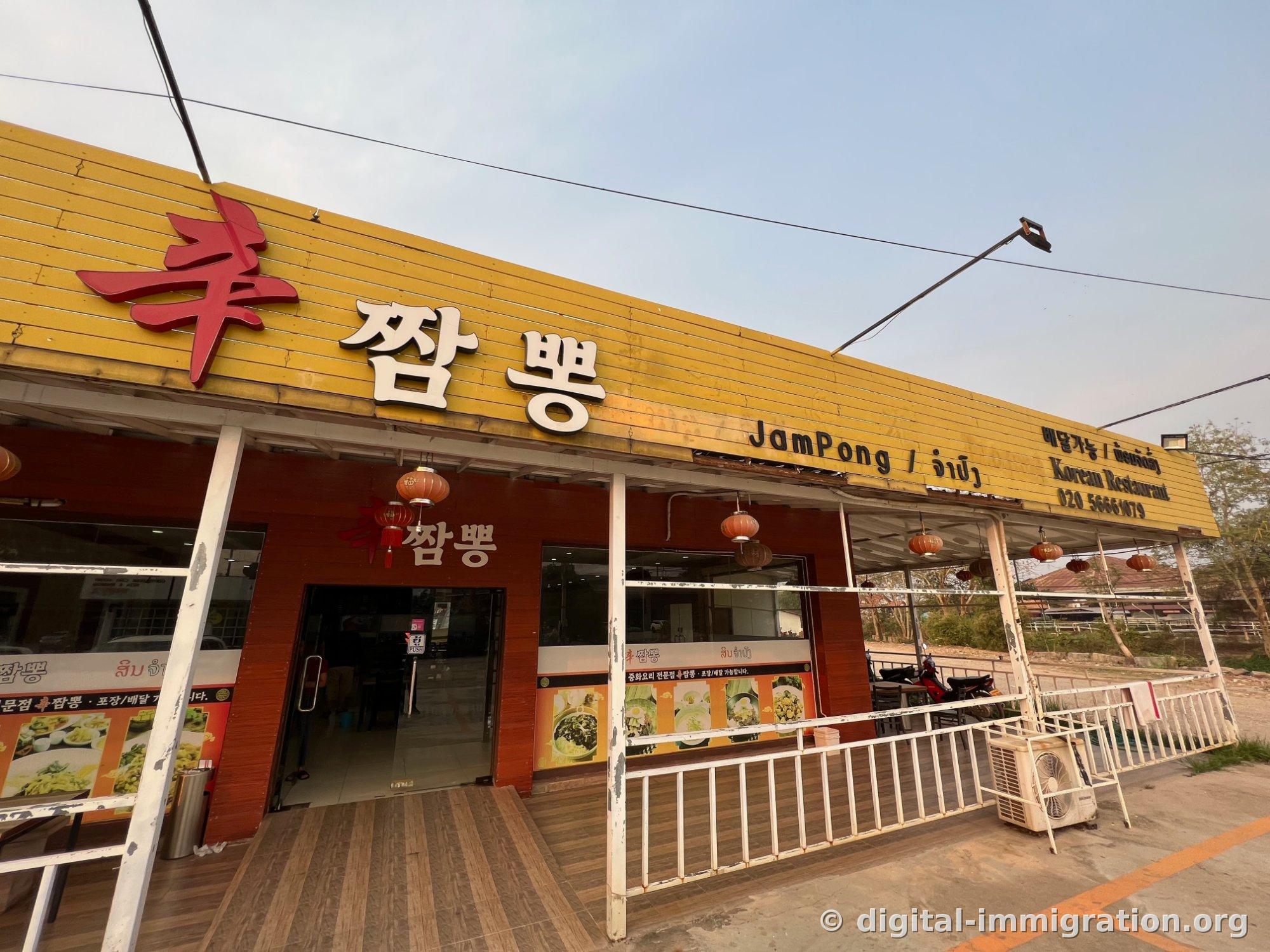
The building is single-story, with a menu photo banner attached beside the glass entrance door. Photos of jjamppong bowls, stir-fried dishes, and plates are printed large, so even if you can't read Lao, you can point with your finger. The terrace on the right is open-air with just a roof, and the evening breeze is nice. However, before sunset, the heat from the asphalt rises up, so if you can't stand the heat, it's better to go inside where the air conditioning is running. Beside the door—a stand ashtray, slippers left off, motorcycles parked—this isn't a place dressed up for tourists, but has the face of a neighborhood restaurant where locals and Korean expats come and go.
Ordering a set is the answer
Whenever I come here, I always order a set. You could pick individual items one by one, but since set prices are so cheap, there's no real reason to. Two people sitting down can split one set, and you get soup, stir-fried dishes, and fried items all at once, with side dishes like pickled radish and chili paste. The exact amount changes with each visit, so I won't list it here. But if you think of the price of a plate of pasta in downtown Vientiane's tourist area, this place definitely gets the better deal. I recommend checking the payment methods and set composition on-site.
The first dish to arrive was sweet and sour pork. Since the sauce comes pre-poured, the debate about pouring versus dipping doesn't apply here.
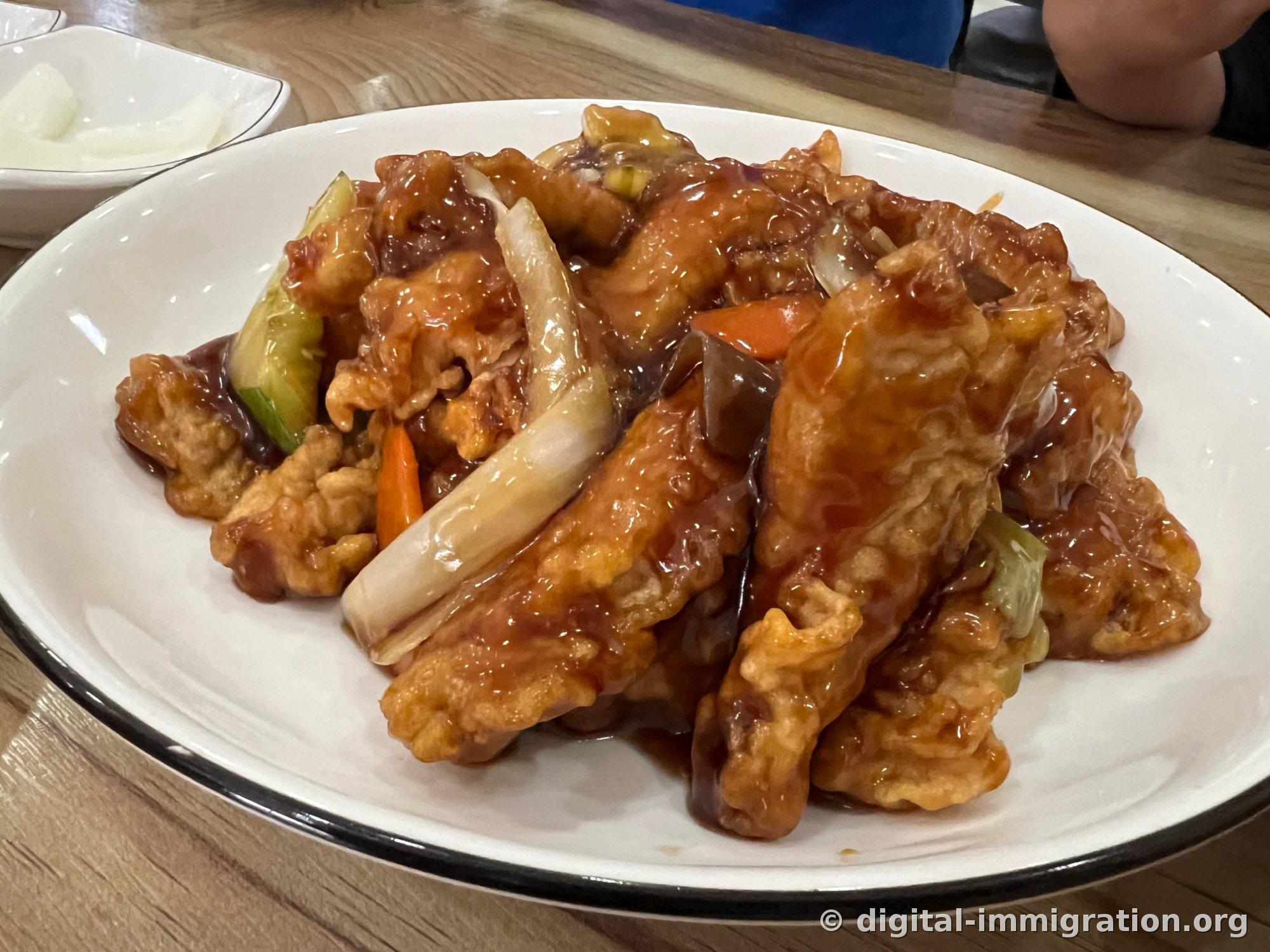
The batter is thin and bumpy, exactly like the style of a Korean neighborhood Chinese restaurant. Even though it's soaked in sauce, the outside doesn't completely soften, so there are still parts that crunch when you bite. The sauce leads with tartness and is backed by sweetness—not the cloying 'sugar-dominates-everything sweetness' commonly found in Laos, but with vinegar that's properly alive. Adding cucumber was a stroke of genius; just as you're getting tired after a few bites, a crisp piece of cucumber cleanses your mouth. The pickled radish also came cold, not lukewarm.
Mag-apply para sa Digital Immigration Form (LDIF)
The jjamppong broth is richer than expected
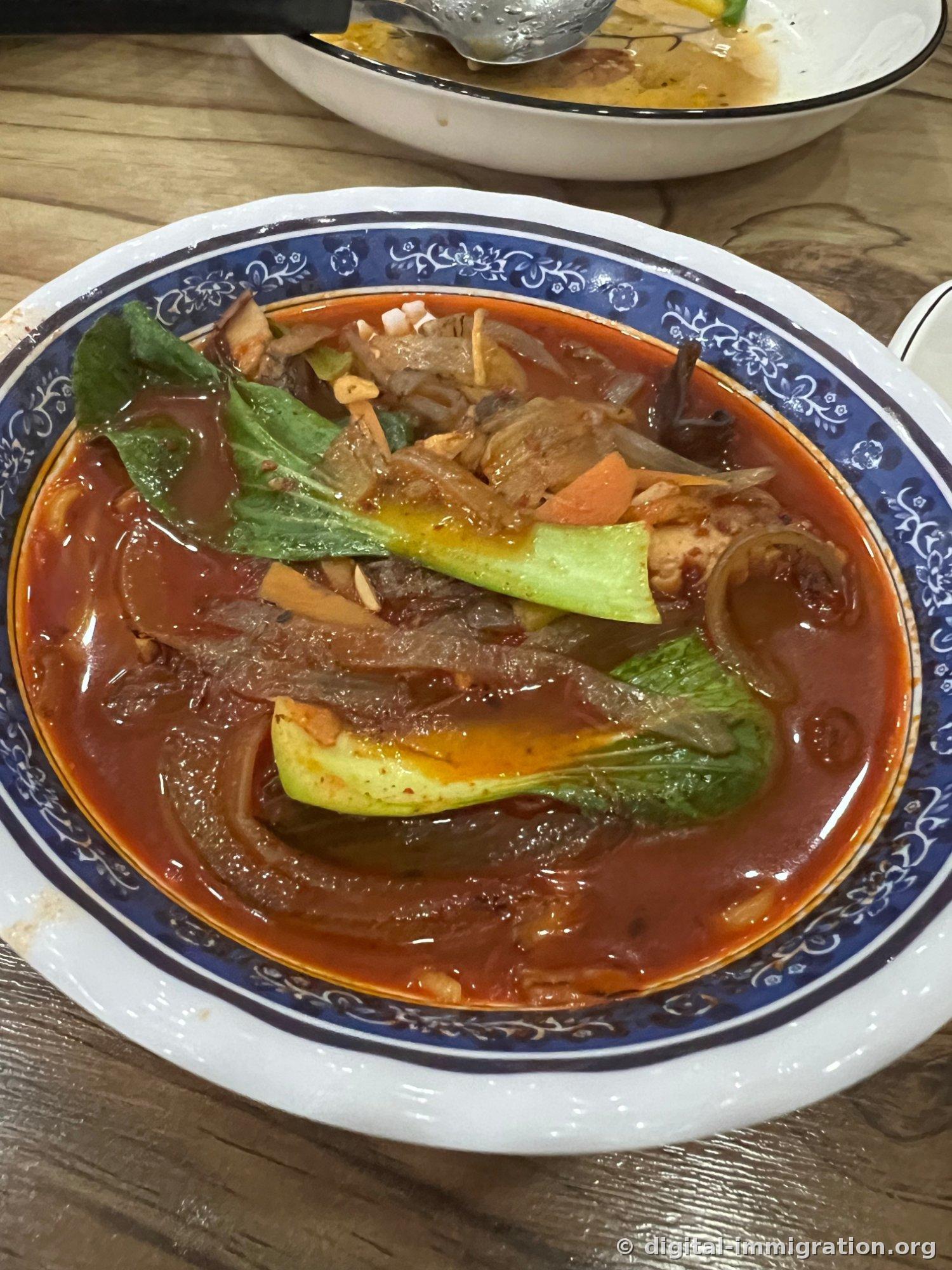
Since it's the signature dish on the restaurant's name, I naturally ordered jjamppong. It comes in an old-fashioned bowl with blue floral patterns, and you can see chili oil floating in circles on top of the broth. The technique of adding lots of onions and stir-frying over high heat to create the broth is evident. So it's not just spicy—there's sweetness underneath. The bok choy is cooked just enough that the stems still retain their green color and bite, and wood ear mushrooms, carrots, and squid are evenly distributed.
The spice level is medium by Korean Chinese restaurant standards. It has a different quality from local Lao food's spiciness—not the sharp sting of chili, but a round spiciness from chili powder toasted in oil. After drinking half the broth, sweat beaded on my forehead, even though I was sitting under the air conditioning. One small caveat—after eating all the noodles, if the broth cools a bit, you'll notice the oil solidifies on the surface. It's best to eat it fast while it's hot.
The stir-fry with flower bread is the real surprise
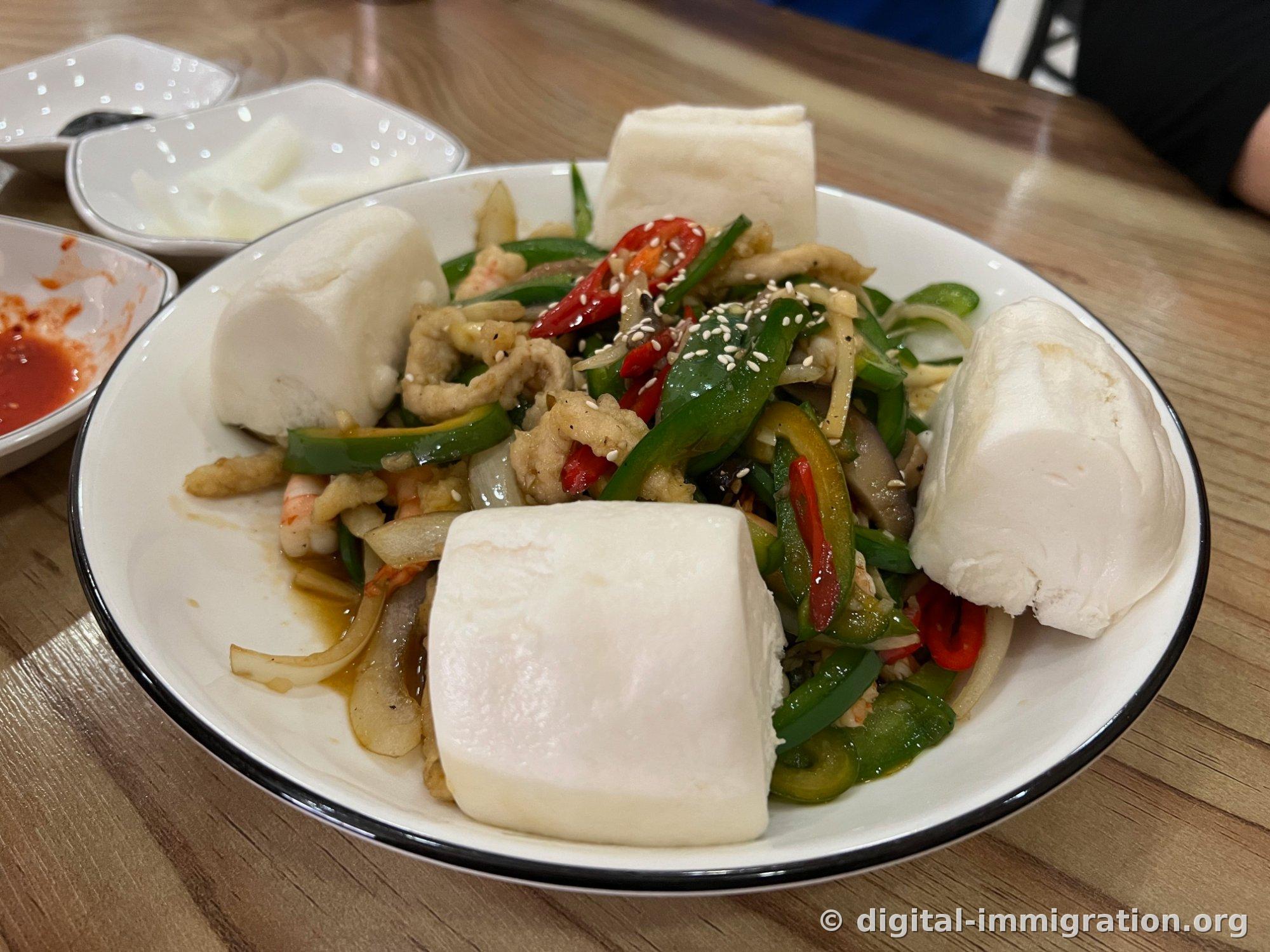
The stir-fried dish that came with the set was the day's real surprise. Four pieces of white flower bread are stood upright around the edges of the plate, with the stir-fry piled in the center. Green peppers, red chilies, onions, shiitake mushrooms, shrimp, and shredded meat are mixed throughout, with sesame seeds sprinkled on top. It's stir-fried in soy oil with no broth, so it doesn't overlap with the jjamppong. The pepper aroma comes through clearly, and the red chilies aren't just decoration—they're genuinely hot. Once you hit one while chewing, you'll be reaching for water.
The flower bread came warm enough that steam was still rising from it. Tearing it apart with your fingers and pressing it into the stir-fry sauce lets the oil and soy soak in. Because of this combination, you don't even need to order rice separately—you'll be full. It feels odd every time that I'm eating this for this price in Laos. Honestly, it was better than what I've had at Korean neighborhood Chinese restaurants. They don't skimp on ingredients, and the wok-fired flavor is properly there.
How to find it and practical tips
The location is on a main road heading west from downtown Vientiane. From the city center (Nampu Fountain, night market area), it's not a walkable distance—you'll need to use a tuk-tuk or ride-hailing app. Since it's right on the roadside and the sign is large and yellow, showing the driver the coordinates won't leave you lost. There's space to park motorcycles and cars out front.
- The sign shows 'delivery available' and phone number 020 5666 6079. This means you can have it delivered to your accommodation, though you'll need to confirm the delivery range by phone.
- One set is enough for two people. When the sweet and sour pork, jjamppong, and stir-fry all come out at once, the plates cover the entire table. For three or more people, add one rice.
- If you can't eat spicy, go for the stir-fry without broth instead of jjamppong. The flower bread combination is much safer.
- The outdoor terrace is much better after sunset. During the day, I recommend dining indoors.
- Business hours, set composition, and prices vary by season. If you're planning to come from far away, it's safer to call ahead and confirm.
The longer you stay in Vientiane, the more knowing about a place like this changes your travel stamina. On a day when you're tired of getting by on noodles and rice, sitting under the yellow sign and having a piece of sweet and sour pork somehow makes you curious about the next day's plans again.
Basahin din
- Pha That Luang sa Vientiane - Ang Golden Stupa na Napunta sa Limang Hapon ng Isang Makulot na Araw
Sa loob ng labinlimang minuto sa tuktuk mula sa sentro ng Vientiane patungo sa hilagang-silangan, ang kalsada ay bigla na lumalaki, at sa likod ng pader ay umuusbong ang isang gint…
Vientiane Capital · That Luang - Nakahanap ng Kyoto-style Mizujingenomochi sa Vientiane — KYO Cafe & Meal
Ang Vientiane ay pinakamatibay sa ika-dalawang oras ng hapon. Walang tulong ang anino, at nararamdaman mo na ang iyong damit ay tumatak na sa likod. Noong araw na iyon din, habang…
Vientiane Capital · KYO Cafe & Meal - Francesong Gabi sa Le Vendôme, Vientiane, Laos — Talaan ng Tatlong Putahe: Pizza, Carbonara, at Salad
Sa gabi kung kailan ang hangin mula sa Mekong River ay umabot na sa kalsada, pumasok kami sa Le Vendôme Restaurant, na nakaposisyon sa loob ng isang alley malapit sa Wat Inpeng. Ka…
Vientiane Capital · Le Vendôme Restaurant