A Morning Walk Through Kunming Market — Figs for 20 Yuan, Fried Insects, and Qingke Cakes for 3.5 Yuan
The only thing I did after waking early in Kunming, Yunnan was wander around a local market near my accommodation, but that morning stands out the most from this entire trip. I've…
Yunnan
The only thing I did after waking early in Kunming, Yunnan was wander around a local market near my accommodation, but that morning stands out the most from this entire trip. I've traveled through Southeast Asia many times and thought I'd seen plenty of markets, but Yunnan markets have a different character. Where Thai or Laotian markets assault you with tropical sweetness and spices, here at high altitude, mushrooms, wild greens, and cured meats catch your eye first. At around 1,900 meters elevation, the morning air was crisp even in August, and I went out in just a t-shirt, rubbing my arms for the first thirty minutes.
Mushrooms and Wild Greens — This is Real Yunnan
My feet came to a stop right at the market entrance. Bamboo baskets were simply laid out on the ground, with leaves as liners, items sorted by type. Brown tuberous roots (labeled on a sign as '昭通 天麻', Zhaotong gastrodia), fat mushrooms without umbrellas, heaps of pale oyster mushrooms, fluorescent-orange coral-shaped mushrooms, and bundles tied with green cord of yellow flower buds that looked like squash blossoms. In front, tender bamboo shoots with pink-tinged roots and pristine root vegetables were piled high.
Most impressive were the jasmine flower buds in the lower right. White buds filled a basket, portioned into small colored mesh bags. Passing by, the fragrance hit me — among the morning market's earthy and fishy smells, this section smelled like a perfume shop.
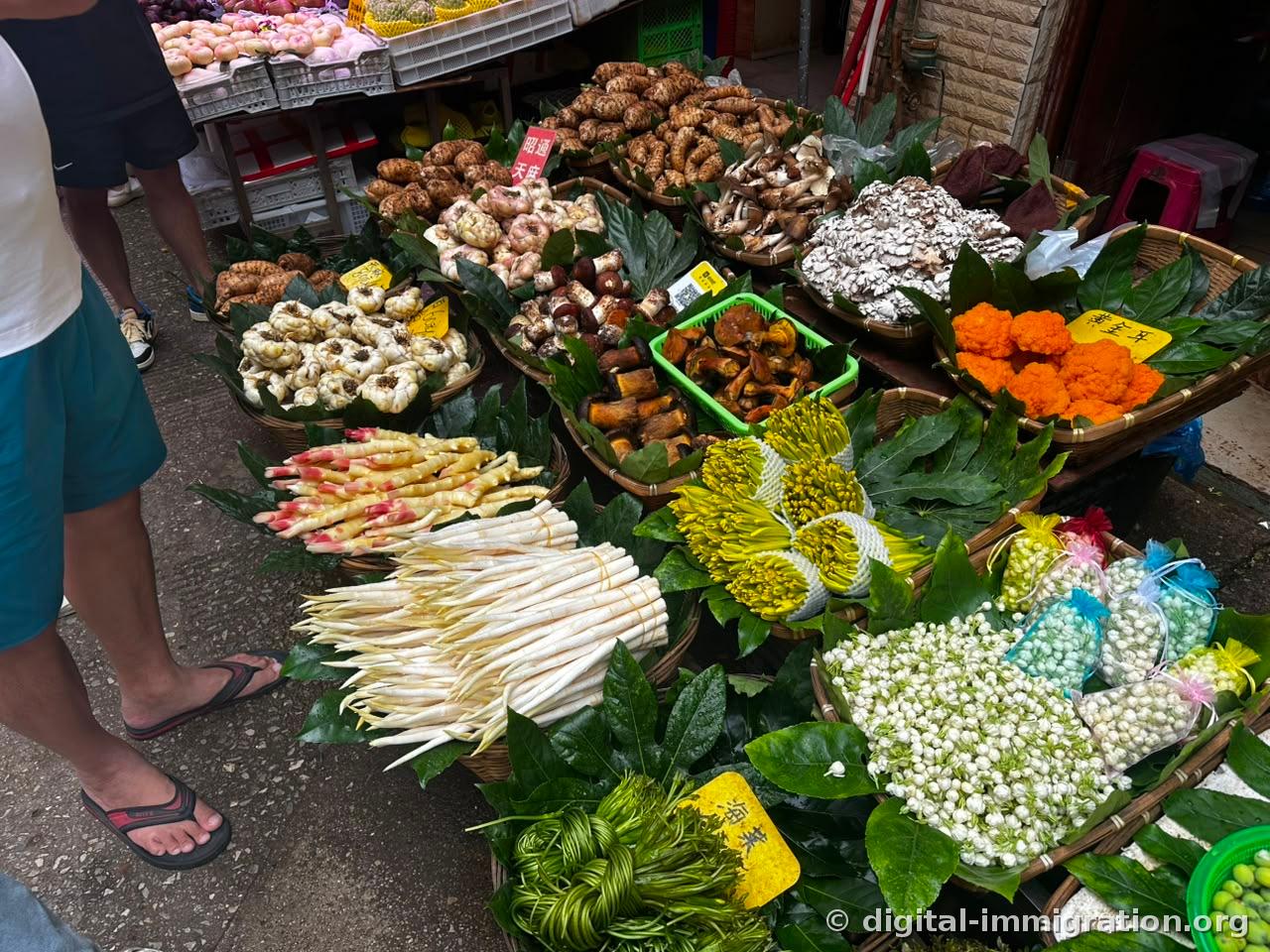
I didn't know any mushroom names, so I pointed at them and asked the vendor, but I only understood half of her answer. Yunnan dialect mixed with standard Mandarin makes listening comprehension nearly useless. I ended up just taking photos and left empty-handed. My accommodation was a hotel with no kitchen — this is the eternal regret of market browsing. That evening I made a note: next time, I need a place with a kitchen.
Fried Insects — I'd Heard the Stories, but Seeing Them in Person Is Another Scale
In front of a yellow shutter, on a red cloth-covered counter, sat seven or eight bamboo trays. All filled with fried insects. Plump mealworms, grasshoppers, what looked like bamboo worms (竹虫) that were pale and chubby, and in the back tray something dark with many legs — even something that looked like a centipede. The large front tray was tossed with dried chilies and sesame seeds, turned a deep red.
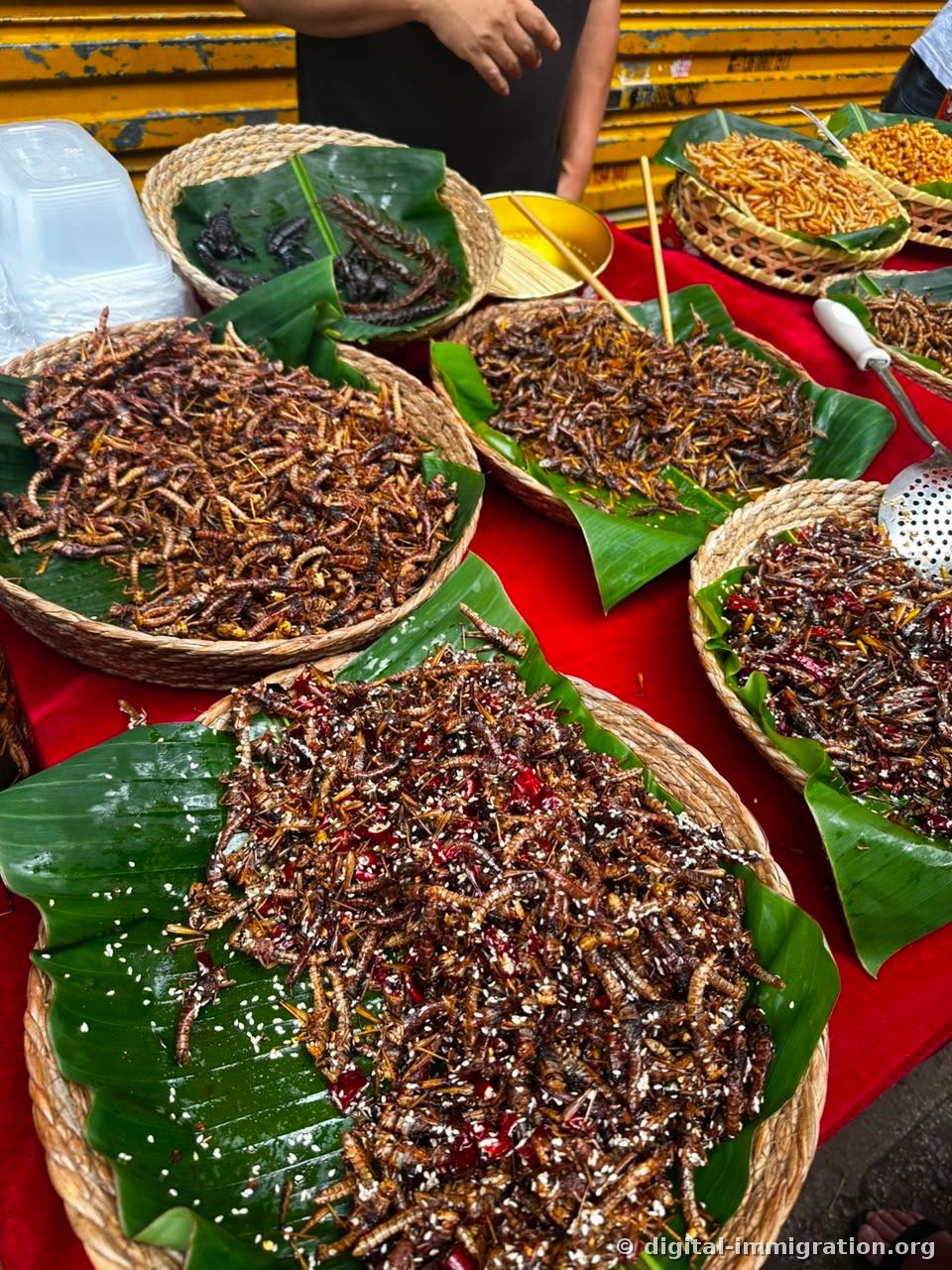
To be honest, I couldn't eat them. I tried bamboo worms in Laos — nutty, like prawn crackers — but this centipede-like creature was just too much. I watched a local man casually scoop mealworms into a styrofoam container, and that naturalness was proof this stand wasn't just tourist eyecandy. The smell wasn't fishy but oil and chili. I couldn't see the price sign — if you want to buy, you ask by weight.
Vegetable Counter — Colors Are So Intense the Photos Look Strange
Yunnan vegetables have intense colors. The green is almost fluorescent, the eggplant purple looks artificial. The left side of the photo is filled with angular, crown-like squash (an older variety of pumpkin common here), the right has long thin purple eggplants and plump violet eggplants side by side, tomatoes and peeled orange carrots stacked in rows next to them. The center is red chilies piled like mountains in plastic bags. A vendor's hands caught adjusting the chili bags.
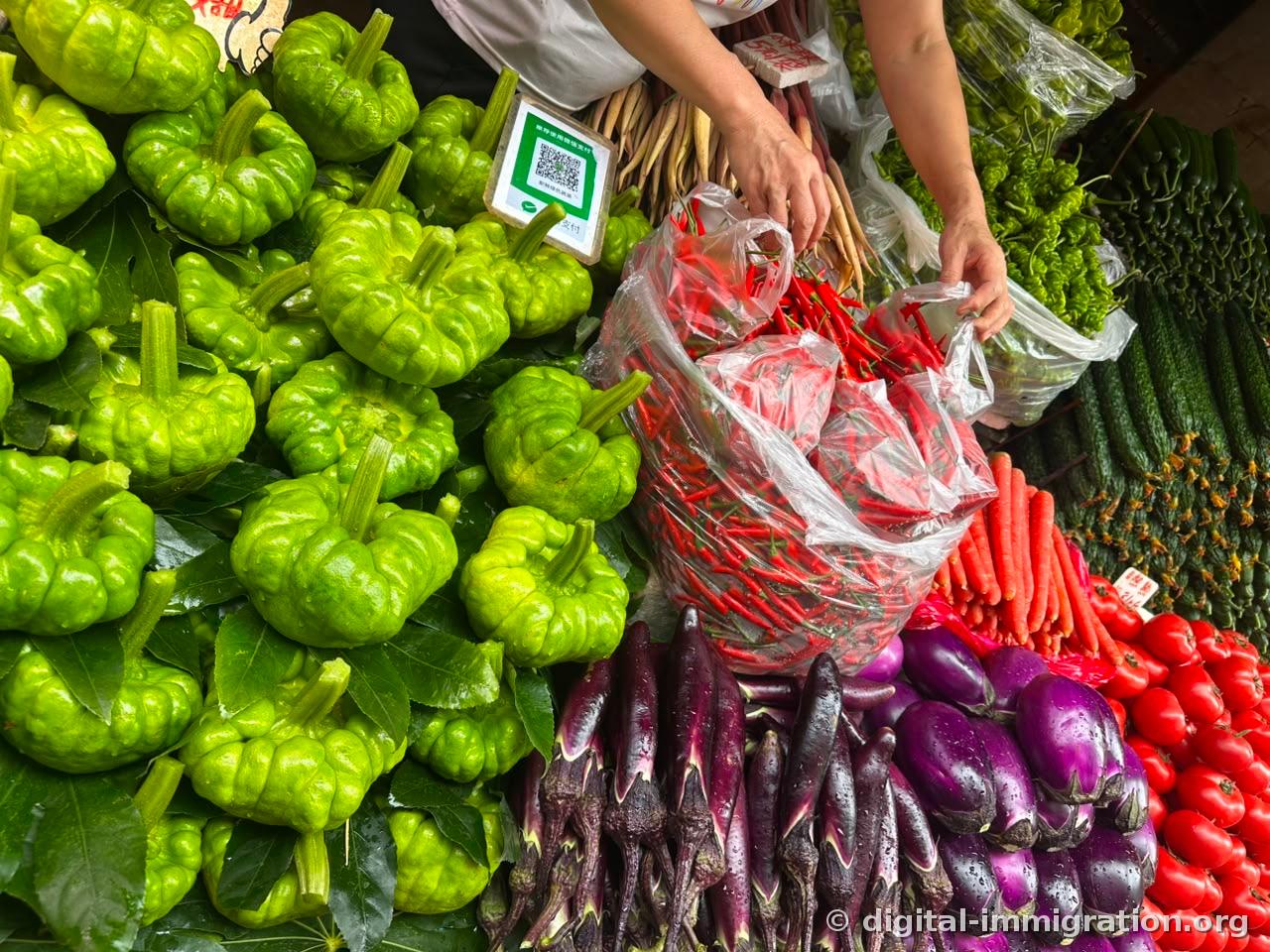
This is the biggest trap first-time visitors fall into, captured right in the photo. The green QR code sign wedged into the wooden stand at the center of the counter. WeChat Pay. Many vendors at Chinese traditional markets don't bother keeping cash change. If you don't pre-register an overseas card with Alipay or WeChat Pay, you can't buy anything with a 100-yuan note. I lost half a day on my previous trip not knowing this. Register and complete real-name verification before you leave.
Pork and Cured Meat — Vacuum-packed Pork Belly, and Whole Meat Hanging on Hooks
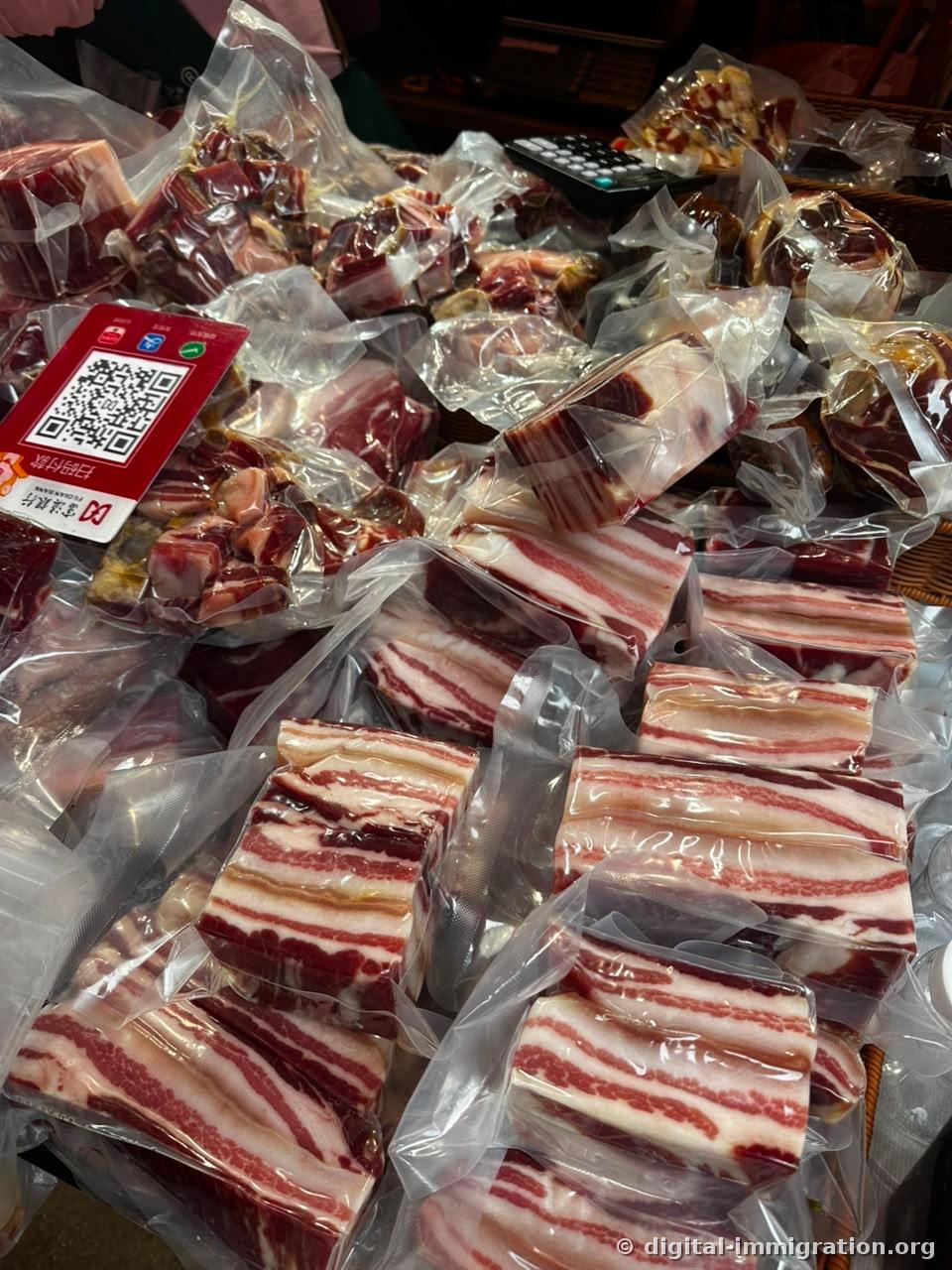
Entering the meat section, the atmosphere completely changes. Vacuum-packed pork belly is piled high, the fat and lean layers cut cleanly into three or four distinct striations that look beautiful. Behind, brown-tinted meat packages that seem already marinated are mixed in. Here too, an inevitable red QR code sign, and a calculator simply resting on top of the meat.
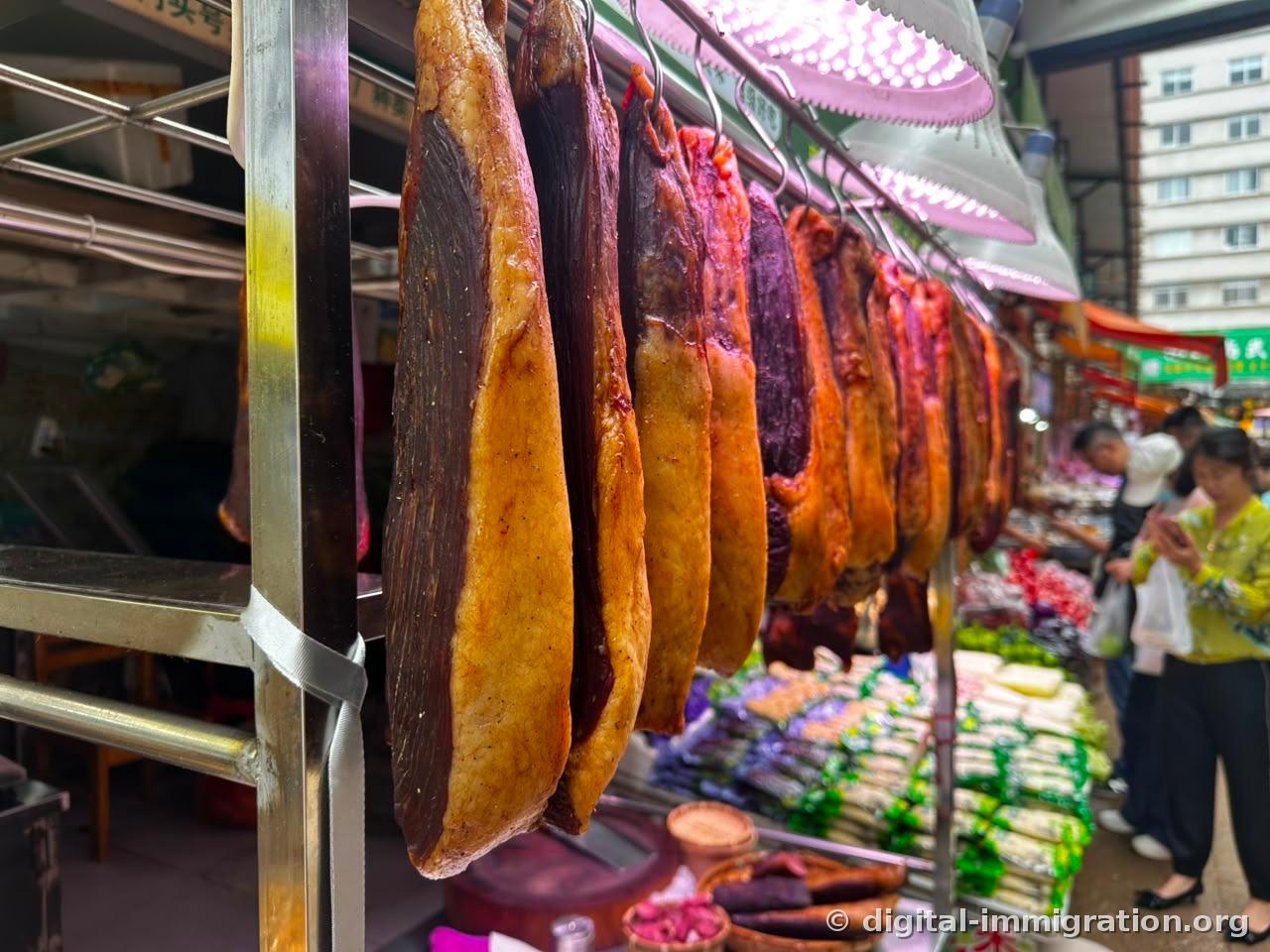
More impressive was the cured meat shop in the next alley. Whole pieces of meat hung from stainless steel rods on hooks, the surface glossy with absorbed oil, amber-toned, and the cross-section inside a deep purple. Pink lighting shone from above, making the actual color appear redder than it is — Chinese market butcher sections always have lighting like that. In the wooden bowl below, tasting samples and powdered seasoning mix. To the right, customers passed by carrying bags.
Luwei (卤味) Counter — People Buying This for Breakfast
Inside a glass display case were things braised in soy sauce, each in its own compartment. The large left section held pig trotters and ears, intestines piled whole; the center had chicken feet, duck necks and wings; the right compartment had braised eggs and julienned pressed tofu and seasoned bamboo shoots. A customer next to me was picking items into a plastic container, a scale and card reader at the center of the counter.
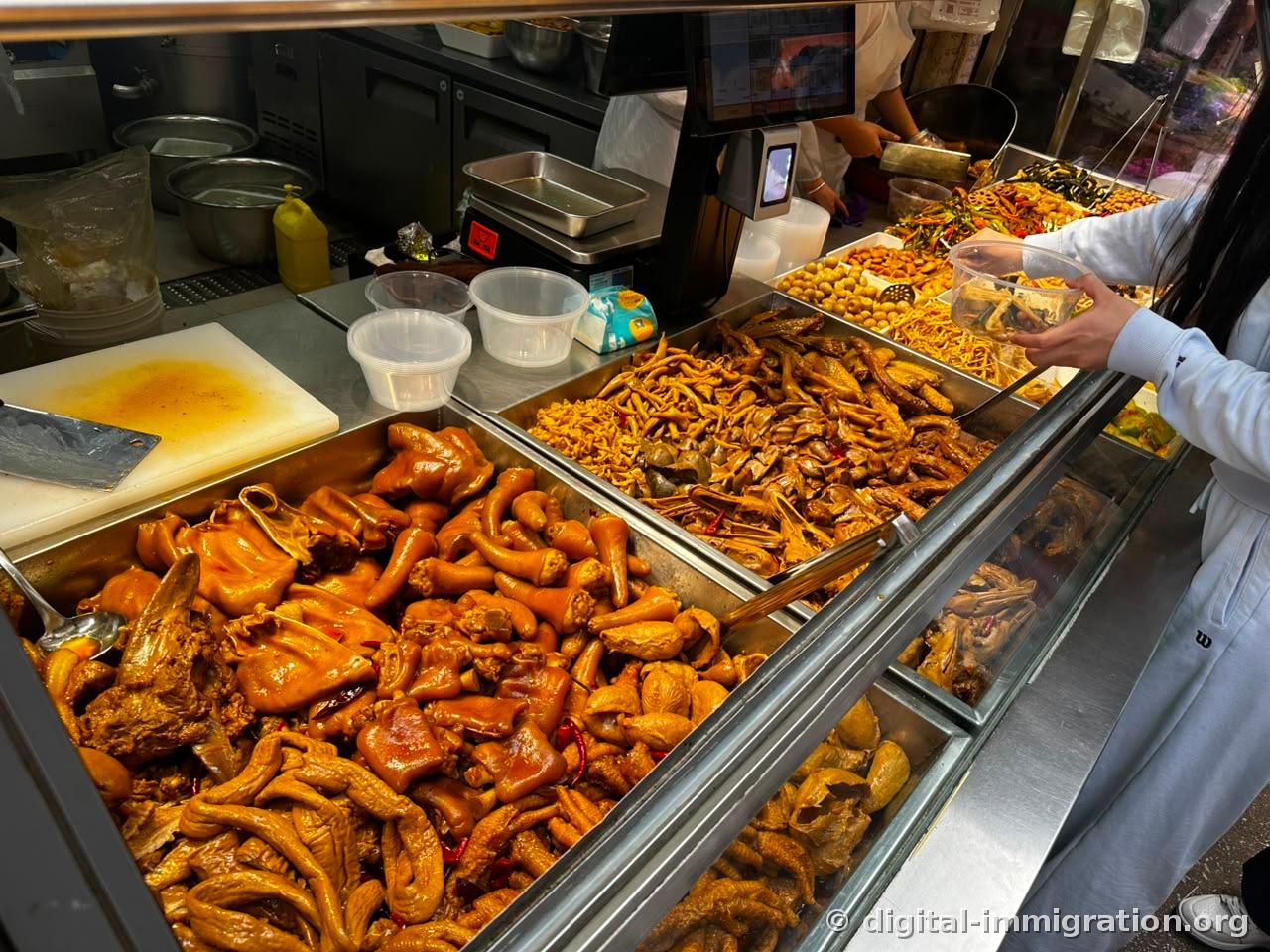
The trick here is buying exactly as much as you need. Point with your fingers and say "this much" and they scoop it onto the scale. It's awkward to ask for something back once it's already in there, so it's better to indicate clearly from the start using two fingers. I didn't see a price sign here, so you need to check the per-weight price on site.
Fruit — Figs 20 Yuan, Buddha's Hand 48 Yuan/kg
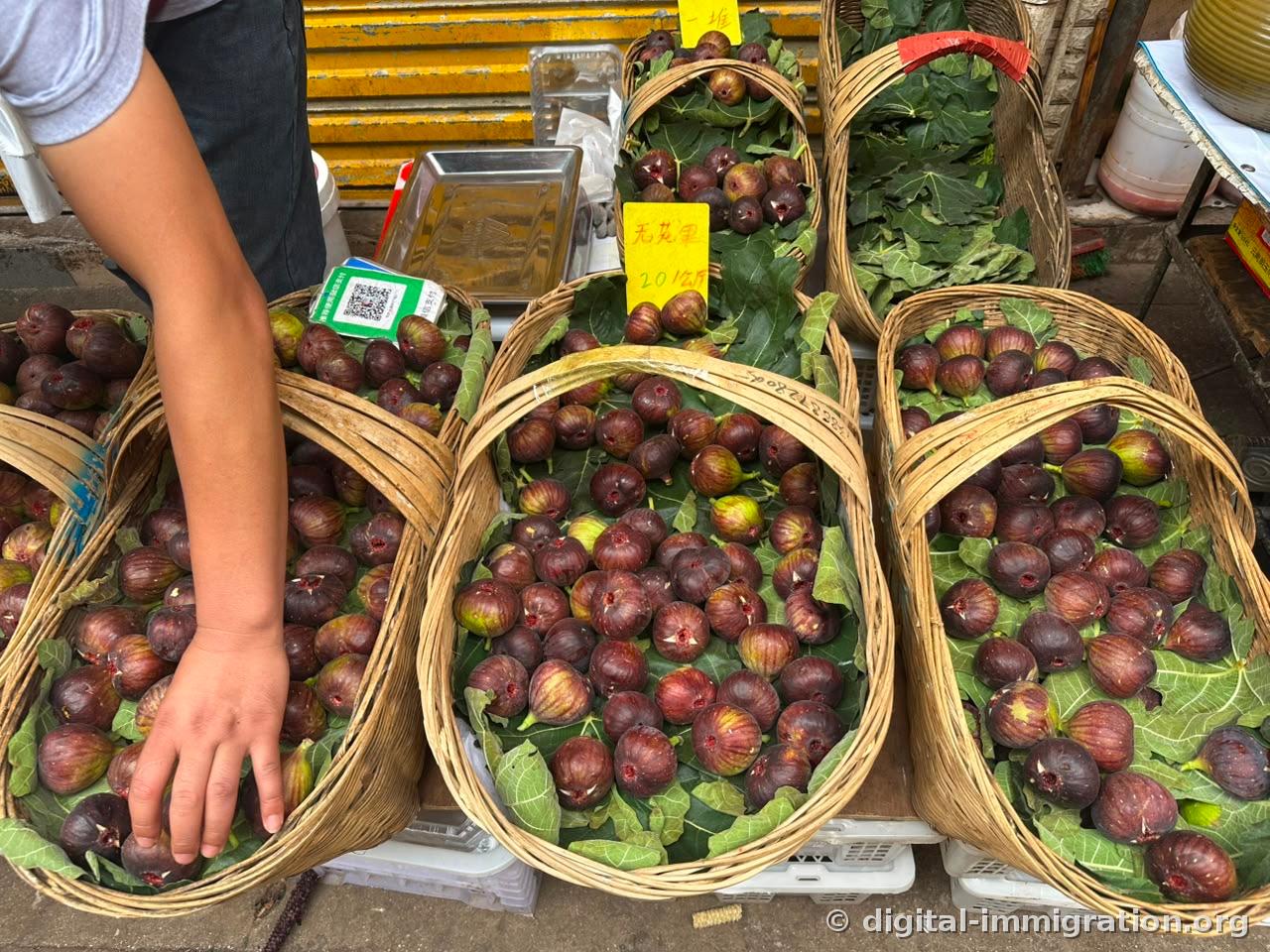
The fruit section was where I spent the longest. Figs are sold in bamboo baskets lined with fig leaves, heaped neatly. A yellow sign reads '无花果 20元/公斤' — 20 yuan per kilogram. Anyone who's bought figs in Korea will laugh at that price. The ripe ones show red flesh through the crack. The vendor was arranging the figs in the basket with their hands.
The indoor fruit counter was all pink from the lighting. From left: large yellow pomelo (with a sign next to it saying '空运榴莲' indicating durian), Buddha's hand with finger-like segments (48元/kg), pomegranates piled high in red, flat flat peaches in mesh netting. A sign on white paper in handwriting reads '水蜜桃 38元/2斤' (honey peaches, 38 yuan for two catties). In the front box, '印尼 蛇皮果' (Indonesian salak) — snake-skin patterned just like the real thing. I've seen this often in Southeast Asia, but seeing it here in the middle of a Yunnan market felt nostalgic.
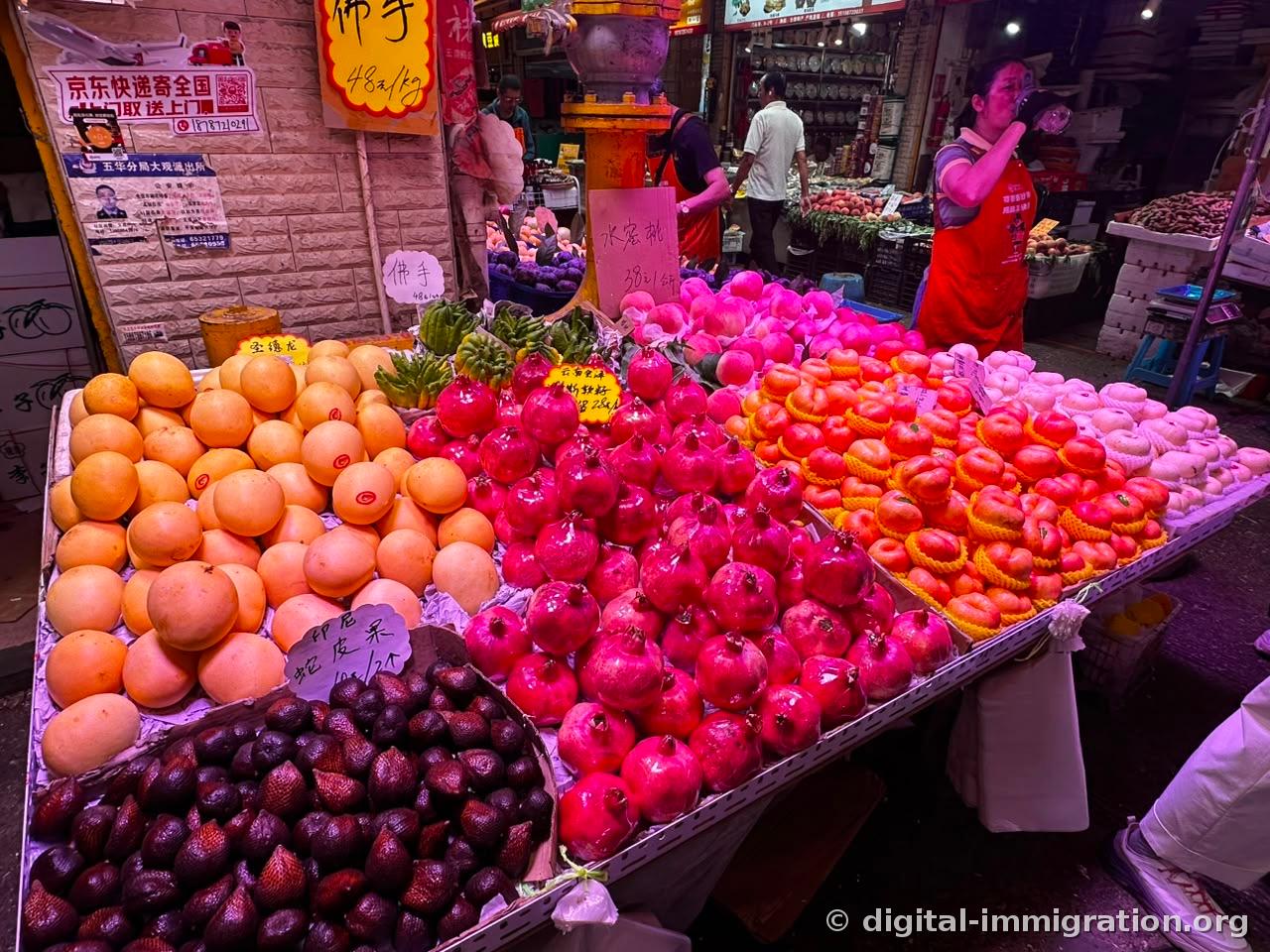
Even when price signs are posted, always check whether it's '斤 (catty, 500g)' or '公斤 (kilogram)' — these units mix, and the calculation becomes twice as expensive. I once confused them and thought to myself "why is this so expensive?" only to realize I'd read the catty price as kilogram.
Qingke Cakes for 3.5 Yuan — This Morning's Breakfast
What I bought for breakfast was this. Glass display cases held flat cakes made from pale green batter, each basket full. Reading the blackboard price signs: 青稞 玫瑰 豆沙 3.5元 (qingke rose red bean), 青稞 苏子 3.5元 (qingke perilla), 青稞 玫瑰 糖 4元 (qingke rose sugar), 青稞 小米 加糖 3.5元 / 无糖 3.5元 (qingke millet with/without sugar), and 梅菜鲜肉 4元 (preserved mustard greens and pork). Qingke is naked barley from the Tibetan plateau, which gives the dough its distinctive pale green color.
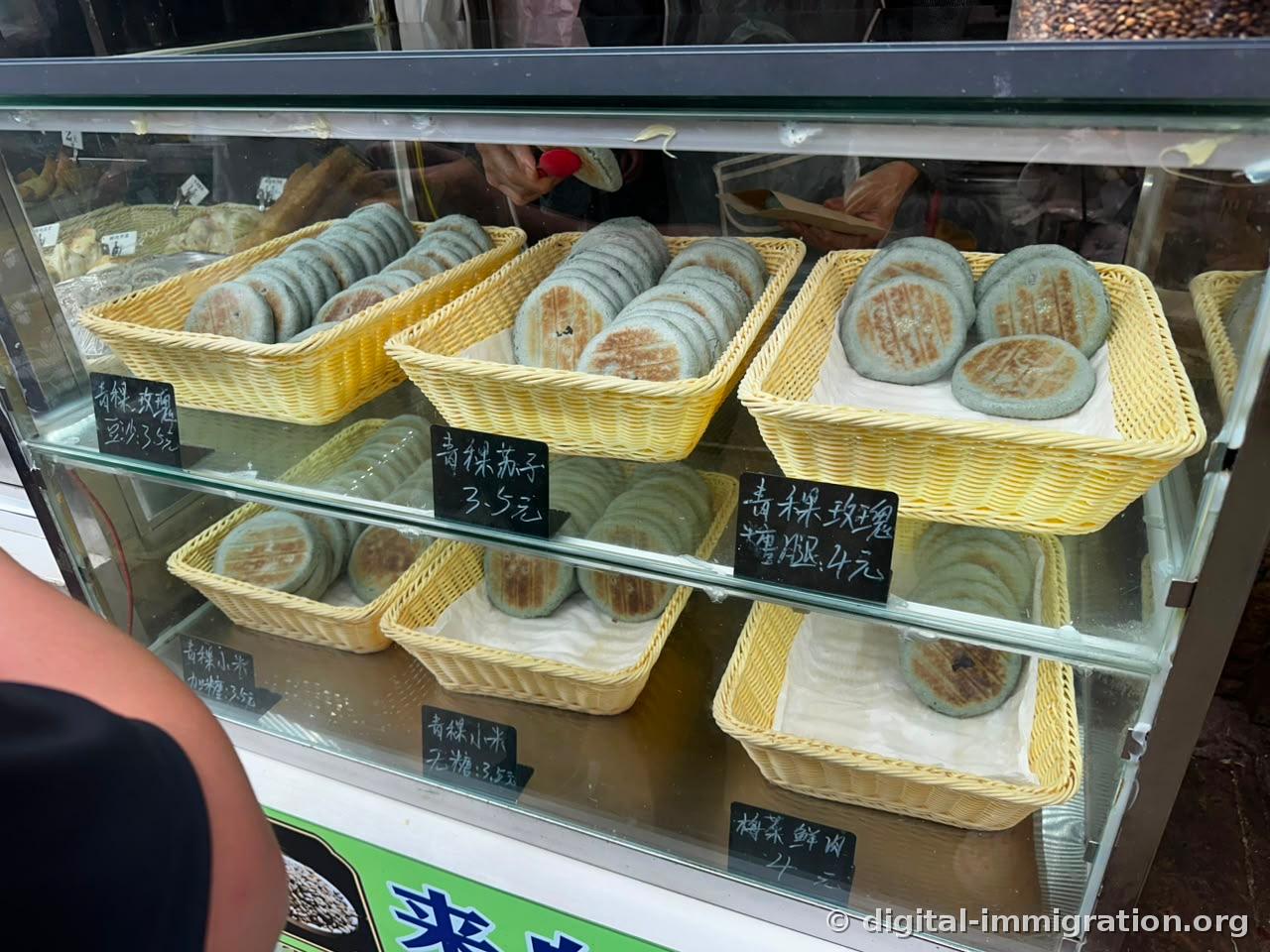
I chose the perilla filling. It wasn't fresh-baked, just from the display case, so it was lukewarm and slightly damp on the outside. The taste — almost no sweetness and a strong barley-husk flavor. If you expect Korean cake's chewiness, you'll be disappointed. It's rough and crumbly instead. I liked the simplicity, but my companion took one bite and handed it to me. If you want something sweet, get the rose sugar version at 4 yuan. And you should buy these when they're fresh from the oven — ones that have been in the display case are noticeably worse.
Actually Useful Tips
- Payment: WeChat Pay or Alipay is essential. Every counter has a QR sign, and many don't have cash change. Complete overseas card registration and real-name verification before leaving Korea.
- Units: 斤 = 500g, 公斤 = 1kg. Check which one the sign shows every time. It's a twofold difference.
- Timing: Fresh items come out in the morning. Go in the afternoon and the mushroom and wild greens baskets are often empty.
- Clothing: Kunming is high altitude so August mornings and evenings are cool. Bring a light jacket. Conversely, midday UV is strong.
- Prices: The numbers I listed above are what I read from signs on the day I visited. Prices change with season and vendor, so check on site.
- Photos: Most don't mind, but ask before taking angles with people's faces. At busy spots like the luwei counter, don't block the walkway.
Back at my accommodation washing the figs, I thought: in the end, the most Yunnan thing about this city wasn't a tourist spot but these two hours this morning. Not knowing a single mushroom name, not managing to eat the insects, buying room-temperature cakes — failing at things and all.