Vientiane HANCOOK — How Much You'll Spend on a Korean Meal in Laos, and Why It Was Worth Every Kip
On my fourth day in Vientiane, after khao piak in the morning and noodles again for lunch, my tongue went on strike by evening. It's not that I dislike Lao food, but four straight…
Vientiane Capital · HANCOOK
On my fourth day in Vientiane, after khao piak in the morning and noodles again for lunch, my tongue went on strike by evening. It's not that I dislike Lao food, but four straight days of that cilantro-lime-fish sauce axis had my body craving doenjang instead. So I went looking, and ended up at HANCOOK, a Korean restaurant in Vientiane, Laos. Bottom line up front — this isn't a place backpackers stop by for a quick bite. By local standards, it's a genuinely upscale restaurant. And it earns that price tag.
Let's talk price first — this is an "expensive place" by Lao standards
The moment you open the menu, if you've gotten used to Lao prices, you pause for a second. Copying straight from the menu I photographed at the table: kimchi jjigae 120,000 kip, tuna kimchi jjigae 130,000 kip, sundubu jjigae 130,000 kip, doenjang jjigae 120,000 kip, yukgaejang 135,000 kip, galbitang/gamjatang-style soups 145,000 kip, samgyetang 245,000 kip. Move up to the two-person hot pots and the price jumps another notch — budae jjigae 295,000 kip, bulgogi mushroom jeongol 315,000 kip, kimchi galbi jjim 315,000 kip, galbi jjim 315,000 kip.
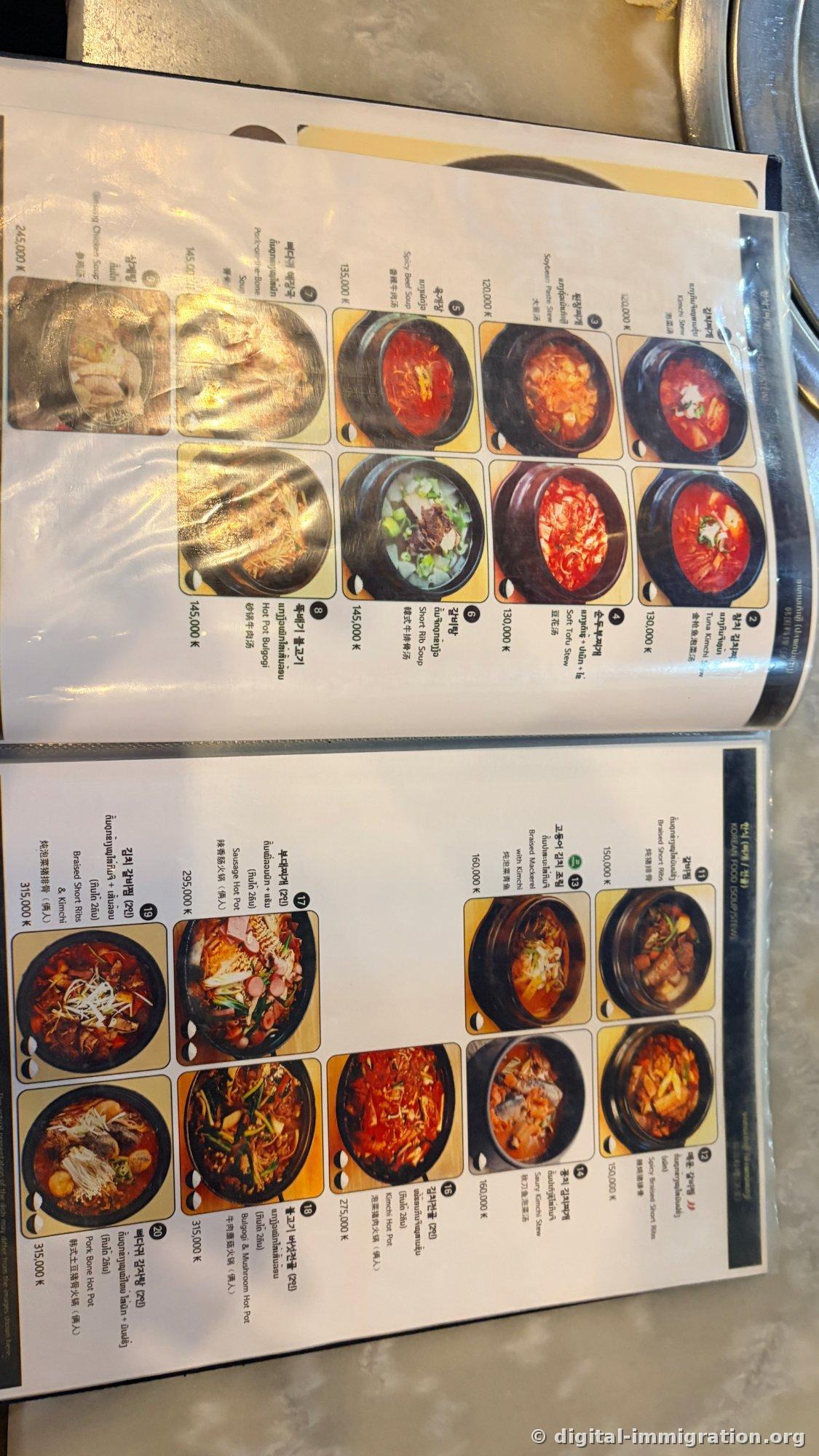
In a country where a bowl of street noodles runs 25,000–30,000 kip, a single jjigae here costs four times that. By Lao standards, this is clearly a place for entertaining guests or celebrating an occasion. Sure enough, the next table over was locals in dress shirts. Before a visitor from Korea gets shocked and thinks "why is this kimchi jjigae so pricey," it helps to consider how Korean ingredients even get into this country. Laos is landlocked, and a good chunk of the napa cabbage, chili powder, and stock meat has to travel a long import chain to get here.
Yukgaejang — the dish that surprised me most here
When my companion's yukgaejang arrived in its stone bowl, I honestly expected it to be unremarkable. One spoonful of the broth changed my mind. The beef wasn't shredded fine — it kept a coarse grain, and the meaty flavor hit first with each bite. The broth was a classic red-oil yukgaejang, but it wasn't heavy or muddy, and sesame seeds were scattered generously across the top. The carrots were cut unusually large — you rarely see chunks that big in a Korean yukgaejang — and there was even a whole potato in there, so my first impression sat somewhere between yukgaejang and galbitang. But it wasn't lacking in flavor at all — if anything, it gave a strong impression that they hadn't skimped on ingredients.
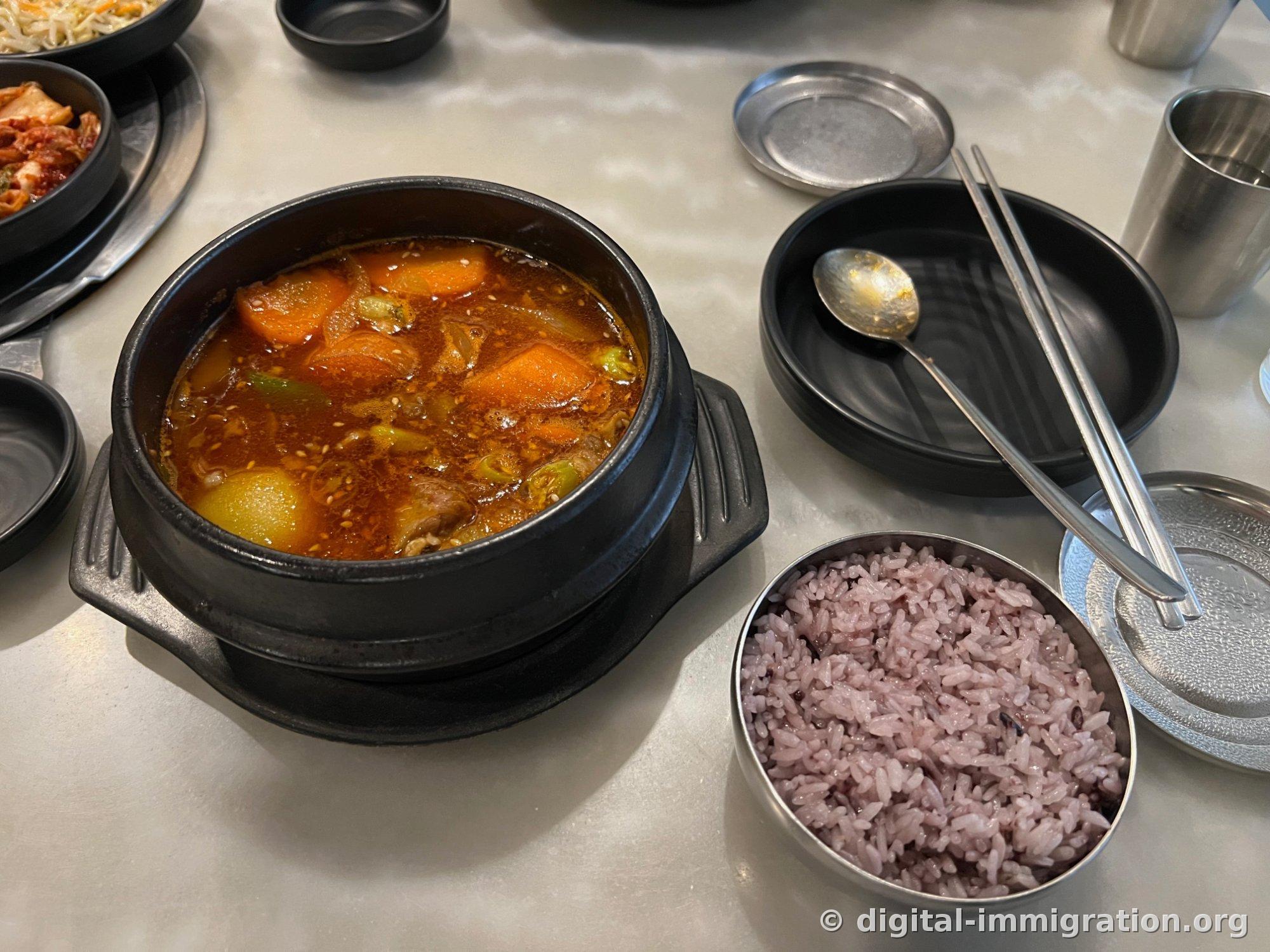
There's something worth emphasizing here. If you're craving Korean food in Laos, this place is a solid answer. But what's even more interesting is that a few dishes actually felt better than what I've had back in Korea. I don't think that's purely down to the chef's skill. In Korea, a $9 bowl of yukgaejang faces cost pressure, but here, since they're charging a locally "premium" price, there's no reason to be stingy with the meat. When the price goes up, the ingredients go up with it, and when the ingredients go up, the broth changes accordingly. You can taste that difference right in the bowl.
Sundubu jjigae and the banchan spread
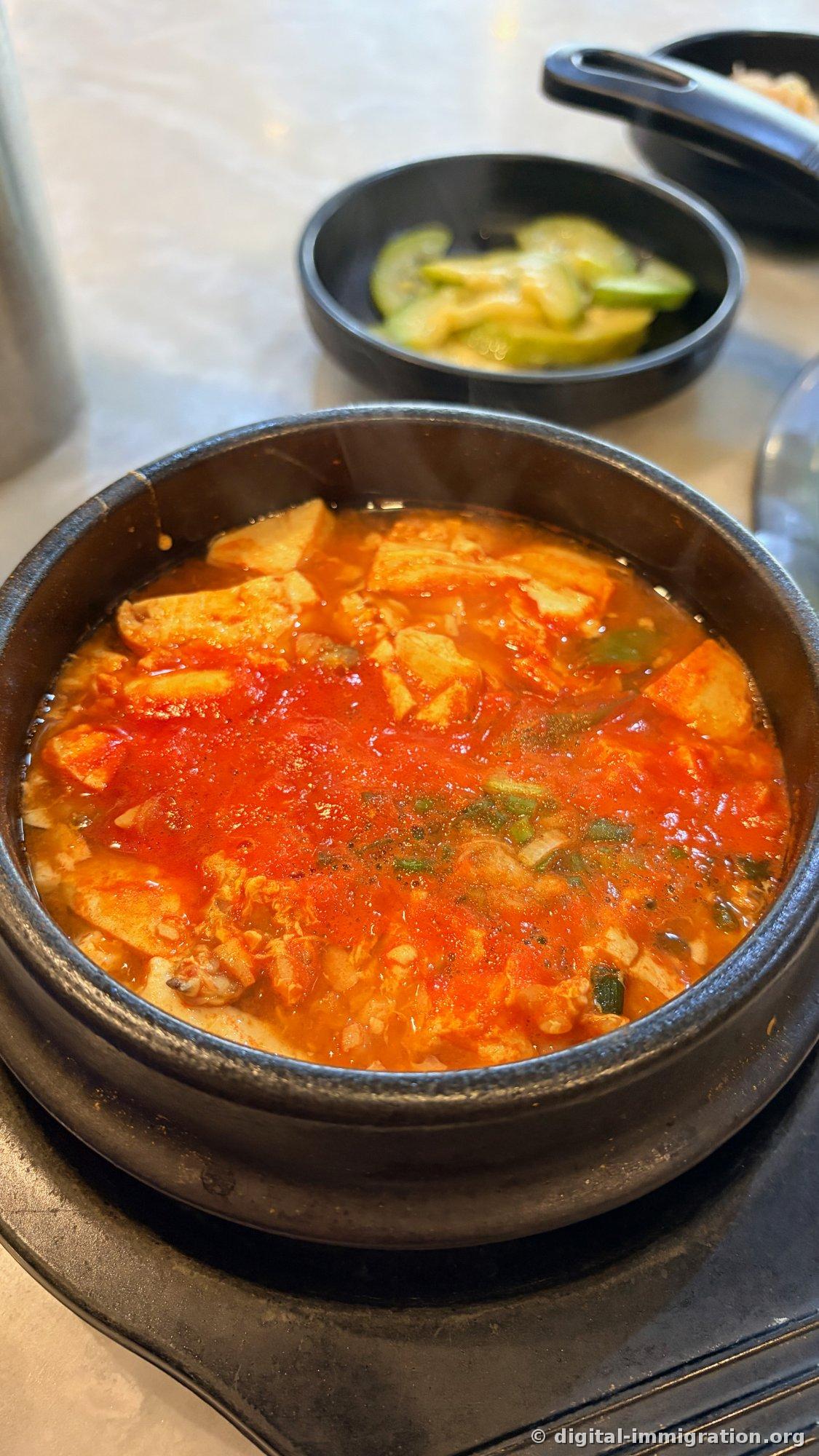
What I ordered was sundubu jjigae (130,000 kip). A layer of red chili oil sat clearly on the surface of the broth, and the tofu came in large chunks — closer to soft pressed tofu than the usual silken curd. Clams lined the bottom of the pot, so stirring with chopsticks kept catching on shells. The spice level was medium by Korean standards, though probably fairly spicy for a Lao palate. The stone pot came out properly preheated and stayed at a rolling boil the whole time, keeping its temperature all the way through to when I mixed in the rice.
Apply for the Digital Immigration Form (LDIF)
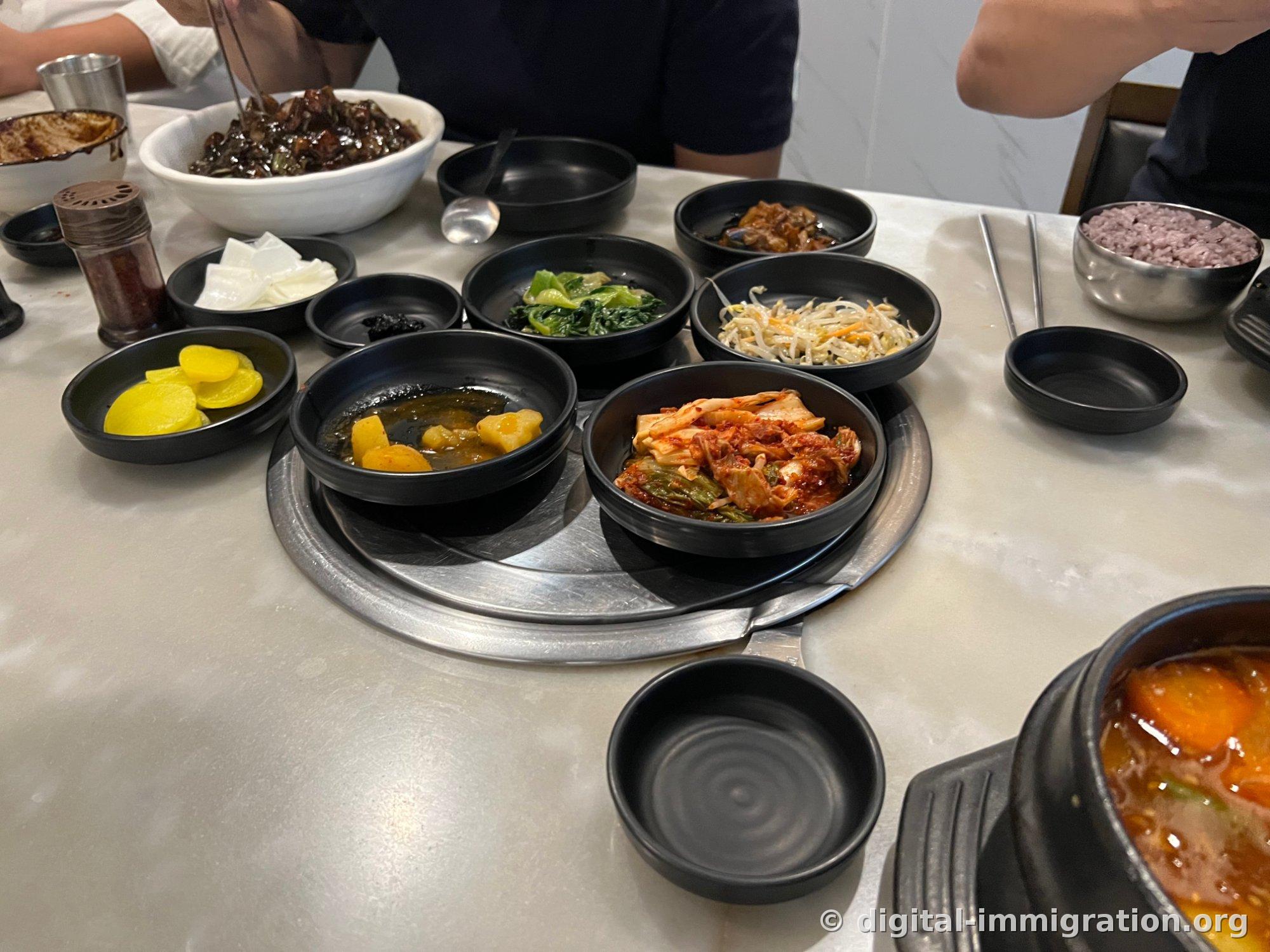
The banchan exceeded expectations. Pickled radish, radish kimchi, spinach namul, bok choy namul, seasoned bean sprouts, napa cabbage kimchi, braised potatoes, and something close to salted squid — eight dishes in all, arranged on a lazy Susan. I've been to plenty of Korean restaurants in Southeast Asia where you get three or four banchan and that's it, so this spread was genuinely a pleasant surprise. The kimchi was less fermented than what you'd find at a restaurant back home, so the sweetness of the chili powder came through more than the sourness. If you like your kimchi well-aged and tangy, this might be a slight letdown.
Sweet and sour pork and jjamppong — Chinese dishes that turned out to be the real deal at a Korean restaurant
My companion said, "They serve jjajangmyeon here too," and ordered jjajangmyeon, jjamppong, and sweet and sour pork on top of everything else — and that turned out to be the twist of the day. The sweet and sour pork had that puffed-up, snow-white batter style — coated in glutinous rice batter and double-fried so the outside cracks into thin shards while staying hollow inside, close to the so-called "snowflake" texture. The sauce came served on the side rather than poured over, so the crunch was still intact even 20 minutes later. The fact that they serve it on porcelain dishes stamped with the HANCOOK logo around the rim is another sign this place invested in its tableware.
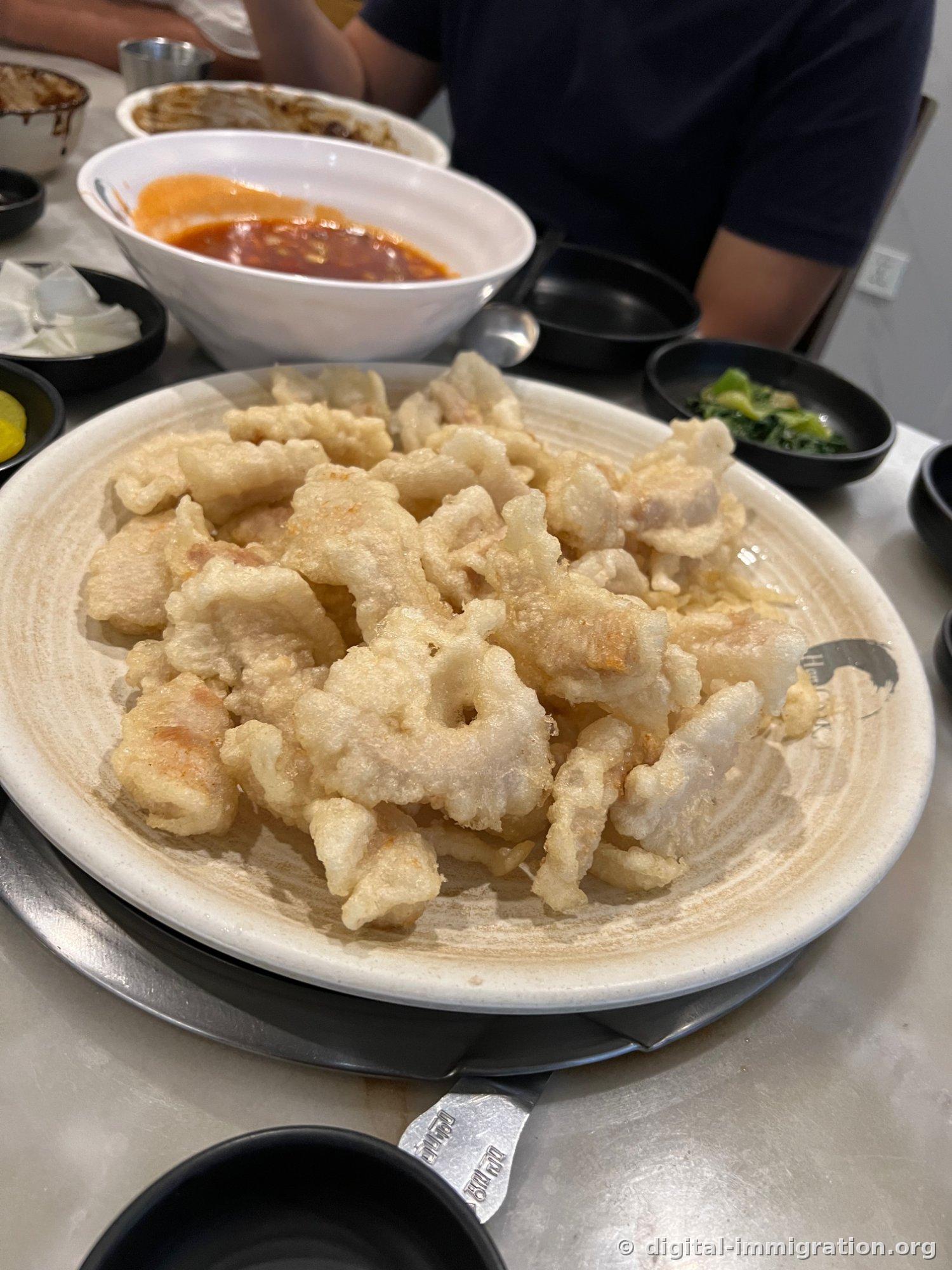
Even from what's left in the photo, the jjamppong broth looks red and rich, and eating it in person confirmed the balance leaned more toward chili oil than seafood. It was the first time I'd come across jjamppong this good in Laos, so I ended up finishing almost the whole bowl. The jjajangmyeon, though, was just average — the chunjang flavor was thin and the noodles a touch soft, so if I had to pick just one of the three, I'd go with the sweet and sour pork.
Jeyuk bokkeum — served with lettuce wraps on the side
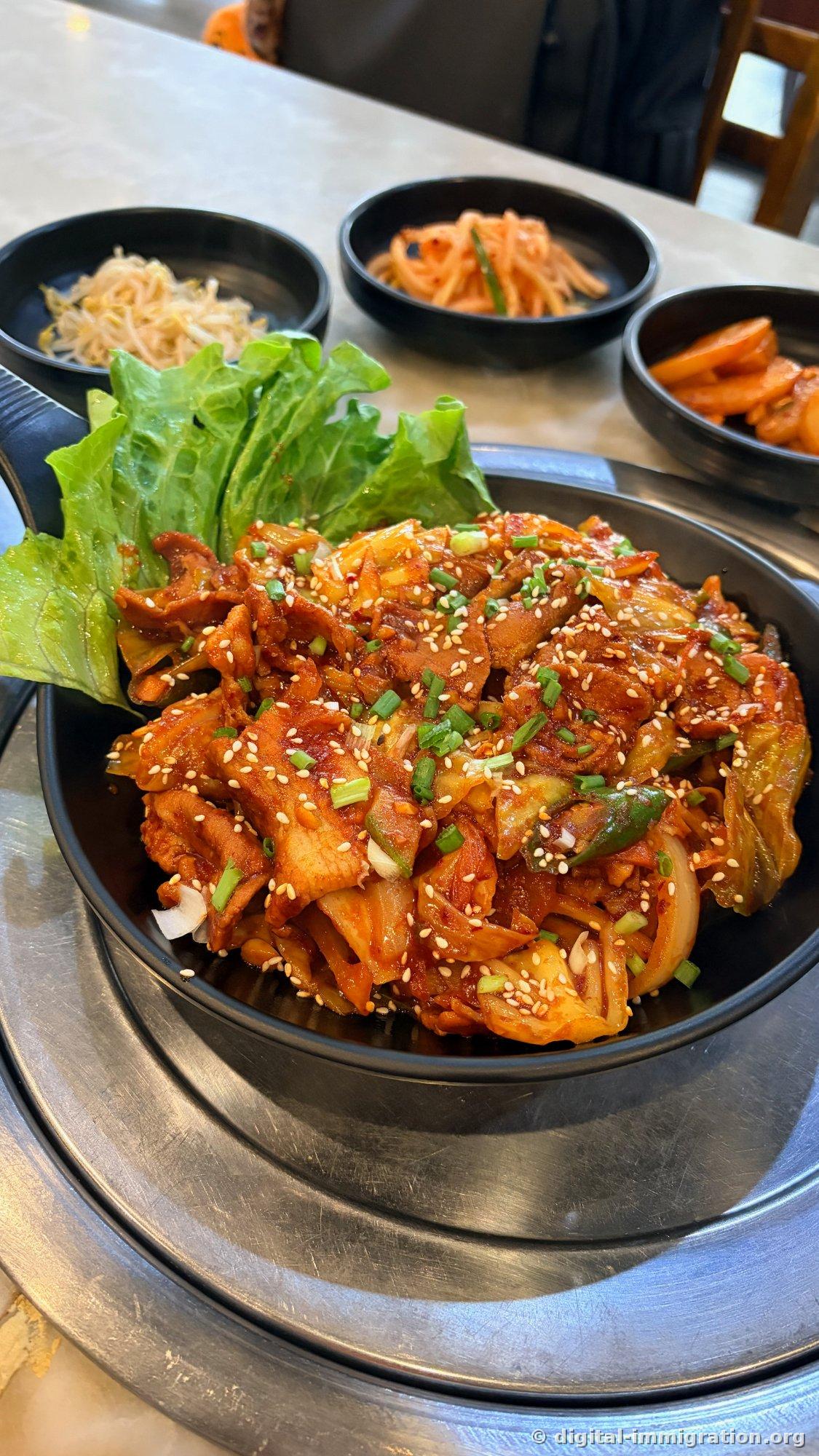
Worth noting the jeyuk bokkeum (spicy stir-fried pork) I ordered on my second visit as well. Onions and cabbage were stir-fried in generously, topped with sesame seeds and chopped scallions, with lettuce leaves laid out alongside on the plate. Instead of pork belly, they used thin slices of what looked like pork shoulder, and it wasn't tough at all. The gochujang seasoning leaned sweet rather than spicy — if you're expecting the fiery kick of Korean-style jeyuk, it might come across as a bit mild. Given the mostly Lao clientele, that seemed like an intentional adjustment. It came with seasoned bean sprouts, radish salad, and kimchi on the side.
Location and building — finding the sign is the trick
The restaurant sits on the ground floor of a two-story colonial-style building with cream and orange trim, and "HANCOOK" is displayed in large white capital letters, with a Lao-language sign right next to it. A large black shade screen is hung over the second-floor windows, making the whole building look dark from a distance — but that actually works as a landmark. Just look for the "round corner building draped in black cloth." There's parking space out front for three or four cars, so if you're coming by rental car or motorbike, there's somewhere to park. The sidewalk is narrow and cars park right up against it, so approaching on foot means veering slightly toward the road.
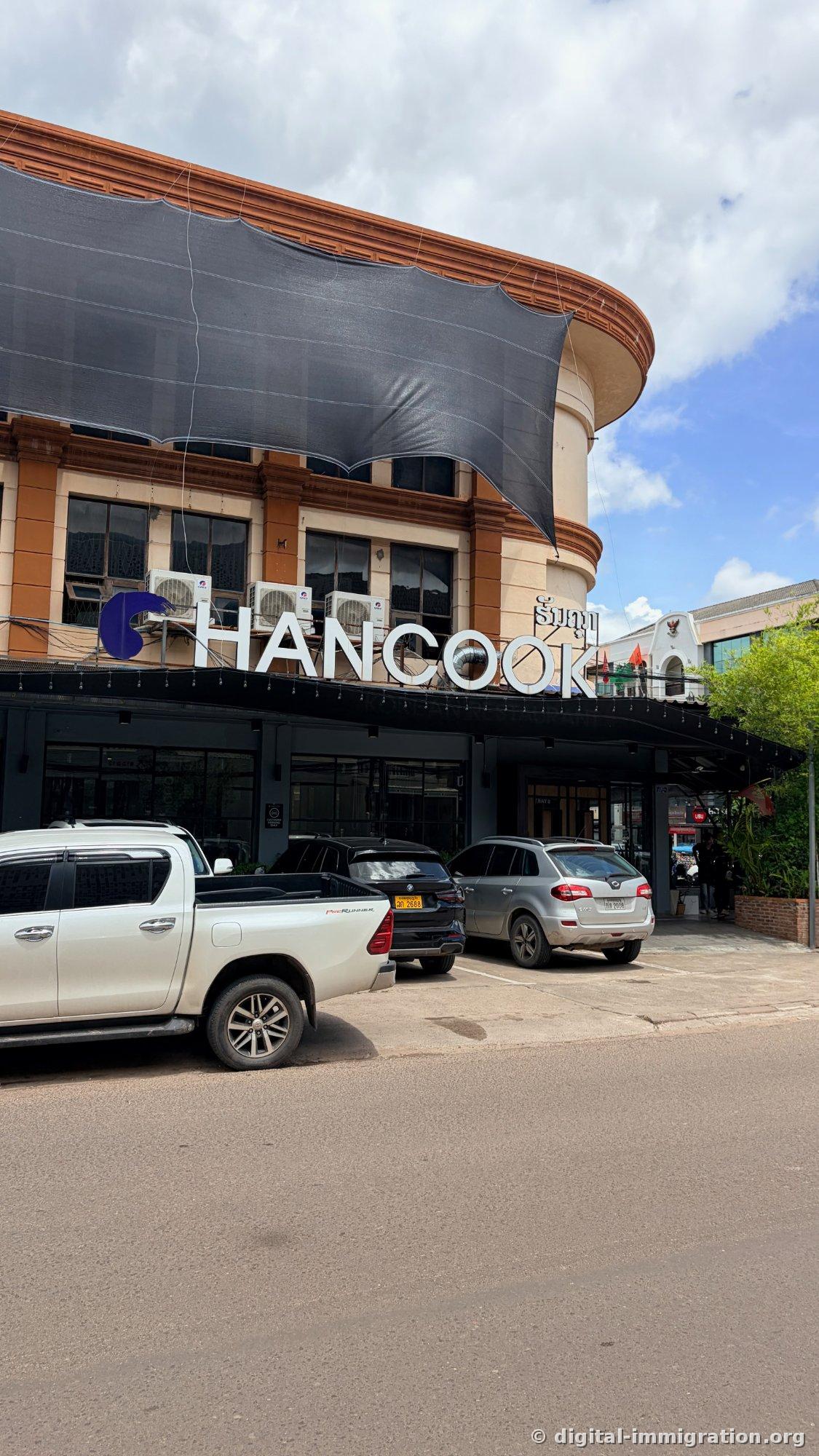
It's an easy distance to reach from central Vientiane by tuk-tuk or ride-hailing app. That said, drivers sometimes struggled to understand when I pronounced it "Han-kook," so it was much faster to just show them the coordinates or map screen above. I only confirmed opening hours during the times I visited (lunch and dinner), so it's worth checking on site whether there's a break between service periods.
In summary
- Jjigae dishes run 120,000–145,000 kip, and two-person hot pots run 295,000–315,000 kip. By Lao standards, this is definitely an upscale restaurant.
- But they don't skimp on ingredients. The texture of the beef in the yukgaejang and the crispness of the sweet and sour pork batter were actually better than what I've had at this price range back in Korea.
- Eight banchan dishes come standard — more generous than the Southeast Asian Korean restaurant average.
- The kimchi is less fermented, and the jeyuk seasoning leans sweet. If you want bold, classic Korean flavors, keep these two points in mind.
- The Chinese-style dishes are surprisingly legit. The sweet and sour pork is worth ordering.
This isn't just a place to go when you're sick of Lao food — it's worth keeping in mind as a place to set aside a budget for and visit when you want a proper, satisfying meal during your trip. I went on the evening of my fourth day, and went back again three days later.
Read next
- Pha That Luang in Vientiane: Walking the Golden Stupa on a Cloudy Afternoon at Five O'Clock
Take a tuk-tuk fifteen minutes northeast from downtown Vientiane and the road suddenly widens, with a golden mass rising abruptly beyond a wall. Pha That Luang. The very stupa that…
Vientiane Capital · That Luang - Kyoto-Style Water Drop Mochi Found in the Heart of Vientiane — KYO Cafe & Meal Record
Vientiane is fiercest at two in the afternoon. Shade does nothing to help, and you can feel your shirt clinging to your back. That day, while walking through downtown, it became un…
Vientiane Capital · KYO Cafe & Meal - A French Evening at Le Vendôme in Vientiane, Laos—Record of Three Plates: Pizza, Carbonara, and Salad
On an evening when the breeze from the Mekong River drifted across the street, I stepped into Le Vendôme Restaurant tucked into an alley near Wat Inpeng. Whenever French cuisine co…
Vientiane Capital · Le Vendôme Restaurant