Kinkaku-ji in Kyoto: Rokuon-ji Seen from the Pond and the Hillside Beyond
Rokuon-ji (鹿苑寺), located in Kita Ward, northwest Kyoto, in the Kinkaku-ji district, is simply called Kinkaku-ji by the locals. I visited on a hazy morning in late winter. The pine…
Kyoto · Kinkaku-ji
Rokuon-ji (鹿苑寺), located in Kita Ward, northwest Kyoto, in the Kinkaku-ji district, is simply called Kinkaku-ji by the locals. I visited on a hazy morning in late winter. The pine needles still held moisture, and the wind bit at the back of my neck. Yet the moment the path bent left past the ticket office, the view suddenly opened up, and there stood the golden pavilion in its entirety across the Kyōko Pond. You could say that single stretch encompasses the whole temple. The problem, though, is that I wasn't standing there alone.
The Front View from Across the Pond — Crowded and Cramped
This is the first view you encounter after entering from the main gate. Of the three-story pavilion, the upper two stories are covered in gold leaf, while the first floor remains exposed white plaster and wooden posts without any gilding. From photos, I'd assumed the entire building was gold, but seeing it in person, the plainness of the lower level actually makes the gold above stand out more dramatically.
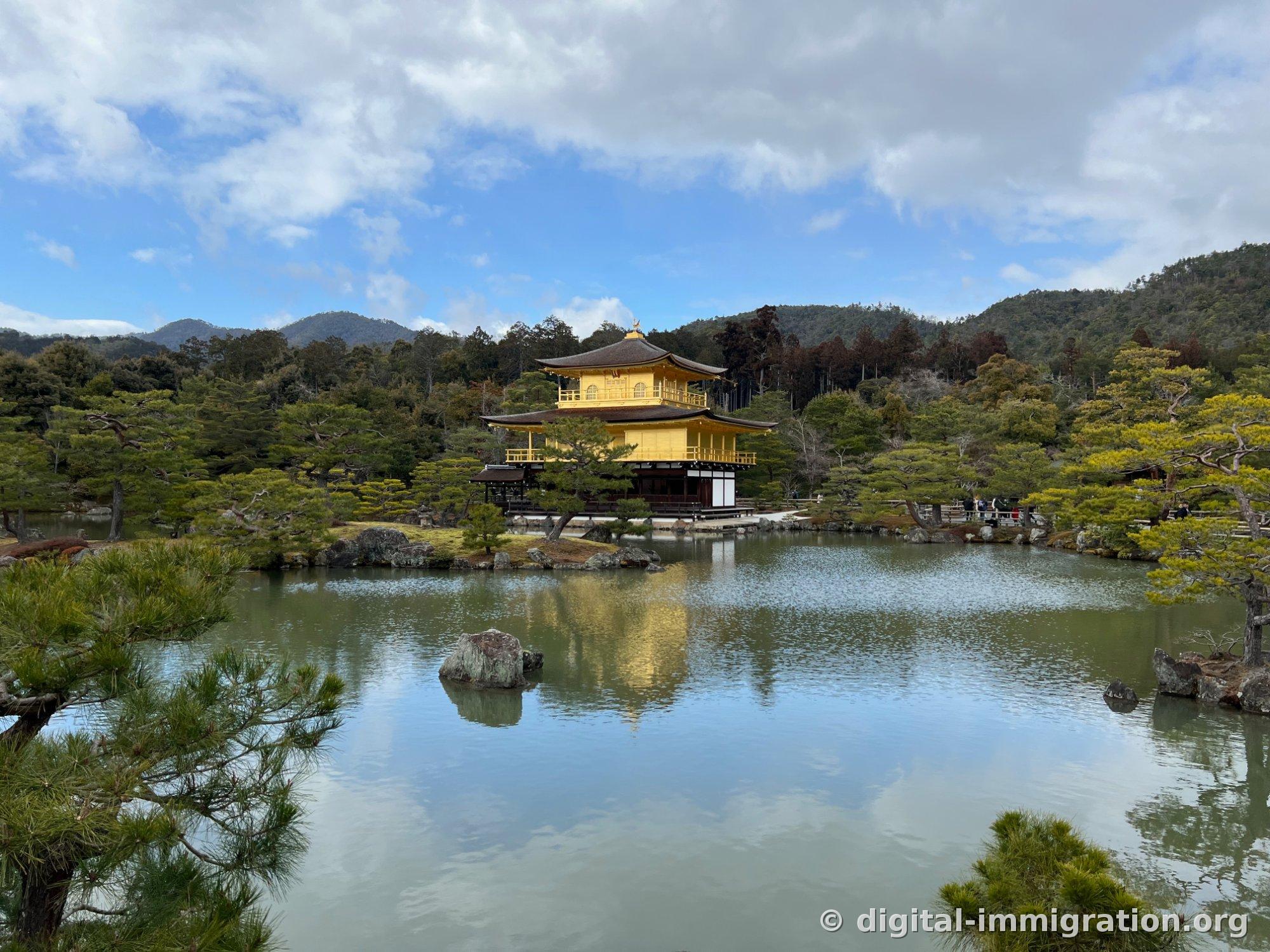
To properly capture the golden pavilion's reflection, you have to wait for the wind to calm. When ripples form, the reflection breaks apart into just yellow smudges. I stood in the same spot for two or three minutes, waiting for the moment the water became still. That hazy, broken section of reflected light in the lower right of the photo is exactly where the wind had passed over. Since this viewing path is one-way only, if you miss the shot you want, don't push your way back in. There's a line of people behind you.
Turning to the Side Reveals the Structure
Moving counterclockwise along the path and climbing slightly, you see the golden pavilion from a diagonal angle. Only then do you grasp the building's actual structure. Each story has a different style. The lower two stories have the appearance of residential and reception spaces, with continuous eaves and railings, while only the top floor has the dense latticed form of a Buddhist chapel. A golden phoenix perches on the roof's peak, which isn't clearly visible from the front view of the pond but appears here in silhouette against the sky.
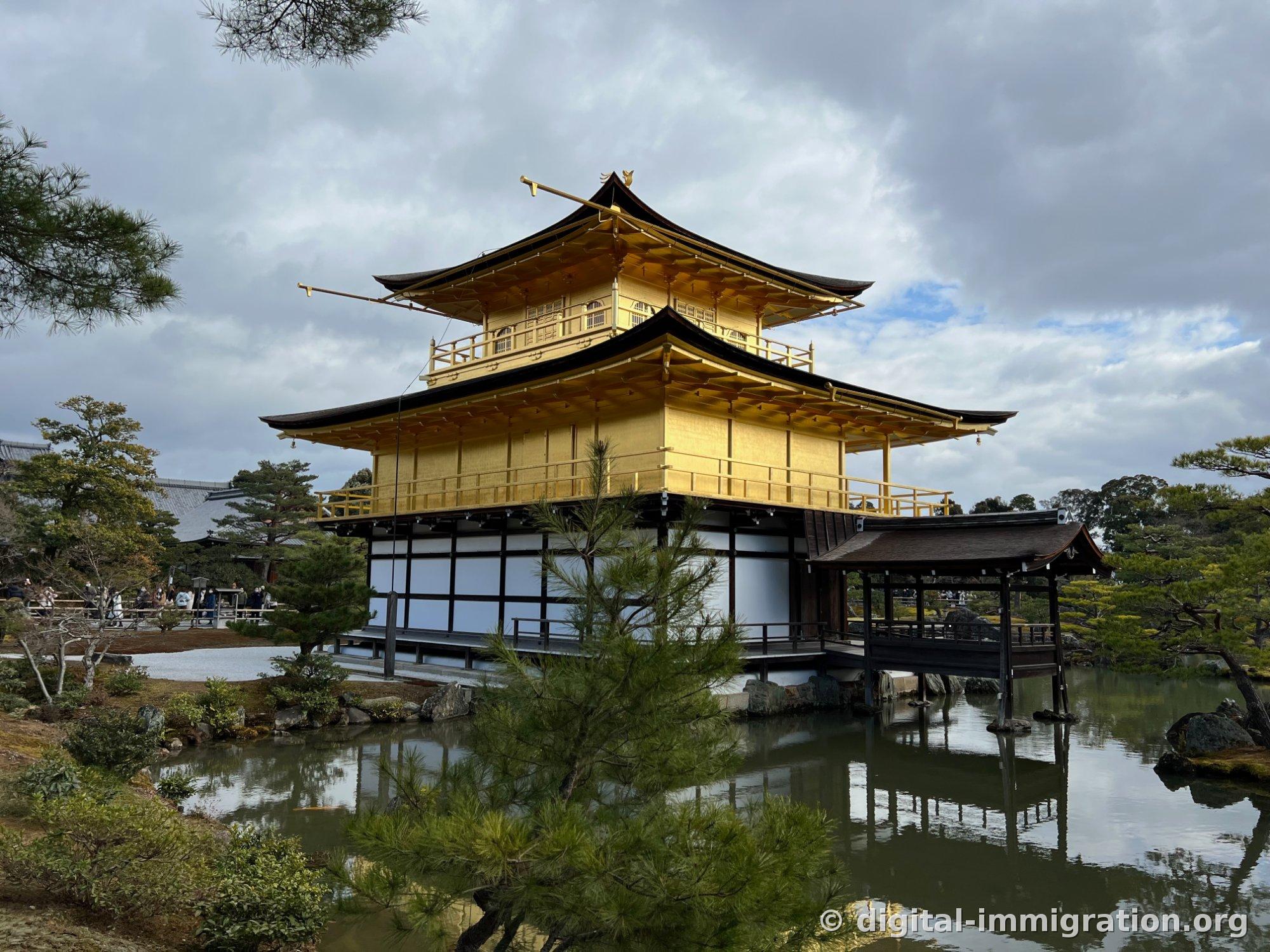
On the right, a small pavilion catches the eye, with pillars driven into the water. Its low roof and complete lack of gilding create a stark contrast with the main building. Beyond the wall on the left, you can see the line of visitors clearly—and this was on an overcast day. To keep people out of photos, you'd have to angle the camera further right or hold pine branches in front of the lens.
How to Get There and Route Planning — The Bus is Your Answer
The nearest train station is somewhat inconveniently far, so most people take the bus. From the bus terminal in front of Kyoto Station, take Kyoto City Bus 205 or an express line, get off at the Kinkaku-ji-michi (金閣寺道) stop, climb the hill a little, and it's about a 3–5 minute walk to the main gate. From the Kawaramachi/Shijō area, bus 12 is more convenient. Buses run frequently, but after 10 a.m., you'd better resign yourself to standing. Check the information board at the stop for current fares and schedules.
The grounds form a completely one-way loop circuit: pond's front → side view → hilltop behind → Anmin-taku Pond → tea house → exit. Even if you walk the entire course, you'll be done in under 40 minutes. Don't be discouraged by the brevity. Instead, combine it with nearby Ryōan-ji and Ninna-ji as a half-day itinerary—your time won't feel wasted. Your admission ticket is a talismanic charm-shaped paper, so hang onto it rather than throwing it away, and you'll have a souvenir.
One More Look Back on the Hillside at the End
Most people, once they've photographed the pavilion from across the pond, hurry through the rest. I did too on my first visit. But later in the loop, when you turn around while climbing the gentle wooded hillside, that same golden pavilion appears again—tiny now, glimpsed through the forest gaps. The impression is completely different from the front view.
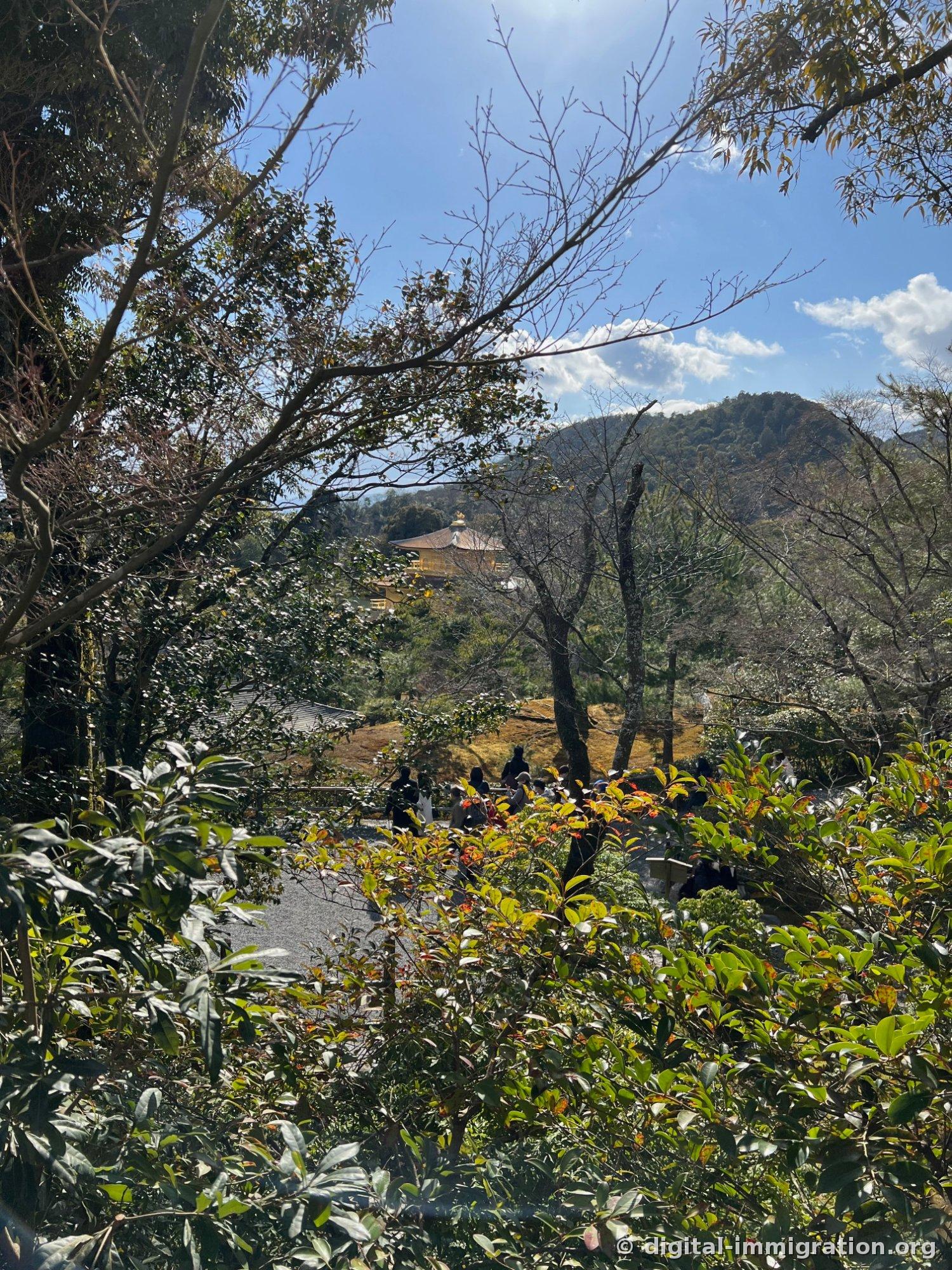
By the time I took this shot, the clouds had cleared and the sky opened blue. Same temple, same day, yet the tonal quality of the images differs so much in just 30 minutes. The foreground shrubs still have reddish leaves, and beyond them, visitors file past along the gravel path. Branches half-obscure the frame, so it's not a "perfect" photograph. Yet this scene stays with me more vividly. It's not meeting the golden pavilion head-on, but catching it by surprise, as if stealing a glance.
Things to Know Before Visiting in Winter
- The area around the pond is shaded and catches the wind off the water. It feels noticeably colder than downtown, so bring an extra layer.
- On cloudy days, the gold looks dull but reflections show clearly. On clear days, around midday the gilt tends to wash out to white.
- Interior visits aren't permitted. This is a temple you view from outside, not one you enter.
- It's one-way only—you can't backtrack. Shoot your desired angles before moving on.
- Opening hours and admission fees change seasonally, so check the official website before your visit.
Those three minutes from the bus stop climbing the hill, that instant when the gold first catches your eye between the trees. Only on my third visit did I truly understand why crowds flock here for those few fleeting moments.
Read next
- From Akihabara's Chuo-dori to the Kanda River: A Record of Tokyo's Electronics District Revisited Multiple Times
Tokyo's Akihabara is a neighborhood where it's hard to say you've seen everything in a single visit. I've come multiple times across different seasons, and each time the signs chan…
Tokyo · Akihabara - Buying a Single ¥300 Year-End Jumbo Lottery Ticket at Nishi-Ginza Chance Center in Tokyo
Exit from the Hibiya exit of Tokyo's Shimbashi Station, walk toward the elevated highway for about three minutes, and suddenly you'll see a line of people stretching along the side…
Tokyo · Nishi-Ginza Chance Center - Ueno Ameyoko, the real magic starts after sunset — an evening walk from the Okachimachi Gate to Ueno Station
Every time I come to Tokyo, my feet find their way to Ueno Ameyoko (アメ横) without fail. This time I entered from the Okachimachi side and worked my way toward Ueno Station. I've met…
Tokyo · Ameya Yokocho Market