Kagari on the 3rd Floor of Keio Plaza Hotel Tokyo in Shinjuku, a Japanese Breakfast Set Served Covered
I had breakfast at Kagari (かがり), the Japanese cuisine restaurant at Keio Plaza Hotel Tokyo on the west side of Shinjuku. After checking in late the night before, I picked up my bre…
Tokyo · Keio Plaza Hotel Tokyo Kagari
I had breakfast at Kagari (かがり), the Japanese cuisine restaurant at Keio Plaza Hotel Tokyo on the west side of Shinjuku. After checking in late the night before, I picked up my breakfast voucher and chose a "Japanese set" instead of the buffet—a decision that turned out to be just right. Just a five-minute walk from the west exit of Shinjuku Station, in the block right next to the Tokyo Metropolitan Government Building. When I arrived around 8 a.m., outside the windows was a gray sea of commuters, but inside, the deep wood tables and low lighting made the time of day feel uncertain. It was surprisingly quiet.
Everything Comes Covered — First Course
Not long after I sat down, a wooden tray arrived all at once. At first, I was a bit confused. Every dish had a lid—the chawanmushi cup, the soup bowl, the rice bowl—so I couldn't tell what was what. The white lid on the bottom right was rice, the silver one in the middle was miso soup, and the ceramic lid on the left was egg custard. Only the porridge bowl came without a lid, topped with seaweed. The chopstick wrapper had the KEIO PLAZA HOTEL TOKYO logo printed on it, and the seaweed came separately in individual packets labeled "Nori from Saga Prefecture (焼海苔)." They give it in the packet so it doesn't get soggy, which is thoughtful. If you open it just before placing it on your rice, you get that satisfying crisp sound.
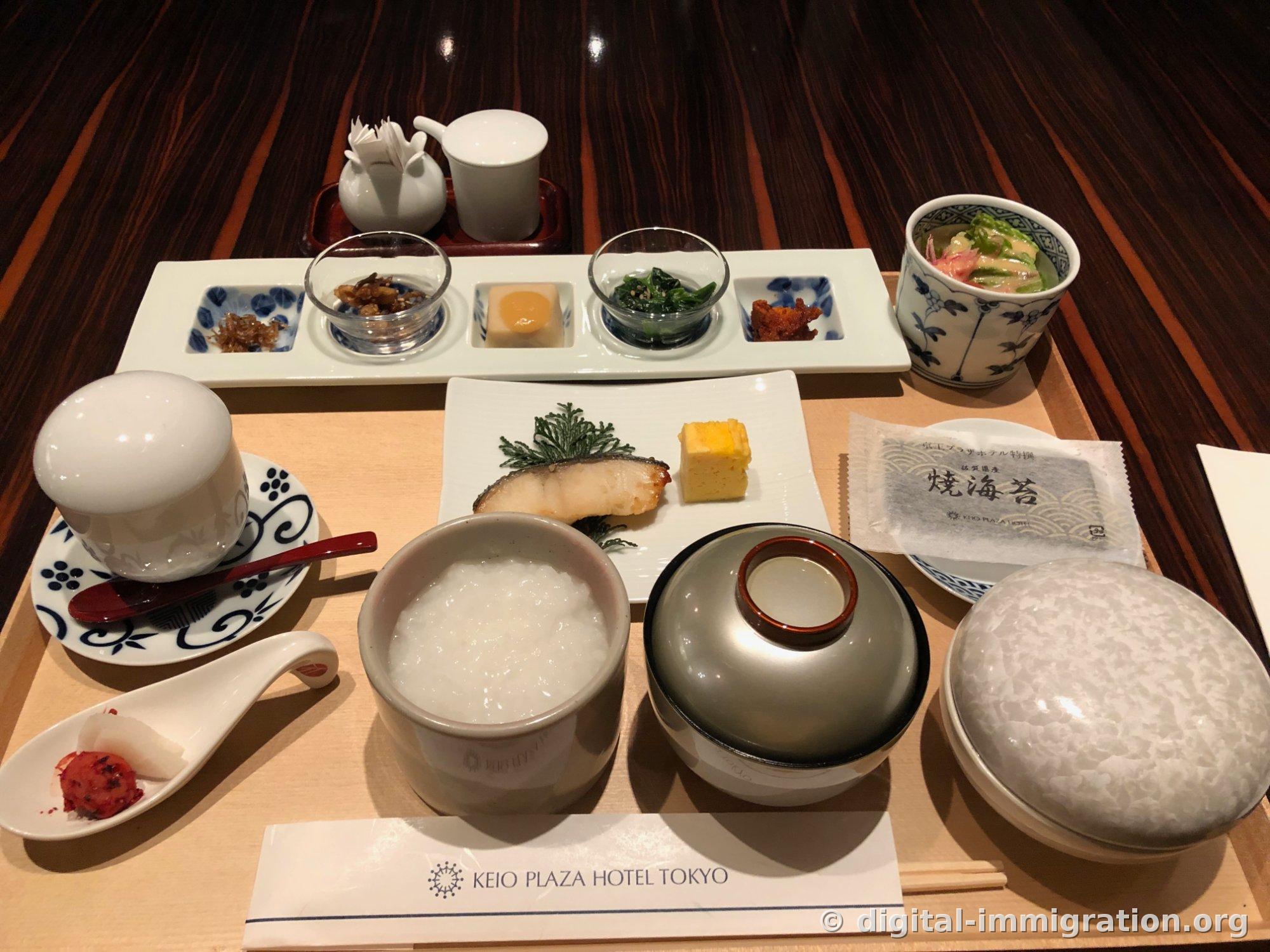
You get both white rice and porridge, not a choice between them. It's an easy thing to miss for a first-timer, but rice, porridge, and miso soup all come with free refills. There's a small note in the upper right of the menu that says "Free refills on rice, porridge and miso soup." The staff will understand even if you just gesture.
The Hand-Drawn Menu Is Actually an Instruction Manual
They give you a folded piece of paper along with the tray. It's a menu with calligraphy and watercolor illustrations that sketch out the entire spread, with lines drawn to label each of the five side dishes. Both Japanese and English are included, so you can identify the mystery components of those small compartments. From left to right: じゃこ有馬煮 (tiny fish and pepper sansho simmered), 胡桃小女子 (walnuts and whitebait), 柚子豆腐 (yuzu tofu), お浸し (spinach with dashi), 真たら子のうま煮 (cod roe simmered). The yuzu tofu looks like pudding, so I almost saved it for dessert until I checked the menu and reordered. In reality, it's closer to a yuzu-flavored jelly than actual tofu.
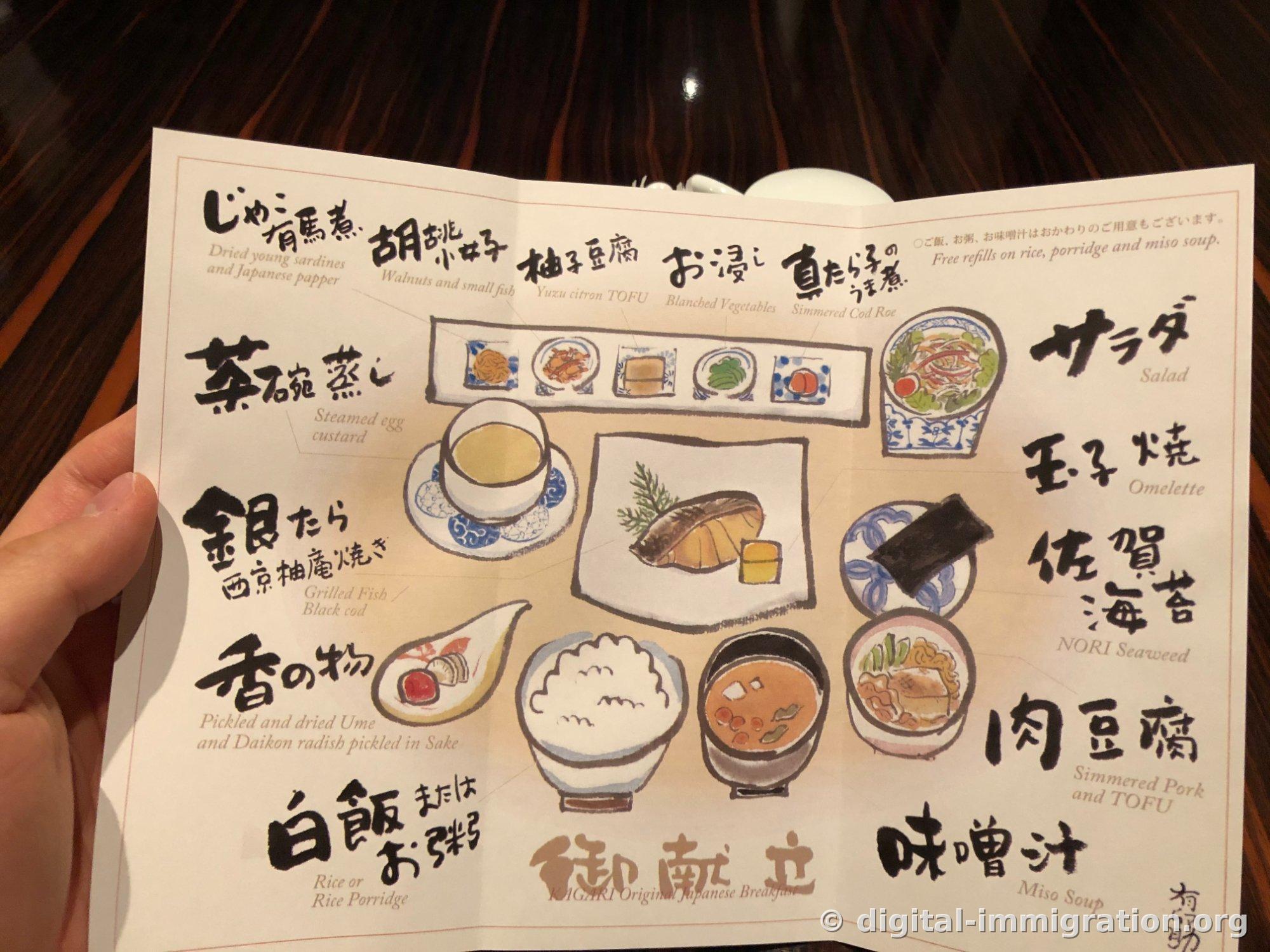
I held the menu in my left hand and took a photo with my right, and my finger ended up in the shot. I considered retaking it but didn't bother. The paper is so stiff it won't open with one hand.
Grilled Silver Cod Saikyo Yuzu Is the Star
Once you lift all the lids, the spread suddenly expands. In the center, on a white rectangular plate, sits 銀たら西京柚庵焼き—silver cod marinated in saikyo miso and yuzu sauce, then grilled. Only the skin is slightly charred while the flesh stays white with visible grain. The moment you touch it with chopsticks, it falls apart effortlessly. The sweetness comes first, not saltiness. The tamagoyaki next to it is the Kansai-style with plenty of broth, so each bite releases dashi. Just these two dishes alone are worth the price of breakfast.
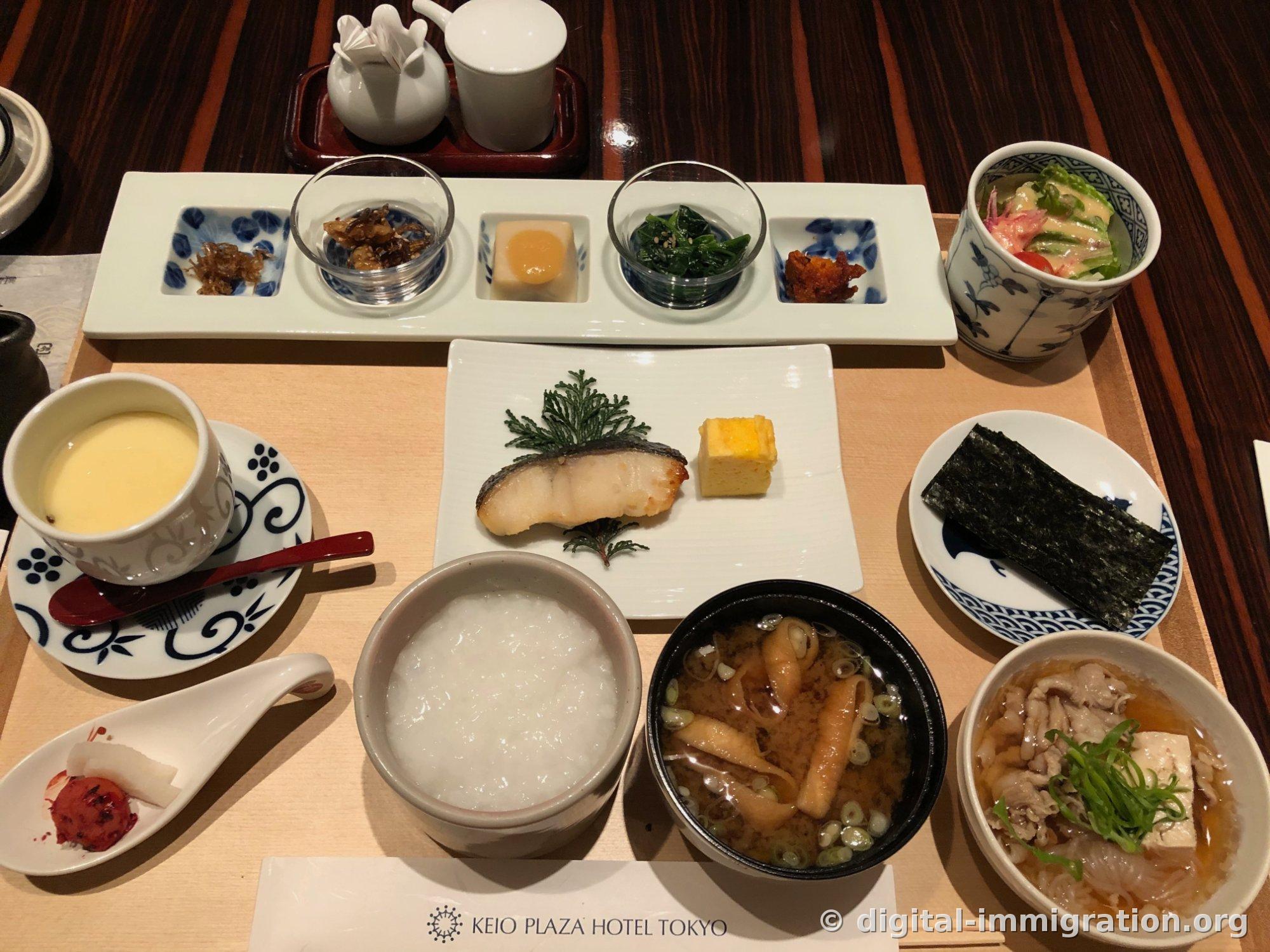
The real surprise was the nikudofu (肉豆腐) on the bottom right. Pork, tofu, and shirataki noodles braised in soy broth with green onion on top. Meat for breakfast felt a bit heavy at first. But the broth is clear and lean, pairing better with the porridge than you'd expect. The miso soup uses dark akamiso with abura-age and green onion, so it's deeply flavored and distinctly salty. The chawanmushi arrives hot, so don't rush. If you only eat the top layer without stirring the bottom, you'll miss the ingredients underneath entirely.
The only downside was the portion size. It looks like a lot of dishes at first glance, but each one is genuinely small. Each of the five side dishes is gone in two chopstick-fulls. If you're someone who eats a hearty breakfast, plan on requesting a refill of rice or porridge. I got another bowl of porridge.
Location and Practical Information
The hotel is in the high-rise office district on the west side of Shinjuku. While it connects to Shinjuku Station via underground passage, the tunnels are quite confusing, so if you're a first-timer, it's faster to exit at ground level and follow the signs toward the Tokyo Metropolitan Government Building. The observation deck (free admission) is a five-minute walk away, so the flow of eating breakfast and walking straight there to see Tokyo from above in the morning light works perfectly.
- If you're on a room breakfast plan, ask at check-in whether you can choose this Japanese set instead of the buffet. It depends on the plan.
- Rice, porridge, and miso soup all have free refills. It's noted on the menu.
- The nori comes in a packet, so open it just before eating.
- Around 8 a.m. is the busiest time. If you want to eat quietly, aim for right after opening or after 9 a.m.
- Exact hours of operation, breakfast prices, and whether non-guests can dine vary by season, so it's best to check with the front desk or in person.
If you eat breakfast out in Tokyo, whether it's convenience store onigiri or a chain restaurant set, you end up with pretty much the same thing. Here, those five seconds of lifting each lid slow down your morning. Because of that alone, I think I'll make the same choice next time.
Read next
- From Akihabara's Chuo-dori to the Kanda River: A Record of Tokyo's Electronics District Revisited Multiple Times
Tokyo's Akihabara is a neighborhood where it's hard to say you've seen everything in a single visit. I've come multiple times across different seasons, and each time the signs chan…
Tokyo · Akihabara - Buying a Single ¥300 Year-End Jumbo Lottery Ticket at Nishi-Ginza Chance Center in Tokyo
Exit from the Hibiya exit of Tokyo's Shimbashi Station, walk toward the elevated highway for about three minutes, and suddenly you'll see a line of people stretching along the side…
Tokyo · Nishi-Ginza Chance Center - Ueno Ameyoko, the real magic starts after sunset — an evening walk from the Okachimachi Gate to Ueno Station
Every time I come to Tokyo, my feet find their way to Ueno Ameyoko (アメ横) without fail. This time I entered from the Okachimachi side and worked my way toward Ueno Station. I've met…
Tokyo · Ameya Yokocho Market