Ephesus After the Rain: A Day Walking Down from the Upper Gate to the Ancient City of Selçuk
When I arrived in Selçuk after heading south from Izmir, the sky was half-cleared. March in Turkey's Aegean region is like this: mornings start with green-shimmering hills, afterno…
Selçuk · Triodos Square
When I arrived in Selçuk after heading south from Izmir, the sky was half-cleared. March in Turkey's Aegean region is like this: mornings start with green-shimmering hills, afternoons bring dark clouds drifting past in chunks. The ancient city of Ephesus lies sprawled between those hills, and the biggest mistake first-time visitors make is entering through the lower gate. I started from the Magnesia Gate at the top and descended to the lower section with the Celsus Library and the Grand Theater. It's the same route, but without the uphill climb. That difference alone determines your stamina for the entire day.
Marble was underfoot the entire descent. Since the rain had just stopped, the paving stones were wet and slippery, and in fact, someone ahead of me stumbled badly once. You really need proper athletic shoes here.
The State Agora and the Lined Columns — The Quietest Section
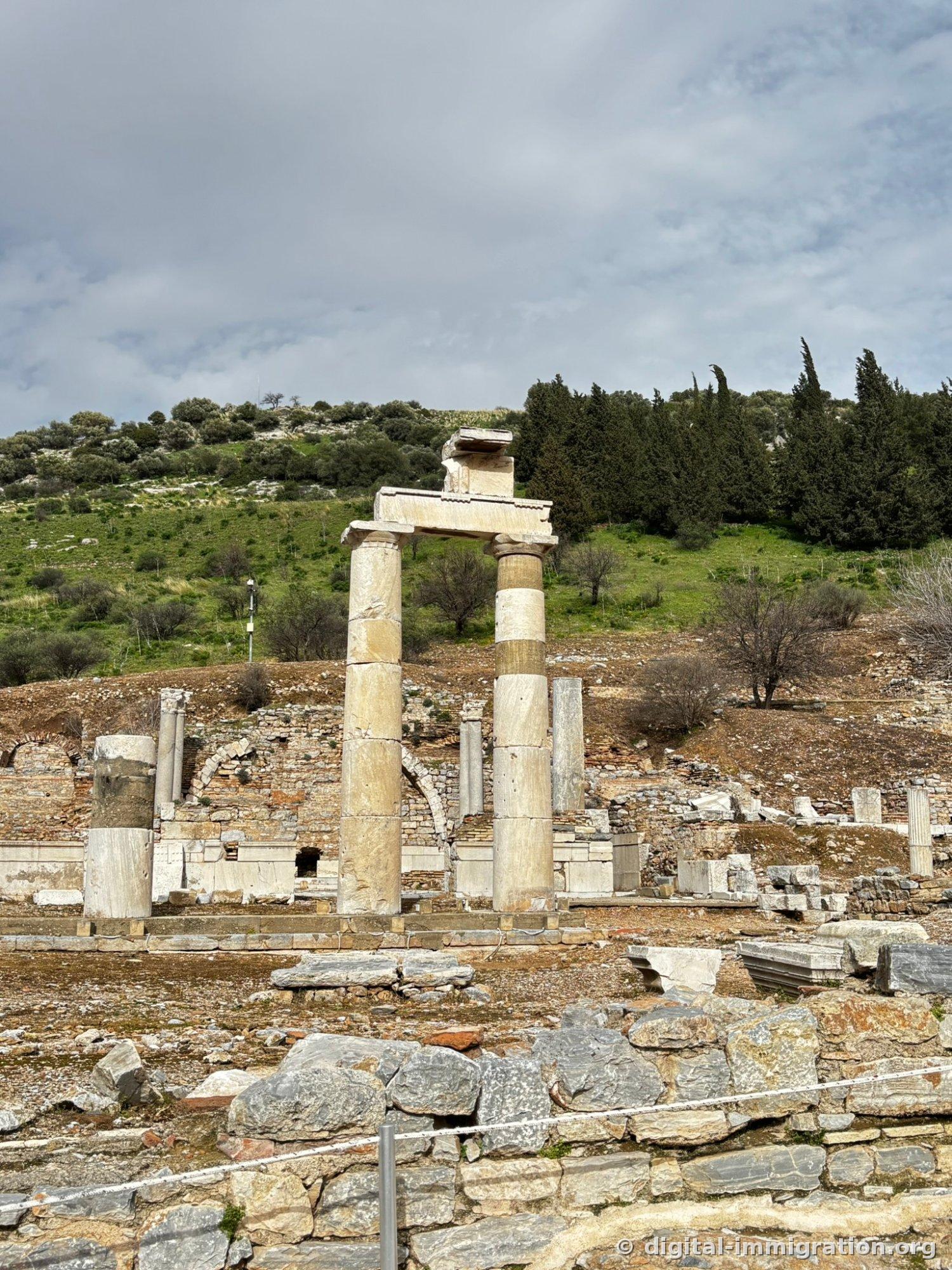
Once you pass through the upper gate, the first thing you encounter is the State Agora area. This is the quietest part of Ephesus. Most tour groups hurry through here since they're focused on photographing the library, so this section is almost always empty. I did the opposite—I stood here for over twenty minutes. The way the columns reflected in the pooled water was quite striking.
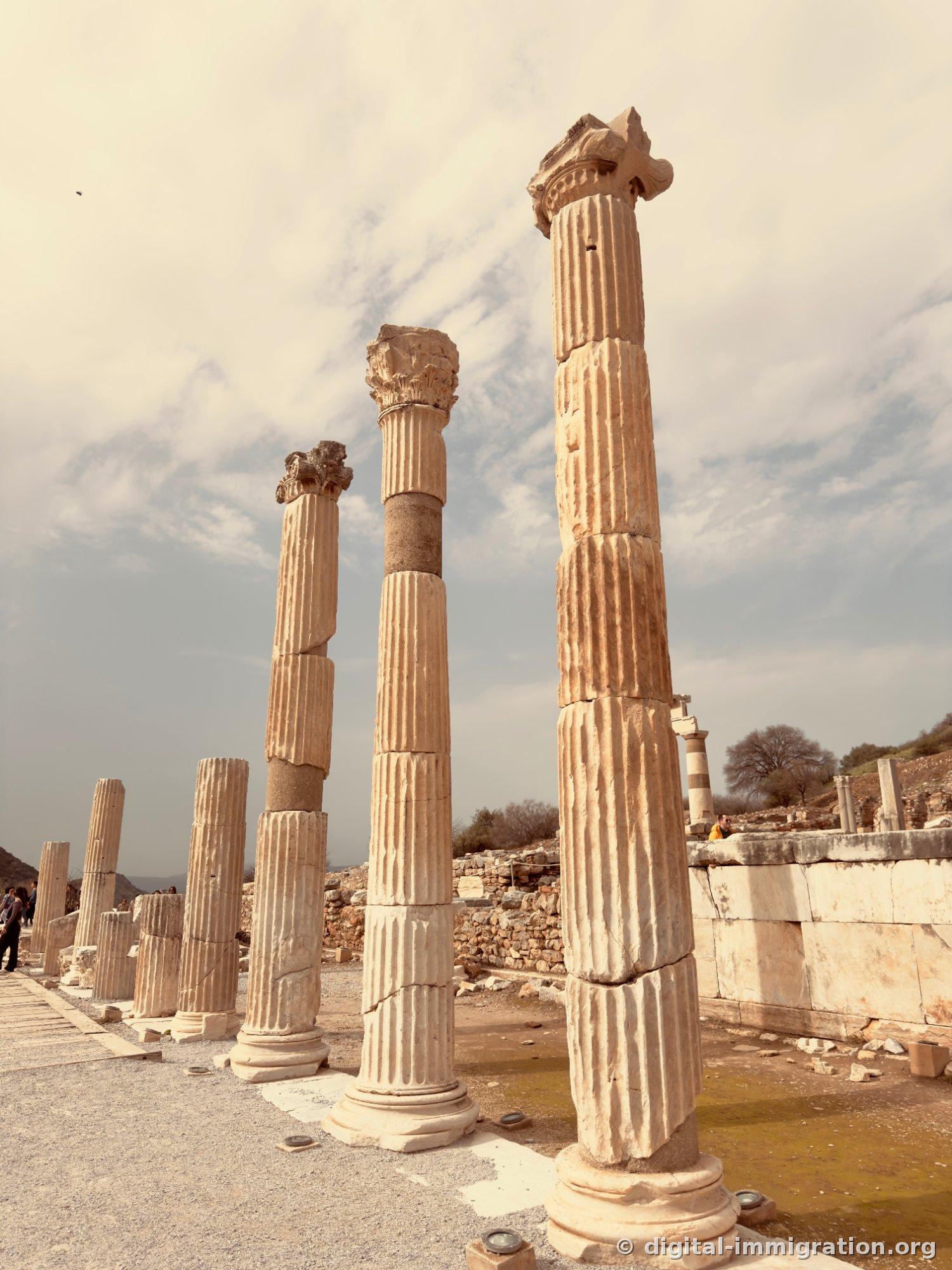
Looking closely at the columns from below, you notice the material varies by layer. Yellowish stone is wedged between white marble drums—a sign of where the fallen structure was rebuilt and fragments reassembled. Rather than being perfectly restored, it's left in that "pieced-together" state, which actually made it stick in my memory longer.
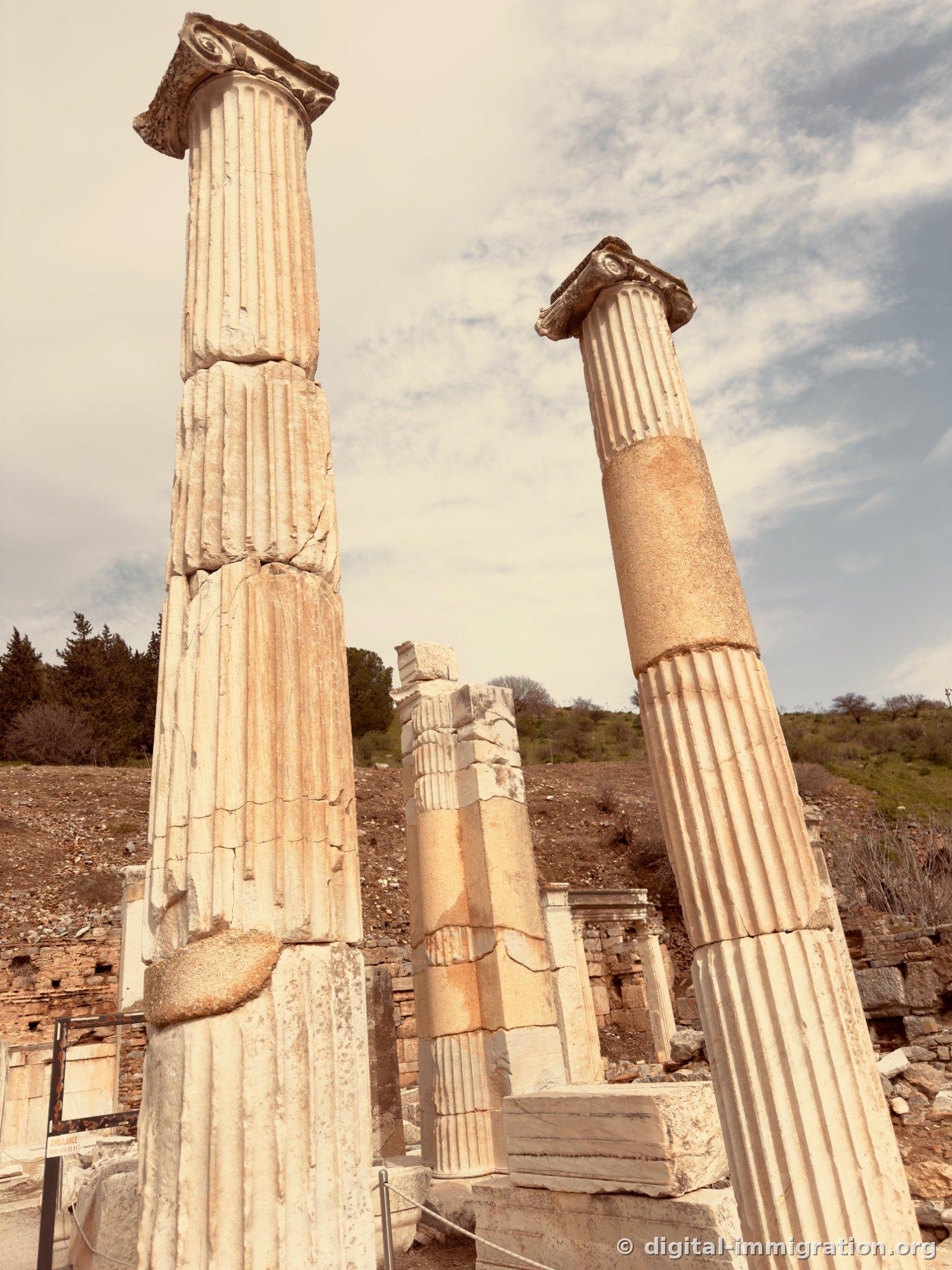
The Odeum — Sit Down and Test the Acoustics
A bit further down, you come to a semicircular seating area. This is the Odeum, a small theater. While much smaller than the Grand Theater, I actually preferred it here. Because of its compact size, you can physically feel how sound actually travels. A guide standing in the orchestra pit spoke in a normal tone, and it was heard clearly all the way to the back row. Without a microphone.
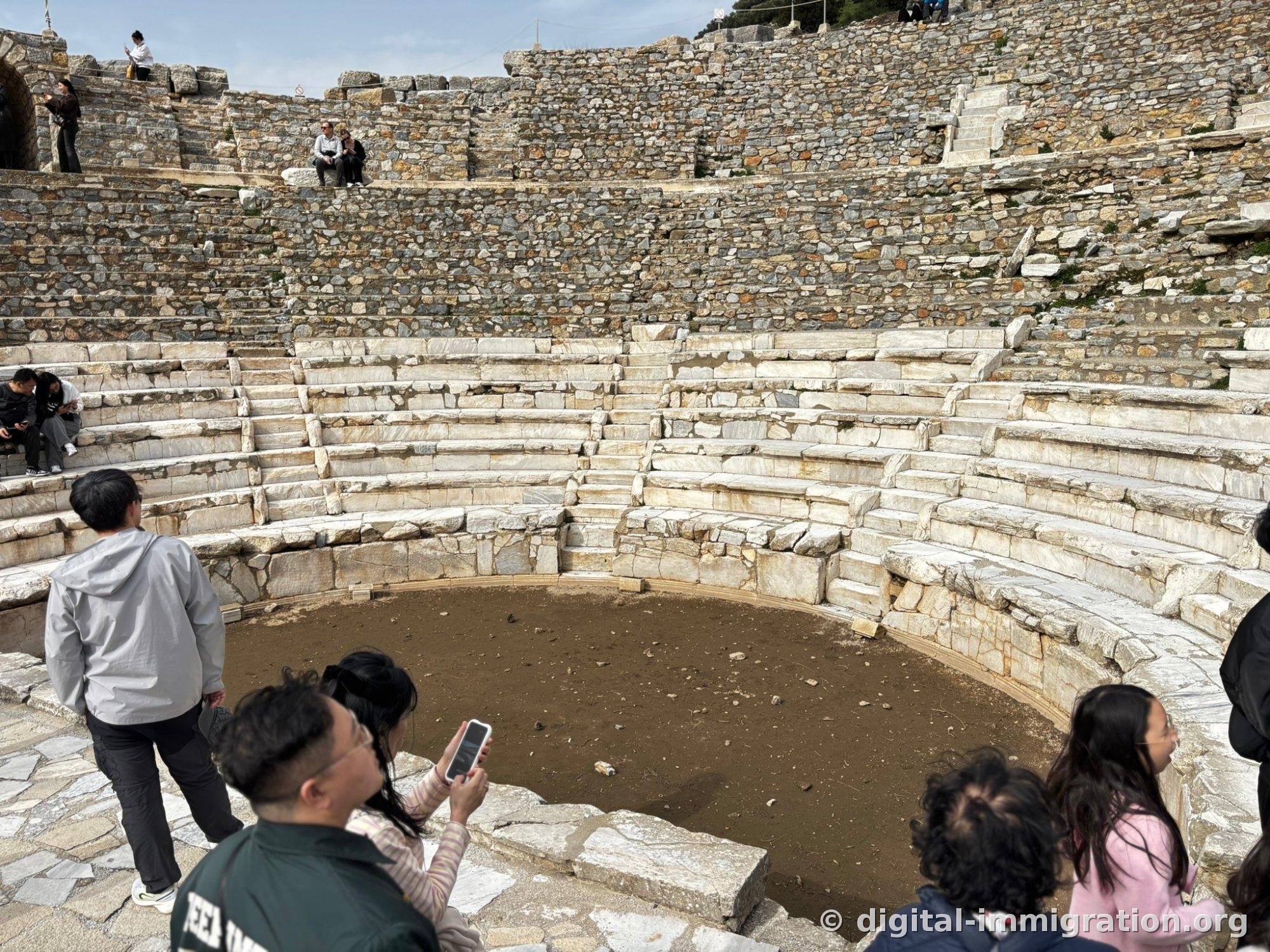
The Odeum floor was packed earth that day and damp in places. I wanted to go down and stand in the center, but there was standing water, so I gave up. That's what happens the day after rain.
Don't Skip the Signboards — The Prytaneum and Artemis
The signboards at Ephesus are in three languages—Turkish, English, and German—with floor plans and excavation photographs. The signboard in front of the Prytaneum had these numbers: the Rhodian-style peristyle courtyard was 33×28m, the columned courtyard leading into the Prytaneum was 26×22m, and the western dining or residential space was 14×11m. The construction date was listed as the Augustan period (27 BCE–14 CE). And from this location came the famous "Beautiful Artemis" statue now in the Selçuk Ephesus Museum. Below the sign were the UNESCO World Heritage inscription marker (2015) and audio guide number 06.
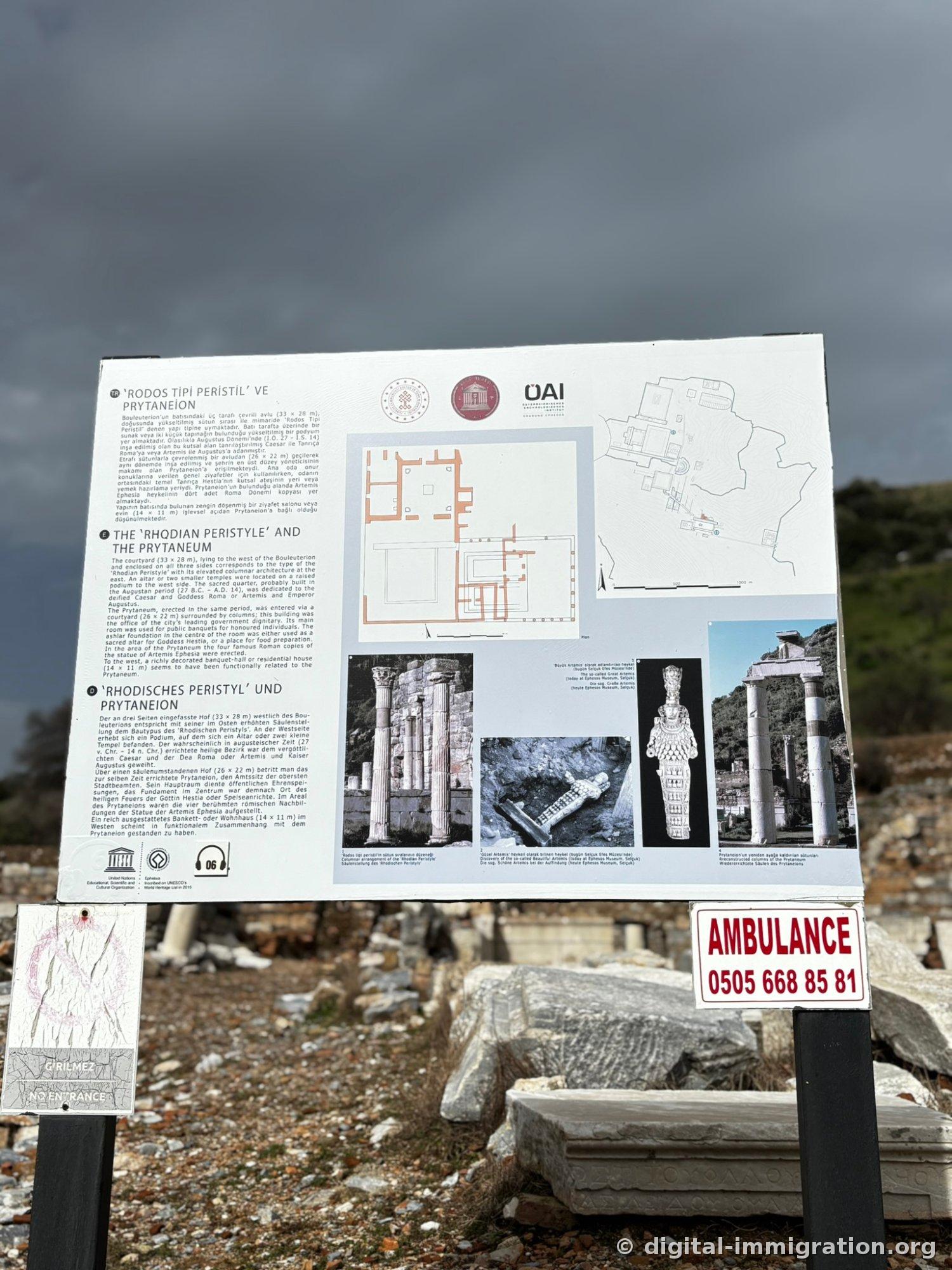
By the way, that red ambulance sign appears throughout the ruins. At first I wondered why they made it so visible, but given the landscape has almost no shade, it probably becomes genuinely necessary in summer. On the left was also a "No Entry (GİRİLMEZ / NO ENTRANCE)" sign.
Location and Access — Practical Movement from the Town of Selçuk
The ancient city of Ephesus is about 3km west of the town center of Selçuk. You can walk, but the shoulders are narrow and traffic moves fast, so it's not recommended. I took a dolmuş (minibus) near Selçuk's otogar. Taxis are common, and most tour buses drop passengers at the upper gate and pick them up at the lower gate. If you're traveling solo, mimicking this route is your best bet. Exit at the top, descend to the bottom, and catch transportation back to town from the lower gate area. Check the entrance fee, separate Terrace Houses fee, and opening hours, as these change by season—I recommend verifying at the site or the official ticket office right before your visit.
From the Monument of Memmius to the Heracles Gate
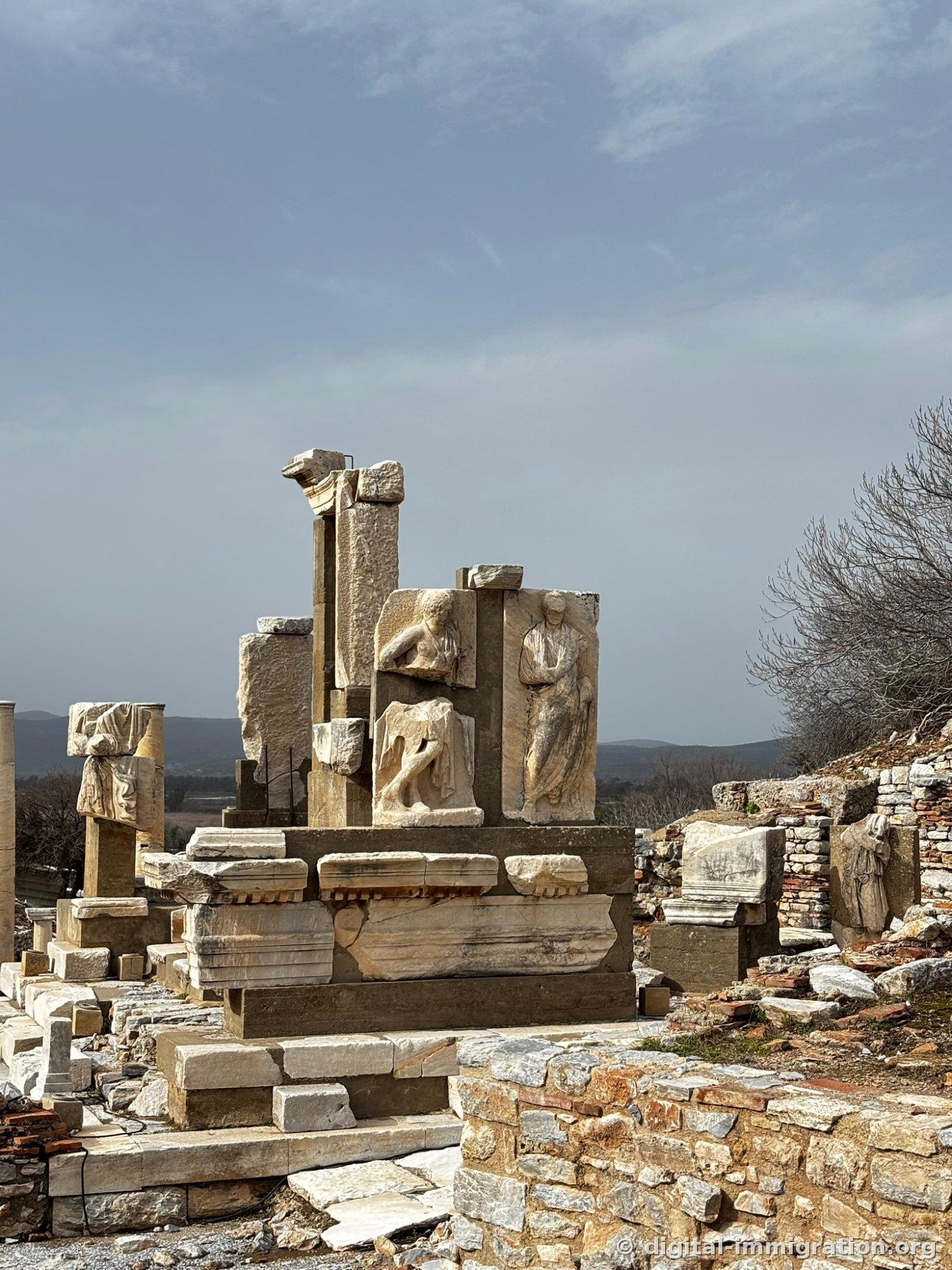
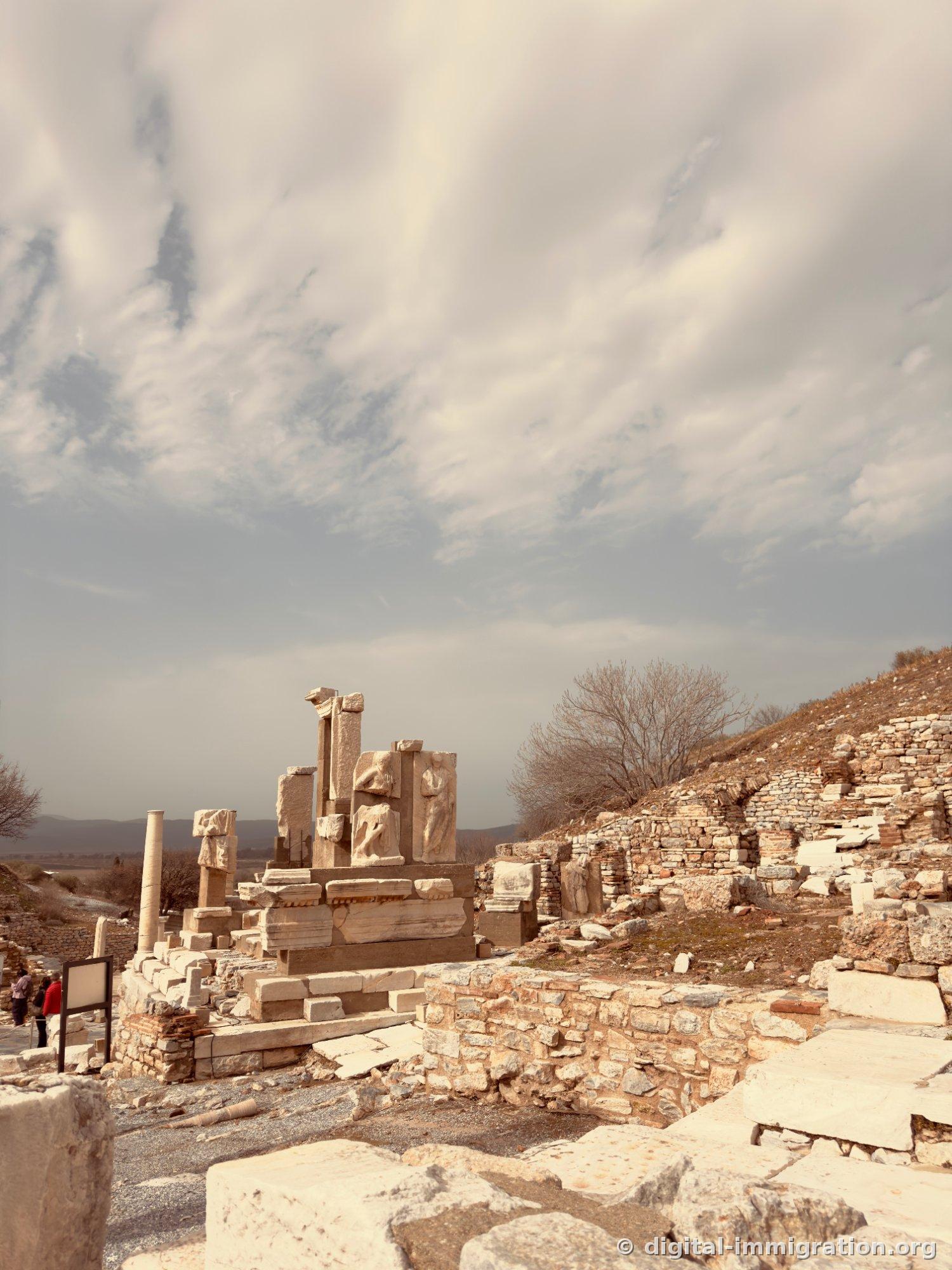
The Monument of Memmius stands at the point where the descent seriously begins. From a distance it looks like just a pile of rubble, but up close you can see three sculpted reliefs remain: one seated figure, one standing figure, and one where only the hem of clothing survives. The faces are almost completely worn away.
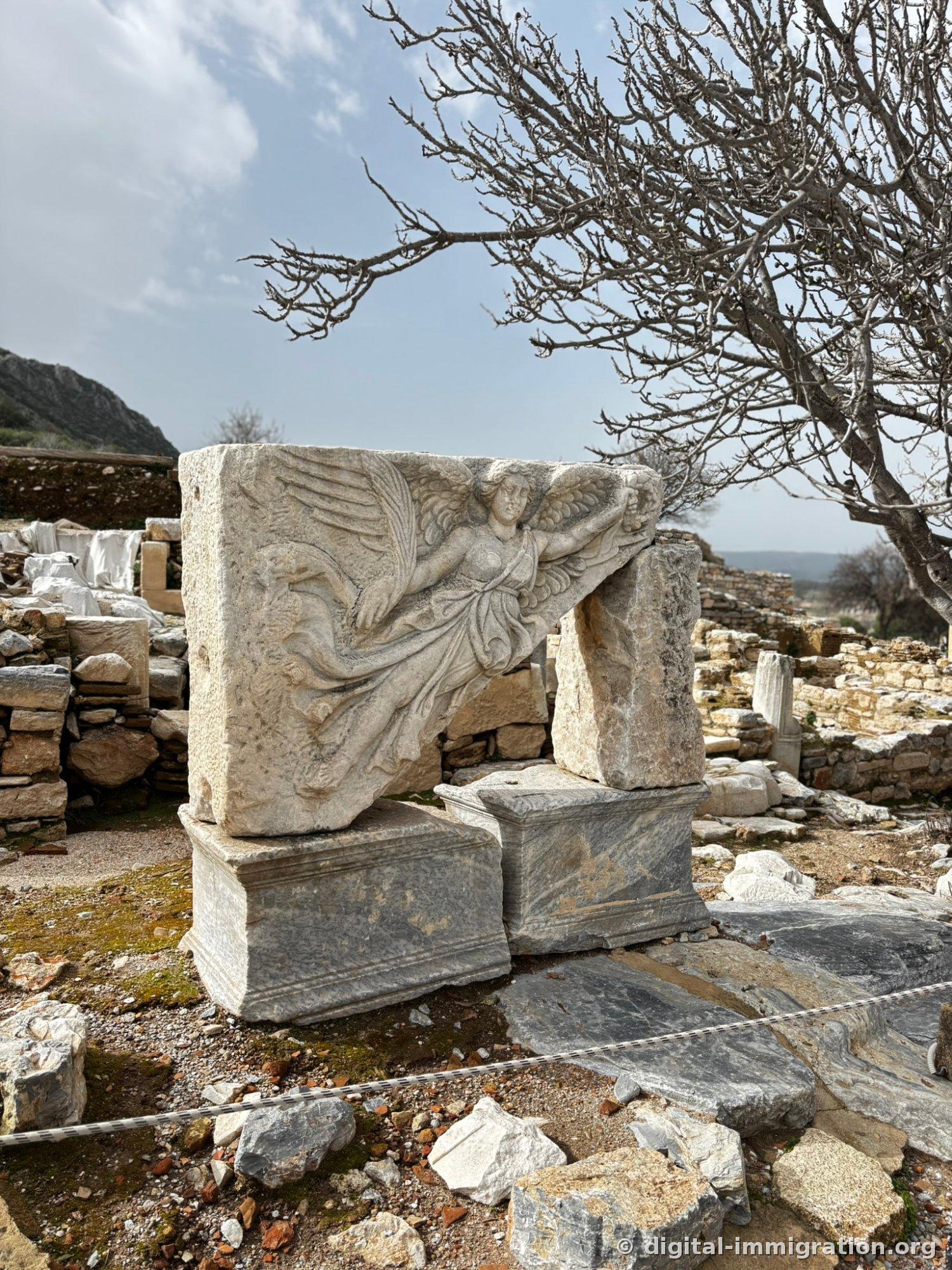
Just below is a relief of Nike. The goddess of victory holds a wreath in one hand with wings spread—guides always mention this is the prototype for the Nike logo. Whether that's true or not, the actual piece is larger than expected and the fabric draping is carved remarkably vividly. It originally sat above the Heracles Gate but now rests on a base at ground level, making it easier to see up close from eye level. There's a rope barrier, so don't touch it.
Curetes Street — Where Cats Are the Landlords
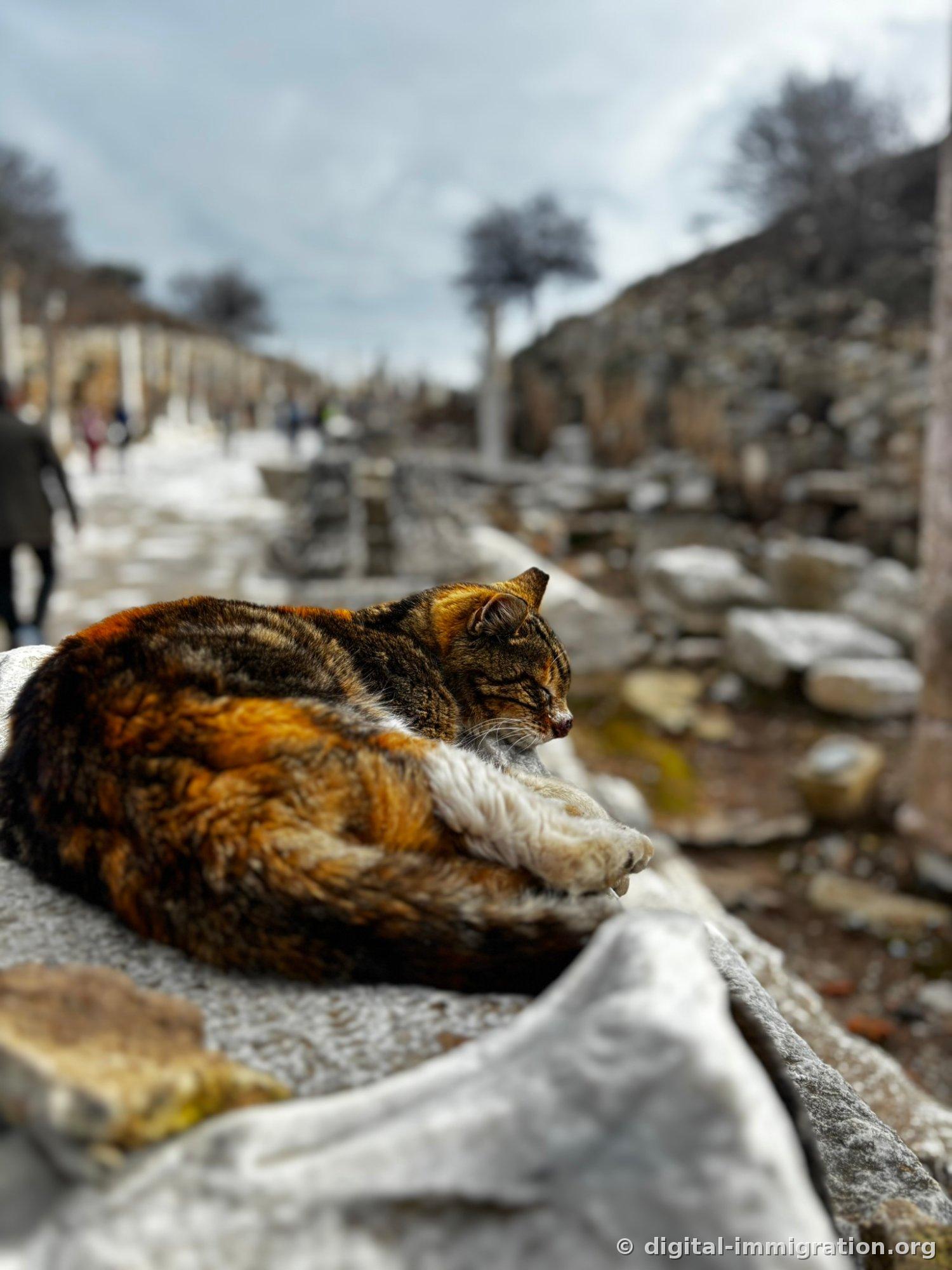
Beyond the Heracles Gate comes that famous Curetes Street. The most guaranteed thing you'll encounter here isn't the ruins—it's cats. The cats of Ephesus pay tourists absolutely no attention. This one had claimed a piece of cloth on a marble block as its bed and was completely asleep. Someone could click a shutter 20 centimeters away and it wouldn't open an eye.
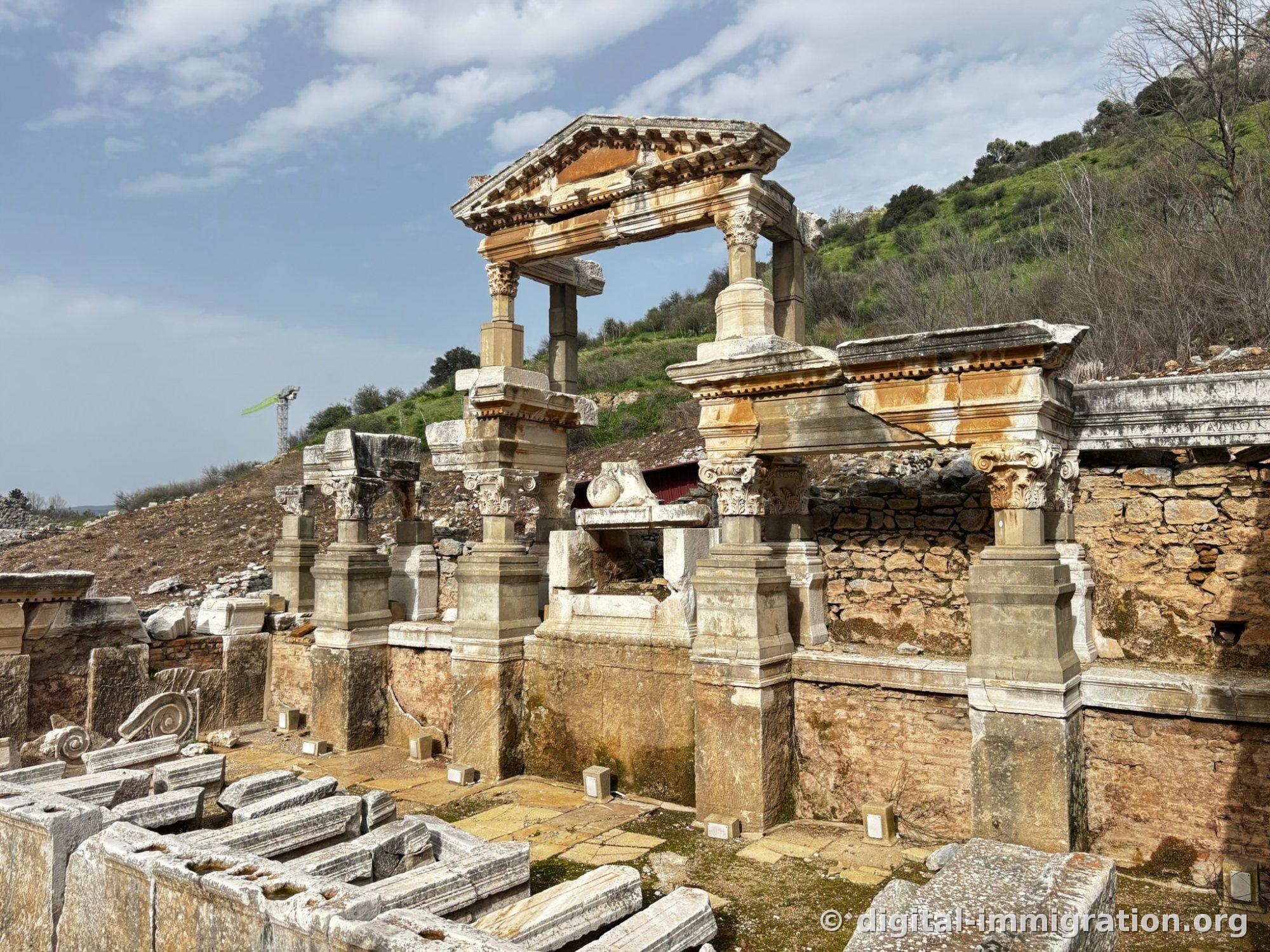
The Trajan Fountain in the middle of the street stands only partially. Two columns with Corinthian capitals support a pediment, while the remaining pieces lie in order in the courtyard. Water supposedly cascaded here originally, but now moss grows in the basin where it pooled. An excavation crane visible on the hillside behind drives home the fact that this city is still "under construction."
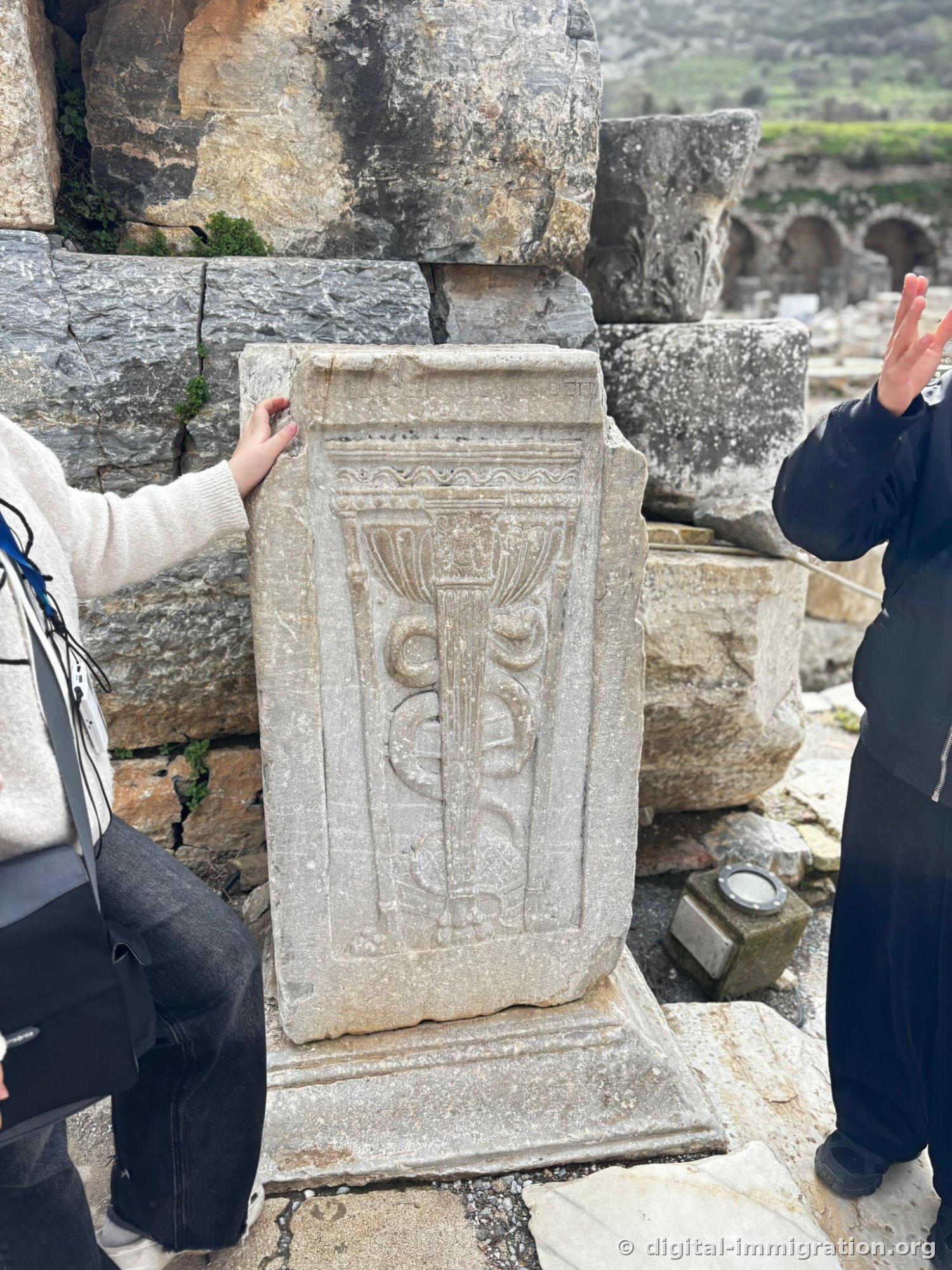
Before the Staff of Snakes Relief
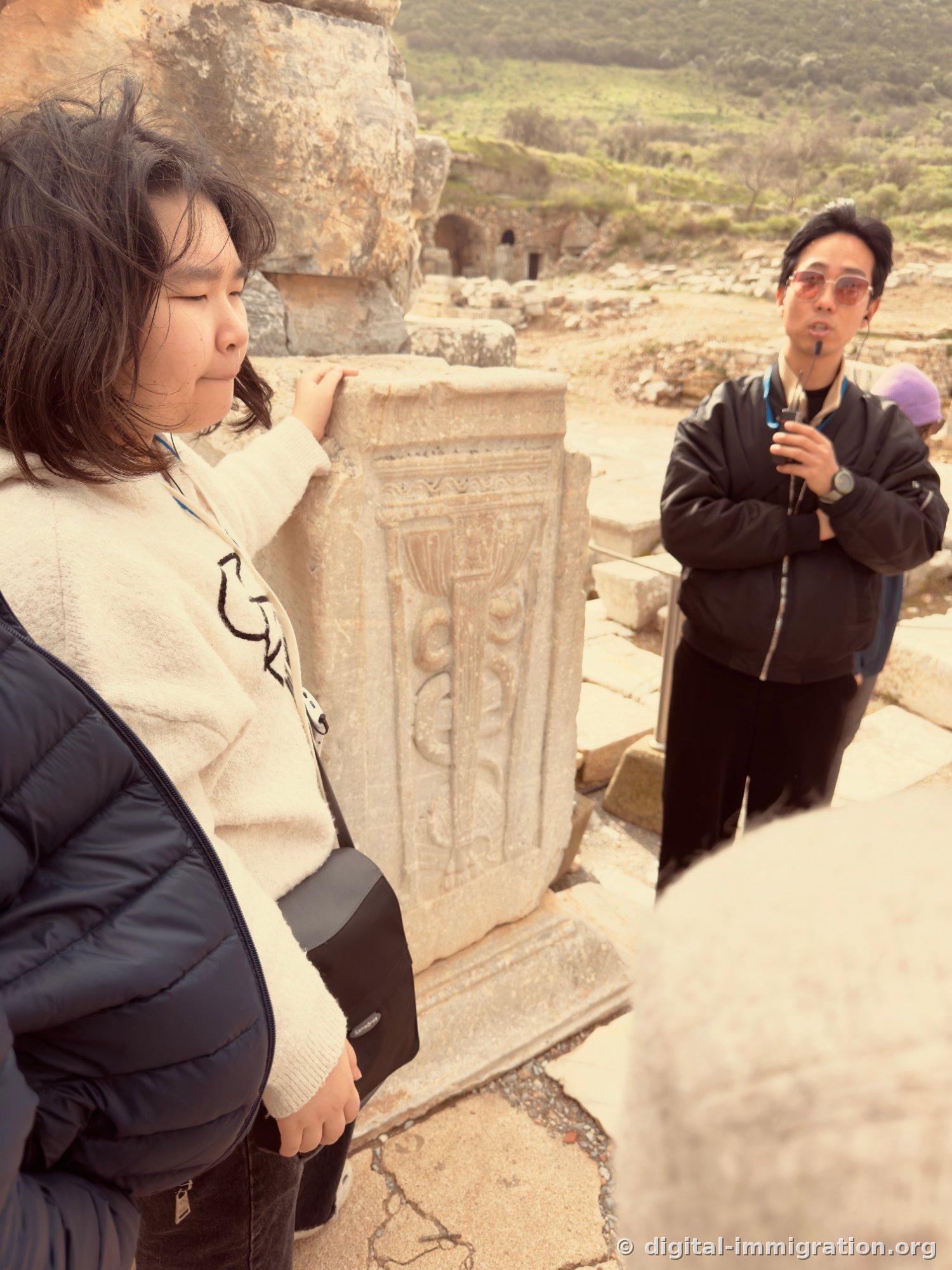
A single marble slab standing to one side drew crowds of people. It's a relief of a staff with two serpents coiling up around it, with leaf patterns at the top and wave motifs along the border. It's a symbol of medicine, and guides explain this area was medical in function. Greek inscriptions are faintly visible at the top of the panel.
Here's a tip: tour groups at Ephesus use earpiece receivers. As a solo traveler, you can pick up quite a bit by trailing a group for a few minutes, but honestly it's awkward. I eventually switched to reading the signboards one by one. It took longer, but it was better that way.
A Single Wheel Drawn on the Ground
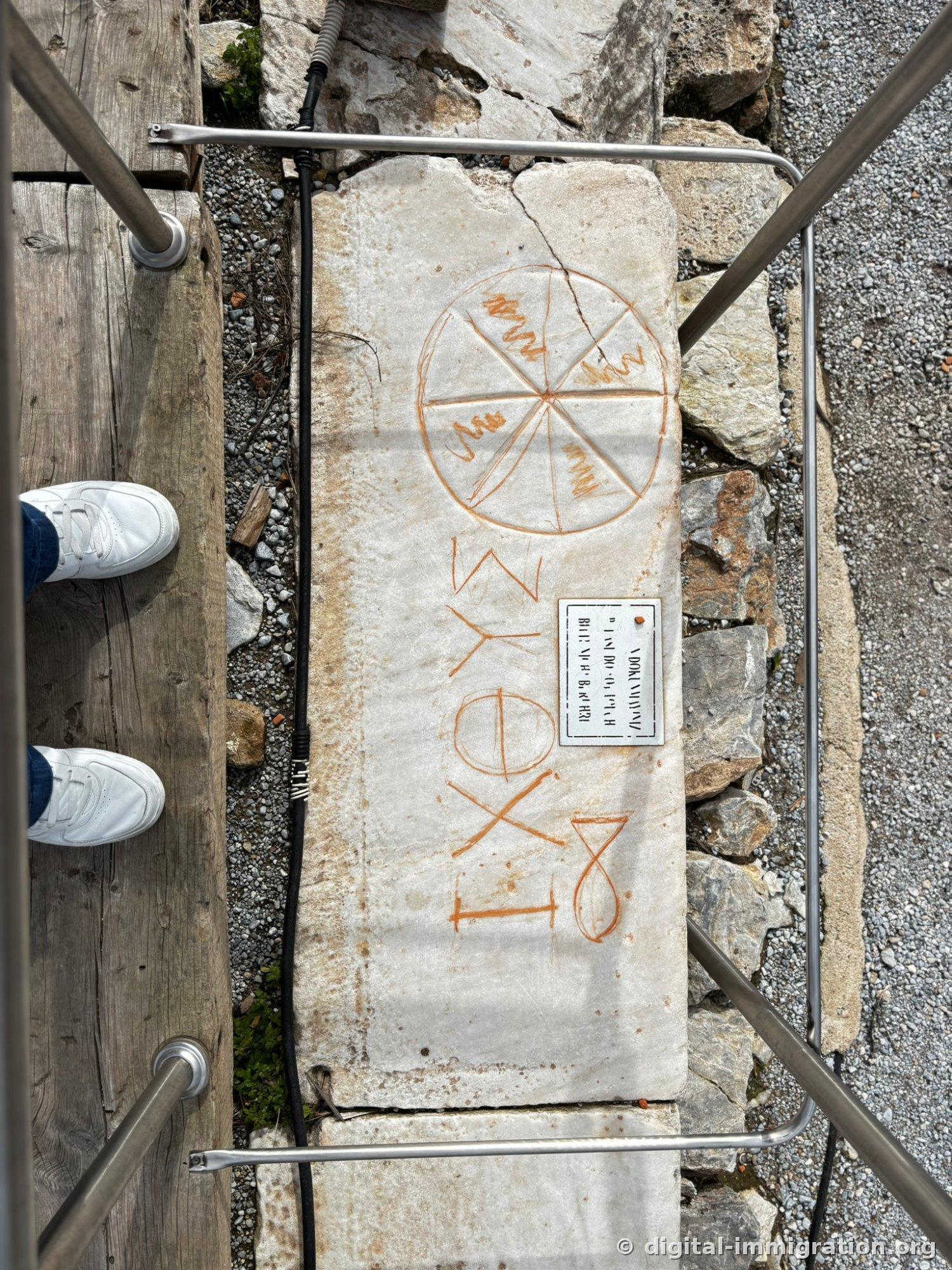
Beneath a wooden deck beside the path, a marble slab lies in a narrow passage. In red pigment, it shows a wheel divided into six sections and Greek letters—it's known as a symbol used by early Christians. Below it, a fish shape is also drawn. It's one of the smallest and least noticeable things in the entire site, but you'd walk right past it unless you lean on the deck railing to look down.
Mosaic Paving and the Bathhouse Area
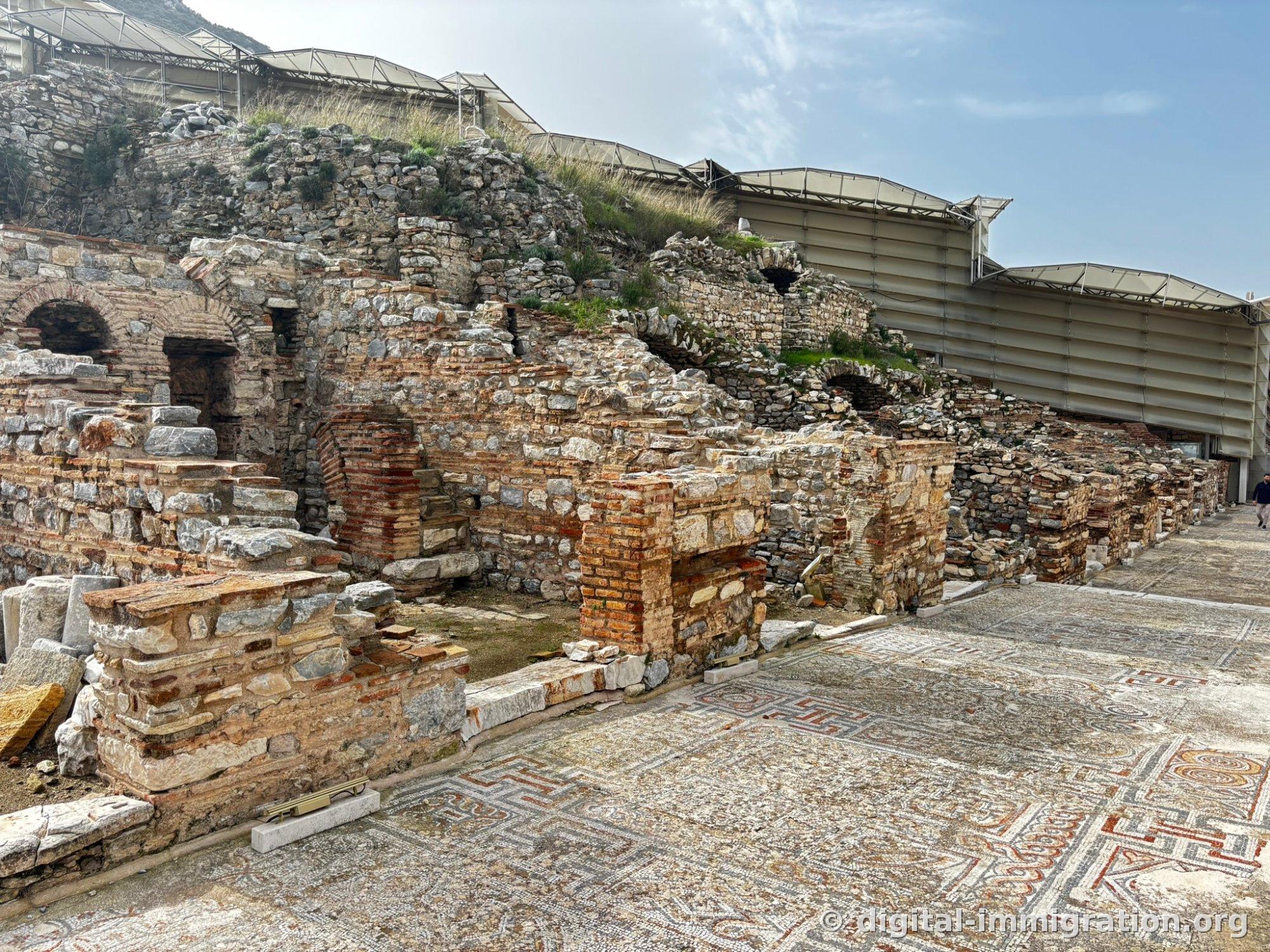
When you start seeing the protective roof over the Terrace Houses, the ground suddenly becomes ornate. Geometric mosaic paving stretches for quite a stretch, with patterns in red and black tiles still vivid. The fact that people just walk over them is a bit dizzying. On the left, walls mixed with red brick and stone remain, with arched structures layered on top of each other.
The Celsus Library — Why It Doesn't Photograph Well
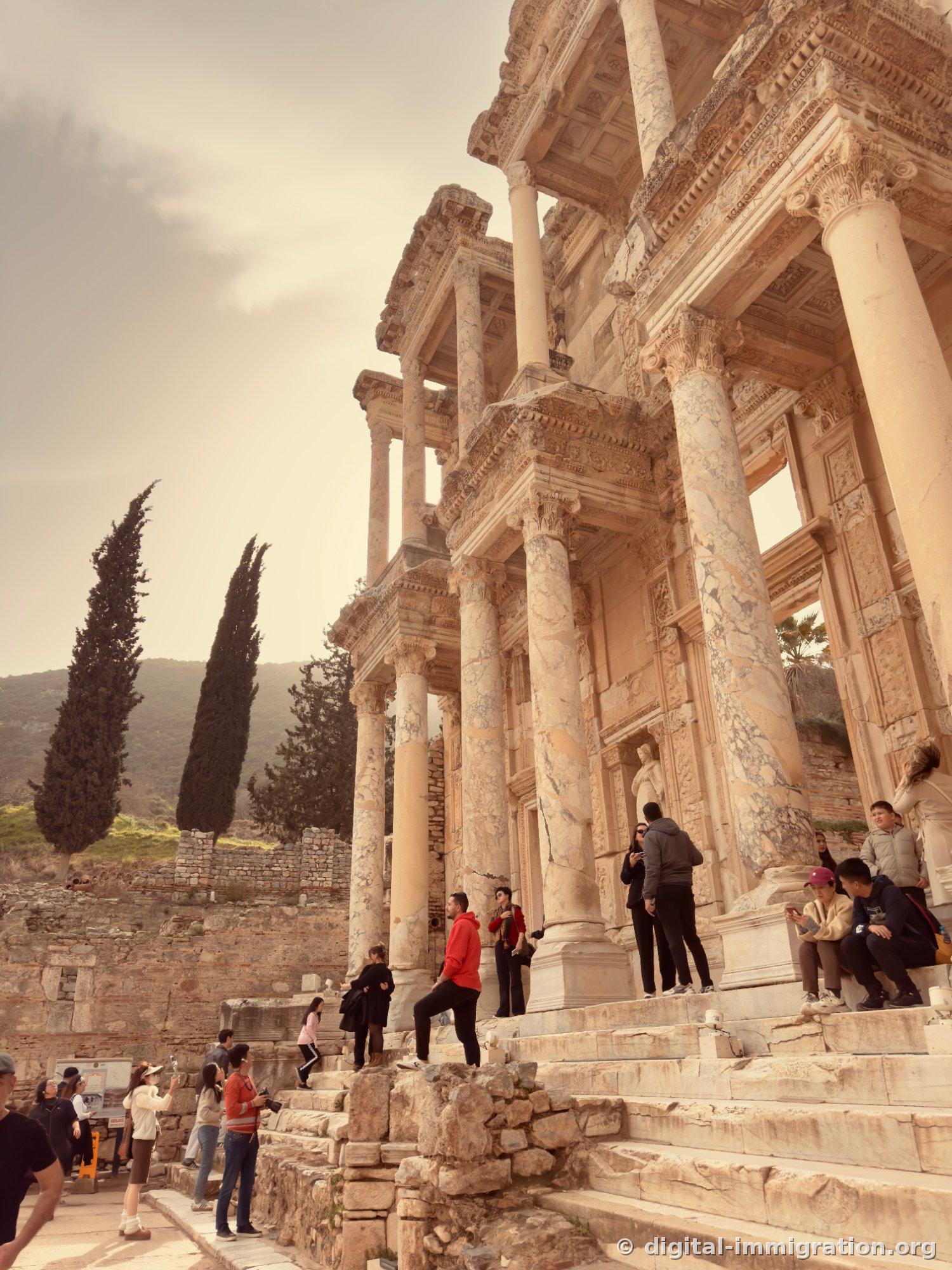
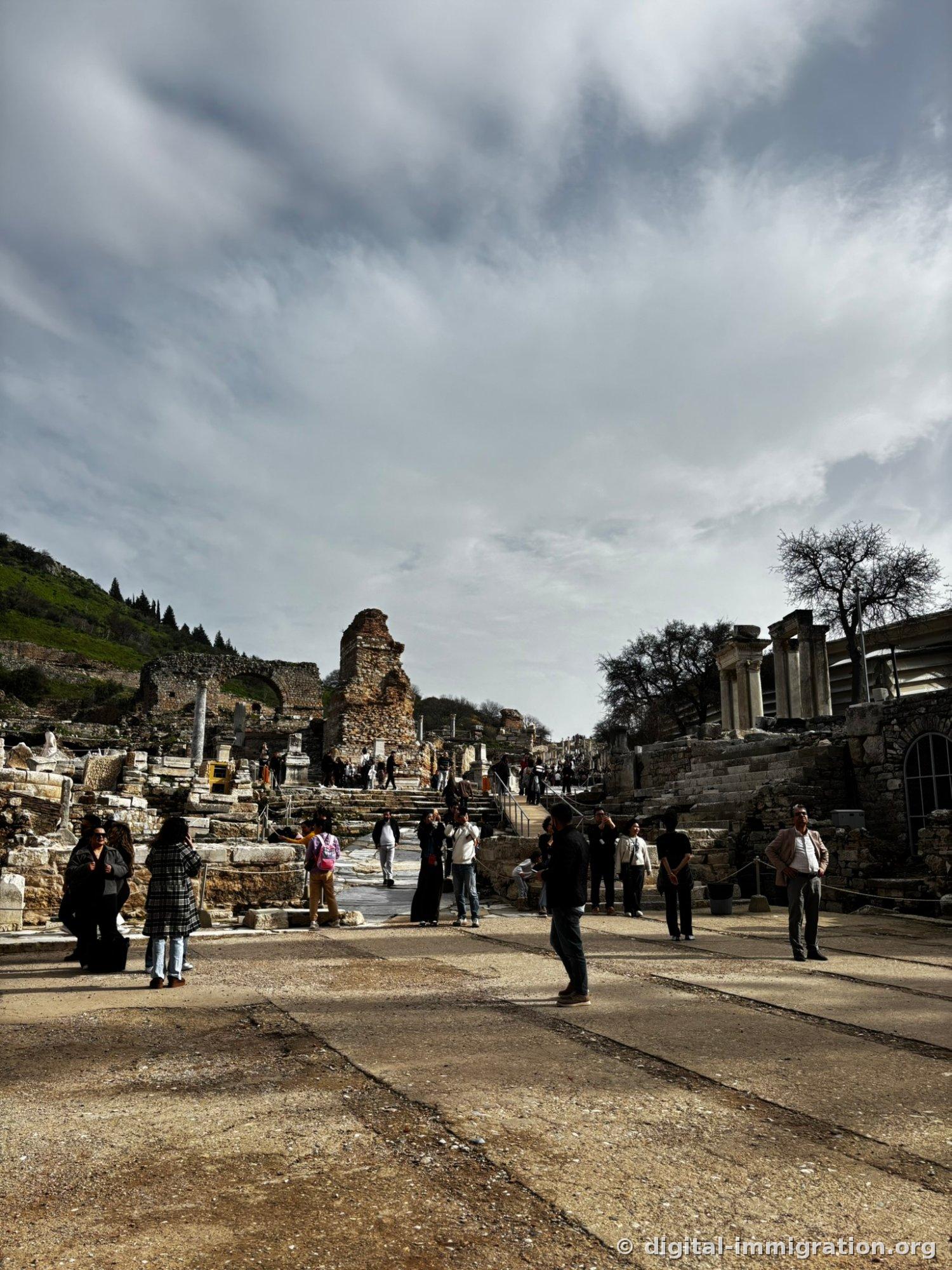
Where the descent ends, the facade of the Celsus Library appears in its entirety. The two-story facade, the statues in four niches on the lower level, the Mazeus and Mithridates Gate continuing to the right. To be honest, I didn't manage to photograph this scene properly. The square in front is always packed with people, and to fit the whole thing you need to back up, but backing up puts you behind the pile of rubble in front.
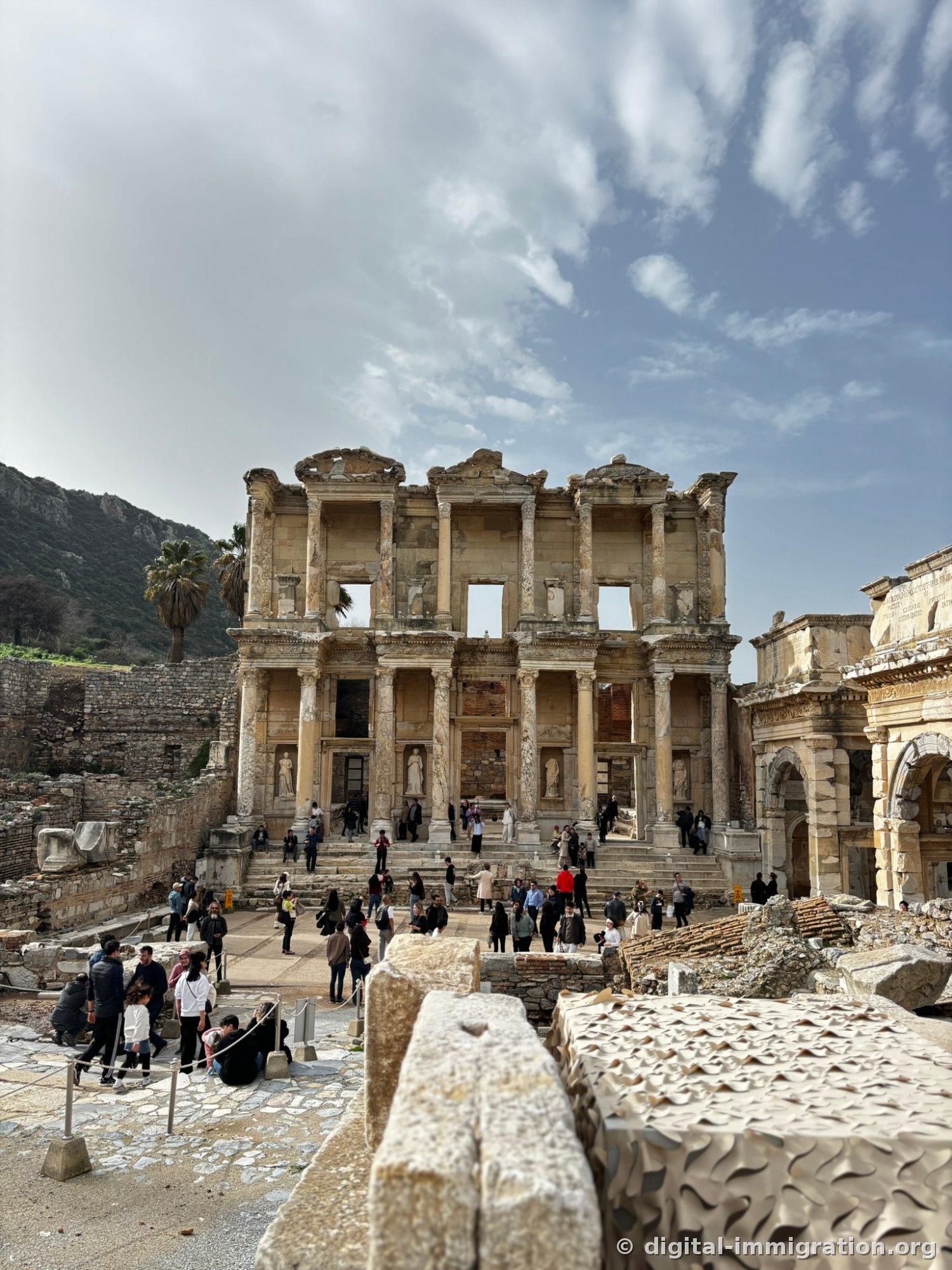
Instead, the angle from down below near the steps was much better. The marble grain in the column shafts shows clearly, and two cypress trees on the hillside behind frame the shot. No matter how many people are there, at this angle they become scale markers.
The square in front of the library is also the widest open space in these ruins. I stood there for a while watching the wet paving stones reflect the sky. To the left are steps and collapsed arches; to the right are three remaining Corinthian columns with a modern protective roof attached behind them. Ancient and steel frame in a single shot—this is Ephesus's real face.
The Grand Theater, and the Backalleys Most People Don't See
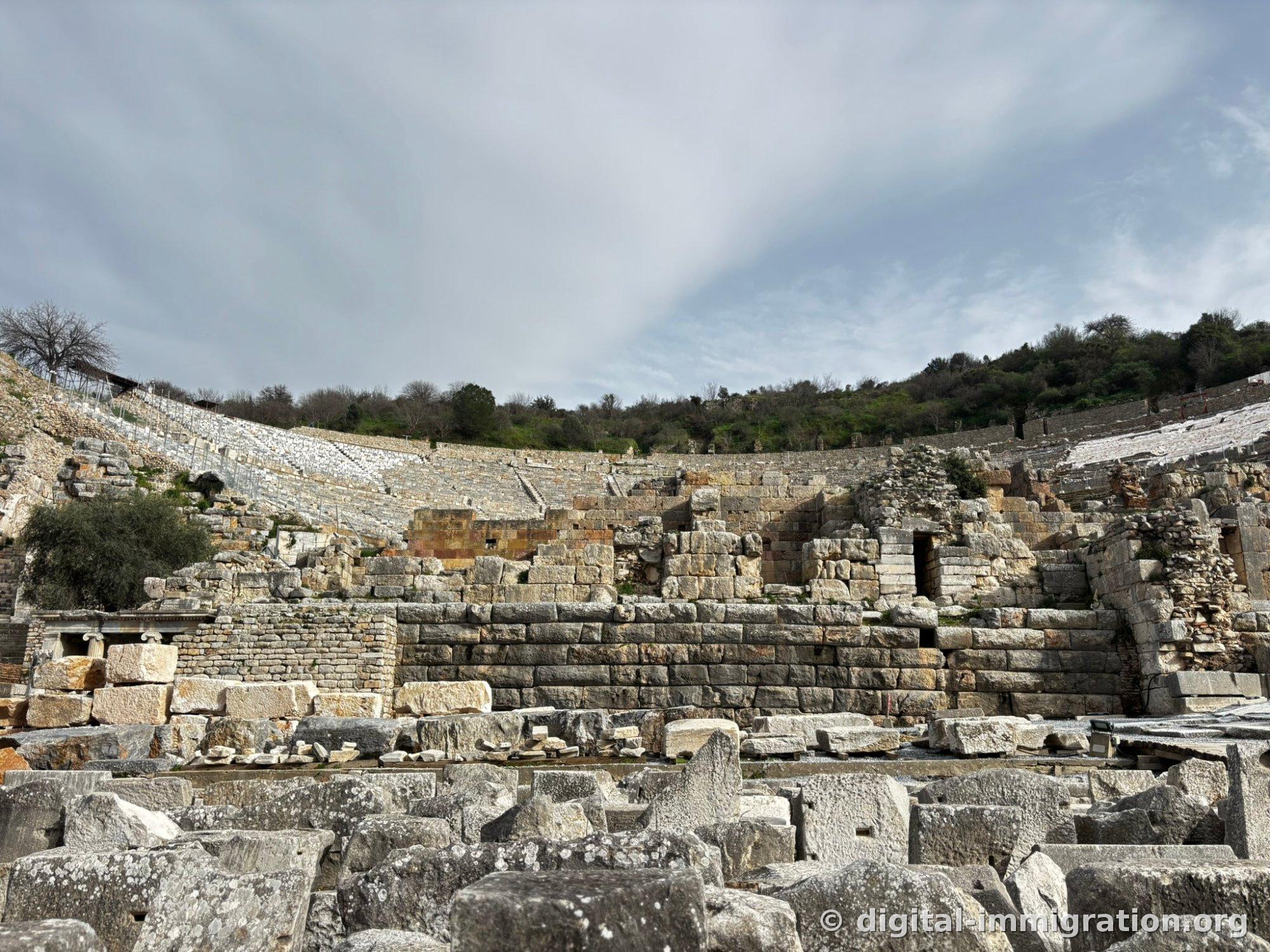
Turning toward the harbor road, the Grand Theater is wedged into the hillside. The scale is overwhelming—it doesn't fit in a single camera frame. The upper seating is still under renovation with white scaffolding and metal framework in place. The stage building has almost entirely collapsed, leaving only the lower wall sections and passage arches, with cut stone blocks scattered in front like a field.
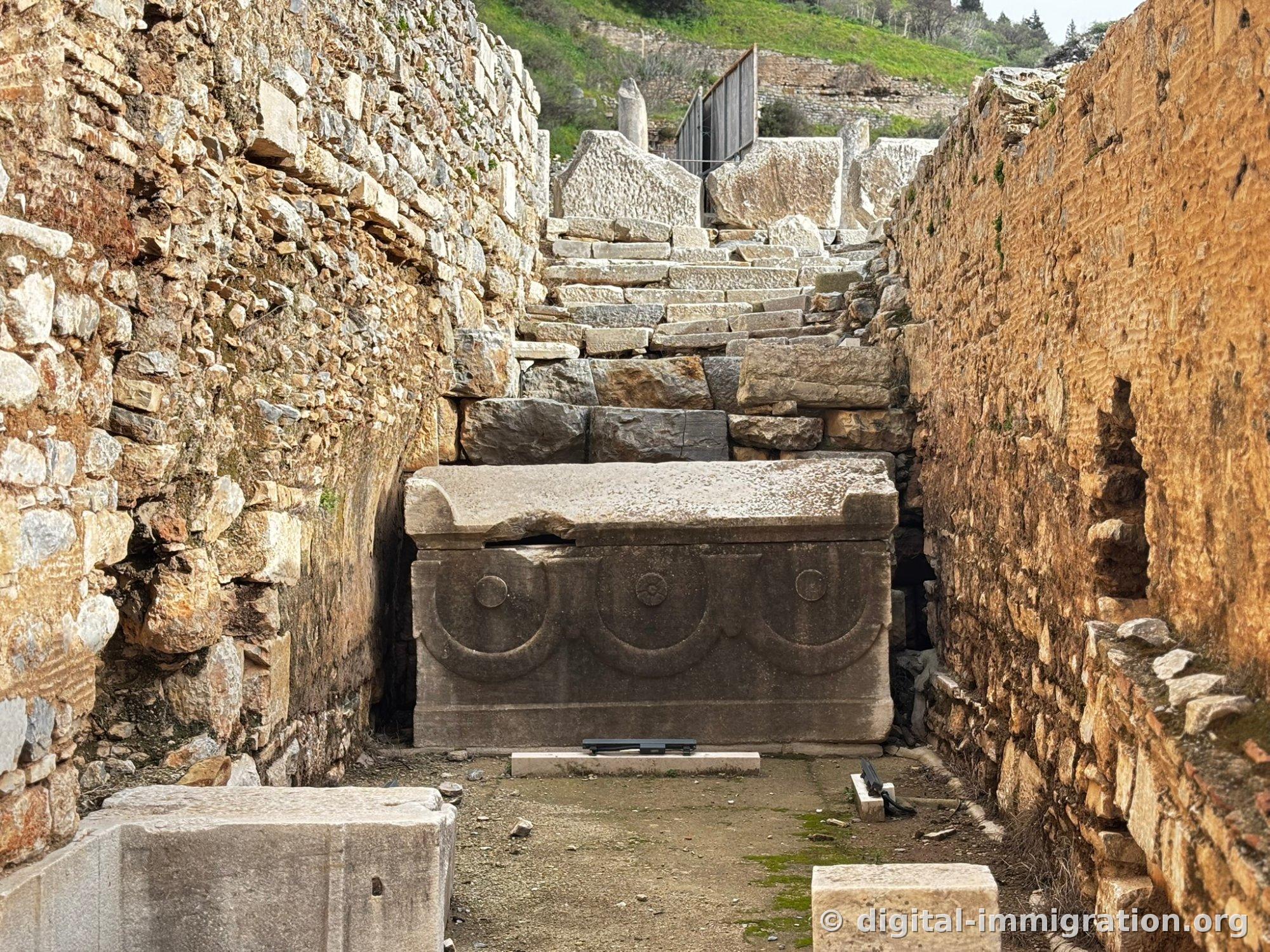
There are a few narrow passages around the theater where you can escape the crowds. At the end of one, a marble sarcophagus with garland reliefs sits waiting. Three semicircular wreaths and disk ornaments between them are distinct, and the lid is broken on one side. The passage between the two walls is barely 2 meters wide, so almost nobody goes in—it was the quietest spot that day.
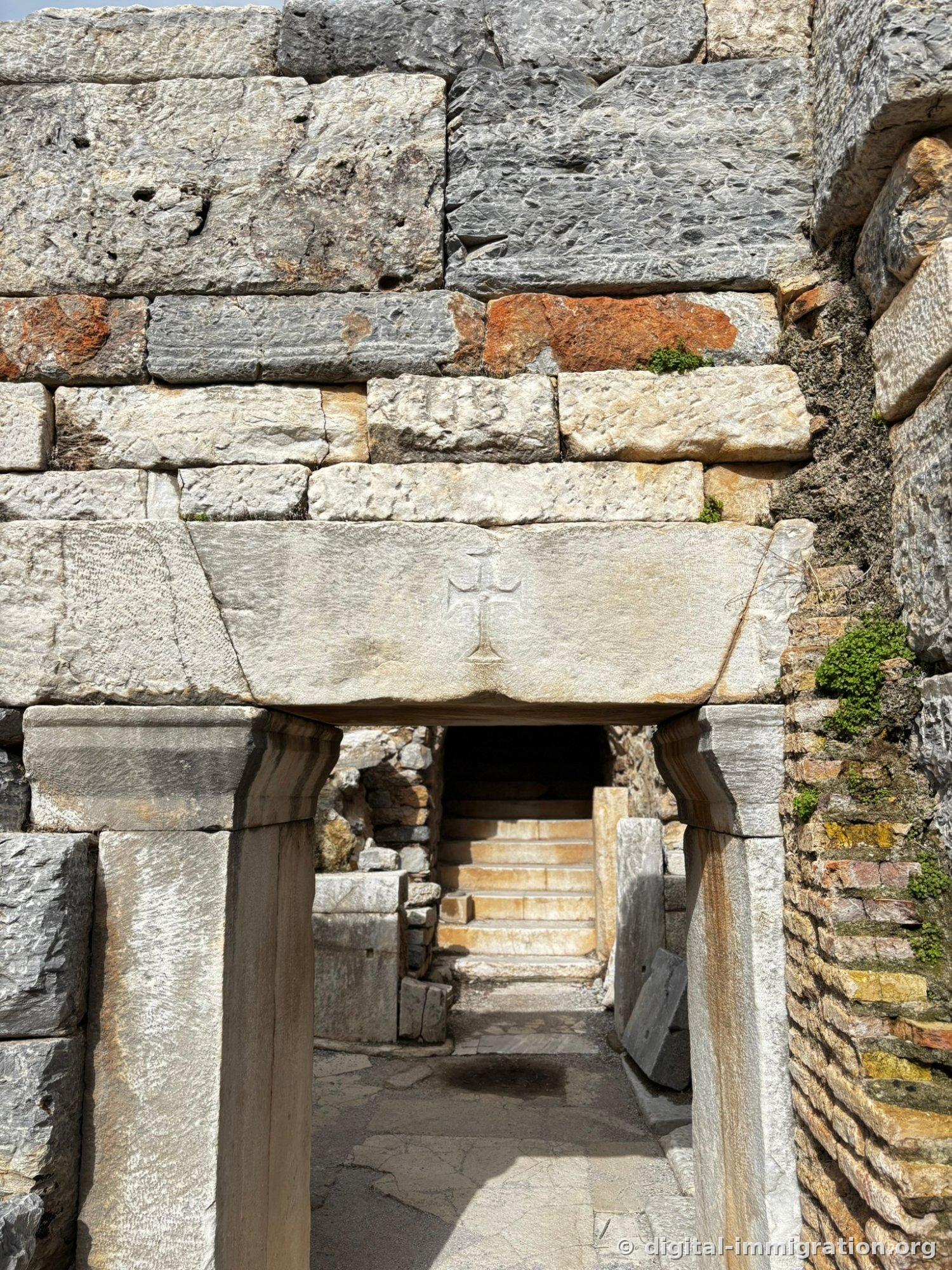
There's another thing. I came across a doorway with a cross carved on the lintel. It's where Roman city and Byzantine period traces overlap. Stone steps continue beyond the door, but there's no sign whether they lead up or down. There's quite a lot of this at Ephesus. About half the structures you pass, you have no idea what they are.
What I Organized After the Visit
- Direction: top to bottom. Following this one thing alone completely changes your perceived difficulty level.
- The ground is entirely marble. The day after rain it's slippery; on dry days the glare is intense. Proper athletic shoes and sunglasses are essential.
- There's almost no shade. Even the big trees in photos had no leaves in March. In summer, water and a hat aren't optional.
- Allocate time to reading the signboards. They're in three languages plus floor plans and excavation photos, so you can follow at least half without a guide.
- Always verify fees and hours on-site. They change by season and the Terrace Houses have a separate fee. Speaking from experience—I didn't check and got turned around at the ticket booth.
The total walk took about three and a half hours. I never felt like I'd seen everything, and instead my list of what I might have missed just grew longer. If I return, I plan to arrive right after opening and spend a full hour on the State Agora side. By then, the cat will probably be asleep on a different stone.
Das könnte Sie auch interessieren
- Schwarze Shin-Ramyeon auf einem Hügel vor dem Zemi Hotel Cappadocia in Göreme im Februar
Der Sommer ist die Hochsaison in Göreme, Kappadokien. Ich bin im Februar dorthin gereist. Es war die Zeit, in der die Morgentemperaturen unter Null fallen und auf den Bergrücken de…
Göreme - Ein Nachmittag in Yuvam Shisha Nargile Kafe auf den Klippen von Kaleici in Antalya, mit Blick auf den Hafen
Die Altstadt Kaleici von Antalya, Türkei, mit ihren engen Gassen innerhalb der Stadtmauer, wirkt beim ersten Besuch wie ein Labyrinth – man verliert schnell die Orientierung zum Me…
Antalya · Yuvam Shisha Nargile Kafe - Antalya Kaleiçi Yacht Harbor — Ein Tag, den Hafen dreimal von verschiedenen Blickwinkeln betrachtet
Die Altstadt Kaleiçi im türkischen Antalya behält ihre Stadtmauern, die auf den Klippen thronieren, und direkt darunter erstreckt sich ein ganzer Yachthafen. Auf der Karte wirkt es…
Antalya · Yuvam