Akihabara Back Alley Kyushu Jangara Ramen Main Branch — A Bowl of Tonkotsu with Mentaiko Under the Blue Signboard
In Akihabara, Chiyoda Ward, Tokyo, down a narrow alley one block off the main electronics district road, there's a brilliantly blue glowing signboard. Kyushu Jangara. You can tell…
Chiyoda · Kyushu Jangara Ramen Akihabara
In Akihabara, Chiyoda Ward, Tokyo, down a narrow alley one block off the main electronics district road, there's a brilliantly blue glowing signboard. Kyushu Jangara. You can tell this is the main branch by the brush-stroke calligraphy reading "Akihabara Main Branch" on the right wall. I arrived around eight in the evening and there were already people lined up outside. Two curly-haired foreign customers at the front, someone in a beanie behind them. Like most Tokyo ramen shops, the line isn't intimidatingly long—it just clears out quickly.
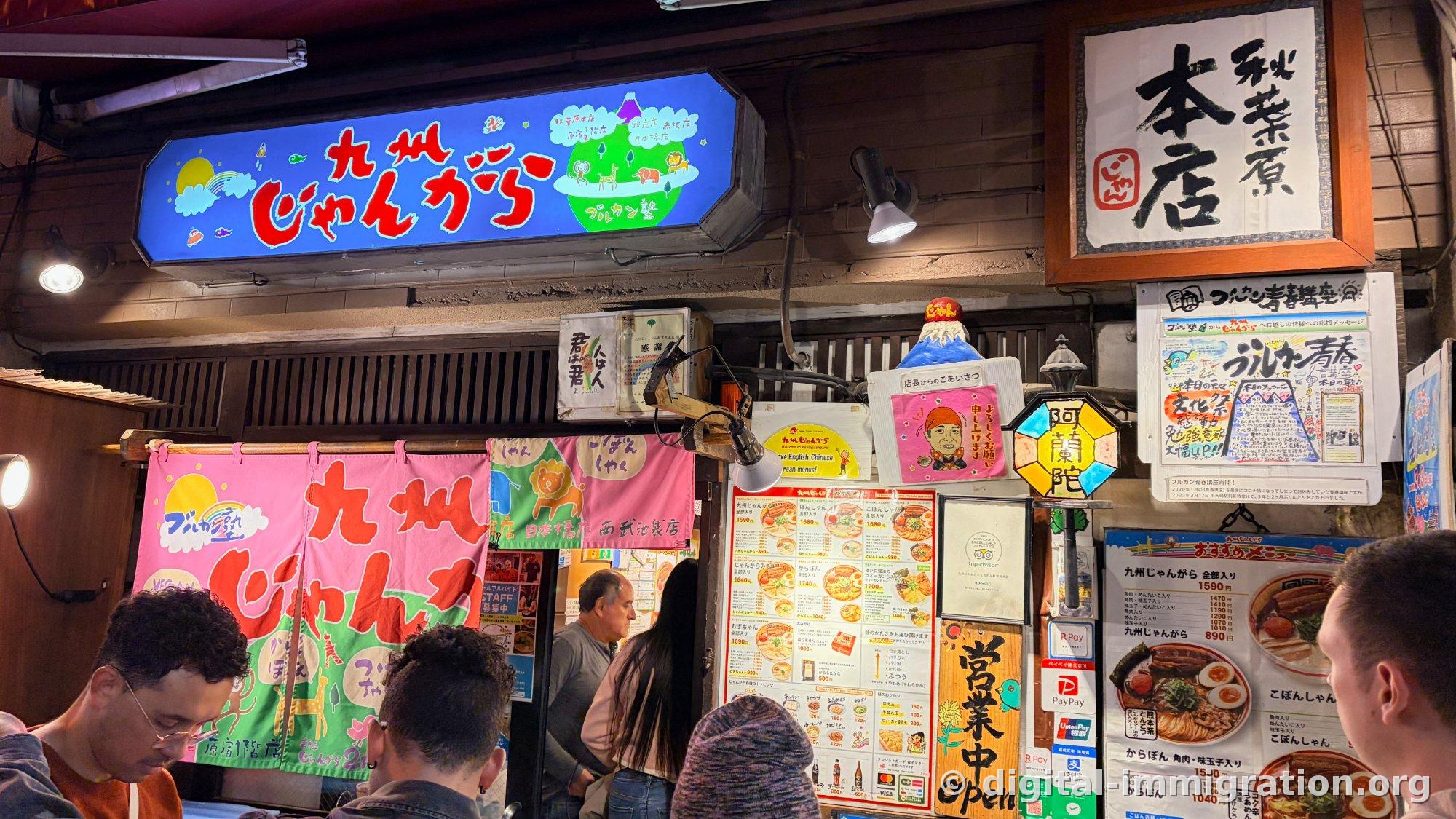
It Pays to Read the Menu While Waiting in Line
The wall next to the entrance is essentially one giant menu board. This is why waiting in line isn't wasted time. You need to decide before you go in, or you'll be flustered inside. Copying the prices directly from the wall:
- Kyushu Jangara All-In 1,590 yen / Basic 890 yen
- Bonshan All-In 1,680 yen / Basic 980 yen
- Kobonshan All-In 1,680 yen / Basic 980 yen
- Karabon All-In 1,740 yen / Basic 1,040 yen
- Rich Soy Sauce Base Vegan Ramen 1,700 yen, Vegan version without chashu 1,400 yen
- Children's Ramen 580 yen (up to elementary school, weekends/holidays only)
- Sapporo Medium Beer 650 yen
- Gift Box Ramen for Two 1,000 yen
"All-In" means a version with kakuni, mentaiko, and ajitsuke tamago all included. It costs about 700 yen more than the basic version, and if this is your first time, I'd recommend spending that extra 700 yen. There are also mid-range combinations—skipping kakuni or adding just mentaiko—starting around 1,100 yen, so you can assemble it like picking components to fit your budget. You can also choose noodle firmness—from Kona Otoshi (extremely hard) to Harigane, Bari Katai, Katame, Futsuu, and Yawarakame. If you don't specify when ordering, you get the normal firmness. There's a yellow notice board right there saying English, Chinese, and Korean menus are available, so you don't need to worry even if you don't speak Japanese. For payment, stickers for credit cards, PayPay, R Pay, and UnionPay were all visible (though prices and payment methods may change, so confirm on-site).
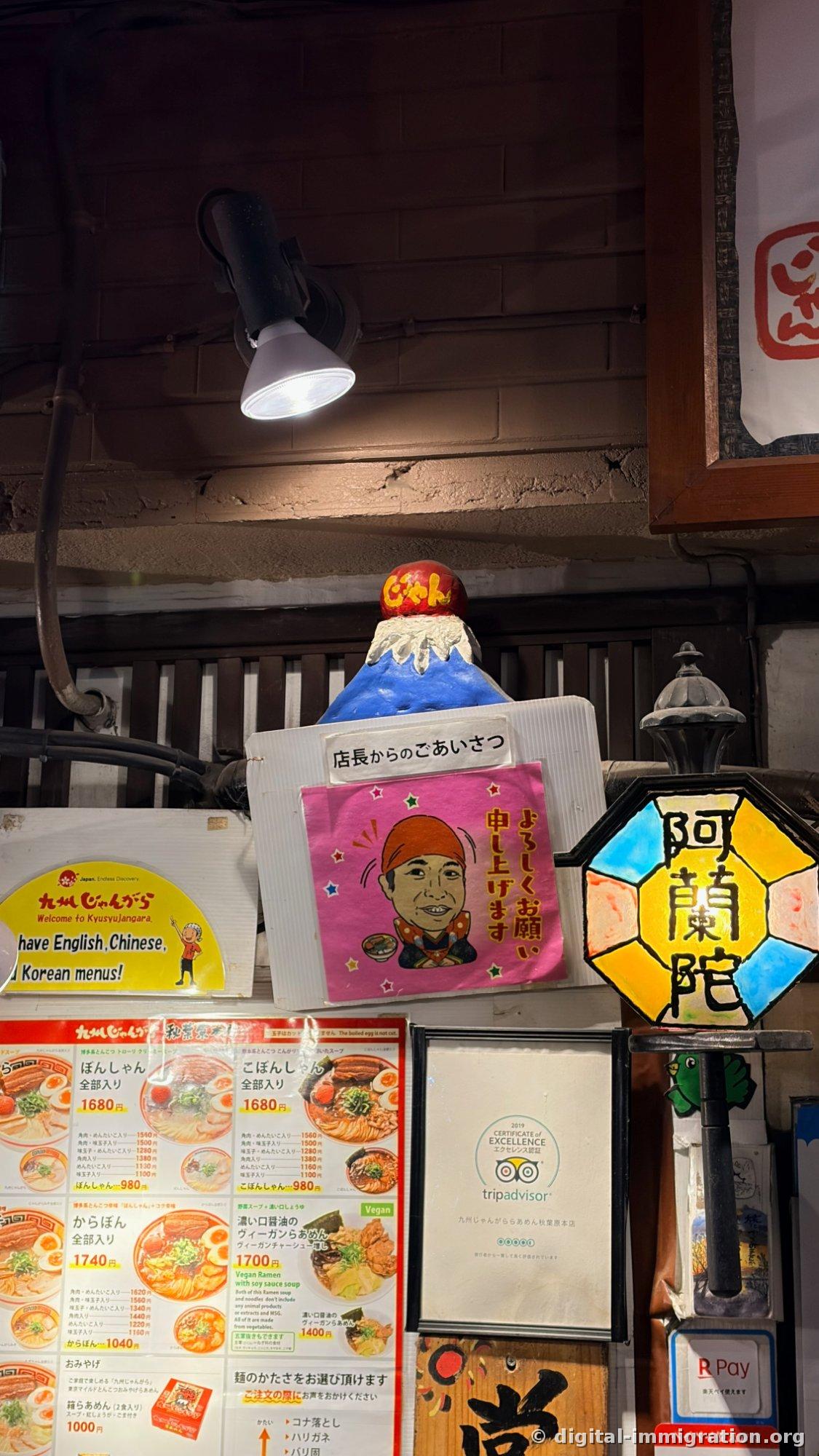
Location — Quieter for Being Off the Main Road
It's just a few minutes' walk from JR Akihabara Station. But it's not on the glittering main drag like Yodobashi or the Radio Kaikan building—it's tucked into a narrow alley between older buildings, so without a map I walked past it twice trying to find it by intuition. The blue signboard hangs well above eye level, so if you're looking at your phone while walking, you'll miss it. Look up.
The Shop Walls Are Entirely Filled with Things to Read
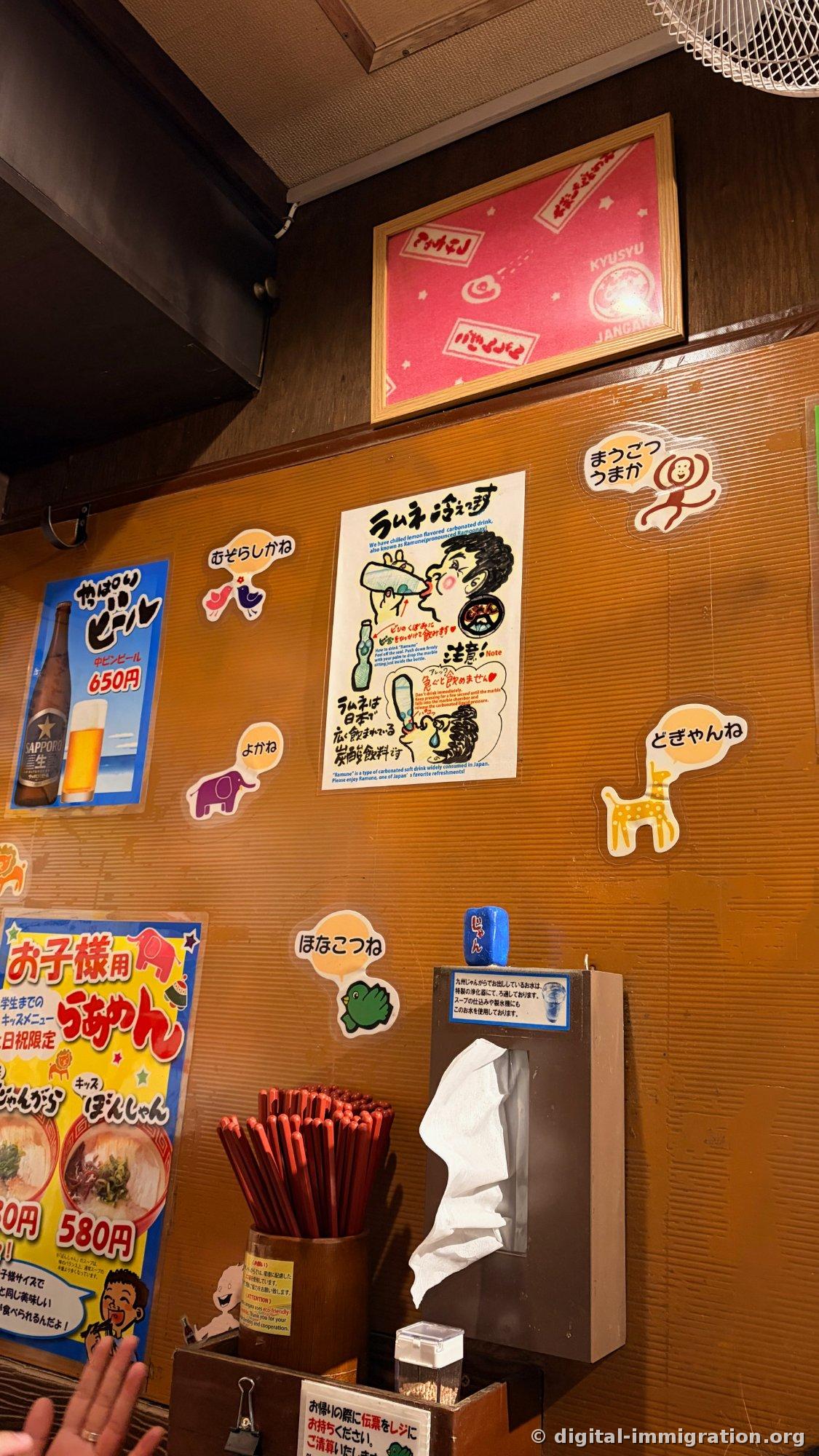
Once seated, your eyes never get bored. All over the brown wallpaper are Kyushu dialect speech bubbles stickers. Muzorashikane, yokane, dogyanne, honakottsune, maugotsuu umaka. There's an elephant, a deer, a monkey, and a green bird each paired with one—you can pick up the vibe even without knowing what they mean. A large sheet of paper in the center explains how to drink ramune. It says you have to push the marble in and wait a few seconds before drinking, and don't gulp it down too fast, even with drawings to show you. Below that is a notice explaining that the shop water comes from a water purifier, and the same water is used for soup preparation and the ice maker. Red chopsticks are packed tightly in a dispenser, with a box of napkins beside it. There's a separate notice on the table saying to bring your finished receipt slip to the register.
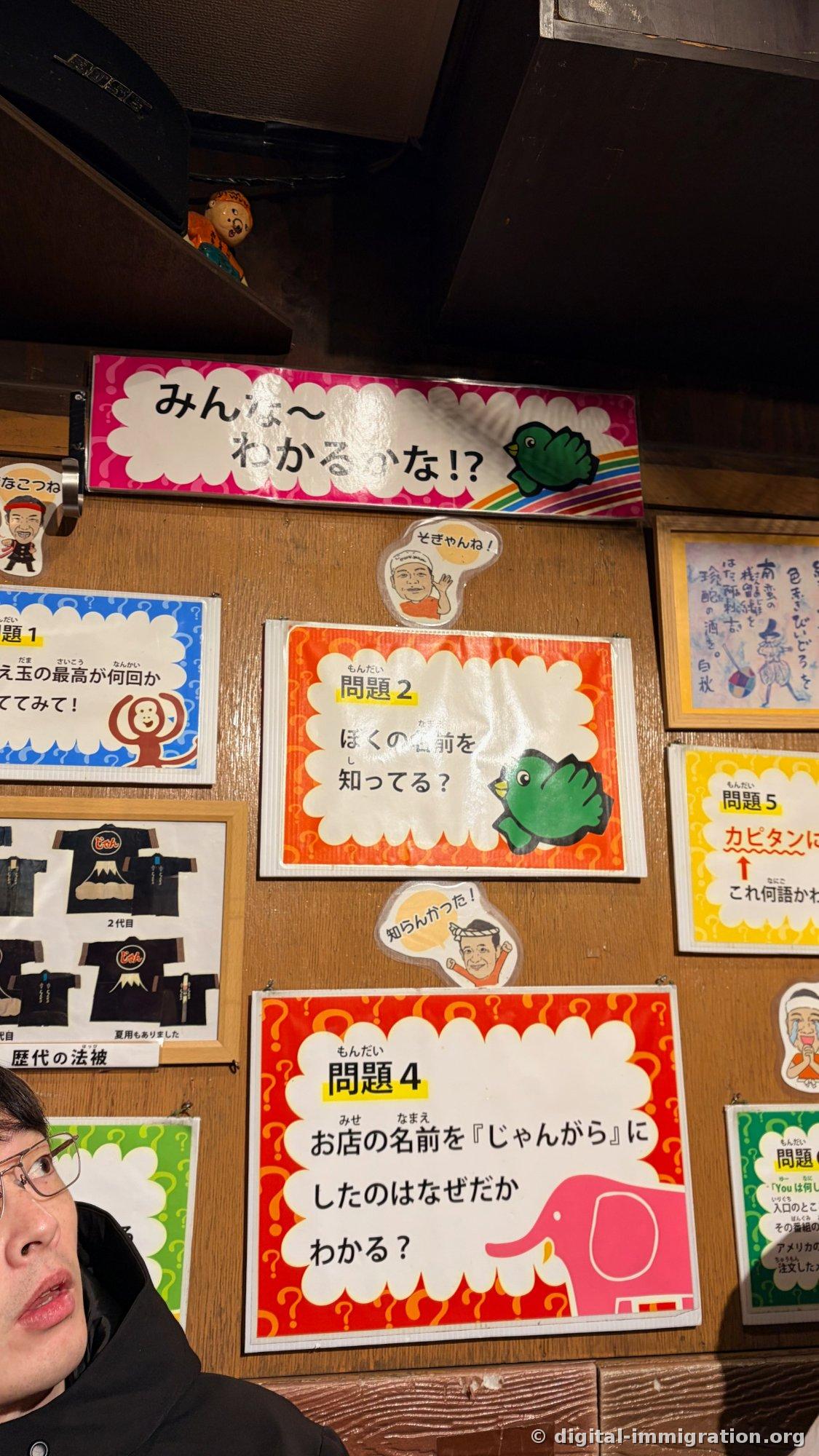
The opposite wall is entirely a quiz corner. Below a pink banner reading "Everyone—Can You Figure This Out!?" are problems 1 through 6 in different colors. One asks you to guess the highest number of times someone's ordered kaedama, another asks if you know the name of the green bird, another asks if you know why the shop is named 'Jangara,' and one asks what country the language 'Kapitan' is from. Next to it are framed photos of all the hapi jackets from different eras—the original, second generation, and summer version all lined up neatly. The five minutes waiting alone for ramen to come out wasn't boring at all, thanks entirely to this wall. I never did find the sheet with the answers.
The Bowl Arrives — The Broth Is Yellow
The first thing I noticed about the ramen that came out was the color. When you think of Hakata tonkotsu, you picture white broth, but this is a yellow with an orange tint. A thin layer of oil floats on the surface of the broth, and the foam is delicately formed. There's one ajitsuke tamago on the left, thinly sliced scallion and kikurage mushroom in the center, and a whole lump of mentaiko perched on the upper right. And rising above the broth is a piece of kakuni—a chunk of pork with the grain still visible.
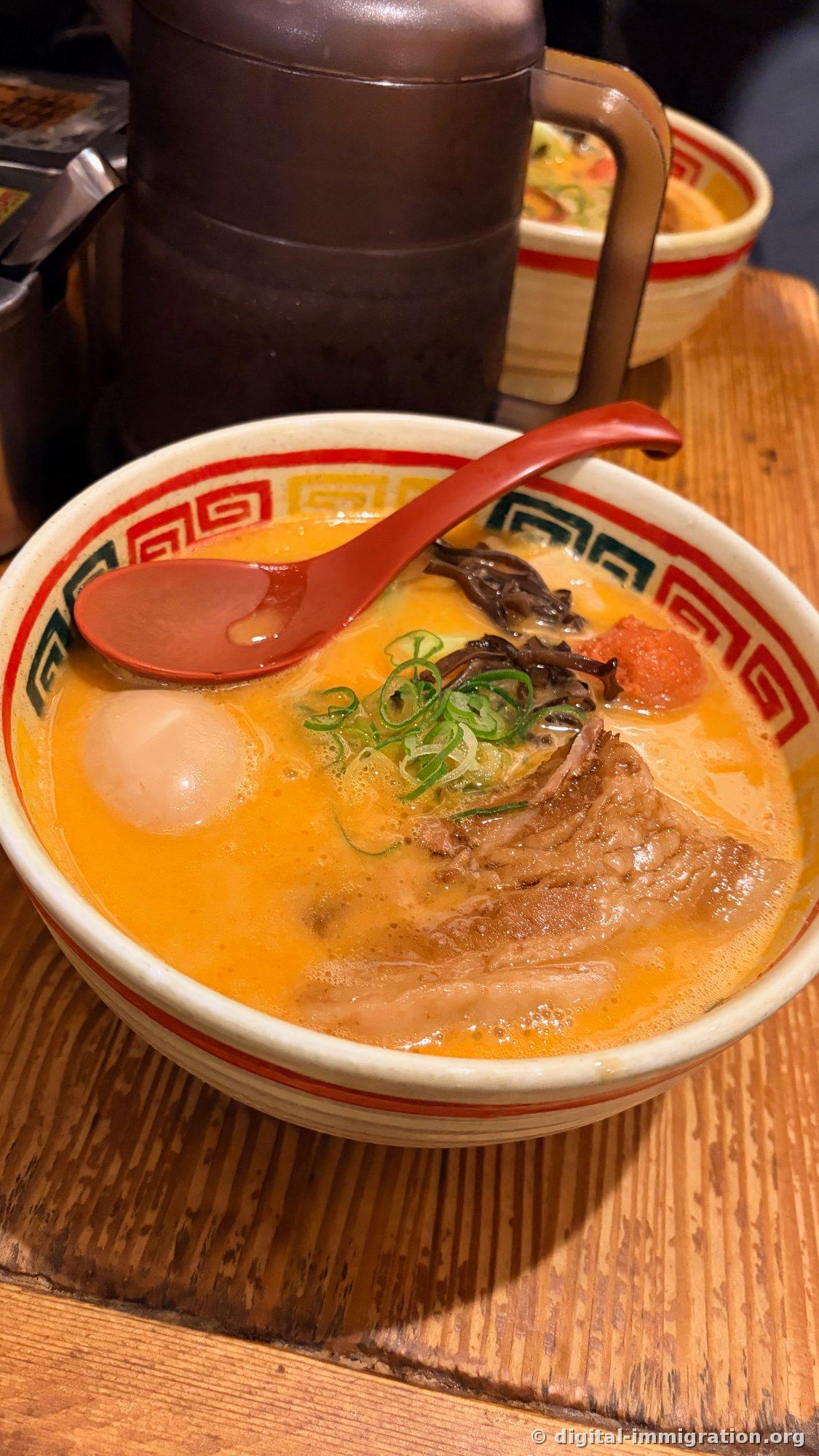
A spoonful of broth first. It's rich but not heavy. The distinctive pork-bone smell is almost absent, so even people who find tonkotsu off-putting might get past it. Instead, there's a subtle sweetness on the finish, and when it meets the mentaiko, it shifts firmly toward the salty side. I was about halfway through before I mixed the mentaiko into the broth. As it turns pink, the flavor changes noticeably, but if you mix it in from the start, you miss the original broth flavor, so I'd recommend mixing it midway.
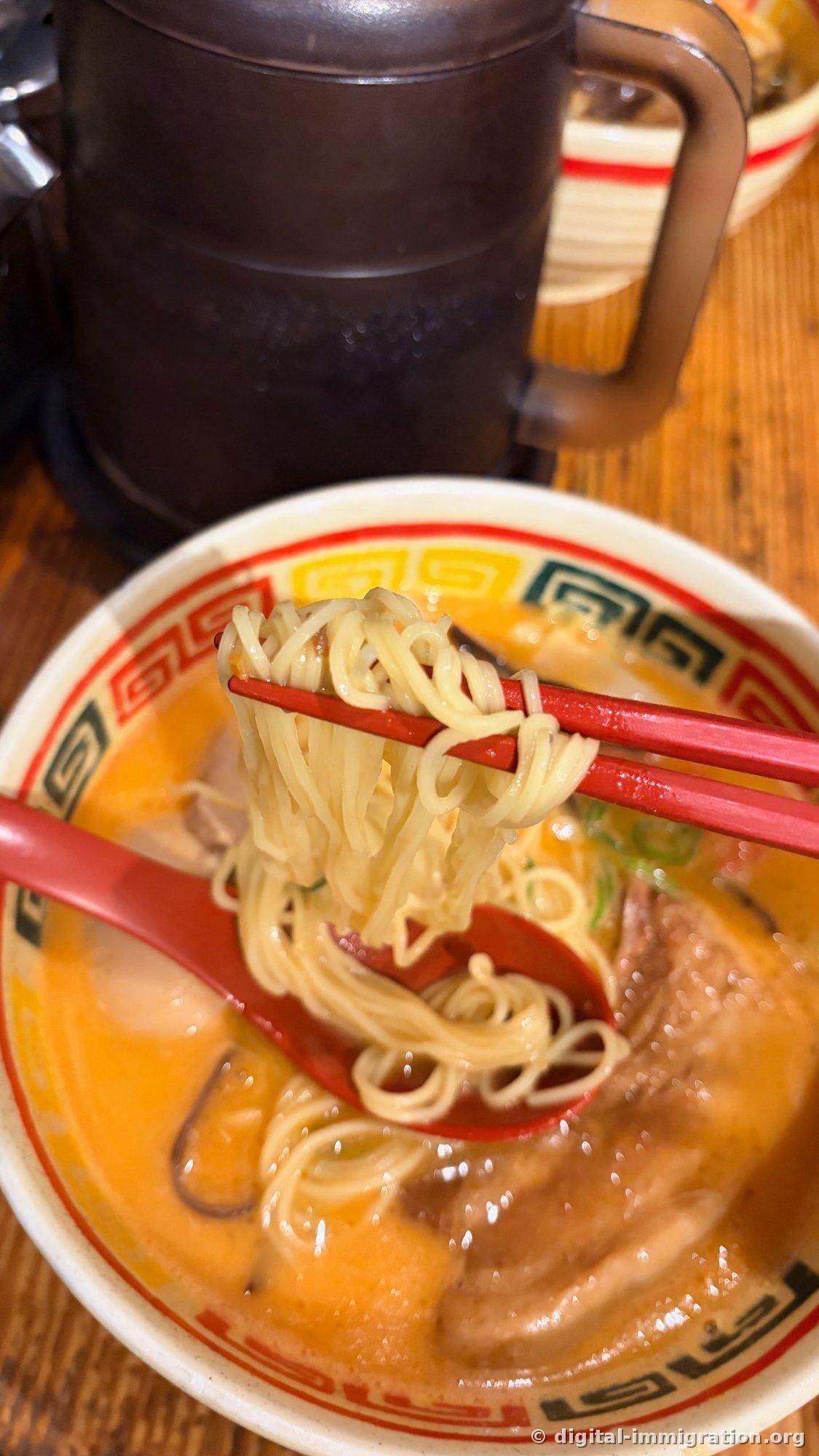
The noodles are thin, straight Hakata-style. Since I'd ordered normal firmness, they came with just a bit of firmness in the center. When you lift them with chopsticks, they don't clump together—they fall apart strand by strand. Because they're thin, they pick up broth well, but soften quickly, so the surface changes even while you're snapping a few photos. If you want to order kaedama, you need to ask before the noodles are completely gone so the timing works out.
The kakuni splits along the grain when pressed with chopsticks. The fat layer melts in the heat of the broth, turning tender, but for people who find fat off-putting, this part could go either way. I ate one piece of the two and left the other. The broth was already rich, and by the time I'd finished eating the kakuni, I felt a bit full by the end. Next time I come, I think I'll go with the 1,130 yen combination with just mentaiko and ajitsuke tamago, skipping the kakuni.
Good to Know Before You Go
- Table spacing is tight. If you come in with a large backpack or carry-on luggage, you'll bump into your neighbors. If you're coming after shopping in Akihabara weighed down with bags, you need to be prepared.
- If you don't specify noodle firmness when ordering, you get futsuu. If you want to properly taste Hakata noodles, katame is a safe bet.
- Mentaiko is something you can mix into the broth. You can also leave it and eat it last like rice, but you'd need to order rice separately.
- Vegan ramen is on the regular menu. The menu clearly states that neither the broth nor the noodles use animal products or MSG, so if someone in your group is vegetarian, you can all sit together.
- Children's ramen at 580 yen is available on weekends, holidays, and national holidays. If you're taking a child around Akihabara, it's good to check this condition and time your visit accordingly.
- Gift box ramen for two at 1,000 yen is available by the register. If you don't want to increase your luggage, it's better to buy it on your last day.
At 1,590 yen for a bowl of ramen, it's not cheap by Tokyo standards. But considering that includes mentaiko, kakuni, and egg, it makes sense. As I left the shop, the alley was still dark, and only the blue signboard glowed alone. One sentence from the Kyushu dialect stickers I'd seen inside kept coming back to me—Maugotsuu umaka. When I looked it up later, it meant "Really delicious."
Das könnte Sie auch interessieren
- From Akihabara's Chuo-dori to the Kanda River: A Record of Tokyo's Electronics District Revisited Multiple Times
Tokyo's Akihabara is a neighborhood where it's hard to say you've seen everything in a single visit. I've come multiple times across different seasons, and each time the signs chan…
Tokyo · Akihabara - Buying a Single ¥300 Year-End Jumbo Lottery Ticket at Nishi-Ginza Chance Center in Tokyo
Exit from the Hibiya exit of Tokyo's Shimbashi Station, walk toward the elevated highway for about three minutes, and suddenly you'll see a line of people stretching along the side…
Tokyo · Nishi-Ginza Chance Center - Ueno Ameyoko, the real magic starts after sunset — an evening walk from the Okachimachi Gate to Ueno Station
Every time I come to Tokyo, my feet find their way to Ueno Ameyoko (アメ横) without fail. This time I entered from the Okachimachi side and worked my way toward Ueno Station. I've met…
Tokyo · Ameya Yokocho Market