Jakarta National Museum (Museum Nasional Indonesia), Half a Day at the Elephant Museum
On the west side of Merdeka Square, along Jl. Medan Merdeka Barat, sits a low neoclassical white building. It's Indonesia's National Museum, though locals still call it Museum Gaja…
Jakarta · Museum Nasional Indonesia
On the west side of Merdeka Square, along Jl. Medan Merdeka Barat, sits a low neoclassical white building. It's Indonesia's National Museum, though locals still call it Museum Gajah because of the bronze elephant in its courtyard. Every time I visited Jakarta, I'd just photograph the Monas and move on, but this time I cleared the entire afternoon. The bottom line: two hours doesn't come close.
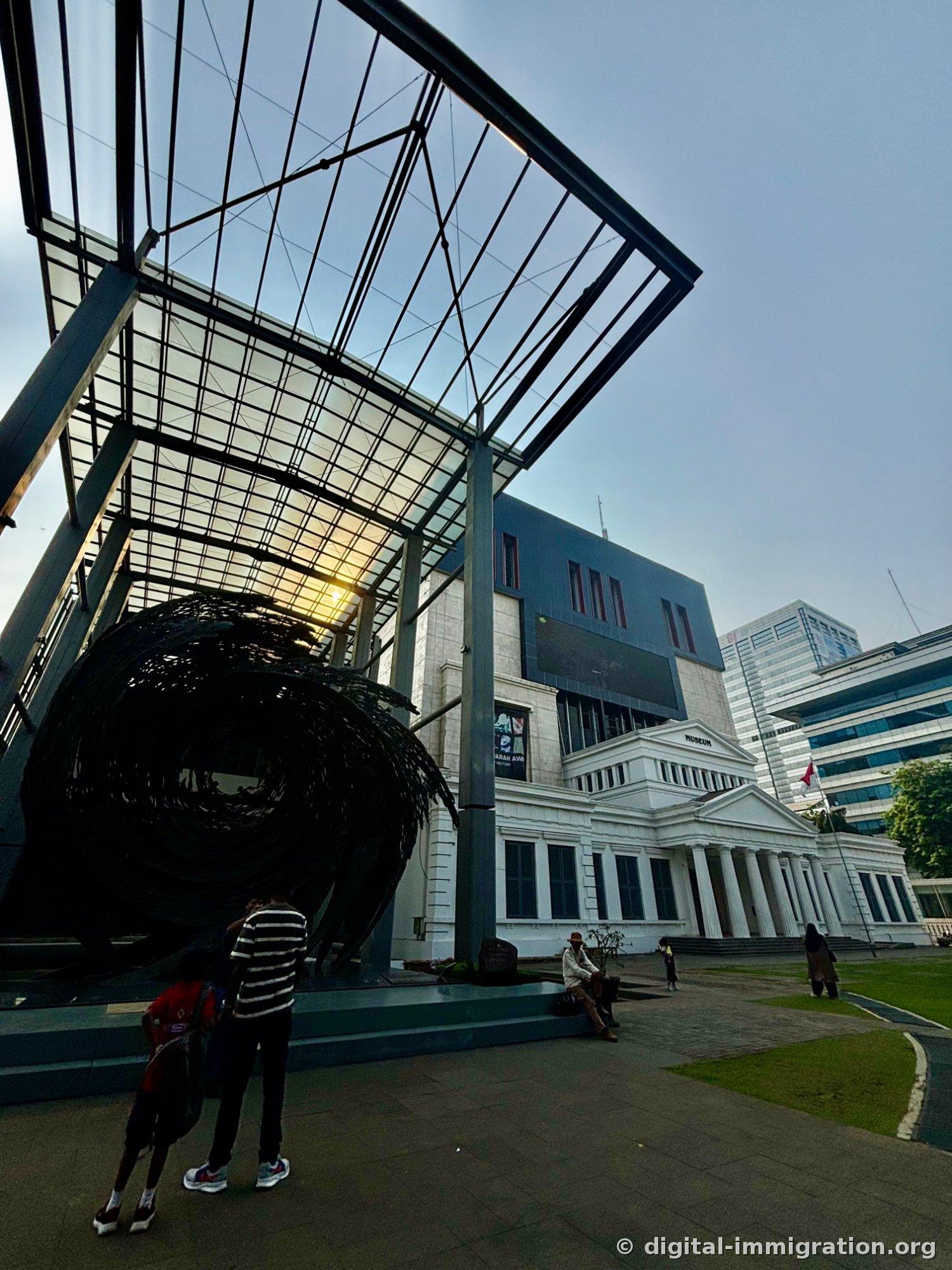
I arrived in the late afternoon. The sun hung in the glass canopy as people photographed in the courtyard, and behind them the white-columned old building and gray new wing sat awkwardly joined. This awkwardness is the museum's character. Over two centuries of collections and recently renovated exhibition paths mix inside one building.
White-Columned Colonnade and Courtyard — Decide Your Stamina Budget Here
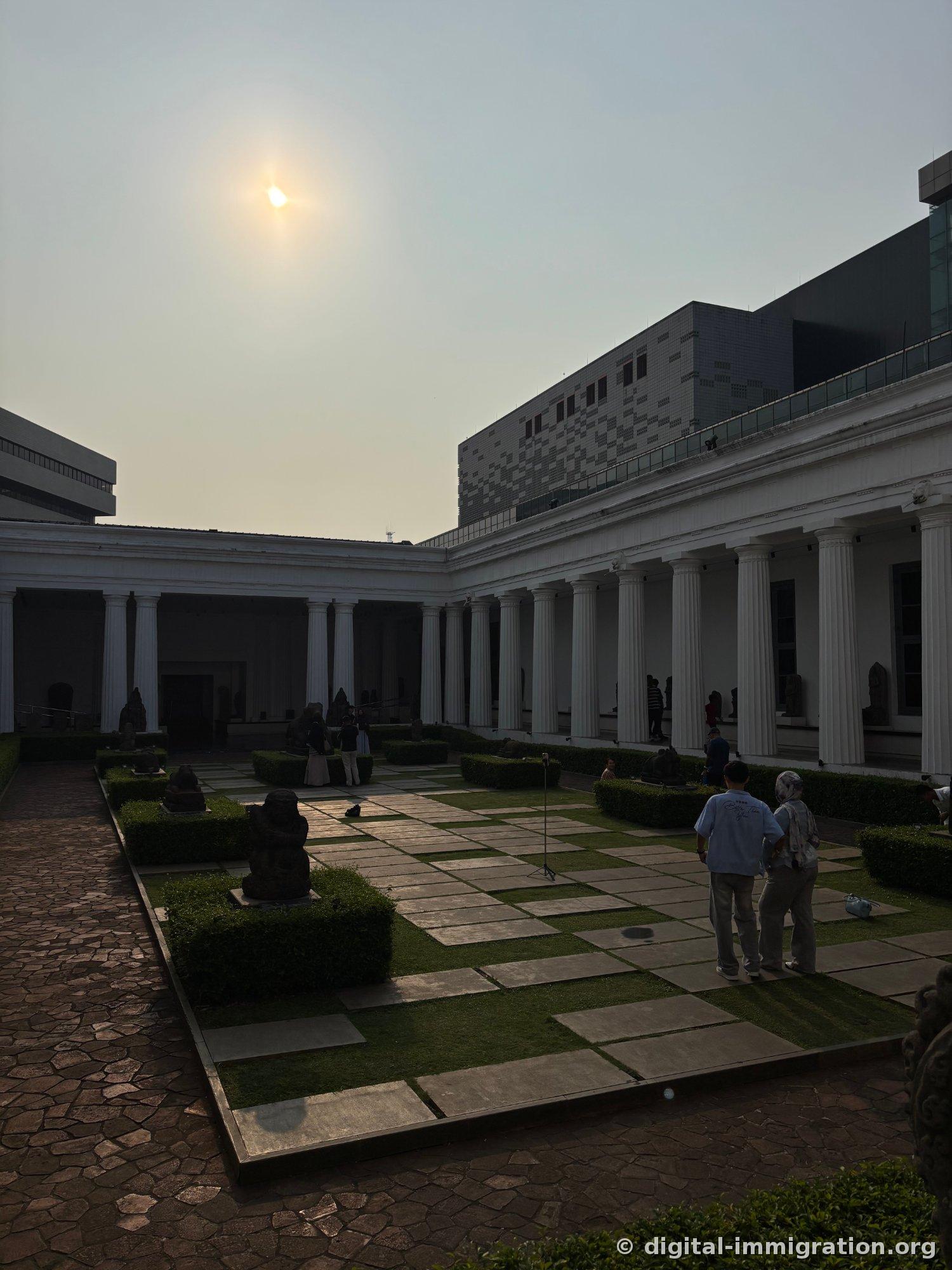
After buying your ticket, the first thing you encounter is a square courtyard. Doric white columns surround it on all sides, and stone statues line the colonnade below. A hijab-wearing couple stood taking photos on the checkered grass and stone floor, and a solitary tripod stood nearby. By four in the afternoon, this courtyard is half in shadow. The benches in the shaded colonnade are a rare cool spot in downtown Jakarta.
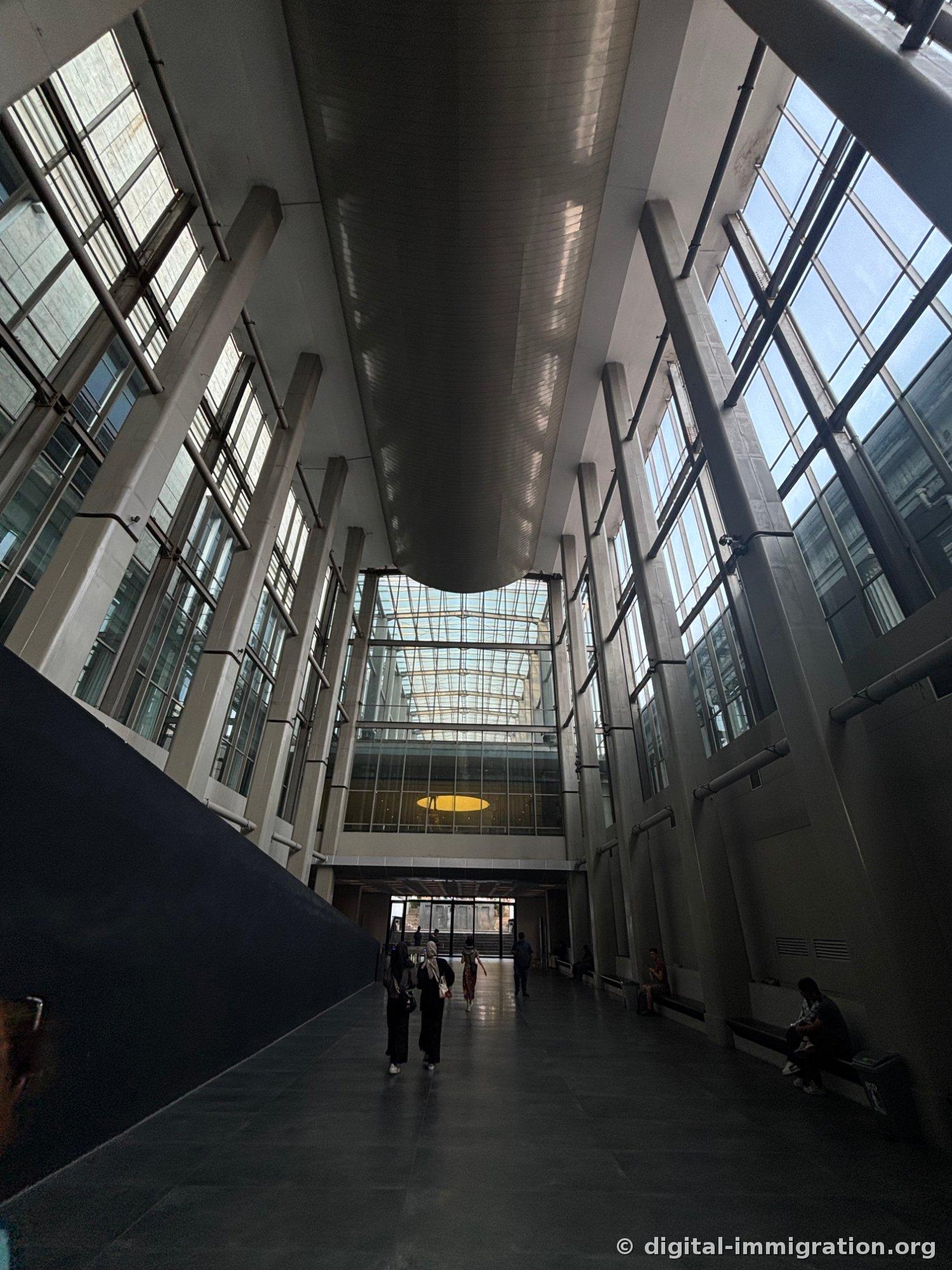
Cross over to the new wing and the atmosphere changes completely. It's an atrium with a long skylight, but with exposed concrete columns and white ducts—more like an airport terminal than an art museum. Gray floor tiles bounce footsteps loudly. There are always a few people resting on the benches here.
Sculpture Hall — Where Java's Hindu and Buddhist Sculptures Gather
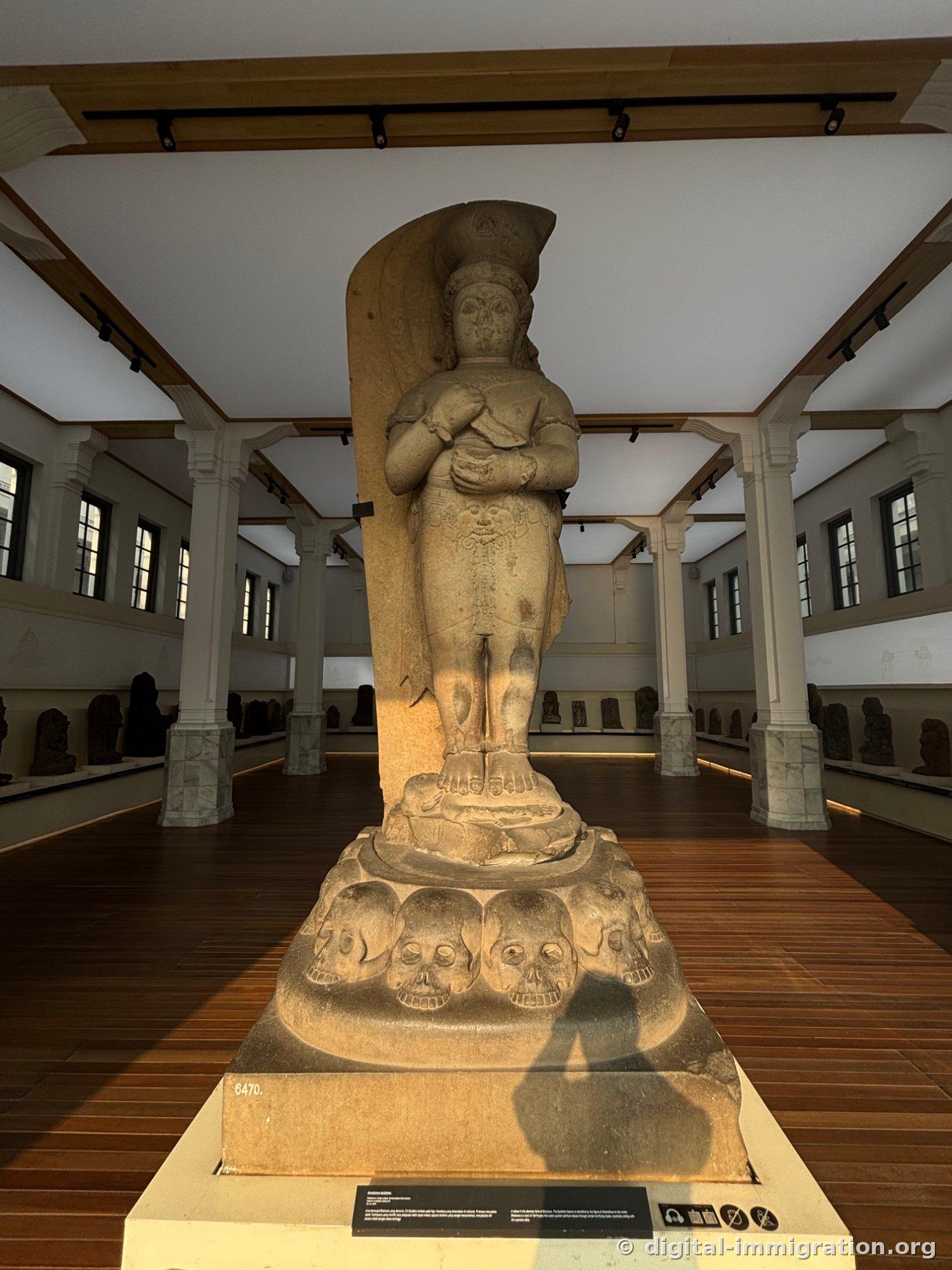
The old building's main hall is a long room with white columns on a wooden floor. Small statues line the walls, and in the center stands a figure that towers over human height. Five skulls are carved side by side on the base—visible from far away. The plaque reads Bhairawa Buddha, artifact no. 6470. The combination of a Buddhist deity standing above skulls was unfamiliar, so I stared for a while.
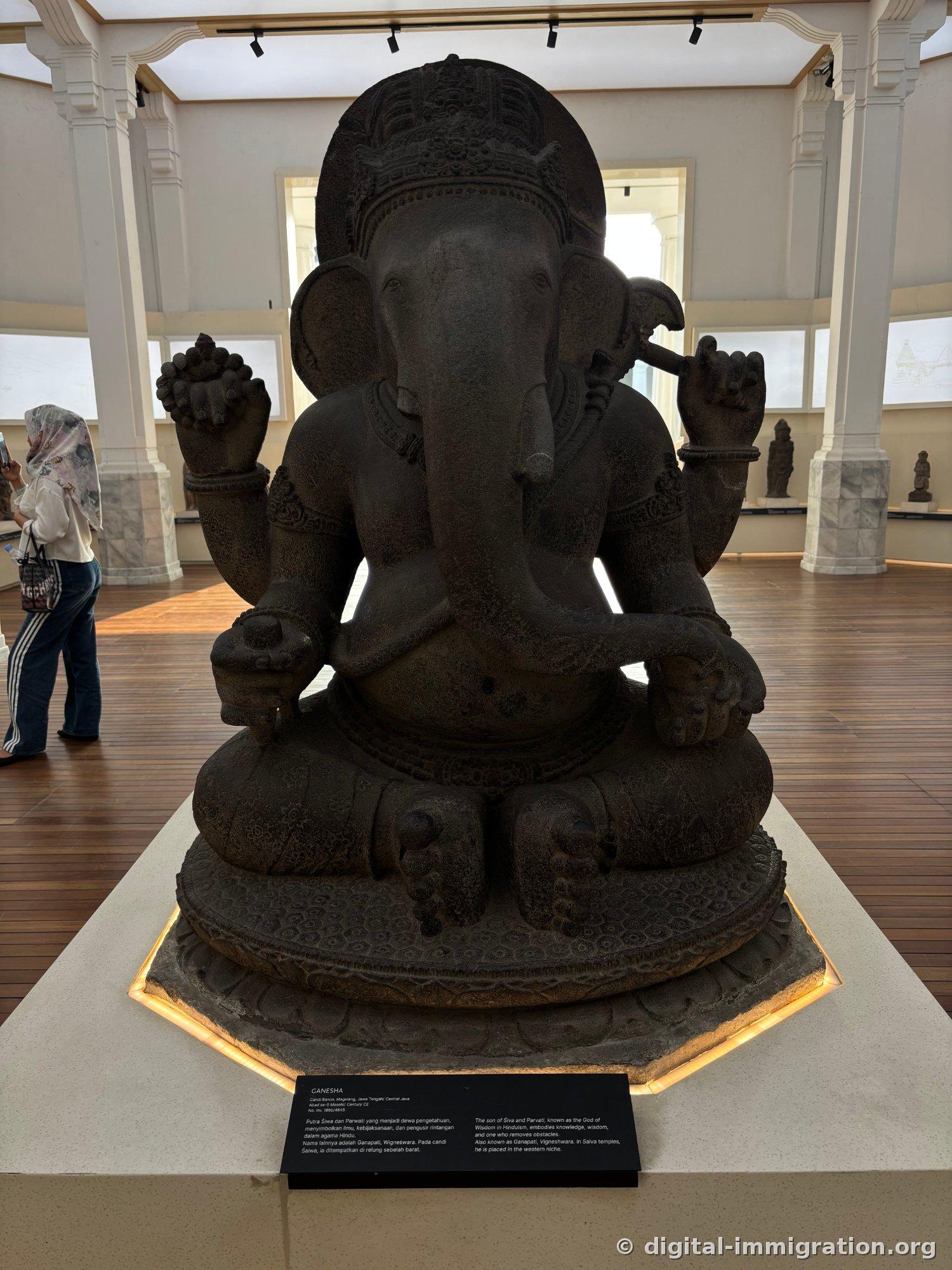
Inside the same hall sits a Ganesha. The plaque indicates it was excavated from Candi Banon in Magelang, Central Java, dating to the 9th century. The trunk extends toward the left hand, and four arms spread outward. Indirect lighting beneath the base reveals the raw, rough surface characteristic of volcanic stone. You only grasp its size when someone walks past. Even seated, it's as tall as an adult.
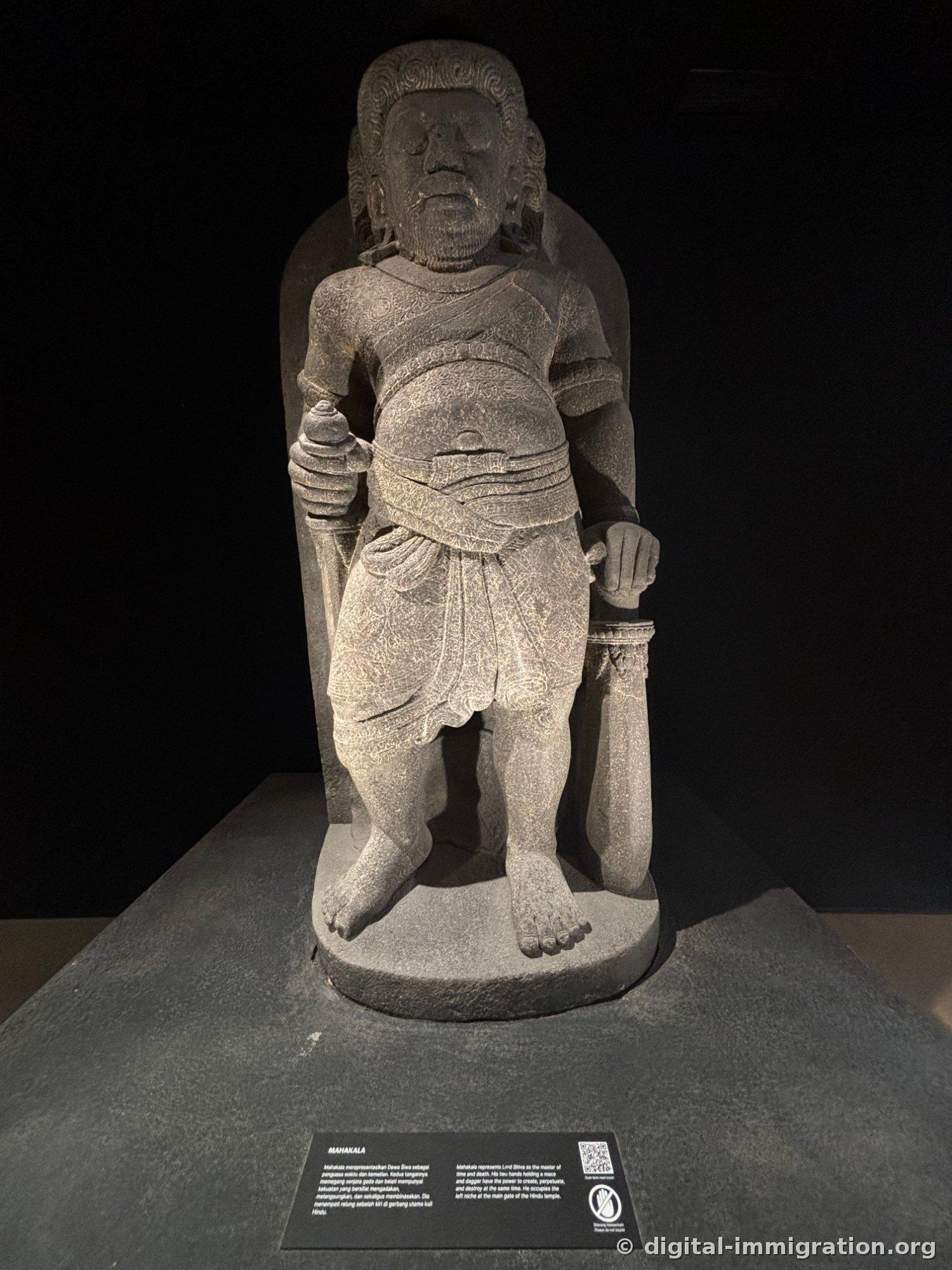
In a completely dark room are a few more statues. The Mahakala figure stands with a protruding belly, leaning on a club. The plaque explains it once sat in a niche to the left of a Hindu temple's main entrance. Photography here is terrible. Two spotlights strike only the front, casting deep shadows on the face. I retook it three times, yet the eye sockets still came out pitch-black.
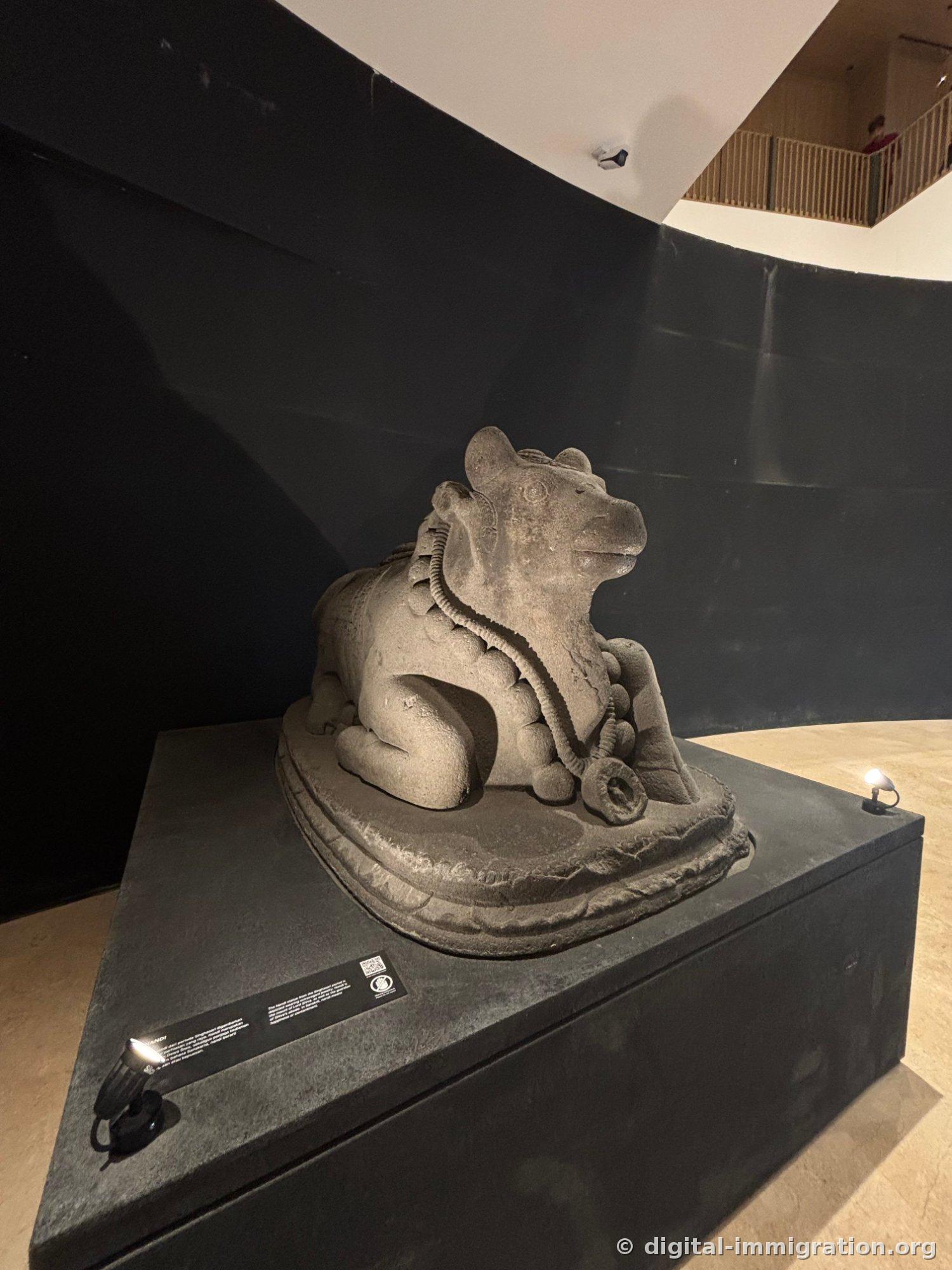
Beside it crouches a Nandi statue. A bull, Shiva's mount, with even the dangling bell rope carved from stone. It sits along the curve of the black wall with almost no room to step back. To fit the entire figure, you must press your back to the wall and shoot vertically.
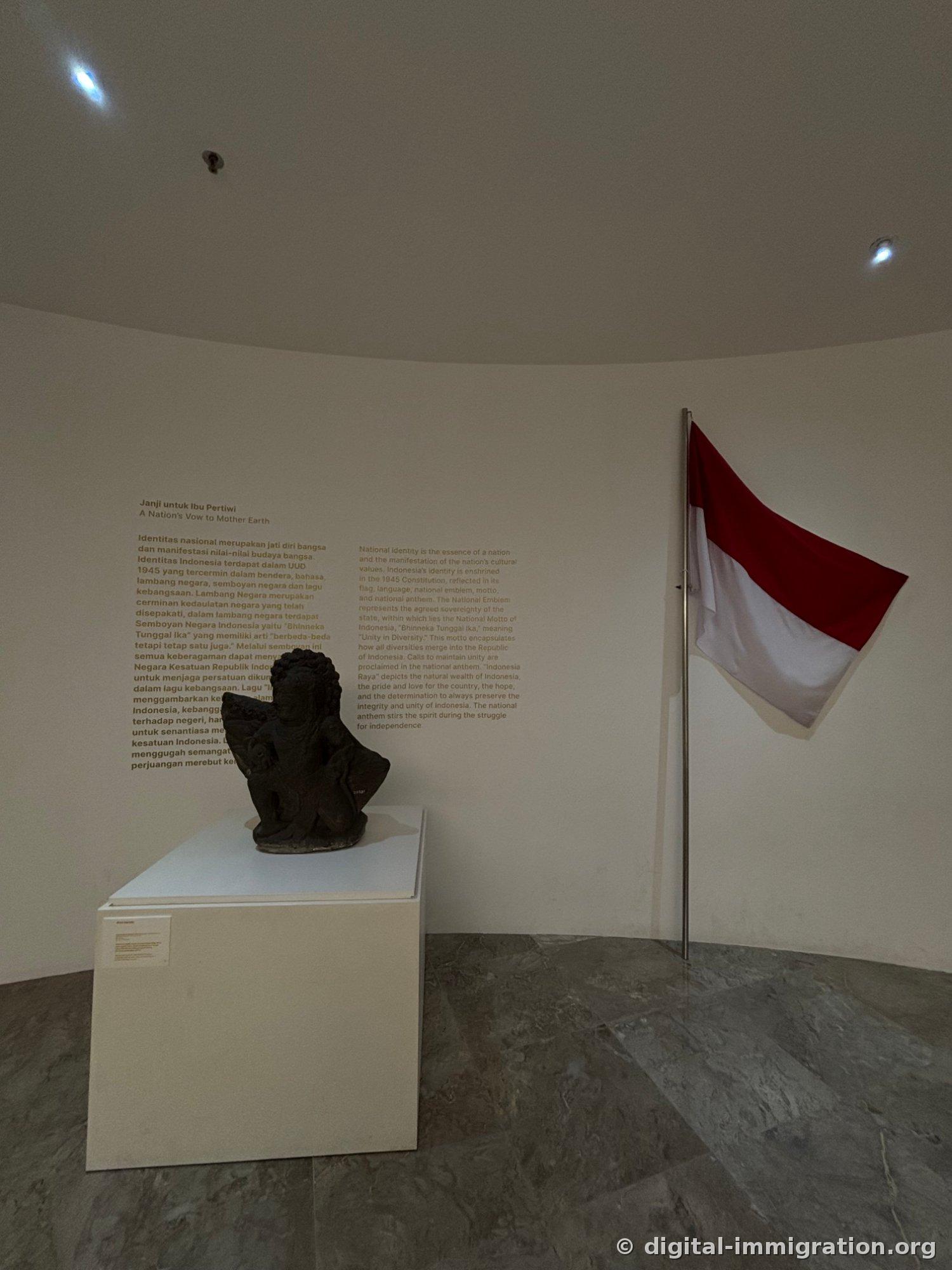
At the end of the route is a circular room. On the wall, Janji untuk Ibu Pertiwi (A Nation's Vow to Mother Earth) appears in Indonesian and English side by side. In front sits a white pedestal with one statue, and to the right hangs the red and white flag. The wall text discusses the 1945 constitution and 'Bhinneka Tunggal Ika' (unity in diversity). After wandering among artifacts for two hours, entering this room shifts the mood abruptly. Lighting is dim and sound deadened—people actually lower their voices here.
Masks, Documents, Lamps — Easy-to-Miss Small Things
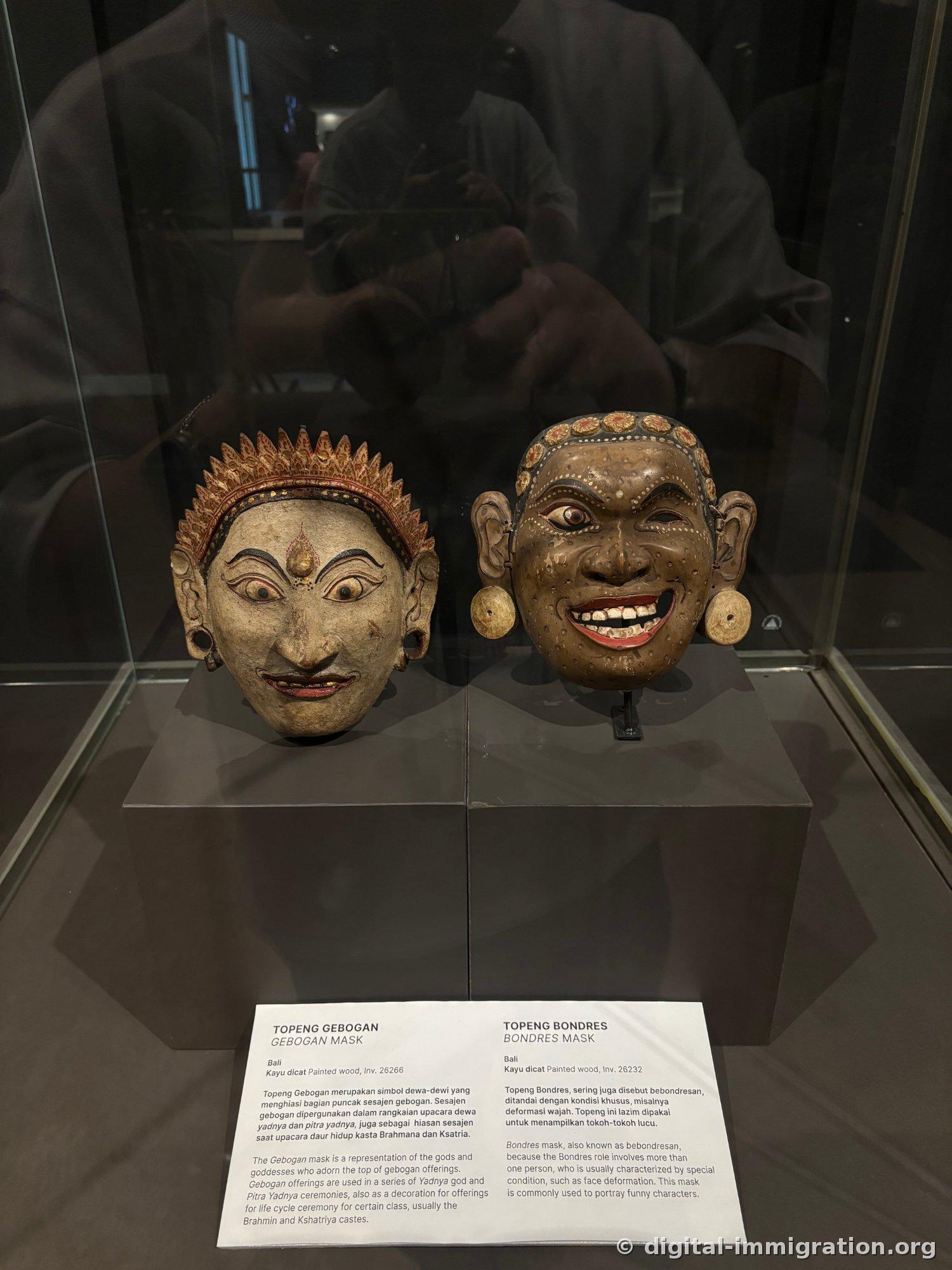
When large statues capture your attention, glass cases pass by unnoticed. Such is the case with two Balinese masks displayed side by side. On the left, Topeng Gebogan—a white face wearing a flame-shaped crown; on the right, Topeng Bondres—a face with bumpy protrusions, mouth open in laughter. The plaque notes that Bondres masks are worn when performing comic characters. Placing two faces in one case was the display's most clever touch in this room.
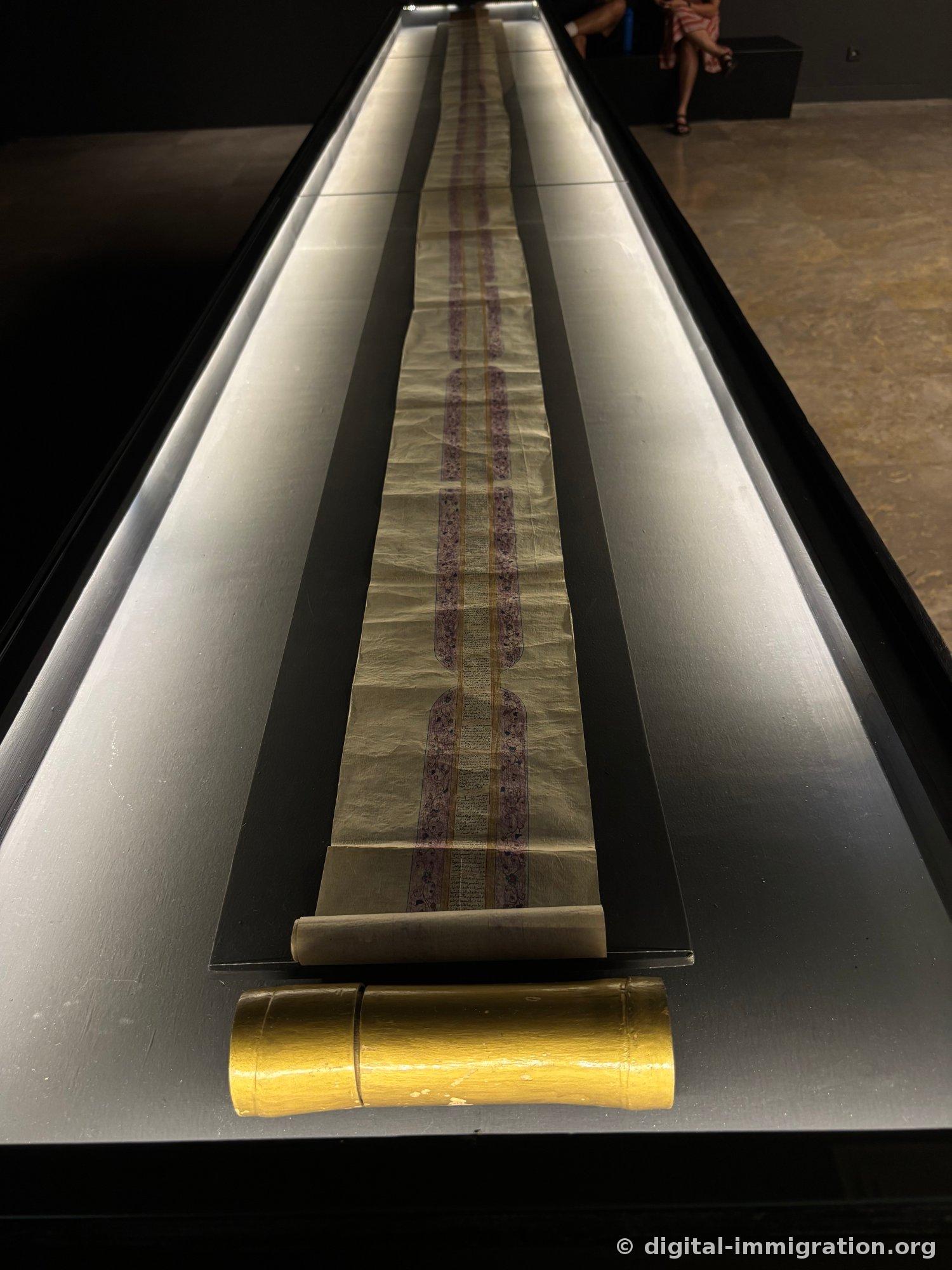
One long glass display case holds a single scroll. Yellowish paper features repeated purple border decorations, with dense handwritten script filling the interior. At the end sits a yellow tube that once held the scroll. The display case is roughly long enough for three or four adults to lie down, and the scroll is unrolled about halfway across it. Lighting reflects directly off the glass—shooting head-on produces only white wash. You must shoot from the side at an angle to capture the text.
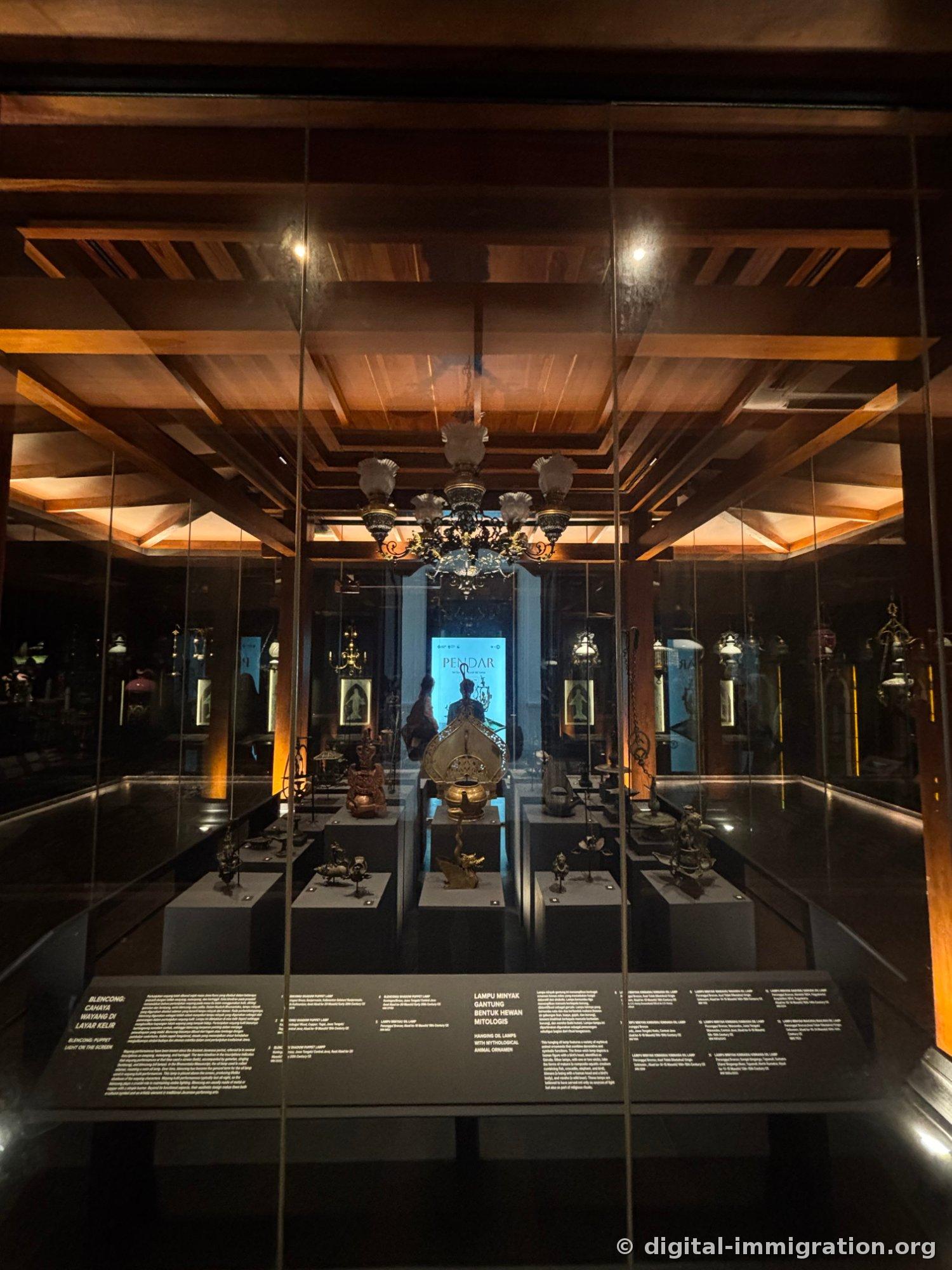
There's also a room devoted entirely to lamps. A curated exhibition titled 'PENDAR,' it features a chandelier with a glass shade hanging inside a glass box beneath a wooden ceiling, with brass oil lamps arranged on low pedestals below. The left panel reads Blencong: Cahaya Wayang di Layar Kelir (Light Illuminating the Wayang Screen); the right discusses mythologically-shaped hanging lamps. It was my first time seeing the actual oil lamps that once lit wayang shadow-puppet screens displayed in multiples. The lighting is so dim it takes about a minute for your eyes to adjust.
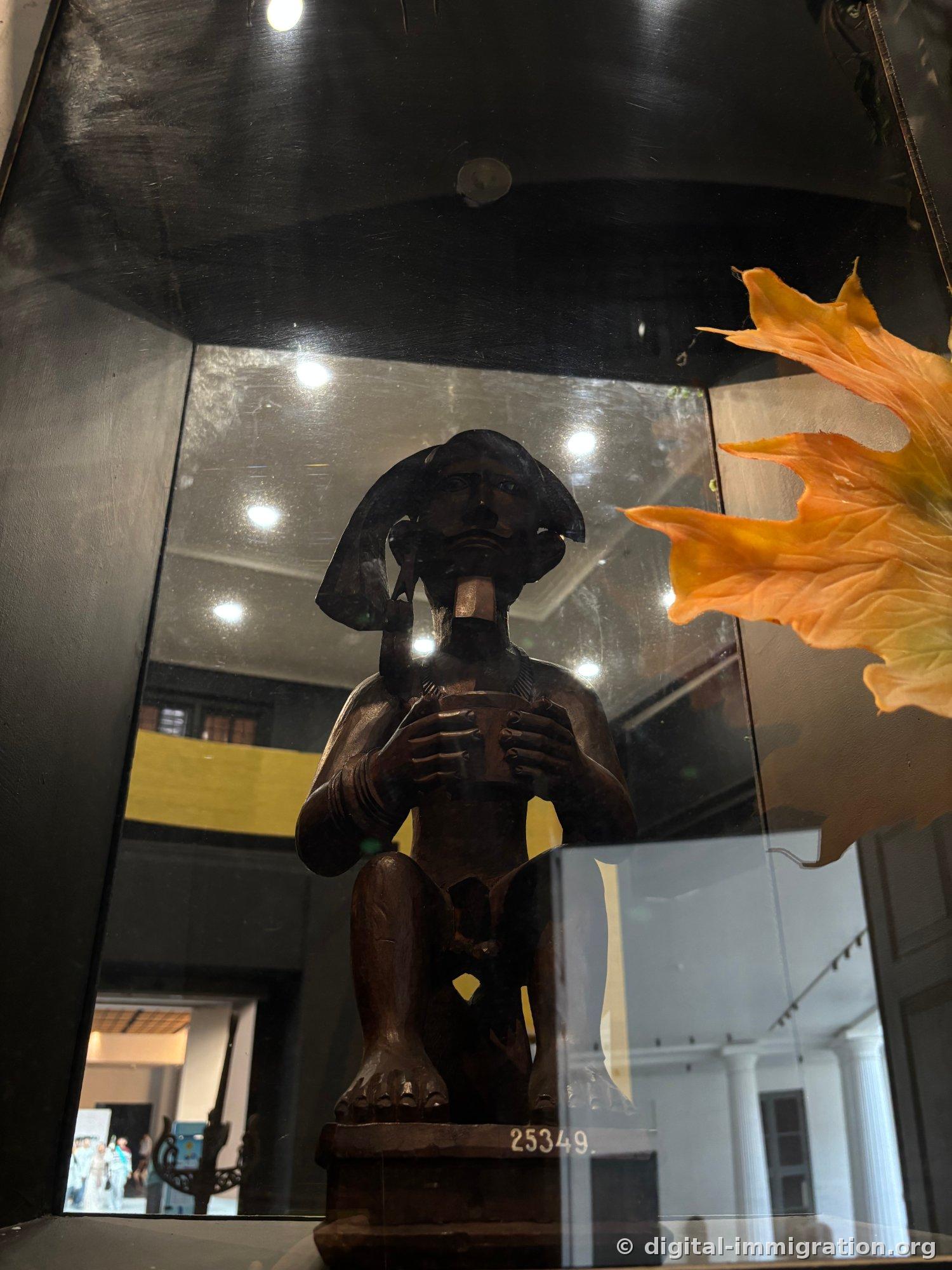
The wooden figure marked artifact no. 25349 stuck in my memory precisely because of heavy glass reflections. A kneeling figure cradles a bowl-like object in both hands, with the courtyard, white columns, and passing visitors all mirrored in the glass. An orange artificial leaf beside the case crept into the right side of the frame. There was no way to shoot around it, so I left it as is.
Wooden Ancestral Figures Before the Golden Wall
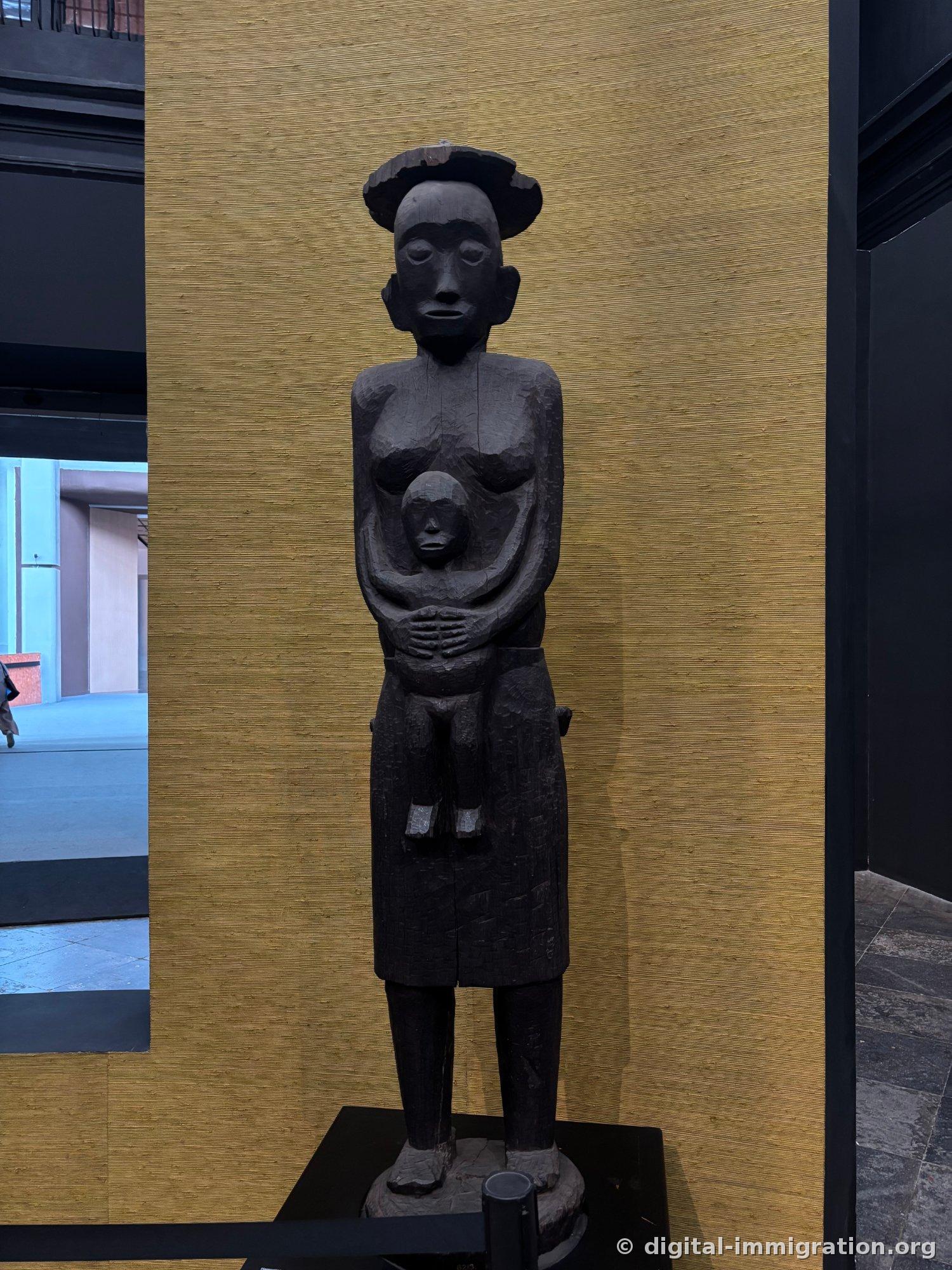
In one section of the old building stands a golden wall that looks woven from straw, with large wooden figures displayed before it. These are blackened wood pieces bearing visible axe marks. One is a female figure cradling a child at her chest. She wears a broad-brimmed hat-like headdress and gazes forward, but the child's face is disproportionately large compared to the adult body, drawing the eye there.
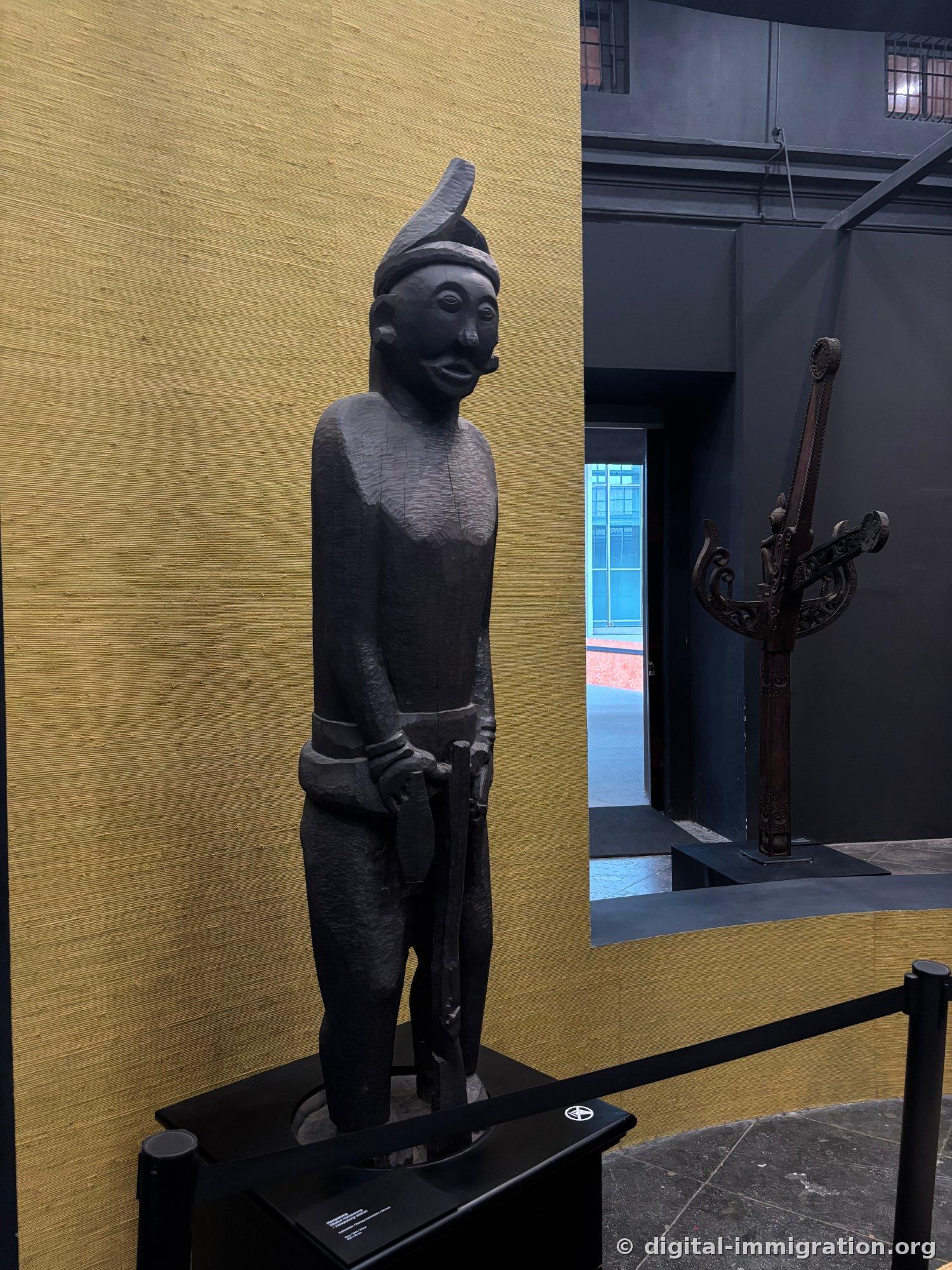
Across from it stands a male figure wearing a pointed hat, leaning on a staff-like object with both hands. A mustache and open mouth lend his expression an odd vitality. Behind him, through an open doorway, a densely carved red wooden pillar is visible, with the next room's blue wall beyond. A velvet rope blocks the floor, preventing closer approach.
Two Dark Rooms — Fossils and Humanity
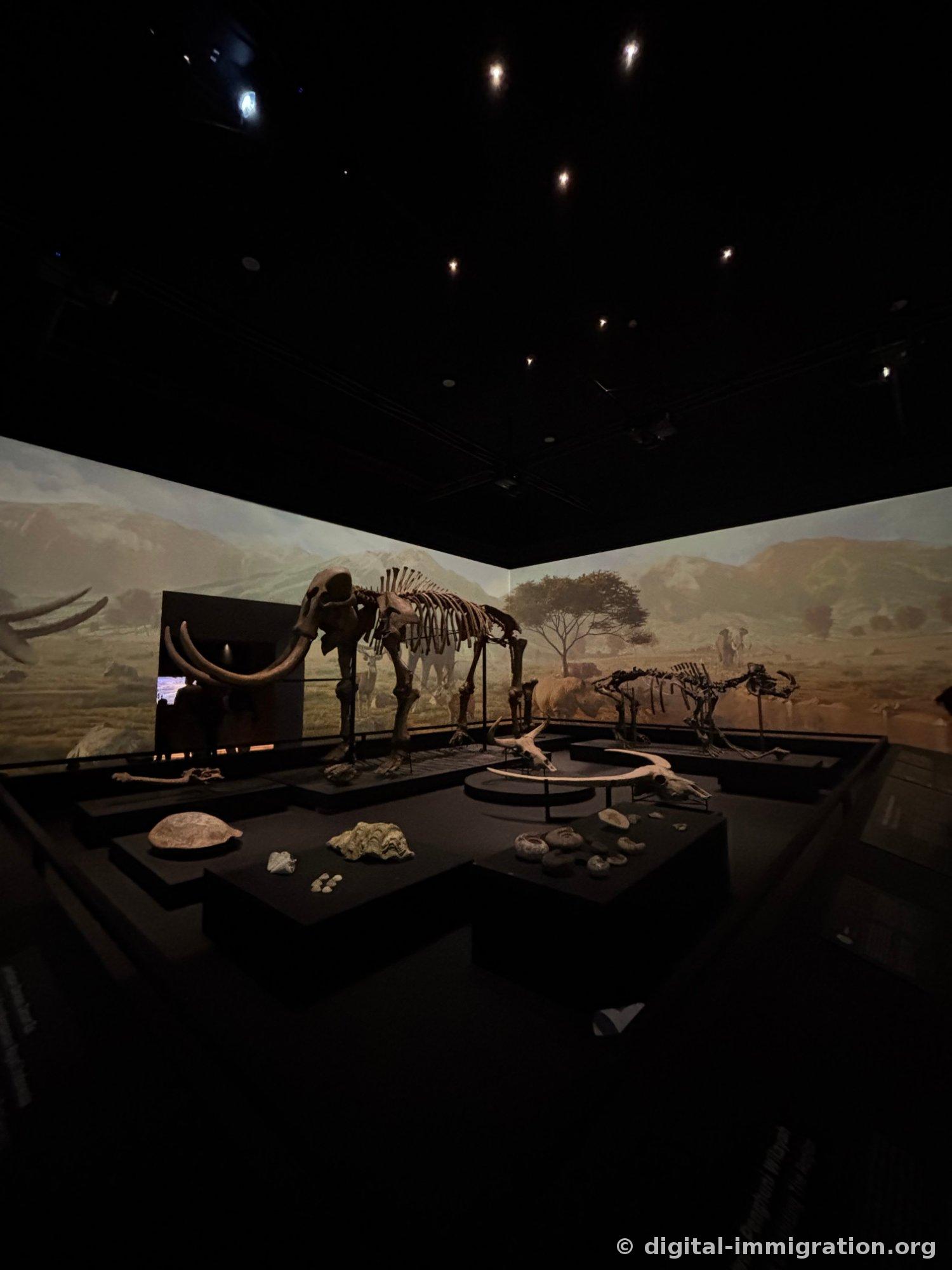
The prehistoric section is a room with lights nearly off. A grassland scene is projected across the entire wall, with what appears to be a Stegodon skeleton displayed before it. Long tusks curve forward, and beside it scattered on low pedestals are a rhinoceros skeleton and several horned skulls. On the front pedestal sit fossilized turtle shells, large shell fossils, and round stone specimens. This was where children lingered the longest.
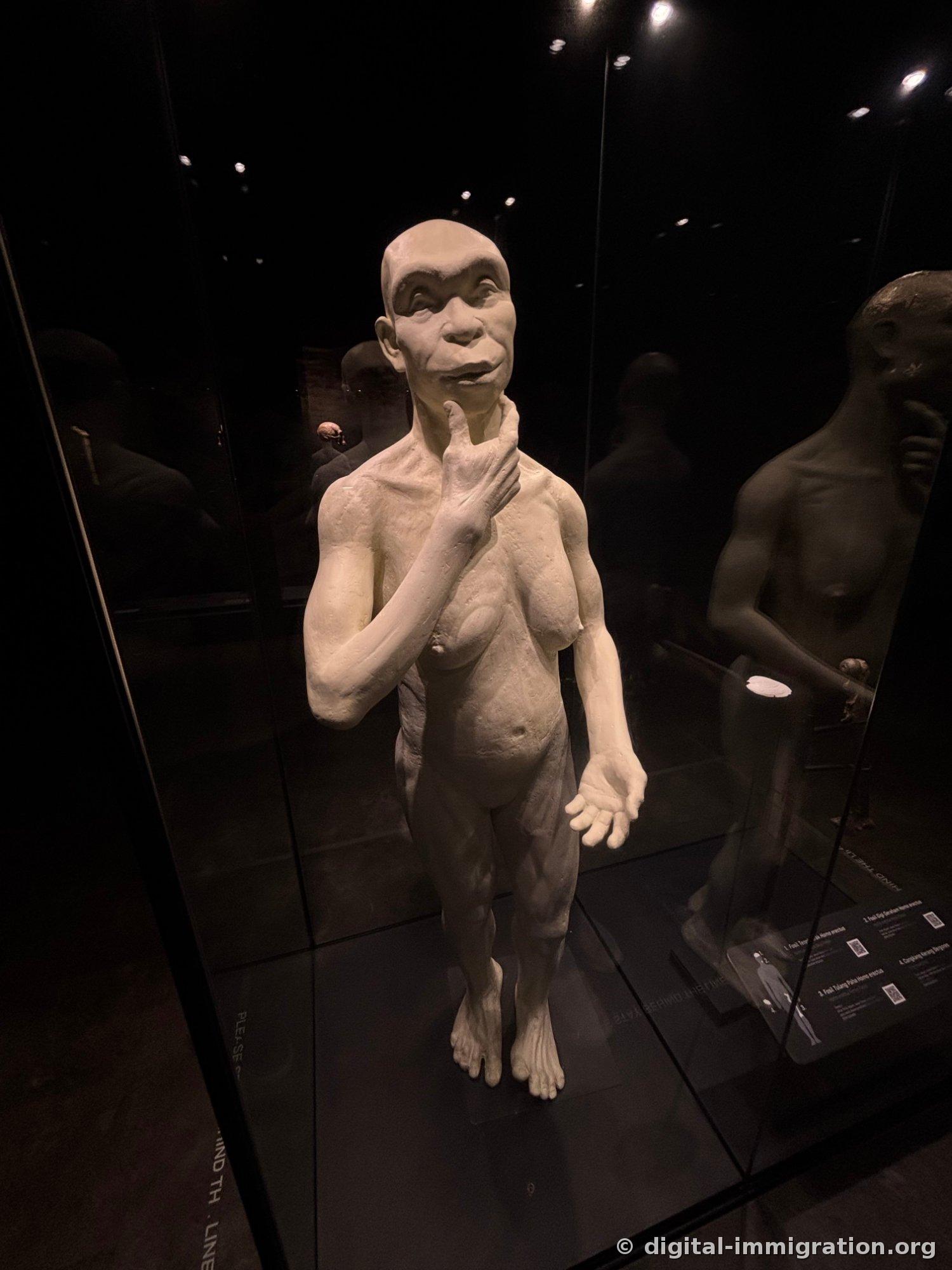
In an adjacent glass case stands a life-size human reconstruction model. A low forehead and prominent eye sockets characterize the face, which gazes toward visitors with one hand to its chin. Behind it, a plaque bears photos of a Homo erectus skull and teeth fossils. The model's surface texture mimics skin, so encountering it suddenly in the dark room startles you. I actually stepped back.
One Painting in a Dark Room
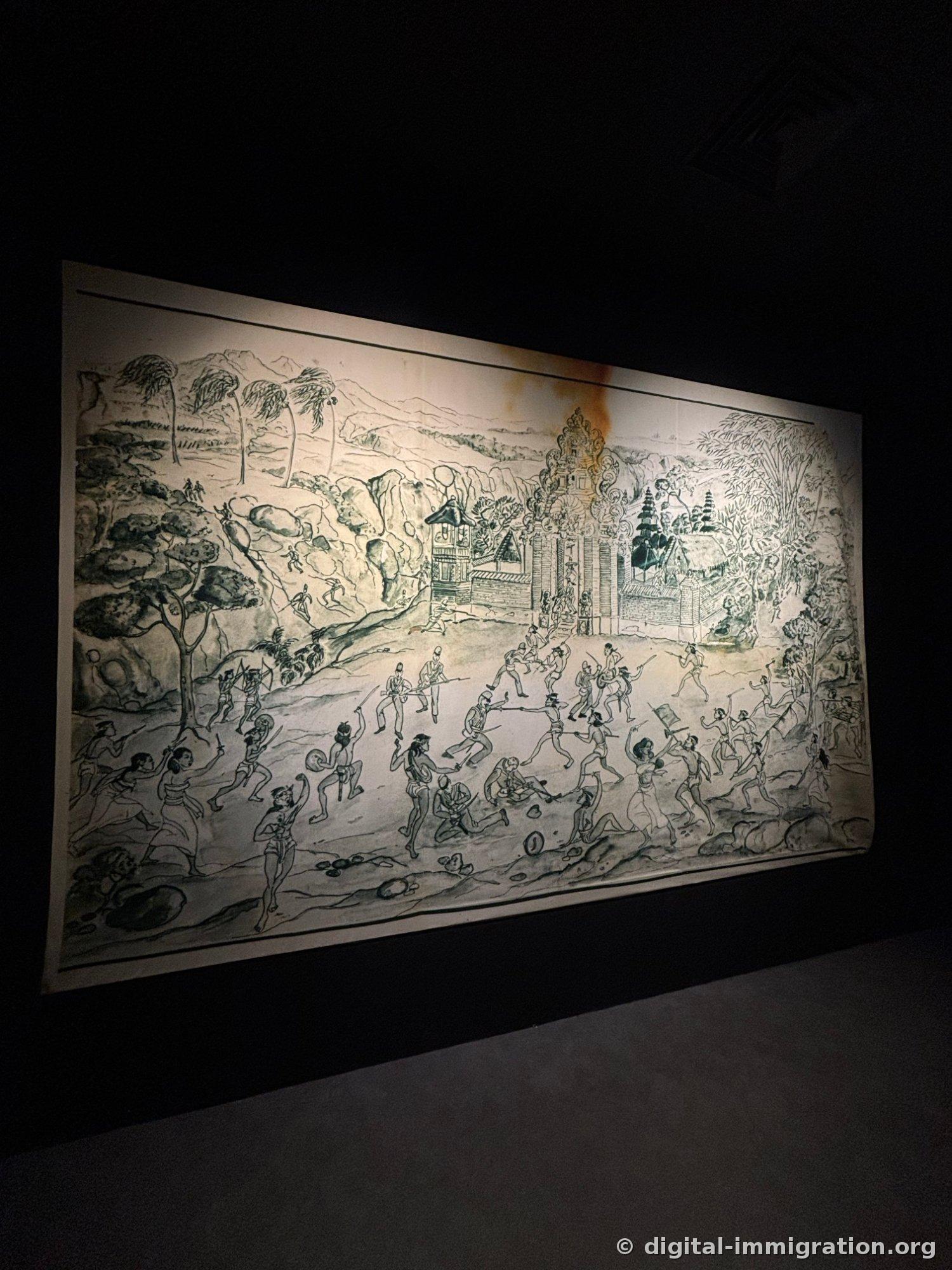
In the center of a completely dark room, a single large paper painting hung illuminated. Below palm trees and rocky mountains stands a Balinese split gateway (candi bentar) and temple roof, with a crowd tangled in combat before it—some wielding spears and krises, others carrying rifles. Fallen bodies, rushing women, flag-bearing figures—all fit into one scene. Brown stains spread across the paper's top edge, yet the museum displays it without hiding its condition—a choice I found more striking. With only this one painting in the room, everyone lingers.
How to Get There and Actually Useful Tips
It's located on the road west of Merdeka Square. Taking Jakarta's north-south MRT, exit at Monas or Bundaran HI station and walk from there. TransJakarta buses also stop directly on the square's west side. Grab or Gojek will take you to the main entrance rotunda, but Medan Merdeka Barat is nearly gridlocked during rush hour. I spent over 30 minutes sitting in traffic for a roughly 3km ride. Avoid entering this road after 4 PM.
Things I learned from actual experience:
- The old building's sculpture hall is bright due to large windows, but the lamp and prehistoric exhibitions are quite dark. Alternating between bright and dark rooms strains your eyes. Better to group the dark sections together.
- Many artifacts have no-flash signs. Check the icon next to the plaque before photographing. Signs against touching are posted alongside them.
- Many plaques have QR codes—scanning them yields longer descriptions in Indonesian and English, but not Korean.
- The floors are mostly hard wood and stone. Sneakers are better than sandals. I wore sandals and my feet were sore after two hours.
- The courtyard colonnade and new wing atrium benches are good resting spots. Bring water from outside; it's more convenient.
- Admission fees, hours, and Monday closures vary by period. Check on-site or official channels before visiting—I won't list specific prices due to frequent changes.
After two and a half hours, there were still rooms I hadn't seen. The volcanic-stone Ganesha, the figure on the skull base, the two Balinese masks, the lamp room's dim light. If I return, I'll slow down and focus only on the lamp room and prehistoric section from the start.
Das könnte Sie auch interessieren
- Gold Dragon Coffee's Meat Buns Made with Pumpkin Dough in Jakarta's Glodok Chinatown
Glodok is an old Chinese commercial district in West Jakarta. Walking through alleys tangled with jewelry shops, herbal medicine stores, and mobile phone parts shops toward Pasar G…
Jakarta · Glodok Chinatown Market - Gold Dragon Coffee - From under the Glodok Pancoran arch to Petak Enam, three hours of evening in Jakarta's Chinatown
Walking south from Jakarta's Kota Tua, you encounter a gray stone archway that stretches across the middle of the road. "SELAMAT DATANG — KAWASAN GLODOK PANCORAN — CHINATOWN JAKART…
Jakarta · Glodok Chinatown Market - Four dishes at Ta Wan on the 2nd floor of Harmonie Exchange in Jakarta for 19,000 won
I went to the Harmoni area in central Jakarta on business and grabbed lunch inside the Harmonie Exchange building. Indonesian buildings use different floor numbering than Korea's.…
Jakarta · Harmonie Exchange - Ta Wan